




The curse did not begin with Oedipus. It began with a chariot lesson.
This is the detail that most retellings of the most famous cursed family in Greek mythology leave out, and its absence changes the whole shape of the story. Oedipus did not inherit a vague, cosmic misfortune. He inherited a debt, incurred a generation before his birth, for a crime that had nothing to do with prophecy, riddles, or fate in the abstract sense. It had to do with a king named Laius, a beautiful young prince named Chrysippus, and a wrong that a father never forgave.
What follows is the full cycle: the founding, the debt, the exposure, the riddle, the war, the two wars after that, and the ending almost nobody remembers, in which the family’s own founder chooses to become the thing his ancestor once had to kill.
Cadmus and the City Built From Teeth
Thebes existed before its curse did, and its founding already carried the ingredients the curse would later use.
Cadmus, a Phoenician prince from Tyre, was sent by his father to find his sister Europa after Zeus abducted her in the form of a bull. The search was hopeless from the start, and the Delphic oracle eventually told Cadmus to abandon it and follow a particular cow instead, founding a city wherever the animal finally lay down to rest. The cow led him to Boeotia. The site was guarded by a dragon sacred to Ares, which Cadmus killed, and which cost him eight years of servitude to the war god as penance for the killing, a debt to Ares that the family would carry in its blood from the very beginning.

On the advice of Athena, Cadmus sowed the dragon’s teeth into the ground, and armed men, the Spartoi, the sown men, sprang up and fought each other until only five survived. Those five became the ancestors of the Theban nobility, a city literally grown from violence between brothers before Oedipus’s own sons ever existed to repeat it.

Cadmus married Harmonia, daughter of Ares and Aphrodite, in a wedding the gods themselves attended, a genuine honor that came bundled with a genuine catastrophe: Hephaestus, still furious at Aphrodite’s affair with Ares that had produced the bride, gave Harmonia a golden necklace forged with a curse worked into its metal. Every one of the couple’s children met a horrifying end. Semele, seduced by Zeus, was destroyed when Hera tricked her into demanding to see the god in his full divine form. Ino, driven mad, jumped into the sea with her surviving son.
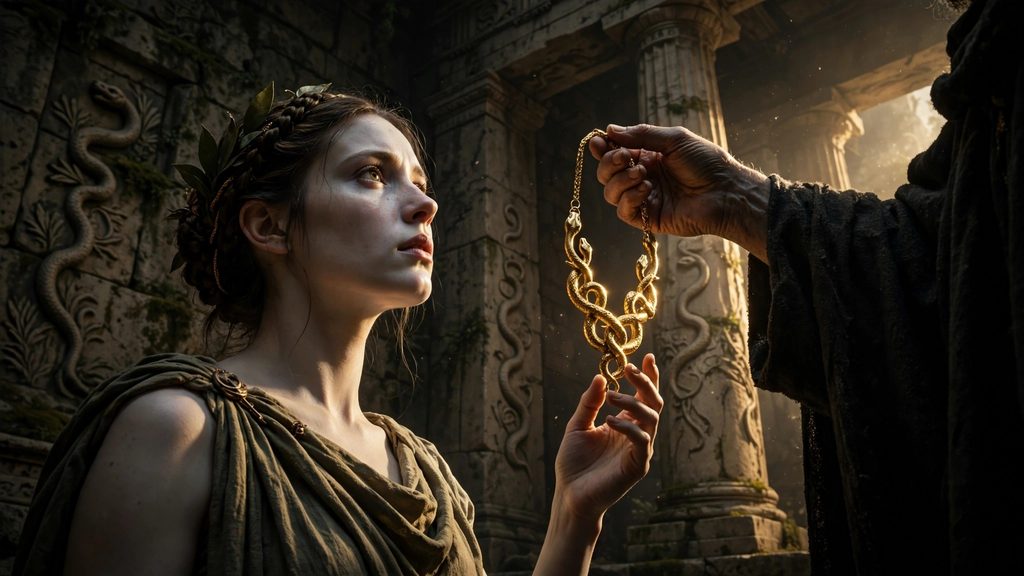
Autonoe’s son Actaeon was torn apart by his own hunting dogs after glimpsing Artemis bathing. Agave, in a Dionysian frenzy, tore apart her own son Pentheus with her bare hands, believing him a lion. The family Ares married into inherited his temperament along with his blood debt, and the city built from armed brothers kept producing more of them.
The Debt Laius Never Repaid
Generations later, the throne came to a descendant named Laius, and it is here that the personal curse on Oedipus’s immediate line actually begins, a detail Sophocles’s audience would have known and that most modern retellings quietly drop.
As a young man, driven from Thebes during a period of usurpation, Laius took refuge at the court of King Pelops in the Peloponnese, examined at length in this site’s own account of the region’s deeper mythology. There he fell in love with Pelops’s young son Chrysippus, and while teaching the boy to drive a chariot, abducted and raped him. In the version of the story that later mythographers treat as the origin of Theban tragedy, Chrysippus died from the shame of it, by his own hand. Pelops, who had loved this son more than any of his others, cursed Laius directly: that he would die at the hands of his own child. The evidence for this episode is not uniform, and Sophocles himself does not build it into the plot of Oedipus the King. But the tradition is old enough, and was important enough to enough of the wider Theban mythology, that leaving it out makes Apollo’s later prophecy to Laius look more arbitrary than it was ever meant to be. The god did not invent a random cruelty. The broader tradition remembered a debt someone else had already called in.

Laius eventually returned to Thebes and took the throne, married Jocasta, and consulted Delphi when the old curse began to weigh on him. The oracle’s answer restated Pelops’s curse in the unbearable form the myth needed: any son born to Laius and Jocasta would kill his father and marry his mother. Laius, by most accounts, tried to avoid the prophecy by avoiding his wife altogether. Jocasta, unaware of the danger, is said to have gotten him drunk. Oedipus was the result.
The Argument at the Crossroads
Laius had the infant exposed on a mountainside, his ankles pinned together, which is where the name Oedipus, swollen foot, actually comes from, a detail written directly onto the child’s body by the attempt to kill him. A shepherd, unable to complete the task, passed the baby along a chain of hands that eventually reached the childless king and queen of Corinth, Polybus and Merope, who raised Oedipus believing him their own.
As a young man, told by a drunk at a banquet that he was not truly Polybus’s son, Oedipus went to Delphi himself and received the same prophecy his birth father had once received: he would kill his father and marry his mother. Believing Polybus and Merope to be his real parents, Oedipus resolved never to return to Corinth again, and set out instead toward Thebes, a city he had no reason to think held any danger for him at all.

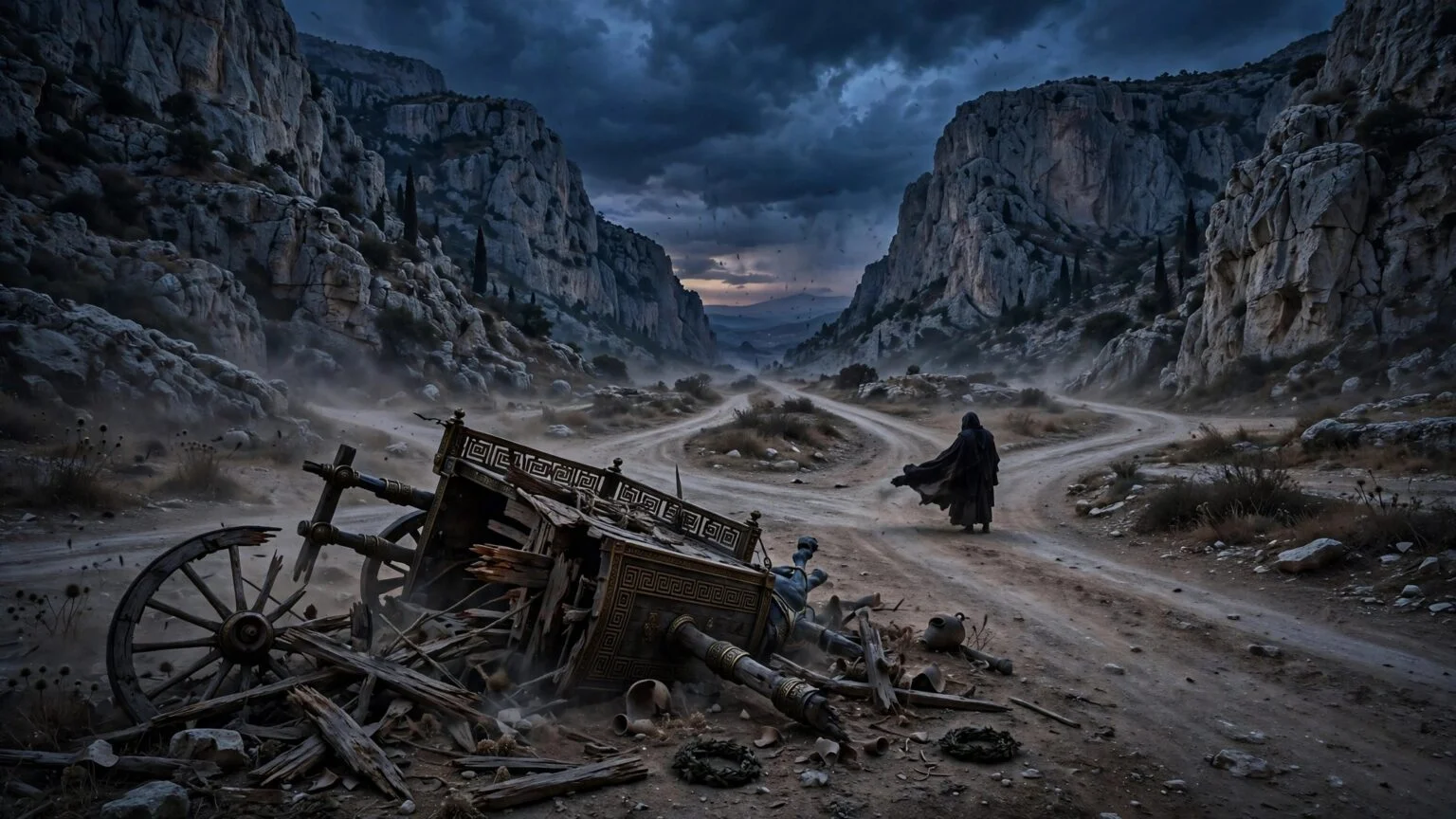
On the road, at a narrow place where three routes met, he encountered an older man in a chariot. What happened next is, in almost every surviving account, disturbingly mundane: an argument over who had the right of way. The older man’s driver tried to force Oedipus off the road. Oedipus, in anger, killed the driver, and then the passenger, not knowing either of their identities, not recognizing his own father in the older man he had just struck down. The prophecy’s first half was fulfilled by nothing more mystical than two strangers refusing to yield a road to each other.
The Riddle That Made Him King
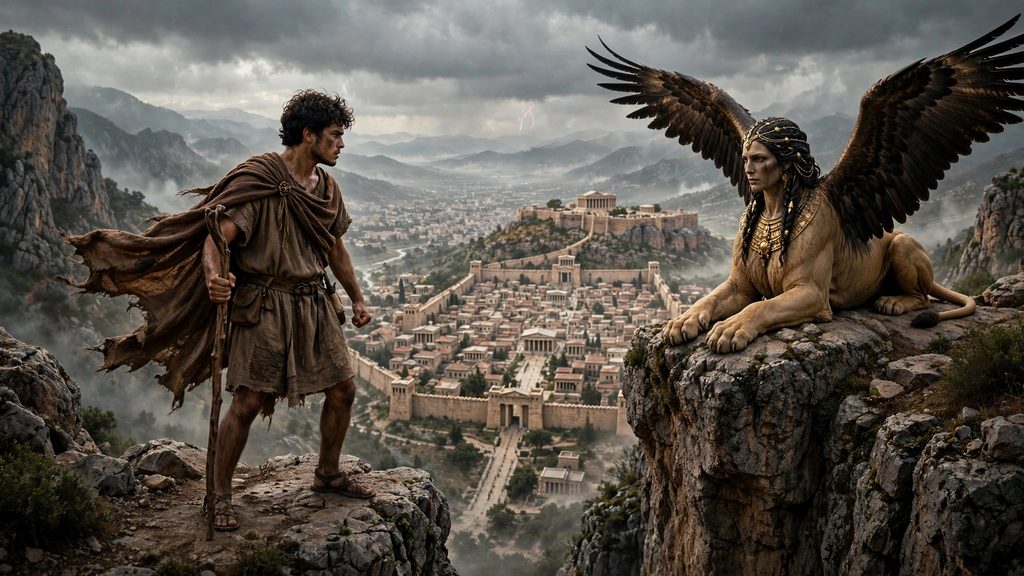
Thebes, meanwhile, was under a different kind of siege. A monster with a lion’s body, an eagle’s wings, and a woman’s face, examined in full in this site’s own dedicated essay on the Sphinx, had taken up residence on a cliff outside the city and was killing travelers who could not answer her riddle. Creon, Jocasta’s brother and acting ruler in the crisis, offered the throne and Jocasta’s own hand in marriage to whoever could rid the city of her.
Oedipus answered the riddle, and the Sphinx, defeated, threw herself from the cliff. He entered Thebes a hero and left the crossroads behind him, unaware he had already killed the king whose throne he was now handed, and unaware he was about to marry his own mother in the same transaction. He and Jocasta had four children, Eteocles, Polynices, Antigone, and Ismene, and for years the household had no reason to suspect what it actually was.
The unraveling, when it came, came through the same mechanism ancient Thebes always seemed to rely on: a plague, an oracle, and a blind seer named Tiresias, whose own strange history this site has examined in full elsewhere, forced by Oedipus’s own relentless investigation into confirming what the audience had likely suspected from early in the play. Jocasta, understanding first, hanged herself. Oedipus, understanding a moment later, used the pins from her own robe to blind himself, choosing to see nothing further rather than continue seeing what he had already seen with such catastrophic clarity.
The Sons Who Could Not Share a Throne
Oedipus, blind and disgraced, was eventually driven from Thebes, though the timing and manner vary between sources, and spent his final years wandering in exile with his daughter Antigone as his guide, ending at a sacred grove near Athens where, according to the strange coda Sophocles gives the story late in his own life, Oedipus’s actual place of death became a hidden, protected secret, and his buried remains were said to grant supernatural protection to whichever land guarded them, a final, backhanded gift from a man the gods had spent a lifetime punishing.
Back in Thebes, his sons Eteocles and Polynices agreed to alternate the throne year by year to avoid exactly the kind of conflict their family history should have taught them to fear. Eteocles took the first year and, when it ended, refused to hand power to his brother. Polynices fled to Argos, married the king’s daughter, and began assembling the army that would try to take by force what he had been denied by his brother’s broken word.
Seven Gates, Seven Oaths
Aeschylus dramatized what followed in a play that survives as the third part of a trilogy whose first two installments, Laius and Oedipus, are lost entirely, meaning the version of the family’s origin story that fifth-century Athenian audiences actually watched performed no longer exists for us to read. What survives is the siege itself: seven champions, one for each of Thebes’s seven gates, swearing an oath over the blood of a sacrificed bull that they would either raze the city or die trying.
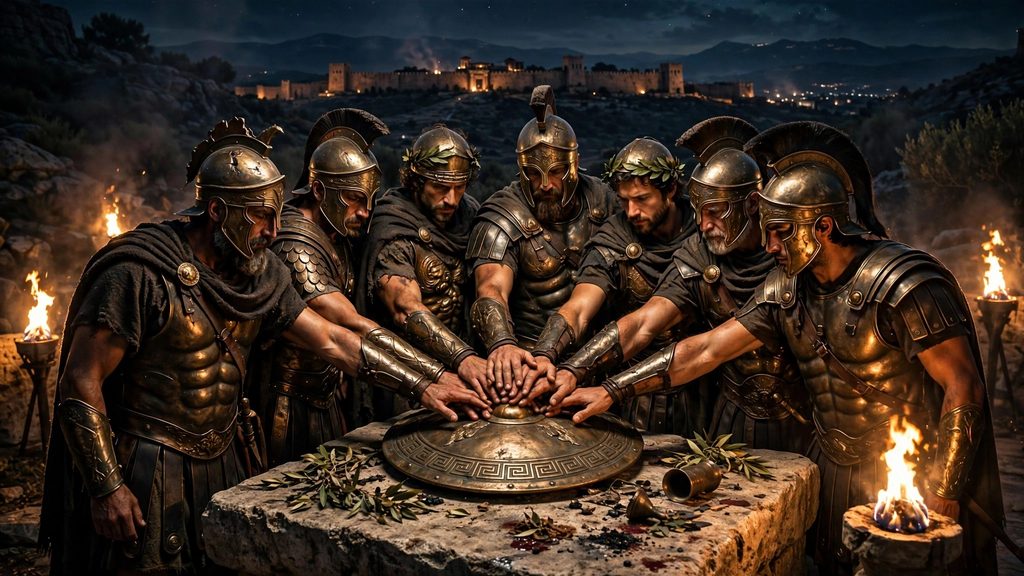
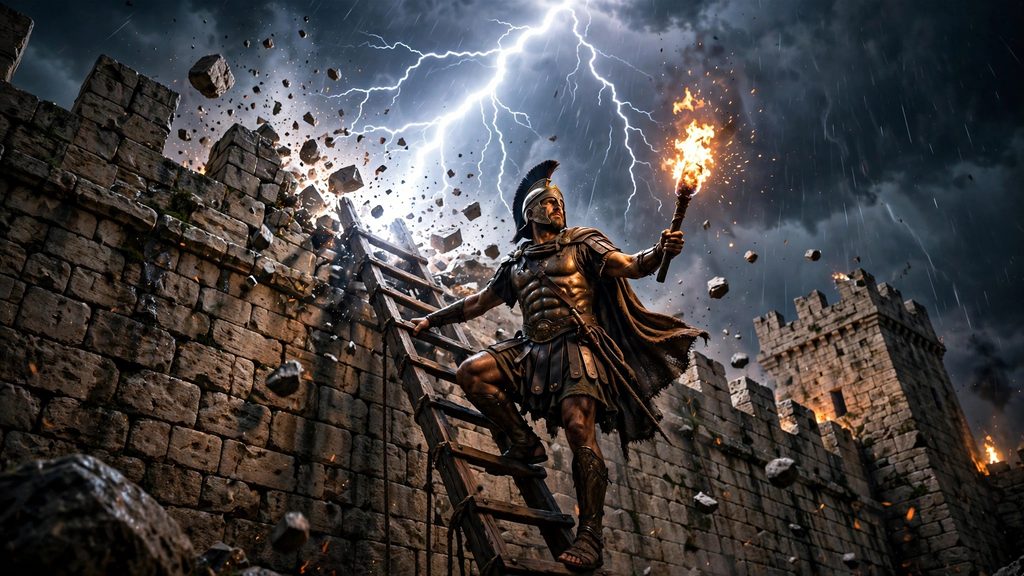
Each champion carried a shield with its own emblem, described by Aeschylus in enough visual detail that the play functions almost as a catalogue of Argive heraldry. Tydeus bore a night sky ablaze with stars and a full moon at its center. Capaneus, the most reckless of the seven, carried a shield showing a man bearing fire, with an inscription boasting that he would burn the city whether the gods willed it or not. He nearly kept his word, scaling the wall itself with a ladder, boasting as he climbed that not even Zeus could stop him. Zeus answered the boast directly, striking Capaneus down with a thunderbolt in mid-climb, the single most literal case of hubris meeting immediate divine punishment anywhere in the Theban tradition.
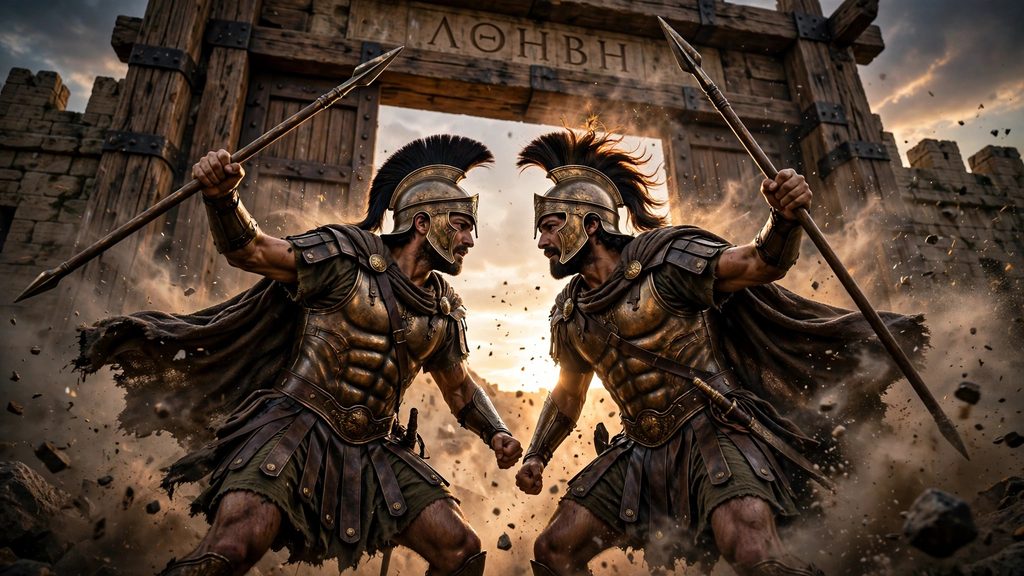
The seventh gate was reserved, by design, for Polynices himself, and Eteocles, learning this, chose to meet his own brother there in person rather than send a substitute. The two killed each other simultaneously, each blade finding its mark at the same moment, fulfilling their father’s own curse on them with a symmetry that reads as intentional even in translation: two brothers who could not share a city ended by sharing a single death.
The Law Antigone Chose Over the Law of the City
Creon, ruling Thebes again in the vacuum left by both brothers’ deaths, issued a decree that gave the family’s oldest curse its final, most philosophically consequential turn: Eteocles, who died defending the city, would receive full funeral honors. Polynices, who died attacking it, would be left unburied, exposed to the birds and dogs, with death as the punishment for anyone who tried to bury him.
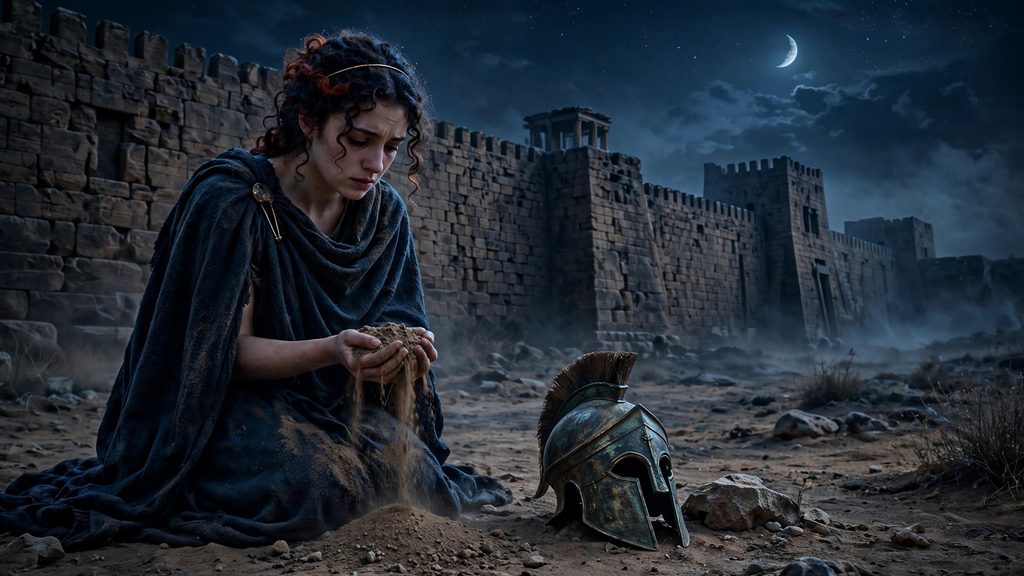
Antigone buried her brother anyway. Brought before Creon, she did not deny it, and did not apologize for it. Her argument, as Sophocles constructs it, was not that Creon’s law was unwise or excessive. It was that Creon’s law was not, in the relevant sense, a law at all: that the gods’ unwritten and unchanging demands, that the dead be honored regardless of the politics of their dying, held an authority no mortal decree could override, and that she would rather die honoring that older law than live having betrayed it. Creon sentenced her to be sealed alive in a tomb. She hanged herself before the sentence could finish its slow work. Haemon, Creon’s own son and Antigone’s betrothed, killed himself over her body. Creon’s wife Eurydice, on hearing of her son’s death, took her own life as well, cursing her husband with her final words. Creon, who began the play certain that civic order required absolute obedience, ended it having buried his own family through the exact rigidity he had mistaken for strength.
The argument Antigone makes, unwritten divine law against the civic law of the state, became one of the most cited passages in the history of Western political and legal philosophy, invoked for millennia afterward by anyone arguing that a government’s authority has limits a government cannot legislate away.
The War the Sons Actually Won
The story does not end with the Seven’s defeat, though this is where most popular retellings stop. Ten years later, the sons of the fallen champions, known collectively as the Epigoni, those born after, gathered a second Argive army and marched on Thebes again, this time successfully. The city that had withstood their fathers fell to their children, completing a cycle of inherited obligation that mirrors, at the level of two allied families rather than one, the same inherited debt that had driven Oedipus’s own story from its opening scene. The war of the fathers had been a tragedy. The war of the sons was simply a conclusion, arriving exactly on schedule.
What Cadmus Chose to Become
The cycle’s strangest ending belongs not to Oedipus’s line at all, but to Cadmus and Harmonia themselves, the founders whose choices had set every subsequent tragedy in motion.
Having watched their daughters destroyed one after another and their city consumed by a curse traceable to the dragon Cadmus had killed at its founding, the aged couple eventually left Thebes for Illyria, where they fought successfully on behalf of a local people called the Enchelii and where Cadmus, according to the version of the story that reads as a kind of exhausted surrender to everything his life had cost him, is said to have remarked that if the gods loved the life of a serpent so much, he might as well wish that life for himself. The wish took immediately: scales spread across his skin, and he began to change. Harmonia, watching her husband become the very creature he had killed to found their city, stripped herself and begged the gods to share his fate rather than be left behind as the only human witness to what he had become. The gods, for once in this family’s story, answered a plea with mercy rather than punishment. Both were transformed into serpents and carried by Zeus to the Elysian Fields, the paradise reserved for mortals the gods had decided to spare rather than continue to test.

Euripides, writing the Bacchae near the end of his own life, gives a darker version of the same transformation: Cadmus and Harmonia become serpents earlier, and at Thebes itself, punished rather than released, condemned by Dionysus for the city’s failure to properly honor him, and sentenced to lead a barbarian horde against Delphi’s own sanctuary in some distant future war. Even the family’s ending could not settle on a single meaning. It remained, to the last surviving telling of it, exactly what it had always been: a story two different playwrights could not agree was tragedy or mercy, because by that point in the cycle, it had genuinely become difficult to tell the difference.
A Family Told in Fragments
It is worth stating plainly what the surviving evidence actually looks like, because the popular image of a tidy Oedipus trilogy misrepresents it. Sophocles’s three Theban plays, Oedipus the King, Oedipus at Colonus, and Antigone, were never written or performed as a connected trilogy. They were composed decades apart, in an order that does not match the story’s own chronology: Antigone, dealing with events latest in the family’s history, was actually written first, generally placed in the 440s BCE. Oedipus the King followed later, probably in the 420s, though the exact date remains debated among classicists. Oedipus at Colonus, dramatizing Oedipus’s final days, was Sophocles’s last play, produced only after his death near 401 BCE. Modern readers who encounter the three in story order are experiencing a sequence the ancient audience never saw performed together at all.
Aeschylus did write his own Theban material as a genuine connected trilogy, Laius, Oedipus, and Seven Against Thebes, but only the third survives. Euripides added his own versions of the same material, Phoenician Women and Suppliants, from angles the two other playwrights never fully explored. What survives of the cycle as a whole, across three major tragedians and several centuries of retelling, is a family whose story no single ancient author ever told completely, assembled by modern readers from fragments that were never meant to be read as one continuous account.
What the Modern World Kept and What It Lost
The family’s afterlife in modern thought has been oddly selective. Sigmund Freud extracted a single moment, a son unknowingly desiring his mother and resenting his father, and built a complete theory of childhood psychosexual development around it, naming it after a man whose actual story is not really about desire at all. Oedipus does not want Jocasta. He does not know she is his mother until the play’s final revelation forces the knowledge on him against every instinct he has. The Freudian complex borrows the myth’s structure while discarding almost everything that makes the original story a tragedy of knowledge and its absence rather than a tragedy of forbidden want.
Antigone has fared better in serious philosophical terms. Hegel read her conflict with Creon as the collision of two genuinely valid ethical claims, family and religious duty against the state’s need for order, rather than a simple case of a tyrant crushing a martyr, and that reading has shaped legal and political philosophy ever since, invoked in arguments about civil disobedience, natural law, and the limits of state authority that have nothing directly to do with ancient Thebes at all.
What the modern world mostly discarded was the beginning: the chariot lesson, the abducted prince, the debt a father called in against a man who had wronged his son. Oedipus became shorthand for a psychological complex. His entire family’s actual crime, the one that started all of it, is barely remembered outside the specialists who still read the scholia.
The Debt That Finally Came Due
Trace the whole cycle from its actual beginning and a different shape emerges than the one popular memory preserves. This was never simply a story about one man who could not escape a prophecy. It was a debt passed down across generations, incurred by one act of violence against one victim, compounding through every generation that followed because nobody involved, not Laius, not Oedipus, not Eteocles or Polynices, ever found a way to settle it honestly. Cadmus killed a dragon to build a city. His descendant abducted a boy who died of the shame. The gods confirmed the resulting curse rather than inventing it from nothing, and every subsequent death, the crossroads, the riddle, the seven gates, the tomb Antigone chose over her own survival, was the same debt finding a new way to collect.
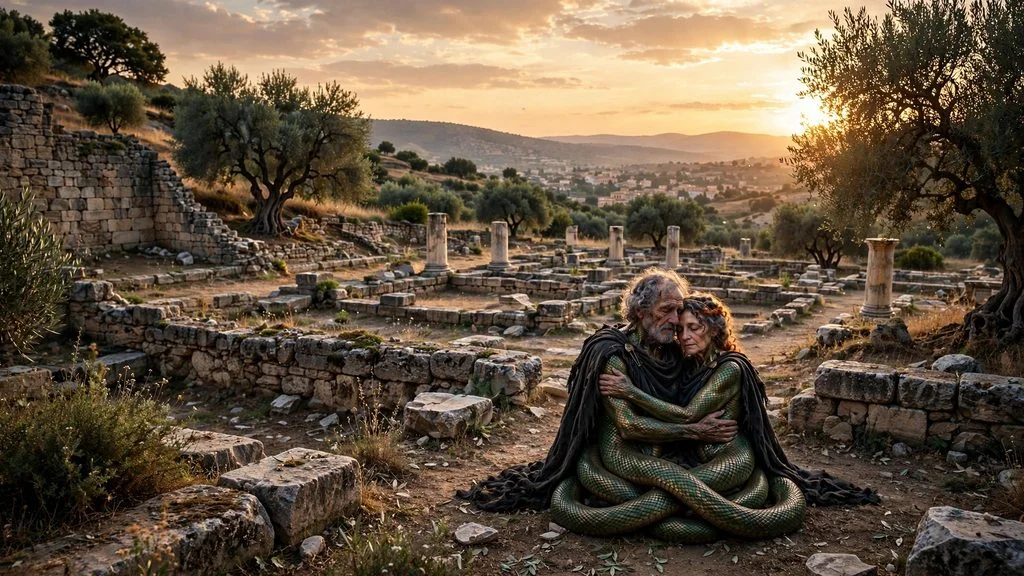
Only Cadmus himself, at the very end, found an exit that was not another death. He became the thing he had once killed. It is difficult to call that a happy ending. It is equally difficult to call it anything else the family had earned.
At Olympus Estate, Tales from Olympus moves through the deeper currents of the Greek tradition. The curse on Oedipus’s family began a generation before his birth, when his father Laius abducted and raped Chrysippus, son of King Pelops, who cursed Laius to die at his own child’s hands. Oedipus fulfilled the first half of that curse in an argument over right of way at a crossroads, and the second by marrying the widow of the man he had just unknowingly killed. His sons Eteocles and Polynices killed each other at Thebes’s seventh gate. His daughter Antigone chose a tomb over betraying the unwritten law of the dead. Ten years later, the sons of the men who died besieging Thebes returned and finished what their fathers started. And the family’s own founder, Cadmus, ended his life by becoming a serpent, the same creature he had once killed to build the city in the first place.