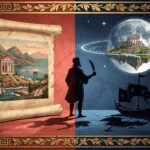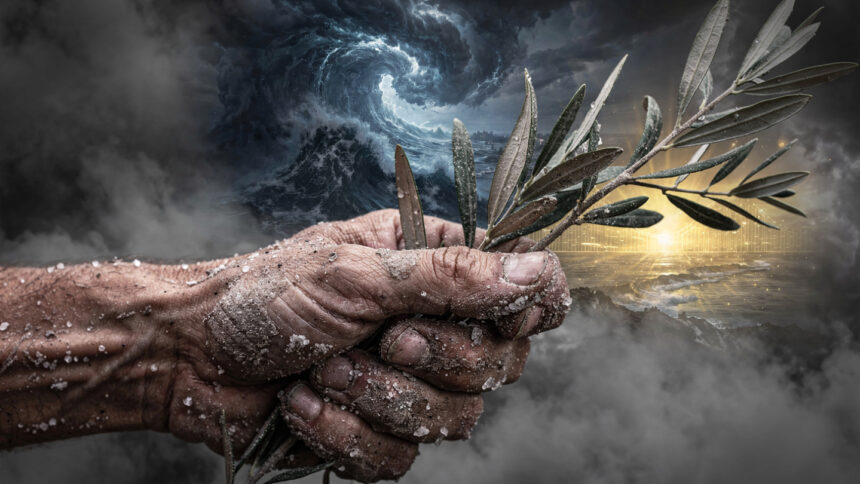


The first poet in Western literature to tell us his own name met his goddesses on a mountainside, and they began by insulting him. He was a young shepherd grazing his flock on the slopes of Mount Helicon in Boeotia, and they came down to him out of the mist. “Shepherds of the wild fields,” they said, “poor disgraces, nothing but bellies.” Then they plucked a branch of flowering laurel, gave it to him as a staff, breathed a divine voice into him, and told him to sing of the gods.
The shepherd was Hesiod, and the poem he went on to write, the Theogony, opens with the nine goddesses who had made him a poet. They were the Muses, and Hesiod gives them a mother whose name explains everything they do. They were the daughters of Mnemosyne, Memory.
Their name is still all around us. A museum is a mouseion, a house of the Muses. Music is mousike, their art. Even the mosaic on a church floor takes its name, through medieval Latin, from work “of the Muses”. The Greeks built an entire idea of art on a single claim, that every song, story and science begins in memory, and they gave that claim nine faces.
The Shepherd on Helicon
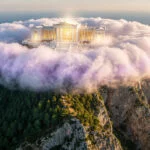
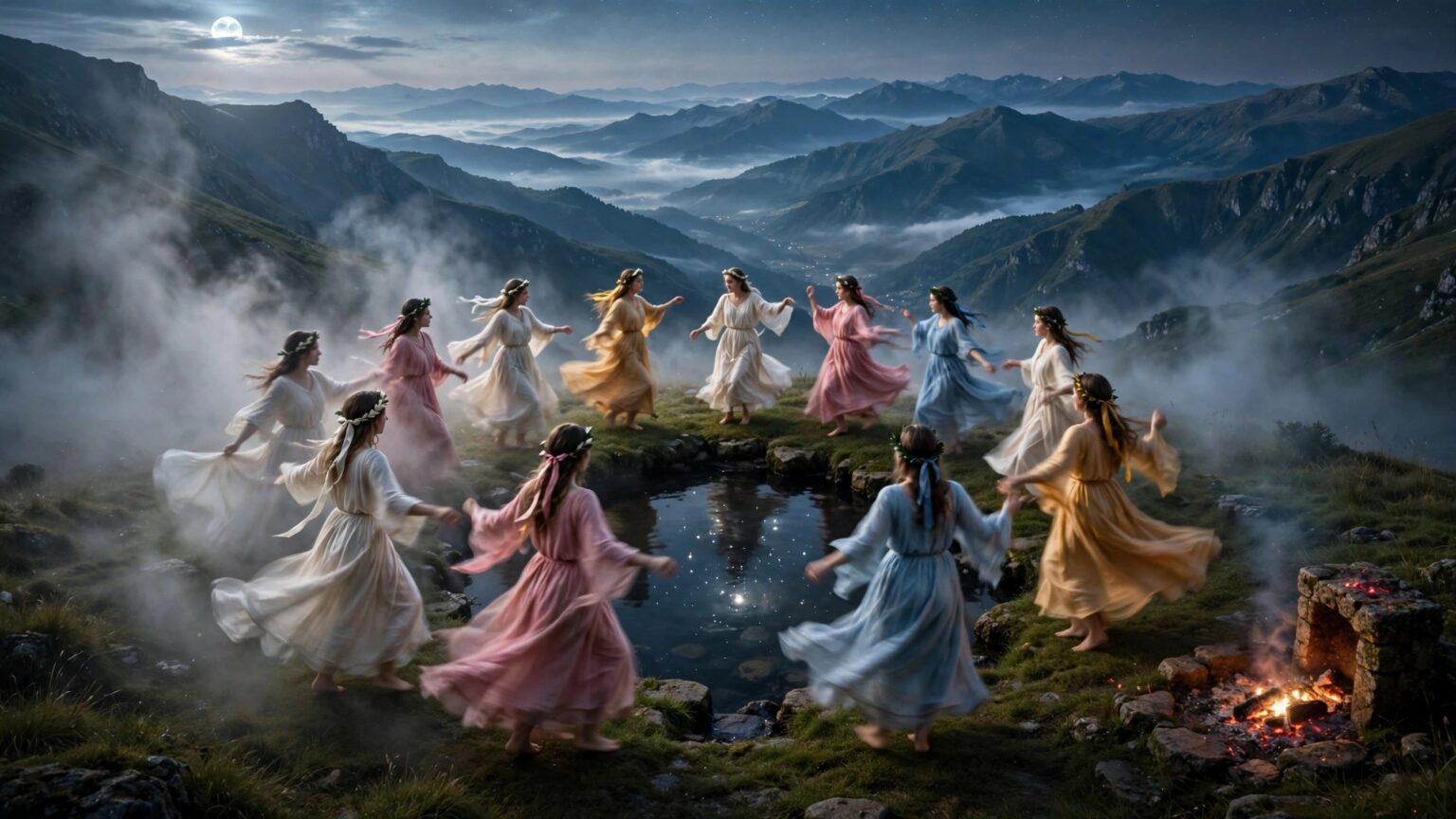
Hesiod’s account, written around 700 BC, is the oldest scene in Greek poetry in which a poet describes how he became one. Its details are worth reading closely. The Muses dance by night on the summit of Helicon around a violet-dark spring and the altar of Zeus, their feet soft on the ground, wrapped in thick mist. They bathe in the springs of the mountain. Then they walk down through the dark, singing, to find a mortal on the lower slopes.
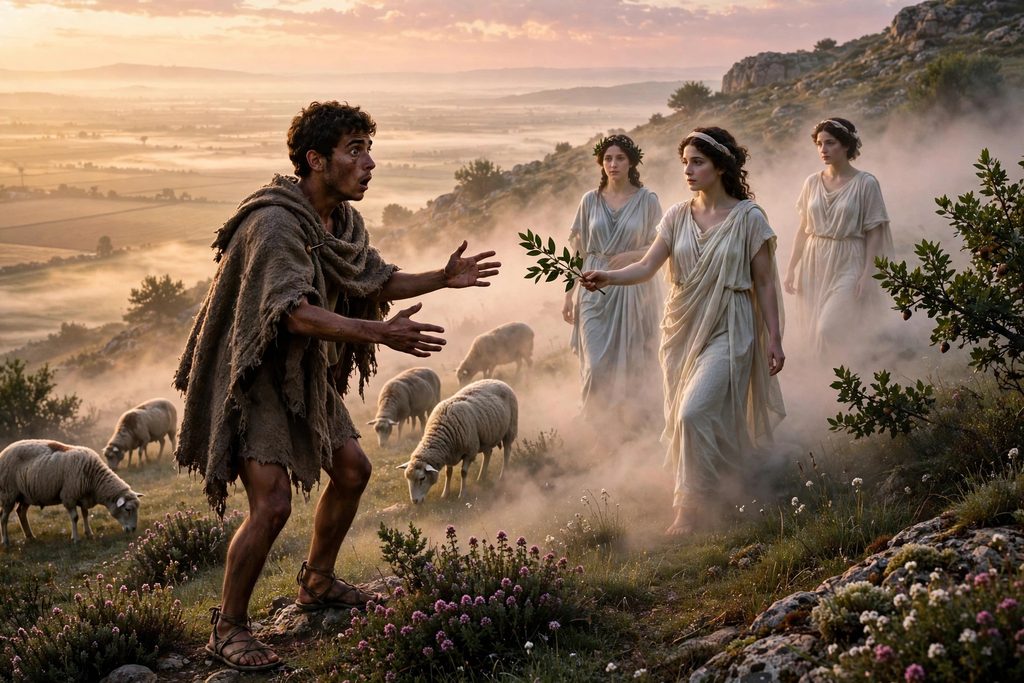
Their first words to him are among the most quoted in Greek literature. “We know how to tell many lies that sound like truth,” they say, “and we know, when we wish, how to speak the truth.” The goddesses of poetry warn their poet, before he writes a single line, that what they give him may be beautiful falsehood or real knowledge, and that only they decide which.
The staff matters too. It is laurel, Apollo’s tree, the sacred plant of his oracle at Delphi. Singers of epic carried a staff as they performed, and Hesiod’s came straight from the goddesses. He was not claiming talent. He was claiming a commission.
Daughters of Memory
Mnemosyne was a Titaness, a daughter of Sky and Earth, older than the Olympians. Hesiod says Zeus lay with her for nine nights in Pieria, the green country at the foot of Mount Olympus, apart from the other gods. When a year had turned, she gave birth to nine daughters, “of one mind, whose hearts are set on song, their spirits free from care”, born, he says, to bring forgetfulness of sorrow and rest from trouble.
Why Memory? Because in Hesiod’s world, before writing spread, poetry was memory. There were no archives, no libraries and no history books. Everything a people knew about its gods, its ancestors, its wars and its laws lived in songs that singers carried in their heads and passed on, line by line, from one generation to the next. A poet who forgot was a people that forgot.
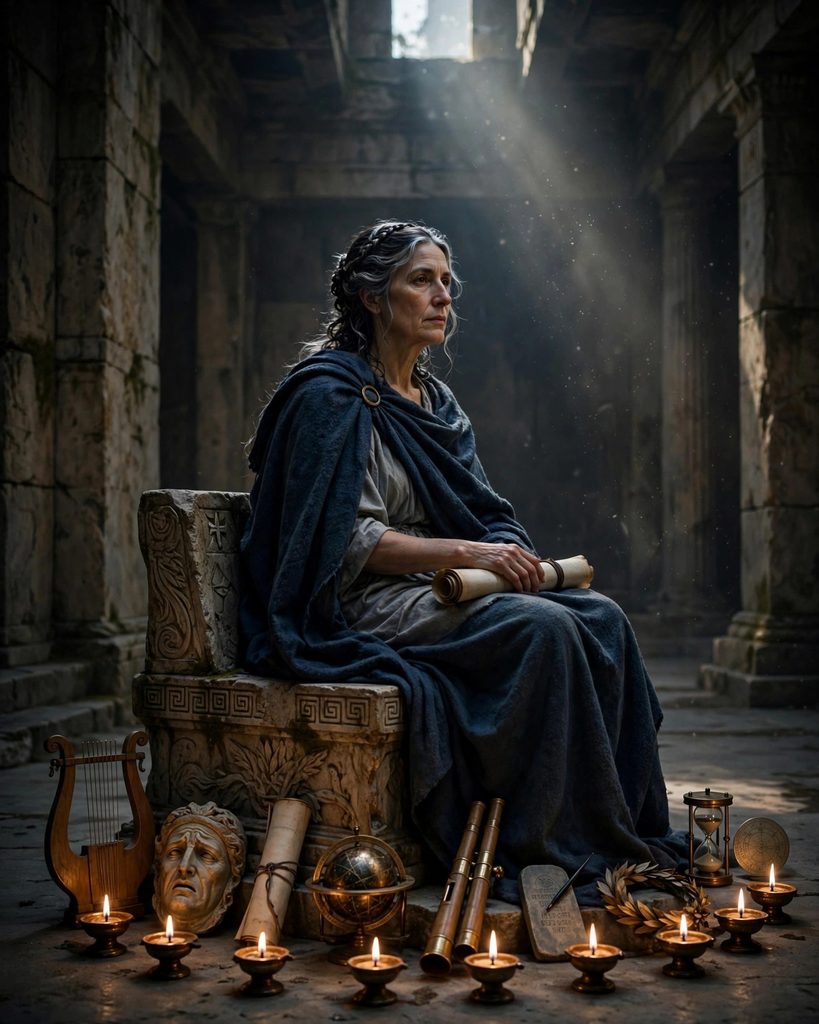
Homer says it plainly. Before the great catalogue of ships in the second book of the Iliad, more than a thousand vessels and the names of every leader, the poet stops and prays. “Tell me now, Muses who live on Olympus,” he says, “for you are goddesses, you are present everywhere and you know all things, while we hear only rumour and know nothing.” The Muses in Homer are not a mood or a spark. They are the memory of everything that happened, and the poet asks them for facts.
They also remember the dead. In the last book of the Odyssey, the ghost of Agamemnon describes the funeral of Achilles. All nine Muses came and sang the lament over his body, answering one another in turn, and not one Greek in the army stayed dry-eyed. It is the only place in Homer where their number is given as nine. The hero who chose a short life for undying fame was mourned by the goddesses whose song would keep that fame alive.
Three Before Nine
Nine was not the only number. The traveller Pausanias, visiting Helicon in the second century AD, recorded a local tradition that the first people to sacrifice to the Muses on the mountain worshipped only three. Their names were Melete, Mneme and Aoide, Practice, Memory and Song.
As an account of how art is made, those three names are hard to improve. A singer needs something to remember, the discipline to shape it, and the voice to bring it out. At Delphi, according to Plutarch, the three Muses were named instead after the strings of the lyre, High, Middle and Low. Whether the count was three or nine, the idea underneath stayed the same. Memory came first.
The Nine and What They Came to Mean
Hesiod gives the nine their names, and every name describes song, dance or celebration. What he does not do is give each one a separate art. The neat division that most people know today, one Muse for history, one for comedy, one for the stars, took shape centuries later. It was settled mainly in the Roman period, when sculptors on sarcophagi and wall painters needed a way to tell nine identical goddesses apart, and gave each a recognisable object to hold.
Read as a group, the later list still keeps Hesiod’s idea. Clio’s name comes from the same root as kleos, the fame that heroes died for, so history is the art of making the past famous enough to be remembered. Urania, the strangest of the nine for a modern reader, makes sense once astronomy is understood the Greek way, as the long memory of the sky, the record of where every star and planet stood, kept across generations so that farmers knew when to sow and sailors when to sail.
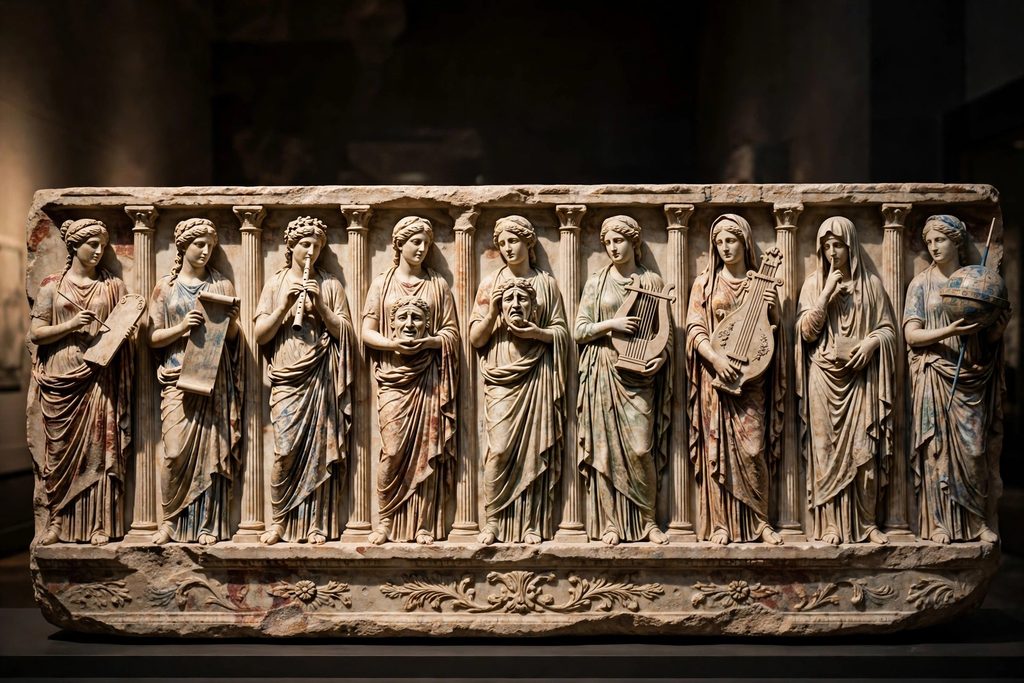
Hesiod picks out one sister above the rest. Calliope, he says, is the greatest of them all, because she attends on kings. In later myth she is also the mother of Orpheus, the singer whose music could move trees and stones and soften the rulers of the dead.
Kings and Poets
The link to kings is one of the most surprising passages in the Theogony. When the Muses favour a king at his birth, Hesiod says, they pour sweet dew on his tongue, and his words flow like honey. The people watch him settle disputes with straight judgements, ending even a great quarrel with skill, and they greet him like a god as he walks through the town.
Poets and kings receive the same gift, the power of speech that people trust. Both need memory. A judge must remember the customs, the precedents and who promised what to whom. A poet must remember the gods and the heroes. In a world without written law, the man who could recall and speak well was the man who held a community together.
Rivals of the Muses
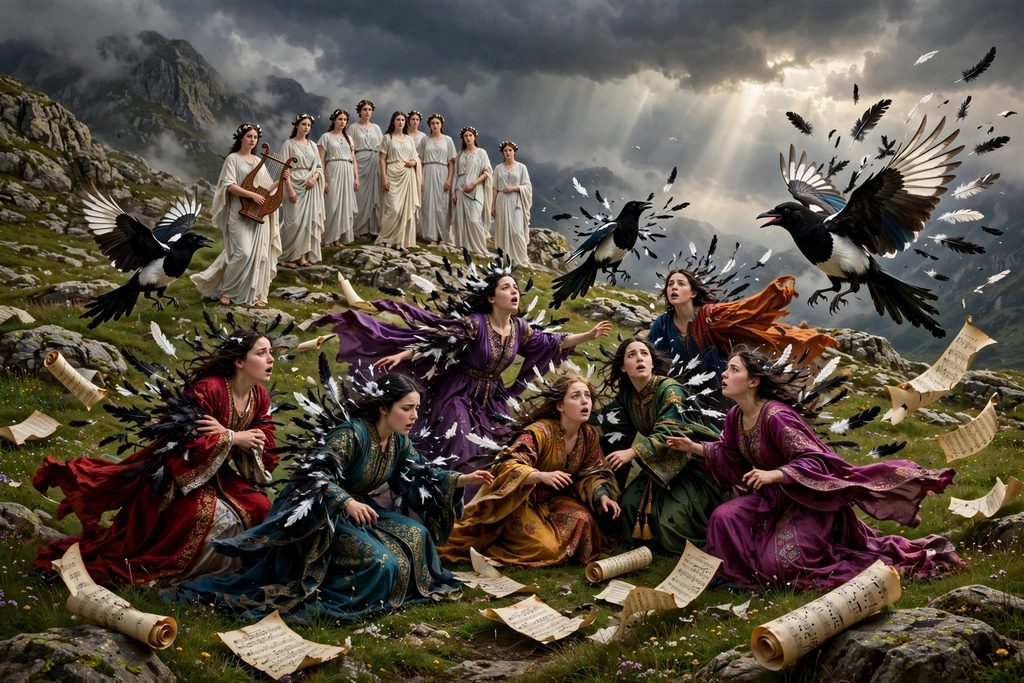
The Muses were generous to those they chose and merciless to anyone who claimed their gift without them. Homer tells of Thamyris, a Thracian singer who boasted that he could beat the Muses even if they sang against him. They maimed him, took away his divine song and made him forget his skill with the lyre. For a singer, losing his memory was the punishment.
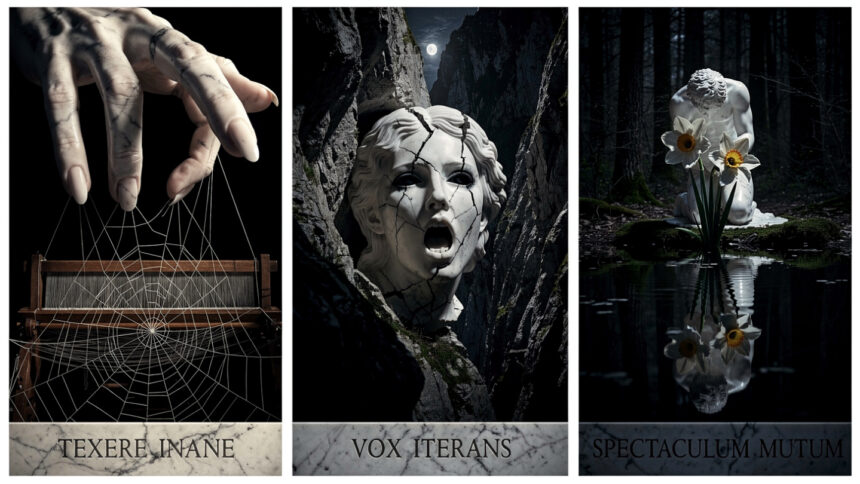
Pausanias records another contest. Hera persuaded the Sirens to challenge the Muses in song. The Muses won, plucked out the Sirens’ feathers, and wore them as crowns. In Ovid, the nine daughters of King Pierus challenged them too, and when they lost and kept insulting the goddesses, they were turned into magpies, birds that chatter endlessly and say nothing worth remembering. Ovid has the Muses tell the story to Minerva, and at the start of the next book she goes straight on to punish Arachne, another mortal who challenged a goddess at her own art.
The Springs of Memory
The Muses lived beside water. On Helicon, the horse spring Hippocrene burst from the rock where the winged horse Pegasus struck the mountain with his hoof, and the nearby spring Aganippe was sacred to them too. Pieria, their birthplace, gave them the title of the Pierian Muses, and English poetry still remembers its spring. “A little learning is a dangerous thing,” Alexander Pope wrote in 1711, “drink deep, or taste not the Pierian spring.” Under Parnassus, the Castalian spring at Delphi came to be counted as theirs as well.
Memory had a spring of her own in the underworld. Thin gold tablets buried with followers of the Orphic mysteries, from the fourth century BC onwards, gave the dead directions. Near the house of Hades, they said, there is a spring beside a white cypress. Do not drink from it. Go further, to the cold water flowing from the lake of Memory, and tell the guards, “I am a child of Earth and starry Sky, give me to drink.” The ordinary dead drank forgetfulness. The initiate who remembered was saved.
Not far from Helicon, at the oracle of Trophonius in Lebadea, visitors drank from two springs before going down into the earth, first from Lethe, to forget their old thoughts, then from Mnemosyne, to remember what they would see below. When they came back up, the priests sat them on a throne called the Throne of Memory and asked what they had learned. The same idea runs through Plato, who argued that all learning is remembering. For the Greeks, memory was not a filing cabinet. It was a way back to the truth.
Simonides and the Palace of Memory
A Greek poet is also credited with the most famous memory technique ever devised. Cicero tells the story. Simonides of Ceos was performing at a banquet in Thessaly when a message came that two young men wanted to see him outside. He went out and found no one. Behind him the roof of the hall collapsed, crushing every guest beyond recognition. Simonides was able to name the dead by remembering where each one had been sitting.
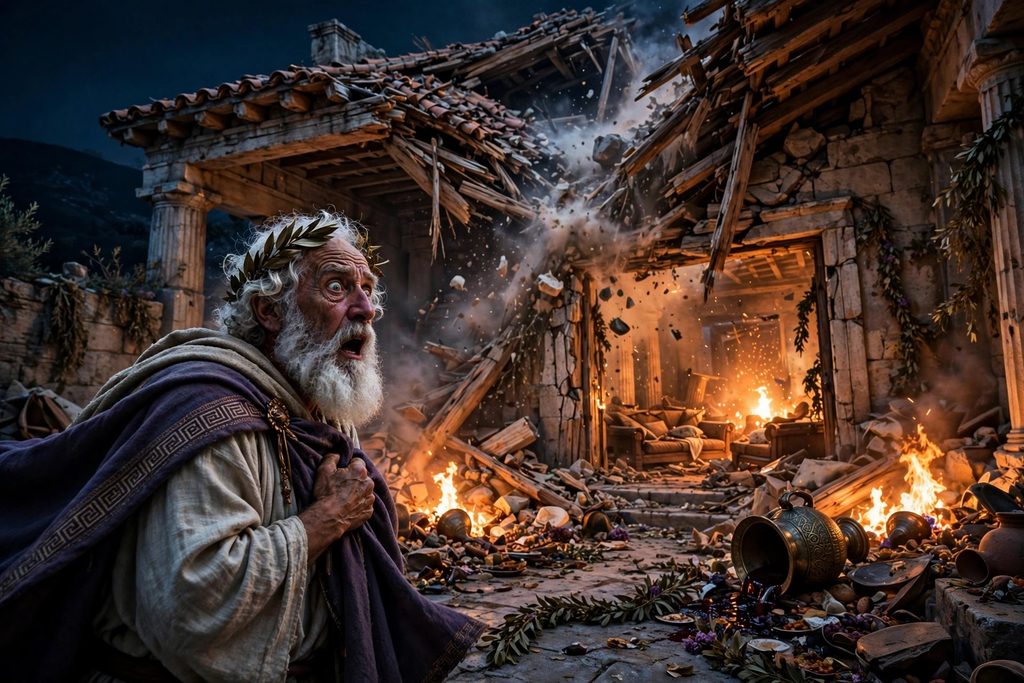
From that night, the story goes, he worked out the method of places. To remember a long series of things, imagine a familiar building, place each item in a different room, and walk through the rooms in your mind to collect them again. Orators used it to deliver speeches for hours without notes, and memory champions still use it today. The Muses’ mother turned out to have a floor plan.
The House of the Muses
The first places called a mouseion were shrines. The philosophers built them into their schools. Plato set up a shrine of the Muses at the Academy in Athens, and Aristotle’s school at the Lyceum had one too. To study, in Athens, was to work under the eye of Memory’s daughters.
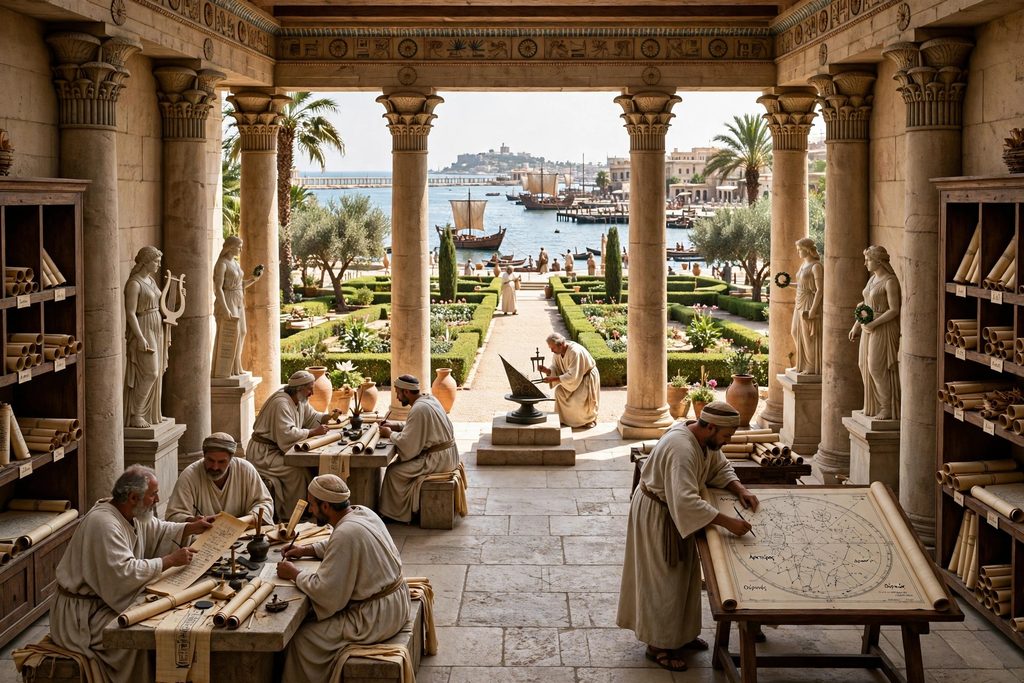
The most famous Mouseion of all was in Alexandria. Around 300 BC the first King Ptolemy founded it beside the great Library, as a community of scholars paid by the crown to live, eat and work together. Its members edited Homer, catalogued Greek literature, studied anatomy and mapped the heavens. Eratosthenes, who ran the Library, measured the circumference of the Earth from Alexandria with remarkable accuracy. Not everyone was impressed. The satirist Timon of Phlius mocked its pampered residents as bookish scribblers, fattened and endlessly quarrelling “in the birdcage of the Muses”.
The modern museum inherited the name. Oxford’s Ashmolean, opened in 1683 as one of the first public museums, was called the Musaeum Ashmoleanum, and the word spread across Europe with the institution. It sits beside music and mosaic among the Greek words that conquered the world. One popular claim is wrong, though. To amuse has nothing to do with the Muses. It comes from an old French word for staring idly into space.
Why the Invocation Was Not a Formality
“Tell me, Muse, of the man of many turns,” the Odyssey begins. “Sing, goddess, the wrath of Achilles,” begins the Iliad. To a modern reader these openings can look like a polite habit, the ancient equivalent of clearing one’s throat. For the Greeks they were something more. The poet was admitting that what followed did not come from him alone.
Plato took this seriously enough to worry about it. In his dialogue Ion, Socrates calls the poet “a light and winged and holy thing”, unable to compose until he is inspired and out of his mind. In the Phaedrus, he says that the madness sent by the Muses is what makes poetry great, and that the sane poet who relies on skill alone will be eclipsed by the inspired one. Pindar, the greatest of the choral poets, called himself the prophet of the Muses.
Writers and composers still describe the same experience in other words, a melody that arrived, a character who started to speak. And the old link between song and memory has turned out to be real in an unexpected place. In people with advanced Alzheimer’s disease, memory for familiar music often survives long after names and faces are gone, and brain studies suggest the regions that hold musical memory are among the last the disease reaches. Euterpe, it seems, is the last sister to leave.
Visiting the Muses
All three of their mountains can still be visited.
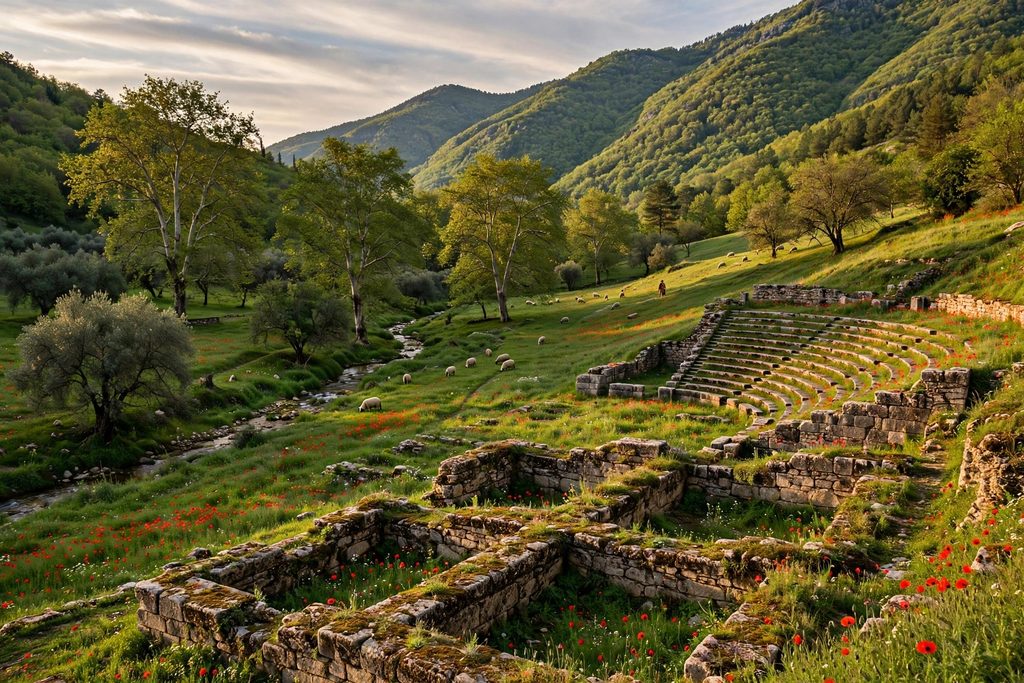
- The Valley of the Muses, Helicon. Below the mountain, near ancient Thespiae and a short way from Hesiod’s village of Ascra, French excavators in the 1880s uncovered the sanctuary where the Mouseia festival of music and poetry was held. The remains of its theatre and altar lie in a quiet green valley about two hours’ drive northwest of Athens.
- Dion, Pieria. At the foot of Olympus, the Macedonian king Archelaus founded a festival of Zeus and the Muses that lasted nine days, and Alexander held it before he left for Asia. The archaeological park and museum at Dion are among the most beautiful in northern Greece.
- The Castalian spring, Delphi. The spring lies in the ravine east of the sanctuary of Apollo, the god who led the Muses’ chorus. Parts of the area are sometimes closed because of falling rock, so check on arrival.
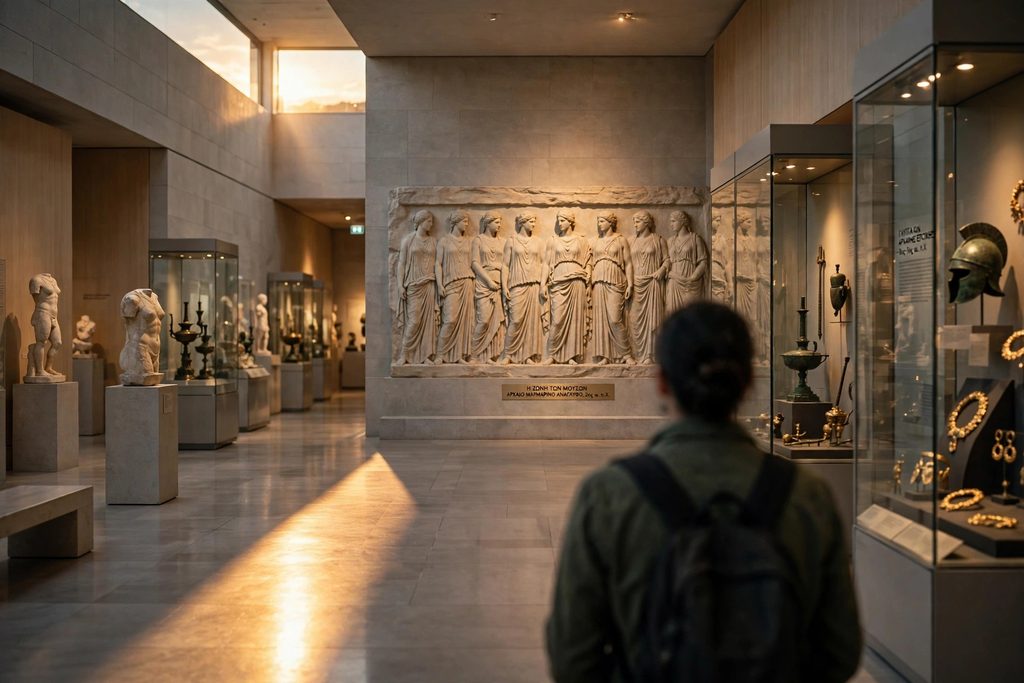
And every museum is a fourth place to find them. The National Archaeological Museum in Athens, with its Mycenaean gold and Cycladic figures, is a house of the Muses in the oldest sense, a building where a civilisation’s memory is kept so that strangers can come and receive it.
What Memory’s Daughters Keep
Hesiod gave the Muses a strange double gift. They were born to make people forget their sorrows, and they were the daughters of Memory. The two are not a contradiction. A song that remembers well lets its listeners set down their own troubles for a while and enter something larger and older than themselves.
That is still what the Muses do. Every epic, every history, every tragedy and every star chart is memory shaped so that it can be handed on. The shepherd on Helicon understood it before anyone else wrote it down. The goddesses gave him a laurel staff and a voice, and told him to sing of what was, what is and what will be. Nearly three thousand years later, his song is still being remembered.
At Olympus Estate, Mythic Essays read the Greek myths closely, from the oldest sources forward. The Muses were the nine daughters of Zeus and Mnemosyne, Memory, conceived over nine nights in Pieria below Olympus. Hesiod met them on Mount Helicon around 700 BC, where they mocked him as a shepherd, gave him a laurel staff and warned that they could tell lies like truth. In a world before writing, poetry was the people’s memory, which is why Homer asked the Muses for the facts of the catalogue of ships and why all nine sang at Achilles’ funeral. An older tradition knew three Muses, Practice, Memory and Song. Hesiod named the nine, Calliope first among them, but their separate arts and emblems, from Clio’s scroll to Urania’s globe, were fixed in Roman art. The Muses punished rivals like Thamyris, the Sirens and the Pierides, lived by the springs of Pieria, Helicon and Parnassus, and shared their mother with the lake of Memory in the Orphic tablets and the springs of Trophonius. Simonides turned memory into a method, Plato and Alexandria built shrines and a research community called the Mouseion, and the museum, music and mosaic still carry their name.