





In the beginning, before the gods were born, something emerged from Chaos that the Greeks called Eros.
Hesiod names him fourth in the sequence of what came into being, after Chaos itself, after Gaia the earth, after Tartarus the abyss. He arrived before the Titans, before Zeus, before Aphrodite, before everything that the mythology we inherited considers primary. His function in the Theogony is explicit and does not require interpretation: he was the force that caused disparate elements to cohere, the principle by which things that had been separate became compelled toward each other, the condition without which the subsequent generation of gods and worlds and living beings would not have occurred.
Parmenides, writing two centuries after Hesiod, went further. Eros was not fourth but first, the original emergence, the initial event from which everything else followed.
Neither of these accounts produces the figure that Valentine’s Day celebrates.
What Hesiod’s Eros Actually Was
The primordial Eros of the Theogony is not a deity in the sense that the Olympians are deities. He has no parents, no biography, no myths in which he acts from personal motivation. He does not fall in love. He does not shoot arrows. He does not serve his mother’s romantic agenda. He is a force, not a person, and Hesiod names him with the purpose of explaining how a universe can generate complexity from a prior condition of undifferentiated absence.

Chaos, in the Greek cosmogonic sense, was not disorder. It was the gap, the void, the condition of pure potentiality before anything existed. From this void emerged the first distinct things, earth and depth and darkness and night. But distinct things, once emerged, remain separate unless something compels them toward relationship. The generation of anything more complex from the first elements requires a principle of attraction, a force that pulls the separate toward the combined.
Eros was that principle.
In this function he is less comparable to any personal deity than to what physics calls a fundamental force: the condition that makes certain kinds of interaction not just possible but necessary, the force that causes what has been apart to tend toward union. Aristotle understood this precisely. The Metaphysics reads Hesiod’s Eros as the productive cause, the force that set the cosmos in motion toward the generation of more complex forms from simpler ones, the condition of there being a universe rather than a void.
The Orphic tradition, running parallel to Hesiod and partially independent of it, gave this cosmological principle a different name alongside Eros. He was also Phanes, the one who appears, the first visible thing, the emergence of light and form from the darkness of undifferentiated chaos. He was Protogonos, the firstborn, because the capacity for attraction and combination had to precede any instance of attraction and combination. In the Orphic egg myth, Eros hatched from a silver egg laid by Night in the void, and his emergence was the event that made the subsequent generation of the world possible.

The Orphic Eros was described as hermaphrodite, carrying both generative principles within a single being, not because the myth was confused about gender but because the cosmological principle of attraction must precede and contain both poles of what it will eventually draw together. A force of attraction that is already gendered in one direction would not be able to pull the universe toward the combination of opposites that the cosmos requires. The primordial Eros contains the whole of what desire will eventually become before it becomes any instance of it.
How Plato Held Both Versions Simultaneously
The Symposium of Plato, written four centuries after Hesiod, contains the most philosophically sophisticated engagement with Eros in the ancient tradition, and it holds the cosmological and the personal versions of the god in a productive tension that neither resolves.
The speech of Phaedrus in the Symposium invokes Hesiod directly, citing the primordial Eros of the Theogony as the oldest of the gods and therefore the most honourable. He is the cause of our greatest goods. He gives us the courage to act well in the presence of those we love and the shame to act badly before them. He makes possible the self-overcoming that love requires.
The speech of Aristophanes offers the myth of the original spherical humans, split in two by Zeus, each half seeking its original other, the erotic impulse as the expression of a prior wholeness seeking restoration. This is Eros as the longing for what has been lost rather than the force of original creation, but the cosmological implication is the same: desire is the trace of an original unity that the present condition of separation makes unavailable, and the pull toward the beloved is the pull toward a state of being that precedes individual existence.
Socrates, speaking last, reports the teachings of Diotima of Mantinea, the only woman in the Symposium and the figure to whom Socrates attributes the philosophical understanding of Eros that the dialogue treats as its highest achievement.
Diotima’s Eros is neither the cosmological force of Hesiod nor the personal desire of the other speeches. He is a daemon, an intermediary between the divine and the human, born of Penia, poverty, and Poros, resource, conceived on the night of Aphrodite’s birth. He is always in want and always resourceful, always dying and always reviving, always moving toward what he does not have and never fully possessing it.
This Eros is desire itself as a philosophical state, the condition of a being who perceives beauty and is drawn toward it and who, in being drawn toward it, moves from the particular beautiful body toward beautiful souls, toward beautiful activities, toward beautiful knowledge, toward the form of beauty itself, which is the form Diotima calls the beautiful itself, available to the philosopher who has been guided by Eros through all the intermediate stages.

The Phaedrus, Plato’s other major dialogue on Eros, describes him as divine madness, the fourth of the great madnesses that the gods give as gifts: the madness of prophecy, the madness of ritual, the madness of poetry, and the madness of love. The philosopher who has seen the forms in their pre-birth condition and who recognises them again in the beauty of a particular person is seized by a wing-growth in the soul, a painful and pleasurable eruption of the soul’s capacity for flight toward the divine, which is the erotic experience philosophically understood.
Plato’s Eros is therefore simultaneously the oldest cosmological force and the most intimate personal experience and the highest philosophical aspiration. He holds these three registers without collapsing them into each other, because the tradition he is working within was sophisticated enough to have produced all three and to have understood that they were not separate phenomena but three scales of the same force.
The Gymnasium and the Sacred
Here is the detail that illuminates the Greek understanding of Eros in the lived world rather than in the philosophical texts.
Altars to Eros were placed in ancient Greek gymnasiums.
The gymnasium was the institution of physical education, athletic training, and philosophical instruction simultaneously. Young men trained their bodies and their minds in the same space, under the supervision of the same pedagogical tradition. The altar of Eros was not incidental to this space. It was placed there because the Greeks understood the force that drew the older man toward the beautiful young man, and the force that drew the younger man toward the knowledge and virtue of the older one, and the force that drove the athlete toward greater physical excellence in the presence of those who admired excellence, as expressions of the same Eros that Hesiod had named as the fourth emergence from Chaos.

This was not a romanticisation of what the modern world would call exploitation. It was a philosophical framework in which the erotic impulse was understood as the primary motivation for human self-improvement, and the relationship between teacher and student was understood as an erotic relationship in the fullest philosophical sense, one in which each party was drawn toward the excellence the other embodied or represented. The gymnasium altar of Eros was the acknowledgement that learning itself is an erotic activity, that the desire to understand and the desire to be beautiful and the desire to be excellent in the presence of those who can see excellence are all expressions of the same primordial force that made the universe cohere.
Thespiae in Boeotia maintained the most significant cult of Eros in the ancient Greek world, with a festival called the Erotidia held every four years in parallel with the Olympic games. The cult statue at Thespiae was considered one of the great sacred objects of the ancient world, and Phryne, the most celebrated courtesan of the fourth century BCE and the model for Praxiteles’ Aphrodite, offered the sculptor’s statue of Eros back to the sanctuary of Thespiae as a dedication. The erotic and the sacred were not distinct in this offering. The most beautiful woman of her era dedicating the image of the cosmological force of desire to the city whose cult maintained it: this is the Greek understanding of Eros as a principle that the personal and the cosmic share.
The Demotion | How Eros Became Small
The primordial Eros and the Olympian Eros coexisted in the Greek tradition for centuries, and the older texts were not forgotten when the newer representations multiplied. But the visual and literary culture of the Hellenistic and then the Roman periods produced a progressive narrowing of the figure that eventually eliminated the cosmological register entirely.
The winged child appears in Greek vase painting from the fifth century BCE, already a long way from Hesiod’s primordial force. He is Aphrodite’s companion, her son in some accounts, her instrument in others. He carries a bow in some images. The bow became standard. The arrows became standard. The childish body, suggesting playfulness and irresponsibility and the capacity for causing harm without malice, became standard.
By the Hellenistic period there were plural Erotes, a swarm of small winged desire-spirits who assisted Aphrodite, decorated sarcophagi, and populated the erotic epigrams of the Anthology. The singular cosmic force had become a category of minor deity, and the category had become decorative.
The Roman Cupid completed the transformation. Cupid is diminutive, mischievous, frequently blindfolded, shooting arrows at random and causing love where love is inconvenient or absurd. He is the explanation for desire that locates desire outside the self, that makes desire something that happens to you rather than something that moves through you from the structure of the universe. If Cupid shot you, your desire is his fault. You cannot be held responsible for what a divine child with a bow did to you without warning.
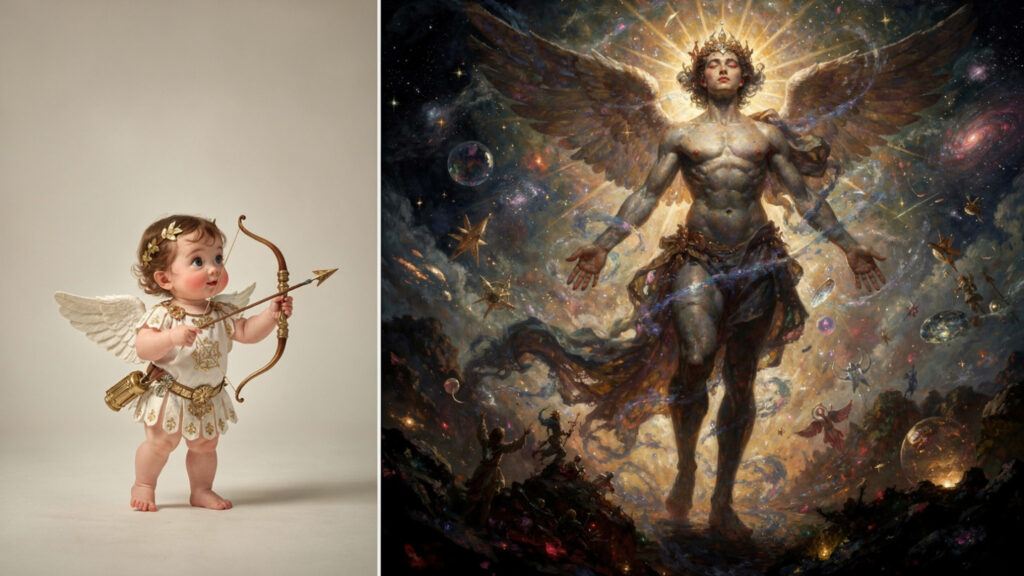
The philosophical implication of this transformation is enormous. The Greek Eros, in his fullest understanding, was a force that ran from the structure of the cosmos through the soul’s aspiration toward the divine. To be in the grip of Eros was to be participating in the same movement that had drawn the elements of the universe toward their first combinations, that had moved the philosopher toward the form of beauty, that had drawn the athlete toward excellence in the presence of those who valued it. Eros was the cosmic force you were made of, expressing itself through your particular desire toward your particular object.
Cupid is a child who shot you. Your desire is random. Its object is arbitrary. The responsibility is elsewhere.
This shift, from desire as cosmic participation to desire as arbitrary affliction, is one of the most significant philosophical movements in Western cultural history, and it was accomplished not primarily through argument but through image: by making the god of desire small enough and irresponsible enough that the force he embodied could no longer carry the weight it had carried in Hesiod and Plato and the altars of the gymnasium.
What Was Lost and What Persisted
The cosmological Eros did not disappear when Cupid arrived. He persisted in the philosophical tradition, in the Neoplatonists who preserved Plato’s Symposium and the Orphic cosmogonies, in the Christian theological tradition that absorbed the Platonic Eros into its account of the soul’s ascent toward the divine, in Dante’s final image of the Love that moves the sun and the other stars, which is Plato’s Eros translated into theological vocabulary without losing its cosmological register.
Freud named one of his two fundamental drives Eros, the drive toward life and combination and complexity, in opposition to Thanatos, the drive toward dissolution and death. This Freudian Eros is recognisably the Hesiodic force: not personal desire but the structural tendency of living systems toward the combination and complication that desire makes possible at the individual level.
The contemporary understanding of physical forces contains something that the Hesiodic cosmology anticipated in its own vocabulary: the recognition that the universe tends toward structure and complexity from simpler initial conditions, that the fundamental forces governing the behaviour of matter are forces of attraction and combination, that the same principle operating at different scales produces the formation of galaxies and the experience of love and the philosophical aspiration toward understanding. Hesiod called the force that does this work Eros, and the name carries more precision than it is usually given credit for.
The winged child on the Valentine’s card is the residue of a demotion that took five centuries to complete.
The god who preceded him emerged from Chaos before the sky existed, before Aphrodite was born from the sea-foam, before anything in the universe had found its form. He was the condition of there being a universe rather than a void, the force by which disparate elements discovered their attraction to each other and moved toward the combinations that produced everything that followed.
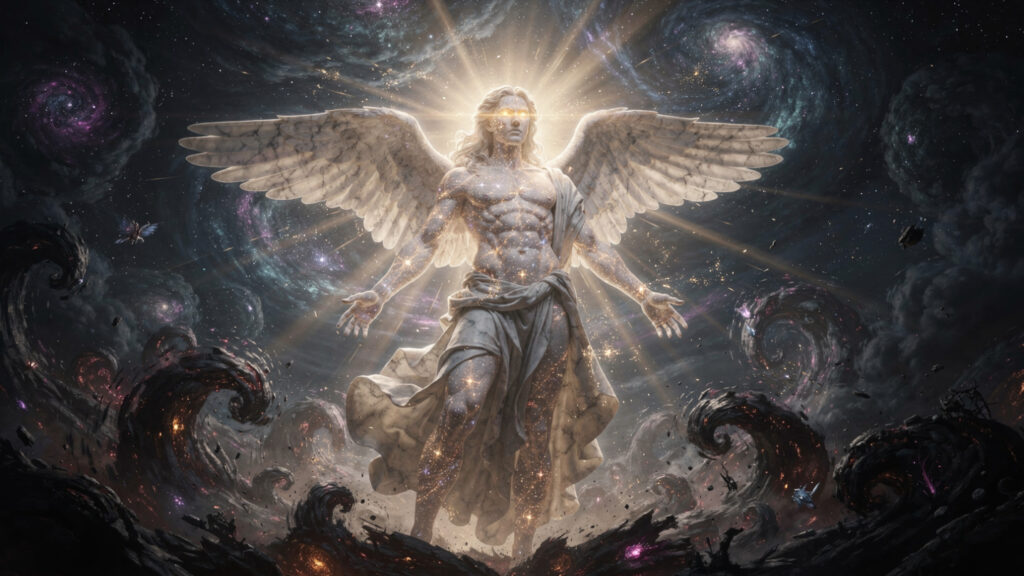
Parmenides called him the first. Hesiod called him the fourth. Aristotle called him the productive cause. Plato’s Diotima called him the daemon who moves the philosopher from the beauty of a body to the beauty of all bodies to the beauty of knowledge to the form of beauty itself.
Each of these accounts is describing the same force at a different scale. The scale that Cupid operates at is the smallest available: the individual who gets shot and falls inconveniently in love with someone who cannot love them back.
The Greeks understood that this scale was real. They also understood it was the least interesting thing Eros could do.
At Olympus Estate, Tales from Olympus explores the full architecture of Greek myth, including the philosophical depths that the mythology encodes and the cultural decisions that simplified it. Eros was not always small. His reduction to a child with arrows is itself a story worth telling, because what was lost in the telling is still recoverable.