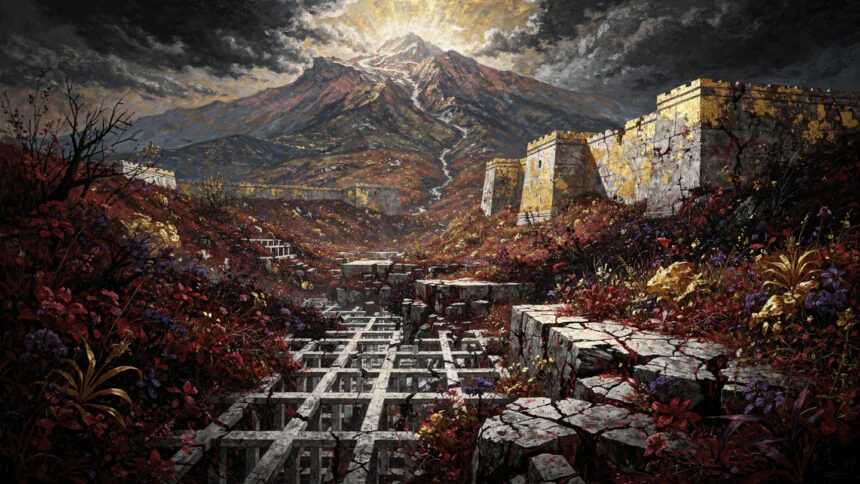




Hesiod interrupted his own argument.
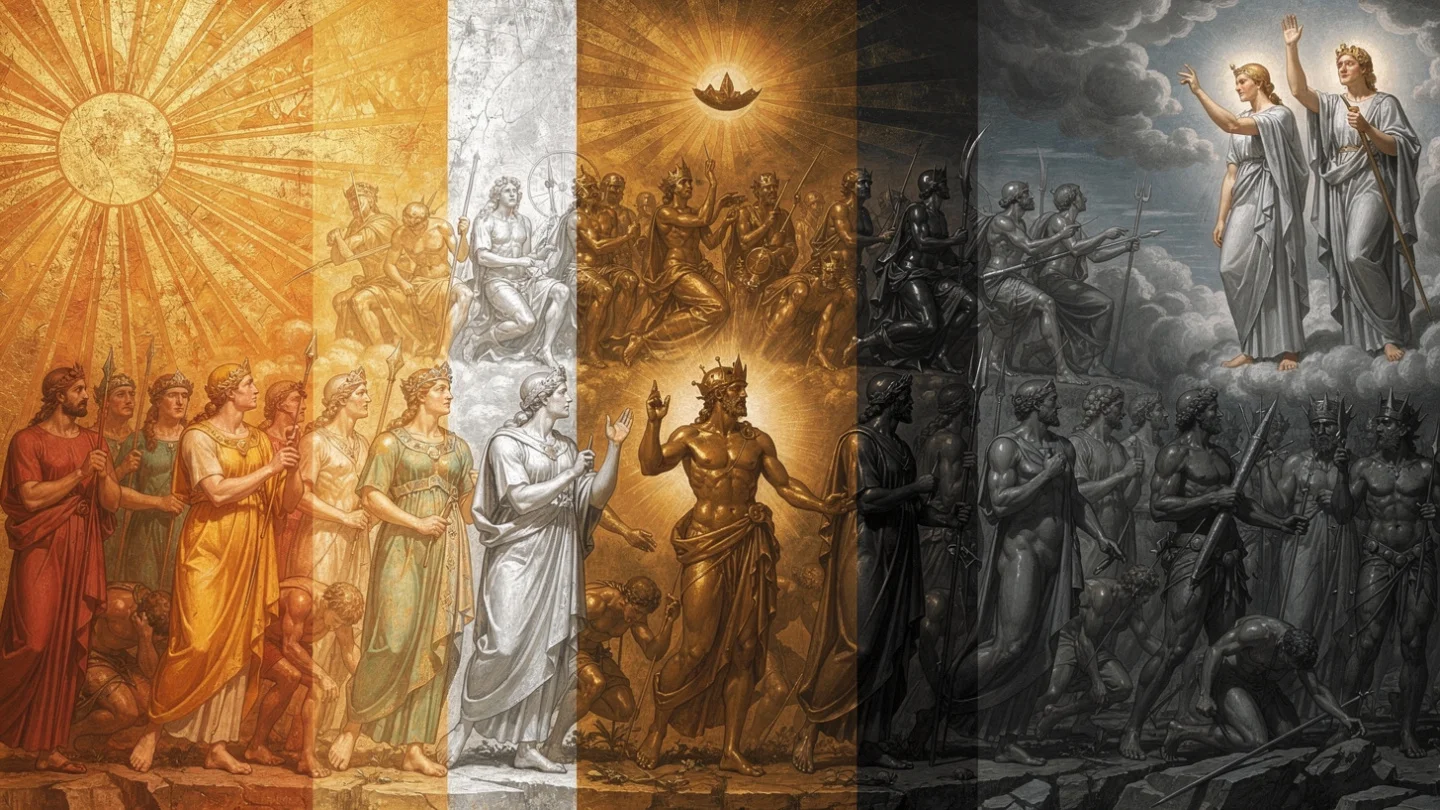
The Works and Days develops a cosmological scheme of human history organized around a single governing logic: the succession of the ages follows the succession of the metals in diminishing value and purity. Gold first, when the race of mortals lived like gods under Kronos, without toil or sorrow or the diminishments that the organized world’s subsequent history would produce. Silver next, when the human character first showed the insolence toward the divine that the Silver Age’s defining trait was the rejection of the piety that the divine order required. Bronze third, when the race was harder and more terrible, interested only in the grievous works of Ares, the warfare whose practitioners destroyed themselves through the relentless application of the only capacity they had developed.
Iron last, which is Hesiod’s own age and ours: the age of toil and sorrow, of the moral deterioration whose expressions the poet catalogs with the specificity of someone who has observed each one and found it exactly as bad as the scheme predicted it would be.
The logic of the sequence is clear. Gold, silver, bronze, iron: the metals diminish in value, and the human moral capacity that the metals encode diminishes with them. The sequence moves in one direction only. Each age is worse than the one before it. The direction is set from the beginning and does not reverse.
Between the Bronze Age and the Iron Age, Hesiod inserted the Heroic Age.
The Heroic Age is not a metal. This is the fact about the Heroic Age’s position in the Five Ages scheme that every standard treatment of the scheme mentions briefly and moves past, as if the absence of a metallic name were a minor peculiarity rather than the most philosophically significant structural decision in the entire Works and Days. The Heroic Age has no metal because it is not part of the metallic sequence. It is the interruption of the metallic sequence at the point where the sequence would otherwise move directly from the Bronze Age to the Iron Age.
Hesiod inserted it deliberately. Understanding why he inserted it and what its insertion means is understanding the deepest available philosophical argument that the Works and Days was making about the relationship between human history and human excellence.
The Four Ages Before the Fifth
The Golden Age was the age of Kronos, before the Olympian order was established, when the race of mortals lived without the suffering that the organized divine world’s theology produced as the condition of the mortal existence within it. They did not labor. The earth produced what they needed without being worked. They did not age in any way that diminished them. They died as if falling into sleep. After death, they became the daimones, the divine spirits whose function was the function of the guardians of the mortal world: watching over justice and injustice, rewarding the good, punishing the bad.
The character of the Golden Age’s daimones is the element of the scheme that encodes the most precise theological content: the beings who were so excellent that they did not require the structures of the organized divine world to maintain their excellence were transformed after death into the beings whose function was the maintenance of the structures of justice that the organized world required. The Golden Age’s best mortals became the guardians of the standard the subsequent ages would consistently fail to maintain.
The Silver Age was defined by the failure whose character was the character of the failure most directly opposed to the excellence of the Golden Age. Where the Golden Age’s mortals had honored the gods with the piety that the organized divine order required as the condition of the mortal’s correct relationship to the forces that governed the world, the Silver Age’s mortals refused to honor the gods. They were raised for a hundred years in the indulgence of childhood and then lived a brief adulthood whose quality was the quality of the insolence whose refusal of the piety that organized existence required earned them the divine punishment of removal from the earth’s surface.
The Bronze Age was the age of the violence whose practitioners were violent toward each other rather than toward the divine order: the age of the warriors whose bronze weapons and bronze houses and bronze tools all encoded the same material hardness that their souls possessed, whose destruction was self-destruction, the warriors who killed each other until there were none left and all descended together into Hades’s realm, nameless, without the memorial function that the heroic tradition would subsequently develop as the technology by which mortal excellence was preserved against the erasure of death.
Then Hesiod inserted the Heroic Age.
The Insertion and Its Logic
The Heroic Age in the Works and Days is the age of the demigods: the beings whose divine and mortal parentage gave them the combination of divine capacity and mortal vulnerability that the heroic tradition developed as its distinctive content. Achilles the son of Thetis and Peleus. Heracles the son of Zeus and Alcmene. Odysseus the mortal whose intelligence the divine world consistently acknowledged as the intelligence whose quality exceeded the ordinary mortal standard. The Seven Against Thebes. The Argonauts. The warriors who fought on both sides at Troy.
Hesiod describes them as a godlike race of hero-men who are called demigods, and he distinguishes them explicitly from the Bronze Age’s warriors in the quality that the distinction most required: the heroes were better. Not simply stronger or more skilled but better in the moral sense that the scheme had been using to organize the succession of the ages. They were, in the available register of the declining sequence, the beings who did not fit the declining sequence.
This is the structural problem that the Heroic Age’s insertion creates and that the standard reading of the scheme consistently undervalues: if the sequence declines from gold through silver through bronze, what are beings who are better than the Bronze Age doing between the Bronze Age and the Iron Age? The scheme’s logic predicts that each successive age will be worse than the preceding one. The Heroic Age is specifically described as better than the Bronze Age. The scheme has been interrupted.
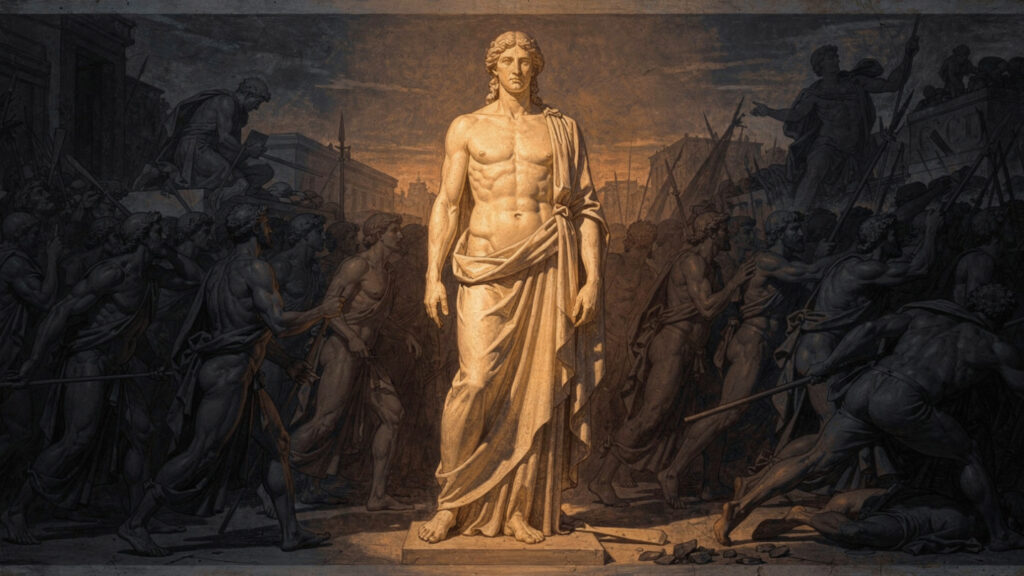
Hesiod knew this. He was not unaware that his inserted age violated the sequence’s governing logic. He was interrupting the sequence deliberately, for the reason that the sequence without the interruption would be making a claim about the relationship between human history and human excellence that Hesiod did not believe was true.
The claim the uninterrupted sequence would make is the claim that history moves in one direction only, toward the deterioration that the declining metals encode, and that the excellence of the individual has no available position within that movement except the position of the moment before the inevitable next decline. The Bronze Age’s warriors were more brutal than the Silver Age’s insolent children who were more irreverent than the Golden Age’s godlike mortals, and the scheme without interruption would predict that whatever came after the Bronze Age would be more brutal still.
The heroes were not more brutal than the Bronze Age’s warriors. They were something else entirely. They were the beings whose character and capacity exceeded the standard of the declining age in which they lived, the individual excellence that the heroic tradition would come to define itself around. Achilles in the Bronze Age would not have been a Bronze Age warrior. He would have been Achilles. His excellence was not the excellence of the age in which he existed. It was the excellence of the individual whose character produced the quality that no age, regardless of its position in the metallic sequence, could generate from its own resources.
This is what the insertion of the Heroic Age was encoding: the claim that the individual excellence of the hero was not a product of the historical age in which the hero existed but an achievement that could occur within any age including the declining ages, and that the existence of such excellence within the declining sequence was the evidence that the declining sequence was not the complete account of what was available to the human being living within it.
The Heroes After Death
The fate that Hesiod assigns to the heroes after death is the element of the Heroic Age that most completely distinguishes it from both the ages that precede it and the age that follows it.
The Golden Age’s mortals became daimones: guardian spirits whose function was the maintenance of the justice the living world required. The Silver Age’s mortals became the blessed spirits of the underworld, honored but removed from the surface world. The Bronze Age’s warriors went nameless to Hades: the punishment of the beings whose violence had left behind no achievement whose memorial function could preserve the person’s excellence against the erosion of time.
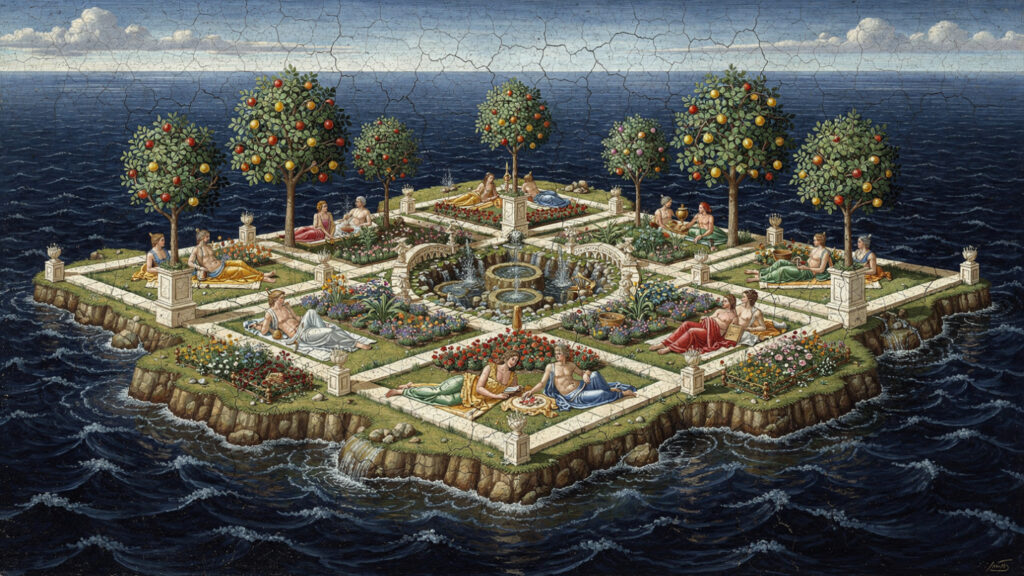
The heroes were sent to the Isles of the Blessed.
The Isles of the Blessed were the location in the Greek geographical imagination most completely removed from the ordinary conditions of the mortal world: the islands at the edge of the world, in the western ocean, where the excellent dead lived the life most closely approximating the Golden Age’s life. No toil. No sorrow. The earth producing three times a year without being worked. The heroes living in the condition of the excellence that their lives on earth had expressed but that the earth’s conditions had not always permitted them to express without the cost of the vulnerability that the mortal condition imposed.
The Iron Age’s dead go to neither location. Hesiod does not specify a post-mortem destination for the Iron Age’s mortals with the same specificity that he specifies the destinations of the earlier ages’ dead, because the Iron Age is the age that is still ongoing, the age within which the Works and Days is being written and within which the reader is reading it. The Iron Age’s fate is not yet settled. It is the age within which the question of what the human being will do with the conditions of the age in which they exist remains open.
This is the function that the Heroic Age serves within the scheme’s overall argument: it is the evidence, placed between the worst age before the Iron Age and the Iron Age itself, that the individual excellence of the hero is available even within the declining sequence. The heroes existed in the age between the Bronze Age and the Iron Age, in the conditions of a world already significantly worse than the Golden Age’s conditions, and they produced the excellence that the Isles of the Blessed were designed to receive. The Iron Age reader of the Works and Days lived in an age worse than the Heroic Age but was reading the evidence that excellence was available even in the declining sequence.
Dikē and the Condition of the Iron Age
Hesiod does not end the Five Ages scheme with the Iron Age’s description. He ends it with a prophecy and a warning.
The prophecy: Zeus will destroy the Iron Age’s race too, when the children are born with grey temples from birth, when father and son are at war with each other, when the guest no longer honors the host, when the brother no longer has the reverence for the brother, when the beautiful is no longer honored and the strong man destroys the weaker without any restraint or justice.
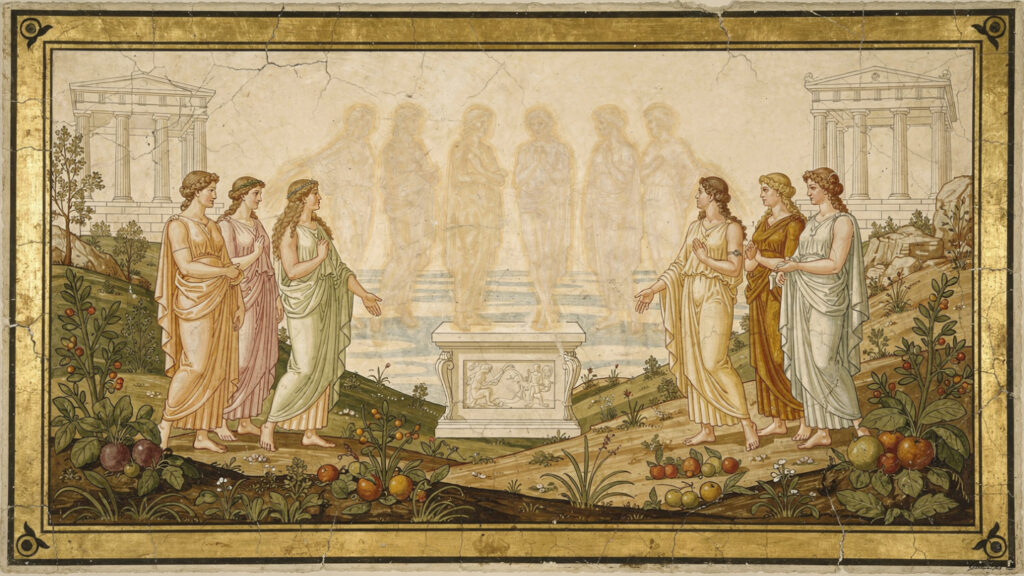
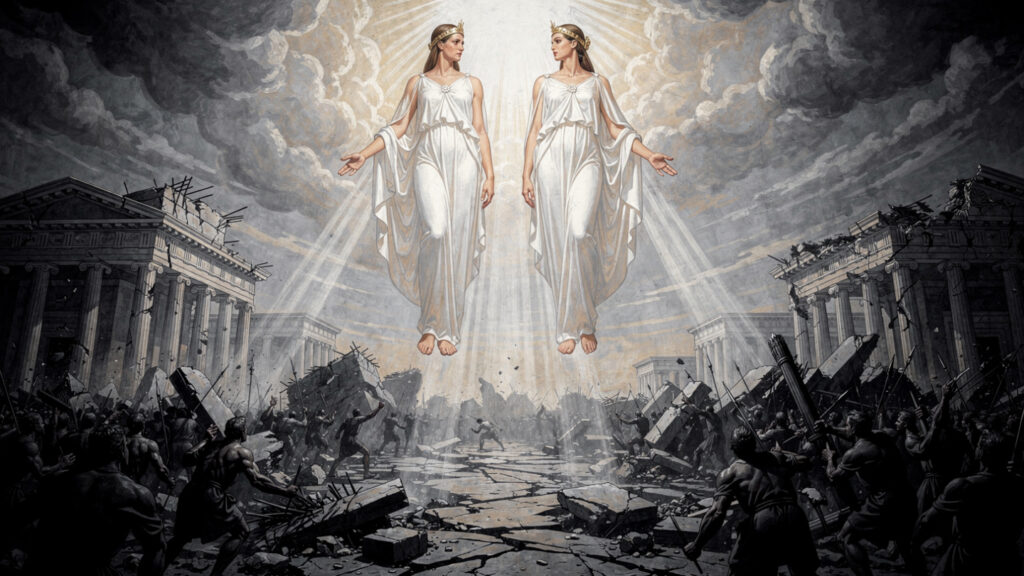
The warning is embedded in the beings who will abandon the Iron Age when the moral deterioration reaches its final stage: Aidos and Nemesis. Aidos is the sense of shame or reverence before the moral standard that the organized human world requires as the condition of its continued organization. Nemesis is the divine retributive force whose function is the function of the cosmic correction of the imbalance that the transgression of the moral standard produces.
When Aidos and Nemesis leave the earth, wrapped in white garments, ascending to Olympus to join the organized divine world and leave the mortals to manage without the forces whose presence was the condition of the moral order’s maintenance, the end of the Iron Age will have arrived. Zeus will destroy the race.
The theological content of this ending is the content that gives the Five Ages scheme its most precise philosophical claim: the organized human world is maintained by the presence of the forces whose function is the function of the moral standard’s maintenance and its violation’s correction. When those forces are no longer present in the world, the world is no longer organized in the way that makes the organized existence of the human community possible, and the divine authority that established the organized world responds by ending the failed instantiation of the organized world and beginning the cycle again.
The scheme is cyclical. The ages decline toward the catastrophe that the final deterioration produces, the catastrophe ends the age, and the cycle begins again.
The Heroic Age and the Tragic Tradition
The relationship between the Heroic Age’s position in the Works and Days and the Greek tragic tradition is the relationship that gives the Hesiodic scheme its deepest available connection to the subsequent development of the Greek philosophical and literary tradition.
The Greek tragic tradition developed the claim about the relationship between human excellence and human fate that the Heroic Age’s insertion into the declining sequence had encoded in the cosmological scheme: the individual whose excellence places them outside the standard of the declining age in which they exist is the individual whose encounter with the conditions of that age is the most complete available demonstration of what those conditions cost.
The Moirai article in this collection develops the reading of Oedipus whose precision the tragic tradition requires: Oedipus is not the victim of fate in spite of his virtues but through them. His relentless pursuit of the truth is the expression of the excellence of the individual who has developed the intellectual and moral character that the heroic tradition names as the standard of the excellent person. It is precisely this excellence whose application to the problem of the plague and its cause produces the discovery whose content is the content that destroys him.
This is the content that Hesiod’s Heroic Age insertion was preparing the ground for: the claim that the individual whose excellence exceeds the standard of the declining age in which they exist is the individual whose encounter with the conditions of that age is the most complete available demonstration of what those conditions cost the excellent person who lives within them.
The heroes are not exempt from the Iron Age’s conditions because they are excellent. They are more fully exposed to those conditions because they are excellent, because their excellence brings them into the contact with the limits of the age that the non-excellent person, whose incapacity keeps them at a sufficient distance from those limits that the limits never fully engage with them, never experiences.
Achilles’s excellence as the greatest warrior of the heroic tradition does not protect him from the limit that the mortal condition imposes. It brings him into the confrontation with that limit in the form that the excellence makes possible: the choice between the long obscure life and the short glorious one, whose terms the excellence makes available to him as a genuine choice rather than as an abstract philosophical possibility, is the choice that the non-excellent person never faces because the non-excellent person’s incapacity removes both options from the range of the available equally.
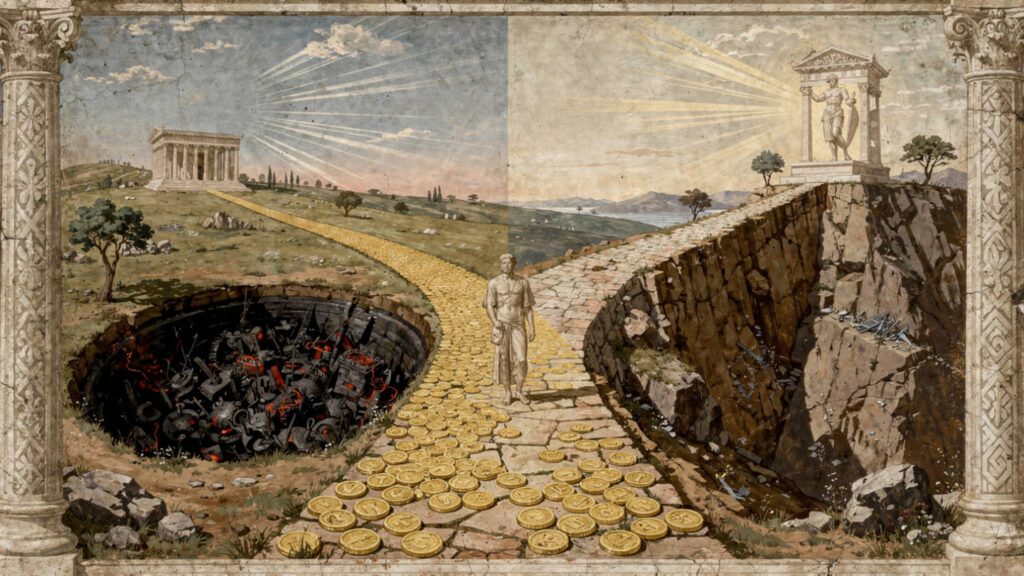
The hero chooses the short glorious life because the hero is the hero. The choice is the expression of the excellence.
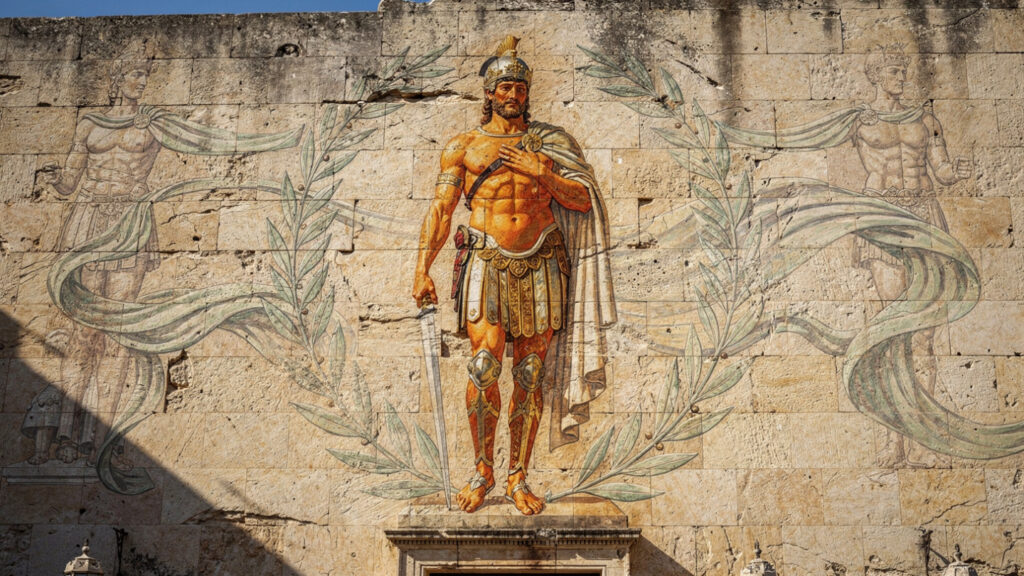
The consequence is the early death that the choice produces. The kleos, the undying glory, is the compensation that the heroic tradition developed as the available response to the cost: the memorial function that preserves the excellent person’s achievement against the erosion of time and the nameless darkness of Hades that the Bronze Age’s warriors received because they had left behind nothing worth preserving.
What Hesiod Was Saying to the Iron Age Reader
The Works and Days was addressed to Perses, Hesiod’s brother, who had bribed the corrupt judges to obtain a greater share of their father’s inheritance and who was being told, through the frame of the personal dispute made the occasion of the larger cosmological argument, that the way of living that the corruption of the judge and the greed of the brother represented was the way of living that the Iron Age made available and that the Works and Days was arguing against.
The argument was not simply the argument that the current age was worse than the previous ages, though that was part of it. The argument was the argument that the way of living that the current age made easiest was not the only available way of living within the current age.
The Heroic Age’s insertion was the evidence for this claim: the heroes existed in the conditions of an age whose moral deterioration was already advanced from the standard of the Golden Age, and they produced the excellence that the heroic tradition named as the standard of the excellent person. They were not products of the declining sequence. They were the individuals who chose, within the declining sequence, to live according to the standard of the excellent person rather than the standard of the declining age.
This is the political and ethical argument that the Works and Days was making through the cosmological scheme: the Iron Age reader who lived in the conditions of the current age was not required by those conditions to live according to the standard that those conditions made easiest. The heroes were the evidence that the individual could choose to live according to a different standard even within the declining sequence.
Dikē, the goddess of justice, was still present in the Iron Age when the Works and Days was written, though she was already under threat from the corruption of the judges and the greed of the brothers. She would eventually leave with Aidos and Nemesis when the deterioration reached its final stage. But she had not yet left. The individual reader of the Works and Days lived in the window between the Heroic Age’s evidence of what human excellence could achieve and the Iron Age’s final deterioration whose arrival would end the age.
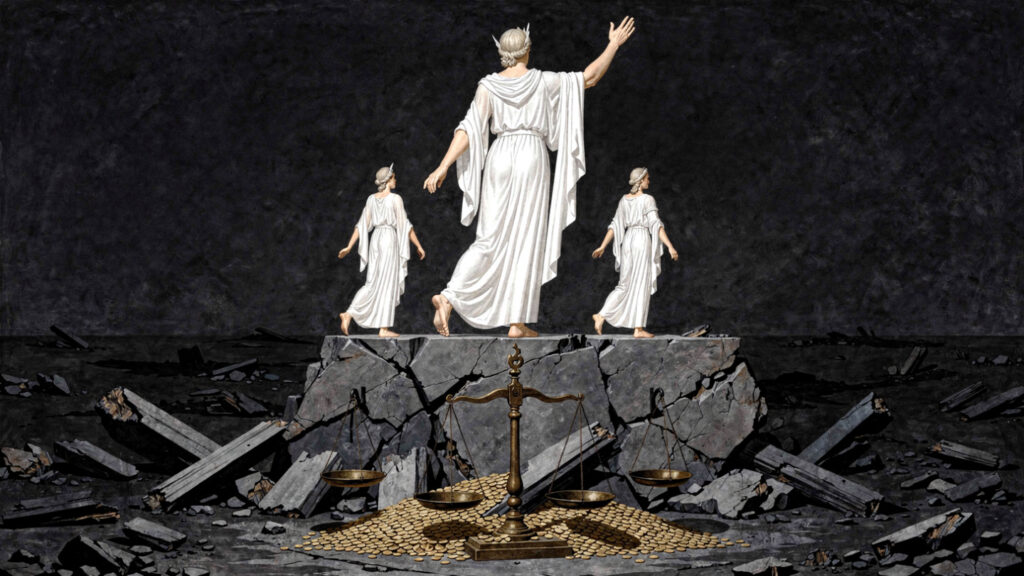
In that window, the choice between the way of living that the declining age made easiest and the way of living that the heroic tradition had demonstrated was possible was the choice that the Works and Days was asking its reader to make.
The Heroic Age was not nostalgia. It was argument. The heroes had existed in conditions worse than the Golden Age and had produced excellence anyway. The Iron Age reader could do the same.
At Olympus Estate, Mythic Essays moves through the deeper currents of the Greek tradition. Hesiod interrupted his own argument. The Five Ages scheme declines from gold through silver through bronze to iron. Between the Bronze Age and the Iron Age he inserted the Heroic Age. The Heroic Age has no metal because it is not part of the metallic sequence. The heroes were better than the Bronze Age’s warriors. The scheme predicts each age will be worse than the one before it. The heroes violated that prediction deliberately. Hesiod was encoding the claim that individual excellence was not a product of the historical age in which the hero existed but an achievement that could occur within any age including the declining ages. When Aidos and Nemesis leave the earth wrapped in white garments ascending to Olympus the Iron Age will end. But they have not left yet. In that window the choice between the easy way and the excellent way remains open. The Heroic Age was not nostalgia. It was argument.