



The goddess could find no flaw.
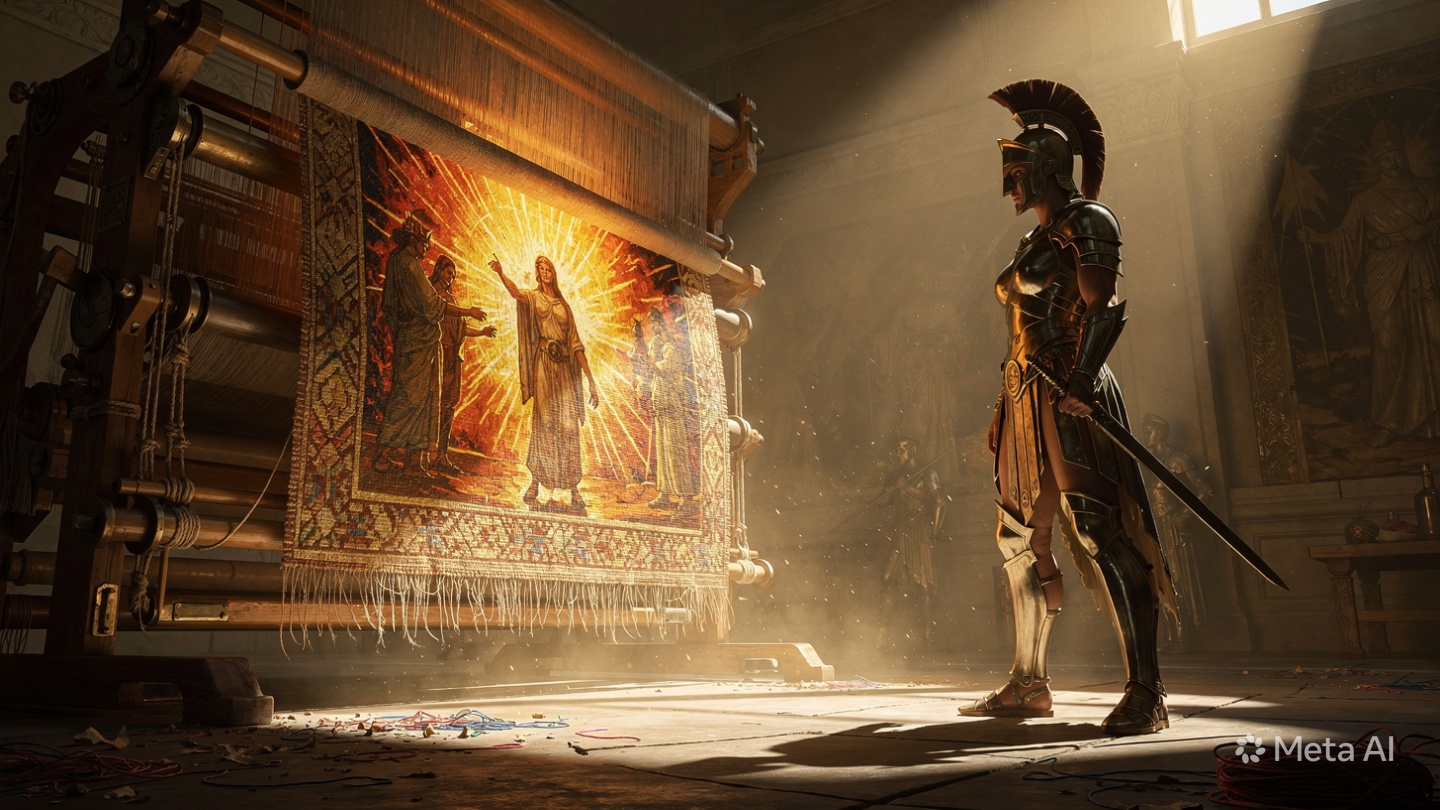
This is the detail in the Arachne myth carrying theological weight every retelling since has repeated without always understanding what it means. Athena examined Arachne’s completed tapestry and found it perfect. A mortal woman from Lydia had produced work the goddess of craft and wisdom could not improve on, could not criticize, could not dismiss as inferior. The technical execution was flawless. The artistic vision was flawless. The representation of divine reality it contained was, by the only standard available for judging it, flawless.
Athena destroyed it.
Destroying the tapestry was never the destruction of inferior work. It was the destruction of work whose very perfection posed a threat imperfect work never could have: a tapestry Athena could not improve on demonstrated, simply by existing, that a mortal had achieved what divinity claimed exclusively for itself. Imperfect work could have been corrected. Perfect work had to be destroyed.
This is the theological argument the Arachne myth was actually making, and it is more radical than the standard reading of the myth as a simple story about punishing pride allows.
The Two Tapestries and What They Contained
The contest was organized around two looms placed side by side, and what each tapestry actually depicted was never incidental to the myth’s argument. It was the argument.
Athena’s tapestry depicted the gods in their glory. Zeus ruling from Olympus. The Olympian order arranged in its full divine authority and power. Mortals who had challenged that order shown receiving the punishments the gods assigned for the challenge, bound, transformed, reduced to whatever diminished condition the divine response to their presumption demanded. The tapestry was the established order’s own self-portrait: divine authority demonstrated as superior to the mortal precisely through the punishments mortals received for denying that superiority.
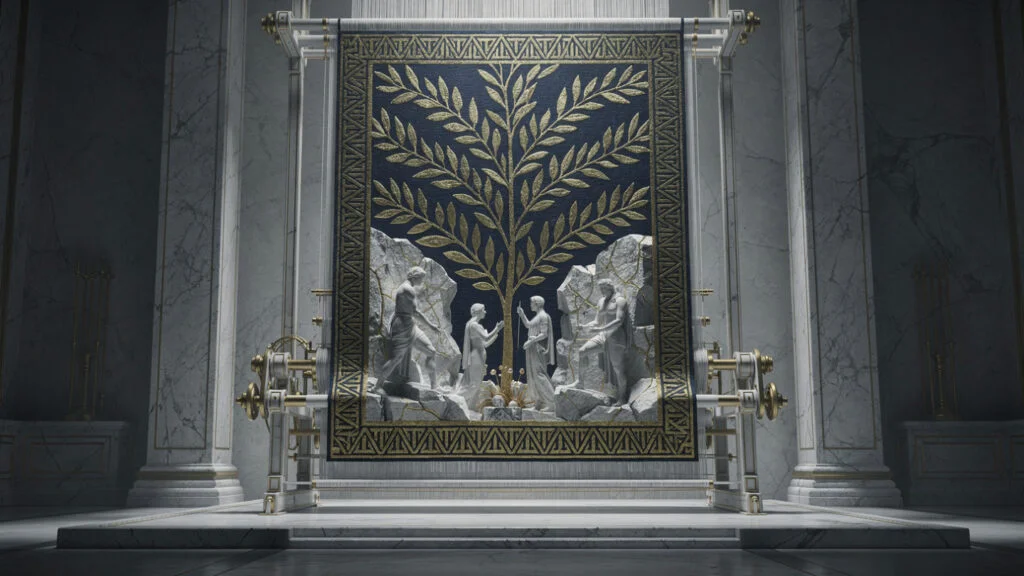
Arachne’s tapestry depicted the gods in their truth. Zeus’s loves and deceptions, the occasions the king of the gods used deception and force to pursue desires exactly the way any powerful figure uses power to get what persuasion alone could not obtain. Poseidon’s violations. Apollo’s failures of restraint. The full catalogue of moments where the divine order’s own claim to moral superiority over the mortals it punished for impiety collapses under the weight of its own recorded behavior.
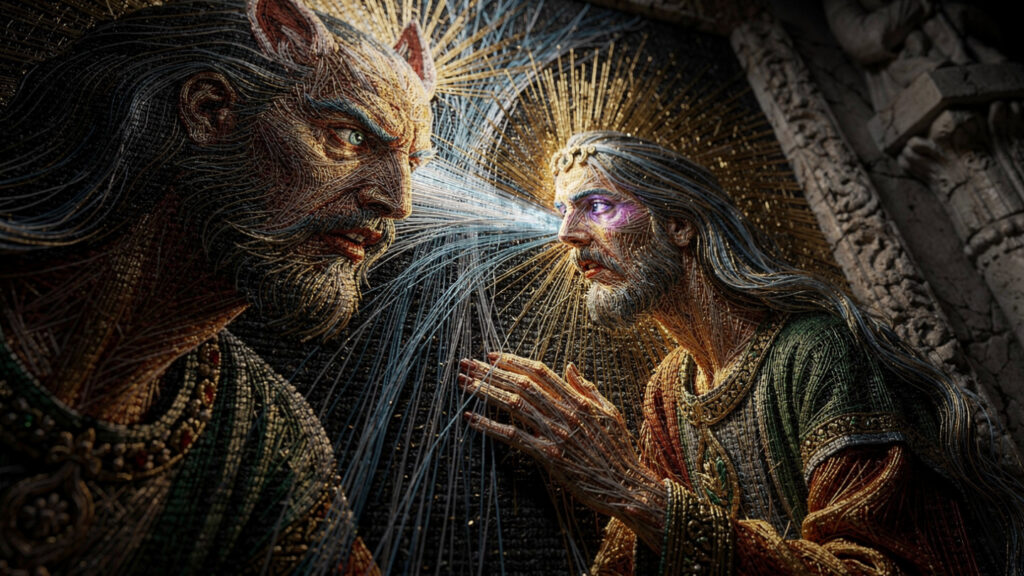
Arachne had woven the truth.
Nothing in her tapestry was disrespectful, crude, or deliberately provocative. It was simply accurate. Every scene she depicted carried the full authority of established myth behind it: none of it was invented, all of it was drawn from stories the gods themselves had already recorded and passed down through the culture. Arachne had taken this same record of divine behavior and rendered it with an accuracy no one had ever intended to see used against the gods themselves.
The tapestry was the indictment. The indictment was perfect. The perfection is exactly what made the indictment intolerable.
What Hubris Actually Was
The standard reading of the Arachne myth names pride as the offense her transformation punished. Arachne was proud. She claimed equality with the divine. The gods punished the claim by demonstrating the superiority it had denied.
This reading is available, and it isn’t wrong exactly. But it isn’t what the flaw-free tapestry actually supports.
The Nemesis article develops hubris as the transgression Greek religion’s corrective mechanism, nemesis, existed to answer: a mortal exceeding the human condition’s own limit by claiming or achieving what divinity reserved exclusively for itself. Hubris was never simple pride in the sense of self-congratulation or arrogance. It was trespass across a boundary whose maintenance was the actual condition for the organized world’s coherence.
But Arachne’s trespass was never a mortal claiming to be a god. It was a mortal whose work demonstrated that the boundary between mortal and divine did not sit where the gods had always claimed it did. Arachne never claimed to be Athena. She claimed her weaving was as good as Athena’s, and the contest’s own outcome proved the claim correct.
This demonstration posed a far more dangerous threat than any mortal simply claiming divine status without ever proving it. A mortal who makes an unproven claim can be dismissed as deluded. A mortal who proves it cannot be dismissed at all. She can only be destroyed.
Arachne’s transformation into a spider was divine authority’s own answer to the problem posed by a mortal whose work was demonstrably equal to the divine: the mortal whose existence in human form constituted that demonstration had to be removed from human form entirely.
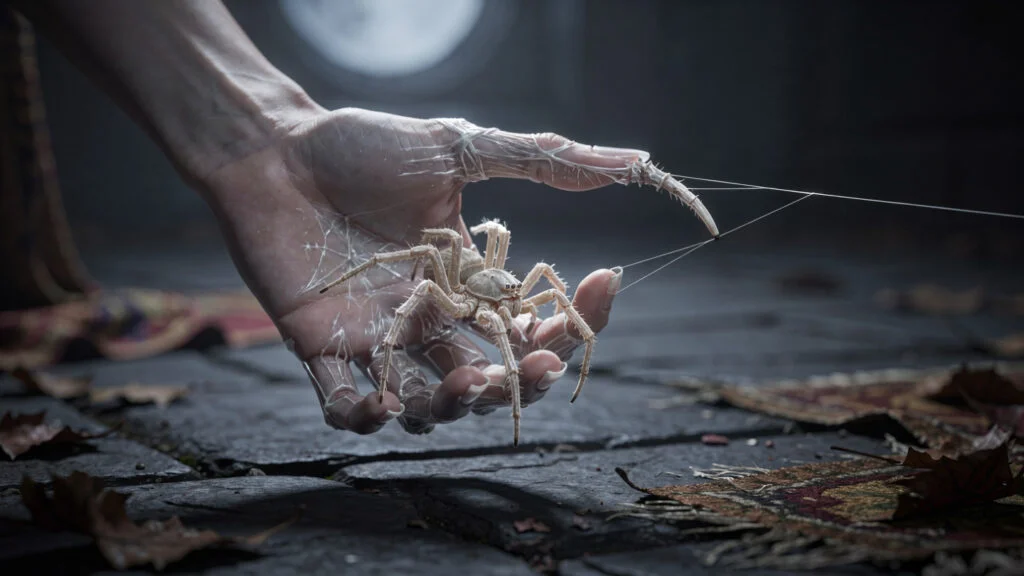
A spider does not make tapestries. A spider makes webs. That distinction is exactly the distinction between a representation of truth that challenges an established order and a piece of structural geometry whose function is capturing the living rather than representing the real.
The Moirai and the Sanctity of Weaving
Weaving’s sanctity in Greek religion came directly from its association with divine creation itself: the Moirai, the three Fates, Klotho the Spinner, Lachesis the Measurer, and Atropos the Cutter, were the divine beings whose own activity produced the pattern of every mortal life.
Klotho spun the thread of life at the moment of birth. Lachesis measured the thread’s length, its measure the duration of that life. Atropos cut the thread at the moment of death. Spinning, measuring, and cutting together produced an individual life across its full temporal extent.
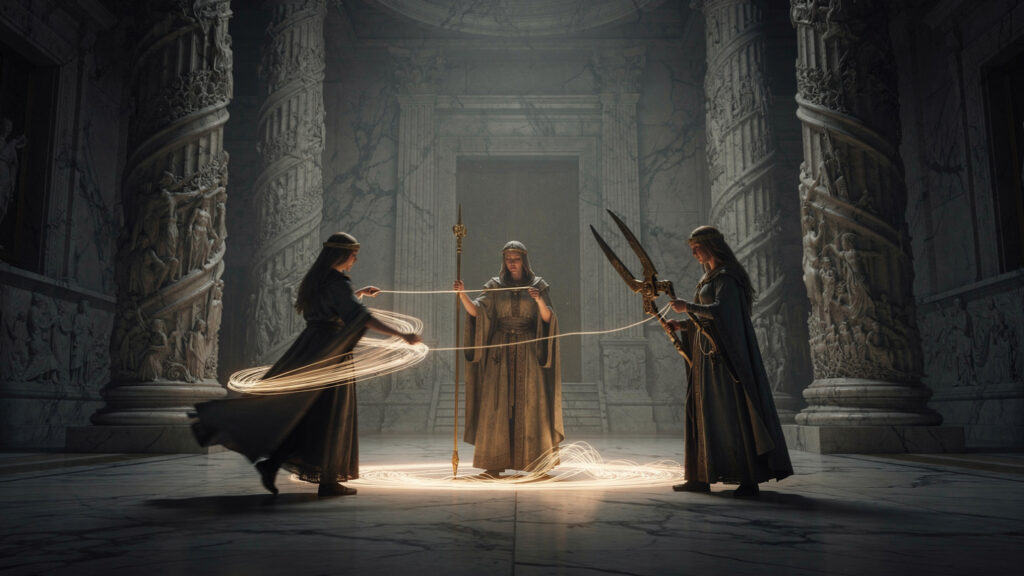
The loom was the actual implement of this divine creation. Thread was the substance the pattern was made from. Weaving was the activity that worked a life’s texture, color, and design into the form that existence would eventually take in the world.
When Arachne sat at a loom to compete directly with Athena, she was not simply challenging the goddess of craft. She placed herself in direct relation to the same divine creative activity that belonged to the Moirai: creating the pattern of reality itself. A mortal weaver whose work was indistinguishable from a goddess’s had just demonstrated that creating reality’s pattern was never, as the gods claimed, exclusively divine after all.
This is what the transformation actually punished: a mortal who could weave as well as a goddess had shown a proximity to divine creative power that authority could not permit to remain in the world, embodied in a human being able to show her work to other human beings and demonstrate to them exactly what that proximity already meant.
The Spider’s Web as the Punishment’s Logic
Arachne’s transformation into a spider took the exact form of the logic being applied to the problem her existence posed.
The spider weaves. The punishment never removed the capacity whose exercise in human form had constituted the challenge in the first place. The spider’s weaving is preserved completely. But its content is nothing like Arachne’s tapestries.
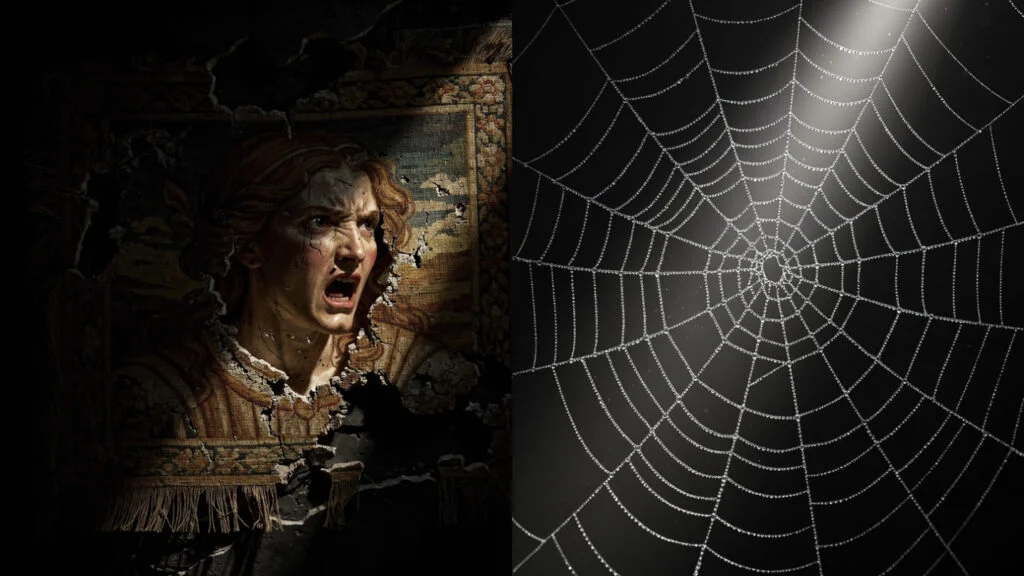
The tapestry represented. It created images of events, beings, and relationships between mortal and divine, accurate enough to challenge the established order’s own self-presentation. The web catches. It creates a geometric structure whose function is not representing truth but creating conditions for capturing the living. A spider’s web is not a tapestry. It carries no content whose truth could ever challenge an established order. It has only structure, and that structure is purely predatory.
Athena’s mercy, announced when she said Arachne would live but hang forever from her own thread, weaving for eternity, preserved the capacity while removing everything it once meant: the spider-Arachne weaves forever, but weaves nothing that can be read, nothing capable of representing truth about the divine order, nothing other mortals could ever examine and recognize as the indictment her tapestry had once been.
The web is the punishment’s most precise element: weaving without representation, creation without content, an artist’s formal activity stripped of exactly the function that had made her dangerous.
Ovid’s Version
The Arachne myth survives in its most complete form in Ovid’s Metamorphoses, whose sixth book gives the contest full narrative development: the disguised Athena’s warning, the unveiling, the parallel looms, the content of both tapestries, the destruction of Arachne’s work, the attempted suicide, and the transformation itself. Ovid’s version, more than any other, is what gave this myth its lasting cultural authority.
The Shield of Achilles article in this collection develops how Ovid’s own first-century BCE Latin poetry engaged with the earlier Homeric material it was amplifying. The Arachne myth works the same way in Ovid’s hands: he supplies the actual content of both tapestries in a level of detail earlier Greek sources never preserve, and that content is exactly what gives the myth its deepest philosophical argument.
The Metamorphoses as a whole organizes itself around transformation, the changes divine authority imposes on a mortal or divine figure whose situation makes transformation the only available response. The Arachne transformation is the Metamorphoses’ single most concentrated statement about exactly how divine authority manages a mortal who has demonstrated a capacity the gods cannot accommodate: not destruction, but reduction, preserving the capacity in a form that strips away everything it once meant.
Weaving’s Contemporary Presence
Greek weaving, still practiced in mainland and island craft villages today, encodes the Arachne myth’s continuity in its most fundamental form: organized pattern-creation in textile carried real social and ritual functions in the ancient Greek world, functions myth expressed directly by treating weaving as a genuinely divine creative activity.

Penelope’s weaving in the Odyssey, which this collection’s Odyssey coverage develops separately, serves the exact opposite function from Arachne’s: where Arachne’s weaving created a representation that directly challenged an established order, Penelope’s weaving is a creation whose systematic undoing is itself the strategy, using the appearance of creative activity to resist the household’s own pressure to choose among the suitors its conventions allowed to remain there.
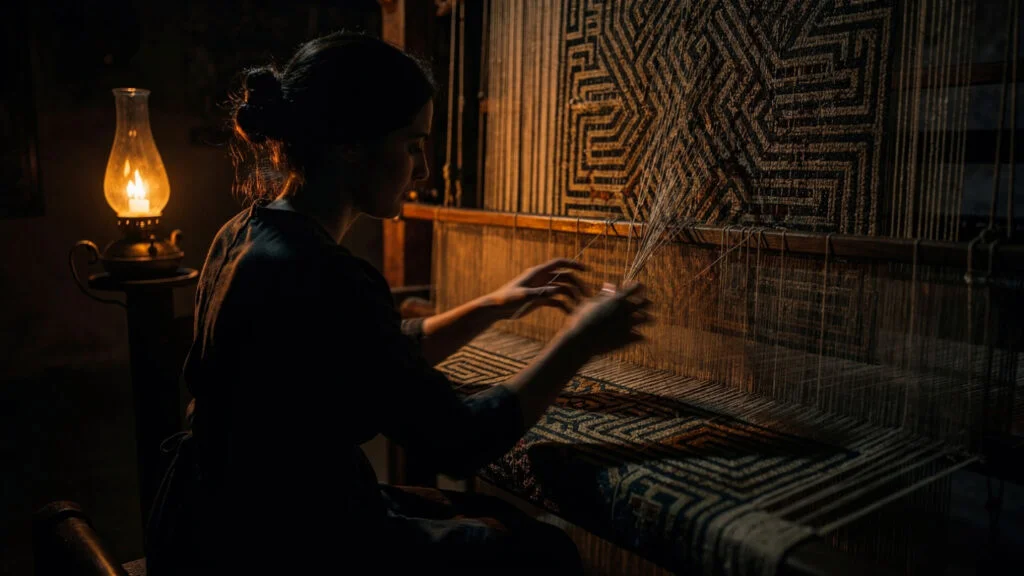
Both women use the loom as an instrument of resistance against established authority, just differently. Arachne’s resistance is direct confrontation: the loom as an instrument of truth whose representation challenges authority’s own self-presentation. Penelope’s resistance is deferral: the loom as an instrument of permanent creation-and-destruction, a cycle that prevents exactly the closure authority demands.
Greek weaving as a cultural practice held both functions simultaneously: creating patterns that represented a community’s own knowledge, and creating structures that expressed a resistance direct statement alone could never achieve.
What the Web Still Is
A spider’s web is among the most precisely engineered natural structures available to human observation: radial threads, spiral threads, the silk’s own tensile properties, and the adhesive properties of the catching threads combine into a predatory trap whose complexity often exceeds human-engineered structures built at the same scale, all of it the product of evolutionary development rather than conscious design.

The web Arachne was condemned to weave forever is not the diminished thing the standard reading of her punishment assumes. It is creative capacity with its content removed, but its formal complexity left completely intact, since removing that complexity too would have meant removing the capacity altogether. A spider’s web carries no representation. It has only structure. But that structure is the most perfectly efficient one available at its scale for what it does.
Arachne’s punishment followed the logic of an authority that could not eliminate creative capacity outright but could redirect it, from representing truth to building traps, from a tapestry that challenged the established order to a web that serves that same order’s predatory function instead. The mortal who wove the truth about the gods became the creature whose weaving now serves exactly the predatory function the gods required of her.
The web lives on. But it no longer speaks.
At Olympus Estate, Mythic Essays moves through the deeper currents of the Greek tradition. Athena examined Arachne’s tapestry and found no flaw. She destroyed it. Arachne’s tapestry depicted the gods’ loves and scandals and deceptions with the accuracy of the mythological record the divine tradition itself had produced. The tapestry was perfect. The tapestry was true. The perfection and the truth were the same problem. The transformation into a spider preserved the weaving capacity while removing the representational content. The spider weaves forever but weaves nothing that can be read as the indictment that the tapestry had constituted. The web has no content. It has only structure. The mortal who wove the truth about the divine order became the creature whose weaving serves the predatory function. The web lives on. But it no longer speaks.