





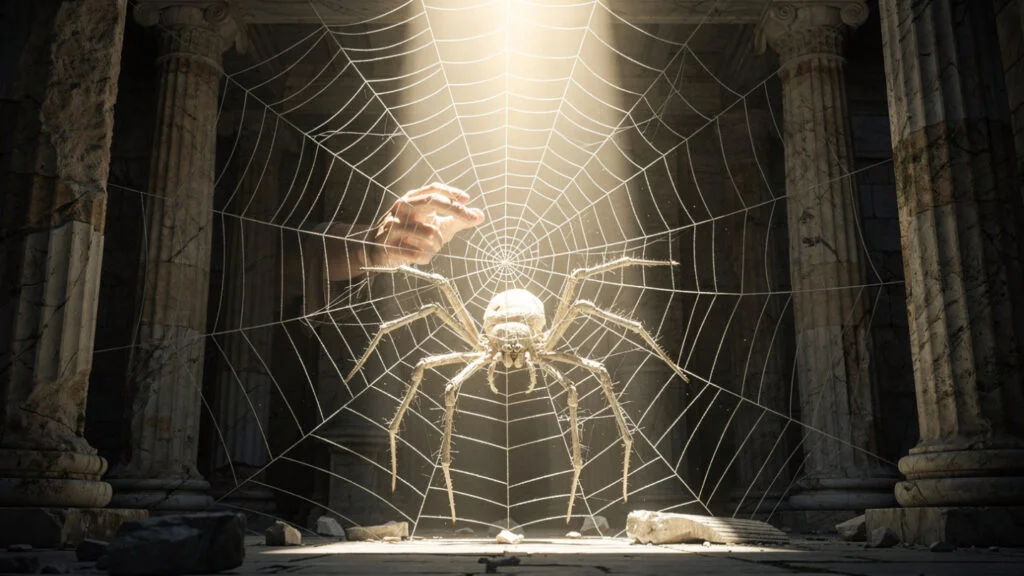
The Arachne article in this collection developed the mechanism of the Ovidian punishment as the punishment whose logic was the preservation of the capacity while removing the content. Athena found no flaw in Arachne’s tapestry and destroyed it. The spider weaves forever but weaves nothing that can be read as the indictment that the tapestry had constituted. The capacity remained. The content was gone.
The sixth book of Ovid’s Metamorphoses contains the Arachne myth. The third book contains Echo and Narcissus. The two myths are not adjacent in the poem but they are structurally adjacent in the logic of the transformations they develop, because both transformations operate through the same mechanism: the punishment preserves the defining capacity of the punished being in a form that removes the function the capacity was performing when it became dangerous.
Echo’s capacity was speech. The function that capacity was performing when it became dangerous to Hera was the function of distraction: covering for Zeus’s affairs with nymphs by engaging Hera in extended conversation that kept the goddess occupied while the affairs continued. The punishment preserved the speech capacity while removing its most important property: the capacity to originate. Echo could still speak. She could only repeat what she heard. The voice that had been the instrument of deliberate, purposeful, creative distraction became the voice that could do nothing but return what it received.
Narcissus’s capacity was perception. The function that capacity was performing when it became dangerous was the function of self-regarding absorption: the attention directed entirely inward, at the reflection in the pool, at the image of the self whose perfection held him immobile at the water’s edge until he died. The punishment preserved the perceptual capacity in the flower that bears his name: the narcissus nods toward the water, always oriented toward its own reflection, always repeating the gesture of the self-absorbed gaze, always at the boundary between the living world and the water that doubles it.
The capacity remained in both cases. The content was gone.
Hera and the Crime of Echo
Echo was an Oread, one of the mountain nymphs whose domain was the rocky terrain of the peaks and the valleys between them. The Oread tradition placed these nymphs in the landscape where sound travels differently than it does in the open plain: the landscape of the echo, where the voice sent into the valley returns from the facing cliff in the form of its own repetition.
The character of Echo before the punishment was the character of the nymph whose speech was her most distinctive quality. She talked. She talked at length and with skill and with the gift for extended conversation that Ovid characterizes as her defining trait. This gift was the gift she used in Hera’s service, or rather in the service of covering for Zeus’s use of the mountain nymphs for the purposes that Hera was perpetually attempting to prevent and Zeus was perpetually continuing to pursue despite Hera’s efforts.

Echo would engage Hera in conversation when the goddess was searching the mountains for evidence of Zeus’s infidelities. The conversation was not accidental. It was the instrument of the deception: keep Hera talking, keep Hera engaged with Echo’s words, keep Hera’s attention directed toward the conversation rather than toward the slopes where Zeus was otherwise occupied. By the time Hera extracted herself from the conversation and continued her search, the evidence was gone.
Hera understood what had happened. She did not punish Echo for the deception with the punishment of exposing the deception. She punished Echo with the punishment whose form was the form most precisely calibrated to the crime: the nymph who had used her gift of speech to prevent Hera from finding what she was looking for would retain the speech but lose the capacity to direct it toward any purpose of her own. You will always have the last word, Hera told her, but never the first.
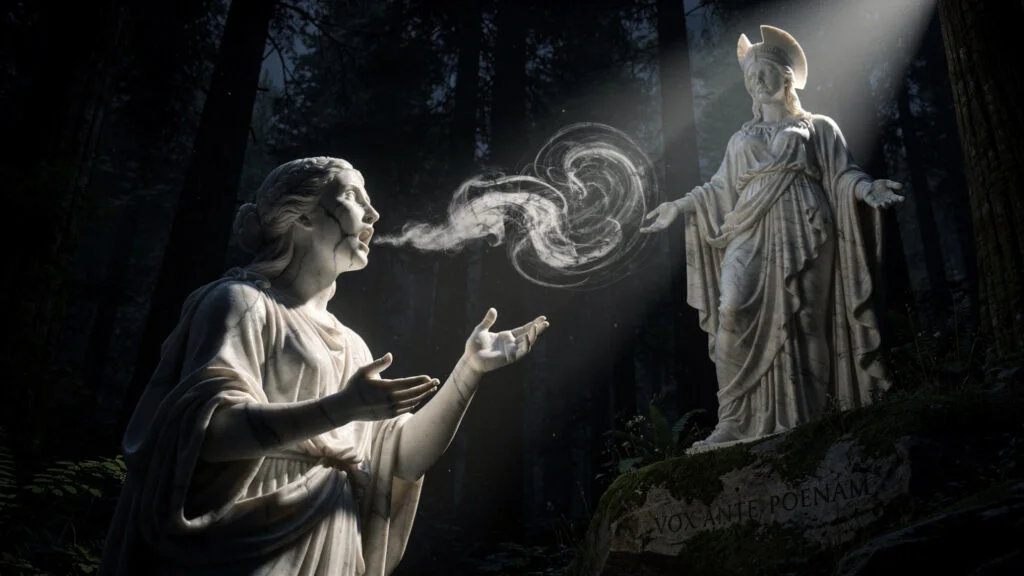
The last word without the first word is not speech. It is repetition. The capacity that Echo retained after the punishment was the capacity that the punishment had hollowed out: the voice remained, the ability to originate the voice was gone. Every word Echo spoke was a word someone else had spoken first. Every sentence Echo completed was a sentence someone else had begun. The instrument of the deception was preserved in the form that made it useless for deception and useless for every other deliberate communicative purpose simultaneously.
Narcissus and the Prophecy
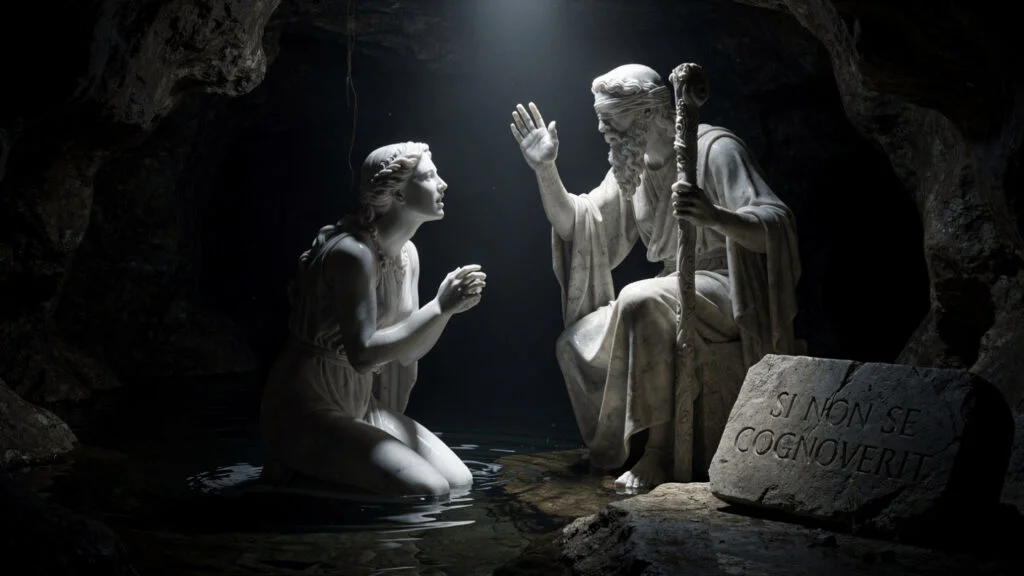
Narcissus was the son of the river god Cephisus and the nymph Liriope. He was born in extraordinary beauty, the beauty that caused his mother to seek out the blind seer Tiresias and ask whether her son would live to old age.
Tiresias gave the prophecy whose formulation has occupied commentators from Ovid’s time to the present: he will live to old age if he never knows himself.
The standard reading of this prophecy treats it as a variant of the Delphic know thyself injunction whose inversion, the life that avoids self-knowledge, seems paradoxical or even morally inverted. The deeper reading is the reading that the myth’s development supports: the form of self-knowledge that the prophecy was warning against was not the philosophical self-knowledge of the Socratic tradition, the knowledge of one’s own nature and limits that the Apollo article in this collection develops as the content of the Delphic maxim. It was the form of self-knowledge that the pool would eventually provide: the sight of the self as object, the encounter with the self as the most beautiful available thing, the absorption in the self-as-image that removed Narcissus from every relationship with anything that was not the self.
Tiresias was warning against the form of self-knowledge that the narcissistic encounter with the pool would constitute: not the knowledge of what you are but the fixation on what you look like, not the understanding of the self but the absorption in the image of the self, not the philosophical examination of the examined life but the perceptual imprisonment in the most beautiful available reflection.
Narcissus rejected every person who loved him. He rejected them not through cruelty in the sense of deliberate harm but through the incapacity of the person whose beauty had placed him at such a distance from the ordinary conditions of reciprocal relationship that he could not make the movement toward the other that reciprocal relationship requires. He moved through the world surrounded by desire and produced none of his own, because the object that his desire would eventually find was an object that no other person could provide: himself.
Echo and Narcissus in the Forest
When Echo saw Narcissus hunting in the forest, she fell in love with him in the form that the Ovidian tradition gives to love at first sight: immediate, total, and organized entirely around the desire for proximity with the object of the love. She followed him through the forest. She waited for the moment when he would speak so that she could speak in return.
The comedy and the tragedy of the encounter that followed is the comedy and the tragedy of the punishment meeting the situation for which its effects are most perfectly calibrating: a nymph who can only repeat what she hears encounters a beautiful youth who calls out to his hunting companions, who is not calling to anyone who can love him, whose words are not directed at her. She takes his words and returns them in the form that her punishment permits, and the words, redirected, carry a meaning their speaker did not intend.
Come, let us meet, he said, meaning come to where I am, speaking to his companions who had separated from him in the forest. Come, let us meet, Echo said back to him, meaning what she could not say, meaning what the punishment prevented her from initiating.
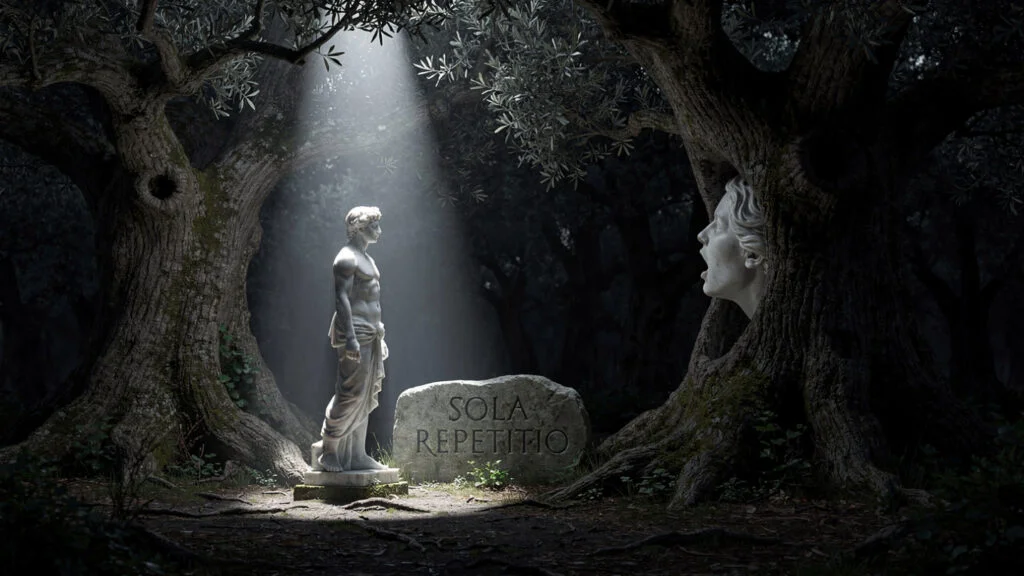
He recoiled. He said he would die before he let her have him. She repeated the last phrase and faded, as Ovid has her fade throughout the rest of her existence in the poem, into the cliffs and the rocks and the empty spaces where sound travels between surfaces without originating in any of them.

What remains of Echo is the voice without the body, the repetition without the source, the last word without the first word that every voice requires in order to be a voice rather than an echo. She did not die in the ordinary sense. She became the acoustic property of the landscape that was always the landscape of her kind: the mountain, the valley, the cliff face that returns the voice of anyone who calls into it in the form of the voice’s own repetition. She is still there. She is whatever answers when you call into a gorge and hear your own words returned.
The Pool
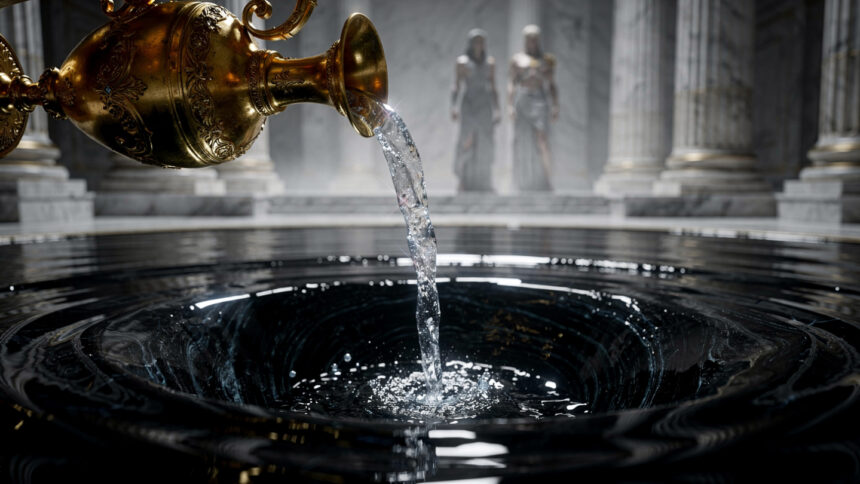
Narcissus came to the pool exhausted from the hunt. The pool was clear and undisturbed and cold, and he bent to drink, and saw his own face in the water.
He did not know what he was seeing. This detail is the detail whose theological weight the Ovidian narrative carries with the greatest precision, because it is the detail that distinguishes the Narcissus myth from the simple morality tale about vanity that the subsequent tradition has made of it. Narcissus did not see his face and think: that is my face and I love my own face. He saw a face of extraordinary beauty in the water and fell in love with it in the same way that anyone falls in love with a face of extraordinary beauty they have not seen before.
He did not know it was himself.
The cruelty of his situation was the cruelty of the situation in which the desire that his beauty had always inspired in others was now directed at an object as inaccessible to him as he had always been to the people who desired him. He reached for the face in the water and the face dissolved. He withdrew and the face returned. He spoke to the face and the face moved its lips but no sound came back across the water. He wept and saw the face in the water weep and could not understand why the beautiful stranger in the pool was as unreachable as he had always been to those who loved him.

The recognition came eventually. The Ovidian Narcissus understands what he has done to himself: he has desired what he cannot have because what he desires is what he is, and what he is cannot be possessed by itself any more than the face in the water can be touched by the hand that reaches for it. He is the lover and the beloved simultaneously and the simultaneity prevents the relationship that love requires, which is the relationship between two beings rather than the relationship of a being to itself.
He stayed. He could not leave the pool any more than the people who loved him could leave the sight of his beauty. He wasted. He became the flower that grows at the edge of the water, the pale blossom that nods toward the pool’s surface with the orientation of the self-absorbed gaze that his life had been moving toward from the moment Tiresias made the prophecy.
The Flower at the Water’s Edge
The narcissus flower grows at the boundary between the living world and the water. It nods toward the surface of the water. Its pale blossoms are oriented downward, toward the reflection, toward the image of the flower that the water returns when the flower looks into it.
The visual character of the narcissus is the visual character of the myth encoded in botanical form: the flower at the edge of the pool, always oriented toward the water, always repeating the gesture of the gaze that looks into the reflected surface rather than outward toward the world.

The plant transformation article that the collection has flagged as a future Mythic Essays candidate will develop this encoding tradition more fully alongside the anemone and the hyacinth and the laurel and the heliotrope: the visual characters of each plant carrying the mythological content of the transformation that the plant commemorates. The narcissus nods toward water because Narcissus died looking into water. The botanical orientation is the mythological gesture preserved in the plant’s permanent posture.
The capacity for perception remained after the transformation. Narcissus as the narcissus still perceives: the flower that faces the water still occupies the position of the being that looks into the reflecting surface. But the perception now serves no purpose. It produces no action, no relationship, no consequence. The flower looks into the water because that is what the flower does. The self-regarding absorption that destroyed the human Narcissus continues in the plant Narcissus in the form that removes the content from the capacity: the flower cannot suffer from what it sees because the flower cannot suffer. The punishment preserved the orientation while removing the consciousness that made the orientation a tragedy.
The Two Transformations Together
The Arachne article in this collection names the web as the punishment’s most precise element: the weaving without the representation, the creation without the content, the formal activity of the artist stripped of the function whose exercise had made the artist dangerous. The web has no content. It has only structure. The mortal who wove the truth about the divine order became the creature whose weaving serves the predatory function.
Echo and Narcissus are the companion transformations that extend this logic across two different capacities and two different crimes.
Echo’s speech was the instrument of deliberate purposeful deception directed at the divine authority that governed the situation she was deceiving within. The punishment preserved the speech as repetition: the voice that had been the instrument of deliberate purpose became the voice that could do nothing but return what it received. The web that catches rather than the tapestry that speaks. The echo rather than the speech.
Narcissus’s perception was the instrument of the self-regarding absorption that made him incapable of the reciprocal relationship that every being around him was trying to establish with him. The punishment preserved the perception as the flower’s permanent orientation toward the water: the gaze that had been the instrument of the self-regarding absorption became the gesture of a plant that cannot suffer from what it sees. The web that catches rather than the perception that understands. The orientation without the consciousness.
In both cases the Ovidian tradition is making the same philosophical argument: the divine punishments in the Metamorphoses are not arbitrary cruelties but calibrations of the capacity to the crime. The punishment takes the capacity that was the instrument of the transgression and preserves it in the form that removes the content that made the transgression possible while retaining the formal character of the capacity.
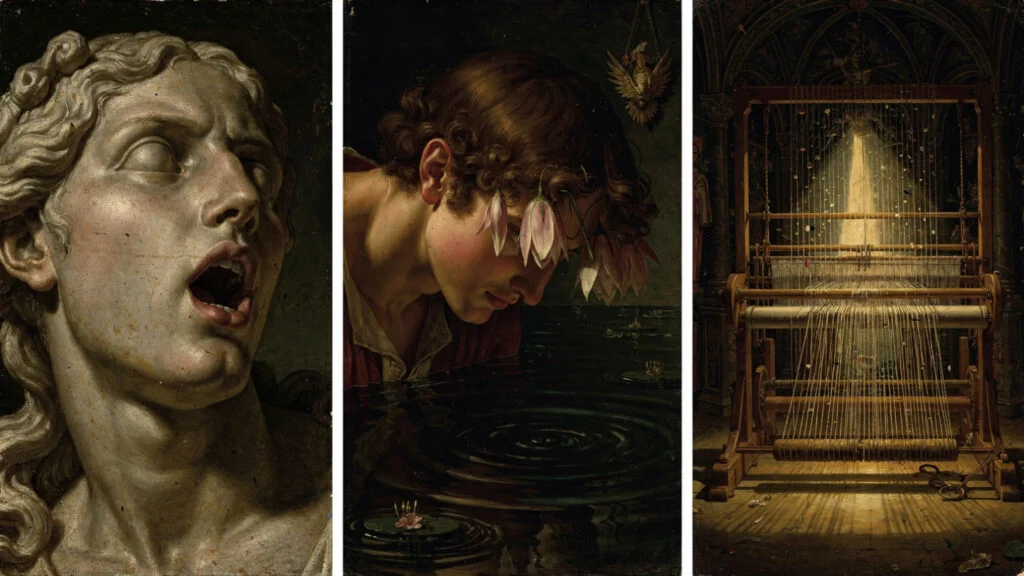
Echo spoke and her speech covered the divine transgression. Now she speaks and her speech can cover nothing. Narcissus perceived and his perception was absorbed in the self. Now he perceives and the perception is a flower nodding toward water.
The capacity remained. The content was gone. The punishment was complete.
At Olympus Estate, Mythic Essays moves through the deeper currents of the Greek tradition. The punishment that preserves the capacity while removing the content is the Ovidian logic that the Arachne article in this collection developed and that Echo and Narcissus extend across two different capacities and two different crimes. Hera preserved Echo’s voice and removed the capacity to originate. Echo can speak but can only repeat. She is still there in the gorge where you hear your own words returned. Narcissus did not know what he was seeing in the pool. He fell in love with a face of extraordinary beauty and did not know it was his own. The recognition came and he could not leave. He became the flower that nods toward the water with the orientation of the gaze that he could never turn away from. The capacity remained. The content was gone. The punishment was complete.