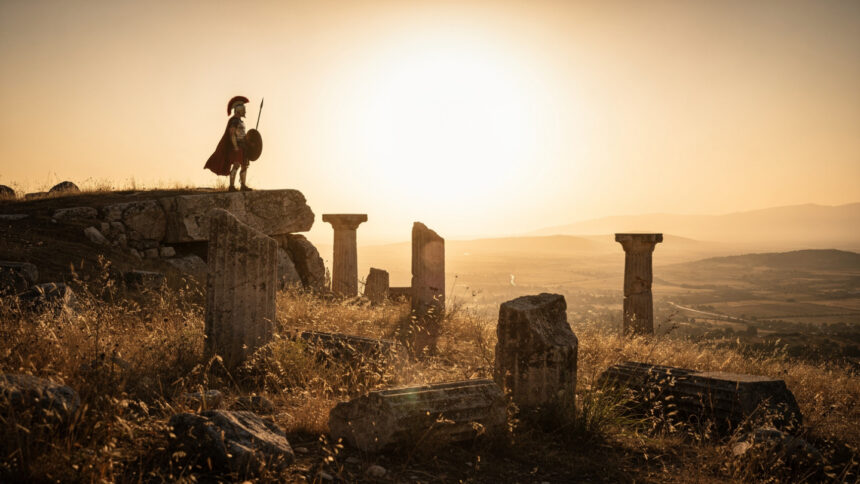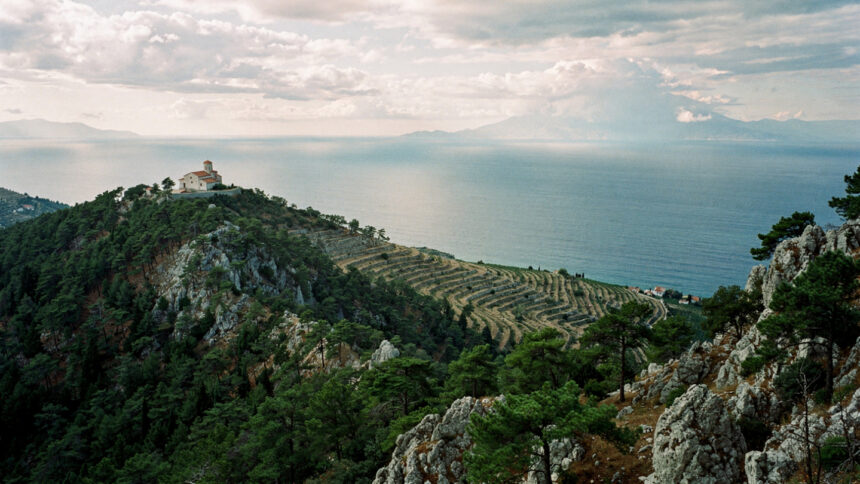

The ancient Greeks were precise people.
When they needed to explain where the gods lived, they did not choose a generic height or a vague celestial location. They chose a mountain, in a region, at an altitude, and they gave it an address that has been in continuous use for three thousand years: Mount Olympus, on the border between Thessaly and Macedonia, 2,917 metres above the Thermaic Gulf, visible from the sea.
The choice was not arbitrary. It was the product of the same quality of observational intelligence that gave us Euclidean geometry and the first systematic natural history: the capacity to look at the world and identify which thing in it best expressed a principle that needed to be communicated. The principle that needed to be communicated was this: the divine exists above the human world, in a place that is accessible in principle but genuinely difficult in practice, governed by conditions that ordinary life does not prepare you for, and more complex and more various in what it contains than its distant profile suggests.
Olympus delivers on every element of this description.
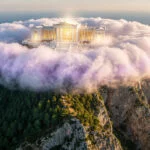
It is the highest mountain in Greece and the second highest in the Balkans. Its 52 peaks create a massif so large that it generates its own weather, pulling cloud and snow from the Aegean against its flanks regardless of the conditions elsewhere in the region. Its summit, Mytikas, meaning the nose, is regularly lost in cloud even on days when the lower slopes are in full sun. From the Pierian plain below, the mountain rises nearly 2,900 metres within a horizontal distance of a few kilometres: one of the most dramatic vertical reliefs in Europe, a wall of rock that reads as a categorical distinction between the world below and whatever is above it.
The gods did not choose Olympus. The Greeks looked at Olympus and understood why the gods were already there.
The Address the Gods Chose | What Homer Saw
The Olympus of Greek mythology is not the geographical summit. It is something both more precise and more interesting: the quality of a high place that is simultaneously visible from the human world below and inaccessible to ordinary human effort.
Homer, in the Iliad and the Odyssey, describes Olympus with the careful attention of someone describing a place he has thought about carefully. The gods’ home is characterised by eternal light above the cloud layer, by stillness and freedom from the storms that afflict the world below, and by the quality of a place that is entirely present to itself rather than contingent on the weather and the seasons that govern mortal experience. Olympus in Homer is not paradise: the gods argue there, fall out of each other’s favour, pursue their individual agendas with a passion that produces consequences that cascade down to the human world below. But it is above the contingency of mortality in the sense that what happens there determines what happens to the humans who pray from below.
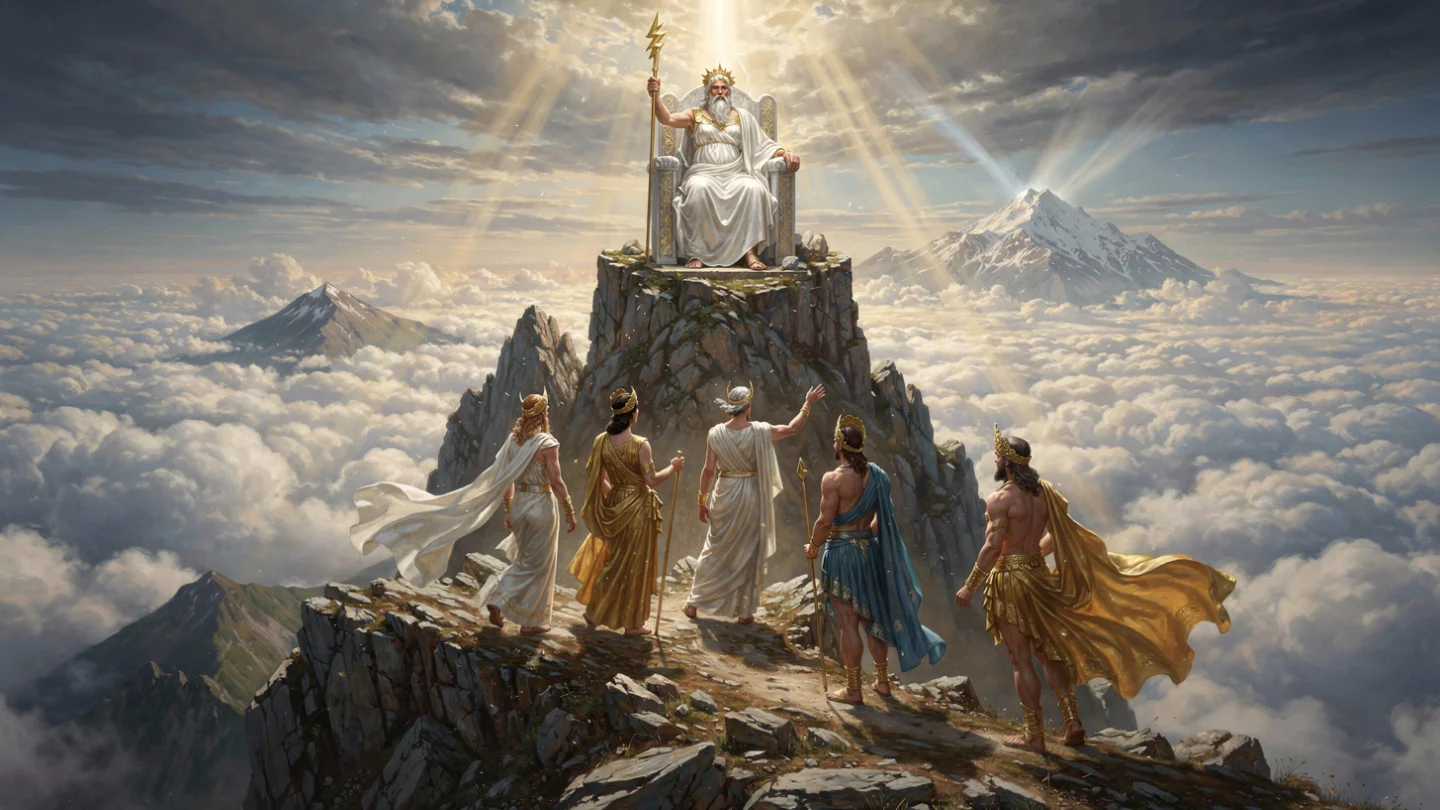
The rock formation called Stefani, at 2,909 metres the third highest peak in the massif, is known as the Throne of Zeus. Look at it from the Pierian plain below, or from the lower slopes of the mountain in clear conditions, and the name is not a translation: the rock tower rises from the ridge in a way that reads, to anyone looking from below, as a throne at the summit of the world. The ancient Greeks who looked up at Stefani from the fields of Dion and the coastal plain of Pieria were looking at the same rock formation, and they drew the same conclusion about what it looked like and who was sitting in it.

The sanctuary at Agios Antonios, one of Olympus’s principal peaks, has yielded pottery and sacrificial ashes from approximately 400 BCE: evidence that Greeks were making the ascent to leave offerings at this altitude during the classical period, before modern trails and mountain refuges and the designated national park infrastructure that now makes the ascent manageable for thousands of visitors annually. The people who climbed to 2,817 metres to leave offerings to Zeus in the fifth century BCE were doing so without technical equipment, without weather forecasts, and with the full understanding that the summit they were approaching was the address of the being to whom they were praying.
The act of making that ascent was itself the prayer.
The First National Park in Greece | What the Mountain Contains
In 1938, the Greek government designated Mount Olympus and its surrounding territory as Greece’s first national park. The scientific justification for this designation is one of the most extraordinary biodiversity arguments in European conservation.
The mountain contains over 1,700 plant species: approximately 25 percent of all Greek flora concentrated on a single mountain. Of these, 32 species are endemic to the region, found nowhere else on earth. The most celebrated is Jankaea heldreichii, a rare relict from the Tertiary period: a plant that has survived on the rock faces of the Enipeas Gorge since a geological era that ended millions of years ago, while the climate changes that eliminated it everywhere else failed to penetrate the microclimate of these north-facing limestone cliffs. It is a survivor from before the Pleistocene, still flowering in the gorge that helped preserve it, named for the German botanist Theodor von Heldreich who found it in the nineteenth century and understood immediately that he was looking at something that had no right to still be alive.

The biodiversity argument extends through the animal kingdom. The rare Balkan chamois navigates the upper rock faces. The golden eagle and the peregrine falcon occupy the high thermal currents above the summit ridge. Wolves move through the lower forest zones. The meadow viper, endangered across its European range, persists in the alpine meadows above the treeline. More than a hundred bird species have been recorded within the park boundaries.
The vegetation zones shift with altitude in a sequence that compresses the ecological diversity of an entire continent into a single ascent. Mediterranean oak, strawberry tree, and bay laurel grow in the dry foothills. Dense beech and black pine forest occupies the middle elevations. Alpine meadows of wildflowers appear above the treeline. The highest zone is rocky tundra, where the Jankaea heldreichii clings to the north‑facing cliffs and the chamois find their footing on terrain that the mountain shares with very few other living things.
This ecological layering is part of what the ancient tradition was encoding in the mythology of Olympus. A mountain that contains the entire range of living conditions available in the Mediterranean world, stacked vertically from the coastal plain to the alpine summit, is a mountain that contains everything: the full inventory of what the natural world produces, compressed into a single geographical feature that rises from sea level to the edge of permanent snow within the same view.
The divine home should contain everything. Olympus does.
The Enipeas Gorge | The Path the Mountain Chose
The Enipeas River begins at a spring called Prionia, high on the eastern flank of the massif, and descends through a gorge of fourteen kilometres to the coastal plain below Litochoro. The path that follows the gorge is the standard approach to the mountain for hikers coming from the east, and it is the most complete introduction to what the mountain contains.
The gorge cuts through the limestone of the massif’s eastern flank, and the cutting has been in progress long enough that the walls in the narrowest sections rise to heights that make the sky above a thin band of light. The river runs cold even in August, fed by the snowmelt from the upper flanks, and the combination of cold water, deep shade, and north-facing limestone creates the microclimate that has preserved the Jankaea heldreichii on the cliff faces above the path: conditions that match the Tertiary environment the plant evolved in, maintained by the gorge’s orientation and the river’s cooling effect.
The wooden bridges that cross the river at intervals along the gorge path, the waterfalls visible from the trail, the monastery of Agios Dionysios tucked into the gorge wall above the river: these are the features that the standard hiking guides catalogue, accurately, as the path’s primary attractions. What the guides do not fully communicate is the quality of attention the gorge path requires: the sound of the river is the dominant sensory experience throughout, and it changes character with each section of the path, louder at the narrows, quieter in the wider sections, always present as the mountain’s own voice conducting the ascent.

The path from Litochoro to Prionia through the gorge is approximately twelve kilometres and takes three to four hours at a comfortable pace. From Prionia, the marked trail continues upward to the Spilios Agapitos refuge at 2,100 metres, the primary overnight base for summit attempts, and then to the ridge above. The final approach to the Mytikas summit involves the Kakoskala, the Evil Staircase: a narrow couloir of exposed rock that requires confidence with scrambling terrain but no technical equipment in dry summer conditions. It is called the Evil Staircase not because it is technically extreme but because it is the passage that separates those who are prepared from those who are not, and the mountain has always made this distinction.
Stefani and the Throne | What the Summit Reveals
Stand on the Mytikas summit on a clear morning before the cloud builds, and the geography of the Greek world becomes legible in a way that no map fully conveys.

The Aegean is visible to the east, the gulf and the coastline of Macedonia clear in the morning light. To the south, across the Thessalian plain, the outline of Mount Pelion is visible, and on very clear days the mountains of Euboea. To the north, the peaks of the Macedonian interior. To the west, the Pindus range that separates Macedonia from Epirus, the mountain spine of northern Greece running toward Albania.
The summit of the highest mountain in Greece commands a view over the full extent of the Greek world in every direction. This is not incidental to the mythology. The gods who live on Olympus need to be able to see everything that happens in the world they govern, and the summit of Olympus provides precisely this: a 360-degree view over the most significant geographical features of the Aegean world, unobstructed, at an altitude that places the observer above the cloud layer on a significant number of mornings.
Stefani, the Throne of Zeus, is approximately ten metres lower than Mytikas but considerably more dramatic in appearance: a sheer rock tower on the western edge of the summit ridge whose profile from below reads as architectural rather than geological. Experienced climbers traverse the Stefani ridge as an alternative to the Mytikas Kakoskala, but the standard hiking route to Mytikas does not require it. From the path between the two summits, looking at Stefani against the sky, the naming of the rock as Zeus’s Throne requires no explanation.

The summit plateau, called the Plateau of the Muses, sits between the major peaks at approximately 2,600 metres and provides the most complete view of the summit zone. Sunrise from the Plateau of the Muses, experienced by those who have climbed to the Spilios Agapitos refuge for an overnight stay and set out in the dark before dawn, is the Mount Olympus experience that most consistently produces the quality of response that the ancient tradition encoded in the mythology: the quality of being present at a threshold between the ordinary world and something else, in the company of weather and light that operates on its own terms rather than in service of human requirements.
The mountain does not become divine because of the mythology. The mythology became attached to this mountain because the mountain is genuinely this.
Dion | The Sacred City at the Foot of the Gods
Twelve kilometres northeast of Litochoro, on the fertile plain where the rivers descending from Olympus water a landscape of extraordinary agricultural richness, the ancient city of Dion was the religious centre of the Macedonian kingdom and the most significant sanctuary of Zeus in the northern Greek world.
The connection between Dion and Olympus is not symbolic. The city was built on the plain directly below the mountain because the mountain made the plain: the streams descending from Olympus’s eastern flanks supply the water that made the Pierian plain fertile, and the fertility of the plain was understood as the direct consequence of the divine presence on the mountain above it. Dion received the overflow of Olympus in the most literal possible sense, and the city’s religious life was organised around acknowledging this.
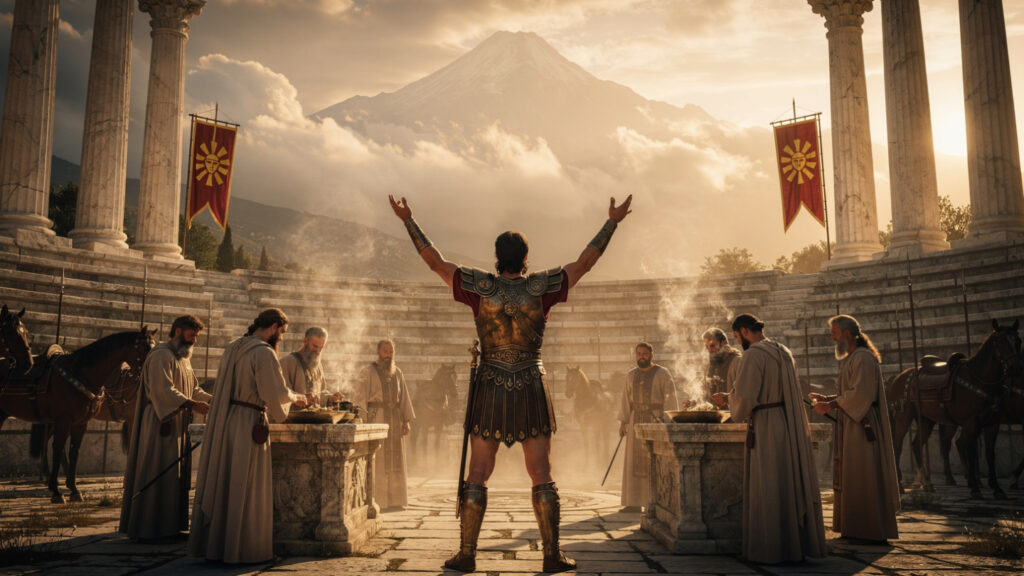
Alexander the Great performed sacrifices at Dion before his Persian campaign: the sanctuary that sat at the foot of the gods’ mountain was the appropriate place to seek divine endorsement for the greatest military expedition in Greek history. The theatre at Dion, where Euripides’s plays were performed at the annual festival, is oriented toward the mountain in the manner of a deliberate architectural choice: the backdrop of the performance was Olympus itself.
The archaeological site of Dion, with its sanctuaries, its theatre, its Roman baths, and the remarkable mosaics preserved in the on-site museum, connects the mountain to the full spectrum of Macedonian cultural life: the religion, the military tradition, the literary culture, the civic infrastructure. The mountain above the site is visible from most of it. The relationship between the divine presence on the summit and the human life on the plain below is the subject of the entire site, expressed in stone and tile and sacrificial ash across a thousand years of continuous occupation.
Litochoro | The City of the Gods
The town of Litochoro, population approximately seven thousand, sits at the mountain’s eastern foothills eight hundred metres above sea level and has been called the City of the Gods since antiquity. It is the base for any serious engagement with the mountain, and it is a genuinely pleasant base: Macedonian architecture, squares with cafes, a food culture that reflects the agricultural richness of the plain and the mountain resources above it, and the quality of a community whose relationship with the mountain behind it has been continuous for three thousand years.

The national park information centre in Litochoro provides maps, current trail conditions, refuge availability, and guidance on the route options. The Hellenic Alpine Club maintains the summit refuges and publishes safety information that should be consulted before any attempt on the upper mountain. The Spilios Agapitos refuge, at 2,100 metres, requires reservation during the peak summer season and provides the overnight accommodation that makes a summit attempt the following morning possible without descending to Litochoro the same day.
The mountain is accessible to serious walkers in good physical condition without technical experience from late June through early October, when the Kakoskala is clear of snow and the weather windows are reliable enough to plan around. Outside these months, the upper mountain requires winter mountaineering equipment and experience, and the conditions change rapidly enough that even summer visitors should have current weather information before beginning the ascent above the refuge.
Practical Notes
Litochoro is eighty kilometres southwest of Thessaloniki, accessible by car on the E75 in approximately one hour, by train on the Athens-Thessaloniki line, and by bus from both cities. The Prionia trailhead, where the Enipeas Gorge path meets the marked summit trail, is twelve kilometres above Litochoro by forest road: accessible by car in summer, best reached by taxi or arranged transport rather than on foot to preserve energy for the ascent above.
The full two-day summit itinerary runs: Litochoro to Prionia through the Enipeas Gorge (three to four hours), Prionia to Spilios Agapitos refuge (three hours), overnight at the refuge, summit of Mytikas and return to Litochoro the following day (eight to ten hours). One-day hikers can drive to Prionia and reach the refuge and return without a summit attempt in a full day.

Carry more water than you think you need above the treeline. The mountain’s microclimate produces afternoon storms in summer with a regularity that the morning sun does not reliably predict. Be at the summit or below the exposed ridge before noon if the weather forecast for the afternoon includes any instability.
The Dion archaeological site is open standard Greek archaeological site hours. The on-site museum holds material from the excavations that cannot be adequately appreciated through the outdoor site alone. Allow four hours for the combined site and museum visit, and combine it with a meal in Litochoro to make a full day that connects the mountain’s sacred geography to the human life it sustained.
The Greeks were Right
The Greeks who climbed to the sanctuary at Agios Antonios in the fifth century BCE and left their pottery and their sacrificial ashes at 2,817 metres were not making a gesture. They were making an argument: that the distance between the human world and the divine one is real, that crossing it requires genuine effort, and that the effort is the point.

The mountain has not changed since they made that argument. The Kakoskala is still the Kakoskala. The summit is still above the cloud layer on the right mornings. The Jankaea heldreichii is still flowering on the north-facing cliffs of the Enipeas Gorge, surviving from the Tertiary period through the conditions the gorge has maintained for it across millions of years.
The park protects an extraordinarily rich flora, with over 1,700 plant species recorded, approximately 25 percent of all Greek flora on a single mountain, of which 32 species are endemic to the region. The Balkan chamois finds its footing on the upper rock faces. The golden eagle turns in the thermals above the ridge.
The gods did not need to be present on the summit for the ancient Greeks to be right that the mountain expressed something real about the relationship between the human world and whatever is above it. The relationship is geometric and ecological and atmospheric: the quality of a place that contains everything the world produces, stacked from sea level to alpine tundra, with the summit above the clouds on the right mornings and the full extent of the Greek world visible in every direction.

Stand on the Plateau of the Muses before dawn and watch the light arrive from the east.
The Greeks were right to put the gods here.
Where to Stay Near Mount Olympus
Explore the foothills of the sacred mountain with this interactive map of nearby stays, from village guesthouses to alpine retreats, and anchor your journey at the threshold of the gods.
At Olympus Estate, Wanderlust Greece explores the sacred landscapes of the Greek world with the precision the subject deserves. Mount Olympus is not merely the highest mountain in Greece. It is the mountain that the entire Greek intellectual tradition was shaped by looking up at. Go and look up at it yourself.