Most people who travel to Greece go south.
Athens, the Peloponnese, the islands: this is the itinerary that the tourism industry has been perfecting for decades, and it is genuinely extraordinary. Nobody who stands on the Acropolis for the first time and watches the light change over the Saronic Gulf is wasting their time.
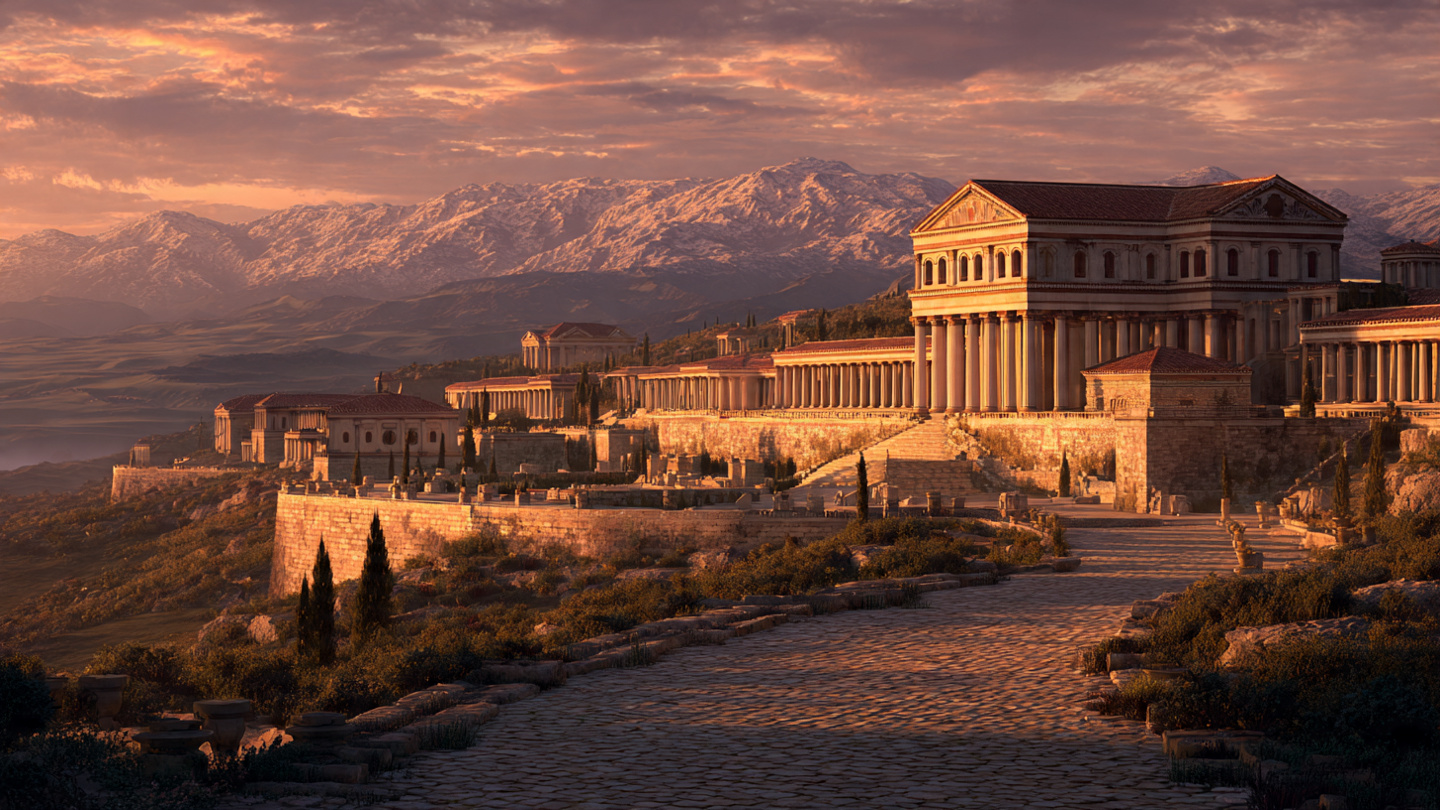
But there is a Greece to the north that most visitors never reach, and it carries a weight of history that the more celebrated south can match but not exceed. A Macedonia of wide plains and sudden mountains, of rivers that flood in spring and run cold from Olympus through summer, of towns that sit on top of Bronze Age settlements that sit on top of older settlements still. A landscape where the historical density is not expressed in marble temples and oracle sites but in the accumulated consequence of one dynasty: the Argeads of Macedon, who produced in the space of two generations the man who conquered the known world and the father who made that conquest possible.
The route this article describes is not long by distance. From Thessaloniki, the capital of northern Greece and one of the finest cities in the country for food, music, and the particular warmth of a city that knows it is underestimated, you drive southwest to Vergina and then south along the foothills of Olympus to Dion. Two days minimum, three if you want to do them justice, with Thessaloniki as your base. The total driving distance is under two hundred kilometres.
What you will encounter in those two hundred kilometres is more than any equivalent distance in the Greek south contains: the tomb of a king who changed the structure of the ancient world, a palace that was the largest building in classical Greece, a sanctuary at the foot of the gods’ own mountain where the greatest military expedition in history began with prayer, and a landscape that looks, in certain morning lights, almost exactly as it looked when Alexander stood in it.
You should go. Here is how.
Thessaloniki | Where Every Northern Journey Begins
Give Thessaloniki at least one full evening before you drive anywhere.
This is not a preamble. It is a necessary recalibration. Thessaloniki is a city that rewards time in the way that all cities with genuine character reward time: the more you give it, the more it gives back. It is also, by the judgment of most Greeks who have eaten widely across the country, the finest food city in Greece, and a meal at a proper Thessaloniki restaurant, mezze arriving in waves, the wine local and honest, the conversation finding its natural depth around midnight, is itself a form of preparation for the historical encounters that follow.
The White Tower on the waterfront is where you orient yourself. The Archaeological Museum of Thessaloniki, which holds material from across Macedonia including significant finds from the Vergina excavations, provides the intellectual frame for what you will see the following day. The Byzantine walls, the Roman Rotonda, the Ottoman-era markets in the upper city: Thessaloniki has been continuously inhabited for over two thousand years and its layers show.
One recommendation: visit the Ataturk Museum, the house where Mustafa Kemal Ataturk was born in 1881, a few hundred metres from the White Tower in what was then the Ottoman city of Salonika. To stand in the birthplace of modern Turkey within walking distance of a Byzantine church within walking distance of a Roman monument within walking distance of a Hellenistic agora is to understand, at a physical level, what “historical density” actually means in a city like this.
Then sleep early. Vergina deserves a morning arrival.
Vergina | Where the Kingdom of Macedon Began
Drive southwest from Thessaloniki on the E86, through the flat agricultural plain of the Macedonian basin, and after about seventy kilometres the road begins to climb toward the foothills of the Pierian mountains. The village of Vergina sits on a gentle slope above the Haliacmon river valley, unremarkable in the way of many Greek villages, its streets dusty in summer and its kafeneion occupied by the same men at the same tables.
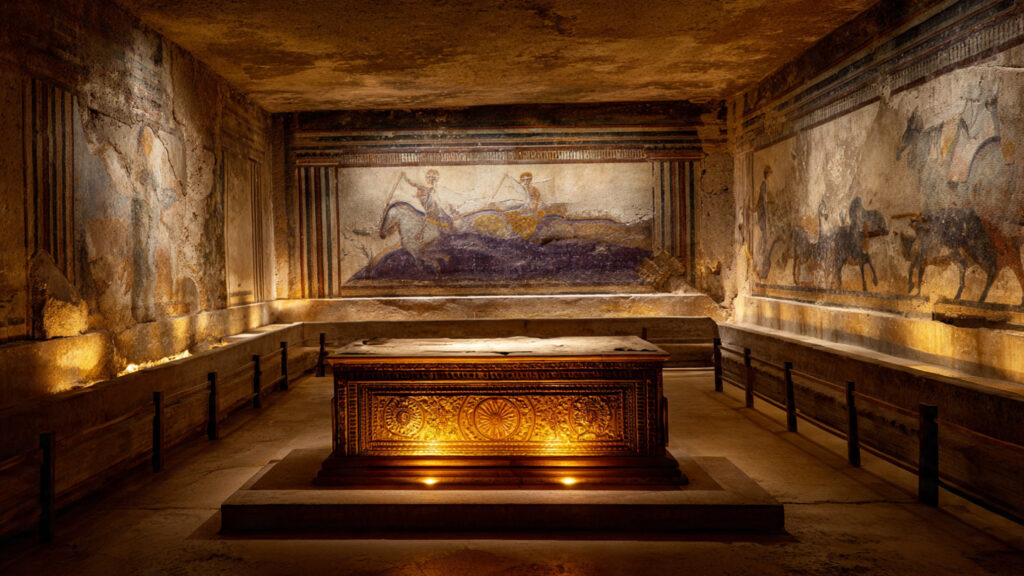
And beneath it, the founding dynasty of a world empire.
The site you are visiting is ancient Aigai, the first capital of the Kingdom of Macedon, and its significance requires a moment to absorb properly before you descend into the underground museum. This was not a secondary city, not a ceremonial site visited for religious purposes and then left behind. Aigai was where the Macedonian kings were crowned and where they were buried, and those two functions together gave it a power that the later capital Pella, larger and more cosmopolitan, never quite superseded. To be king of Macedon was to be crowned at Aigai. To be legitimately buried as king of Macedon was to be buried at Aigai. The ancestral connection between the living dynasty and the dead kings who preceded it was physically concentrated in this landscape, and Philip II, the most ambitious king Macedonia had yet produced, understood that connection with absolute clarity.
It was here, in 336 BCE, during the wedding celebrations of his daughter Cleopatra, that Philip II was assassinated by one of his bodyguards. The details of the plot remain disputed across two and a half millennia of scholarship: whether the killer acted alone, whether Olympias, Philip’s estranged wife and Alexander’s mother, was involved, whether Alexander himself knew what was coming. What is not disputed is the consequence: Alexander, twenty years old, was immediately proclaimed king by the Macedonian army at Aigai, and set in motion the campaign that would end eleven years later in Babylon with the conquest of the largest empire the world had yet seen. Philip’s religious authority also ran through Samothrace, where the Argead kings were initiated into the island’s mysteries, a tradition that shaped the dynasty’s conception of divine legitimacy.
The palace where this happened, the Palace of Aigai, was closed for sixteen years of restoration and reopened to the public in January 2024. This matters enormously for any visitor planning the route now: you can see what previous travellers could not. The palace was the largest building in classical Greece, three times the size of the Parthenon, designed by an architect who may have been the same Pytheos responsible for the Mausoleum at Halicarnassus. Its floor was covered in pebble mosaics of extraordinary precision. Its façade commanded the entire Macedonian plain below, visible for miles. Standing on its restored terrace, looking out across the valley that Philip and Alexander looked out across, is the kind of encounter with historical space that photographs cannot prepare you for.
Inside the Great Tumulus | Descending to the Kings
The Museum of the Royal Tombs is built inside and beneath the Great Tumulus, a massive earthen mound constructed in the third century BCE to protect the royal burial cluster from the looters and invaders who were already a recurring problem. You enter from the side, descend a ramp, and step into one of the most extraordinary museum experiences in the world.
The darkness is the first thing. The museum maintains very low light levels throughout, partly for conservation reasons and partly because the designers understood that a space where kings are buried should not be illuminated like a shopping centre. Your eyes adjust. The tombs emerge from the dark.
There are four tombs in the cluster. Tomb I was looted in antiquity, probably during the raid of Pyrrhus of Epirus in the early third century BCE. Tombs II, III, and IV were intact when Manolis Andronikos excavated them in 1977 and 1978. Andronikos, who had spent decades convinced that the Great Tumulus concealed the Macedonian royal burials and had been met for most of that time with scholarly scepticism, opened the sealed chambers and found what two and a half millennia of earth had protected: gold larnakes, golden crowns, silver vessels, armour, weapons, ivory portraits, and the bones of people who had lived at the apex of the ancient world.
Tomb II is the one that stops you.
The facade is a Doric frieze above a marble entrance, and above the frieze is a wall painting five and a half metres wide, depicting a hunting scene. The figures include a young man on horseback and an older one, and the identification that scholarship has returned to repeatedly, is that you are looking at Philip II and Alexander, painted at the moment of their shared history before the assassination separated them. The painting is not attributed to a minor craftsman. It is thought to be the work of Philoxenos of Eretria, one of the greatest painters of the ancient world.
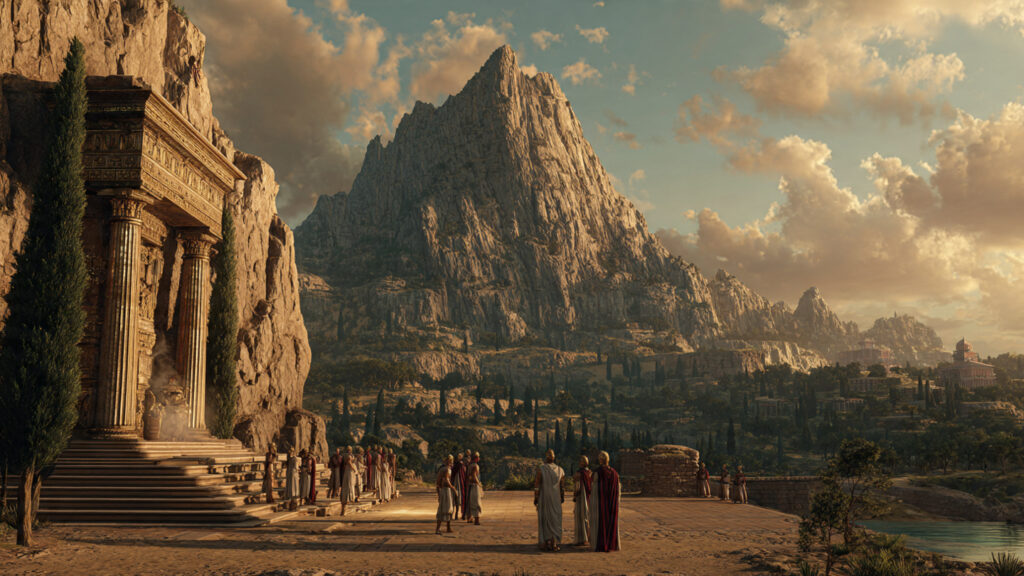
Inside the tomb, the golden larnax that contained the cremated bones of Philip II bears the Vergina Sun, the sixteen-rayed star of the Argead dynasty. The bones were wrapped in a golden-purple cloth before being placed inside. A separate golden larnax in the antechamber contained the bones of a woman, identified by the grave goods as Meda, Philip’s Thracian wife, who died on the funeral pyre by her own choice according to the custom of her people.
In 2025, new research suggested that some of the grave goods in Tomb II may have belonged to Alexander himself: items that Philip III, who was buried there according to the revised identification, had inherited from his half-brother. The implication is extraordinary. Objects that Alexander owned, objects that were with him across the campaign to India and back, objects that survived the death of the man who conquered the known world, may be on display in an underground museum in a village in northern Greece.
Stand with that thought for a moment. Then continue.
Tomb III, the prince’s tomb, is identified as the burial of Alexander IV, Alexander’s son by Roxana, who was murdered as a child by the regent Cassander when he was thirteen years old. He never ruled. He barely lived. His tomb contains objects of beauty that he never saw, placed there by people who needed the dynasty to end with proper ceremony even as they were ending it by force.
The Road South | Between the Mountain and the Plain
Leave Vergina and drive south along the E75, following the western edge of the Macedonian plain toward the Pierian mountains. The road runs between two geological presences. To the east lies the flat agricultural basin that stretches toward the Thermaikos Gulf. To the west rises the wall of the Pierian range that culminates, after thirty kilometres of ascent, in the peak of Mount Olympus at 2,917 metres.
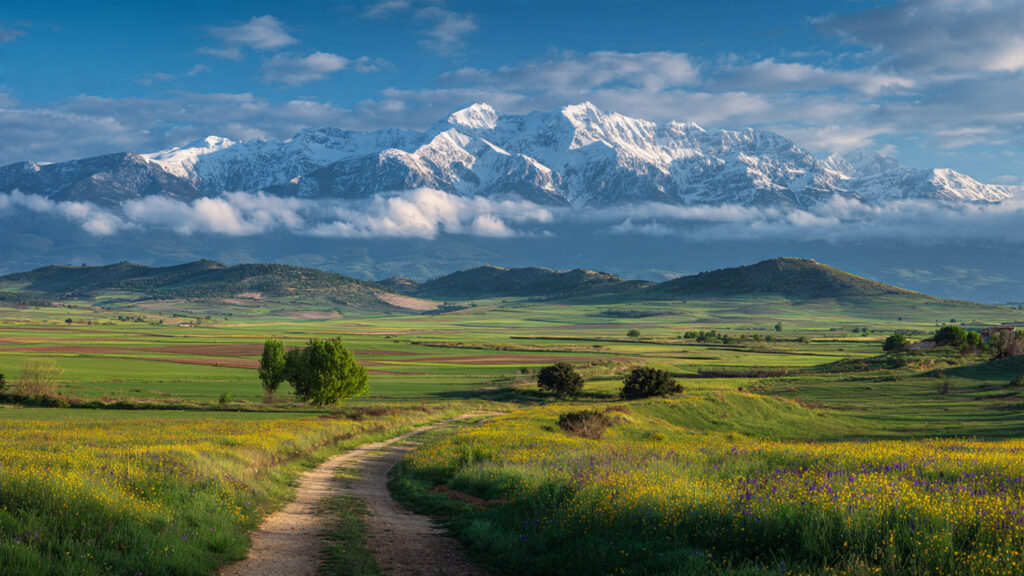
This is a landscape that does not perform. It is not Santorini or the Mani or the dramatic caldera views that have made Greek tourism what it is. It is a working agricultural plain with a mountain range behind it and a highway running through it and small towns every ten kilometres where the kafeneion opens at six in the morning and the men who come in at that hour have been farming since before dawn.
But look west as you drive, toward the mountain, and something shifts.
Olympus from this angle is not the view of a single dramatic peak that the photographs show. It is a massif, a collection of summits that rise together in a wall so continuous and so high that they create their own weather, pulling cloud from the Aegean and holding it against their flanks. The snowline, in spring and early summer, extends almost to the treeline. The light above the upper peaks, even in August, carries a quality that differs from the light over the plain: cooler, more vertical, as if the mountain is generating its own illumination.
The Greeks who chose this landscape as the home of the gods were not being metaphorical. They were making a precise geographical observation. Olympus is the highest point visible from the inhabited Greek world, and its summit disappears into cloud with a regularity that, to a people who understood the divine as inhabiting heights inaccessible to mortals, made it the most obvious possible address for whatever lived above human reach.
Dion, which you are approaching, was built at the point where the mountain meets the plain, and everything about its location is a statement about the relationship between human life and divine authority.
Dion | The Sacred City at the Mountain’s Feet
Pull off the E75 near the village of Dion and walk into the archaeological park.
The first thing you notice is the water.
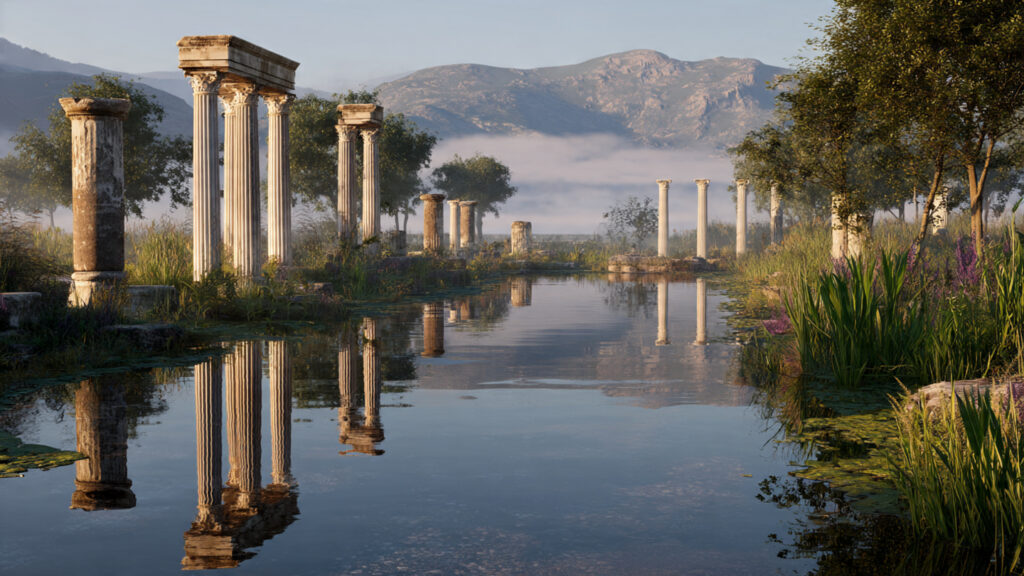
Dion is irrigated by springs flowing down from Olympus, and the water runs through the site in channels and pools that have been part of the landscape since antiquity. The sanctuaries rise from this moisture. The Sanctuary of Demeter, the oldest in the site, was in continuous use from 600 BCE to the fourth century CE. The Sanctuary of Isis belongs to the Egyptian goddess who became one of Alexander’s favourites, and her presence here is a measure of how the Macedonian world absorbed the cultures it encountered. The great Sanctuary of Zeus Olympios gives the city its name, Dion being a derivation of Dios, the genitive of Zeus.
The Sanctuary of Zeus is where Alexander stood.
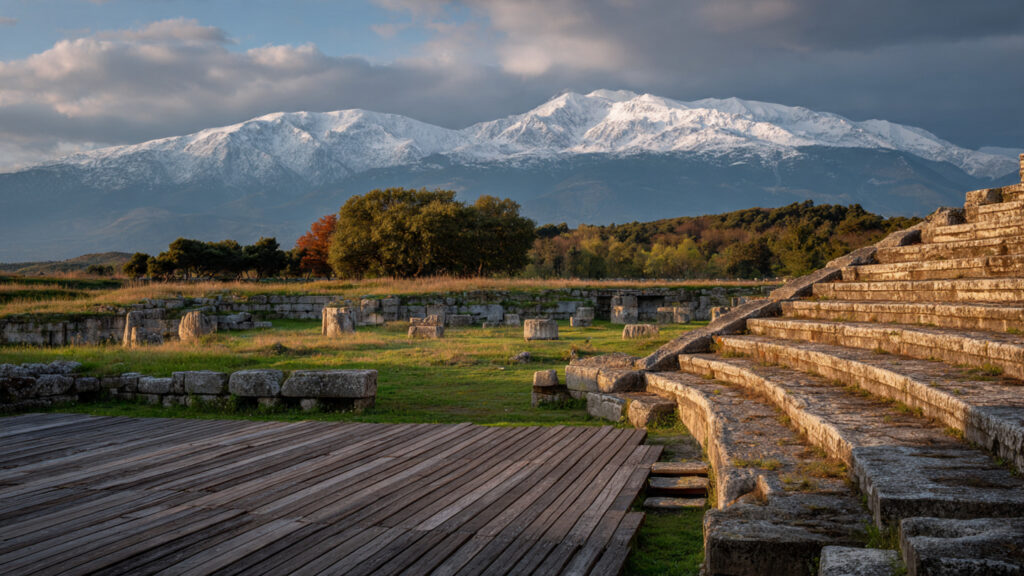
In 334 BCE, before crossing to Asia with an army of approximately forty thousand men to begin the campaign that would take him to India and back, Alexander came to Dion. He hosted a celebration here for his officers and allies, entertaining one hundred guests in tents pitched in the sanctuary’s grounds, nine days of feasting and games in honour of Zeus and the Muses. The theatrical performances staged during that celebration included plays by Euripides, who had lived his final years in Macedonia at the invitation of King Archelaus. The theatre at Dion, whose reconstructed wooden stage still stands with Olympus as its backdrop, was where those plays were first performed.
Then Alexander approached the altar of Zeus Olympios and made his sacrifice.
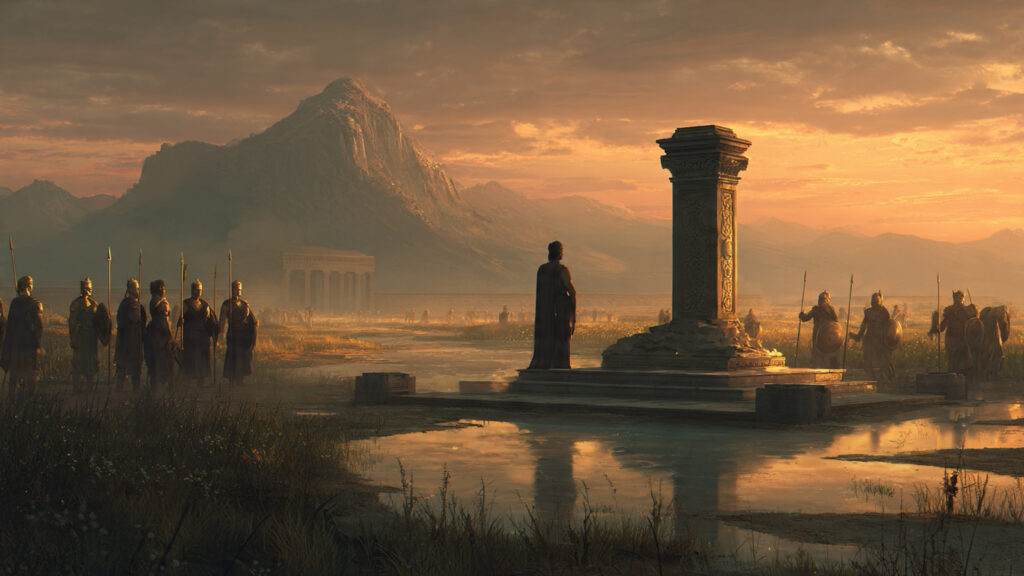
Stand at the altar site and consider what he was doing. He was not performing a ritual as a formality. The Greeks understood sacrifice as a genuine transaction: you gave something of value, the gods received it, and in the giving you opened a channel of communication with the forces that governed outcomes. Alexander had inherited from his father not just an army and an empire in embryo, but a relationship with the divine that placed the Macedonian king as intermediary between the human world and Olympus. His sacrifice at Dion was the formal beginning of a campaign that he intended the gods to witness, to understand, and to assist.
He then crossed to Asia and never came back to Macedonia.
The bronze statues of the twenty-five cavalrymen who fell at the Battle of the Granicus, the first major engagement of the campaign, were created by Lysippos, Alexander’s personal sculptor, and sent back to Dion as his memorial offering to Zeus. Twenty-five men who died in the first serious test of the campaign, commemorated in bronze at the sanctuary where the campaign began. The statues are gone, taken to Rome eventually, but their bases have been found and their inscription recorded: not a boast, but an acknowledgement. These men served. They fell. They are remembered here, at the feet of Olympus, in the sight of the god.
What the Site Contains
The archaeological park at Dion sprawls across fifteen hundred acres, and the full circuit takes two to three hours at the pace that the site rewards, which is unhurried.
Beyond the sanctuaries, the excavated city reveals its Roman as well as its Macedonian layers. After the Roman conquest of Macedonia in 169 BCE, Dion was given a second life as a Roman colony, and the streets that you walk today are largely Roman in their paving and their width, though they follow Macedonian alignments beneath. The mosaic of Dionysus, extraordinarily well-preserved, depicts the god emerging from the sea on his chariot: a floor that Roman citizens walked across in the second and third centuries CE, maintained in its colours by the same wet ground that buried the city under two metres of mud and preserved it for twenty centuries.
The Sanctuary of Isis deserves more time than most visitors give it. The standing columns of the temple are reflected in the water channel that runs beside it, and the votive statues of Isis-Tyche and Aphrodite Hypolympidia, discovered standing in the water where they had fallen and left in that position for scholars to find, were replaced in situ with replicas when the originals went to the museum. The effect is of statues that emerged from the ground in the positions they occupied when the city was still alive, which is precisely true.
The theatre, at the far end of the site, is the reason that every serious travel photographer who reaches Dion comes back with the same image: a stage in the foreground, the orchestra circle visible in the grass, and behind it, filling the entire sky to the north and west, the massif of Olympus. The mountain and the human space scaled against each other, the divine address and the place where people gathered to watch human stories acted out. The ancient Greeks built their theatres in relation to landscape with the same deliberateness they brought to everything else. This one was built where it was built because the mountain behind it was not incidental to what was being performed.
The Archaeological Museum of Dion, half a kilometre from the park in the modern village, holds the original statues, the coin collections, the marble offerings to Zeus with their carved eagles, and the hydraulic organ, an extraordinary mechanical instrument from the first century BCE that is one of only a handful of surviving examples in the world. Allow an hour at minimum.
Practical Notes for the Journey
Getting there: Thessaloniki is the base for this route and has an international airport with direct connections to most European cities. The drive to Vergina is approximately seventy-five kilometres, around an hour. Vergina to Dion is a further sixty kilometres south, under an hour along the E75.
When to go: Spring and autumn are ideal. April through early June brings the Macedonian plain into flower and keeps the mountain snowline high and visible. September and October offer harvest light, cooler temperatures, and the return of the quality of attention that the landscape commands when the summer heat relents. July and August are hot on the plain, though the proximity to Olympus keeps temperatures more moderate than in Thessaloniki itself.
What to allow: Three hours minimum at Vergina, including both the underground tomb museum and the Palace of Aigai. The palace was closed for sixteen years and only reopened in January 2024: do not skip it. Two to three hours at the Dion archaeological park, plus an additional hour for the Dion museum in the village. If you intend to continue to the Enipeas Gorge on Olympus, which begins approximately fifteen kilometres from Dion and offers one of the most dramatic hiking experiences in Greece, allow a full additional day.
Where to stay: Katerini, the main town of the Pieria region and ten kilometres from Dion, provides comfortable accommodation options and good access to both sites. If you prefer a village context, accommodation in and around Litochoro, the mountain village at the foot of the main Olympus trailhead, puts you within fifteen minutes of Dion and within hiking distance of the gorge.
What to eat: The Pieria region produces exceptional fresh fish from the Thermaikos Gulf and a lamb culture rooted in the mountain pastures above. The tavernas in Litochoro are reliable and unpretentious. In Katerini, the seafood restaurants along the coastal road to Paralia serve the catch of the day in the plainspoken manner of working fishing towns that have not yet been rediscovered by tourism.
Why This Route Matters
The sites of northern Greece do not ask for your admiration in the way that the Acropolis asks for it. They do not rise from a hill above a capital city with the accumulated expectation of twenty-five centuries of tourism directing your response. They sit in a working agricultural landscape, accessible by ordinary roads, staffed by ordinary museum employees, visited by a fraction of the people who queue for the Parthenon.
This is, depending on your temperament, either a limitation or the point.
What Vergina and Dion offer is direct encounter. The golden larnax that held Philip’s bones is not behind reinforced glass at the end of a queue that took forty minutes to clear. You stand a metre from it in a room where the light is kept low and the temperature is maintained for conservation purposes and the only sound is the particular quality of silence that spaces beneath the earth have when the things they contain are important enough. The altar where Alexander made his sacrifice before leaving Macedonia forever is a stone platform in a field with an irrigation channel running beside it and the mountain behind it and no interpretive railing between you and it.
Greece has spent a generation directing its visitors south and west, toward the Cycladic light and the Athenian monuments and the Peloponnesian battle sites that shaped the classical tradition that the world inherited. Northern Greece received its share of that inheritance too, and arguably gave more of it: the man who took Greek language and culture from Macedonia to the edge of India did so because his father had spent his reign building the instrument that made the campaign possible, and both of them, at the moments that mattered most, stood in the landscape this route passes through.
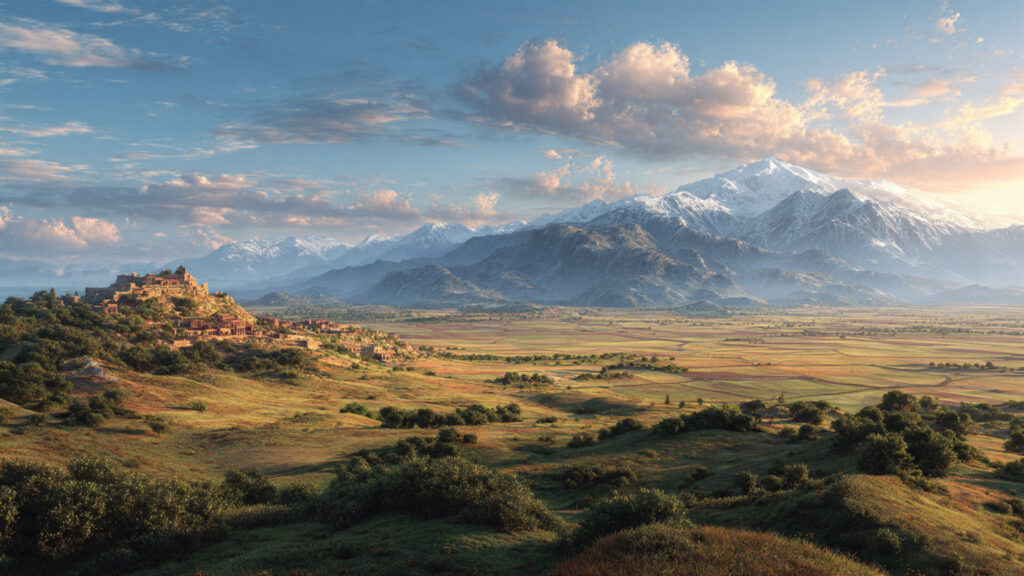
There is a kind of historical completeness available to the traveller willing to go north. You begin the journey in Philip’s tomb, in the dark and the gold, at the end of the man who made it possible. You end it at the altar where his son asked for divine assistance before beginning the campaign that neither of them could have imagined finishing.
Between those two points: a mountain that the Greeks gave to the gods because no other address was adequate, and a plain that an empire grew from before anyone had found a word for empire.
That is worth two days of driving.
At Olympus Estate, Sacred Geography explores the places across Greece where landscape, history, and myth read as a single text. Vergina is the burial ground of the Macedonian royal dynasty: the tomb of Philip II, the gold larnax carrying the cremated remains of a king, the Vergina Sun that became the most contested symbol in modern Balkan politics. Dion is the sanctuary city at the foot of Mount Olympus where Alexander sacrificed to Zeus before leading his army east toward Persia. Between them, these two sites in northern Greece hold the beginning and the end of the world the Macedonian kings made.