



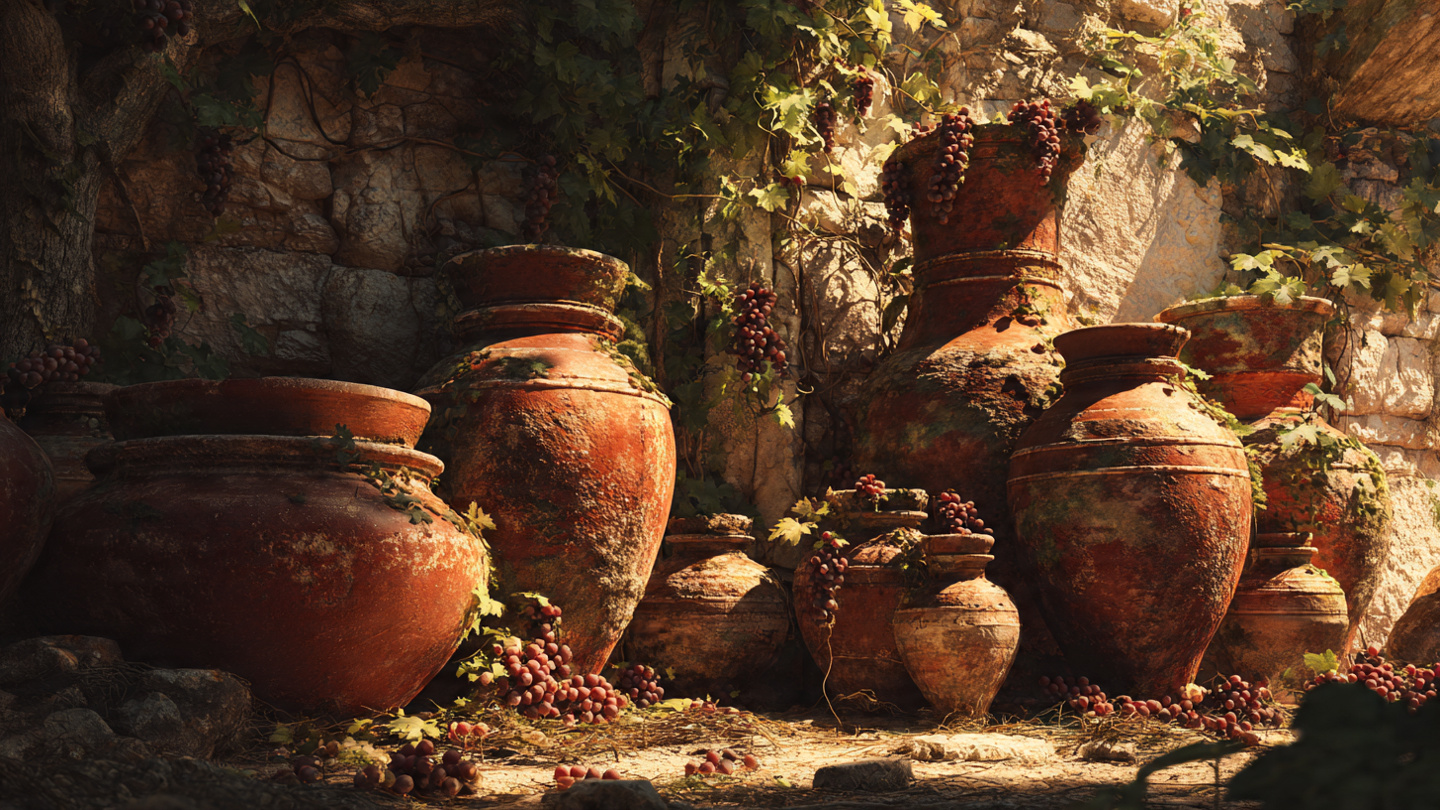
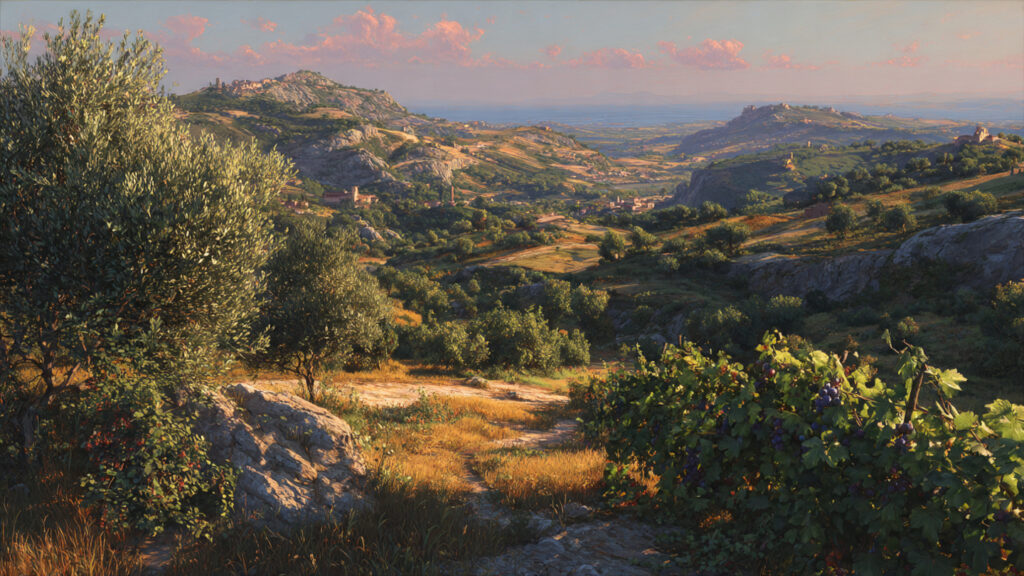
In the countryside of Ancient Attica, the land rises in gentle folds of limestone and dry earth. Vineyards cling to the slopes, shaped by winds that move through the silver leaves of the olive groves. This landscape carries the memory of Icarius, a cultivator of vines and a guardian of hospitality, one of the most honored virtues in the Greek world.
According to tradition, Dionysus arrived at his home in the form of a traveler. Icarius welcomed him with quiet generosity, offering food, shelter, and respect. The god revealed the hidden craft of winemaking, a knowledge that had not yet entered the daily life of the region. Icarius learned to press the fruit, ferment the juice in clay vessels, and store a drink that would later become a defining element of Greek culture.
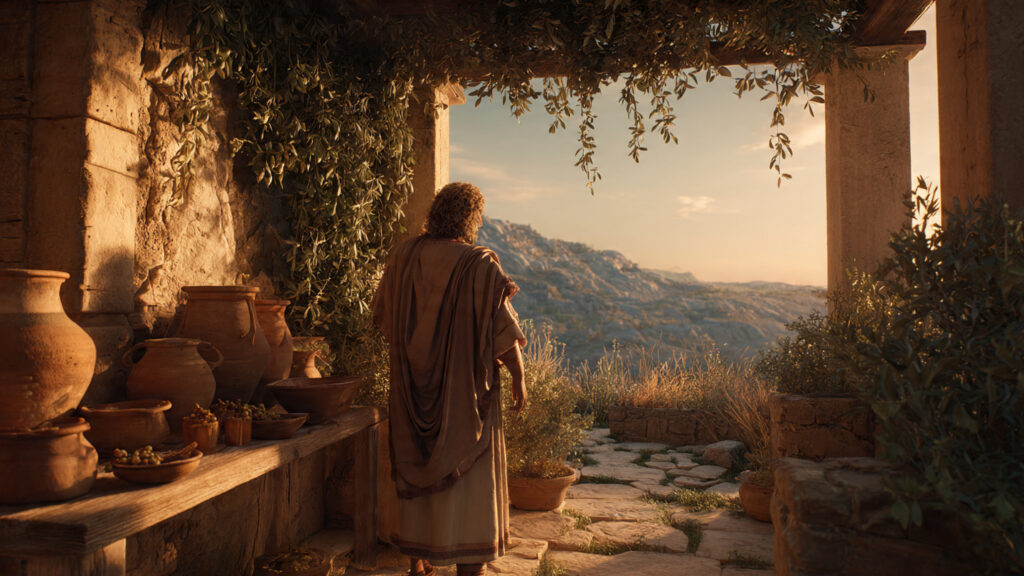
The vine entered human discipline through this meeting. It became part of the land’s rhythm and part of the sacred relationship between mortals and the divine. Apollodorus, who preserved the fullest surviving account of the myth, places Icarius among the small number of mortals granted direct instruction from a god rather than a hero’s indirect blessing, a distinction that marks the vine as a gift of an entirely different order than fire or grain. Dionysus did not simply give Icarius wine. He gave him the knowledge of how wine is made, which is a different and more dangerous inheritance, because knowledge can be passed on before the wisdom to use it correctly has caught up.
The First Sharing and the Shadow That Followed
Icarius carried the new drink to local shepherds. They tasted the wine without understanding its nature. The sensation of intoxication was unfamiliar and they believed they had been poisoned. Fear overtook judgment. They struck him down and buried his body beneath a tree in the soil he had tended.
This moment placed a shadow across the history of the Attic vineyard. A divine gift requires knowledge and restraint. Without them, it becomes a source of confusion and danger. The shepherds were not villains in the way later retellings sometimes flatten them into. They were men encountering an entirely new physical sensation with no framework for interpreting it, and the myth’s severity toward them says less about their cruelty than about how seriously the Greek tradition took the danger of an ungoverned gift. The wine was real. The knowledge of how to drink it safely had not yet reached the men who received the bottle before they received the instructions.
Erigone and Maera
The Search Through Ancient Paths
Icarius left behind his daughter Erigone and a loyal hound named Maera. When he did not return, Erigone began searching across the hills and rural paths of Attica. These paths carried the memory of Bronze Age communities and the influence of Mycenaean and Minoan traders who once moved through the region.
Maera guided her with unwavering devotion. The hound followed faint traces across the terrain until she reached the disturbed soil where Icarius had been buried. Her cries led Erigone to the hidden grave.
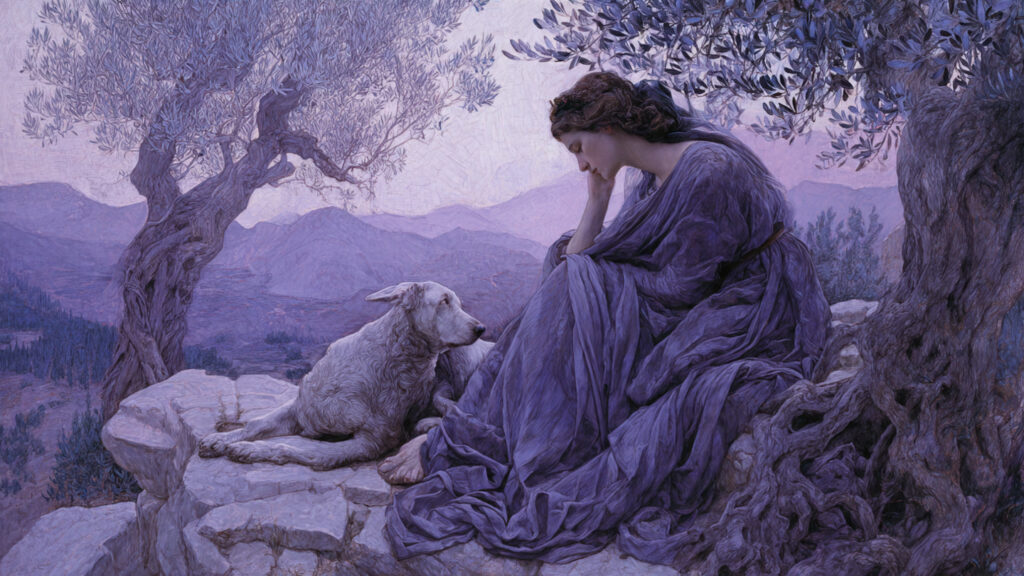
The discovery broke the young woman. Overcome by grief, she ended her life beneath the same tree. Maera remained beside her until her own life faded. Their devotion became part of the land itself, a quiet presence in the hills of Attica. Some ancient sources add a coda often left out of shorter retellings: the death of Icarius and the grief of Erigone were said to have brought a plague of suicides among the young women of Athens, a divine punishment for the murder that the city could not lift until it instituted rites in Erigone’s honor. The myth, in this fuller version, is not only about one family’s grief. It is about a city forced to answer collectively for a wrong done by a few of its shepherds.
The Celestial Preservation of Memory
The gods ensured that the story would not disappear. They placed the three figures in the night sky, creating a map of memory that could be read across the Aegean. Icarius became Boötes, the herdsman who watches the northern horizon. Erigone became Virgo, the maiden associated with seasonal renewal. Maera became Procyon, the brightest star in Canis Minor.
In the ancient Greek world, constellations were not decorative. They formed a practical system that guided farmers, sailors, and travelers. The name Procyon, meaning “before the dog,” refers to its rising shortly before Sirius, the Dog Star. Placing a faithful animal in the sky ahead of its own master’s constellation, Sirius belonging to the hunter Orion in one common association, was itself a small act of narrative justice: the hound that never stopped searching arrives first, every year, announcing what is coming before it comes.

For communities across Thessaly, Crete, and the wider Aegean, the rising of Procyon signaled the approach of intense summer heat. The loyal hound became part of the seasonal rhythm, a celestial marker woven into the agricultural calendar. Farmers timed the harvest and the threshing of grain by these risings long before written calendars standardized the year, which means the myth of Icarius was not simply told and retold. It was consulted, in a practical sense, every summer when the sky delivered its warning.
Wine as Ritual Knowledge
The myth of Icarius reflects a deeper understanding of wine in the ancient Greek world. Wine was not an ordinary drink. It required ritual context, discipline, and maturity. Without guidance, it could bring disorder. Within structured ceremonies, it strengthened community and celebration.
This is the same theological logic the collection’s Lycurgus and the cabbage of the anti-vine and Dionysian fermentation traditions explore from different angles: the Dionysian gift is never safe in its raw form, and Greek myth consistently encodes the cultural technologies, moderation, fermentation discipline, ritual context, required to receive it without catastrophe. Where Lycurgus represents total refusal of the gift and paid for that refusal with everything he had, Icarius represents premature acceptance passed on too quickly, and paid for that haste with his life. The myths sit as a matched pair describing the two ways a culture can fail to absorb a genuinely dangerous inheritance.
In Attica, vineyards eventually became central to the regional economy. Amphorae filled with wine traveled across the Aegean, linking local agriculture with maritime networks that had existed since the Bronze Age. The myth preserves a memory of the moment when this powerful substance entered human life and required cultural structure.
The Aiora and the Renewal of Memory
Erigone’s death became part of communal tradition. In Classical Athens, the festival of the Aiora commemorated her story. Young women swung from ropes tied to trees, echoing the myth while transforming personal sorrow into collective remembrance. Through this ritual, the bond between father, daughter, and faithful hound remained part of the social fabric.
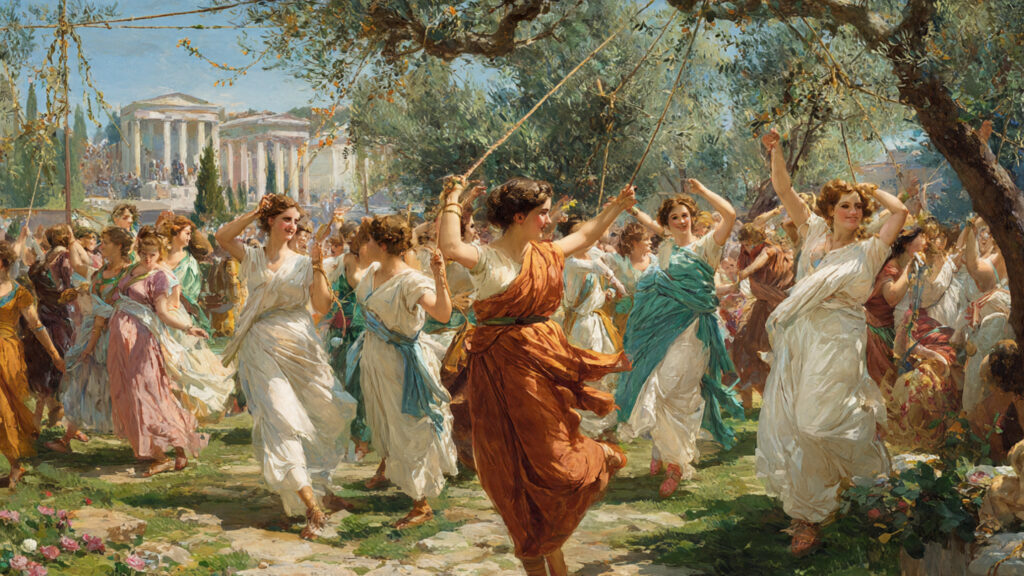
The festival acknowledged that the health of the vineyard and the stability of the home were connected to the honoring of those who came before. The Aiora fell during the same autumn festival cycle as the Anthesteria, the citywide wine festival that opened the new vintage each year, which means the swinging ritual and the drinking of the season’s first wine occurred within days of each other. The city, in effect, paused each year to remember the cost of the gift before celebrating its arrival.
Procyon in the Modern Sky
Today the constellations Virgo, Boötes, and the star Procyon remain visible across the Greek mainland and islands. In a quiet field in Epirus, along a vineyard slope in the Peloponnese, or near the shoreline of the Aegean, the same stars continue their measured course.
Watching the rise of Procyon requires no instruments. It requires only the willingness to look upward and recognize patterns that have guided human communities for thousands of years. The stars become a continuation of the land, extending the memory of the soil into the sky.
Across Greece, where vineyards still shape the landscape and ancient paths cross the countryside, the story of Icarius, Erigone, and Maera remains quietly present. In the appearance of a star or the change of a season, the past continues to shape the present in subtle and enduring ways. A gift that killed the man who first received it eventually became the drink of the entire Mediterranean world, and the sky still keeps the account of what that transition cost.
At Olympus Estate, Mythic Essays moves through the deeper currents of the Greek tradition. Icarius welcomed Dionysus disguised as a traveler with quiet generosity and was taught the hidden craft of winemaking in return. He carried the new drink to local shepherds, who tasted it without understanding its nature, believed they had been poisoned, and struck him down. His daughter Erigone searched the hills of Attica guided by his loyal hound Maera until the dog’s cries led her to the disturbed soil of the grave. She ended her life beneath the same tree. The gods placed all three in the sky: Icarius became Boötes, Erigone became Virgo, and Maera became Procyon, whose name means before the dog because it rises shortly before Sirius and once signaled the approach of summer heat across Thessaly, Crete, and the Aegean. In Classical Athens the festival of the Aiora commemorated Erigone: young women swung from ropes tied to trees, transforming personal sorrow into collective remembrance. The myth preserves the moment when a powerful gift entered human life and required the discipline to receive it correctly. The stars become a continuation of the land, extending the memory of the soil into the sky.