




The English language has two vocabularies.
The first is the Germanic vocabulary: the short, blunt, immediate words that English inherited from the Anglo-Saxon and Norse and Dutch roots that the spoken language of the British Isles developed across the first millennium CE. House, hand, love, child, eat, sleep, give, work, death: these are the words that the language reaches for when it wants to say something directly, without distance, without qualification. They are the words whose quality of immediacy comes from having been in the mouth of the English speaker for a very long time, worn smooth by the continuous use of a thousand years.
The second source is the Greek vocabulary: the longer, more abstract, more technical words that entered English primarily through Latin and through the Latin‑derived Romance languages, through the historical process by which the Greek intellectual world’s engagement with philosophy, science, medicine, literature, and mathematics gave the West the conceptual language it needed to think about these subjects at the level of precision they required. Democracy, philosophy, tragedy, biology, astronomy, logic, rhetoric, psychology, theology, ethics: these are not words that English borrowed from Greek because Greek happened to have convenient sounds. They are words that English required because the concepts they named were Greek concepts, developed in the Greek intellectual world, and had no equivalents in the pre‑Greek vocabulary of the Western languages.
The Greek vocabulary of English is the Greek intellectual inheritance of English, expressed in the medium of the language.
The Philosophical Vocabulary
The word philosophy itself is Greek: philosophia, from philos, loving, and sophia, wisdom, the love of wisdom that Pythagoras is credited with first using as a description of the intellectual enterprise he was engaged in. The claim embedded in the word is the claim that the philosopher’s relationship to wisdom is the relationship of the lover to the beloved rather than the relationship of the possessor to the possession: the philosopher does not have wisdom but pursues it, and the pursuit rather than the achievement is the defining activity of the philosophical life.
Logic comes from logos, one of the most semantically rich words in the ancient Greek philosophical world. Word, reason, account, argument, rationality, and the capacity of the human mind to give an ordered explanation of the world are all dimensions of what logos names. The philosophical work that Aristotle developed around the study of valid inference and the conditions under which arguments preserve truth is the work that gave logos its most technical English descendant. Logic became the study of the formal properties of valid reasoning, the discipline that examines how truth is maintained when one statement follows from another.

Ethics comes from ethos, which in ancient Greek meant character, custom, or the characteristic disposition of a person or a community. The philosophical work that Aristotle developed in the Nicomachean Ethics and the Eudemian Ethics, which asks what kind of character a person must have in order to live well rather than simply asking what actions a person should perform, is the work that gave ethos its most developed philosophical descendant in the Western world.
Politics comes from polis, the Greek city‑state that was the form of political organization the ancient Greek world created and that the political philosophical tradition took as its primary subject of analysis. Aristotle’s Politics is not simply a book about politics in the modern generic sense of government and power. It is a book about the polis, about what the polis is for, and about what kind of human life it makes possible. The form of political analysis the book exemplifies is the form that the word politics carries into every subsequent context in which it appears.
Democracy comes from demos, the people, and kratos, power or rule. It names the political order that Athens developed in the late sixth and fifth centuries BCE and that the Western political world has been arguing about ever since. The word itself encodes the political claim the Athenian democratic world was making: that the power to govern belonged to the people as a whole rather than to a king or an aristocracy or any subset of the population organized by birth or wealth. The claim was controversial in antiquity and has remained controversial ever since, and every time the word appears in a contemporary political context it carries the charge of that ancient argument.
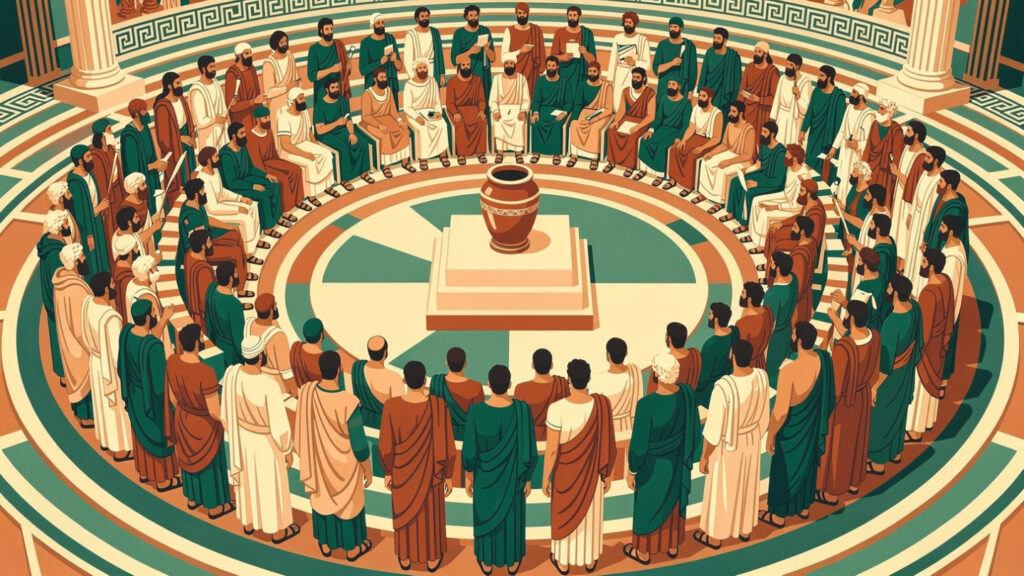
Rhetoric comes from rhetor, the public speaker, and from the art of speaking effectively in public that the sophistic and later the philosophical world analyzed and systematized. The modern word has acquired a pejorative dimension that the ancient word did not have. Rhetoric in contemporary usage often implies empty or manipulative speech rather than the skilled and persuasive use of language in public contexts that Aristotle’s Rhetoric examined as a legitimate art. The Greek rhetor was the citizen who could make arguments in the assembly and the law court, and the art of the rhetor was the civic art of the democratic city.
Theory comes from theoria, which in ancient Greek meant a looking at, a contemplation, or the act of beholding something from a perspective of attentive observation rather than practical engagement. The philosophical distinction that the ancient world drew between the theoretical and the practical life, the life organized around contemplation and the life organized around action, is the distinction that gives theory its character in English. The theoretical is what has been worked out in contemplation rather than demonstrated in action, and the word carries this ancient philosophical distinction into every context in which it appears.
The Scientific Vocabulary
The Greek contribution to the scientific vocabulary of English is the contribution that most directly expresses the relationship between the concerns of the Greek intellectual world and the domains of knowledge that Western science developed from those concerns.
Biology comes from bios, life, and logos, the study or account of something. It names the study of living things as the domain of scientific inquiry that grew from the natural historical work beginning with Aristotle’s History of Animals and continuing through the Linnaean taxonomy. Aristotle’s systematic investigation of the living world, his classification of animals by their structural and behavioral characteristics, and his attempt to identify the principles that governed the organization of life are the intellectual foundation of what biology names.
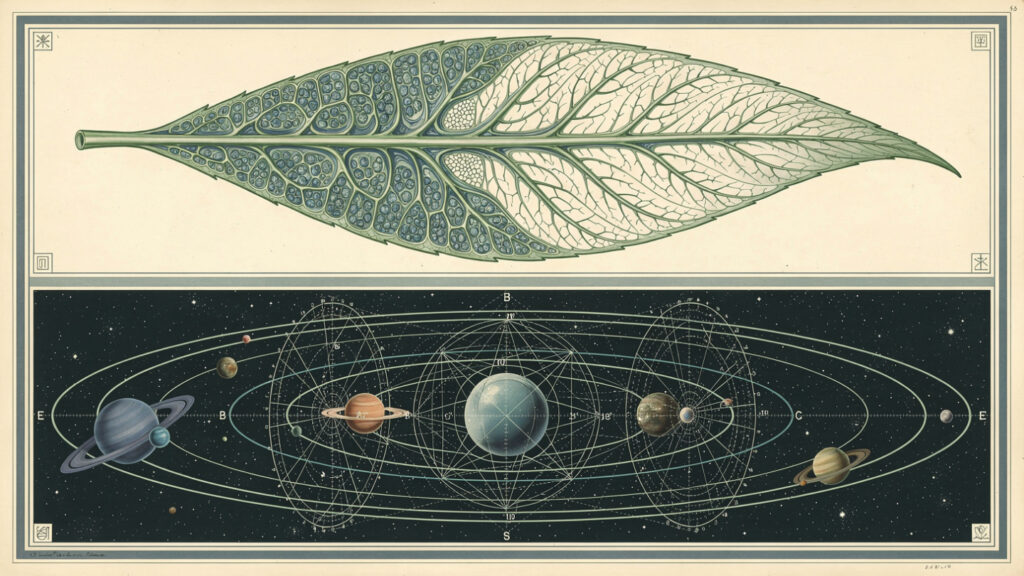
Astronomy comes from astron, star, and nomos, law or ordering principle. It names the study of the laws that govern the stars, the systematic investigation of the celestial bodies and their movements. The ancient Greek astronomical world, from the pre‑Socratic cosmologists through the Pythagorean work on the mathematical ratios of the spheres and through the Ptolemaic system that organized ancient astronomical knowledge into its most complete form, is the world that gave the West both the science and the word.
Geography comes from ge, earth, and graphia, writing or description. It names the writing of the earth, the systematic description of the earth’s surface and its human and physical features. Strabo’s Geographica, the most complete surviving work of ancient Greek geographical writing, is the text whose ambition to describe the entire inhabited world from the perspective of the educated observer who has traveled widely and read everything available established the model for geography as a systematic discipline.
Physics comes from physis, nature, and from the inquiry into the nature of things that the pre‑Socratic philosophical world began and that Aristotle organized into his systematic treatment in the Physics, the text that established the framework for the Western scientific engagement with the natural world. The question that physics asks, what the natural world is made of and what principles govern its behavior, is the question that the pre‑Socratic world first formulated in the terms that the subsequent scientific world has continued to use.
Psychology comes from psyche, the soul or mind, and logos, the study of. It names the study of the soul or mind as a domain of scientific and philosophical inquiry. The ancient Greek engagement with the psyche, from the Platonic account of the soul’s immortality and its relationship to the body through the Aristotelian account of the soul as the form of the living body that gives it its capacity for life and sensation, is the intellectual foundation from which the modern scientific discipline took its name even as it departed from the ancient theories that the name points back to.
The Literary Vocabulary
The Greek contribution to the literary vocabulary of English is the contribution that most directly reflects the ancient Greek engagement with the forms of writing and performance it created and that the Western literary world has been working with ever since.
Tragedy comes from tragoidia, from tragos, goat, and oide, song. It names the goat‑song, the choral performance that the Dionysian festival world developed in the late sixth century BCE and that Aeschylus, Sophocles, and Euripides transformed into the dramatic form that the Western theatrical world has been engaging with since its first contact with the ancient texts. The formal and thematic character of tragedy, the downfall of the protagonist through some combination of external fate and internal flaw, the cathartic emotional effect on the audience, and the chorus’s mediating role between the action and the audience’s response, are all properties that the Greek world created and that the word tragedy carries into every subsequent context.
Comedy comes from komos, the revel or festive procession, and oide, song. It names the revel‑song, the theatrical form that developed alongside tragedy in the Athenian festival world and that the Old Comedy of Aristophanes, the Middle Comedy of the fragmentary writers, and the New Comedy of Menander represent in their different periods. The ancient theatrical context, the festive revel that ended in communal celebration rather than catastrophic downfall, is the context that gives comedy its English meaning: the genre that ends well rather than badly, that concludes in marriage and reconciliation rather than death and ruin.
Epic comes from epos, word or song, and names the long narrative poem that the Homeric world exemplifies. It is the sustained narrative in dactylic hexameter verse that recounts the deeds of heroes and gods across the broad canvas of the mythological world. The Iliad and the Odyssey are the defining examples of the form, and the character of the epic, the elevated style, the divine machinery, the catalogue of forces, the extended similes, and the focus on the hero’s relationship to fate and to the community, are all properties that the Homeric world created and that the word epic carries into every subsequent context.
Lyric comes from lyra, the lyre, and names the poem composed for singing to the accompaniment of the lyre that the archaic Greek world developed in the hands of Sappho, Alcaeus, Anacreon, and Pindar. The character of the lyric, the personal voice, the expression of private emotion, the direct address to the beloved or to the god or to the self, is the property that the ancient Greek lyric world developed in distinction from the epic’s communal public voice and the dramatic world’s theatrical representation.
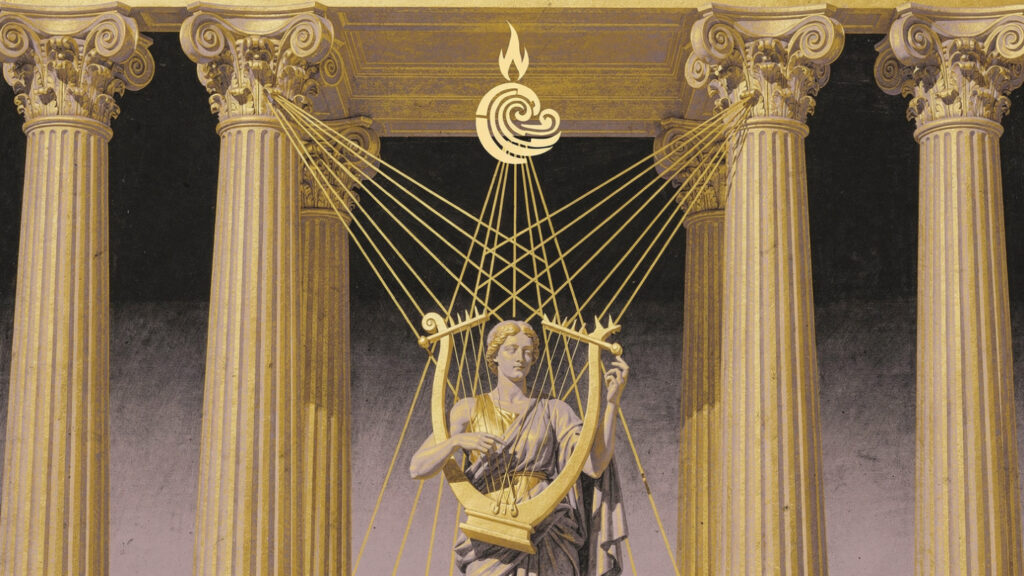
Drama comes from dran, to do or to act, and names the form of theatrical performance that enacts rather than narrates its subject matter. The ancient Greek theatrical world’s contribution to the Western literary inheritance is the contribution that the word drama most directly captures. It is the mode of representation in which the action is shown rather than told, in which characters speak and act in the present tense of the performance rather than being described in the past tense of a narrator’s account. The stage becomes the place where the story happens rather than the place where the story is reported, and the word drama carries this ancient distinction into every context in which it appears.
The Medical Vocabulary
The Greek contribution to the medical vocabulary of English is among the most extensive and most systematic of the Greek language’s contributions, reflecting the character of the ancient Greek medical world’s development of a conceptual framework for understanding the human body and its conditions.
Anatomy comes from ana, up, and temnein, to cut. It names the cutting up, the systematic dissection of the body for the purpose of understanding its structural organization. The ancient Greek medical world’s development of anatomical knowledge, from the Hippocratic texts through the anatomical work of Herophilus and Erasistratus in the Hellenistic period and the comprehensive synthesis of Galen in the second century CE, is the world that gave the Western medical vocabulary the conceptual foundation that anatomy names.
Symptom comes from symptoma, from sym, together, and ptoma, a fall or a coincidence. It names that which falls together with the disease, the observable sign that coincides with and indicates the underlying condition. The Hippocratic world’s development of the observation and classification of symptoms as the systematic basis for medical diagnosis is the intellectual foundation of the word’s medical meaning.

Diagnosis comes from dia, through, and gignoskein, to know. It names the knowing through, the process of arriving at knowledge of the patient’s condition through the systematic examination of the available evidence. The Hippocratic world’s development of the diagnostic method, the careful observation of the patient’s symptoms, history, and physical signs for the purpose of identifying the underlying condition, is the intellectual foundation of the word’s medical meaning.
Therapy comes from therapeia, service, attendance, or healing care, itself derived from therapon, an attendant or one who serves. The word did not originally belong to medicine alone: a therapon served a god, a master, or a guest with the same devoted attention a physician later brought to a patient. Its migration into the medical vocabulary carries this older sense of attendance intact. Therapy is not simply treatment applied to a body. It is a sustained, attentive service given to whatever condition requires it, and the word still holds the trace of the servant standing ready beside the one being served.
The Everyday Words
Beyond the technical vocabularies of philosophy and science and literature and medicine, the Greek language contributed a substantial number of words to the English everyday vocabulary whose Greek origins are less obviously signaled by their form than the philosophical and scientific terms.
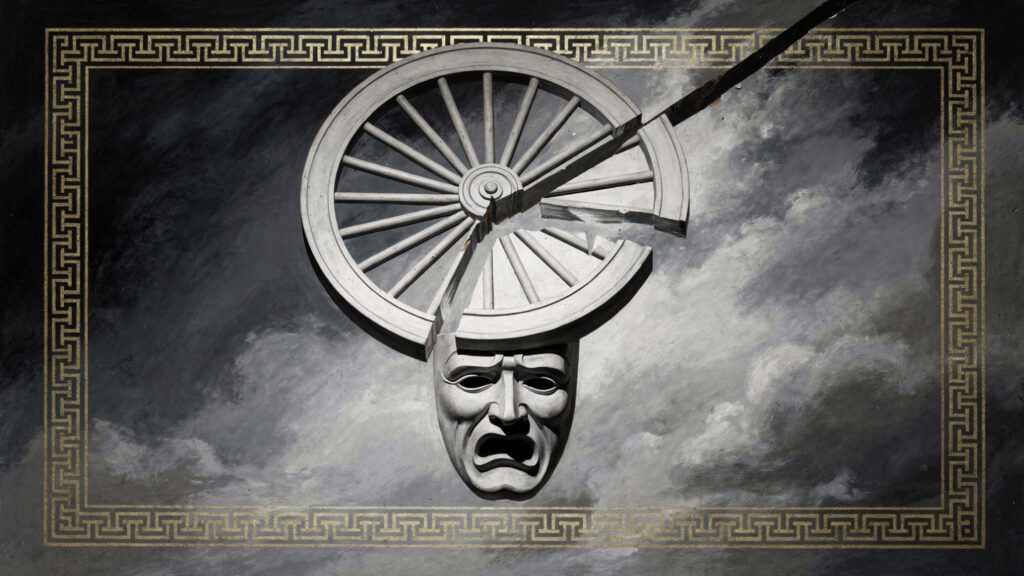
Catastrophe is from kata, down, and strephein, to turn: the overturning or the downturn, the sudden reversal of fortune that the tragic tradition identified as the defining moment of the tragic plot and that the general vocabulary extended to any sudden and severe misfortune. Every catastrophe in the contemporary English vocabulary is performing the tragic overturning that the ancient Greek word named.
Chaos is from the Greek chaos, the yawning void or the formless matter from which Hesiod’s Theogony says the cosmos was organized. The word carries the cosmological claim of the ancient Greek creation tradition into every contemporary context in which disorder is described as chaos: the disorder that precedes or represents the failure of the organized cosmos is the cosmological condition that the Greek word names.
Mentor is from Mentor, the character in the Odyssey who was the loyal friend of Odysseus and the guardian and counselor of Telemachus during Odysseus’s absence. The word’s passage from the proper name of a Homeric character to the common noun for a trusted advisor and guide is among the most complete examples of the eponymous process: the character was so precisely the exemplar of the trusted advisor that the character’s name became the word for the role.
Alphabet comes from alpha and beta, the first two letters of the Greek alphabet, whose names derive from the Phoenician letters aleph and beth from which the Greek alphabet was adapted in the early archaic period. The word names the writing system by naming its first two elements, and the phonemic writing system that the Greeks adapted from the Phoenician consonantal alphabet by systematically adding letters for vowels is the writing system that the Western alphabetic tradition inherited and from which the Latin alphabet that English uses derives.
What the Vocabulary Reveals
The Greek words in the English vocabulary are not simply borrowed sounds. They are inherited concepts, each carrying the intellectual world in which the concept was developed and the question that the concept was designed to answer.
When a scientist says biology or psychology or astronomy, they are using words that carry the ancient Greek understanding of what a systematic study of living things or the mind or the celestial bodies was: an inquiry organized around logos, the principled account of the thing studied that the discipline’s systematic method produces. When a philosopher says ethics or logic or rhetoric, they are using words that carry the ancient Greek understanding of what the discipline investigated and what it was for. When a literary scholar says tragedy or comedy or epic or lyric, they are using words that carry the formal and thematic character of the ancient Greek literary forms that the words named.
The Greek vocabulary of English is the Greek intellectual inheritance made audible: the legacy of a civilization that developed the conceptual frameworks for thinking about nature and mind and society and art and the good life in the forms that the Western world has been working with, modifying, extending, and arguing about for two and a half thousand years.
Every time the word philosophy appears in an English sentence, the love of wisdom that Pythagoras first named is present in it. Every time catastrophe appears, the tragic overturning of fortune that the ancient Greek theatrical world analyzed is present in it. Every time democracy appears, the Athenian political experiment whose strengths and weaknesses Thucydides and Plato and Aristotle documented is present in it.
The words carry the history. The history is still in the words.
At Olympus Estate, Cultural Chronicles traces the practices and institutions that defined Greek civilization from the inside, and through the inside to the outside. The Greek words in the English vocabulary are the Greek civilization in the English language: philosophy and ethics and politics and democracy and tragedy and comedy and biology and astronomy and anatomy and therapy. These are not borrowed words. They are inherited concepts. The concepts are still alive. The language that carries them is still the language that the ancient tradition gave to the Western world to think with. Use it carefully.