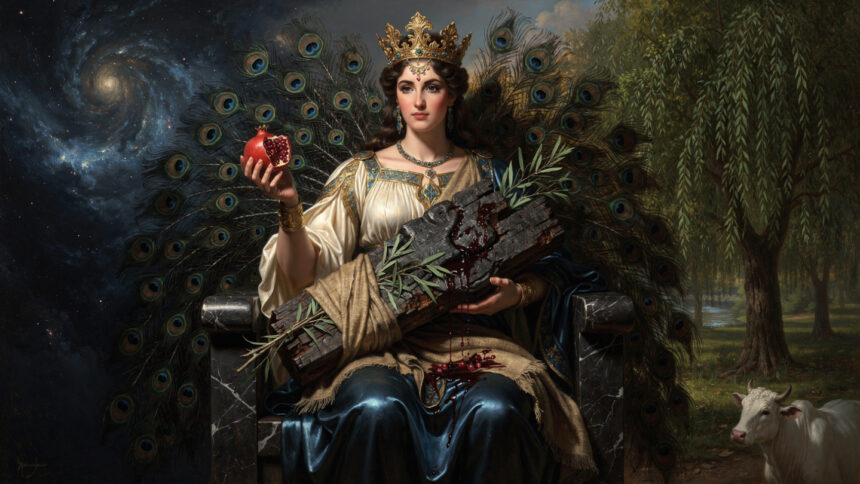





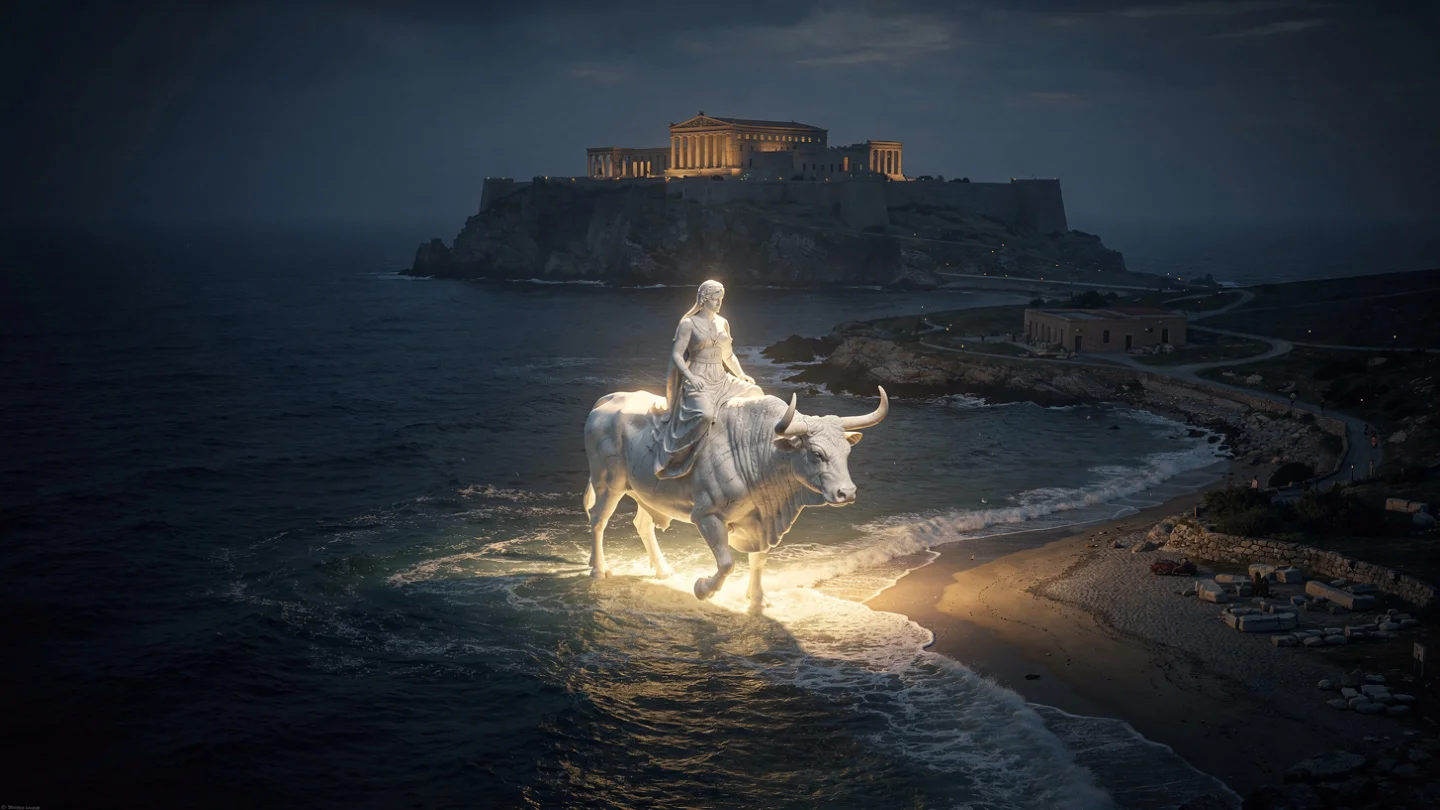
The continent is named for a Phoenician princess who was carried off by a bull.
This is among the most consequential acts of divine mythological naming in the Western world, and the mechanism by which it occurred is worth attending to before the story itself is told. Europe, the landmass whose western boundary was the Atlantic Ocean and whose eastern boundary the ancient Greek geographical world debated across centuries, took its name from Europa, the daughter of Agenor, king of Sidon, and Telephassa, in the mythological world that the ancient Greeks transmitted. The Phoenician princess became the geographical category. The geographical category became the continental frame that Western civilization has organized its self‑understanding within ever since.
The irony is precise and deliberate: the continent that the Western world has most consistently associated with its own origins and its own distinctiveness took its name from a figure who came from the East, who was the daughter of a Phoenician king, who was the sister of the man who brought the Phoenician alphabet to Greece and thereby gave the Greek civilization the tool whose development made the philosophical and literary world possible. The West named itself after an Eastern princess. The naming was not an accident.
The myth of Europa is ultimately a story about naming, not only about abduction, and it fixed the identity of an entire continent to an act the continent never witnessed.
Europa and the Mythological Family
Europa’s position in the mythological genealogy encodes the cultural transmission that the myth was organized around. She was the daughter of Agenor, the king of Sidon in the Phoenician world, and the sister of Cadmus, and the relationship between these two siblings in the mythology is the relationship between the two most significant cultural transmissions from the Phoenician world to the Greek world that the ancient world preserved.

Europa carried the name that would attach to the western landmass. Cadmus carried the alphabet.
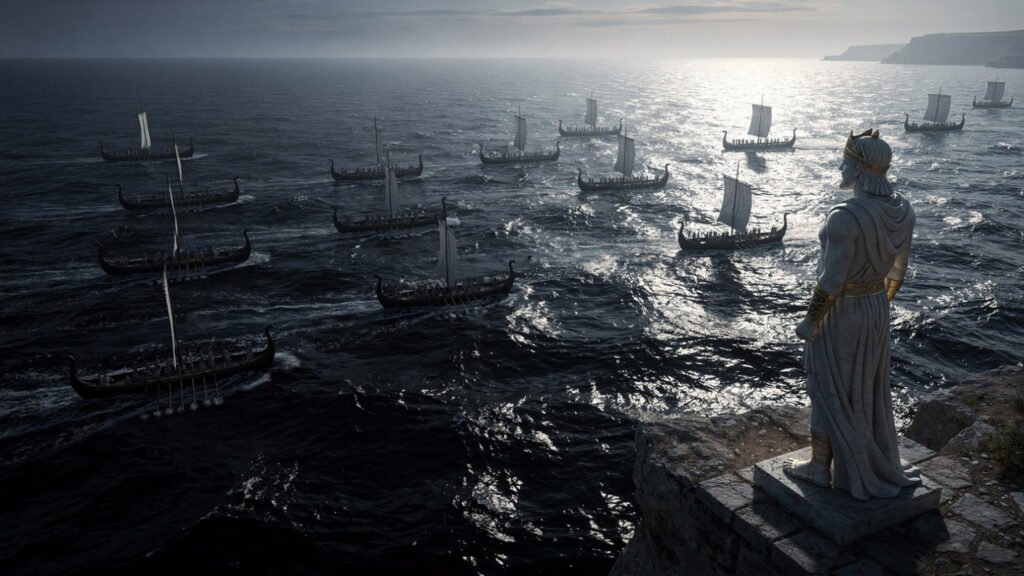
The mythological account of Cadmus’s journey is the account of the search for the abducted sister: Agenor sent his sons, Cadmus and Phoenix and Cilix and Thasus, to search for Europa and not to return without her. They traveled west, following the route of the abduction, and Cadmus eventually received the oracle’s instruction to abandon the search and instead follow a cow until it lay down, and on the spot where it lay to build a city. The city he built was Thebes. The founding of Thebes by the Phoenician who was searching for his abducted sister is the foundational narrative of the city that produced Oedipus and Antigone and Dionysus’s own birth city and the location of the Seven Against Thebes and Heracles’s birthplace: the entire Theban mythological tradition begins with the man who came from Phoenicia to search for his sister.

And Cadmus brought the Phoenician letters with him. The tradition that Cadmus introduced the Phoenician alphabet to Greece is not simply a mythological claim: it is the accurate encoding of one of the best-documented cultural transmissions in the ancient world. The Greek alphabet is a direct adaptation of the Phoenician consonantal script, modified by the innovation of adding letters for vowels that the Phoenician script did not represent. The adaptation is documented in the form of the letters, whose Greek names, alpha, beta, gamma, delta, are the Greek phonological adaptations of the Phoenician letter names, aleph, beth, gimel, daleth, which are themselves words in Phoenician, ox, house, throwing stick, door. The Greek letters were named for the Phoenician letters they were adapted from, and the Greek names preserved the Phoenician words whose sounds they no longer meant.
The Olympus Estate article on Greek words in the English language develops the tradition of how the names of the Greek letters entered Western culture through the word alphabet, which is simply the first two Greek letter names, alpha and beta, combined. The alphabet that gives the West its foundational literacy technology takes its name from the first two letters of the adapted Phoenician script that Cadmus brought when he came searching for his sister. The search for Europa produced the tool that made Western thought possible.
Zeus as the Bull | What the Transformation Means
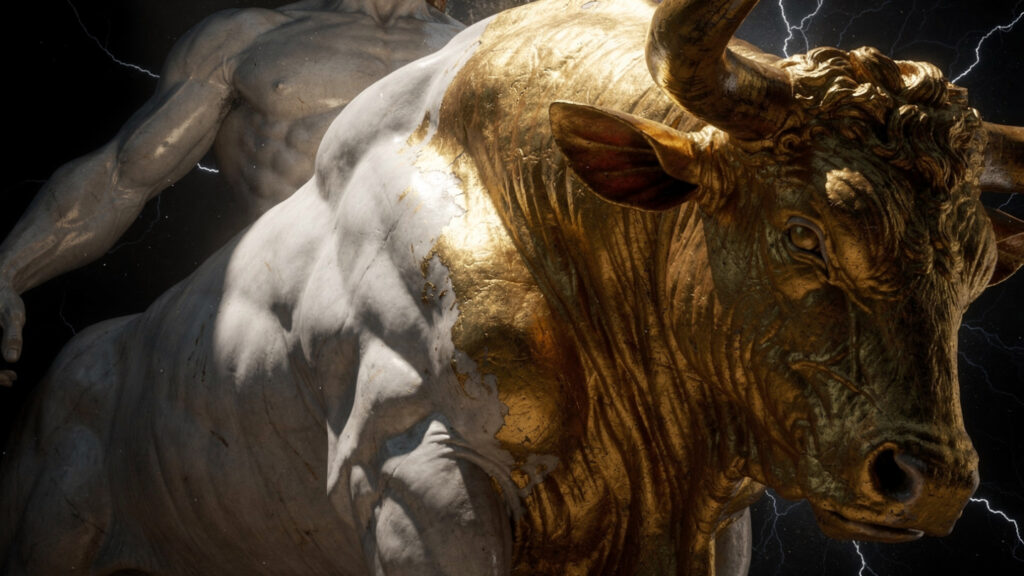
Zeus transformed into a bull to approach Europa, and the choice of the bull as the form of the divine seduction is the choice that carries the most significant theological content in the myth.
The bull was the sacred animal of the Minoan religious world that preceded the Greek civilization in Crete. The palace at Knossos, whose mythological world the Theseus and Minoan civilization articles in this collection develop, was organized around the religious significance of the bull in a way that no other Bronze Age Aegean palace was. The bull-leaping frescoes, the bull rhyta, the elaborate bull iconography of the Minoan artistic tradition: all of these document the centrality of the bull to the Minoan sacred world. When Zeus arrived in Crete in the form of a bull, he arrived in the form of the sacred animal of the civilization he was entering.
The theological argument that the myth was encoding in this transformation is the argument of the theological meeting between the Olympian world and the pre‑Greek Aegean world. The king of the Olympians, whose own divine character was the character of the sky god’s authority and the thunderbolt’s directed power, arrived in Crete in the form of the animal that the Cretan world understood as the vehicle of divine presence. The transformation was the mythological acknowledgment of the transaction: the Olympian order was absorbing the Minoan sacred world, and the absorption took the form of the Olympian king taking the Minoan sacred animal’s form to enter the Minoan landscape.
This is not the standard interpretation of the Europa myth’s bull transformation, and the standard interpretation, that the bull symbolizes fertility and divine power in a generic sense, is not wrong. The bull did carry these associations across the ancient Mediterranean world, not only in the Minoan world. But the application of the bull symbolism in the Europa myth, in which the Olympian king takes bull form specifically to carry a Phoenician princess to Crete, is the application that makes the Minoan sacred animal interpretation the most contextually precise reading. The bull that carries Europa to Crete is the sacred animal of the civilization that Europa’s abduction is founding the mythology of.
The Minotaur, Pasiphae’s monstrous offspring by the white bull that Poseidon sent and that Minos refused to sacrifice, is the continuation of the same bull mythology in the next generation. The bull that was Zeus in the Europa world becomes the bull whose union with the Cretan queen produces the monster in the Minotaur world. The bull at the center of the Cretan mythological world is always present in both its sacred and its monstrous forms, and the Europa myth is the narrative that placed the bull at the center of the Cretan cosmology by making it the vehicle of the divine seduction that produced the Cretan royal line.
The Abduction and Its Ancient Accounts
The oldest surviving extended account of the abduction is in the Homeric Hymns, and the most complete ancient narrative is in Moschus of Syracuse’s Europa, a poem from the second century BCE that gives the most detailed surviving account of the meadow scene and the sea crossing.
Moschus describes Europa’s dream on the night before the abduction: two lands, in the form of women, one representing the East and one the West, appeared to Europa and disputed possession of her. The eastern land claimed her as her own child. The western land claimed her as the person who was fated to belong to her through Zeus’s will. The prophetic dream structure is the literary device that Greek poetry used to frame events of divine causation: the dream announces the abduction before it happens and gives the abduction its specifically cosmic rather than simply erotic dimension. Europa was not simply beautiful. She was fated.

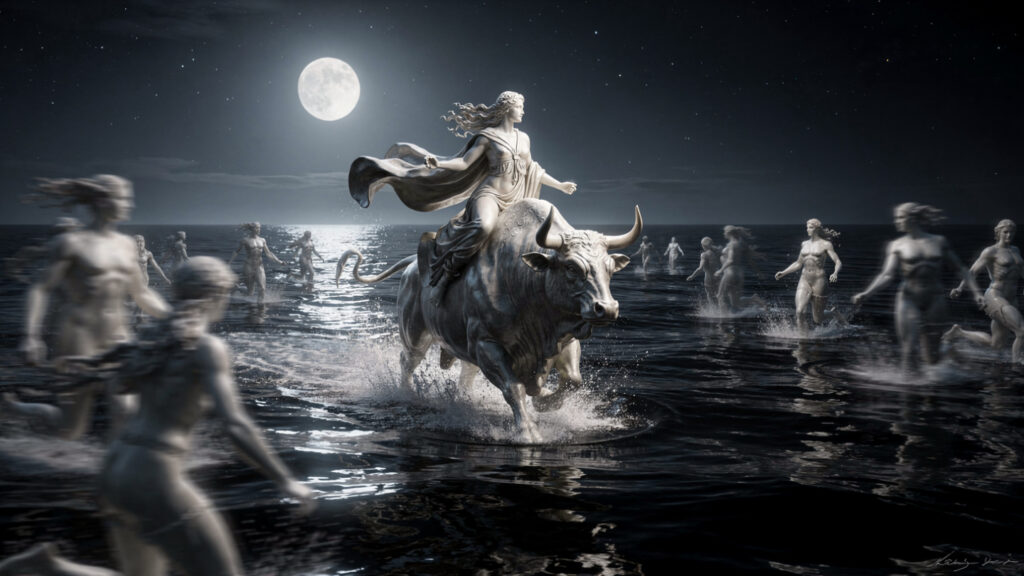
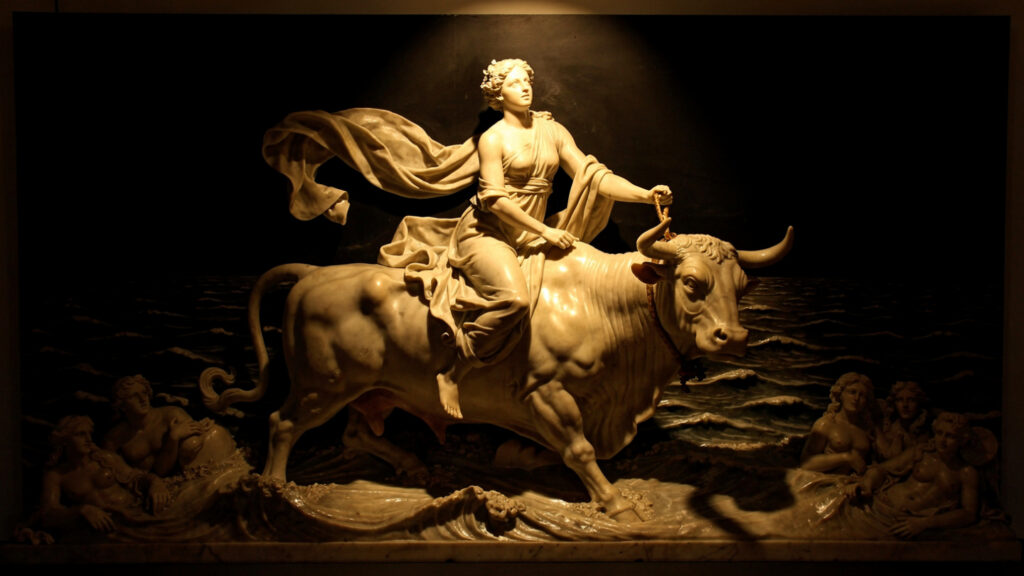
The meadow scene in Moschus is the most complete ancient description of the setting and the approach: Europa and her companions gathering flowers in the meadow by the sea, the divine bull appearing among the herds, his beauty described in detail as a golden-colored bull without any of the usual blemishes of the animal, the bull’s behavior of approaching Europa gently and allowing himself to be touched, and then Europa’s decision to climb onto the bull’s back before the bull springs into motion and carries her to the sea.
The sea crossing accompanied by the divine sea escort of Tritons and Nereids and the sea deities of the divine marine company is the element that gives the crossing its specifically cosmic character: this is not a bull crossing a strait but the divine retinue of the sea god’s court escorting the future queen of Crete to the island where her sons will found the lineage. The marine escort is the mythological device that signals the divine orchestration of the event rather than its accidental or erotic character.
Homer in the Iliad names only Minos and Rhadamanthys as Europa’s sons by Zeus. Hesiod in the Catalogue of Women adds Sarpedon to the list. Herodotus, in the revisionist mode that makes him the most interesting and the most troublesome of the ancient historians, proposes that Minos was not Zeus’s son but the son of Asterion, the Cretan king who subsequently married Europa, and that the Zeus paternity was the mythological elevation of a historical figure into the divine lineage. This is the Herodotean move that the Histories consistently makes with the mythological tradition: the rationalist demythologization that reduces the divine to the human and the miraculous to the credible. It does not help with the Minotaur.
The Variants and What They Reveal
The two primary variant worlds about where the union of Zeus and Europa occurred encode the regional identities of the Cretan communities that maintained different versions of the foundational myth.
The Dikteon Cave world, which places the union in the cave on the Lasithi plateau associated in some accounts with the birth of Zeus himself, is the world that gives the Europa narrative its most complete connection to the broader Zeus mythology of Crete. The cave that was sacred to the infant Zeus becomes the cave where Zeus consummates the abduction that began his relationship with the Cretan world. The circularity of this geography, the god born in the cave returning to the cave with the woman he has abducted from the east, is the kind of mythological circularity that the ancient world found satisfying rather than repetitive.

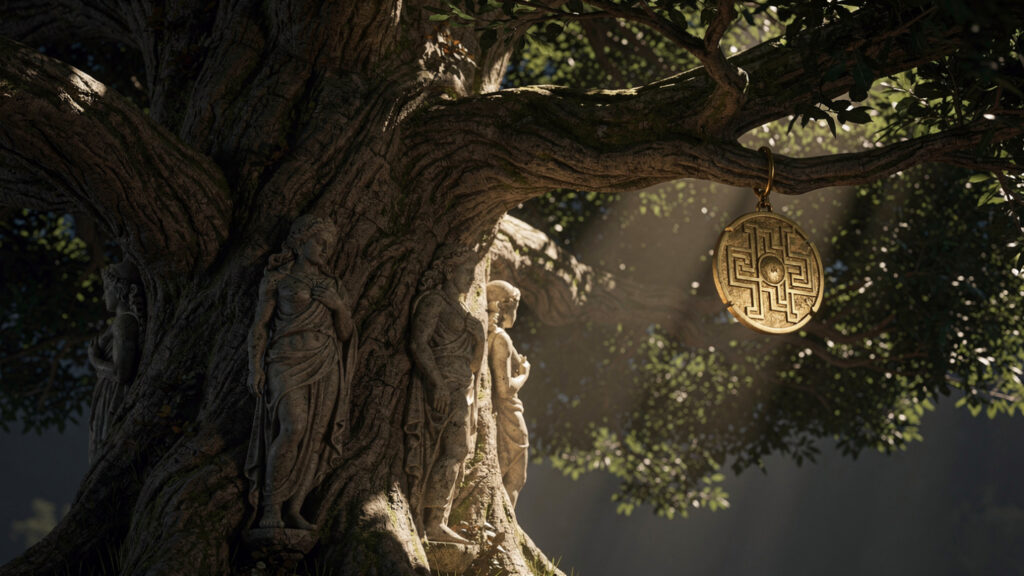
The Gortyn world, which places the union under the shade of an evergreen plane tree at Gortys on the south of the Cretan plain, is the world that the Gortynians immortalized on their coins and that gives the Europa myth its most specifically Cretan territorial reference. The plane tree that never sheds its leaves became the symbol of the divine encounter’s eternal significance. The evergreen plane marks the spot where something happened that does not stop having happened, that continues to bear its consequences across the generations of the lineage that the union produced.
Thucydides gives Minos the historical character that the mythological world had always given him but in the historical rather than the divine register. Minos was the first ruler to establish a navy, to control the Aegean sea, to suppress piracy, and to extend political control over the Aegean islands. The thalassocracy, the sea‑empire, that Thucydides attributes to Minos is the historical world’s engagement with the archaeological reality that the Minoan palace civilization represented: the first organized maritime power in the Aegean, whose commercial and political reach the Linear A tablets document as extending across the eastern Mediterranean.
Rhadamanthys in the world was associated with divine justice rather than political power. He became one of the judges of the dead in the underworld alongside Minos and Aeacus, and his character as the just judge whose decisions the underworld souls could not appeal was the mythological encoding of a divine justice principle that the Minoan legal world apparently represented in the ancient memory. The reputation of Minoan Crete for legal order and civic justice that the ancient sources preserve is the reputation that the mythological world encoded in Rhadamanthys’s underworld function.
The Continent and Its Name
The mechanism by which the name of a Phoenician princess became attached to the western landmass is a puzzle that the ancient geographical world does not fully resolve, and the scholarly engagement with this puzzle has produced more proposals than conclusions.
The ancient Greek geographical world used the name Europe to describe the landmass to the north and west of the Aegean, and the world is at least as old as Hesiod, who uses the name in a geographical sense in the eighth century BCE. The ancient etymology that the world proposed, from the Greek roots eurys, broad, and ops, eye or face, producing either the broad gaze or the broad face as the geographical name, is a folk etymology that the linguistic world has generally declined to accept as historically accurate. The derivation of a geographical name from a Greek compound meaning broad‑gaze or broad‑face requires the assumption that the name was already Greek before it was applied to the princess, which would make the princess’s name a personification of the geography rather than the geography a naming after the princess.
The most plausible alternative etymology, proposed by the comparative linguist Robert Beekes among others, connects the name to a pre-Greek Aegean root whose meaning was something like sunset or west: the landmass to the west of the Aegean, the land of the sunset, was the land that the name originally described, and the Phoenician princess who was carried to the west acquired the name of the direction she was carried in. The West named itself after the woman who was taken to the West.
What is certain is that the ancient Greeks understood the Europa myth as the foundational narrative for the cultural relationship between the Phoenician East and the Greek West. The princess who came from Tyre was the figure whose name was on the landmass that received her, whose brother brought the alphabet that made the civilization of the landmass possible, and whose sons founded the lineage that produced the first great Aegean civilization. The myth is not simply a story about divine seduction. It is the Greek world’s account of its own origins in the cultural encounter between the East and the West that the abduction narrative encodes.
The princess came from Phoenicia. The alphabet came with her brother. The continent kept her name. The Western world was born from the meeting.
At Olympus Estate, Mythic Essays moves through the deeper currents of the Greek tradition. Europa came from Sidon. Her brother Cadmus came looking for her and founded Thebes instead and brought the Phoenician letters that became the Greek alphabet. Zeus arrived in Crete in the form of the sacred bull of the Minoan religion. The sons of the union became the judges of the underworld and the first king of the Aegean sea-empire. The continent took the princess’s name. The alphabet took the first two letters of the adapted Phoenician script. The Western tradition begins in Phoenicia. The myth was honest about this. We have been slower.