



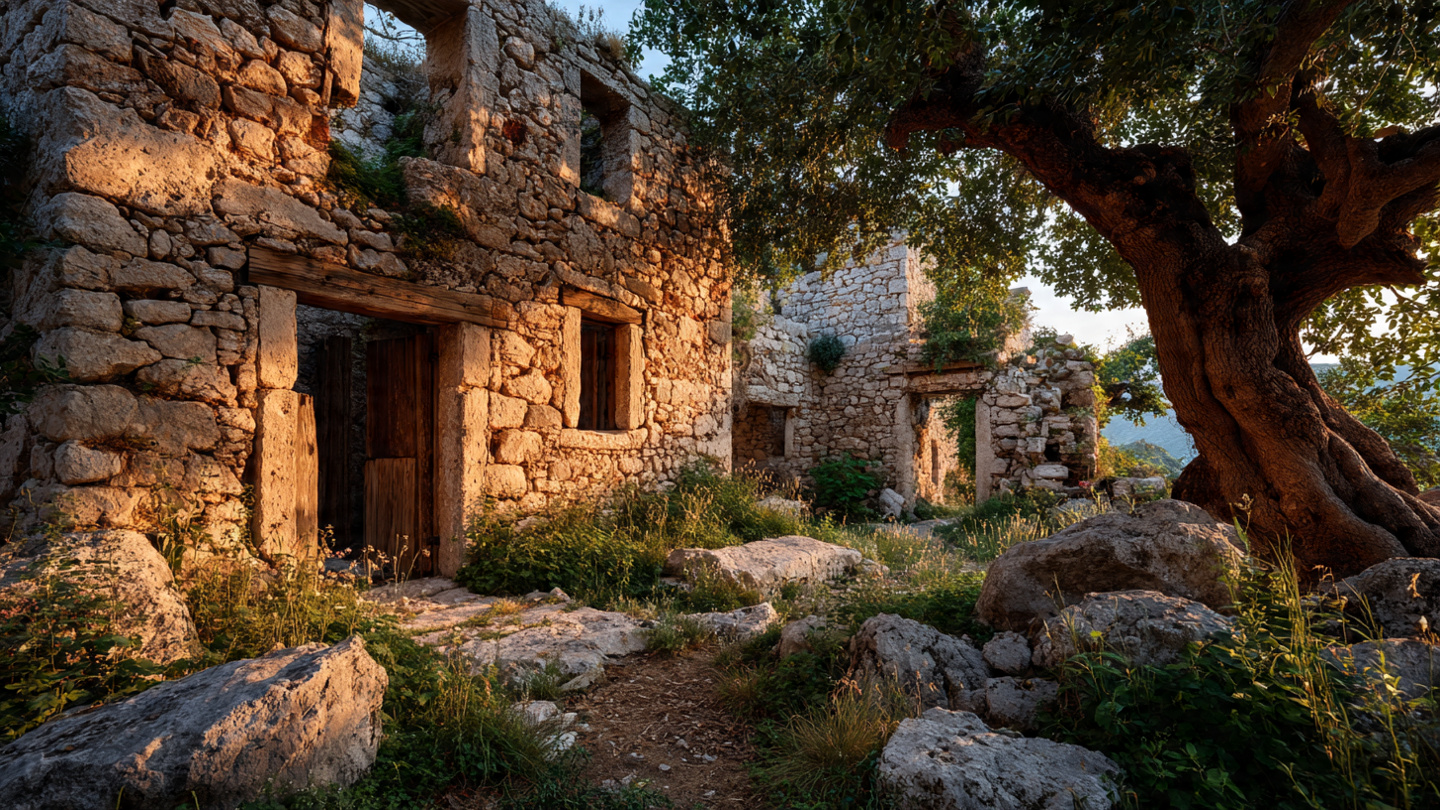
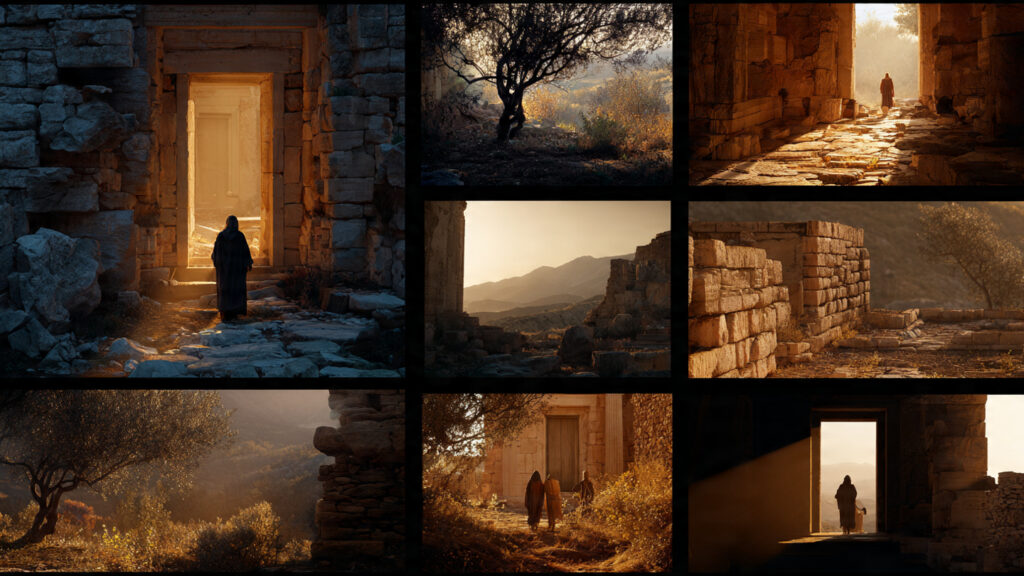
There is a particular kind of silence that lives inside a ruin.
Not the silence of emptiness, but of waiting. Stone walls that have absorbed two centuries of summer heat and winter rain carry a temperature. Walk through a doorway missing its door, and you feel it, a resistance in the air, as if the house is deciding whether to trust you.
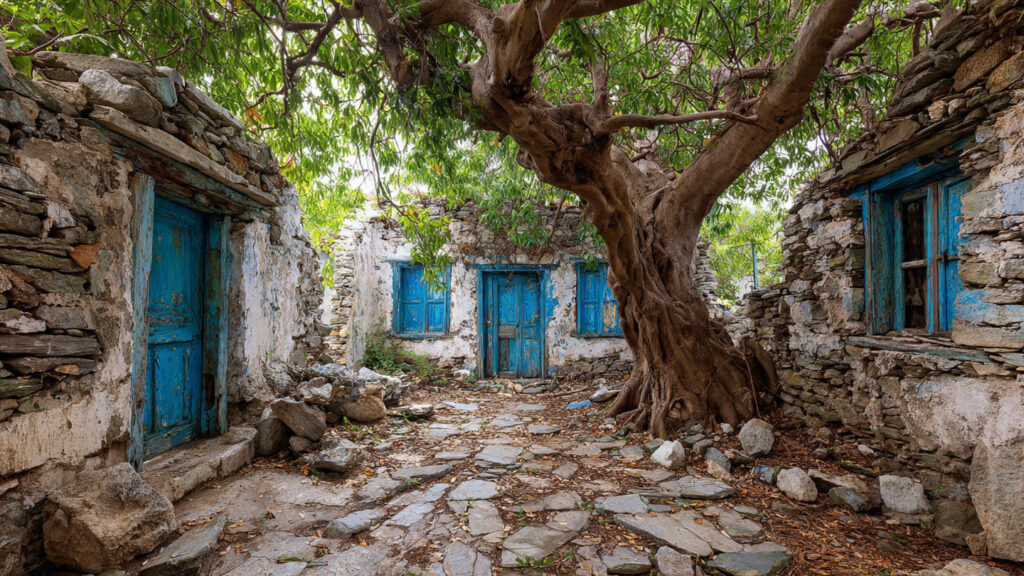
Every year, a quiet procession of Europeans, Americans, Australians, and diaspora Greeks find themselves standing inside exactly this kind of silence. On a hillside in the Mani. In a crumbling village lane in Epirus. On an island where the last resident left decades ago and the fig tree has since reclaimed the courtyard entirely.
They feel something they cannot immediately name.
Then someone, usually the local estate agent or a cousin-of-a-cousin who arranged the visit, says the number.
Forty thousand euros.
And the silence in the ruin shifts.
What a Ruin Actually Is in Greece
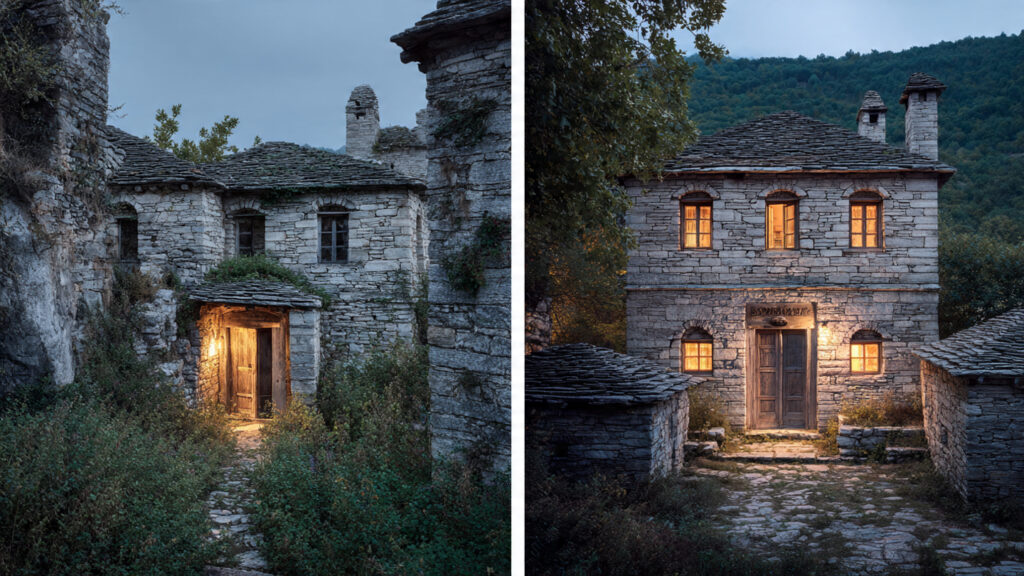
The word ruin in the Greek property market covers considerable territory. It can mean a structurally intact neoclassical mansion in a northern mainland town, its plaster peeling but its bones impeccable. It can mean a one-room island house with no roof, no plumbing, and a view that would silence a cynic. It can mean a Mani tower house, built for blood feuds and siege logic, its walls a metre thick and its spirit uncompromising.
What these properties share is the condition of legal incompleteness: a structure that exists, has a title, occupies a plot, and has been classified as inhabitable by Greek law but no longer functions as a dwelling.
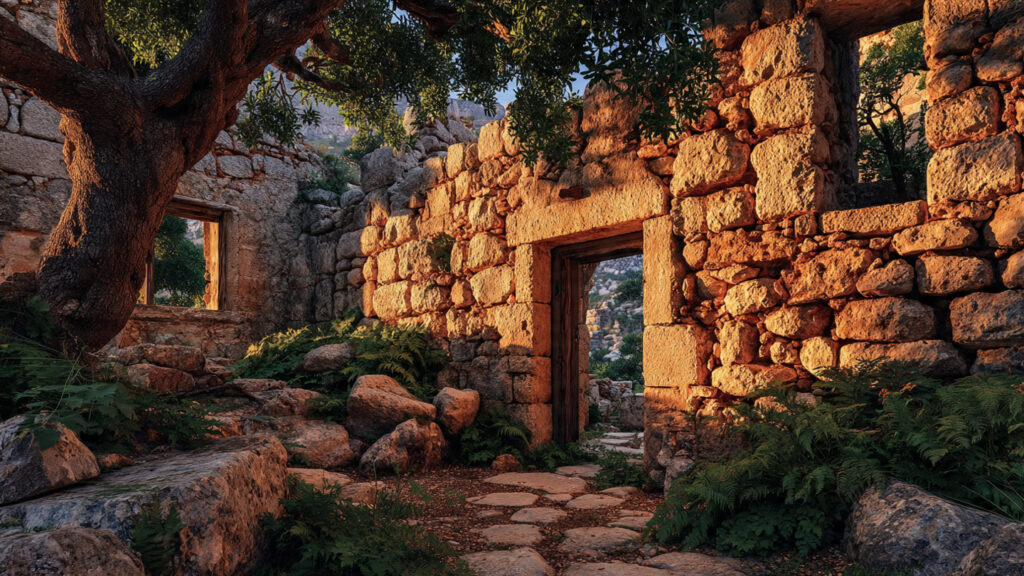
The Greek cadastre, the Κτηματολόγιο or national land registry, has spent the past two decades mapping and digitising much of the country’s property landscape. Older records, however, particularly in island communities and mountain villages, can still be layered with complications. Informal inheritance, undivided shares between siblings and cousins, boundary disputes settled by handshake and memory rather than deed: these are the textures you are entering when you step into the Greek ruin market.
To buy intelligently, you need to understand not just the building but the legal history of the ground beneath it.
What the Price Actually Means
The entry price for a ruin in Greece can be genuinely low by European standards. Properties in depopulated villages of the Peloponnese, Epirus, the northern Aegean islands, and parts of the mainland interior often begin in the range of fifteen to forty thousand euros. Some go lower.
This number, however, is not the cost of the project. It is the cost of permission to begin it.
A realistic renovation budget for a stone ruin in Greece runs roughly between eight hundred and eighteen hundred euros per square metre, depending on the region, the contractor, the access to the site, and the degree of structural intervention required. A modest 80-square-metre island house, bought for thirty-five thousand euros, might require ninety to one hundred forty thousand euros to become liveable to a modern standard. Add professional fees, permit costs, furnishing, landscaping, and the inevitable surprises hidden in walls that have been sealed for decades, and the full cost of a completed restoration typically lands somewhere between one hundred fifty and three hundred fifty thousand euros for a small to medium property.
This is not a discouragement. It is a calibration.
The people who fare best in Greek restorations are those who entered with honest numbers, contingency funds of at least twenty percent, and a patient relationship with time.
Permits | What You Are Actually Navigating
Greece has a layered permit system that reflects the country’s layered relationship with its own built heritage. Understanding the architecture of approvals is not a bureaucratic exercise. It is the difference between a project that moves and one that stalls for years.
Getting a building permit. For any structural intervention, new walls, roof replacement, floor reconstruction, you will need a building permit issued by the local Urban Planning Office, the Πολεοδομία. This requires a licensed civil engineer or architect to draw and submit the technical study, a topographic survey of the plot, an energy performance study for the completed structure, and payment of the permit fee calculated against the project’s estimated value.
The timeline for a standard permit, in an uncomplicated case, typically runs several months. In areas with archaeological sensitivity, which in Greece means a significant portion of the country, additional review by the Central Archaeological Council may extend this considerably. Permit fees, processing times, and the exact scope of required studies shift periodically with regulatory updates, so always confirm current requirements with a local engineer or architect before budgeting a timeline.
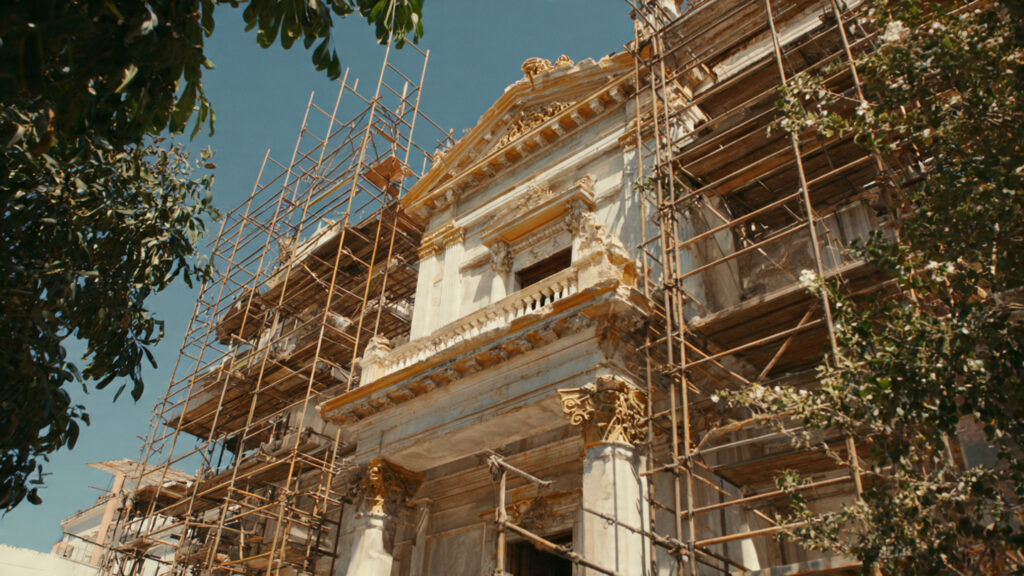
Listed buildings and the Archaeological Service. If your ruin sits within a protected settlement, a listed archaeological zone, or has been individually classified as a monument, the Διατηρητέο, you enter a different regime entirely.
The Central Archaeological Council and the relevant Ephorate of Antiquities become co-authors of your project. This is not an obstacle. It is, for many restorers, the beginning of a far more interesting conversation.
Listed status typically means façade preservation is mandatory, often extending to window proportions, door placement, and external stonework. Interior modifications may be permitted but must not compromise structural authenticity. All groundwork requires archaeological supervision: if anything significant is found during excavation, work pauses and the discovery is assessed.
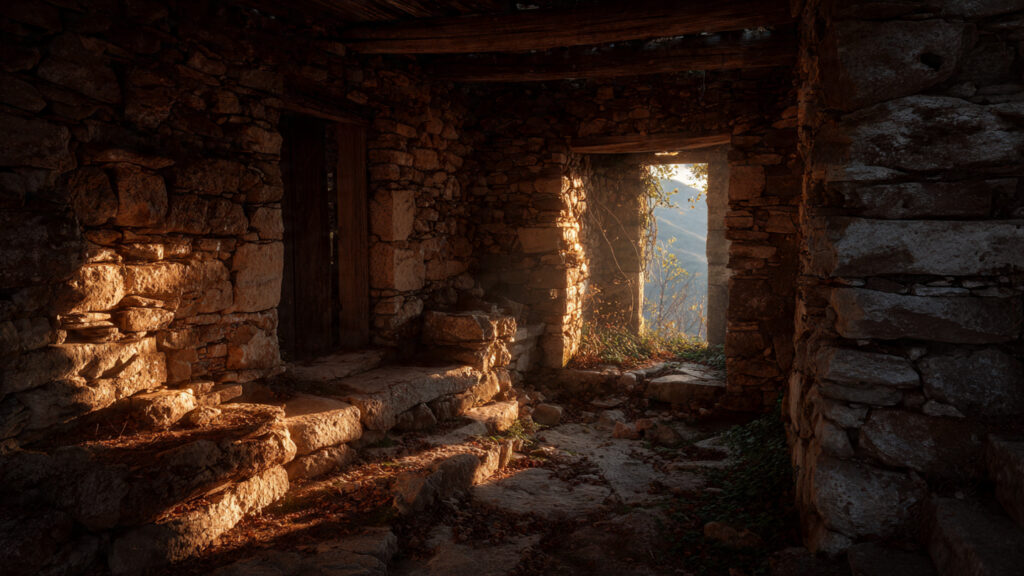
The most experienced restoration architects in Greece navigate this world fluidly. They know which compromises the Ephorate will accept and which they will not. They know how to present a project so that preservation and habitability are not in conflict.
A note on residency and investment pathways. Greece periodically adjusts its residency-by-investment frameworks, and restoration of historic or neoclassical structures has, at various points, qualified for preferential treatment under these programmes. Because these rules change with the political and economic climate, treat any specific figures you encounter as provisional, and verify the current framework directly with a Greek immigration lawyer before making any restoration decision on that basis. What does not change is the underlying logic: Greece has consistently shown a willingness to reward buyers who restore rather than simply acquire, because a restored ruin returns more to a village than a finished villa ever does.
Finding a Contractor
The Greek construction ecosystem is regional and relational. In Athens, you will find established firms with project management infrastructure. In a village in the Zagori or a minor Cycladic island, you are likely working with a small team led by a master builder, a μάστορας, whose knowledge of local stone and traditional technique is irreplaceable, and whose administrative communications may be conducted primarily by telephone and handshake.
Both worlds have their integrity. Neither should be romanticised uncritically.
The critical relationships in a Greek restoration project break down like this.
Your architect or engineer is your licence holder, permit navigator, and technical authority. In Greece, the supervising engineer signs every document and carries legal responsibility for the project’s compliance. Choose someone with demonstrable experience in restoration, not general construction, and ideally someone with relationships in the region where you are building.
Your contractor should ideally be introduced through the architect. Ask to visit a completed project. Ask how they managed the discovery of problems mid-build. The answer tells you everything about their character.
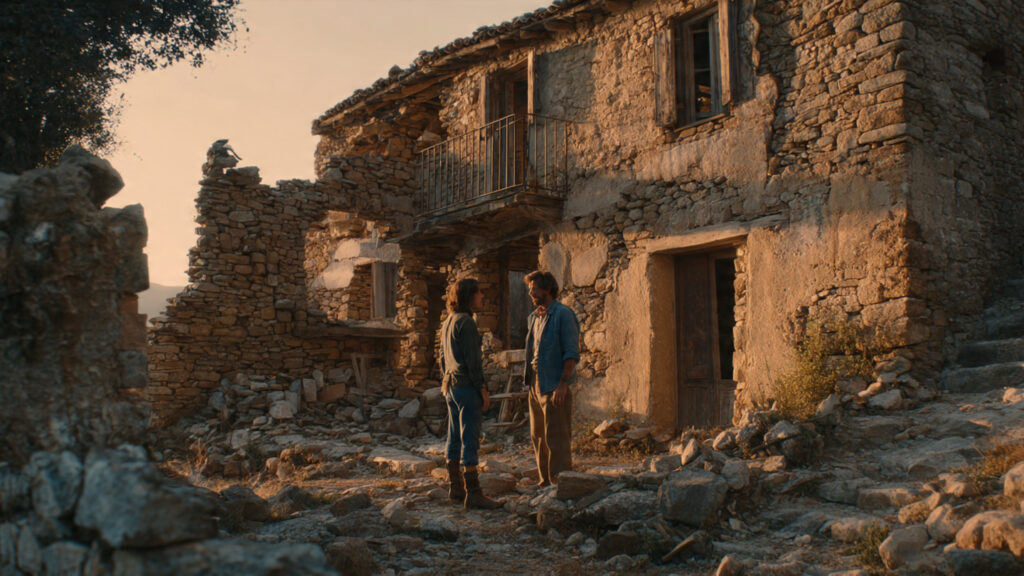
Your notary, the Συμβολαιογράφος, is not a contractor but is essential from the beginning. The notary prepares and registers all property transfers and must verify the clean title before any transaction completes.
Your lawyer, the Δικηγόρος, is separate from the notary. Your lawyer researches the property’s title history, checks for encumbrances, verifies inheritance claims, and ensures that what you are buying is legally whole.
Do not attempt to economise on legal and technical fees. In the Greek property restoration market, these are the professionals who protect you from the expensive surprises that no amount of enthusiasm can remedy.
A Realistic Timeline
Honesty about time is an act of respect toward the buyer.
A Greek restoration, from the moment you identify a property to the day you spend your first night in a completed house, typically takes three to five years for a project of meaningful complexity. Simpler projects in well-serviced areas with clean titles can be completed in two. Complex restorations of listed structures in remote locations have been known to take a decade.
Property search and due diligence runs three to twelve months. Title clearing, if required, runs six to twenty-four months in complex cases. Permit application and approval takes several months to a year. Construction takes twelve to twenty-four months. Finishing, landscaping, and services connection adds another three to six months.
This is not a schedule that rewards impatience. It is a schedule that rewards people who understand that the house was here before them and will outlast them, and who approach the project with something closer to stewardship than ownership.
The Costs in Full
For buyers who want a working map of the financial landscape, treating every figure below as an order of magnitude to plan around rather than a fixed quote:
| Cost Category | Approximate Range |
|---|---|
| Purchase price (ruin, village location) | €15,000 – €80,000 |
| Transfer tax | roughly 3% of assessed value |
| Notary and legal fees | €2,000 – €6,000 |
| Topographic survey | €600 – €1,500 |
| Architect / engineering fees (design + supervision) | 8–12% of construction cost |
| Building permit fees | €500 – €3,000 |
| Construction cost per m² | €800 – €1,800 |
| Archaeological supervision (if applicable) | Variable |
| Services connections (electricity, water, sewage) | €2,000 – €8,000 |
| Interior fitting and furnishing | €15,000 – €60,000 |
| Contingency (essential, not optional) | 20% of construction budget |
The total investment for a well-restored, fully habitable 80 to 120 square metre stone house, purchased as a ruin, typically falls between one hundred eighty and four hundred thousand euros when all costs are included. In certain locations, particularly sought-after Cycladic islands or the Mani, this figure can climb considerably higher. All figures should be confirmed with current local professionals before any project budget is finalised, since material costs, labour availability, and currency conditions shift over time.
What you receive for that investment is not comparable to buying an equivalent finished property. You receive something rarer: a building that is genuinely yours in its making, embedded in a landscape, carrying a material history, and belonging to a place in a way that new construction rarely achieves.
Regions Worth Knowing
The ruin market is not uniform across Greece. Each region carries its own architectural character, its own permit complexity, and its own relationship between cost and reward.
Mani, Peloponnese. Tower houses built from local limestone, massively constructed, culturally protected. The Mani carries significant archaeological and architectural listing. Projects here require patience and the right technical team, but the result, a house that looks as though it emerged from the mountain, is unlike anything in Europe.
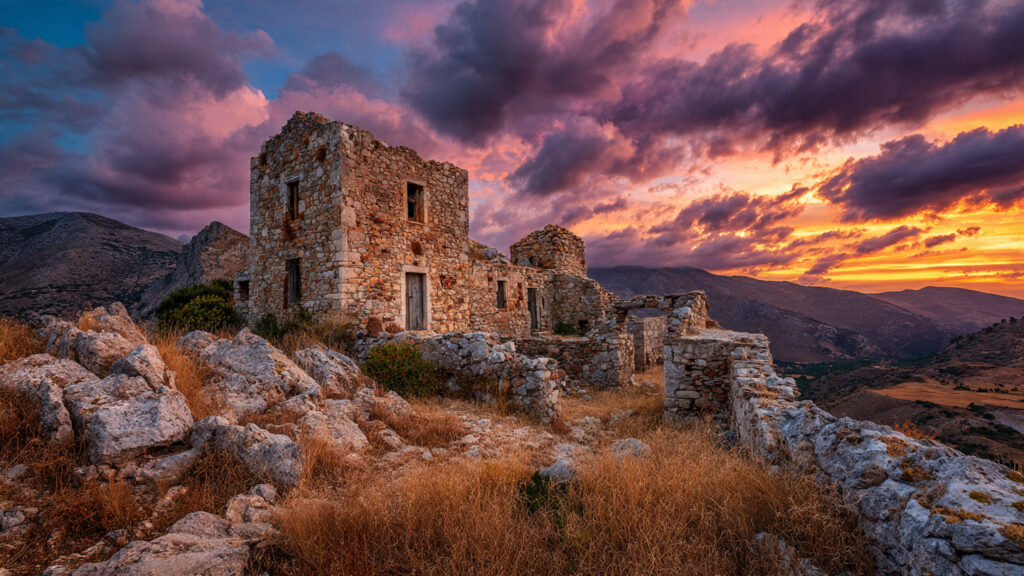
Epirus and Zagori. Stone villages of extraordinary completeness, many nearly abandoned. The Zagori is a UNESCO-recognised cultural landscape, which means robust protection and robust oversight. But the architecture, arched bridges, slate roofs, monumental stone interiors, justifies every constraint.
Lesbos, Chios, Samos. The eastern Aegean islands carry a distinct architectural vocabulary shaped by Byzantine, Ottoman, and Aegean influences. Prices remain moderate relative to the Cyclades. The ferry connections have improved over the years. The food and the pace of life are quietly extraordinary.
Northern mainland: Florina, Kastoria, Grevena. Often overlooked, carrying some of the most intact vernacular architecture in the country and some of the lowest property prices. These are regions for buyers who are genuinely interested in the fabric of the place rather than its international recognisability.
Naxos and the lesser Cyclades. Naxos, Folegandros, Amorgos, and Sikinos offer more accessibility and slightly gentler pricing than Mykonos or Santorini, and architectural character that is, if anything, more authentic.
What Nobody Tells You Until You Are Already In It
The wall you planned to keep will need to come down. The well that appeared on the old survey maps is dry. The neighbour who smiled warmly when you shook hands on the boundary will discover, once the permits arrive, that he has a memory of a different boundary altogether.
The electrician will be unavailable in August. In fact, everyone will be unavailable in August.
The stone that matches the original coursework exactly is available from a quarry forty minutes away, but the quarry owner’s cousin handles deliveries, and his cousin is not in a hurry.
These are not complaints. They are the texture of the project. The people who restore houses in Greece and emerge on the other side with a finished building and their sanity intact are almost universally the people who stopped trying to impose their schedule on the country and started listening to its own rhythms.
There is something in that which the Greeks have always understood. Kairos, the right moment, the opportune instant, was never only a concept for philosophy. It was a lived practice, a way of reading when a thing was ready rather than forcing it to be ready on command. The house will be ready when it is ready.
What You Are Really Buying
At the end of this accounting, the permits, the contractors, the timelines, the contingency funds, there is something that resists quantification.
You are buying the right to sit in a courtyard that has known voices you will never hear. To drink coffee in the morning light that falls through a window your hands helped to frame. To belong, incrementally, to a landscape that has no particular interest in being hurried.
The ruin was waiting. Not for a buyer. For someone with the patience to understand what it was asking.
If that is you, Greece will give you something that no new-build, no turnkey villa, no managed resort can approximate.
A house with a memory. And enough silence, still, to hear it.
At Olympus Estate, Property Pantheon: Architecture & Restoration explores the practical and material reality of bringing Greek heritage buildings back to life. A ruin in Greece is rarely just a ruin: it is a structure entangled in land history, archaeological oversight, and a regional craft tradition that rewards patience over speed. The cost of entry can be low. The cost of restoration rarely is. What the finished house returns, a building with a real material memory, is something no new construction can replicate. For anyone weighing whether a Greek ruin is the right entry point at all, the wider case for buying in Greece now is worth reading before committing to any one property.