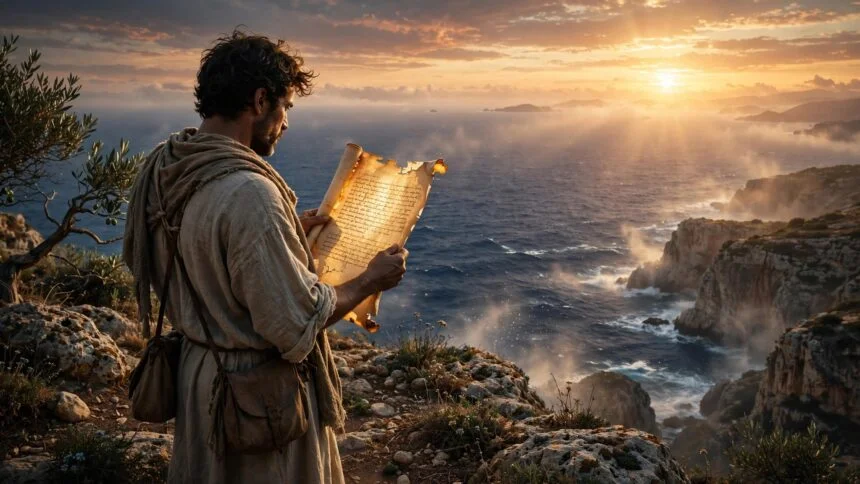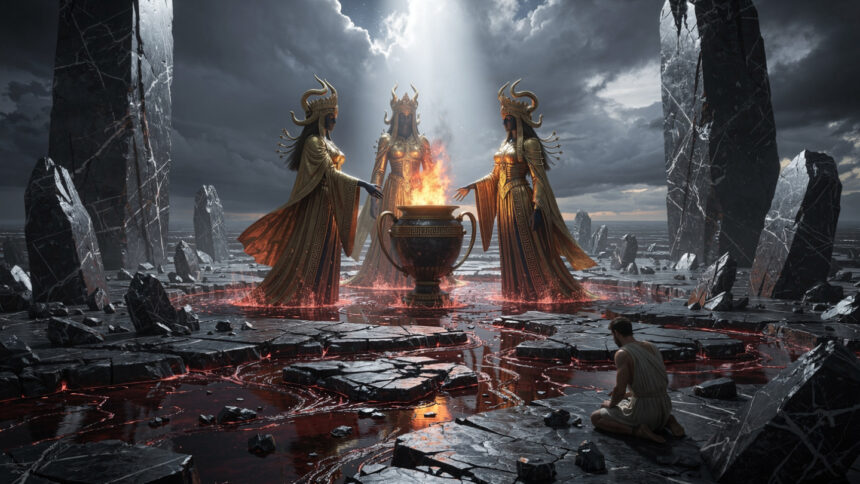





July in the Aegean is not a season you experience passively.
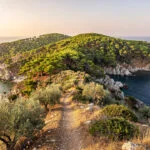
The sun arrives before five in the morning and does not fully release its grip until after nine at night, and in between those two moments it does something to the light that visitors from northern Europe consistently struggle to describe and eventually stop trying to describe, reaching instead for the simplest available statement: the light here is different. The white limestone of the Cycladic islands bounces it back at angles that eliminate shadow almost entirely at midday. The sea surface, flat and metallic in the still hour before the Meltemi wind arrives, acts as a second source, throwing light upward into the undersides of things that have no reason to be lit from below. The olive trees, whose leaves are silver on their undersides and green on top, shimmer in a way that has been producing metaphors in Greek writing since the first Greek writing existed.
The people who lived here first did not call this light a climatic phenomenon. They called it a god, and they built around the god’s daily passage across the sky an entire theological and philosophical vocabulary for what it meant to exist under such conditions, to have your every act and word witnessed by a being who traversed the whole of the visible world each day without missing a single thing that happened beneath him.
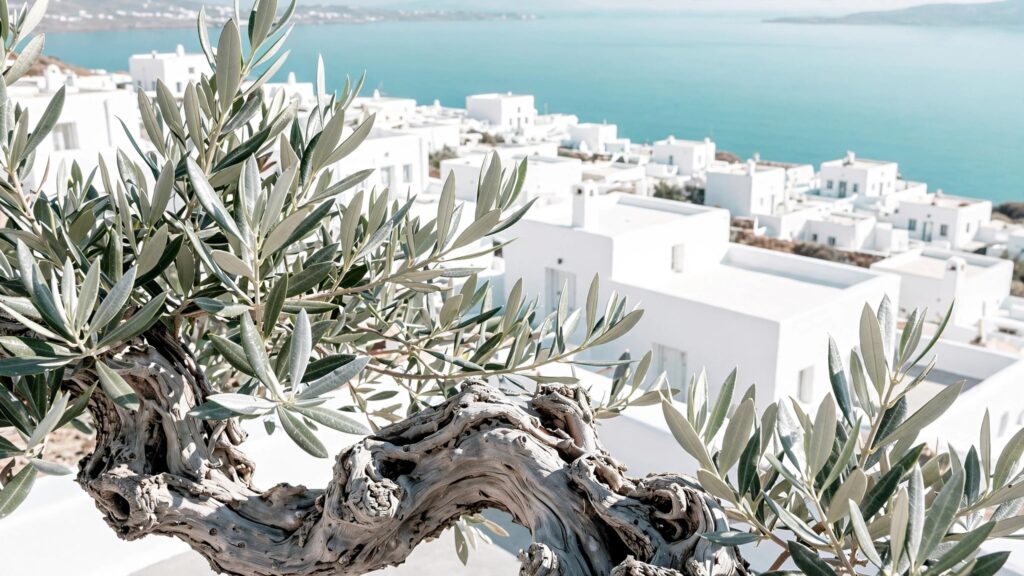
His name is simply the Greek word for sun. That is what Helios means. The Greeks did not search for a metaphor. The sun was divine, the divinity was the sun, and the name acknowledged the identity directly.
What Helios Actually Was
Before the Olympian mythology organized itself into the familiar hierarchy of twelve, the sun had already been moving across the sky in the hands of a Titan, and it kept moving in those hands through the whole of the classical period regardless of Apollo’s subsequent association with solar attributes.
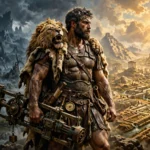
Helios was the son of the Titans Hyperion and Theia, brother to Selene the moon and Eos the dawn, a family of light-bringers whose existence predated the Olympian settlement of the cosmos and whose function could not be transferred or delegated to the Olympian generation without the actual light stopping, which even Zeus could not permit. He drove a chariot pulled by four horses whose names described what they carried: Pyrois, the fiery one, Aeos, the swift, Aethon, the blazing, and Phlegon, the burning. Each morning, after Eos had opened the gates of the eastern sky, Helios ascended from Oceanus in the east and drove his chariot across the dome of heaven, descending into Oceanus again in the west at evening, then spending the night in a great golden cup that carried him, sleeping, back around the southern edge of the world to his starting point in the east, where Eos would open the gates again at dawn.
This route was not merely a narrative explanation for the sun’s daily motion. It was a statement about the relationship between visibility and accountability. Helios saw everything. His chariot’s path across the entire sky from horizon to horizon meant that nothing on the surface of the earth was invisible to him at some point during the day, and the ancient Greeks treated this total visibility as a form of divine witnessing that carried genuine moral weight. Helios was invoked in oaths because he saw all oaths made. He was called upon in treaties because he witnessed their signing from above. When Odysseus’s companions slaughtered the sacred cattle of the sun on Thrinacia, Helios knew immediately, before anyone on earth had told him, because he had seen it happen from his chariot, and his complaint to Zeus that followed was not the report of a spy but the testimony of a witness who had been present for the transgression from the only vantage point that encompasses the entire world simultaneously.
This witnessing function is what distinguished Helios from Apollo, despite their later mythological conflation. Apollo’s solar associations developed gradually and never fully absorbed Helios’s own cult. The two gods are distinct in Homer, distinct in Hesiod, and still distinct in the fifth century BCE. What they share is light, but in different registers: Apollo’s light is the clarity of reason, order, and the intelligible world, the light that makes things comprehensible. Helios’s light is light itself, undirected, physical, total, indiscriminate, falling equally on the just and the unjust, the sacred and the profane, the hiding and the revealed. Apollo chooses where his clarity falls. Helios does not choose. He simply traverses.
The Moment He Missed the World’s Division
When the gods divided the earth among themselves after the Titanomachy, the settlement that gave each deity their particular domain, Helios was not present. He was late, or absent, or otherwise occupied, and the distribution was completed without him.
Pindar, in the Seventh Olympian Ode, gives the most beautiful surviving account of what happened next and why, and it is worth quoting in spirit if not in the letter of its language: the reason Helios missed the allotment was that he had paused his chariot mid-journey to watch the birth of Athena from Zeus’s head, the moment when the sky shook and the earth trembled and a goddess sprang fully formed and armed from the skull of the king of heaven. He was so transfixed by what he was watching from his unique vantage in the sky, the only being present who could see the whole scene from above, that he forgot he had somewhere to be, and by the time the birth was complete and the reverberations had stilled, the other gods had already divided everything.
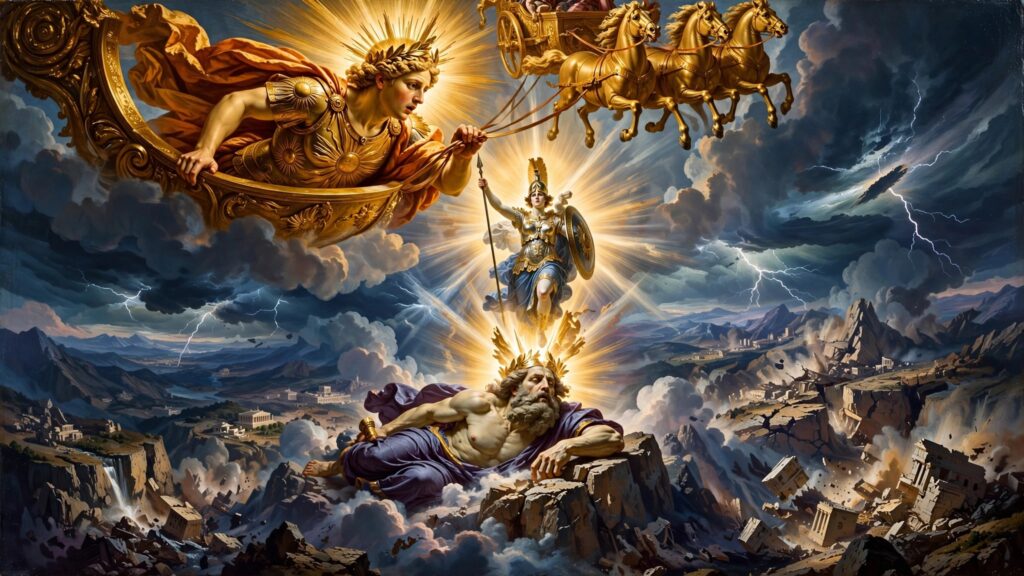
He went to Zeus and explained what had happened. Zeus, who had an obvious interest in the event that had caused the delay, was sympathetic. He offered to do the division again. Helios declined: he had seen, he said, something rising from the sea as he watched, a new island emerging from Oceanus, and he wanted that. He claimed it before it had fully surfaced, and Lachesis, one of the three Fates, swore the oath that bound the claim permanently.
The island was Rhodes.
This mythological account, preserved in Pindar and elaborated by subsequent sources, is the Rhodian people’s explanation for the extraordinary quality of light on their island, and it is considerably more interesting than a simple foundation story. The sun god possesses their island not because he fought for it or was given it as a reward for service, but because he stopped to watch something beautiful and missed what everyone else was doing, and received in compensation a piece of land that had not yet been claimed by anyone because it had not yet finished appearing above the surface of the sea. His patron island is the one given to the god who was paying attention to the wrong thing at the right moment, which makes it the island given to inattention in the service of wonder, an appropriately Aegean distinction.
The Sea Nymph, the Seven Sons, and the Three Cities
The island Helios claimed was not, in the fuller Rhodian tradition, an empty prize. As the new land rose from the water, so did a sea nymph, Rhodos, daughter of Poseidon and Aphrodite in most versions of the genealogy, and Helios, having claimed the island itself, claimed her as well. Their union produced seven sons, the Heliadai, remembered in ancient sources as gifted astronomers and navigators, men who studied the movements of the stars and the sea with the same attentiveness their father brought to his own daily passage across the sky. Three grandsons descending from this same line, Kamiros, Ialysos, and Lindos, gave their names to the three original cities of Rhodes, the settlements that would eventually combine, in 408 BCE, into the single federal city of Rhodes that still bears the island’s name today. The island’s entire civic self-understanding, in other words, ran directly back through Helios’s own household: not a god who merely happened to own the place, but a god whose descendants had built it, city by city, in his own image of careful, attentive observation.
The Halieia, the great festival of Helios celebrated on Rhodes, took its name directly from Halios, the Doric form of the god’s own name, and included chariot and horse racing, gymnastic contests, and music competitions, the victors crowned with wreaths of white poplar, a tree sacred to Helios for the way its leaves catch and throw back the light. But the festival’s most striking rite, recorded by the Roman grammarian Festus, was its central sacrifice: on a fixed day each summer, the Rhodians drove a team of four white horses, yoked to a chariot in careful imitation of Helios’s own quadriga, over a cliff and into the sea. This was not simply an offering. It was a reenactment of the myth this site has already documented in its own right in the Phaethon essay, the sun’s dangerous daily route rendered as a physical act, the horses returned to the same Oceanus from which their master’s chariot rose each morning and into which it descended each night. The Rhodians understood that their patron god’s most sacred attribute was not a static image or a fixed shrine but a route, a journey undertaken and completed anew every single day, and the most complete offering they could make to him was to reenact that route at its most extreme point, the exact place where sky meets sea and the chariot has no choice left but to turn or fall.

It is this same devotion that produced, centuries later, the most famous monument Helios ever received anywhere in the Greek world. After Rhodes withstood a long siege by Demetrius Poliorcetes in 305 and 304 BCE, the Rhodians sold off the massive siege equipment their enemy had abandoned and used the proceeds to fund a bronze colossus of their patron god, standing, by ancient report, some thirty meters tall near the city’s harbor, one of the Seven Wonders of the Ancient World and a subject this site has examined in full elsewhere. The statue stood for barely sixty years before an earthquake brought it down, and an oracle, consulted about rebuilding it, advised the Rhodians to leave it as it had fallen, a piece of counsel they apparently respected, since the fragments remained visible on the ground for centuries afterward, still drawing visitors who came to see the fallen god almost as readily as they might once have come to see him standing. Whether the sun’s own damaged monument lying broken in full public view for that long was received by the Rhodians as a warning, an embarrassment, or just an unavoidable fact of a landscape Helios still governed regardless of what had happened to his statue, no ancient source quite says. But it is difficult not to notice that a god defined above all by his daily, uninterrupted, unbroken route continued that route every single morning directly over the wreckage of the one image his own people had built to hold his likeness still.
Anaxagoras and the God Who Turned Out to Be a Rock
In approximately 450 BCE, a philosopher from Clazomenae named Anaxagoras, who had moved to Athens and become closely associated with Pericles, made a claim about Helios that caused him to be prosecuted for impiety and eventually forced him into exile.
Anaxagoras said the sun was a gigantic red-hot ball of metal, larger than the Peloponnese.
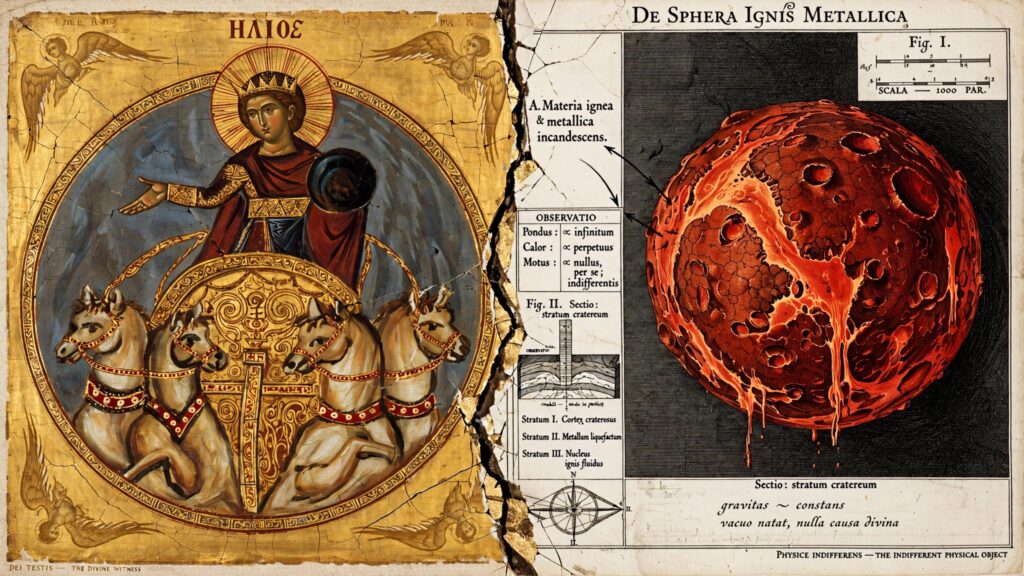
The claim was, in terms of the direction of its thinking if not the specific detail, correct: the sun is a physical object, not a divine being in a chariot. But in Athens in 450 BCE, this claim was not simply a different scientific opinion. It was an assault on the theological framework that made Helios’s daily passage an act of governance rather than a mechanical process, that made the sun’s witnessing of oaths a meaningful form of divine accountability rather than a celestial body with no interest in human affairs. His prosecution, and the more famous subsequent prosecution of Socrates for related forms of impiety a generation later, mark the moment when the pre-scientific understanding of the Aegean sun as a divine presence began to come under genuine philosophical and legal pressure in Athens.
The Ionian proto-scientific tradition had been moving in this direction for a century before Anaxagoras, and the tension between what that tradition called meteora, the phenomena of the heavens, and the religious understanding of those same phenomena as divine beings was not a conflict between superstition and reason alone. It was a conflict between two entirely different accounts of what the summer sky over the Aegean actually was: a journey undertaken by a god who saw everything and bore witness to human affairs from the only vantage point that encompassed all of them simultaneously, or a physical phenomenon that happened to be very large and very hot and entirely indifferent to what happened beneath it.
The Greeks never fully resolved this conflict, which is precisely why both Anaxagoras and Socrates could be prosecuted for impiety in a city that was simultaneously producing the most rigorous philosophy the ancient world would generate. What the persistence of Helios’s cult through the full classical period alongside the development of a genuinely proto-scientific understanding of the sun demonstrates is that the two were not, for most Athenians, mutually exclusive. You could understand the sun as a physical object and still invoke Helios in a treaty, because the witnessing function his theology provided was socially and morally useful in a way that a lump of hot metal having seen you make your promise simply was not.
The Meltemi and What the Greeks Called It
The wind that arrives in the Aegean in July, the north wind that drops the temperature of a day that was otherwise heading toward forty degrees and drives the sea into whitecaps that no small vessel wants to be caught in, was not, in the ancient Greek understanding, a meteorological phenomenon without a name or a character.
The north wind was Boreas, son of Astraeus and Eos, which means he was the brother, in the mythological kinship system, of the very dawn goddess who opened the gates for Helios each morning. The seasonal winds that govern the Aegean summer, the Meltemi, the Etesian winds of the ancient sources, were understood as expressions of divine personality operating within a family system, the brother of the dawn interacting with the domain of the sun’s own daily passage in a relationship that was simultaneously meteorological and genealogical.

Aristotle, in the Meteorologica, distinguished between the Etesian winds that blew in the summer months and the other seasonal winds with the careful observational precision of a genuinely scientific thinker, noting their regularity, their direction, their relationship to the melting of the northern snows and the specific atmospheric conditions of the post-solstice Aegean. He was describing the same wind that Eos’s son had always been. The Aristotelian meteorology and the mythological genealogy were two ways of making sense of the same annual, physically real experience: that the Aegean summer brings, after the flat, airless heat of June and early July, a regular, reliable northern wind that the people of the islands had been building their harbors and their sailing routes to accommodate for as long as they had been building harbors and sailing routes.
This wind is still called the Meltemi. Boats still time their passages around it. Sailors in the Cyclades still watch the north for the quality of haze and horizon-brightness that signals its coming before it has actually arrived. The name has changed from its ancient one. The behavior and the shape and the relief it brings to a July afternoon in the Aegean have not changed at all, because the same sun producing the same heat differential has been driving the same atmospheric pattern across the same geography for as long as the Aegean has been an Aegean.
What the July Sun Does to This Landscape
The quality of Aegean light in July is not only a matter of intensity. It is a matter of angle, of reflection, and of the particular Mediterranean atmosphere that concentrates certain wavelengths and strips away others, producing something that painters and photographers have been attempting to capture in a fixed medium for centuries, with the consistent result that the experience of being in the light is never adequately conveyed by any image of it.
The ancients understood this, and their solution was not photographic but theological: since the light could not be fixed in any medium and remained always slightly beyond what representation could capture, it must be divine. The thing that escaped every attempt to contain it was the thing that was, by definition, not containable. Helios could not be painted adequately because Helios was not a painting. He was the condition under which seeing happened, the medium in which everything visible existed, and no medium could represent the medium itself without some essential quality being lost in the translation.
This is why the Greek summer, and the July Aegean specifically, does something to time that cannot be attributed to longer days or higher temperatures alone. It is the quality of the light that alters the relationship between attention and its object: colors are more saturated, distances are clearer, the line between the sea and the sky at noon is sharper than at any other time of year in any other geography, and the mind, confronted with a visual field of this clarity and intensity, becomes capable of a quality of attention that more diffuse light does not produce with the same ease.
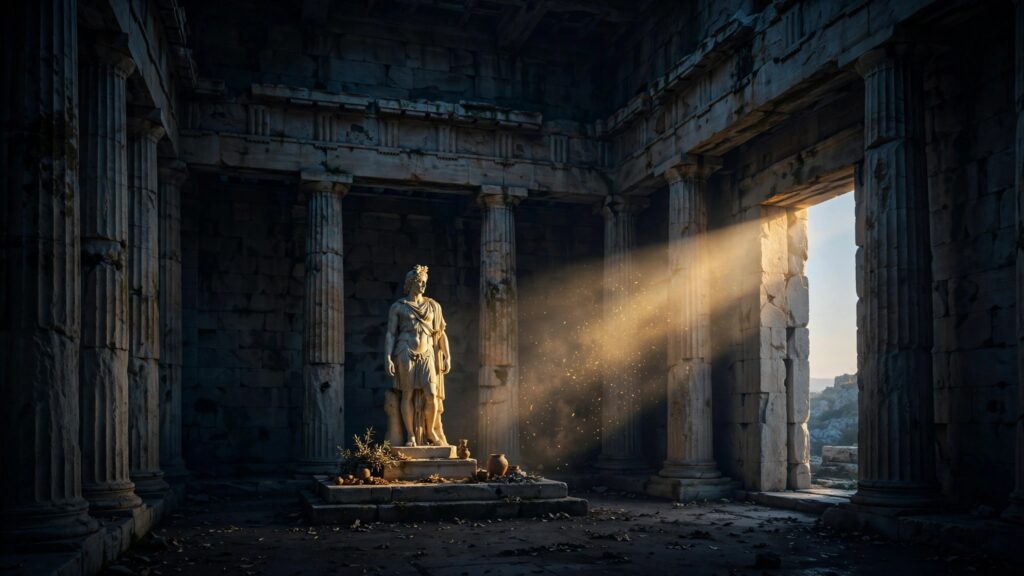
The Greeks built their most important temples on the highest available ground not only for defensive advantage but for the quality of light those positions received, and they oriented those temples, in most cases, toward the east, so that Helios’s dawn arrival illuminated the cult statue inside at the moment of first light, the god of light acknowledging, in the architecture of worship, the specific Titan whose daily passage made the entire visible world available to human contemplation in the first place. Even Corinth, whose acropolis held one of the only other major cult centers Helios possessed outside Rhodes itself, positioned its own shrine to him with the same deliberate relationship to the rising light, a small enough cult in the wider Corinthian religious landscape but a telling one: even a city whose fame rested on trade, war, and Aphrodite still found room to honor the god whose daily arrival made every other activity of the day, commercial or otherwise, visible at all.
What July Asks of Those Who Are Here For It
The ancient Athenians had a practice, documented in various sources, of rising before dawn in the summer months to catch the quality of the light in the first hour after Helios had passed through Eos’s gates and begun his morning ascent, the quality of light that the season and the hour together produce for roughly forty-five minutes before the full intensity of the Aegean day establishes itself. This was not an ascetic practice. It was the recognition that the thing Helios provided was most complete at its edges rather than at its midday peak, that the extraordinary quality of the July Aegean light is experienced most fully not at noon, when it is most intense, but at the hour of its arrival and the hour of its departure, when it has an angle and a warmth that the full strength of midday eliminates through pure intensity.
The hour after dawn on a clear July morning in the Aegean, when the sea is still and the light is low and the whitewashed walls of the islands catch it at an angle that makes them glow from within rather than reflect from without, is the hour that Helios intended, in the theology that named him, to be witnessed. It is also the hour that most visitors to the Aegean sleep through, arriving late and staying up late in the modern tourist rhythm that is in many ways the precise inversion of what the ancient world understood the Aegean summer to be for.
Helios asked, at every dawn, to be received. The people who named him understood that reception required being present at his arrival, not simply at the moment of maximum intensity, and that the quality of the light he provided was most fully available to the person who woke before it peaked rather than the person who waited until it was unavoidable.
He missed the division of the world because he stopped to watch something beautiful, and received in compensation the island that now has more sun than anywhere else in Greece, a nymph and seven sons whose grandsons built its three founding cities, and a festival at which his own worshippers, every summer, drove his chariot back into the sea from which it had always risen. This seems, from the Aegean in July, like less of a story about loss than it initially does.
At Olympus Estate, Tales from Olympus explores the full architecture of Greek myth, including the gods whose domain is the most immediate physical fact of the landscape we write about. Helios was not a metaphor. He was the daily passage of the most powerful force in the Aegean world, and the Greeks named him simply what he was: the sun, understood as a being who saw everything and forgot nothing, traversing the whole of the visible world every day of every year, pausing only once, to watch a goddess being born, and claiming, in that single distracted moment, the island of Rhodes, the nymph who became its own mythical mother, and a festival in which his descendants, every summer for centuries, drove his own chariot back into the sea.