



There is a line buried in Greek mythology that most people have never encountered, and it is one of the most extraordinary sentences in the entire ancient tradition.
Zeus and Hera are arguing about which sex experiences more pleasure in love. The argument has reached the point where neither of them can settle it from their own authority, because neither of them has occupied both sides of the question. They call Tiresias, the blind prophet of Thebes, who has.
He considers. He answers.
“Of ten parts a man enjoys one only. But a woman enjoys the full ten parts in her heart.”
Hera strikes him blind.
This moment, preserved across multiple ancient sources and given its fullest literary treatment in Ovid’s Metamorphoses, is not a minor mythological footnote. It is one of the most precise and most unsettling things Greek mythology ever said about desire, about knowledge, about what it costs to tell the truth to people with more power than you, and about the danger of possessing the kind of understanding that comes only from having lived inside two experiences that most mortals inhabit only one of.
Tiresias knew what he knew because the gods had made him a woman for seven years. He had been a priestess. He had been a wife. He had been a mother. He had lived the interior life of the body in a form entirely different from the one he was born into, and when he was returned to his male form, he carried that knowledge inside him permanently.
Then the gods asked him to use it. Then they punished him for what he reported.
The Greeks were not being straightforwardly cautionary in this myth. They were encoding something more complex: a story about the relationship between experience and knowledge, between knowledge and power, and between truth and the anger of those who benefit from its suppression.
This is that story, taken seriously.
What Happened on Mount Cyllene
The beginning is simple, and the simplicity is deceptive.
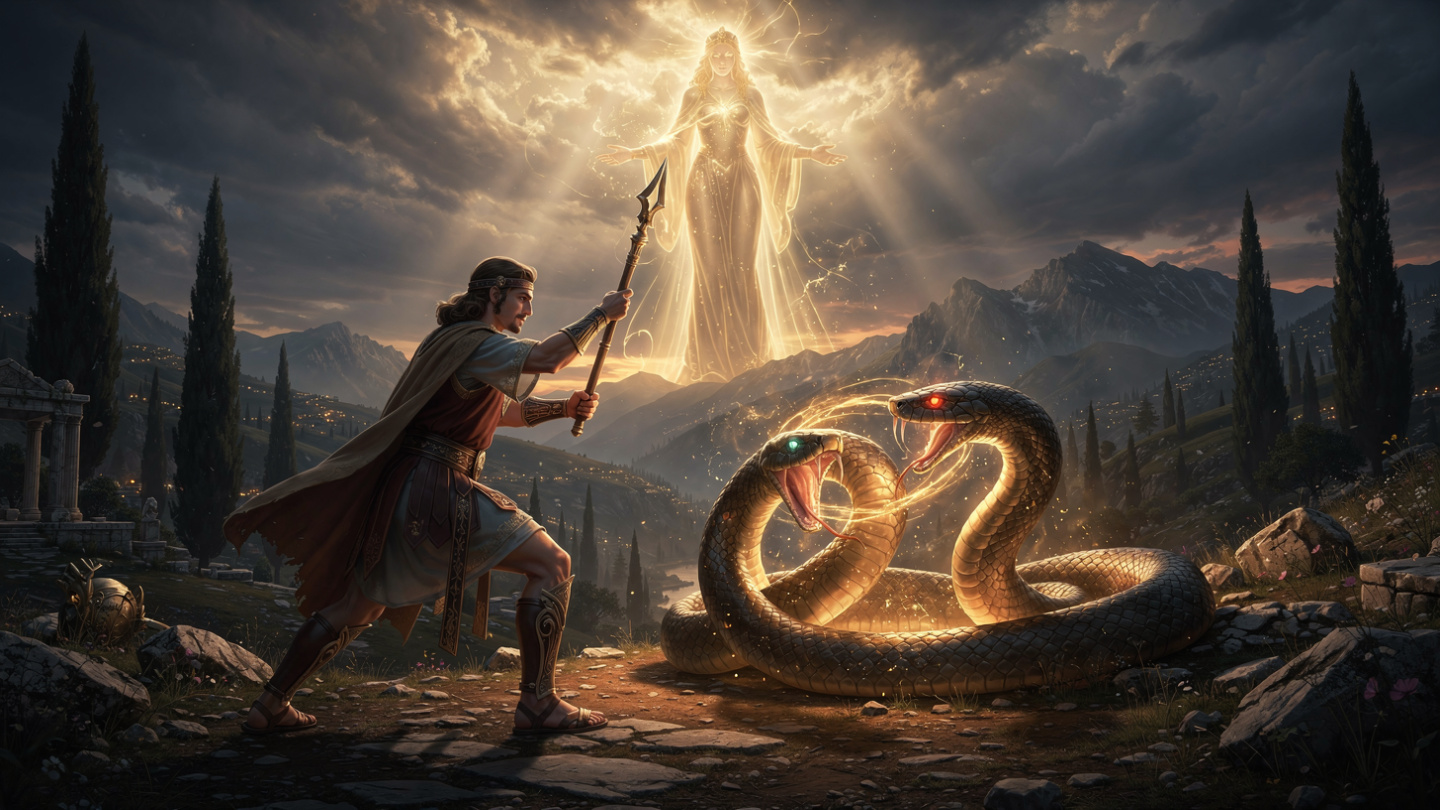
Tiresias, a young Theban of noble birth and no particular divine distinction, was walking on Mount Cyllene in the Peloponnese when he came upon two snakes in the act of mating. He struck them with his staff.
Why he struck them is one of the small mysteries the sources handle differently. Some say disgust. Some say a reflexive response to the unexpectedness of the encounter. Ovid does not explain the motivation at all, as if the act were simply what happened and what matters is its consequence. One version says he struck and injured only one of the snakes. Another says he killed the female. The variation in the sources on this point suggests that the ancient tradition was more interested in the significance of the act than in its psychological motivation.
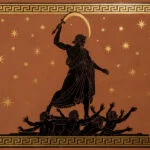
What followed was immediate. Hera, whose connection to the serpent is ancient and whose domain over sacred sexuality made the snakes’ mating a matter under her jurisdiction, transformed Tiresias into a woman.
He became she.

The ancient sources record this transformation with varying degrees of elaboration. What they agree on is that it was complete, that the new female Tiresias did not persist as a man in a woman’s body but became, by divine transformation, a woman in the fullest sense that the Greek world understood womanhood to mean. She became a priestess of Hera, which is itself an extraordinary detail: the goddess who punished her now received her service. She married. She had children. Her daughter Manto, born during these seven years, inherited her prophetic gift and became one of the significant prophetesses of the Greek world in her own right.
For seven years Tiresias lived this life.
The question of what those seven years contained, what it meant to be a priestess of the very goddess who had imposed the transformation, what the experience of marriage and motherhood and the specifically female relationship to the body and to the social structures of the ancient Greek world involved, is a question that the ancient sources do not linger on. They move quickly to the second serpent encounter and the reversal. The interior experience of the seven years is mostly left for the reader’s imagination.
This reticence is itself significant. The Greeks were not squeamish about describing the experience of divine transformation in other myths. What they seem to have understood about the Tiresias story is that the content of those seven years was both too private and too consequential to be summarised. The experience produced knowledge. The nature of the knowledge was demonstrated by what Tiresias said when the gods asked him about it. The intervening seven years were the mechanism, not the story.
The Second Encounter and the Return
After seven years, Tiresias encountered mating snakes again.
The sources vary on exactly what she did this time. The most common version holds that she left the snakes alone, neither striking nor harming them, and that this act of non-intervention reversed the transformation: she became he again, restored to the male form he had inhabited before Mount Cyllene. A less common version, recorded by the mythographer Hyginus and the writer Phlegon, holds that she struck the snakes again and that this second striking, rather than the leaving alone, was what the god Apollo had privately informed her would restore her previous form. In this version the logic is less about restraint than about the pattern of the act: the same gesture that transformed him could, in the right circumstances, reverse the transformation.

What unites the versions is the restoration. Tiresias became male again after seven years, carrying with him the complete interior knowledge of both forms of embodied experience that any being in the Greek world had ever possessed.
The Greeks understood this as unique. Not exceptional. Unique. There was no other figure in the mythological tradition who had inhabited both sexes completely, from the inside, over a sustained period, and who had then been returned to witness the contrast from a position of genuine knowledge rather than speculation. Tiresias was the only being in the cosmos who could answer the question that Zeus and Hera were about to ask him, not because he was particularly wise or particularly prophetic, but because the gods themselves had given him the experience that made the answer available to him.
There is an irony here that the ancient tradition appreciated: the knowledge that made Tiresias uniquely authoritative on the most intimate question the gods could ask him was a knowledge that had been imposed on him as punishment. He did not seek the experience of womanhood. It was given to him against his will, by a goddess who was angry at him, for reasons that had nothing to do with his interest in the question she would eventually require him to answer.
The blindness that followed was also imposed. The prophecy that compensated for the blindness was given, not chosen. Tiresias did not accumulate his extraordinary capacities through ambition or desire. He accumulated them through a sequence of encounters with divine power that left him, each time, diminished in one way and enlarged in another.
The Question Zeus and Hera Could Not Answer Alone
The argument between Zeus and Hera recorded in the Tiresias myth is not a domestic quarrel in the manner of their more familiar conflicts, which tend to involve infidelity, jealousy, and the dynamics of a marriage between the two most powerful Olympians whose interests are chronically misaligned.
This argument is philosophical. It is about the nature of pleasure itself, about where in the human experience the greater intensity of desire and satisfaction resides, and about whether the answer to this question has implications that either of the arguers needs to conceal.
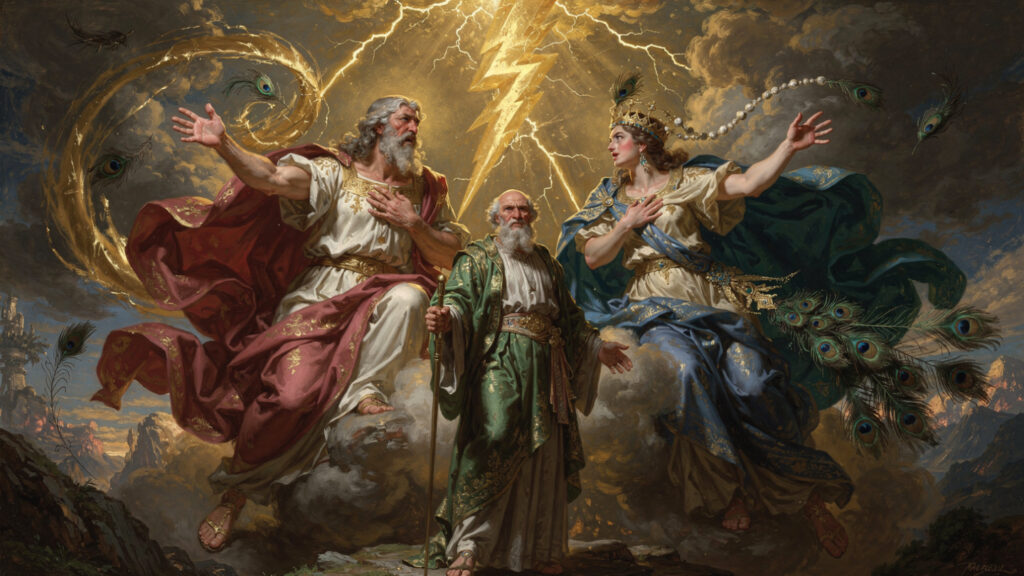
Hera’s position, that men experience greater pleasure, is described in the sources as a claim she had been using to deceive Zeus: she had been arguing this position while privately knowing the opposite was true, for reasons that the sources suggest have to do with maintaining her own claim to a kind of mysterious superiority. If women experience more, then Hera possesses something Zeus does not, a kind of interior richness of pleasure that the king of the gods is not party to. Her argument is a maintenance of advantage through misdirection.
Zeus’s position, that women experience more, aligns with what he apparently knows or suspects from his own extensive experience of both pursuing desire and observing Hera. He wants the claim confirmed by someone whose authority on the subject cannot be questioned.
They call Tiresias.
He considers the question from the position of someone who has genuinely lived both answers. He does not hedge. He does not defer to the power of the beings asking him. He gives the most precise answer available to him, in a formulation that the ancient tradition preserved in exactly the proportional terms in which he delivered it: of ten parts, a man receives one. A woman receives the full ten.
He sided, as the sources note, with Zeus. He exposed what Hera had been concealing. He told the truth as completely as he could tell it, given what his experience had made available to him.
Hera struck him blind.
What the Blindness Actually Means
The blindness of Tiresias is the most discussed element of his myth in the literary and philosophical tradition, and it has accumulated interpretations across twenty-five centuries of reading that range from the straightforwardly punitive to the profoundly paradoxical.
The straightforward reading: Hera blinded him because he answered against her and she was angry. Divine punishment for speaking a truth that embarrassed a goddess. This is accurate as far as it goes.

The paradoxical reading goes considerably further: Tiresias lost his sight of the visible world and gained sight of the invisible one. The god who punished him took from him the capacity to see things as they are in ordinary experience, and in its place, Zeus compensated him with the capacity to see things as they will be. The prophet’s vision, which the Greek tradition consistently associated with a withdrawal from ordinary sensory experience rather than an enhancement of it, was made possible by the removal of the faculty that the Greek world considered the primary instrument of knowing the present world.
Tiresias could no longer see what was in front of him. He could see what was coming.
The blindness also carried an irony in the context of the myth’s internal logic. He had lived for seven years in a world where his gender, and therefore his social visibility, his relationship to public space, his capacity to act independently in the political and religious structures of the Greek world, was fundamentally altered. Female experience in the ancient Greek world was, in significant respects, a kind of reduced visibility: more interior, more constrained, more dependent on the structures of household and religion than the broader public world that male citizenship occupied.
The prophet who knows the future because he cannot see the present is, in this reading, in a relationship to knowledge that has something in common with the female experience he has inhabited: access to a kind of interior knowing that the bright external world of ordinary male experience does not provide, achieved through a removal from that external world rather than a full participation in it.
The Greeks did not make this argument explicitly. They did not need to. The myth makes it structurally, in the relationship between the seven years of female experience and the subsequent blindness that produced prophetic sight. Tiresias’s most significant capacity, his ability to know what others cannot see, emerged from the combination of having inhabited female experience and then been stripped of ordinary male sight. Both movements were in the same direction: away from the confident outward-facing visibility of the Greek male citizen, toward an interior knowledge that the external world cannot access.
What Tiresias Did With What He Knew
The myth of the serpent transformation and the divine question is the origin story. What Tiresias did with the knowledge it produced is the rest of his mythological life, and that life was one of the most consequential in the Greek tradition.
He appears in the Oedipus cycle as the prophet who knows the truth about Oedipus’s origins before Oedipus does and who attempts, with the careful indirection of someone who has learned that speaking truth to power has costs, to prevent the catastrophe that Oedipus’s determination to know everything brings upon him. The scene in Sophocles’ Oedipus Rex where Tiresias and Oedipus argue over what the prophet knows and what he is willing to say is one of the great dramatic confrontations in world literature: a man who insists on knowing the truth arguing with the only person who has it and who understands that the truth will destroy the man who demanded it.
He appears in the Theban cycle at multiple points: advising Creon, warning the city, delivering judgements that nobody wants to hear and that prove correct in ways that arrive too late to prevent what they predicted.

He appears in the Odyssey, retained in his prophetic capacity even after death in the underworld, where Odysseus descends to consult him. Odysseus feeds the shade with blood to give it temporary speech and receives from the dead prophet the guidance he needs to complete his return to Ithaca. The prophet who lived seven times longer than an ordinary mortal, who retained his prophetic gifts through death itself, is the one being Odysseus cannot manage without.
What unites these appearances is the consistent character of what Tiresias knows and how he delivers it. He does not comfort. He does not simplify. He does not tell people what they want to hear, and the myth’s central episode, his answer to Zeus and Hera’s question, established this as a defining quality: he had been blinded for telling the truth once and it had not taught him to tell anything other than the truth. The prophetic capacity that the blindness gave him was deployed with the same honesty that the blindness had punished him for.
This is a kind of integrity that the myth encodes precisely: the person who has paid the full cost of honesty and continues to practice it anyway. Not because they are unafraid of the consequences but because the experience of having lived inside multiple truths has made dishonesty structurally unavailable to them. Tiresias could not pretend to know less than he knew. The seven years had made that impossible.
Hera’s Role and What It Reveals
The position Hera occupies in the Tiresias myth is more complex than the role of angry divine punisher that she most visibly plays, and the complexity is worth examining directly.
In the first episode, she transforms Tiresias into a woman because he disturbed her snakes. The punishment appears disproportionate to the offence. A young man, walking in the mountains, strikes at mating snakes with his staff. The response is a complete transformation of his embodied identity for seven years. The disproportion is the signal that the myth is not about proportional justice but about something else.
Hera is the goddess of marriage and the sanctity of the bond between male and female. The mating snakes she protects are, in her theological domain, the sacred expression of that bond in the natural world. Tiresias’s act of disruption, whatever his motivation, violates something that Hera considers inviolate. Her response is to give him, involuntarily, the complete experience of the female side of that bond: not as a punishment in the conventional sense of suffering, but as an enforced education in what he had treated carelessly.
She makes him a priestess in her own service. This is the detail that most retellings underemphasise, and it changes the entire character of the seven years. Tiresias does not live as a woman in isolation or obscurity. She is initiated into the service of the goddess who transformed her, made a participant in the religious structures through which Hera’s domain over marriage and the sacred bond is maintained. She learns, from the inside, what those structures protect and why they matter.
Then, in the second episode, Hera blinds Tiresias for telling the truth about female pleasure. The same goddess who gave him the female experience and made him her priestess strikes him blind for reporting what that experience contained.

This sequence is not a simple story of divine malice. It is a story about the danger of knowledge that belongs to two worlds simultaneously. Hera gave Tiresias the female experience. She did not give him permission to report it to Zeus. The knowledge was meant to be interior, held within the structures of female religious experience, not deployed in a divine argument that would expose what Hera had been concealing about the nature of female desire.
Tiresias violated this implicit boundary not through dishonesty but through complete honesty. He told the truth as he knew it, which is exactly what a prophet is supposed to do, and the goddess who had made the truth available to him punished him for making it available to others.
What Came After | The Tradition That Received This Story
The Tiresias myth did not stay in the ancient world. It moved through the Western tradition with the persistence of stories that contain something genuinely unresolved, something that each generation needs to work out for itself.
Ovid gave it its most complete literary treatment in the Metamorphoses, where it sits in the third book alongside the stories of Narcissus and Echo, Actaeon and Artemis: a cluster of myths about sight, identity, and the consequences of seeing or knowing things that the divine order would prefer to keep concealed. The placement is not incidental. Ovid understood the Tiresias story as belonging to a category of mythological experience: the encounter with knowledge that changes the person who receives it and that cannot be shared without cost.

Alfred, Lord Tennyson wrote “Tiresias” in 1833 and revised it for fifty years, finally publishing it in 1885, making it one of the most extensively revised poems in the Victorian tradition. His Tiresias is a figure of exhausted wisdom: a prophet who has been right so many times, who has warned so many kings who did not listen, that the gift of foresight has become less a power than a burden.
T.S. Eliot placed Tiresias at the centre of The Waste Land in 1922, describing him in the notes as “the most important personage in the poem, uniting all the rest.” Eliot’s Tiresias has “foresuffered all,” having enacted in advance every experience the poem describes, male and female, ancient and modern, the full range of human suffering across its various forms. The choice of Tiresias as the poem’s central consciousness was not incidental: Eliot needed a figure who could hold contradictory experiences simultaneously, who had been inside both the male and the female experience of desire and its disappointments, who could observe without being confined to a single perspective.
The myth has continued to generate this kind of engagement because it contains something that the Western tradition has found genuinely difficult to settle: the question of what it would mean to know desire from both sides of the experience, and what such knowledge would reveal about the asymmetries in how desire is distributed, described, and discussed.
Tiresias’s answer, that women experience nine times what men experience, has never been scientifically verified. But neither has it been refuted. The question it answers remains one that the tradition has continued to circle around, in philosophy and psychology and literature and medicine and ordinary conversation, precisely because the answer that Tiresias gave from the authority of his unique double experience was so specific and so complete that it has never been entirely superseded.
What the Greeks Were Actually Saying
Let’s be direct about the argument the Tiresias myth is making, because it is more precise and more challenging than the story’s most familiar elements suggest.
The Greeks built a myth in which the only being in the cosmos with genuine authority on the question of comparative desire was a mortal man who had been involuntarily transformed into a woman for seven years, served as a priestess, raised children, and then been returned to his male form. The authority was not theoretical. It was experiential. And when that authority was exercised, honestly and precisely, the being who had created the conditions for the authority to exist struck him blind for using it.
The myth is, among other things, a myth about what happens to knowledge that threatens power.
Hera did not want Tiresias’s answer because it confirmed what she had been concealing: that the female experience of pleasure is vastly richer than the male, and that the structures of the ancient world, which gave men public authority and restricted female experience primarily to the domestic and religious spheres, were not a reflection of female limitation but of a social arrangement that kept a specific and inconvenient truth out of the public record.
The prophet told the truth. The powerful figure who benefited from the suppression of that truth took from him what she could take. Zeus, who received the benefit of the truth, compensated him with the gift that the blindness had accidentally made possible: the sight of what is coming, given in exchange for the sight of what is.
The Greeks were not naive about what they had encoded here. They knew the myth was about more than mating snakes and divine domestic arguments. They preserved it across centuries of retelling, in multiple versions, with the central exchange, the question, the answer, the blindness, the prophecy, consistently intact, because it said something true about the relationship between knowledge, power, gender, and the cost of honesty that no other myth in the tradition said with the same precision.
At the Cost of His Sight
Tiresias lived seven lives. He was given this span by Zeus in partial compensation for what Hera had taken, because the blindness was not reversible and the gift of prophecy, however extraordinary, was not an equal trade for the sight of the ordinary world.

He spent those seven lives telling truths that people did not want to hear. He told Oedipus what Oedipus had demanded to know and would have preferred not to. He told Creon what the city required and Creon refused to act on. He told the gods what they had asked and was punished for the accuracy of his answer.
He retained his prophetic gifts after death. When Odysseus descended to the underworld and needed guidance he could not obtain from any living source, he sought out Tiresias. The shade of the prophet, temporarily restored to speech by blood, told him what he needed to know to get home.
The man who had been a woman, the prophet who had been blinded for telling the truth, the mortal who had lived inside the full range of human experience and reported it honestly to those with the power to punish him for it: this is the figure the Greek tradition made its most enduring prophet. Not because prophecy is a comfortable gift. Because the truth, as Tiresias demonstrated at the cost of his sight, is not given to those who protect the powerful from it.
It is given to those who have lived inside enough different kinds of experience to know what the powerful prefer to conceal.
And who are willing, despite knowing what that costs, to say it anyway.
At Olympus Estate, Mythic Essays traces the deeper currents of Greek myth. Zeus and Hera argued about which sex experiences more pleasure. Neither could settle it from their own authority. They called Tiresias, who had lived seven years as a woman and seven years as a man. He answered. Of ten parts a man enjoys one only. A woman enjoys the full ten parts in her heart. Hera struck him blind. The Greeks were not being cautionary in this myth. They were encoding something more complex: the relationship between experience and knowledge, between knowledge and power, and between truth and the anger of those who benefit from its suppression.