
Greece has been softening itself for tourists for decades.
Not dishonestly. The islands genuinely are beautiful. The food genuinely is extraordinary. The light genuinely does something to the Aegean that no other light does anywhere else. The softening is real because the material is real: Greece has not needed to invent its appeal, only to present the most accessible version of it to the largest possible audience.
But there is a part of Greece that refused to soften.
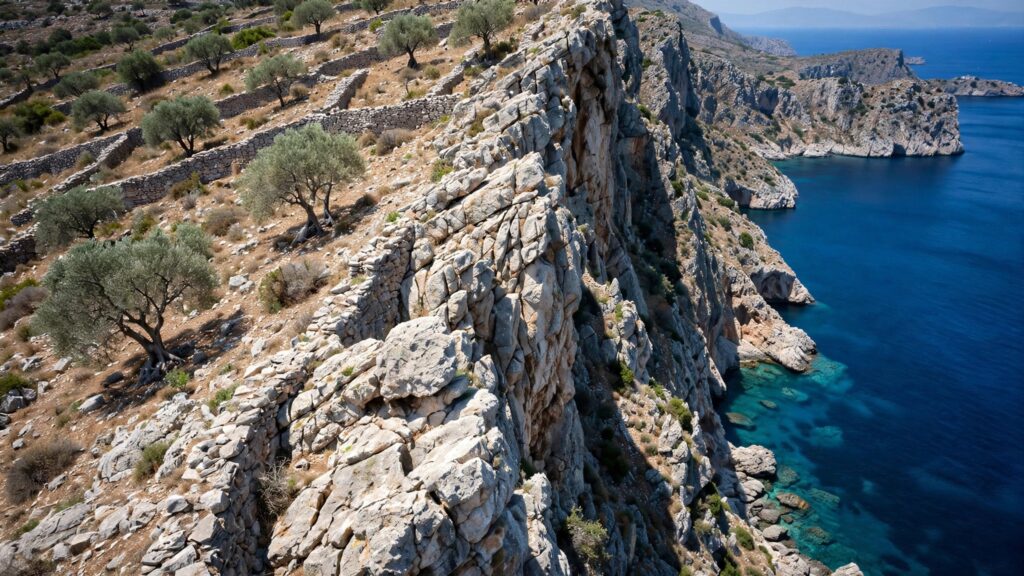
The Mani Peninsula, the middle prong of the trident-shaped southern coast of the Peloponnese, is the place where the rest of the country’s accommodations with modernity, with comfort, with the requirements of visitors who need things to be easier than they actually are, do not apply. It is a landscape of savage beauty and equally savage history: a limestone finger pointing south into the Mediterranean, its spine formed by the Taygetos mountains dropping in sheer walls to a sea so clear that you can count the rocks on the bottom from a boat in ten meters of water, its villages built not for beauty but for warfare, its people descended from clans who spent four centuries killing each other from the upper floors of stone towers and who, when the Ottomans arrived, simply redirected that energy outward and never submitted.
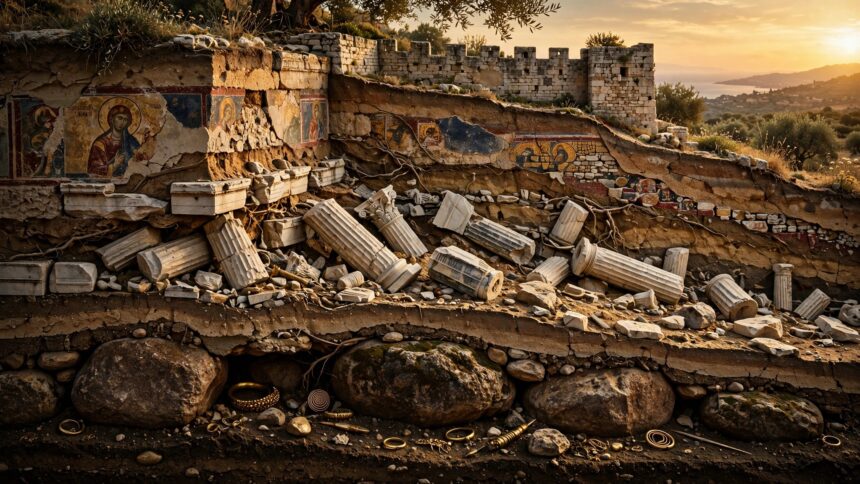
What the towers do not tell you is that the same culture maintained, in parallel and largely through its women, a tradition of funerary poetry that scholars have traced directly back to the laments of the Iliad: verses composed on the spot at the graveside, in a form that the Greek tragic chorus inherited from the same source, binding the mourners to vows of vengeance or protection in the same breath that they grieved. The Mani built upward in stone for its feuds and outward in language for its dead, and both traditions are equally old, equally serious, and equally necessary to understanding what this peninsula actually is.
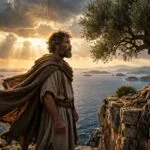
Patrick Leigh Fermor, who walked through the Mani in the 1950s and then spent the rest of his life in Kardamyli because he could not bring himself to leave, wrote of it as the place where Greece was most completely itself: stripped of pretension, indifferent to approval, shaped entirely by the logic of its own history and its own landscape. He was right. It is still true.
This is the article for the person who has done the islands and wants to understand what Greece looks like when it has never been asked to perform for anyone.
A Geography That Made Everything Inevitable
You cannot understand the Mani without understanding its geography, because the geography explains everything else: the violence, the autonomy, the architecture, the quality of light and hardness that the landscape communicates before you know enough history to interpret it.
The Taygetos mountain range, whose highest peak reaches 2,407 meters, forms the backbone of the peninsula and separates it from the rest of the Peloponnese with an effectiveness that no political boundary could have matched. For most of Greek history, you reached the Mani not by the road that was finally cut through in the 1970s but by sea or by mountain pass, and both routes were controlled by the people who lived there. The Ottoman Empire built roads through most of the territories it governed. It did not build a road through the Mani, because the Mani did not permit it.
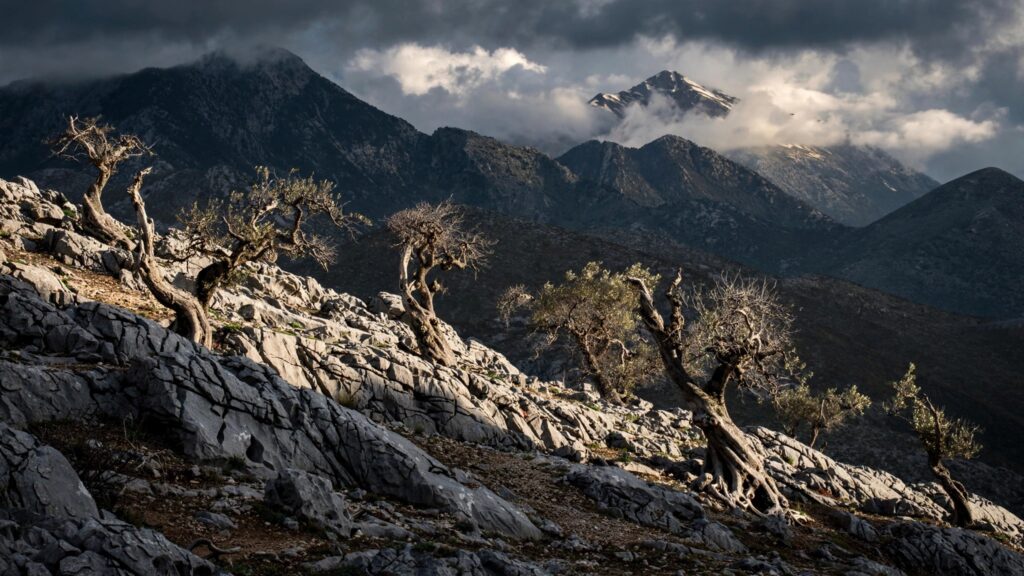
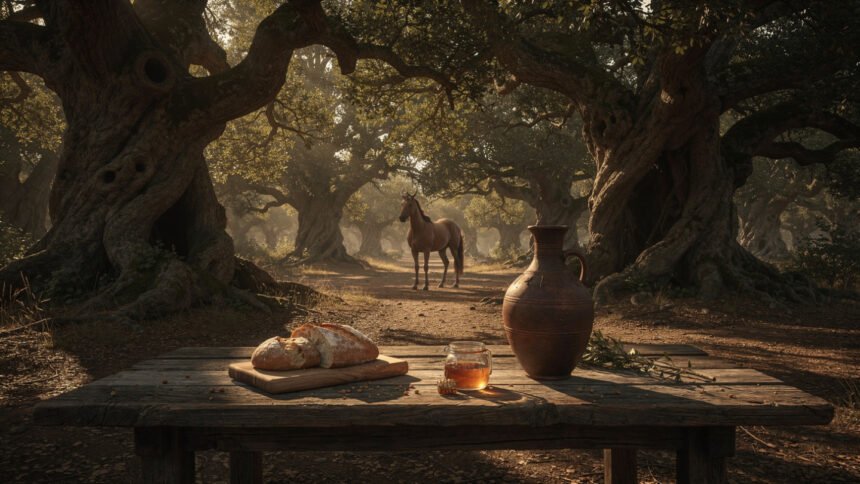
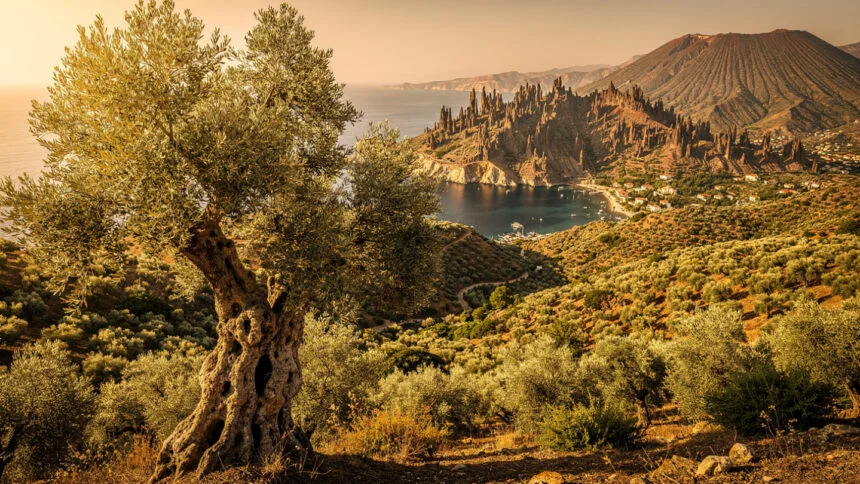
The landscape inside this geographical enclosure is the landscape that happens when limestone meets sea and resists everything: sharp ridges, dry terrain, sparse vegetation except where the olive trees have managed to establish themselves in the thin soil between rocks. The olives of the Mani are among the oldest cultivated trees in Europe, their trunks twisted by centuries into shapes that suggest they have been engaged in a private struggle with the terrain for as long as anyone can remember.
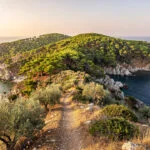
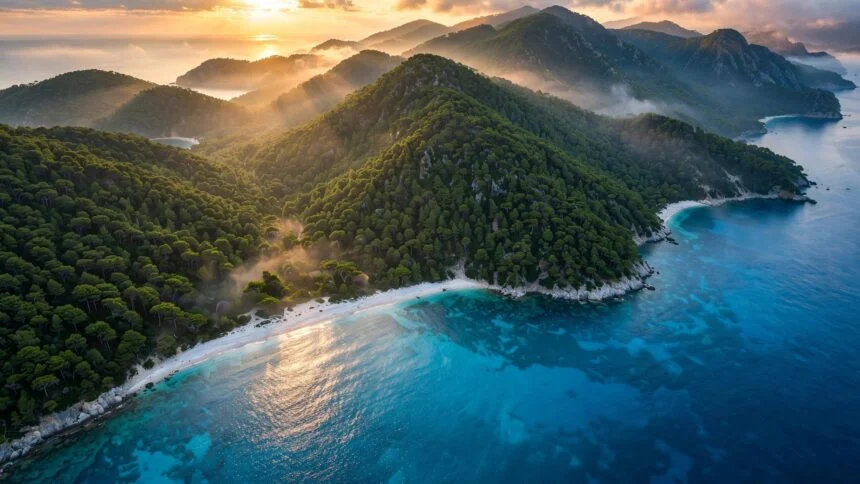
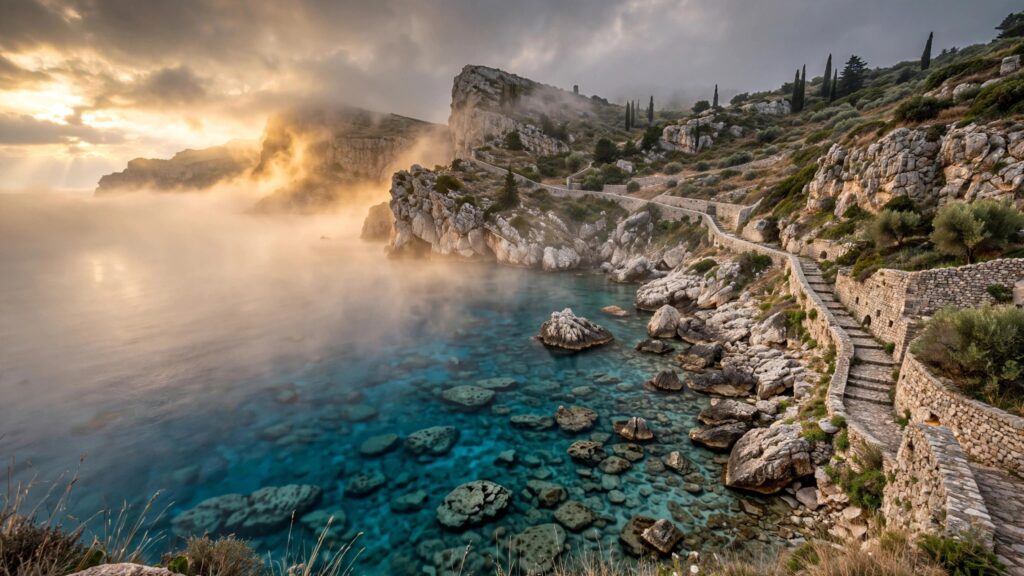
The coastline is the Mani’s other landscape: not the sandy-beach Mediterranean of the tourist imagination but something more austere and more compelling, coves of pebble and rock where the water achieves a clarity that is almost hallucinatory, colors shifting from transparent turquoise over sand to deep blue-green over rock in the space of a few meters.
This is not a landscape that invites passivity. It asks something of the person who enters it. The Maniots, who have been entering it for four centuries, arrived at an answer to what it asked: a culture of honor, self-sufficiency, and a relationship with violence that was neither casual nor regretted but structural.
The Towers and What Built Them
Stand in the village of Vatheia on a clear afternoon and look at what surrounds you.
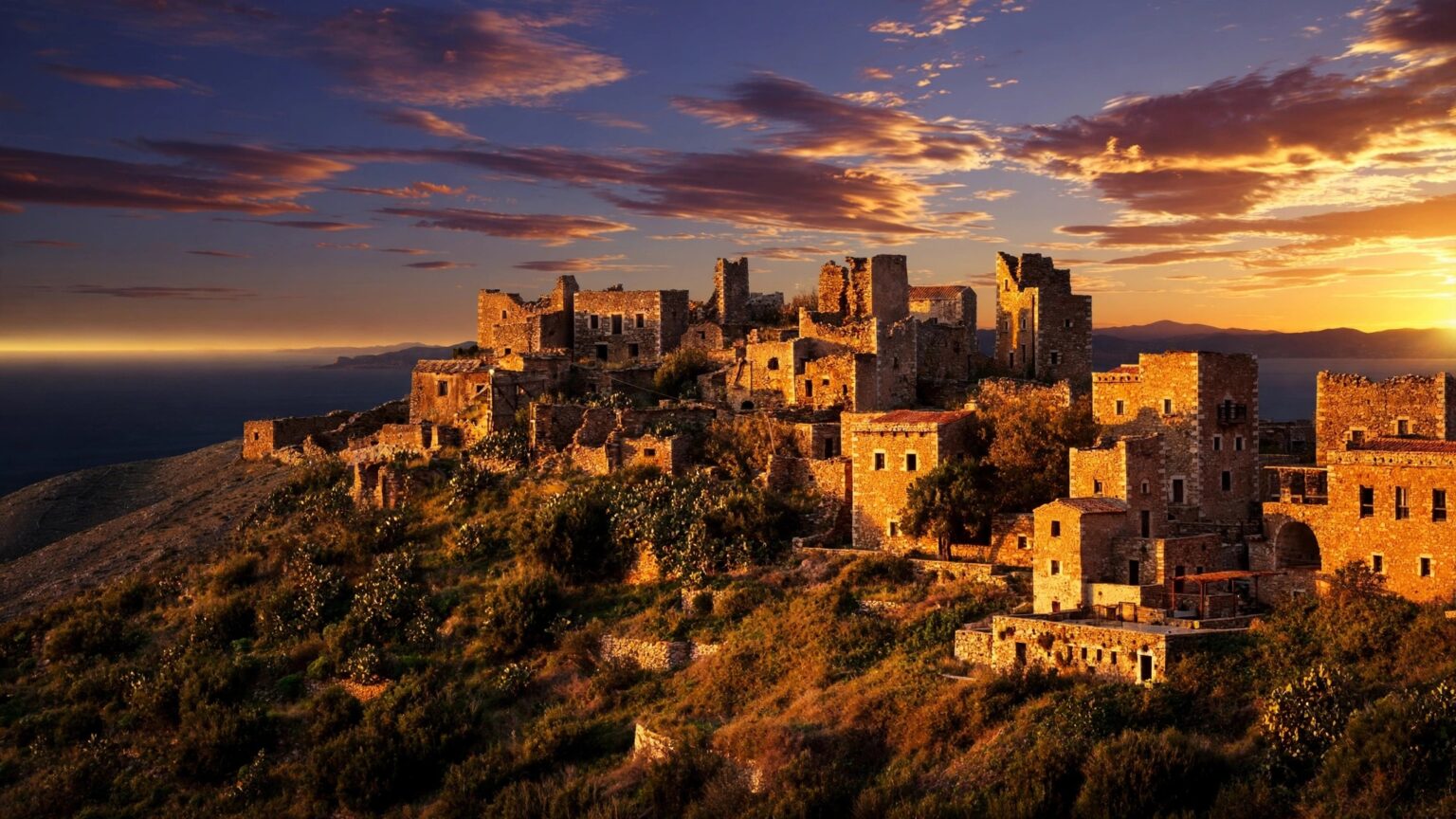
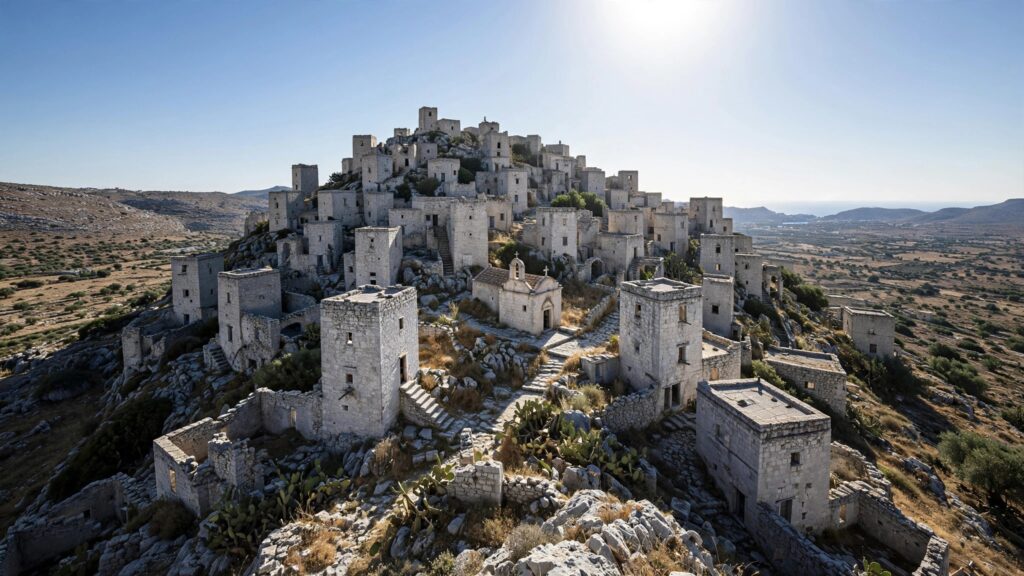
Tower houses, dozens of them, clustered on the hilltop like a stone city frozen mid-construction. Some are intact, some are ruined to their first or second floor, some are ghost structures with no roofs and no floors but walls that have held their form across centuries. The towers are square, massive, built primarily between 1770 and 1850 from the local grey limestone in courses that required considerable skill to lay, their narrow window slits positioned not for light or ventilation but for firing through. The tallest among them would have reached twenty meters or more.
Vatheia is the most dramatic and the most photogenic expression of what blood feud architecture produced across the Deep Mani. The story begins in the fifteenth century, when the collapse of Byzantine power and the subsequent pressure of Ottoman expansion brought waves of refugee aristocratic families into the Mani. The peninsula’s inaccessibility made it a refuge, and the families who arrived brought with them the social codes of a Byzantine nobility that had lost everything except its pride, building a new social order on that pride in the most literal possible way.
The Nyklians, the privileged clan families of the Mani, held the exclusive right to build towers, a formal social distinction that separated them from the non-Nyklian population who were restricted from building at the same height or in the same style. The tower was not simply a defensive structure. It was a declaration: we have the standing to build this, to defend ourselves from this height against those who would challenge us. The height of your tower announced the power of your family in the same register that a coat of arms announced it elsewhere in Europe, but with the additional dimension that the tower was functional rather than merely symbolic.
The vendettas themselves had a name and an internal logic: gdikiomos, retaliation that arose from disputes over property, power, or insults to family reputation, compelling a response across generations to restore equilibrium. These were collective obligations of entire families rather than personal quarrels, governed by unwritten codes that dictated the scale and timing of reprisals. Some of the longest-running rivalries, of which the feud between the Gatzouli and Mavromichalis families is among the most cited, inflicted heavy losses on both sides across years of intermittent siege and exemplified how thoroughly such rivalries could come to define an entire region’s social structure.
When a feud began, announced by the ringing of the village church bell, the families retreated to their towers and the siege began. Women were protected and could move freely to supply the towers with food and water. Truces were called at harvest time, because the olive crop had to be gathered or everyone would starve. The feud resumed when the harvest was in. It ended only when one side was annihilated or completely surrendered.
The last recorded blood feud in the Mani took place in 1870 in the village of Kita, and was stopped only by the intervention of the Greek army.
The Women Who Sang the Dead Into Their Obligations
While the men of the Mani built upward in stone, the women of the Mani maintained, in parallel, an oral tradition every bit as structural to the culture’s survival: the moirologia, the ritual laments performed exclusively by women at the graveside.
This is not folk color. Scholars studying the form have traced its structure directly back to the choirs of Greek tragedy, in which a principal singer began the mourning and a chorus followed, and further back still to the funerary poetry that Homer recorded in the Iliad, whose laments for the dead share a striking formal resemblance to what Maniot women were still performing into living memory. The laments blended melodic improvisation, spoken dialogue, and exclamations to invoke the deceased’s fate, express communal sorrow, and, crucially, negotiate the social obligations of the living: a moirologia did not simply express grief. It bound the surviving kin, in the act of mourning itself, to vows of vengeance or protection, mirroring in its solemnity the oath-taking of a Maniot wedding.
The women who performed this role were professionals in the fullest sense, composing verses on-site to personalize the grief of a specific death for a specific family. Their performances were antiphonal, and their physical expression of despair, hunched figures dressed entirely in black, head coverings framing eyes and mouths in a manner one observer compared to figures from an El Greco painting, was itself part of the art. Ethnographic researchers have collected over a thousand documented variants of these laments across the twentieth century, a body of oral literature that preserved family histories of loss in a form that no written record could replicate, because the form itself, composed fresh at each grave, was the point.
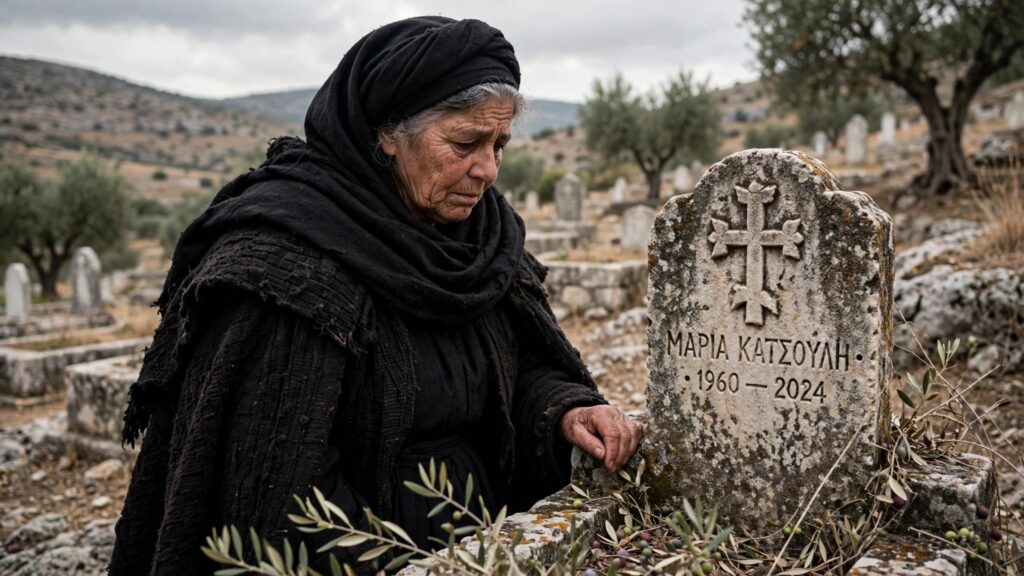
The custom persisted into the early twenty-first century before waning under the pressure of modernization and, from the 1980s, legal restrictions on hired mourning. It is a tradition every bit as old and every bit as serious as the towers that dominate the photographs of the peninsula, and it deserves equal weight in any honest account of what the Mani actually built across its centuries of isolation: not only fortresses against the living, but a sustained, female-authored literature against forgetting the dead.
What the Ottomans Found Here
The Ottoman conquest of the Peloponnese in the fifteenth century reached the Mani and stopped.
Not because the Ottomans were incapable of pressing further. What it found in the Mani was a calculation of costs and benefits that produced a different arrangement: the Mani would not be subdued, but it would not be ignored. It would be governed through its own internal leadership structure, paying a tribute to the empire in exchange for a degree of autonomy that no other Greek region enjoyed.
The arrangement was formalized through the institution of the bey, the local chieftain who governed the Mani on behalf of the Ottomans while in practice governing it on behalf of the Maniots. The Maniots engaged in piracy against Ottoman shipping with a regularity that the empire found annoying and never fully suppressed.
When the Greek War of Independence began in 1821, the Mani was ready in a way that no other Greek region was ready, because it had never stopped being at war. Petros Mavromichalis, the last bey of Mani, gathered the clan leaders at Areopoli on March 17, 1821, a full week before the date the rest of Greece would come to commemorate as the start of the revolution, and proclaimed the uprising there first. Within days, Maniot fighters had joined forces with Theodoros Kolokotronis and taken Kalamata, the first major city of the revolution.
The independence of Greece should have satisfied the Mani. It did not. When Ioannis Kapodistrias, the first president of the new Greek state, attempted to extend central government authority over the peninsula, the Maniots resisted with the same energy they had directed at the Ottomans. The conflict culminated in the assassination of Kapodistrias by members of the Mavromichalis family in 1831. The Mani had fought for Greek freedom. It had not fought to be governed by Greeks.
The Deep Mani and the Outer Mani | Two Different Worlds
The peninsula divides itself naturally into two regions with distinct characters, and understanding the difference shapes how you travel through it.
The Exo Mani, the outer or northern Mani, is the part that most visitors know. It runs along the western coast of the peninsula from Kalamata south through Kardamyli and Stoupa to Areopoli. It is greener, more accessible, more accommodating to the kind of travel that involves comfortable hotels and reliable restaurants.
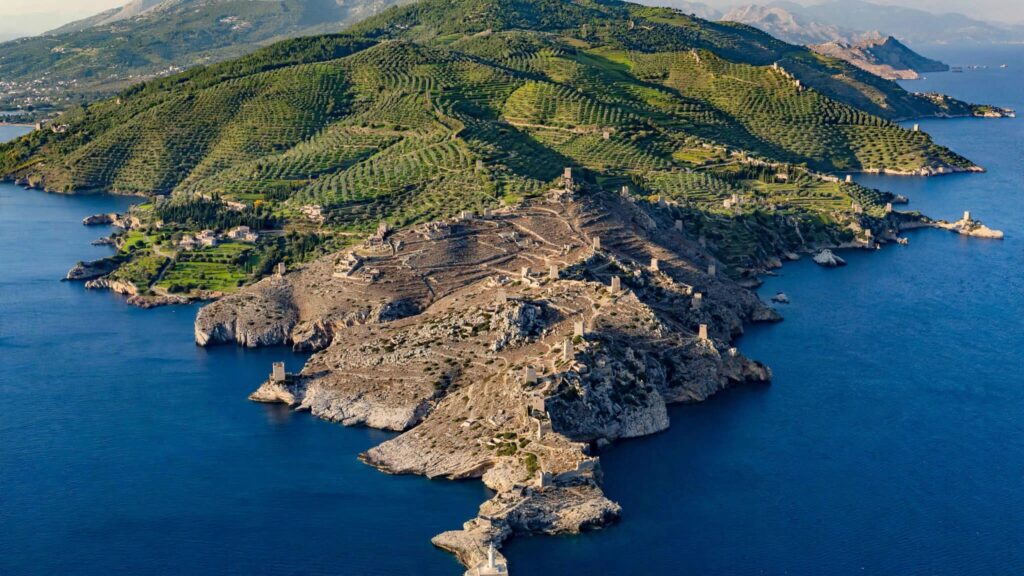
The Mesa Mani, the deep or inner Mani, begins south of Areopoli and continues down to Cape Tainaron at the very tip of the peninsula, the southernmost point of mainland Greece. This is the landscape that the blood feud culture produced and that the absence of people has preserved: dry, austere, wind-scoured, the towers in their villages rising against a sky that offers no softness.
If you have limited time in the Mani, go south. The Outer Mani is pleasant and has its rewards. The Deep Mani is what you came for.
Kardamyli | Where Patrick Leigh Fermor Stayed and Never Left
There is a house outside the village of Kardamyli, in the olive grove above a small bay, that is now managed by the Benaki Museum of Athens and open to visitors on Tuesdays, Thursdays, and Saturdays.
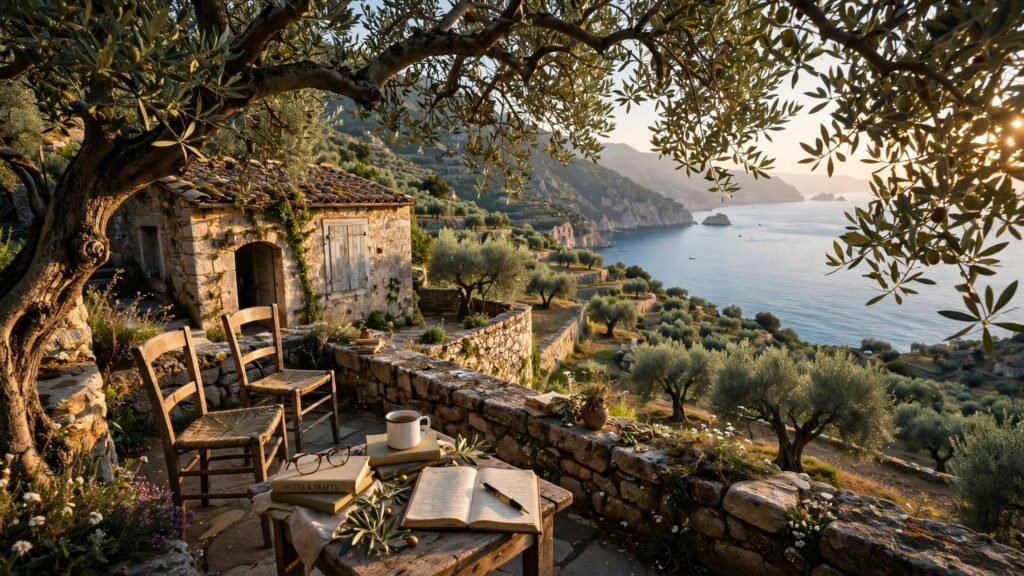
Patrick Leigh Fermor built it in the 1960s, partly with his own hands, on a site he chose for the view it commanded over the water and the island just offshore that he swam around every morning until a heart condition prevented it. He lived there until his death in 2011 at the age of ninety-six, and the house is everything that a writer’s house in the Mani should be: built of local stone, surrounded by the landscape that inspired the book about the Mani that remains the best account of the place that has ever been written.
The Kardamyli that exists today is not the Kardamyli that Leigh Fermor arrived in. The roads came. The tavernas multiplied. Stoupa, ten kilometers to the south, became the resort that Kardamyli resisted becoming. Kardamyli kept more of its character than most. The old town with its fortified Mourtzinos tower complex is genuinely old, and impressive with it. The hiking trails into the Viros Gorge, a twenty-kilometer canyon of extraordinary wildness, begin from the village.
Areopoli | Where the Revolution Began
Areopoli is named for Ares, the god of war, renamed specifically in 1831 to commemorate the role it played in the independence revolution. The original name was Tsimova. The renaming was not modesty.
It is the capital of the Deep Mani and the largest working town in the peninsula’s southern section. The central square, Plateia Athanaton, the Square of the Immortals, is named for the Maniot fighters who died in the independence struggle and framed by tower houses softened by time into something closer to austere domestic architecture than defensive fortification.
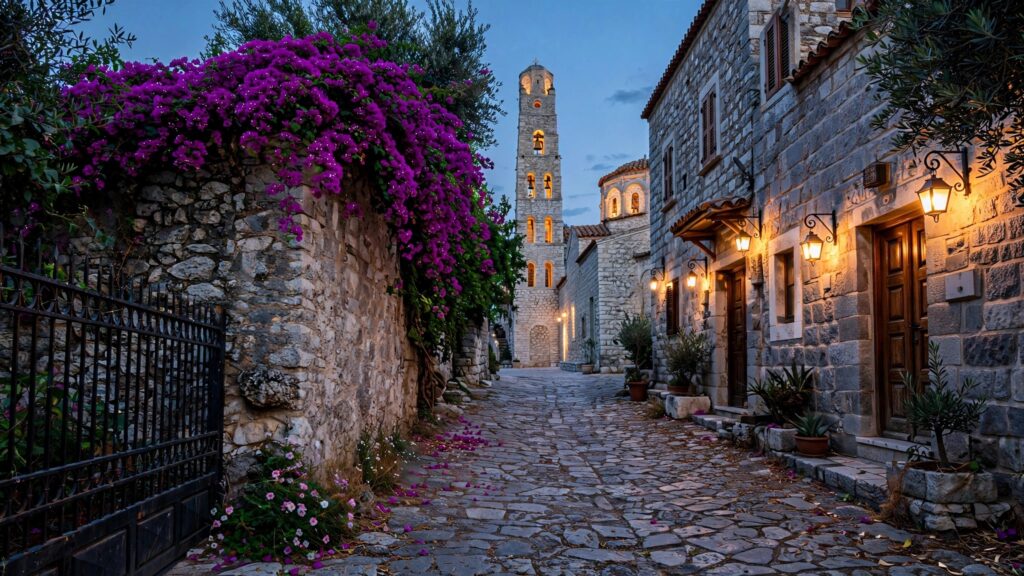
The church of the Taxiarches in the old quarter has eighteenth-century frescoes of a quality that surprises most visitors who encounter them: vivid, well-preserved, iconographically rich in the Byzantine tradition that the Mani maintained more continuously than most Greek regions because of its isolation.
Diros Caves | The Underworld Has an Address
Twelve kilometers south of Areopoli, the Diros Caves are the most visited attraction in the Mani and among the most extraordinary natural sites in Greece.
The visit is by boat, guided through narrow channels of an underground lake system extending for kilometers beneath the limestone, much of it still unexplored, with formations ranging from bone white to deep amber above you and reflected in the water below. The caves have been occupied by humans since the Neolithic period, with archaeological evidence suggesting habitation from at least the fifth millennium BCE.
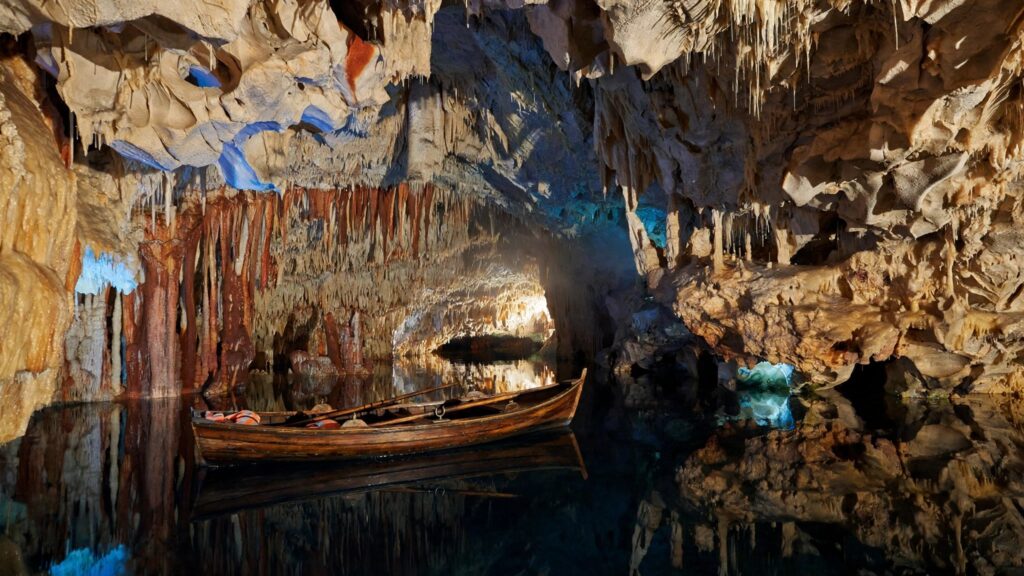
The mythological resonance is not incidental. Cape Tainaron, forty kilometers to the south, was identified in Greek antiquity as one of the entrances to the underworld, and Heracles descended through it on his mission to bring back Cerberus. The Diros Caves, with their underground water and their darkness, belong to the same imaginary geography.
Vatheia | Where the Feuds Ended and the Towers Remain
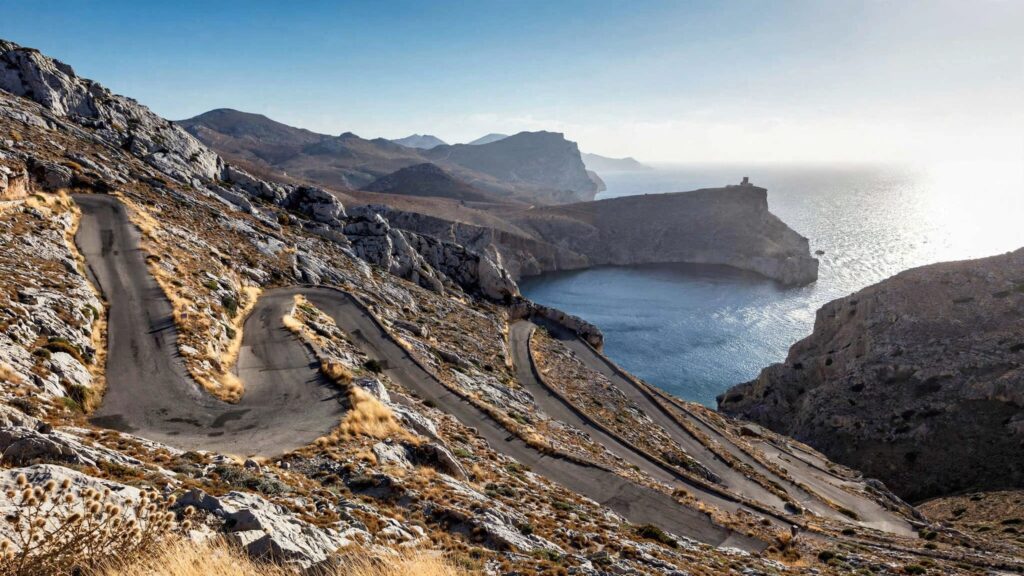
South of Areopoli the road continues through a landscape that grows progressively drier and more remote, past villages whose populations have largely ceased to justify their names on a map.
Vatheia sits on a hilltop with the sea visible on both sides of the peninsula, its towers clustered so closely that the village reads from a distance as a single fortified mass rather than a collection of individual structures. Stand in the central lane at midday in summer when the heat is pressing the sound out of the landscape, and you will feel the quality that the Deep Mani has at its most concentrated: a silence that is not emptiness but presence.
Cape Tainaron | The End of Greece
Drive to the end of the road past Vatheia and walk the final three kilometers on foot to Cape Tainaron.
The rocks here mark the southernmost point of mainland Greece, a title occasionally and incorrectly extended to all of mainland Europe, which in fact belongs to Punta de Tarifa on the Spanish coast, a few minutes of latitude further south. Cape Tainaron does not need the exaggeration. The path to the rocks passes the remains of a Roman mosaic floor that once served a temple of Poseidon. Stand at the actual point and look south. There is nothing between you and the coast of Africa except open Mediterranean water.
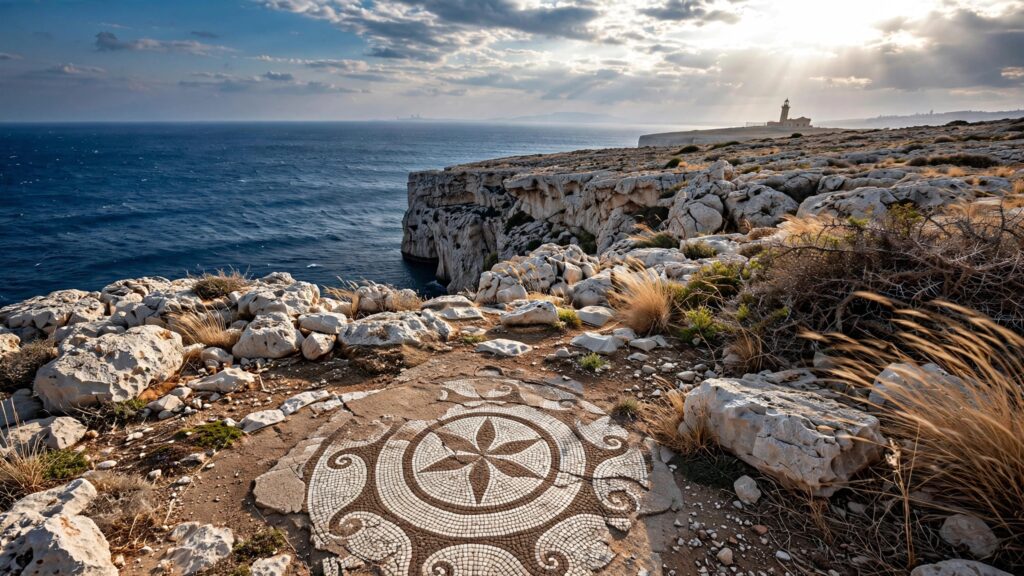
The ancient Greeks believed that one of the entrances to the underworld lay beneath this cape. Looking at it from the rocks above the sea, you understand why.
Practical Notes for the Journey
Getting to the Mani requires a car, without exception. The peninsula is accessible from Athens via the modern highway to Kalamata in approximately three and a half hours. Kalamata has an international airport with direct connections to major European cities.
Kardamyli works as a base for exploring the northern and middle peninsula. Areopoli works for the Deep Mani and the south. For the most complete immersion, spend two nights in each.
The Patrick Leigh Fermor house outside Kardamyli is open on Tuesdays, Thursdays, and Saturdays at eleven in the morning. Spring, particularly April and May, is the best time for hiking the gorges and for the wildflowers that carpet the limestone hillsides before the summer heat burns everything back. September and October are ideal for everything except swimming, which the Mani’s sea rewards throughout a long season.
Avoid planning a tight itinerary. The places worth encountering here are not the places that can be seen quickly.
The Mani does not welcome you.
This is important to say plainly rather than romantically, because it is the most honest thing about the peninsula. Other destinations in Greece welcome you with warmth, with the genuine pleasure that the Greek social tradition takes in the presence of guests. The Mani offers something different: not unwelcome, but not performing welcome either. It is a landscape and a culture that has been shaped entirely by forces internal to itself, by towers that announced power and laments that bound the living to the dead, and it receives visitors with the equanimity of something that existed before them and will exist after them and does not particularly require their approval.
This is not coldness. The people of the Mani are as hospitable as Greeks anywhere, once the relationship has been established. But the establishment takes longer.
Patrick Leigh Fermor stayed fifty years.
That is the honest measure of what the Mani contains: not a destination but a place, in the fullest sense of that distinction. The towers stand in the villages across the southern peninsula. The verses that once bound the mourners at the graveside are mostly silent now. The sea is clear to the bottom in the coves below the roads. The light falls on a landscape that has refused, consistently and without apology, to be anything other than exactly what it is.
Go as far south as the roads will take you, then walk further.
Something at the edge of the world is worth finding.
At Olympus Estate, Wanderlust Greece looks for the places where Greece is most completely and most honestly itself. The Mani Peninsula built two parallel traditions across its centuries of isolation: tower houses, raised between 1770 and 1850 to wage the blood feuds called gdikiomos, and the moirologia, funerary laments performed by women at the graveside and traced by scholars back to the laments of the Iliad and the Greek tragic chorus. The Ottomans never built a road through it. Petros Mavromichalis proclaimed revolt at Areopoli on March 17, 1821, a week before the date the rest of Greece commemorates. The last blood feud ended at Kita in 1870. Patrick Leigh Fermor walked through in the 1950s and stayed the rest of his life. Cape Tainaron, at the peninsula’s southern tip, is the true southernmost point of mainland Greece, not of Europe, a distinction that belongs to Spain’s Punta de Tarifa, though standing on the rocks above the water, the difference in latitude is not what you will be thinking about.