
Every god in the Greek pantheon owned something.
Zeus owned the sky. Poseidon owned the sea. Demeter owned the harvest. Apollo owned light and reason and the oracle’s clarity. Ares owned war. Aphrodite owned desire. The divine portfolio was distributed with the specificity of a legal document: each deity held a defined domain, governed it with the authority of a sovereign, and could be petitioned within it by mortals who understood what they were asking and who they were asking.
Hecate owned the space between domains.
Not the sky and not the sea. Not war and not peace. Not life and not death. The place where the road branches and becomes three roads simultaneously, where a traveller must stop because the direction forward has ceased to be single, where the ordinary logic of destination and arrival momentarily suspends itself and the world opens into something less certain and more alive than a road going somewhere has any right to be.
The Greeks called this kind of space liminal, from limen, the threshold. They understood it with a precision that most cultures recognise only vaguely: that there are places and moments in human experience that belong to neither of the states they connect, that partake of both without being either, and that carry in that doubleness a quality of intensity and possibility that the stable states on either side of them do not possess.
Every culture knows this experientially. The Greeks named a goddess for it.
And then, because they were the Greeks and could not leave a concept without pressing it as far as it would go, they spent a thousand years discovering that the goddess of the threshold was not a minor deity of crossroads superstition but the philosophical principle that held the entire cosmos together.
This is that story.
What a Crossroads Actually Is
Before the philosophy, the physical reality deserves its precise description, because the Greeks were never abstract about geographical facts.
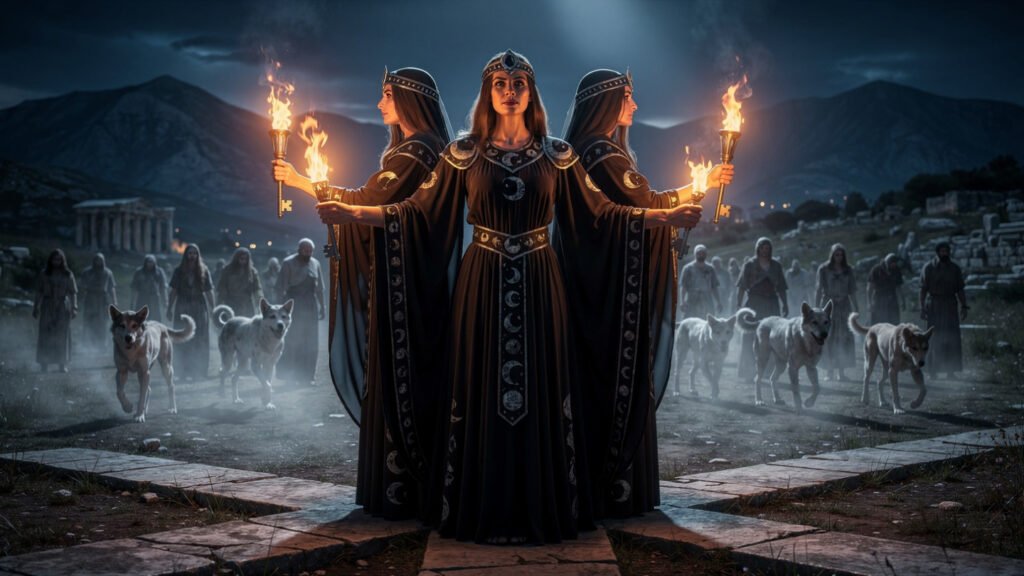
A crossroads in the ancient world was not a traffic intersection. It was a place where three roads met: the triodos, the three-way crossing, which gave Hecate her epithet Trioditis, she of the three roads. Two roads crossing produce four directions. Three roads meeting produce something different: a junction where the geometry of arrival and departure becomes genuinely ambiguous, where a traveller standing at the centre is oriented toward three different futures simultaneously and committed to none of them.
The crossroads was understood as a liminal space because it is, in the most literal sense, none of the roads yet part and parcel of each. The traveller standing at it has arrived somewhere that is not a destination, that exists only as the relationship between paths, that would cease to exist if any one of the roads were removed. It is a place defined entirely by connection rather than by content.
This made it sacred in a way that locations, with their fixed identities and fixed functions, could not be. A temple to Apollo was a place of divine presence. A crossroads was a place of divine possibility: the point at which the structure of the world momentarily opened to show what lay beneath the ordinary organisation of destinations and routes.
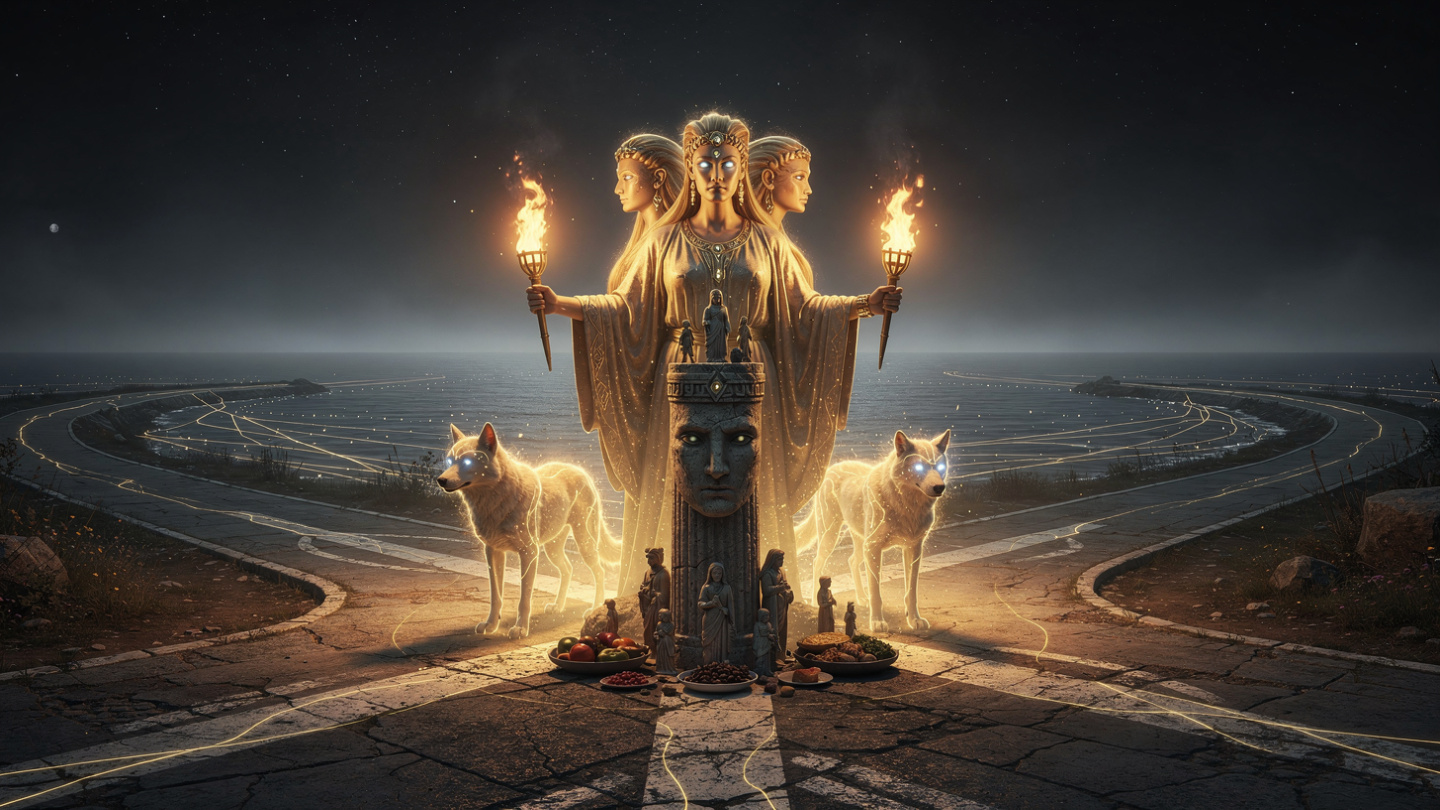
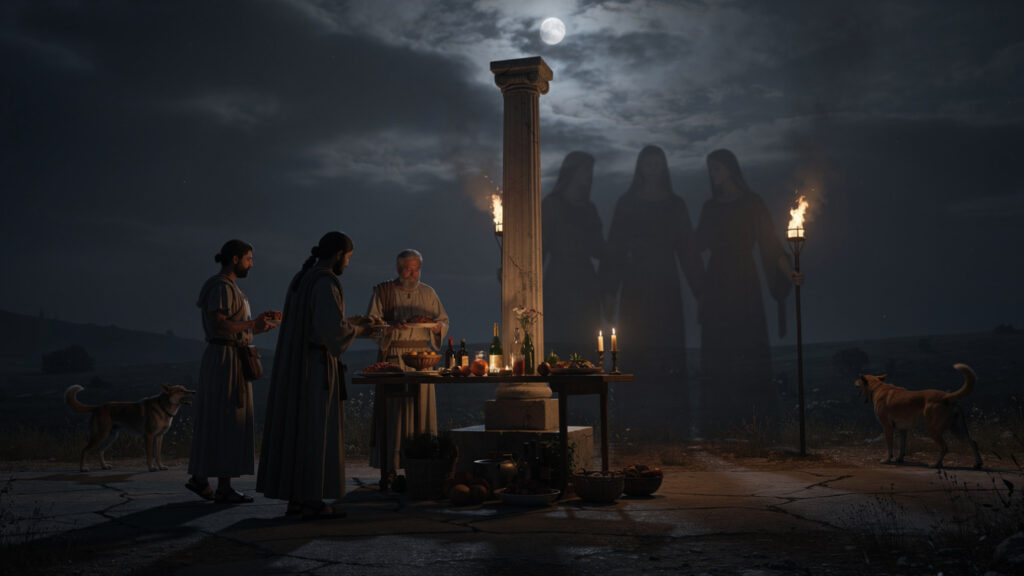
The offerings left at Greek crossroads, the Hecataea, were not made to a temple or an altar but to a pillar, sometimes triple-faced, sometimes simply a post, set at the junction of the three roads. The offerings themselves reflected the in-between nature of the space: food left neither for the living nor for the dead exactly, but for the forces that moved through the night along the roads and congregated where roads met. Hecate herself was imagined as moving through the crossroads at night, accompanied by her dogs and the restless dead, a procession of the between-world moving through the threshold that was her permanent address. These nocturnal offerings belong to the same tradition as the Night Sanctuaries, the temene where the Greeks approached the below through darkness, descent, and boundary‑crossing.
To stand at a crossroads after dark in ancient Greece was to stand at the edge of the organised world. The roads behind you led to known places. The space where you stood belonged to no place at all.
This is who Hecate was before philosophy found her. She was already significant. What philosophy did was reveal that her significance was not local but cosmic.
Hesiod’s Hecate | Older Than the Olympians
The Theogony of Hesiod, the eighth-century poem that established the standard genealogy of the Greek gods, treats Hecate with unusual reverence. Not the reverence of the later philosophical tradition, but something more striking: the reverence of a poet who recognises that the deity he is describing does not fit the organisational structure he has been building, and who responds not by diminishing her but by enlarging the space around her.
Hesiod calls Hecate a Titaness, daughter of the Titans Perses and Asteria: older, therefore, than the Olympians who displaced the Titans in the cosmic succession. He describes Zeus not as her sovereign but as her peer: after the Olympian victory, Zeus honoured Hecate and preserved her privileges across all three realms, earth, sea, and sky. Not one realm. All of them, simultaneously.
This three-realm sovereignty is the first philosophical hint. Every other deity in the Greek system held authority in a realm. Hecate held authority in all three, which means she held authority in the relationships between them rather than in any one of them. She was not the goddess of the sky. She was the goddess of the movement between sky and sea and earth, the force that could be invoked in all three because she belonged exclusively to none.
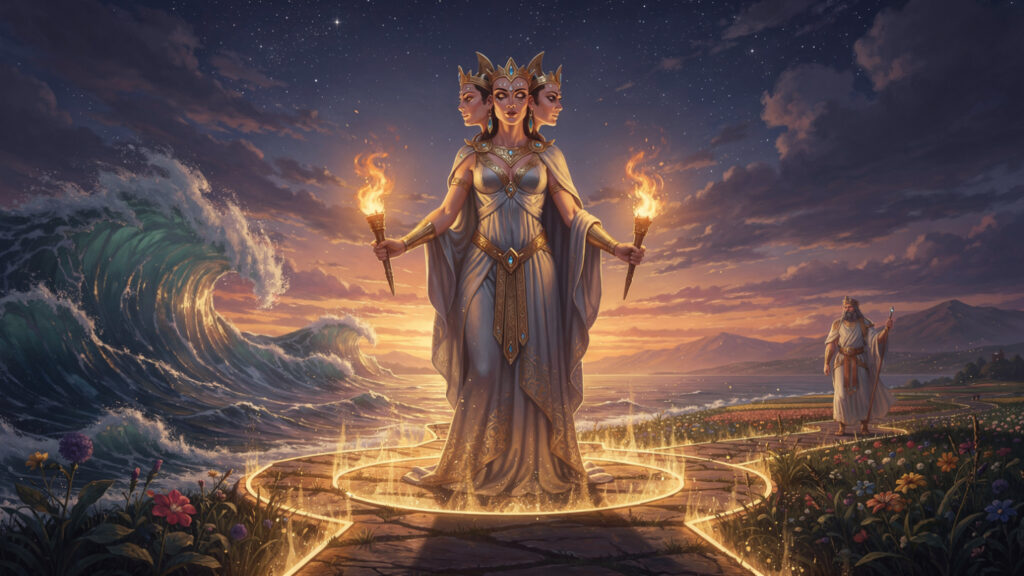
Hesiod is explicit that Zeus honoured her above all others in this. He preserved her ancient privileges. He gave her power over the fates of mortals in all domains: whoever she chose to favour was favoured, whoever she overlooked was not. This is an extraordinary description for a deity who is not one of the twelve Olympians, who does not sit on a throne in the divine court, who does not have the institutional authority of the sky or the sea or the harvest.
What Hesiod understood, without articulating it in philosophical terms, was that the power to move between domains is a different and in some respects greater power than sovereignty within a single domain. The ruler of a kingdom cannot leave it without losing authority. Hecate’s authority was precisely her mobility, her capacity to operate at every threshold, to be present wherever the defined states of the world touched and created between them something undefined.
She was more at home on the fringes than at the centre of Greek polytheism, one scholar of antiquity observed. This is accurate and it is precisely the point. The fringe is where her power lived. The fringe is where all thresholds are.
What Plato Contributed Without Mentioning Her Name
In the fourth century BCE, Plato introduced into Greek philosophical discourse a concept that would, centuries later, reshape the understanding of Hecate entirely.
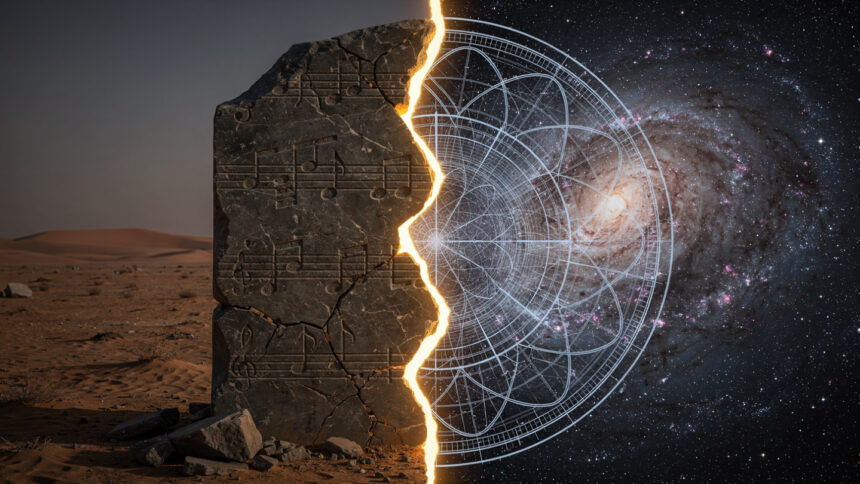
The concept was the World Soul, the Anima Mundi, the intermediary principle that Plato posited in the Timaeus as the force connecting the realm of pure intelligible Forms, the eternal and unchanging, with the material world of physical reality, the temporal and changing. The Forms were perfect and inaccessible to the senses. The material world was imperfect and accessible to the senses. Between them there had to be something: a principle that partook of both, that could bridge the ontological gap between what is eternally true and what is temporarily real.
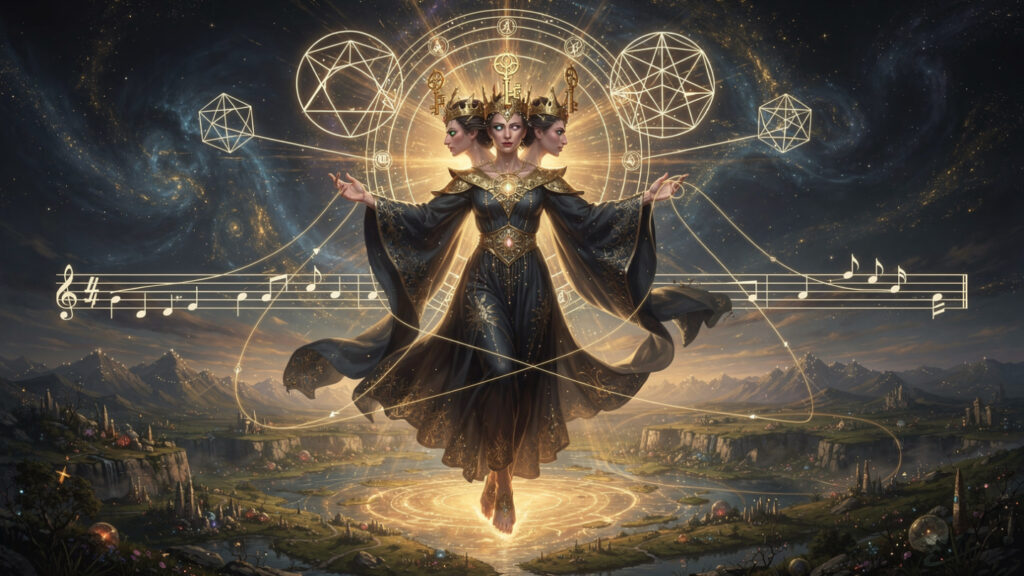
Plato did not give this principle a personal identity. He described it as a mathematical and musical structure woven through the cosmos, a proportion and a harmony that bound the ideal and the material together. The World Soul was philosophical architecture rather than divine personality.
But the structure he described had a shape that any Greek who knew their Hecate would have recognised immediately: a being that belonged to neither of the realms it connected, that derived its power from precisely that non-belonging, that could mediate between the divine and the human precisely because it was not simply either one.
The crossroads is none of the roads yet part of all of them. The World Soul is neither the realm of Forms nor the material world, yet it connects and pervades both. The analogy is structural, and it was not lost on the philosophers who came after Plato and who, over the following centuries, developed his concept of the World Soul in increasingly and eventually theurgical directions.
When the Chaldean Oracles, those second and third-century texts of Platonic mysticism that shaped late antique philosophy and theology, gave the World Soul a name, they named it Hecate.
The Chaldean Oracles and the Cosmic Hecate
The Chaldean Oracles are among the strangest and most consequential texts in the history of Western philosophy: a collection of verse oracles, presented as the words of the gods themselves transmitted through prophetic intermediaries, which synthesised Platonic cosmology with ritual practice and produced a theological system whose influence extended through Neoplatonism, early Christian theology, and the entire subsequent history of Western mysticism.
At the centre of this system stood Hecate.
The Oracles assigned her the role of World Soul, the Platonic intermediary principle that Plato had described structurally and that the Chaldean authors now personified. As World Soul, Hecate was the cosmic mediator between the First Principle, the highest divine intellect, and the material world of human experience. She was the force that held the cosmos together by connecting its highest and lowest levels, passing between them, facilitating the soul’s movement from material incarnation toward divine reunion and back again.
Her epithet in the Oracles was Soteira: Saviour.
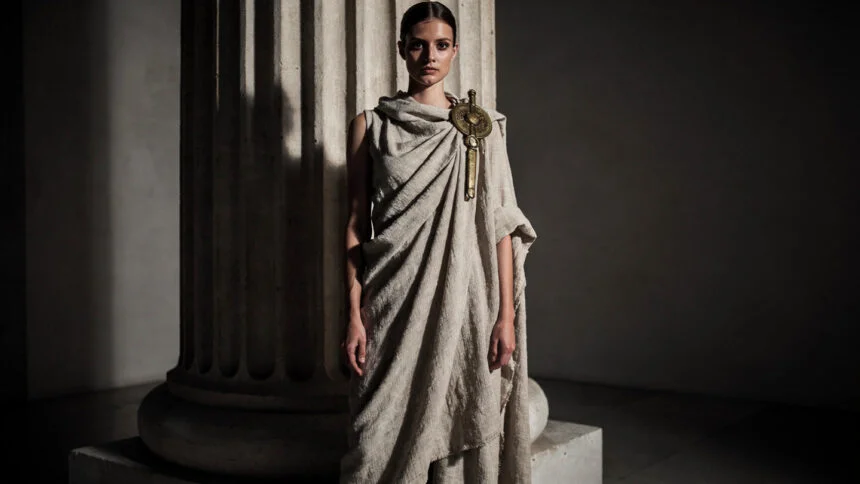
This title, which in Greek theology was applied to deities who rescued mortals from danger, here carried a cosmic weight beyond its normal usage. Hecate as Soteira was the being who, by controlling the crossing of boundaries between humanity and divinity, could aid the soul’s ascent toward the divine or illuminate its path through the darkness of material existence. She held the keys to the cosmos, literally: the keys were one of her defining symbols, and in the Chaldean framework these were the keys to the gates between levels of reality, the thresholds through which souls moved in their passage between incarnation and divinity.
The goddess of the earthly crossroads had become the goddess of the cosmic threshold, and the structure of her power was exactly the same in both cases: she did not belong to either side of the threshold she guarded. She belonged to the threshold itself.
Sarah Iles Johnston, the scholar who produced the most rigorous modern study of Hecate’s role in the Chaldean Oracles, noted that Hecate’s earlier nature as a divinity associated with liminal and intermediary states suited her ideally to assuming the role of World Soul. The Chaldean philosophers did not invent a cosmic role for Hecate. They recognised that the cosmic role was already implicit in what she had always been: the goddess of the in-between, scaled from the village crossroads to the structure of the universe itself.
What the Triple Form Was Actually Saying
Hecate’s triple form, three bodies facing three different directions, or in later depictions three heads on a single body, is the most visually distinctive element of her iconography and the most philosophically loaded.
The standard interpretation is practical: three faces to watch all three roads simultaneously, the perfect form for the deity of the junction. This is correct but incomplete.
The triple form says something more precise about the nature of threshold existence than watchfulness alone explains. A single-faced deity stands in a defined relationship to the world: facing a direction, oriented, committed to a perspective. A triple-faced deity is oriented in all directions simultaneously, which means she is oriented in no single direction, which means her relationship to the world is not perspective but position. She is not looking at the threshold from outside it. She is the threshold, embodied.
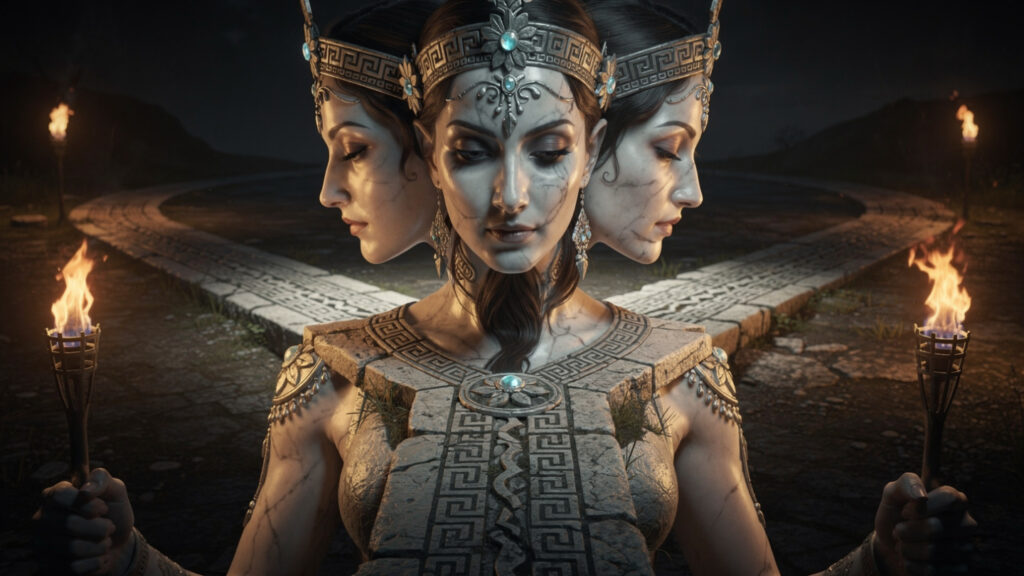
Three roads meeting produce a space that faces all three directions simultaneously. The crossroads itself, if it had a face, would have three. Hecate’s triple form is the crossroads given a body: the in-between space made divine and personal and capable of intervention.
The philosophical implication runs deep. If you want to understand a threshold, you cannot stand on either side of it. You must stand in it. Hecate’s triple form is the embodiment of the stance that threshold understanding requires: not the perspective of one road or another, but the perspective of the junction itself, which sees all roads as they emerge from the single point of their meeting and which is therefore the only vantage point from which the full structure of the choice becomes visible.
This is why she guided the dead. This is why she assisted Demeter in the search for Persephone, leading the grieving goddess with her torches through the night. This is why Circe and Medea, the two great magical practitioners of Greek myth, were her devotees. They all needed what only the goddess of the threshold could provide: the knowledge of how things connect across boundaries, the capacity to move between states that do not ordinarily communicate, the sight that comes not from standing in one place and looking outward but from standing in the space between places and looking in all directions at once.
Dogs, Darkness, and Why Both Make Sense
Hecate’s association with dogs is among the oldest and most consistent elements of her mythology, and it is philosophically precise rather than merely atmospheric.
Dogs in the Greek imagination occupied a liminal position: they were domestic and wild simultaneously, inhabitants of the human household who retained the instincts of the pack, creatures who moved between the interior world of human warmth and the exterior world of the night with a fluency that no fully domesticated animal possessed. They were, in the Greek understanding, threshold beings: their very nature expressed the in-between.
More specifically, dogs could perceive what humans could not. Their hearing extended into frequencies beyond the human range. Their sense of smell navigated a world of information invisible to human senses. They were, in a quite literal sense, more present at the threshold between the perceptible and the imperceptible than human beings were equipped to be. A dog barking at nothing in particular, an experience every Greek household knew, was understood as a dog perceiving something at the edge of the human sensory world: a spirit, a presence, an approach that had not yet crossed into the zone of human detection.
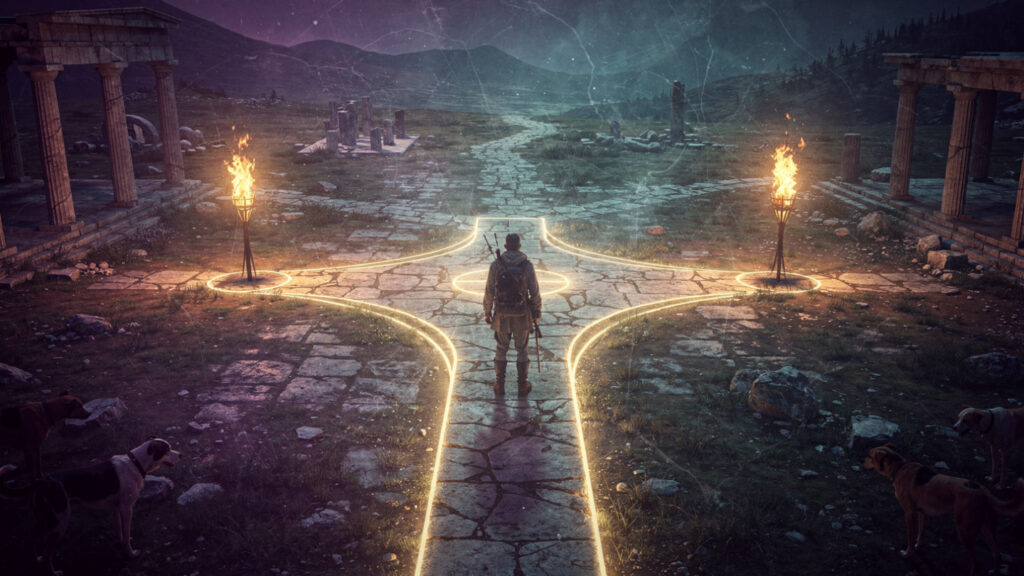
Hecate’s dogs were therefore not incidental companions. They were appropriate attendants for the goddess of the in-between: beings whose perceptual range naturally extended into the liminal zone that was her domain, who could detect what stood at the threshold before it had decided whether to cross it.
The darkness that surrounds her mythology follows the same logic. Darkness is the liminal condition of light: the state in which the visible world has withdrawn into potential rather than actuality, in which shapes exist but are not yet defined, in which the transition between what was and what will be is momentarily suspended. Night is not the absence of day. It is the threshold between one day and the next, the space in which the world stops being what it was and has not yet committed to being what it will be.
Hecate moved through this darkness with torches: not to abolish the dark but to illuminate things within it, to guide through the threshold rather than to remove the threshold itself. Her torches are the light that makes navigation possible without converting the liminal space into the ordinary daylight of defined things.
Thresholds You Already Know
The Greek philosophy of the threshold that Hecate embodies is not an ancient abstraction. It is the most accurate available description of experiences that every human being who has ever lived has encountered and found difficult to name.
Consider what happens at genuine thresholds.
The moment between sleep and waking, when the mind is simultaneously inside the dream and aware of the waking world, and neither state has yet claimed it. The period of mourning after a significant loss, when the life that was has ended and the life that will be has not yet taken shape, and the self that exists in that interval belongs to neither the past nor the future and must somehow function anyway. The moment of standing at a decision that cannot be reversed, when both paths are still open and the person who will have chosen has not yet come into existence, while the person who has not yet chosen is already disappearing. The space between cultures that immigrants inhabit, belonging entirely to neither the world they left nor the world they entered, carrying both simultaneously in a way that those who have only ever lived in one place find difficult to understand.
These are all crossroads. These are all Hecate’s territory.
The Greek insight, expressed through the goddess of the threshold, is that these liminal states are not simply transitions to be endured until the next stable condition arrives. They are places with their own logic, their own knowledge, their own kind of perception that is unavailable from within either of the stable states they connect.
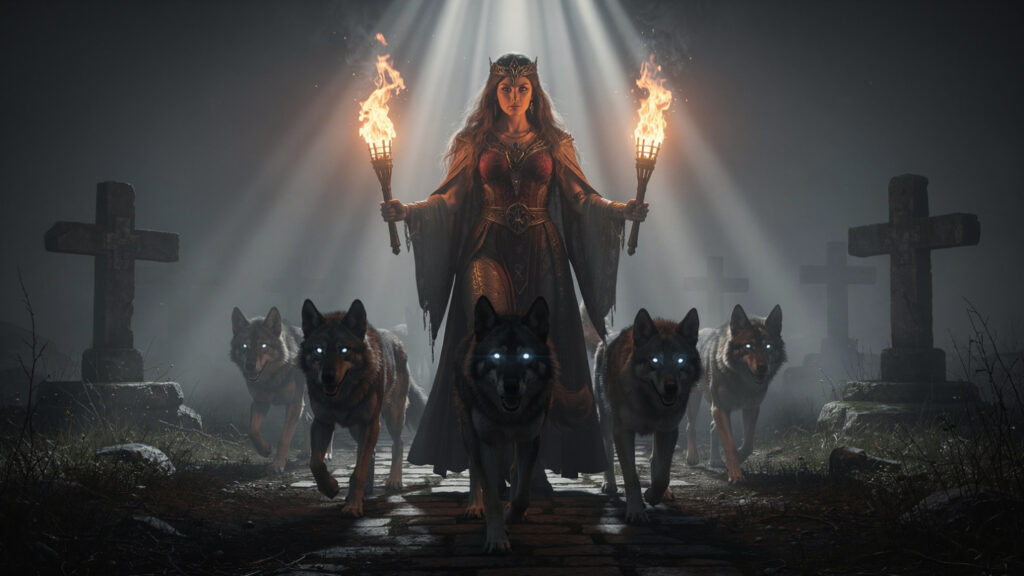
The person who has stood at a genuine crossroads, who has inhabited the in-between with full awareness rather than anxiety, who has allowed the triple vision of the threshold to show all roads simultaneously rather than rushing to eliminate the choice by choosing, has access to a quality of understanding that the roads themselves, for all their clarity of direction, do not provide.
This is what Hecate’s torches illuminate. Not the road ahead. The junction itself.
What Happens at the Crossroads After Dark
There is a practice worth knowing about that the ancient Greek world maintained with the consistency of something understood to be practically important rather than merely symbolically significant.
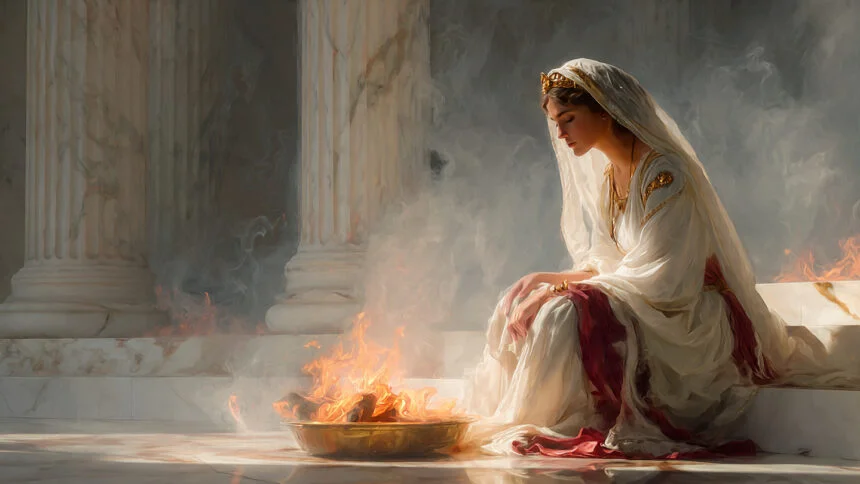
On the eve of the new moon, the darkest night of the lunar cycle, households throughout the Greek world placed offerings at the nearest crossroads. The Deipnon, the Hecate’s supper, was a meal left at the threshold: food, drink, sometimes a small figurine, left where the roads met for the forces that moved through the night along the roads and congregated where roads met. The household that made the offering was understood to be maintaining its relationship with the liminal world, acknowledging that the thresholds between the ordered human world and whatever lay beyond it required regular attention rather than the assumption that they would manage themselves.
The dark moon was chosen because it was itself the liminal phase of the lunar cycle: the night when the moon had completed its visible journey and had not yet begun the new one, when the sky offered neither the full presence of the full moon nor the reassurance of any visible phase at all. The crossroads on the dark of the moon was the most liminal possible intersection: the most completely threshold moment at the most completely threshold place.
The offering was not a petition in the way that sacrifices to Olympic deities were petitions. You did not ask Hecate for a victory or a harvest or a safe voyage. You acknowledged her domain. You indicated that the household understood the geography of its own existence, that it recognised the thresholds as real rather than pretending the world was entirely composed of defined spaces with clear boundaries.
The household that left the Deipnon was saying: we know where we live. We know that the ordered world we inhabit is bounded by thresholds we did not make and cannot abolish. We know that the goddess who governs those thresholds deserves acknowledgement. We are here on the known side of the crossroads. We know there is another side.
That acknowledgement, made monthly, in the dark, at the junction of roads, was one of the most philosophically honest religious practices in the ancient world.
World Soul
Hecate still stands at the crossroads.
Not metaphorically. The crossroads is still there wherever three roads meet, and the quality of attention it commands after dark, the slight suspension of the ordinary logic of direction and destination, the awareness that the space you are standing in belongs to no single road and therefore to all of them, has not changed since the first Greek household left an offering there and named the presence they felt.
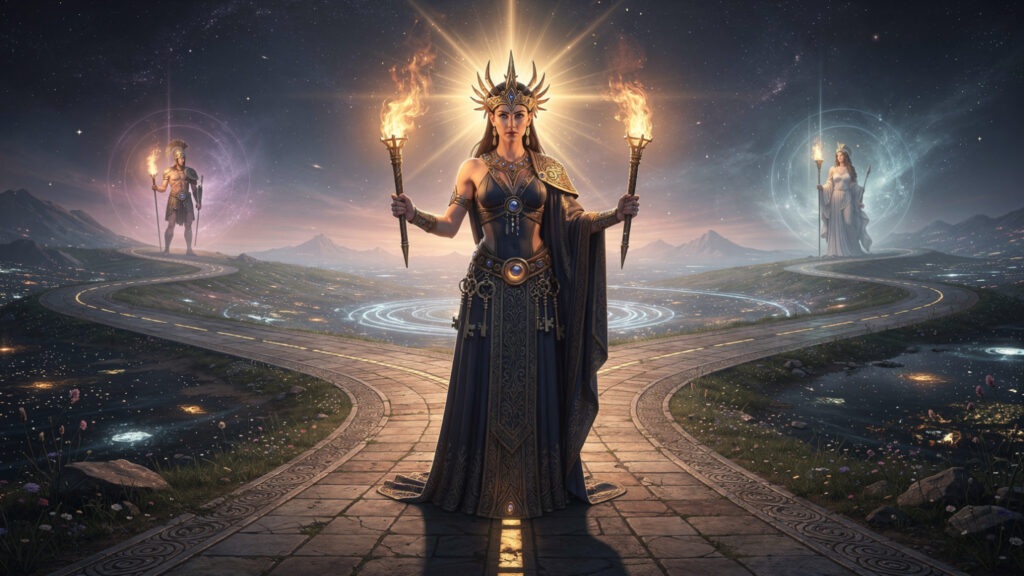
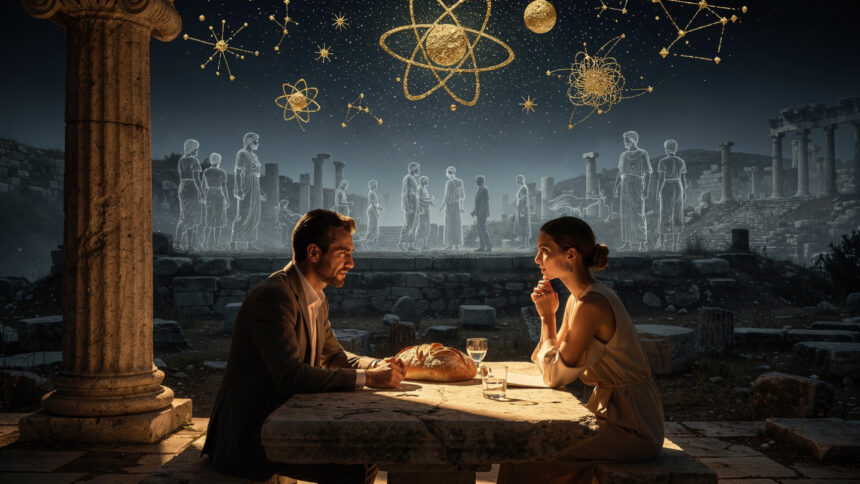
What the Greek philosophical tradition, from Hesiod through Plato through the Chaldean Oracles to the Neoplatonists who transmitted their ideas into the theological bloodstream of the Western world, understood about Hecate is this: the threshold is not a minor geographical feature of the landscape. It is the structure that makes the landscape intelligible. Without the boundaries between things, the things themselves lose their definition. Without the space where roads meet, the roads have no relationship to each other. Without the goddess of the in-between, the between has no meaning and the things it connects have no way of communicating across it.
She was the World Soul not because the philosophers decided to honour a popular goddess with a philosophical promotion. She was the World Soul because the logic of what she had always been, the deity of the threshold, the goddess of the space that belongs to no defined domain and therefore can move through all of them, was already the logic of the cosmic intermediary that Platonic philosophy required.
The crossroads is none of the roads.
That is not a limitation. It is the condition of everything that the roads make possible.
Stand at one long enough, in the dark, in the right quality of attention, and you will understand what the ancient world understood when it named a goddess for it: that the most important space in any landscape is not the destinations at the ends of the roads but the single point where they all begin.
At Olympus Estate, Mythic Essays traces the deeper currents of Greek myth. Every god in the Greek pantheon owned a domain. Hecate owned the space between domains. The Greeks called this kind of space liminal, from limen, the threshold. They named a goddess for it and then, because they were the Greeks and could not leave a concept without pressing it as far as it would go, spent a thousand years discovering that the goddess of the threshold was not a minor deity of crossroads superstition but the philosophical principle that held the entire cosmos together.