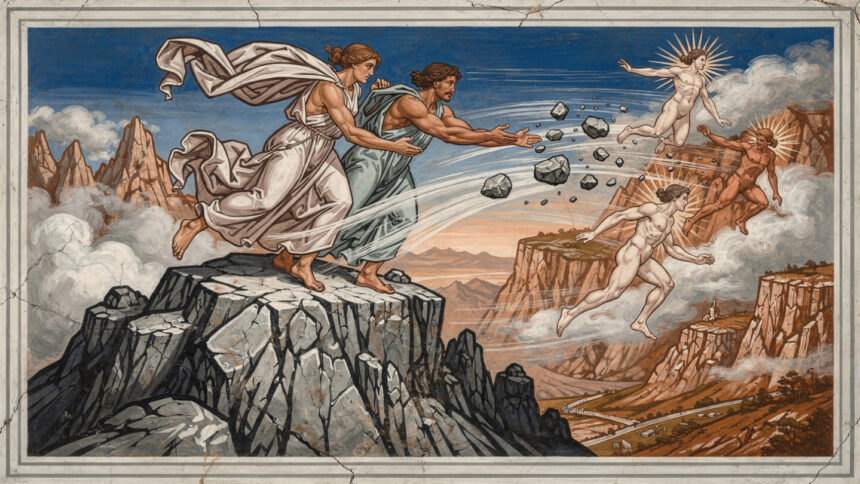






You already know the story.
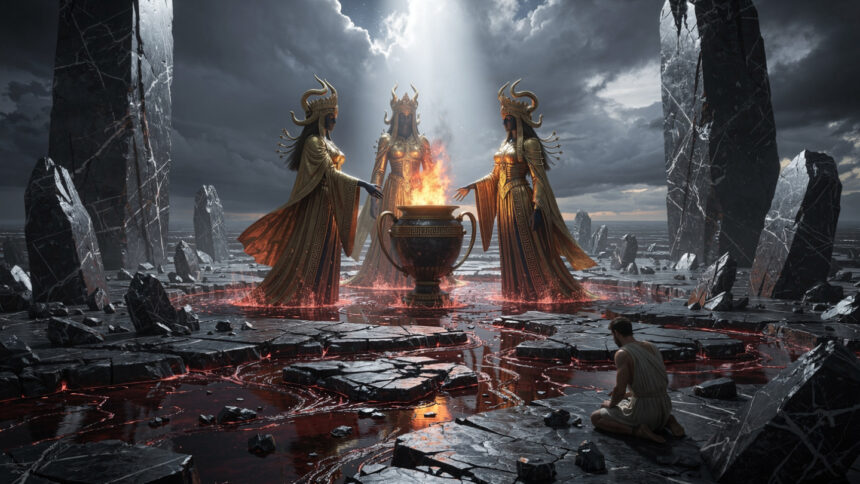
The first woman, fashioned from clay at the command of Zeus as revenge against humanity for accepting fire from Prometheus. Given beauty by Aphrodite, cunning by Hermes, and charm by the Graces. Sent to Epimetheus, who married her despite his brother’s warning never to accept gifts from the gods. Overcome by curiosity, she opened the jar she had been told to leave sealed, and out flew every evil that afflicts the human world: disease, suffering, death, grief, despair. She shut the lid just in time to keep hope trapped inside, but the damage was done. The world was ruined by a woman who could not leave well enough alone.
This is one of the most widely repeated stories in Western culture. It has informed centuries of art, philosophy, theology, and the quiet background assumption that women and curiosity are a combination that leads to catastrophe. It sits alongside Eve and the apple as one of the founding narratives of a civilisation that has spent a long time telling itself stories about why the world is broken and who is responsible.
It is also, as a complete account of Pandora, profoundly incomplete.
Because before Hesiod wrote her as a weapon, Pandora was a goddess.
Not a weapon. Not a punishment. Not the first in a long line of dangerous women. An earth goddess, ancient and generous, whose name in its original meaning described not what she received but what she gave. The story that survived, the one we inherited, is a rewrite. And like all rewrites, it tells us as much about the person who rewrote it as it does about the original.
This is the article about what was there before the rewrite, and what the rewrite reveals about the moment when Greek mythology began to tell a different kind of story about women.
What Pandora’s Name Actually Means
Start with the name, because the name is where the rewriting is most visible.
Pandora. Every schoolchild who encounters Greek mythology is told it means “all-gifted”: the woman upon whom all the gods bestowed gifts. This is Hesiod’s own explanation in the Works and Days, and it is grammatically defensible. The prefix pan means all. Dora derives from doron, gift. All-gifted. The passive recipient of divine endowments, constructed to be a beautiful trap.
But dora in Greek does not only mean gift in the sense of something received. It also means gift in the sense of something given. And the name Pandora, read in its active sense, means not “she who was given all gifts” but “she who gives all gifts.”
This is not a minor grammatical quibble. It is the difference between a passive vessel and an active source. It is the difference between a woman designed to receive and a goddess designed to bestow.
The active reading of the name is confirmed by an alternative title that appears on a fifth-century BCE Athenian vase painting: Anesidora, meaning “she who sends up gifts from below.” This is unambiguously active, unambiguously generous, and unambiguously connected to the earth: a goddess who sends gifts upward, from the ground into the world of the living.
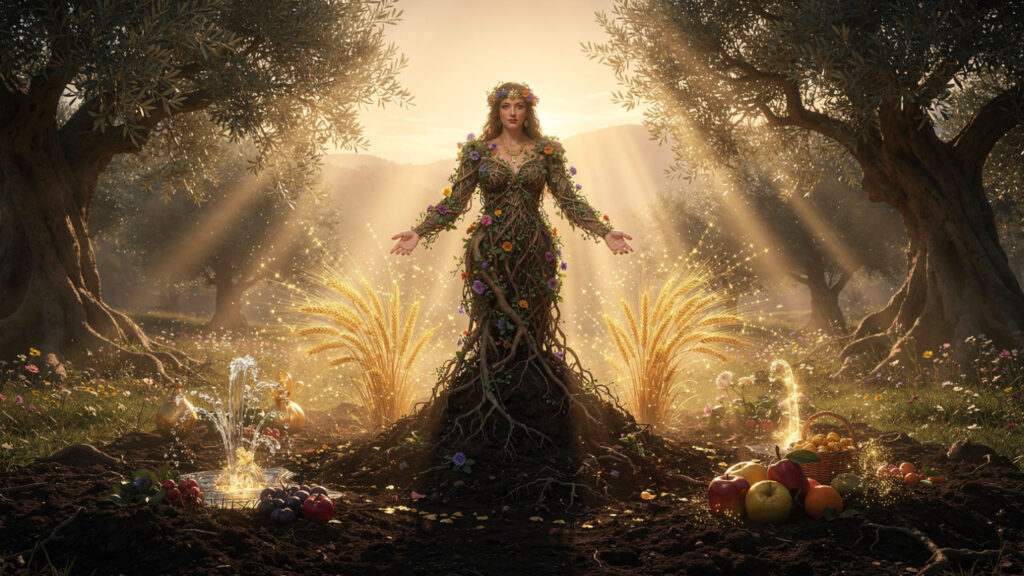
In the pre-Hesiodic tradition that this vase preserves, Pandora was not the first woman sent to punish humanity. She was the earth itself, understood as feminine and generous, the source from which all the necessities of life emerged. Grain from the soil. Water from the springs. The warmth that sustains growth. These were Pandora’s gifts, sent up from below, which is precisely what an earth goddess does.
The name was not changed in the rewrite. It was reinterpreted. The same letters, a completely different meaning, and a completely different kind of story about what a woman’s relationship to the world actually is.
Who Hesiod Was and Why It Matters
To understand what happened to Pandora, you need to understand something about Hesiod.
He was a Boeotian farmer-poet who composed in the late eighth or early seventh century BCE, roughly contemporaneous with Homer, though the two inhabit almost completely different imaginative worlds. Where Homer’s epics are aristocratic, martial, and concerned with the glory of great men in great conflicts, Hesiod’s poems are agricultural, anxious, and deeply concerned with justice, labour, the difficulty of honest work in a world that does not reliably reward it, and the dangers that threaten the ordinary man trying to live decently.
His Theogony establishes the genealogy of the gods and the succession of cosmic power from Chaos through Gaia through the Titans to the Olympians. His Works and Days is part farming almanac, part moral instruction, part extended meditation on why human life is hard and who is to blame.
The question of blame is where Pandora enters.
Hesiod tells the Pandora story twice: once in the Theogony and once in the Works and Days. The two accounts are not identical, and the differences are instructive, but they share the same essential structure: woman as punishment, woman as the origin of human suffering, woman as the vehicle through which Zeus’s revenge against Prometheus reaches its mark.

What Hesiod was doing, scholars have argued for generations, was taking an older mythological figure, the earth goddess Pandora who was the source of all gifts, and inverting her. He kept the name. He kept the framing of a creative act involving the gods. He transformed the meaning completely: the all-giving goddess became the all-gifted trap, and the gifts she had given became the gifts she had been given to make her a more effective instrument of punishment.
Why would Hesiod do this?
The honest answer is that we do not know his intentions with certainty. What we can observe is that the misogyny in the Works and Days is not incidental. It is structural. Hesiod writes of women as an unavoidable evil, a burden that men cannot escape and cannot comfortably live with: “He who flees marriage and the troublesome deeds of women… reaches deadly old age without anyone to tend him.” His vision of the world before Pandora is a world of men, specifically of men who receive the gifts of the earth directly, without the mediation of women. Pandora’s arrival closes that golden age. Women are, in his account, the mechanism of loss.
This is an ideological position, not a neutral recording of tradition. And it required, to make its argument coherently, the transformation of a generous earth goddess into a dangerous vessel.
Two Texts, One Rewrite
The Theogony version of Pandora is the earlier and shorter account. Hesiod describes the creation of the first woman without naming her, focusing on her as a beautiful deception, a “beautiful evil,” a sheer hopeless snare. The gods give her gifts designed to make her irresistible, and she is sent to Epimetheus as punishment. The Theogony does not mention the jar. It does not describe any act of Pandora’s that releases evil into the world. The woman herself, her existence, is the punishment.
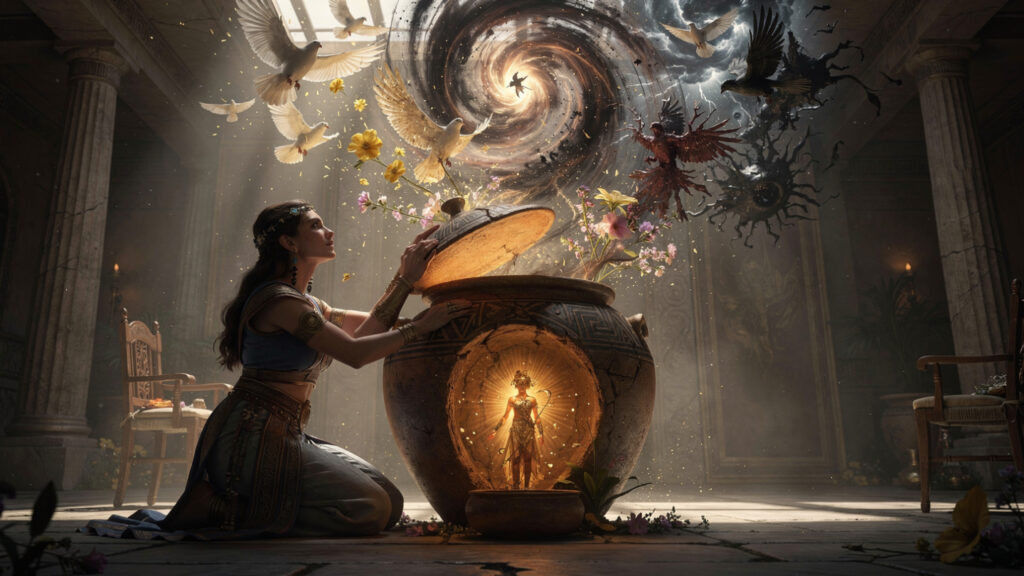
The Works and Days version is fuller and is the source of the jar narrative. Here Pandora is named. Here the jar appears, filled with all the evils and diseases that now afflict humanity, and here Pandora opens it. Hesiod describes the contents escaping: “ten thousand troubles roam among men, the earth is full of evils, and the sea is full.” Hope alone remains inside, under the rim of the great jar, because Pandora replaced the lid before hope could escape.
The jar in the original Greek is a pithos, a large storage vessel of the kind used to store grain, wine, and oil, the containers of agricultural abundance. It is not a box. The transformation of the pithos into a box is a later European mistranslation, often attributed to Erasmus in the sixteenth century, who rendered the Greek word as pyxis, a small box or casket. The image of Pandora with a small decorative box is entirely post-classical. The original vessel was enormous, a storage jar of the kind that holds the provision of a household through winter, and its contents were not simply evils but the full range of what a pithos could contain, which in the agricultural imagination of Hesiod’s world would have been both abundance and its absence, both the gifts of the earth and the disasters that prevent those gifts from arriving.

This is important because a pithos associated with an earth goddess called Anesidora, who sends up gifts from below, is not a container of evils waiting to be released. It is a container of everything that the earth provides: the grain and the drought, the health and the sickness, the good years and the hard ones. An earth goddess’s storage jar holds the complete inventory of what the world produces, including its difficulties. Hesiod took this image and flattened it into a single category: evil. Everything in the jar became a punishment. The earth goddess became the instrument of her own jar’s opening.
What the Vase Paintings Preserved
Here is the evidence that Hesiod’s version did not entirely succeed in replacing what came before it.
A white-ground kylix, a drinking cup, dated to approximately 460 BCE, more than two centuries after Hesiod, depicts the creation of the first woman with a label identifying her as Anesidora. Not Pandora. The all-giving goddess, not the all-gifted trap. The painting shows Hephaestus and Athena putting the finishing touches on the figure, the same scene Hesiod describes, but the name preserved on the vessel tells a different story about who she was.

A scholium, an ancient marginal commentary, to line 971 of Aristophanes’ play The Birds mentions a cult “to Pandora, the earth, because she bestows all things necessary for life.” This is a fifth-century BCE Athenian document. The cult of Pandora as earth goddess was alive in Athens at the height of classical civilisation, existing alongside and in tension with Hesiod’s version of the same figure.
Most significantly: Pandora was depicted on the base of the Athena Parthenos.
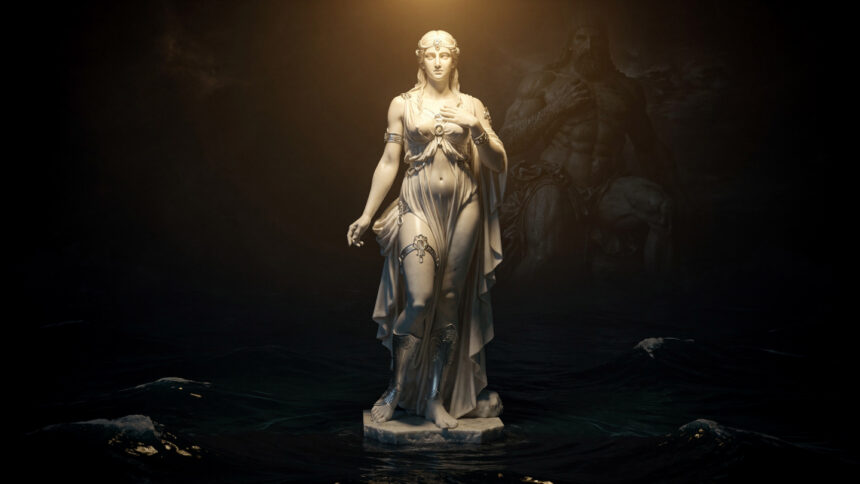
The Athena Parthenos was the great chryselephantine statue of Athena that stood inside the Parthenon on the Acropolis, crafted by Pheidias and one of the supreme artistic achievements of the classical world. Its base was decorated with a relief depicting the birth of Pandora, surrounded by gods. This is not a marginal decoration. This is the foundational statement of Athenian religious identity, the artwork that defined the most sacred space in the most powerful city in Greece, and it placed Pandora at the moment of her creation in a position of honour rather than condemnation.
The Athens that built the Parthenon knew both versions of Pandora. It chose, for the base of its most sacred statue, the version in which Pandora’s creation was a divine event worthy of celebration rather than a punishment delivered against humanity. The Hesiodic warning did not displace the older understanding. The two coexisted, as mythological traditions in Greece so often did, with the older one persisting in cult practice and visual art even as the newer one dominated the literary tradition.
What Hope Is Really Doing in the Jar
Now ask the question that nobody who reads Hesiod’s version of the story carefully can avoid: what is hope doing in a jar full of evils?
Hesiod tells us that Zeus filled the jar with diseases and sufferings and sent it with Pandora to afflict humanity. When Pandora opened the jar, these evils flew out and spread through the world. Before they all escaped, Pandora shut the lid, and hope remained inside, trapped beneath the rim, unable to leave.
The standard reading of this is that hope is the one good thing in the jar, the consolation that remained with humanity after everything else had been lost. This reading is so deeply embedded in Western culture that it operates as a proverb: when everything has gone wrong, at least there is still hope.
But consider the alternative reading, which Hesiod’s own text supports.
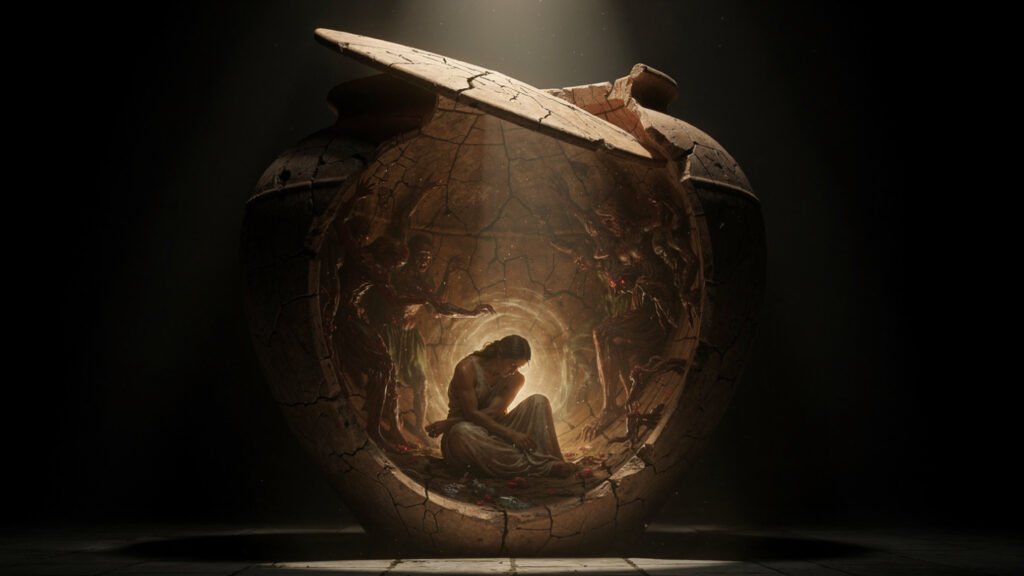
The jar belongs to Zeus, the god who specifically designed it as a punishment. Its contents were designed to afflict humanity. If everything in the jar was designed to do harm, then hope, trapped inside with the diseases and sufferings, is not a consolation. It is another affliction: the force that keeps human beings suffering longer than they otherwise would, that prevents the acceptance of reality, that extends misery by making people believe relief is coming when it may not be.
This darker reading of hope is not without precedent in Greek thought. Theognis, writing in the late sixth century BCE, describes hope as a dangerous and unreliable companion. Aeschylus, in Prometheus Bound, has Prometheus claim that he gave humanity “blind hope” specifically to prevent them from foreseeing their death, which is a kindness framed as a blindness. The Greeks were not uniformly enthusiastic about hope in the way that post-Christian Western culture tends to be. They were capable of seeing it as the thing that prolongs suffering by making people unwilling to accept the truth.
Whether hope in the jar is good or bad is a question Hesiod leaves genuinely open, and the openness is the point. The jar is not a simple morality tale. It is a complex object in a complex story, and the question of whether what remained inside it was a gift or a curse is precisely the question that the pre-Hesiodic Pandora, the all-giving earth goddess, would have found unnecessary. In the older story, the jar was not a container of evil. It was a container of everything. And everything always includes difficulty alongside abundance.
What Prometheus Has to Do With It
The Pandora story is, in Hesiod’s telling, inseparable from the Prometheus story. They are one myth in two acts.
Prometheus steals fire from the gods and gives it to humanity. Zeus, furious, creates Pandora as his revenge: not specifically against Prometheus, who has his own punishment in the form of the eagle and the regenerating liver, but against humanity as a whole, which had the audacity to receive what Prometheus gave.
This framing positions Pandora as the consequence of human receipt of divine technology. Fire represents knowledge, craft, civilisation, the capacity to transform the natural world. Before fire, humans lived in the condition of the golden age: without labour, without suffering, but also without the complicated agency that knowledge produces. After fire, they could build and cook and forge metal and survive winter, but they also received Pandora and her jar.
The myth is, at this level of reading, about what it costs to know things.
But notice what Hesiod has done to the gender of this transaction. Prometheus, the male figure, gives humanity something valuable. Pandora, the female figure, takes it away, or more precisely, takes away the condition of life that made the gift of fire purely beneficial by adding to it all the complications that make a human life genuinely difficult. The structure of the myth assigns creative benefaction to a male and destructive consequence to a female.

The pre-Hesiodic Pandora had no relationship with Prometheus because she did not need one. She was not the consequence of anything. She was not a punishment or a compensation or a reaction. She was the earth: the source of gifts that arrived independently of any divine transaction, the generous ground that produced what living things required before anyone had to steal it from heaven.
Hesiod inserted Pandora into the Prometheus story and by doing so transformed her from a primary figure into a secondary one, from a source into a consequence, from an earth goddess who gave all gifts into a constructed woman who received them. The rewrite demoted her from cosmological significance to narrative function.
What Stayed the Same Across the Rewrite
What is most revealing about the Pandora rewrite is not what changed but what Hesiod could not change.
He could not change the name. Pandora remained Pandora, with all the “all-giving” resonance intact in the word itself. He could only reinterpret the direction of the giving: shifting it from active generosity to passive receipt.
He could not change the involvement of all the gods. In the Works and Days, every Olympian contributes to Pandora’s creation, which is precisely what happens in a cosmogony, a story about the creation of the world: the world is not made by one force but by the collaboration of all the divine principles. A woman as punishment does not require the participation of every god. A world being made does.

He could not entirely suppress the connection to the earth. The pithos, the storage jar, is so clearly an agricultural object, so directly connected to the tradition of earth goddesses who send abundance upward from the ground, that even in Hesiod’s version the image retains its older resonance for anyone who pauses to ask why a jar of evils looks exactly like a grain storage vessel.
He could not prevent the older cult from surviving. For centuries after his Works and Days became the canonical version of the myth, Athenian practice preserved the worship of Pandora as earth goddess. The Acropolis placed her birth on the base of its greatest statue. The vase painters preserved her alternative name. The commentators recorded her cult.
What Hesiod accomplished was not the elimination of the older Pandora but her marginalisation. He pushed the earth goddess out of the literary mainstream and installed the punishing woman in her place. But the original kept surviving in the places where oral tradition and visual culture preserved what written poetry revised, which is precisely what we should expect of a mythological figure whose original role was too important to be fully forgotten even after the dominant account had moved on.
Why the Rewrite Succeeded
If the pre-Hesiodic Pandora was a goddess and Hesiod’s version was a misogynistic revision, why did the revision succeed so thoroughly that most people today only know the later version?
The answer has several components, and none of them is simple.
Hesiod’s texts survived. The Homeric and Hesiodic poems were the foundational texts of Greek education, memorised and transmitted across centuries with a consistency that no oral tradition or visual art could match. What was in the written canon became the story. What was outside it became a curiosity, a footnote, an alternative preserved by scholars who noted the discrepancy without having the institutional support to restore the original’s priority.
The rewrite also served a coherent ideological function that the original did not. An earth goddess who gives all gifts is a cosmological figure. She explains where things come from. She is generous and impersonal and does not generate dramatic narrative. A woman who opens a jar and releases evil into the world is a story: tense, causal, morally instructive, and deeply engaging to anyone who wants to understand why suffering exists and who is responsible for it.
Myth that explains suffering is always more urgently sought than myth that simply describes abundance. Hesiod gave his audience an answer to the question of why life is hard. The pre-Hesiodic Pandora did not ask that question, which is one of the reasons she was vulnerable to being replaced by someone who did.
The Christian tradition accelerated the replacement. The structural parallel between Pandora and Eve, two women whose curiosity or disobedience results in the loss of a golden age and the introduction of suffering into the world, was too useful for moral instruction to resist. Medieval and Renaissance European culture welded the two figures together, reinforcing each with the authority of the other, and Pandora’s role as the originary disobedient woman became essentially impossible to dislodge from the popular imagination.
What survived was what was usable. What was usable was the punishment story. The earth goddess who gave all gifts was not usable in the same way, and so she was largely forgotten outside the scholarly tradition that preserved the traces of what she had been.
The Jar Was Never Only Full of Evils
Her name still means all-giving.
That is the thing that the rewrite could not take from her. Three thousand years of the punishment narrative, from Hesiod through the medieval commentators through the Renaissance artists through every retelling of “Pandora’s box” in every culture that inherited the Greek tradition, and the name still says what it said before any of them arrived: she who gives all.
The earth was her original body. The jar was her original storage vessel, holding the complete inventory of what the world produces, including its difficulties, because that is what the world produces and a goddess honest enough to represent it would not pretend otherwise. The gifts she sent upward from the ground were not curses in disguise. They were the things that living beings need to live, offered without condition by the most fundamental generous force the ancient world could imagine.
Hesiod was a farmer who understood suffering and believed, with the intensity of someone who had experienced injustice personally, that the world was harder than it should be and that someone was responsible for the difficulty. He found in Pandora a useful vehicle for that belief, and he rewrote her into the shape his argument required.
He was not wrong that the world is hard. He was wrong about who is responsible.
The original Pandora knew something the rewritten one was not allowed to say: that the earth gives everything, including the difficult things, not as punishment but as the complete and unedited contents of a world that does not curate its abundance for human convenience. The jar was never only full of evils. It was full of everything. What you find when you open it depends entirely on what you were willing to believe was inside.
Hope was not the last thing in the jar. It was there alongside everything else, available from the beginning, in the same measure as every other thing the earth provides.
The all-giving goddess knew this. Her name still says so, if you read it in the direction she intended.
At Olympus Estate, Tales from Olympus explores the full architecture of Greek myth, including the layers beneath the versions that survived. Pandora was not a warning. She was a world. The story that told you otherwise had its own reasons for doing so.