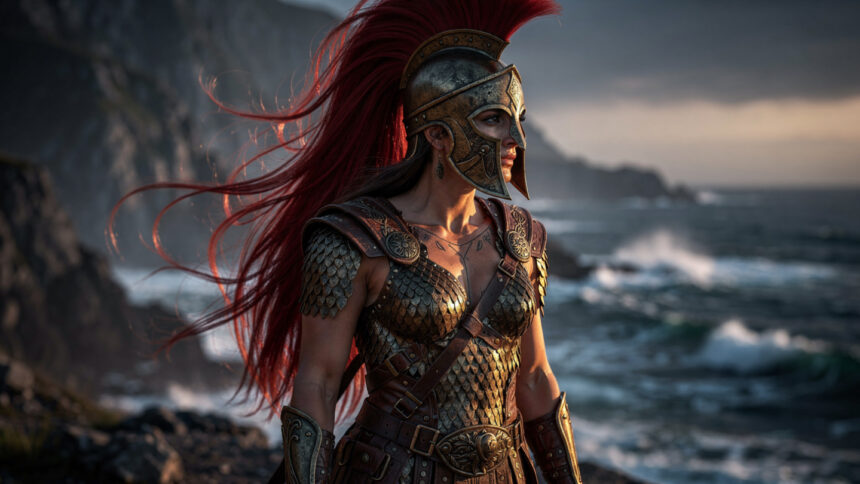





Apollo gave Cassandra the gift of prophecy and then ensured that no one would ever believe her.
The mechanism of the curse is the element of her myth that standard retellings most consistently undervalue, treating the curse as simply disbelief added to foresight, as though the two were independent properties that happened to coexist in the same person. The theological content of the curse is more precise than that.
In Greek religion, a gift once given by a god could never be revoked. This was irrevocable not as a matter of policy but as a matter of the divine world’s own theological structure: a god who gave a gift had committed a portion of divine nature to the recipient, and that commitment could no more be recalled than light already sent across the sky could be called back before it reached its destination. A god could not take back what had already left the divine source and entered a mortal recipient.
Apollo could not revoke the prophecy. What he could do was separate the gift’s content from the gift’s function.
The content of the prophetic gift was accurate foresight of future events. Cassandra kept this completely. Her visions of what Troy would become, what the wooden horse contained, what Agamemnon would find waiting for him in Mycenae, what her own end would be, all of it was accurate. The content of the gift stayed intact through the fall of Troy, the voyage to Greece, and the walk through the gates of the house of Atreus.
The function of the prophetic gift was to be received. Prophecy is never a private experience. It is communication between a prophet and the community whose future that prophet can see. The social function of an oracle, whether the Pythia at Delphi or the seer Tiresias in Thebes or a prophet in an open field, was always to transmit knowledge of what was coming to the very people whose decisions that knowledge could reshape. Without reception, prophecy remains a private vision whose truth can only be verified after the event it described has already happened.

Apollo removed the reception without removing the vision. The curse was never the lie. It was the silence: not a falsification of what Cassandra saw, but the permanent deafness of everyone she told it to.
This punishment is calibrated more precisely than simple silencing would have been. A prophet who is silenced cannot speak. Cassandra could speak. She spoke constantly. She described, with perfect accuracy, events that no one around her would prevent because no one around her would believe the description. She was never prevented from performing the prophetic function. She was permanently prevented from that function ever having an effect.
The gift was intact. The gift was useless. Apollo had found the one form of punishment the gift’s own irrevocability actually permitted.
Troy Before the Horse
The content of Cassandra’s prophecies before the Trojan War‘s final night survives with a precision that reflects exactly what her myth was demonstrating about the relationship between accurate knowledge and effective action.
When Paris sailed to Sparta, Cassandra knew what he would bring back and what bringing it back would cost. When Helen arrived in Troy, Cassandra already knew the sequence of events that would end in the destruction of everything she could see from her father’s city walls. The fall she foresaw included the loss of the Palladium, the sacred image whose theft would later become the decisive ritual act sealing Troy’s fate. She said so. Priam did not act on what she said. Hector, who loved his sister and stands among the most thoughtful and morally serious figures anywhere in the Iliad, still could not make himself believe her, despite his love for her and despite the evident conviction behind everything she told him.
Myth attributes Cassandra’s credibility problem to the history of the curse, known to the gods but not necessarily to her own family and community. But the deeper reading her story actually encodes concerns a human psychological mechanism the Trojan War’s whole progression demonstrates: a community in crisis does not disbelieve an unwelcome prophecy because it has weighed the evidence and found it insufficient. It disbelieves the prophecy because the prophecy is unwelcome.

The Trojans never examined Cassandra’s predictions and found them implausible. They found them intolerable. The possibility that the wooden horse was not a votive offering to Athena but a belly full of armed Greeks, and that dragging it inside the walls would bring exactly the destruction Cassandra described, was not something an exhausted, hopeful community after ten years of siege was constitutionally capable of entertaining. The comfort of believing the war was finally over was not a belief evidence could dislodge, because that comfort was never a product of evidence in the first place. It was a product of need.
This is the real psychological observation Cassandra’s myth encodes: accurate knowledge is not enough to produce correct action when correct action is exactly what a community is most strongly motivated to avoid. The curse Apollo placed on Cassandra was the divine formalization of a human condition that needs no divine curse to produce it in the first place. Communities disbelieve the prophecies they cannot afford to act on, with or without Apollo’s help.
The Horse and the Axe
The night Troy fell gives Cassandra her most concentrated characterization in the entire myth: she did not simply warn. She acted.
She went to the horse with an axe and a torch.
This detail, preserved across multiple ancient sources, is what most clearly separates the actual mythological Cassandra from the version popular culture usually imagines, the passive truth-teller whose tragedy is simply that no one listens. The Cassandra of myth was not passive. She tried to destroy the horse herself. Trojans physically restrained her, afraid she would offend Athena by attacking what they believed was the goddess’s sacred gift, and unwilling to let their own victory celebration be disrupted by a woman they understood as divinely afflicted in her mind.

The restraint, the celebration, and the dragging of the horse inside the walls unfold in exactly the sequence that most precisely demonstrates how the curse actually operates. Cassandra knew. Cassandra said. Cassandra acted to prevent it. The community restrained her, celebrated, and did precisely what she had told them not to do. The events she described occurred in the order she described them.
Vindication for a prophet no one would believe is never experienced by that prophet as vindication. It is experienced as the horror of watching the exact nightmare she was trying to prevent play out in real time.
Ajax in the Temple of Athena
As Troy fell, Cassandra fled to the Temple of Athena and embraced the statue of the goddess at its base.
Embracing a cult statue was a formal claim of divine sanctuary: anyone who placed themselves in physical contact with a god’s own image came under that god’s protection, and violating that protection by force ranked among the most serious acts of sacrilege in Greek religion. The temple was the god’s house. The statue was the god’s presence inside it. Someone claiming sanctuary at the statue’s base had placed themselves directly under the god’s own protection.
Ajax the Lesser, son of Oileus, dragged her away from the statue anyway.
The theological consequence unfolds with the precision of a court judgment matched exactly to the nature of the offense. Athena’s response was the response of any divine authority whose protection has been violated: she withdrew her favor from the Greeks whose victory had produced the violation, and whose failure to punish the violator made the entire army complicit in it.
In some versions, the statue’s eyes turned away or looked to the ceiling at the moment of the violation, a detail that compresses the whole scene’s theological content into a single image: a goddess being dishonored in her own house, through violence done to a woman who had claimed her protection, unable to prevent the act but marking her response in the visual language of a divine witness refusing to watch what was being done in her name.

Athena then did exactly what a goddess whose sanctuary had been violated was theologically entitled to do. She turned against the Greeks. The storms that destroyed much of the Greek fleet on the return voyage from Troy were Athena’s answer to the sacrilege the Greeks had allowed in her own temple. Ajax himself drowned, in most versions at Poseidon’s hand acting on Athena’s request, after boasting on the rocks that he had survived the gods’ opposition once already.
The violation of Cassandra in Athena’s temple was never simply one atrocity among the war’s many. It was the act whose theological consequence the Nostoi, the ancient collection of stories about the Greeks’ returns from Troy, developed as the price the Greek forces paid for what was done in the goddess’s own house on the night Troy fell.
The Voyage and the Arrival at Mycenae
Cassandra was distributed among the Greek commanders as war spoils and assigned to Agamemnon.
The irony of that assignment unfolds with all the structural precision Greek myth is capable of. Agamemnon was the commander whose homecoming the whole tradition had been building toward since the first book of the Iliad: the king of Mycenae, leader of the greatest military expedition in Greek memory, returning victorious to the house of Atreus, a house whose long history of violence, betrayal, and divine punishment gave every homecoming to it its own particular weight.

Cassandra saw what was waiting.
On the ship from Troy. During the voyage across the Aegean. Standing before the gates of Mycenae as Clytemnestra came out to receive her husband with a welcome as elaborate as the trap already closing beneath it.
She described it. She described the smell of blood. She described the net in the bath. She described Clytemnestra’s blade. She described her own death alongside the king’s. She described the red carpet rolled out to lead him from his chariot to the bath where Clytemnestra waited with the woven net that would keep him from defending himself while she struck.
Agamemnon walked across the carpet and into the palace.
Aeschylus develops Agamemnon’s response to this prophecy in the Agamemnon, the first play of the Oresteia, with all the theatrical precision of a playwright who understood exactly what the Cassandra scene demonstrated about the relationship between knowledge and power. Agamemnon was not simply disbelieving. He was not constitutionally capable of entertaining what Cassandra was describing, because accepting that his own wife was waiting to kill him in his bath, on the very night of his victorious return, would have required rebuilding his entire understanding of his own power and his own significance in the world.
The Trojan warriors had been unable to believe Cassandra because belief required giving up the comfort of a peace they thought they had won. Agamemnon was unable to believe her because belief required giving up the self-understanding of a returning victor whose triumph had seemed so absolute that no threat could possibly remain.
The curse required no active disbelief at all. It required only the ordinary human preference for whichever version of reality a person most needed to be true.
The Walk into the Palace
Aeschylus gives Cassandra the single most extraordinary theatrical moment surviving anywhere in Greek tragedy.
She stands before the gates of Mycenae. She knows exactly what is inside. She describes it to the Chorus in the language of a prophet seeing past, present, and future all at once: the children of Thyestes eating their own flesh, the smell of blood on the walls, the net in the bath, the axe already being readied. The Chorus hears her but cannot connect the images she describes to the house standing right in front of them.

Then she walks inside.
She does not try to run. She does not resist. She has seen what is coming with the same clarity Apollo’s irrevocable gift has provided her whole life, and in the fullness of that clarity she has understood that the action left available to her now is not escape but the action of someone who has seen clearly and has accepted what clear sight actually reveals.
This acceptance is not resignation in the sense of defeated submission to a force too strong to resist. It is the acceptance of someone who understands exactly what is happening and walks into it with the dignity of a person who has always known the truth, has never once been able to make that knowledge useful to anyone else, and now makes the last use of it still available to her: meeting the end that was always coming with the same quality of attention the prophetic gift gave her, the quality no curse could ever take away.
She walked into the palace with her head up.

Ancient accounts of her death inside are brief. She died alongside Agamemnon. The manner of her death matters less than the walk that preceded it: the walk of a woman given perfect knowledge of every significant event in her own life, prevented from using that knowledge to change a single one of them, arriving at the end of that life having seen everything that was coming and having been unable to stop any of it, and walking through the last available gate with full knowledge of exactly what waited on the other side.
Apollo’s irrevocable gift was present at the end just as it had been present throughout. The truth was intact. The truth had always been intact. The truth had simply never once been heard.
At Olympus Estate, Mythic Essays moves through the deeper currents of the Greek tradition. Apollo could not revoke the prophetic gift once given. What he could do was separate the gift’s content from the gift’s function. Cassandra retained the accurate foresight. She lost the reception. The Trojans did not examine her predictions and find them implausible. They found them intolerable. She went to the horse with an axe and a torch. She was restrained. Ajax dragged her from Athena’s statue. The statue’s eyes looked away. Athena destroyed the Greek fleet on the return voyage. Cassandra stood before the gates of Mycenae and described the net in the bath and the axe and her own death alongside the king’s. Agamemnon walked across the carpet and into the palace. She followed him with her head up. The truth was intact. The truth had always been intact. The truth had simply never been heard.