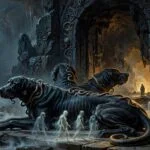

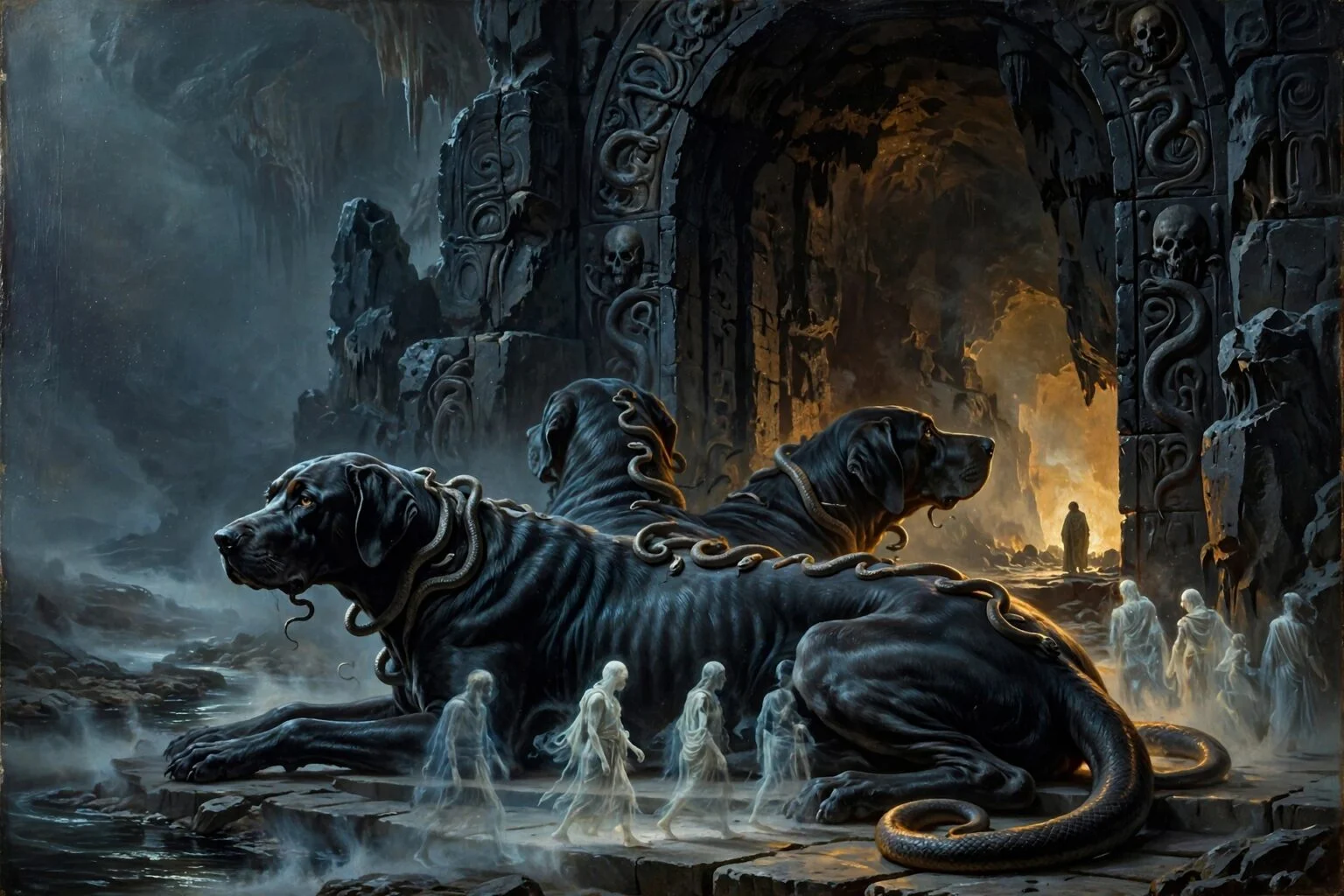
Ask almost anyone what Cerberus does and the answer comes back at once. He guards the gates of the underworld. He keeps people out. He is the three-headed dog that every hero has to get past on the way in, the snarling obstacle between the living and the dead.
The oldest Greek description of him says almost the opposite. Around 700 BCE Hesiod placed a hound in front of the echoing halls of Hades and Persephone and described his habits with unsettling care. The newly dead arrive, and the dog greets them. He wags his tail. He lays back both his ears, the way a dog does when it is pleased to see you. He lets them walk straight in.
Then he watches. And anyone he catches trying to go back out through the gates, he eats.
That is the Cerberus of the earliest source, and once you see him that way the rest of his mythology rearranges itself. He was never a bouncer. He was a warden. The living who forced their way in were rare exceptions, heroes on errands that the stories treat as extraordinary precisely because they almost never happened. The real threat, the constant one, came from the other side of the door. Every soul the underworld had ever received was a soul that might, given the chance, try to leave.
A Welcome at the Door | What Hesiod Actually Wrote
Hesiod mentions the dog twice in the Theogony, and the two passages work as a pair. The first gives his pedigree and his nature. He is “the unspeakable Cerberus, eater of raw flesh, the bronze-voiced hound of Hades, fifty-headed, shameless and strong.” The second, a few hundred lines later, gives his job.
There in front stands a terrible hound, without pity, and he has an evil trick. Those who go in he fawns on, with his tail and with both his ears, but he does not let them come back out. He keeps watch, and whoever he catches going out through the gates, he devours.
Hesiod, Theogony 769 to 773
The word Hesiod uses for the trick is the same one the Greeks used for craft and cunning. The welcome is part of the design. A frightened soul is reassured at the threshold, encouraged across it, and only discovers the nature of the place once the door has closed behind it. Nothing in the passage suggests that Cerberus ever turned anyone away. He had no reason to. Everyone was coming in eventually.
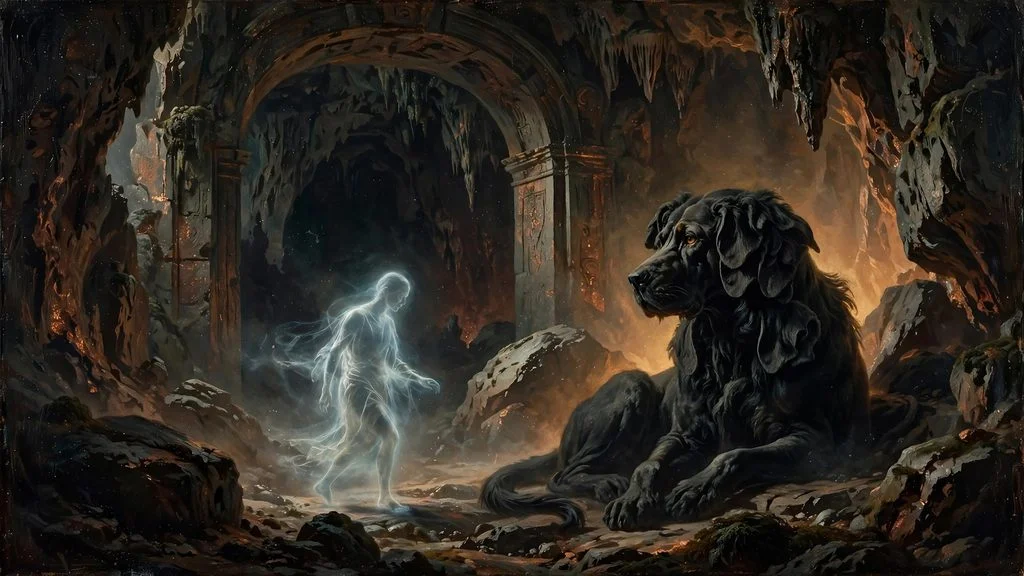
Read this way, the dog becomes something larger than a monster at a gate. He is the rule of the underworld given a body. What goes into death does not come back out. The Greeks could have expressed that idea as law or theology, and in places they did, but they also gave it fur and teeth and a wagging tail, and the image has outlasted every abstract version.
The Children of Typhon | A Family Heracles Worked Through
Cerberus was born into the most dangerous household in Greek myth. His father was Typhon, the storm giant who rose against Zeus after the defeat of the Titans, so terrible that in later retellings the Olympians fled to Egypt and hid in the shapes of animals rather than face him. Zeus defeated him with the thunderbolt only after a struggle that shook the whole cosmos. His mother was Echidna, half nymph and half serpent, who lived apart from gods and mortals in a cave beneath the earth.
Hesiod lists their children in order. First came Orthus, the two-headed dog who guarded the red cattle of Geryon at the edge of the western world. Then Cerberus. Then the Hydra of Lerna. Then the Chimera, the fire-breathing lion, goat and serpent that Bellerophon killed in Lycia. The next generation is where the line gets tangled. Hesiod says that the Chimera, or possibly Echidna herself, since the Greek leaves the mother unclear, bore to Orthus two more creatures, the Sphinx of Thebes and the Lion of Nemea.
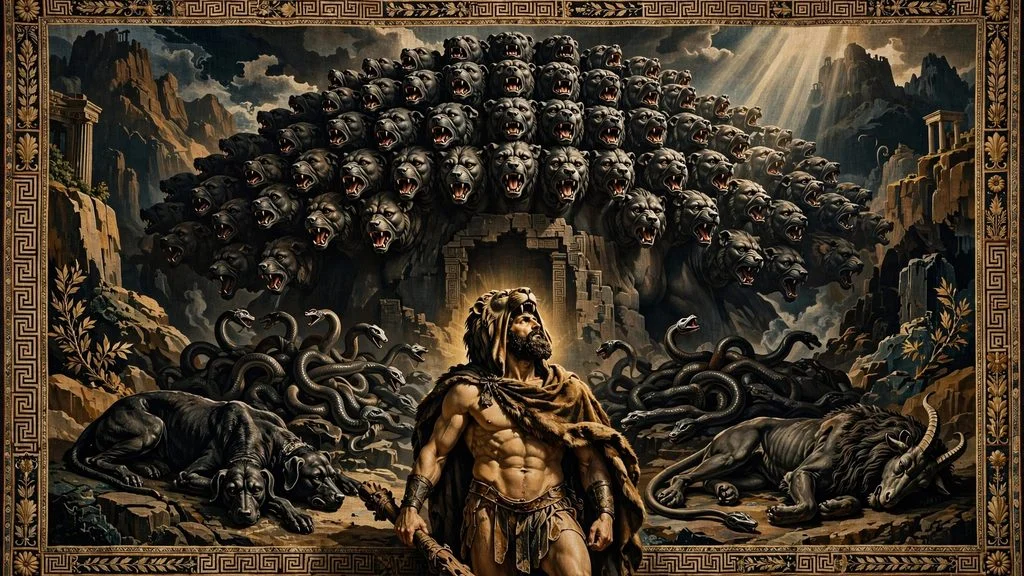
Look at that list again with one name in mind. Heracles strangled the Nemean Lion. He killed the Hydra. He killed Orthus on his way to take Geryon’s cattle. And for his final labour he went down into the earth and came back with Cerberus. Whatever else Heracles was doing across his twelve labours, he was working his way through a single family, and the last member he reached was the one that guarded the oldest boundary of all.
The pattern shows how the Greeks thought about monsters. The children of Typhon were not random horrors. Each one sat at a threshold of some kind, a spring, a road into a city, a herd at the end of the world, the entrance to the dead. To face one was to test whether a hero could cross a line that ordinary people could not. Cerberus held the line that no one was supposed to cross at all.
Fifty Heads or Three | Counting a Monster
The three heads feel like the one fixed fact about Cerberus. The ancient sources say otherwise. Hesiod gave him fifty. Pindar, according to later commentators, gave him a hundred, and Horace followed with a “hundred-headed beast.” Homer, the earliest of all, gave him no heads to count and not even a name. In the Iliad and the Odyssey he is simply “the dog of Hades,” the creature Heracles was sent to fetch. Pausanias noticed this himself in the second century CE. Homer, he pointed out, called the creature the hound of Hades but gave it no name and no monstrous shape, and it was later writers who called it Cerberus and gave it three heads while keeping the rest of it a dog.
The painters had their own ideas. On Athenian vases of the sixth century BCE Cerberus very often has two heads, sometimes with snakes rising from his neck and back, a design that could be drawn clearly on the curve of a pot. Three heads appear in the tragedians of the fifth century. Sophocles calls him “the three-headed whelp of Hades,” nursling of dread Echidna, and Euripides speaks of a “three-bodied” dog. By the time the mythographer known as Apollodorus wrote his handbook, the standard picture was settled. Three dog heads, a serpent for a tail, and the heads of snakes of every kind along his back.
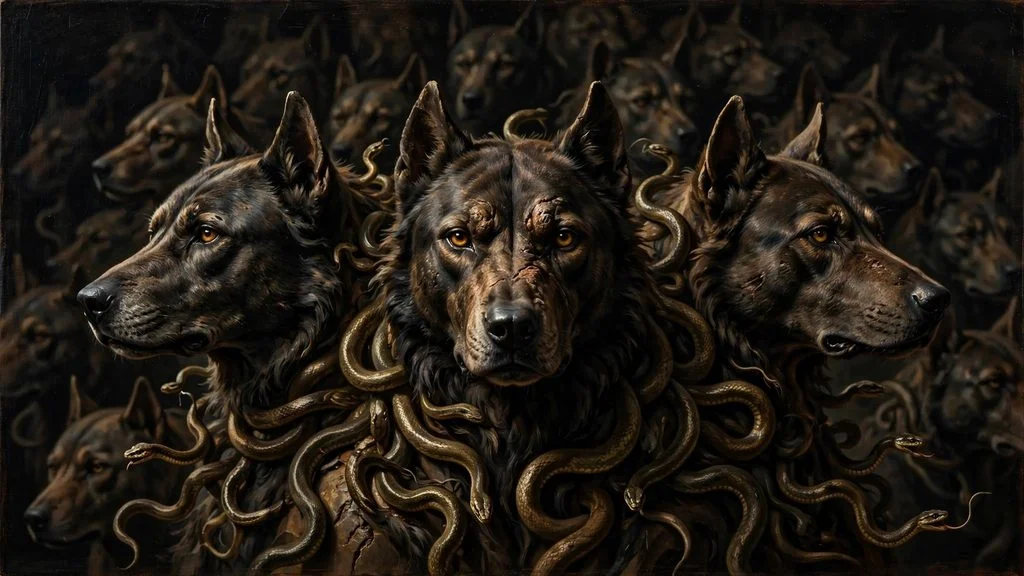
It is tempting to read the variation as confusion, but it may be closer to honesty. What all the versions agree on is that this dog has more heads than a dog should, more eyes than any guard needs, more mouths than any one animal could feed. A creature that faces in every direction at once cannot be crept past, and that is the point of him. Fifty heads is the poet’s way of saying that nothing escapes his attention. Three is the number that survives when the idea has to fit on a vase, in a sculpture or in the memory of a child.
Later allegorists liked to read the three heads as past, present and future, or as youth, maturity and old age. Those readings are inventions of a much later age. In the ancient myths his heads do not stand for ideas. They watch the door.
The Dog Before Cerberus | A Possibility, Not a Proof
Nobody knows for certain what the name Kerberos means. It has no clear Greek root, and that absence has sent scholars looking further east. In the Rigveda, the oldest scripture of India, Yama, the first man to die and the king of the dead, keeps two dogs. They are broad-nosed and four-eyed, and they guard the path that the dead must travel. One of them is called Śabala, which means spotted. Since the nineteenth century some linguists have proposed that Kerberos and Śabala might descend from a shared ancient word for the dog of the dead, older than either Greek or Sanskrit.
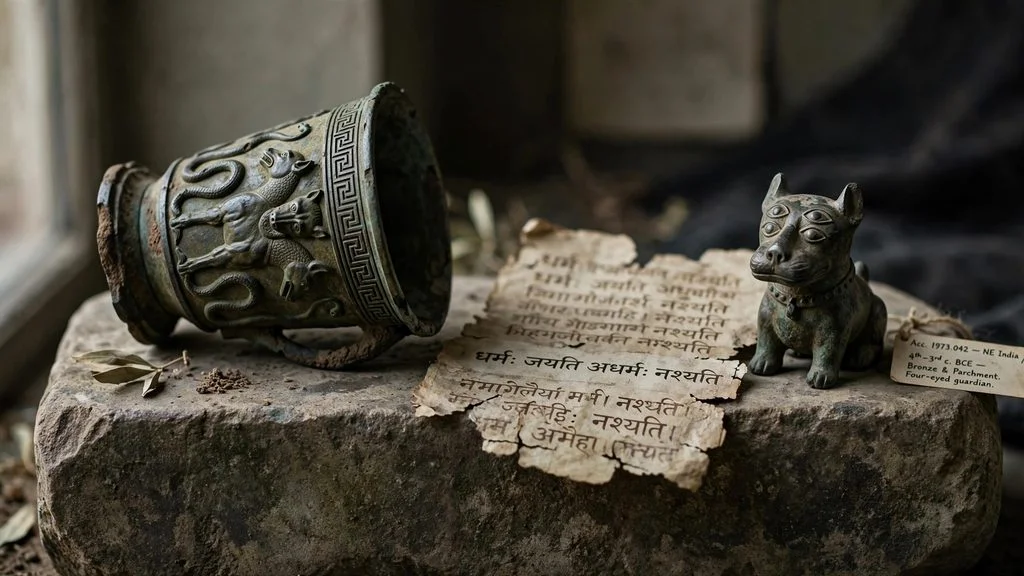
The proposal is still debated, and the sound changes it requires are far from simple, so it belongs among the possibilities rather than the facts. Resemblance is not descent, and Cerberus as the Greeks knew him was shaped by Greek poets and painters, not handed down intact from prehistory. Far to the north, the Norse remembered a hound called Garm, chained before a cave at the entrance to the land of the dead and destined to break loose at the end of the world. Whether or not these dogs share a single ancestor, they show how naturally the dog attaches itself to death in the imagination of very different peoples.
That makes sense of his strange mixture of menace and familiarity. Dogs were the animals that lived closest to the human household and to its dead. They guarded the door, they scavenged at the edge of every battlefield, and they howled at the hour of a death. Hecate, the goddess of crossroads and thresholds, was announced by the baying of dogs. Cerberus belongs to the same world, a domestic animal pushed to the scale of the cosmos, still doing the oldest job a dog was ever given, watching who comes and goes.
A Honey Cake for the Journey | How the Dead Paid Their Way
The Greeks spoke of a coin for Charon, the ferryman of the dead. Whether the dead also needed something for the dog is a harder question, and the best evidence comes from a comedy. In Aristophanes’ Lysistrata, performed in 411 BCE, the heroine insults a pompous magistrate by treating him as a corpse ready for burial, and among the things she offers to provide is a honey cake. The line itself does not name Cerberus. Ancient commentators on the play, writing long afterwards, explain that a honey cake was given to the dead for the hound.
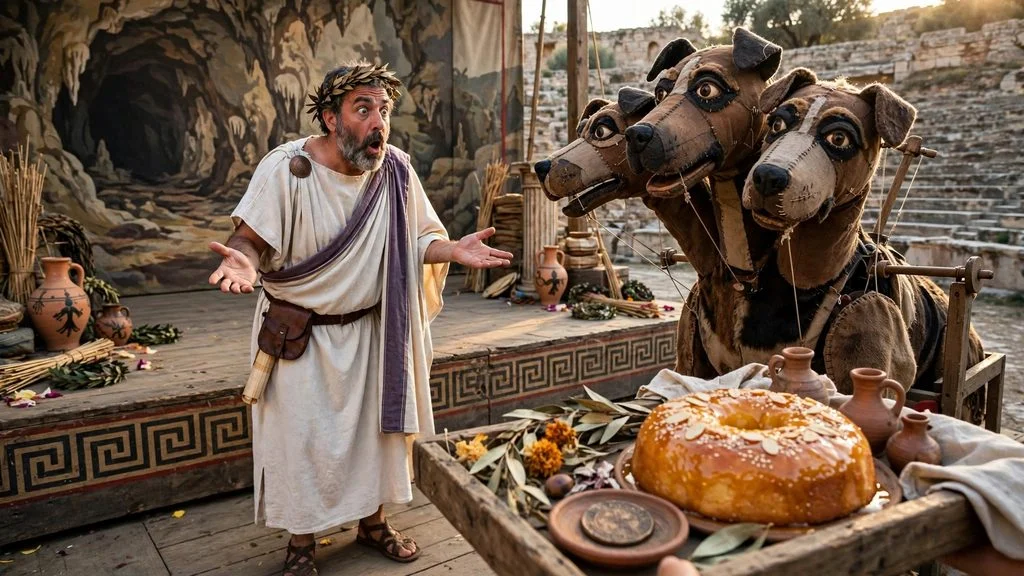
That evidence should be read for what it is. A joke on the Athenian stage shows that the idea was familiar enough for an audience to catch it at once. It does not prove that every family placed a cake in every grave, and Greek burial customs varied too much from place to place and century to century to support any such rule. What it does show is that by the end of the fifth century BCE the dog had a place in how ordinary Athenians pictured death, not only in the epics. People could imagine arriving at the threshold with something in hand for the guard, and it was never because they feared being turned away. Hesiod had already said they would not be.
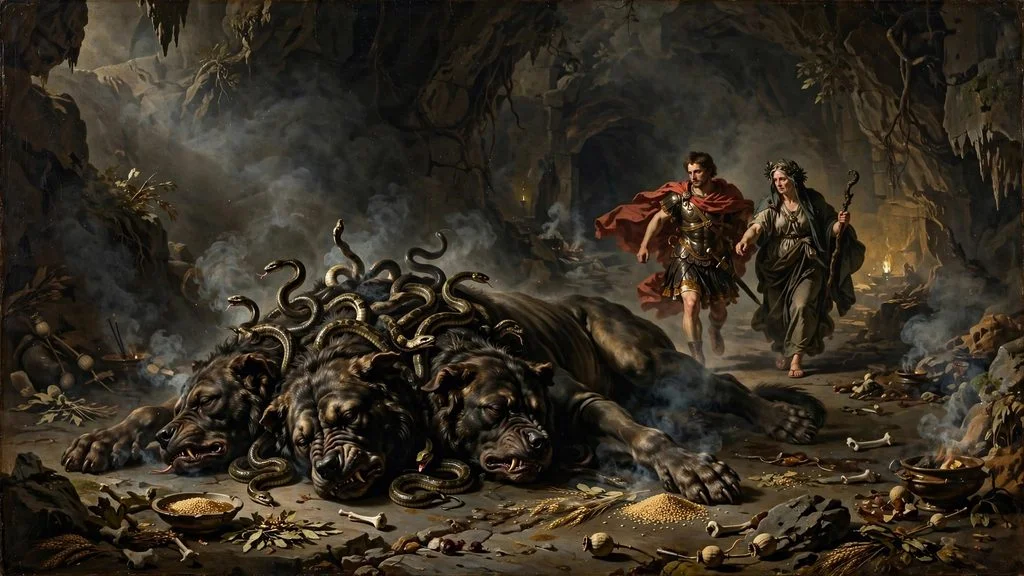
The poets turned the same honey cake into the key for those rare souls who needed to come back out. In the sixth book of Virgil’s Aeneid, the Sibyl of Cumae leads Aeneas down to the realm of the dead, and the guard is waiting.
Huge Cerberus makes these kingdoms ring with the barking of three throats, sprawled enormous in the cave that faces them. The priestess, seeing his necks already bristling with snakes, throws him a lump made sleepy with honey and drugged grain. Mad with hunger, he opens his three throats wide, snatches the offering, and his monstrous back goes slack as he lies stretched across the ground, filling the whole cave.
Virgil, Aeneid 6.417 to 423
The Latin word for that lump of drugged food is offa, a sop, and English still uses the phrase “a sop to Cerberus” for any small bribe that quiets a difficult guardian. The expression is honest about the mechanism. The cake is not a sacrament. It is something to make a hungry animal look away.
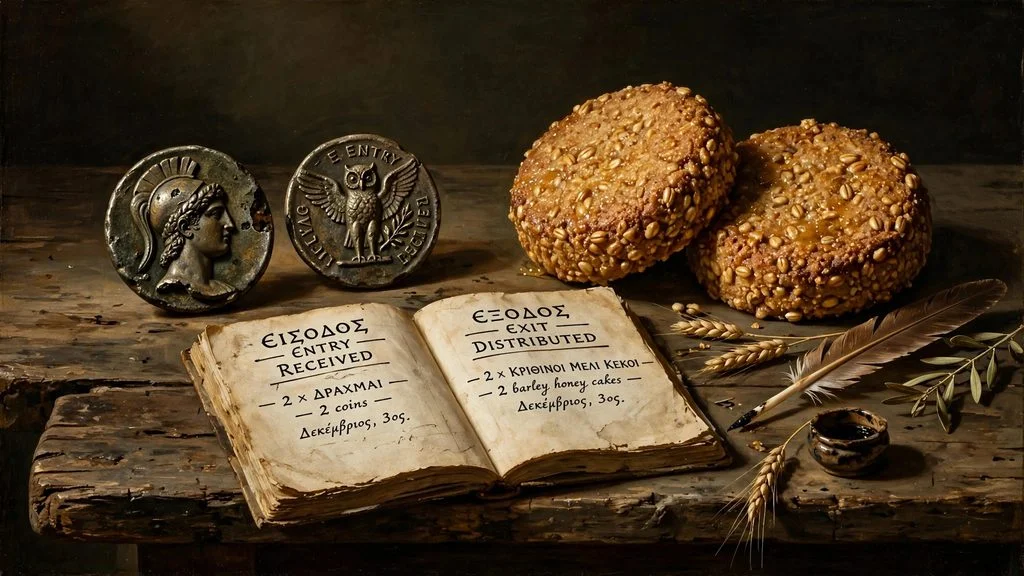
The most precise version belongs to Apuleius, whose second-century novel preserves the story of Eros and Psyche. Sent by Aphrodite into the underworld, Psyche is told exactly what to carry. She must hold two coins in her mouth and two cakes of barley meal kneaded with honeyed wine in her hands. One coin pays Charon for the crossing down and the other for the crossing back. One cake goes to the dog on the way in, and the other is saved for the way out.
Two cakes. That small piece of bookkeeping confirms everything Hesiod said seven centuries earlier. The way in and the way out are separate transactions. The entrance had always been easy. It was the exit that had to be paid for.
Music worked too. When Orpheus went down to bring back Eurydice, the dog fell under the spell of the song along with everything else in Hades. Virgil, in the Georgics, catches the moment in a single line, Cerberus standing with his three mouths hanging open, too absorbed to bark. Horace goes further and imagines the hundred-headed beast lowering his black ears to listen when the poets Sappho and Alcaeus sing among the shades.
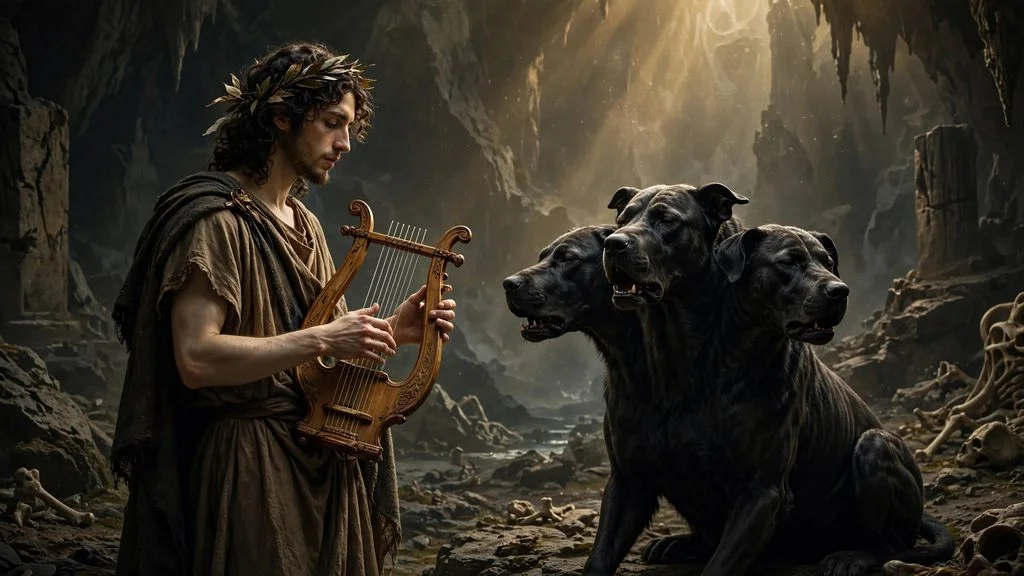
The monster who could not be fought could still be moved. That may be the most hopeful thing the Greeks ever said about him.
The Twelfth Labour | No Weapons, One Lion Skin
The one great adventure in Cerberus’s life is his capture, the last and hardest of the labours that Eurystheus, king of Tiryns, set for Heracles. The fullest account comes from Apollodorus, and it begins not with a fight but with a ritual. Before he went down, Heracles travelled to Eleusis to be initiated into the Mysteries, the rites that promised their initiates a better fate among the dead. Even the strongest man alive prepared for the underworld the way an anxious Athenian might.
In Apollodorus’ version he went down at Taenarum, the cape at the southern tip of the Mani, where a cave by the sea was believed to open onto the road to Hades. Below, he freed Theseus from the seat that held him fast, wrestled the herdsman of Hades’ cattle, and then did something no previous visitor had thought to do. He asked. Hades gave his permission on one condition. Heracles could take the dog if he mastered it without weapons.
Heracles found Cerberus at the gates of the river Acheron. Wearing only his breastplate and the skin of the Nemean Lion, which had once belonged to the dog’s own nephew, he threw his arms around the heads and held on. The serpent that served Cerberus for a tail bit him, and he did not let go. He squeezed until the hound gave in, then carried him up into the world of the living.
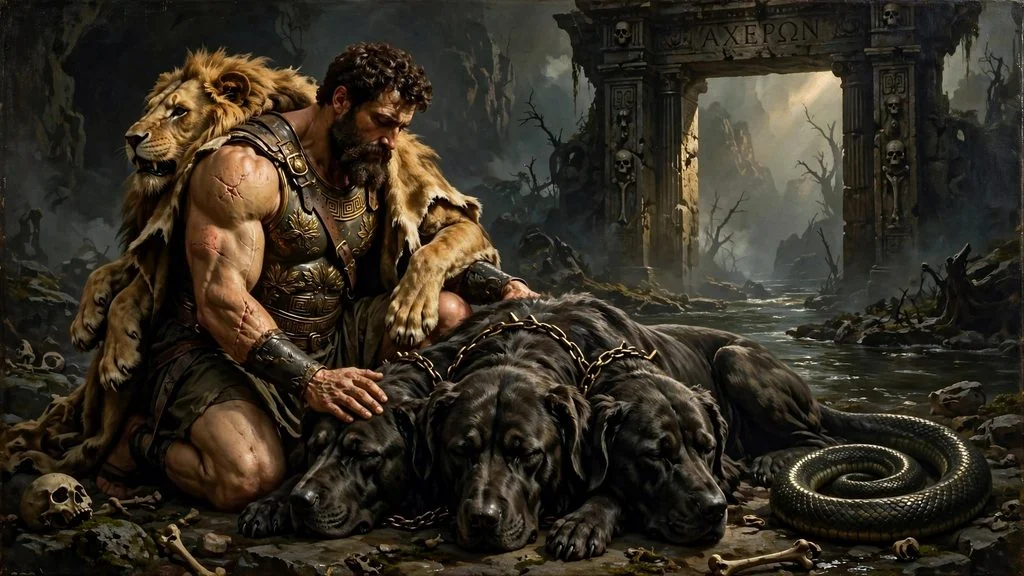
The condition reveals as much as the fight. Heracles was not sent to kill the guardian of the dead. He was sent to master him and bring him back alive, a test of restraint as much as strength, from a hero whose labours had so far ended mostly in corpses. The one monster he could not kill was the one whose survival the world depended on.
Apollodorus is one handbook, written centuries after the stories took shape, and he was not the only authority. Several Greek towns claimed the spot where Heracles came back up. Apollodorus says it was Troezen. The people of Hermione pointed to a chasm in their own territory, and in Euripides’ play about Heracles the hero leaves the dog for a while in the grove of Demeter of the Underworld at Hermione. Taenarum itself kept the strongest claim, and when the traveller Pausanias visited in the second century CE he found a temple built like a cave. He also reported a sceptical opinion from the historian Hecataeus of Miletus, who believed that the so-called hound of Hades had really been a deadly snake living at Taenarum, given the name because its bite sent people straight to the dead. A Greek could stand in the sacred cave, hear the myth, and hear an educated man explain it away, all in the same visit.
The scene at Tiryns became a favourite of the vase painters. A water jar made around 530 BCE, now in the Louvre, shows Heracles arriving with the snarling dog on a leash while Eurystheus, the king who ordered the labour, dives headfirst into a great storage jar, his arms flung up in terror. The man who had spent years inventing impossible tasks had never really expected this one to be completed.
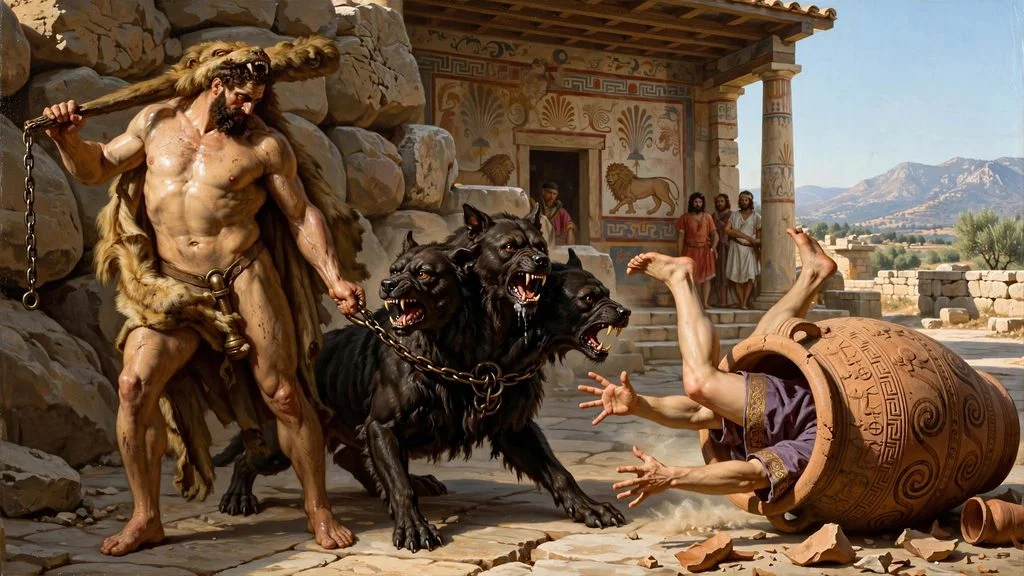
Then Heracles did the part of the story that retellings tend to skip. He took Cerberus back. The labour was never a conquest. The dog was borrowed with permission, shown to a frightened king and returned to his post, and the gate of the underworld was left exactly as it had been found.
Wolfsbane | What Grew Where He Touched the Light
The most vivid sequel to the labour comes not from early Greek myth but from Roman poetry. Ovid, writing at the start of the first century CE, some seven hundred years after Hesiod, tells it in his Metamorphoses while describing how Medea tried to poison the young Theseus, and pauses to explain where her poison came from. When Heracles dragged Cerberus out of the dark cave and into the daylight, the dog fought the chain, dazzled by a sun he had never seen, and barked from all three throats at once. Foam flew from his jaws and spattered the ground. Where it fell, a plant sprang up from the hard rock, and the people who lived there named it aconite.

Aconite is real, and the ancients did not exaggerate its danger. Known in English as wolfsbane or monkshood, it is one of the most toxic plants in Europe, and its tall spikes of hooded flowers still grow wild in mountain meadows across Europe and Asia. Greek explanations of its name connect it either to akonai, the whetstone rocks it was said to grow on, or to Akone, a harbour near Heraclea on the Black Sea, where the local people showed visitors a cave they called the Acherusian, the very place, they said, where Heracles had brought the hound into the light.
Late as Ovid’s version is, it makes a quiet and serious point. Even a crossing approved by the king of the dead, carried out by the son of Zeus and reversed as soon as it was done, left poison behind. The boundary between the worlds was not just a custom. When it was broken, even briefly and for good reasons, something lethal came through.
A Door That Opens One Way | What the Dog Really Guards
Put the stories side by side and a pattern appears. Orpheus passed Cerberus with music and lost Eurydice on the way back. Psyche passed him with two cakes and nearly lost herself to curiosity on the road home. Aeneas passed him with a drugged sop and a Sibyl to guide him. Heracles carried him off with the permission of Hades himself. Sisyphus, who talked his way out of death altogether, earned the most famous punishment in the underworld for it. Every exception required a gift no ordinary person possessed, a god’s son, a god’s lover, a hero with a destiny, the greatest singer who ever lived.
That is the real lesson of the hound. Death in the Greek imagination was not impossible to undo in principle. The myths are full of people who went down and came back. It was impossible in practice, because the price of the return was always more than an ordinary life could pay. Cerberus is the measure of that price. He can be fed, charmed, drugged or wrestled, and yet the ordinary dead, with their single honey cake and their single coin, stay where they are. A dog that can be distracted by a cake turns out to be guard enough.
Even Persephone, queen of the dead and the one figure whose return to the upper world was written into the cosmic order, came back only on terms. She had eaten the food of the underworld, a few pomegranate seeds, and so part of every year belonged below. The same rule held everywhere. Whoever crossed the threshold was changed by it, and whoever came back paid for it.
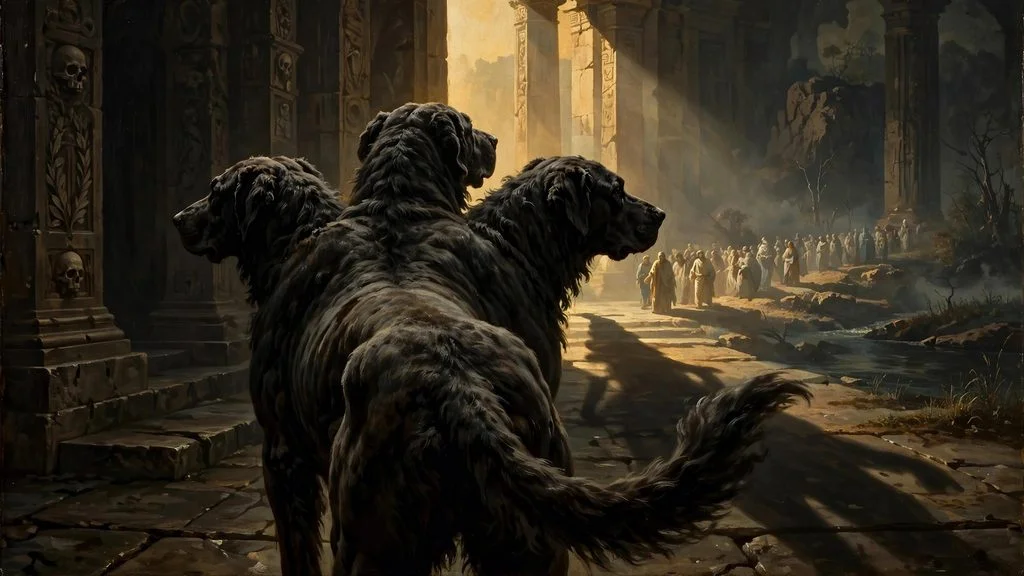
Later ages kept the dog and changed his meaning. In Dante’s Inferno Cerberus has become a demon of appetite, set over the gluttons in the third circle of Hell, and Virgil, acting as Dante’s guide, silences him by flinging fistfuls of earth into his three throats, the Sibyl’s honey cake reduced to dirt. Modern fantasy has given him back his softer side, the giant dog who falls asleep to music. The original lies between the two, neither demon nor pet. He is the threshold itself, friendly to everyone arriving and merciless to anyone trying to leave.
The Dog Who Went Home
Almost every retelling ends with Heracles triumphant and the king hiding in his jar. The ancient story ends a little later and a little more quietly. Heracles walked the dog back down. The heads settled. The tail stopped biting. Cerberus took up his place again at the gate on the bank of the Acheron, with his ears laid back for whoever was arriving next.
The dog goes back to the gate because the gate still needs a dog. None of the heroes who passed him ever defeated him. They distracted him, charmed him, borrowed him for a single errand, and every one of them left. He stayed. That was always the arrangement. The living would come and go through the stories, but the dog would still be there when the last of them had gone, wagging his tail at the newcomers and watching the door behind them.
Somewhere on a rocky slope above the tree line, wolfsbane is in flower this autumn, as poisonous as it ever was. In Ovid’s telling, it marks the only time the dog of Hades ever saw the sun.
And in the oldest Greek telling, that is what makes him frightening. He is not the creature standing between you and the place you fear. He is the creature standing behind you once you are inside it, waiting to see whether you will ever be allowed to leave.
At Olympus Estate, Mythic Essays returns to the oldest sources to hear what the myths actually said, and the hound of Hades is a case where the original story turns the familiar one inside out. Hesiod’s Cerberus greets the newly dead with a wagging tail and lowered ears, lets them walk straight in, and devours anyone he catches trying to leave. He was the son of Typhon and Echidna and brother to Orthus, the Hydra and the Chimera, part of a family Heracles worked through labour by labour. His heads numbered fifty for Hesiod, a hundred for Pindar and Horace, two on many Athenian vases and three by the time the tragedians fixed the image. Some linguists connect his name to the spotted dog of Yama in the Rigveda, a possibility rather than a proof, and Pausanias noticed that Homer gave him neither name nor monstrous shape. An Athenian comedy joked about a honey cake for him, Virgil’s Sibyl quieted him with a drugged sop, Psyche carried two cakes because the exit had to be paid for separately, and Orpheus stilled him with song. In Apollodorus’ account Heracles prepared at Eleusis, descended at Taenarum, mastered him without weapons, showed him to a king hiding in a jar, and brought him home again. In Ovid’s later Roman telling, wolfsbane sprang up where the dog’s foam touched the daylight. The door he guarded opened one way, and it still does.