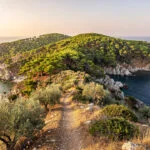





There is a point on the northernmost tip of Skiathos where the Aegean breaks against solid limestone with the violence of a sea that has been driving north swells against this particular coast for as long as the coast has been here.
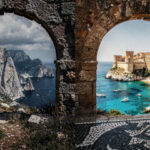
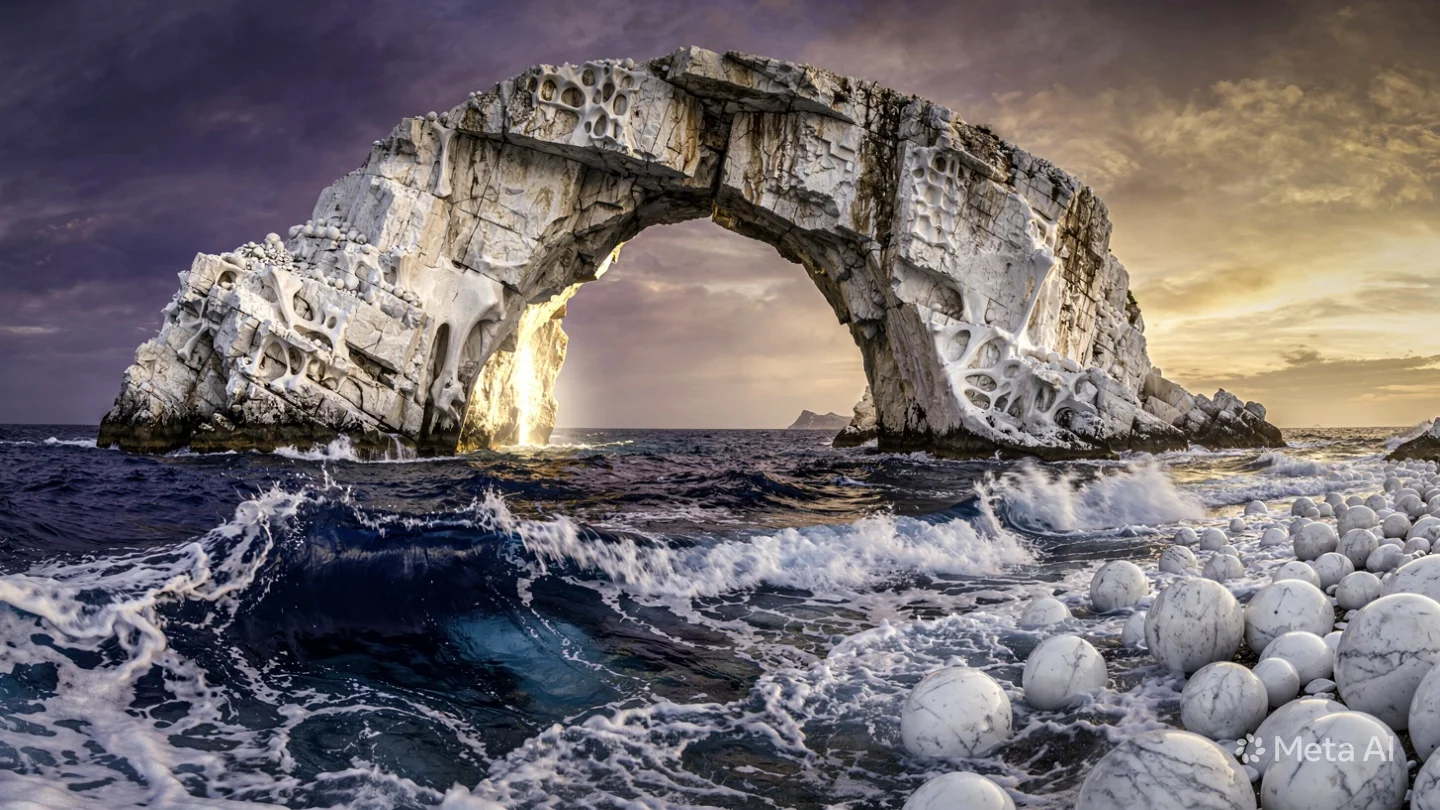
The shore at Lalaria is not sand. It is a field of perfectly smooth, uniformly white stone spheres, shaped by centuries of heavy northern swells rolling down from the open Aegean and polishing the high-calcium limestone until it reflects the noon sun like bleached bone. Behind the beach, a natural stone archway, the Tripia Petra, projects directly into the deep turquoise water: a formation produced by differential weathering, the persistent chemical action of salt water eating away at softer base rock while a denser upper shelf stayed intact, until the base was gone and only the arch remained.
The ancient Greek mariners who navigated the volatile northern Aegean never approached this coastline as simple scenery. The Sporades archipelago sat directly along the early Aegean world’s maritime trade routes, the same sea lanes the Argonaut myth established as the northern islands’ shipping corridor, and the coastal features Aegean weather had carved from the limestone were read as evidence of exactly the force that had made them.
The trident of Poseidon, the triaina, was never modeled after a fisherman’s tool. It was the implement heavy enough to shatter bedrock, split islands from mainlands, open subterranean springs, geological force given a divine name. The coastline it produced was the physical record of that force applied to the rock of this place across the whole duration of the sea’s engagement with the coast.
Every Greek sailor who passed Tripia Petra on the approach to the northern Aegean was reading the coastal geology as the geological record of the very force that governed the sea he was about to cross. The reading was never metaphorical. It was the most accurate account of the coastline’s formation available to anyone doing the reading.
The Earth-Shaker’s Topography
The Poseidon article in this collection develops the lot-drawing by which Poseidon received the sea as his domain: the three sons of Kronos, Zeus, Hades, and Poseidon, dividing the cosmos by lottery after the Titanomachy, each receiving the domain that matched the quality of divine force he embodied. Zeus received the sky, Hades the underworld, Poseidon the sea, along with the force of the earthquake, connecting his maritime domain directly to the geological one.
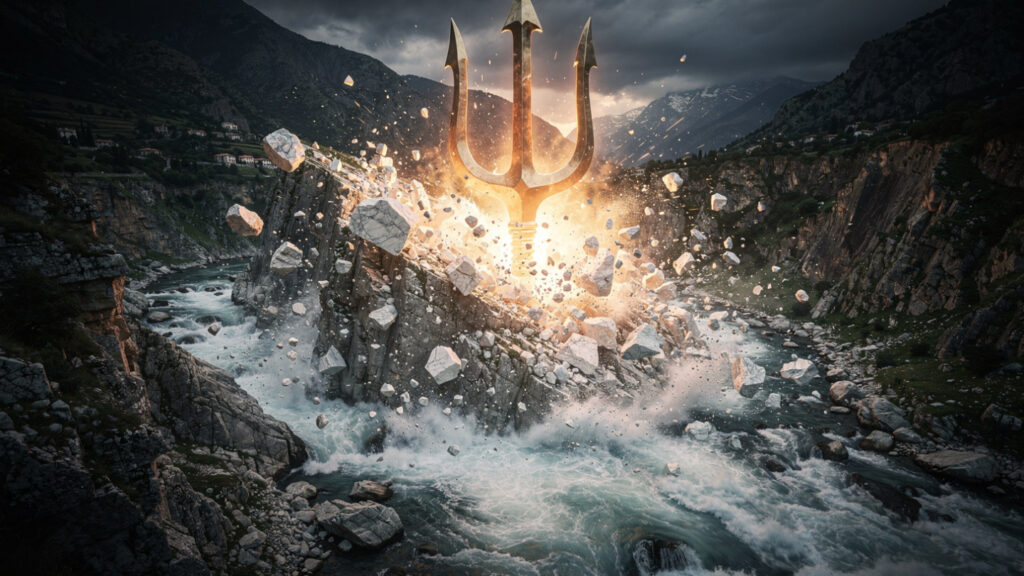
Ennosigaios, the earth-shaker: an epithet claiming that the same divine force governing the unpredictable sea also governed the seismic activity that split coastlines, opened springs, and fractured the bedrock of the inhabited world. The Poseidon article develops this earthquake theology through the Thessalian belief that the Tempe Valley, the gorge carrying the Peneios River to the sea, was opened by Poseidon’s trident, the narrow river gorge cutting through solid rock reading directly as the trident’s own signature.
The coastline of the Greek world is what tectonic activity, the volcanic arc, and the Aegean’s own wave climate have been producing together for four million years. The volcanic arc article in this collection develops the actual mechanism: the African plate moving north, subduction at the Hellenic Trench, the volcanic arc running from Methana to Nisyros as the surface expression of the same tectonic system that produces the earthquakes, the coastal fractures, and the submarine volcanic deposits whose exposure gives these islands their coastal character.
The ancient world was not wrong to connect the sea’s behavior to geological activity. They were the same force. Poseidon was simply the divine name for the connection between the maritime and the geological that Greece’s own physical geography made unusually visible. The coastline of the Greek islands is the physical record of that engagement over geological time, the same record that produced the beach at Lalaria, the arch of Tripia Petra, the volcanic white of Sarakiniko, the sea caves of Kleftiko, and the freshwater springs of the southern Cretan coast.
The Marble Pebbles and Their Acoustic Register
What distinguishes the Lalaria pebbles from an ordinary beach pebble is high-calcium limestone’s own response to prolonged polishing by the northern Aegean swell: a marble-smooth surface, a white color, and the property of staying cold even under intense summer sun, giving the beach a thermal character that sits outside the summer Mediterranean’s usual range.
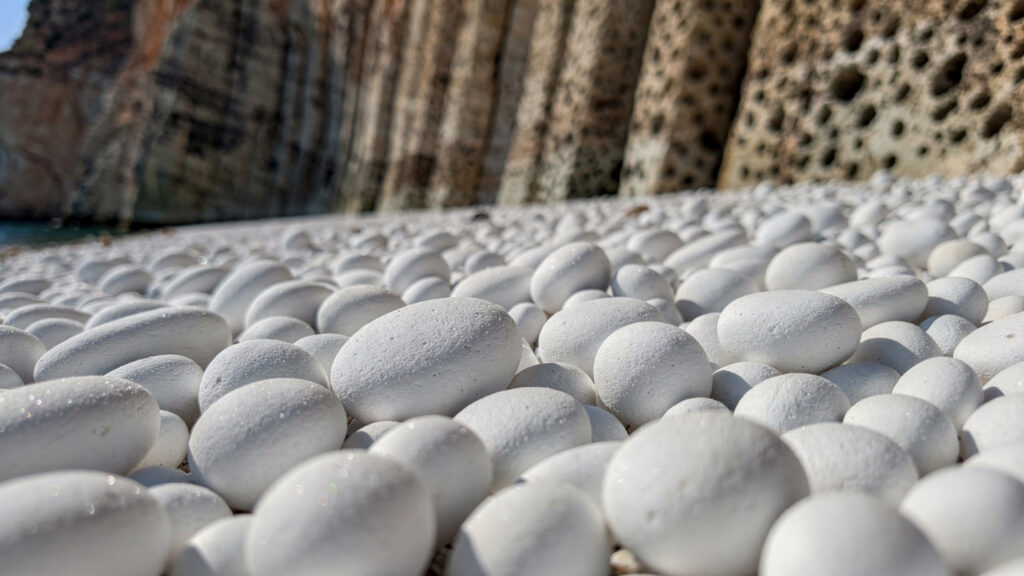
The cold of the Lalaria stones in August is a direct sensory experience of exactly that geology. The stones stay cold because the limestone’s own thermal properties, combined with a north-facing exposure to swells that never carry the warmth of the southern Aegean, hold the beach inside a microclimate the hot interior valleys of Skiathos never share. The beach feels like a different season from the rest of the island.
The continuous movement of water over the Lalaria stones produces a sound ancient coastal belief would have taken as the most direct available expression of the sea’s own divine voice: the deep hollow resonance of polished stones rolling against each other in the swell, amplified by the limestone sea caves flanking the beach, understood as the breathing of the ocean depths, the rhythmic respiration of the divine force whose domain was the marine trench and whose surface expression was the sound of stone on stone.
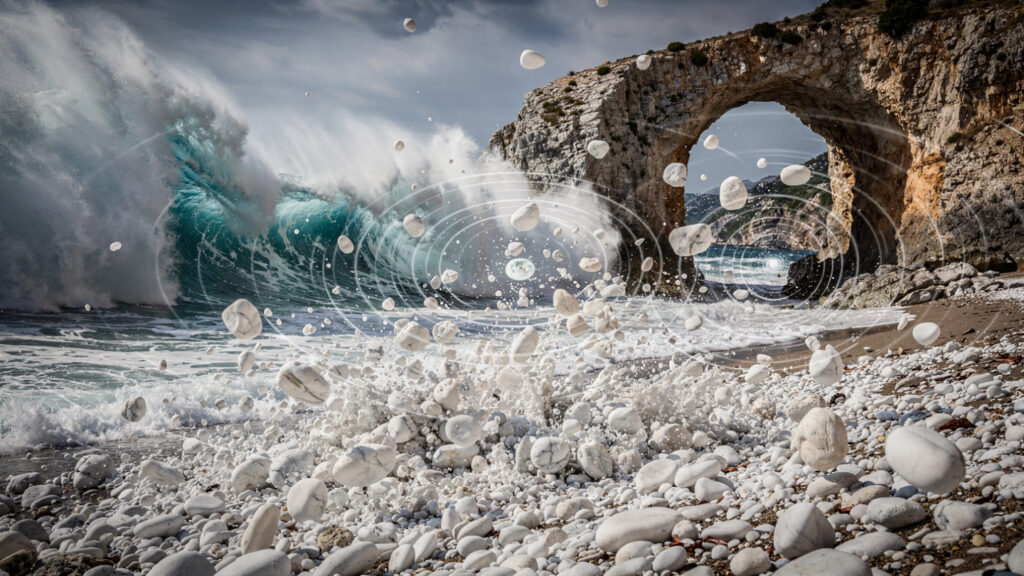
The Tripia Petra arch has always been accessible only from the water, and that condition shaped how ancient sailors engaged with it: the approach by boat, an offering of raw wine or some other sacrifice whose exact content varied by site and by need, and passage through the arch itself as an act of entering the domain of the force that had made it. The limestone arch rising above the water was the threshold between the human maritime world and the divine domain its own physical form marked.
The beach is still reachable only by boat from Skiathos Town. Arriving by water gives a visitor the same encounter with the formation ancient sailors had: limestone cliffs rising above the beach, the arch projecting into the water, the sound of stones in the swell, and the particular quality of a place cut off from the inhabited island by the very limestone walls the sea’s own action produced.
Sarakiniko | The Volcanic Shore
Sarakiniko, on the north coast of Milos, is the Aegean’s most immediately volcanic coastal landscape in the sense that the geological process behind it is most directly legible in what remains.
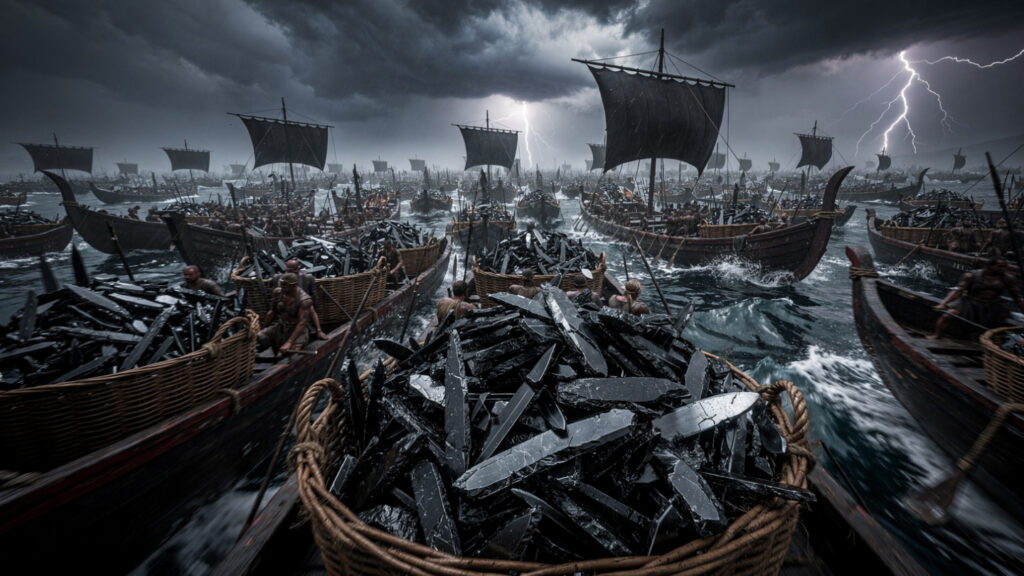
The Milos article in this collection develops the island’s volcanic character through its obsidian trade, tracing its prehistoric significance from Paleolithic quarrying through distribution across the eastern Mediterranean: the same volcanic geology that made Milos the source of the region’s best available cutting technology also produced, at the surface, exactly the formations Sarakiniko now displays. The island’s prehistoric importance was the importance of a place whose volcanic geology had produced a material the surrounding world simply could not produce for itself.
The Sarakiniko formations came from late Pliocene submarine volcanic activity, layers of ash, pumice, and volcanic tuff later lifted above sea level by tectonic uplift and exposed ever since to wind and wave erosion. The Meltemi, the north wind whose character and seasonal regularity the Aegean name article in this collection develops, has been the primary agent shaping Sarakiniko’s surface: the smooth undulating curves, the deep trenches, the hollowed sea caves, and the labyrinthine passages between the white volcanic formations are all products of the Meltemi’s abrasive action on that same volcanic material.
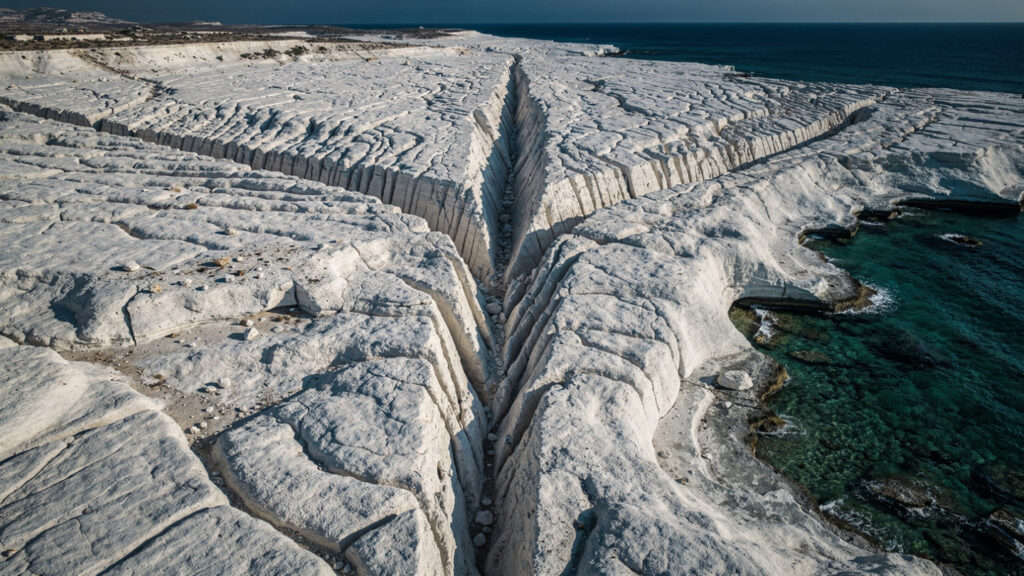
The result is the landscape the Milos article calls the island’s most immediately striking: bleached white volcanic surface with no soil and no vegetation, smooth curves cut by wind erosion from pumice and tuff, a material that reads as something between the geological and the architectural, since the wind’s abrasive action has given it the surface quality of something worked rather than simply weathered.
The ancient reading of this landscape followed exactly what the formation itself suggested: narrow, deep channels cut into white stone, trenches that look like the marks of a sharp, heavy instrument dragged repeatedly across the same surface, real violence implied by the geological result. Trident marks. Not a fisherman’s tool but the implement built for shattering bedrock, whose application to a Cycladic island’s volcanic deposits produced the surface a contemporary visitor still experiences as the most otherworldly landscape anywhere in the Aegean.
The Venus and the Volcanic Substrate
Milos’s volcanic geology connects to the island’s most significant archaeological find in a way that gives the Sarakiniko landscape unexpected theological weight.
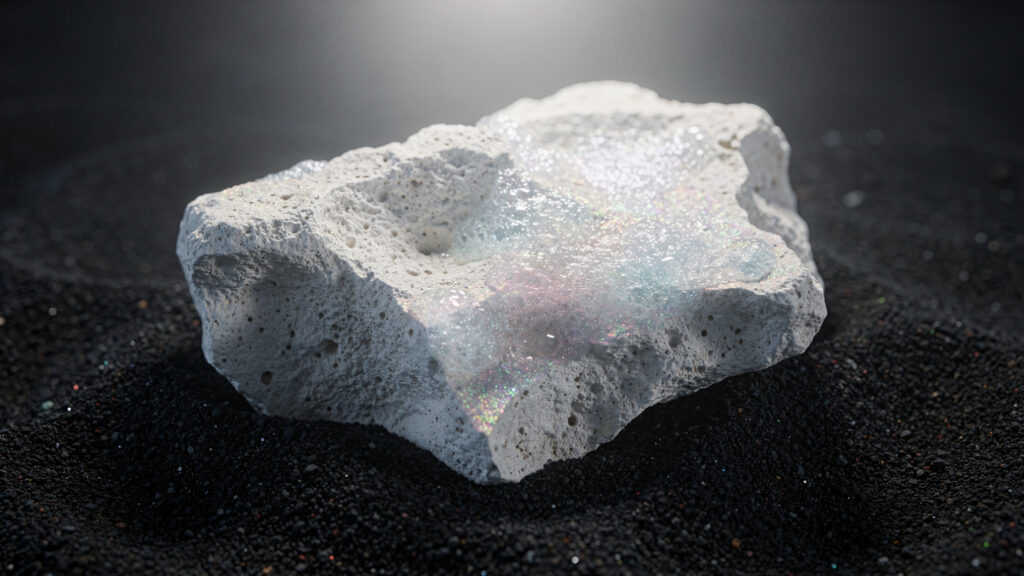
The Venus de Milo, the Aphrodite statue a farmer found in 1820 at the ancient site of Klima on the island’s western coast and which now stands in the Louvre, emerged from volcanic soil whose geological character had already produced the Sarakiniko formations, and that same aesthetic quality expresses almost exactly what Aphrodite’s own mythological origin encodes: a goddess who rose from sea foam at the moment the castrated Ouranos’s blood struck the water, divine blood and salt water and foam together producing a being whose whole character was beauty arising from cosmic violence.
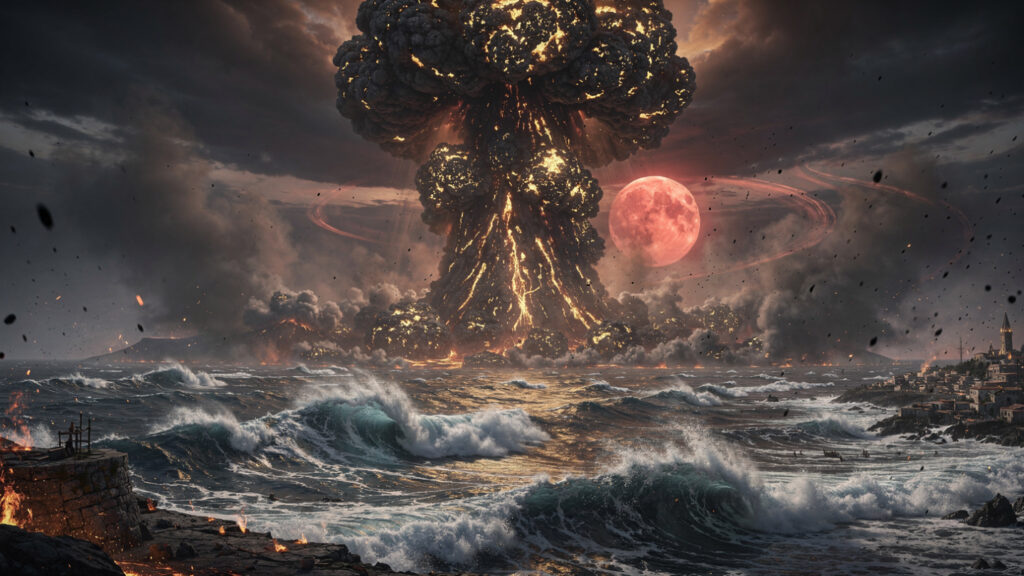
The Eros and Aphrodite article in this collection develops Aphrodite’s two distinct origin stories, the Hesiodic Aphrodite born from the sea foam of Ouranos’s castration, and the Homeric Aphrodite, daughter of Zeus and Dione. The Hesiodic version, divine beauty arising from a violent cosmological event in the medium of sea foam, is exactly what Sarakiniko’s volcanic white expresses in the visible geological record: pumice and tuff, the material of a genuinely violent geological event, eroded into smooth white curves, beauty arising from geological violence itself.
The Venus de Milo was found in the same volcanic soil that produced Sarakiniko. The connection is not forced. It is simply the character of a volcanic island whose geology and whose mythology happen to encode the same underlying quality: divine beauty whose origin is cosmic or geological violence, carried in the medium of white material, whether explosion, sea foam, or volcanic deposit.
Kleftiko and the Hidden Palace
The western tip of Milos preserves a coastal formation ancient belief organized around the Homeric description of Poseidon’s own deep, secure palace hidden within the marine trenches: a network of white stone pillars, natural bridges, and interconnected sea caves the sea’s hydraulic action has been carving from a collapsed coastal cliffside for as long as it has been exposed to the Aegean.
Kleftiko is accessible only from the water, and that single condition preserves the whole quality of this enclosed marine landscape: approach by boat through narrow openings between the stone pillars, a sudden transition from the open Aegean into the enclosed calm water of interior grottoes, a stillness inside the sea caves that remains undisturbed even while storms break against the outer faces of the same stone pillars.
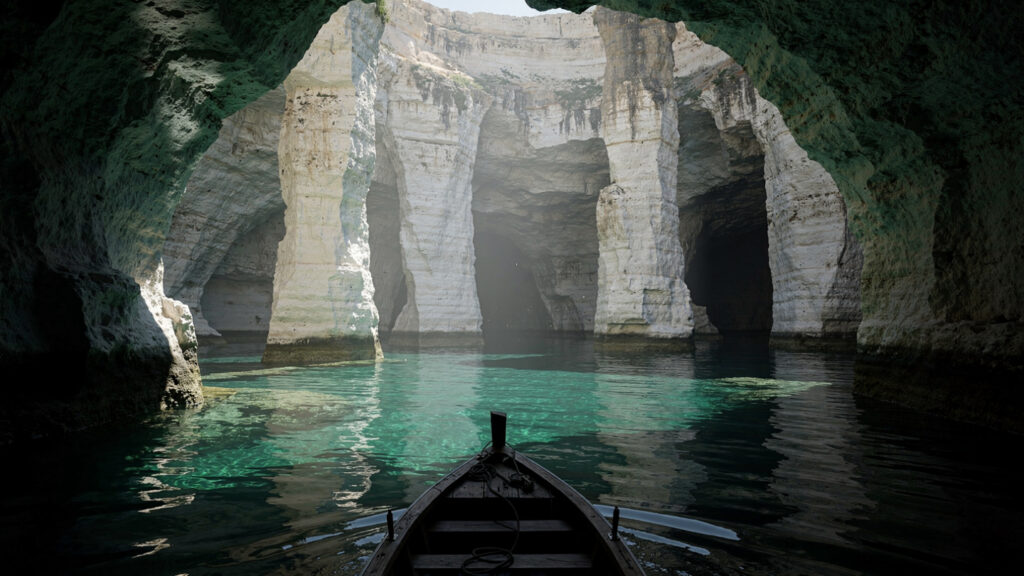
This physical transition, from violent outer surface to absolute inner calm, is precisely what the Homeric description of Poseidon’s palace expressed. The Iliad’s Poseidon, leaving the battlefield at Troy to return to his palace in the marine trenches between Tenedos and Imbros, was returning to a dwelling whose character came from the sea’s own violence, and was simultaneously protected by it: an inner calm generated by outer rock whose function was separating the divine domain from the mortal world’s surface turbulence.
In the later historical period, the Kleftiko grottoes served as hideouts for Aegean pirates, who used the landscape’s defensive properties in essentially the same way sailors had always understood enclosed sea caves, places combining easy access from the water with genuine invisibility from the open sea. The medieval and Ottoman pirate fleets that sheltered in Kleftiko were exploiting exactly the properties ancient maritime belief had already attributed to the sea god’s own domain: hidden interior calm, protective stone walls, a narrow entrance controlling who could get in at all.
Glyka Nera | The Sweet Water and the Salt Sea
On the southern coast of Crete, where the White Mountains send their limestone ridges directly into the Libyan Sea without the gradual coastal descent most shorelines provide, the beach at Glyka Nera presents a genuine natural anomaly, one ancient belief read as a divine force applied directly to the boundary between freshwater and salt water.
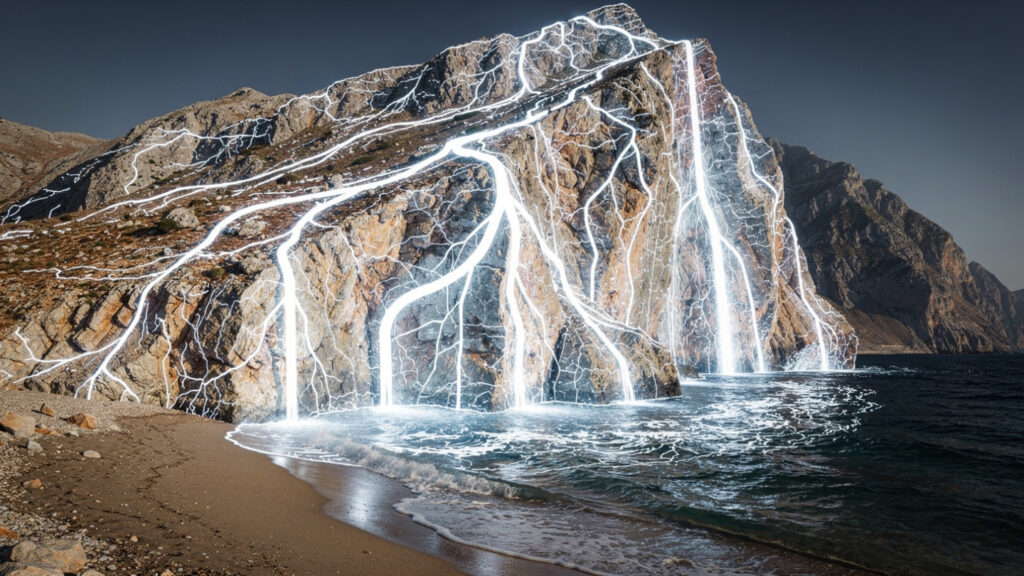
The name translates directly as sweet water. The phenomenon behind it is a deep mountain aquifer at work: winter snowmelt from the high peaks of the Cretan interior, filtered through the limestone geology of the White Mountains over months of underground passage, emerges at sea level through underwater limestone faults exactly where the hydrostatic pressure of that mountain water column is strong enough to push freshwater through the beach sediment and out into the salt sea.
Freshwater bubbling up through a saltwater beach at the base of vertical mountain walls was, to ancient theology, evidence of a divine force governing both the freshwater and saltwater domains simultaneously. Poseidon’s earthquake theology, which already included the opening of underground springs, was exactly the theological framework that most directly explained the mechanism behind Glyka Nera.
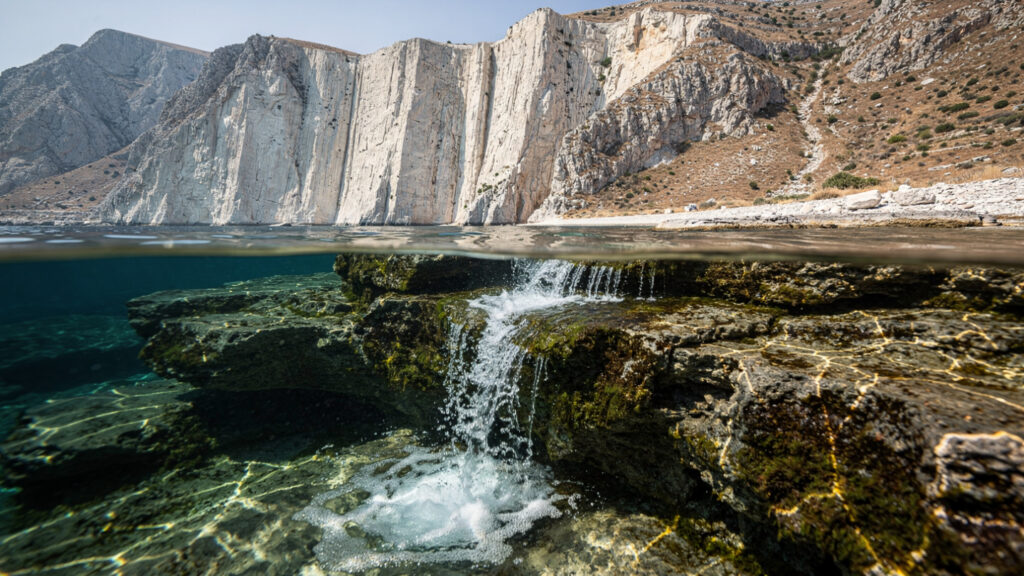
The Poseidon article in this collection develops the Thessalian belief that the trident opened the Tempe Valley, and the connection between that same geological function and the opening of underground springs: the force that opened the sea arch of Tripia Petra and cut the channels of Sarakiniko was, in the same theology, the force that opened the mountain aquifer whose pressure brought fresh water through a limestone fault to the surface of a saltwater beach.
Early Cretan sailors used Glyka Nera as a replenishment point on an otherwise inhospitable, cliff-lined southern coast. Vertical mountain walls that made the coast inaccessible by land made the fresh water accessible only from the sea, which was itself the condition that let this place function as a natural sanctuary, a freshwater spring at the salt sea’s edge. Any sailor needing water on Crete’s southern coast needed the approach by boat, to the exact spot where the divine force had opened a connection between mountain water and open sea.
The beach is reached today by the same approach: a coastal path descending through rocky terrain from the nearest road, or arrival by boat from the west along the cliff-lined coast. The freshwater still bubbles through the sand. The sea is still salt. The mountain walls are still vertical. Whatever force the ancient world named Poseidon is still doing exactly the work that name was meant to describe, moving water between domains whose boundaries the geology itself carved.
What the Shore Was
The Greek coastline is not a backdrop for the mythology. It is the mythology’s physical evidence.
The geological processes tectonic activity, the volcanic arc, and the Aegean’s own wave climate have been applying to the rock of these islands across all their geological exposure are the same processes whose visible results ancient belief read as the direct record of a divine force’s engagement with the coastal rock. The limestone arch at Tripia Petra was the trident’s work because the mechanism that produced it, differential erosion under the sustained chemical and mechanical action of salt water, was the most directly legible record available of a sustained force acting on the sea.
The volcanic white of Sarakiniko was the divine forge’s floor because the volcanic deposit’s surface, worked by the Meltemi’s abrasion into smooth curves, deep channels, and labyrinthine passages, has the quality of material genuinely worked rather than simply weathered by chance. The fresh water at Glyka Nera was the spring the trident opened because the mountain aquifer’s connection to the sea, through a limestone fault, is exactly the mechanism of an underground force applied to the boundary between two domains, precisely the trident’s own function.
The ancient mariners navigating the Sporades, the Cyclades, and the southern Cretan coast were reading the coastal geology as the most accurate account available to them of the force that would determine whether they survived the crossing. They were right to read it that way. The same force whose visible results were the Lalaria arch, the Sarakiniko channels, the Kleftiko grottoes, and the Glyka Nera spring also governed the sea’s behavior on the crossing itself. Understanding the visible results of that force’s previous engagements with the coast was the most direct preparation available for meeting it again, on the water, that same day.
The shore was the archive. The mythology was the reading.
At Olympus Estate, Wanderlust Greece guides you across the sacred and storied terrain of the Hellenic world. The Lalaria pebbles are cold in August because the north-facing coast and the limestone’s thermal properties keep the beach outside the summer Aegean’s thermal regime. The Tripia Petra arch is accessible only from the water. The Sarakiniko channels read as the marks left by a heavy implement dragged across the volcanic surface. The Kleftiko inner grotto is still calm when the outer stone faces are taking the full force of the winter Aegean. The freshwater at Glyka Nera still bubbles through the sand. The mountain walls are still vertical. The shore was the archive. The mythology was the reading.