
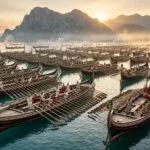

Before dawn on the Holy Mountain, a monk walks the length of a wooden beam suspended at shoulder height and strikes it with a mallet. The sound the Simandron produces is deep, irregular, syncopated, a rhythm that carries no resemblance to a church bell and was never intended to. It travels across water in a way that bells do not, diffusing over the surface of the northern Aegean before the first light has found the cliff faces above it, reaching the fishing boats anchored offshore, reaching the passengers on the early coastal ferry, arriving at the ear not as a signal but as a frequency that the body registers before the mind has identified it.
This sound, preserved on the third finger of Halkidiki for over a thousand years, is one of the most things in Greece. And it is the key to understanding what the peninsula actually is: a geography so varied across its three arms that the differences between them amount to the differences between three distinct civilisations, placed side by side within a single coastline, each carrying its own mythology, its own acoustic signature, its own relationship to time.
The Scar the Gods Left Behind
The ancient Greeks looked at Halkidiki’s three-fingered form and read it as a record of violence.
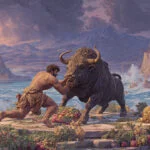
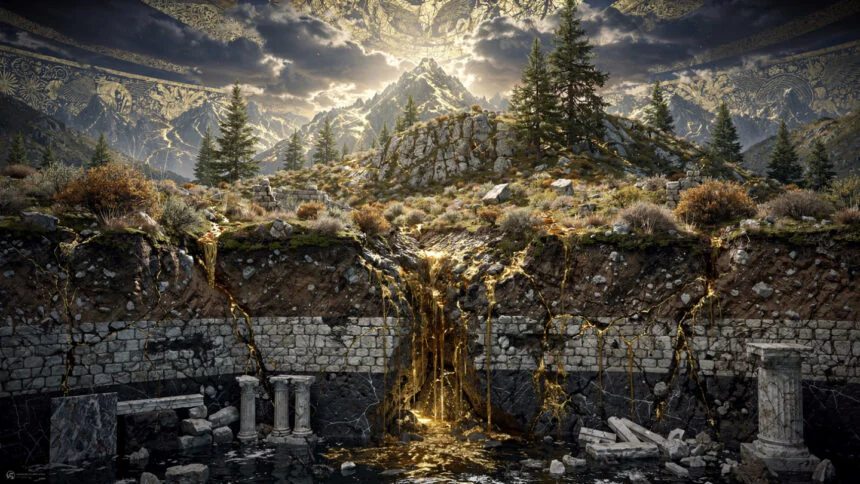
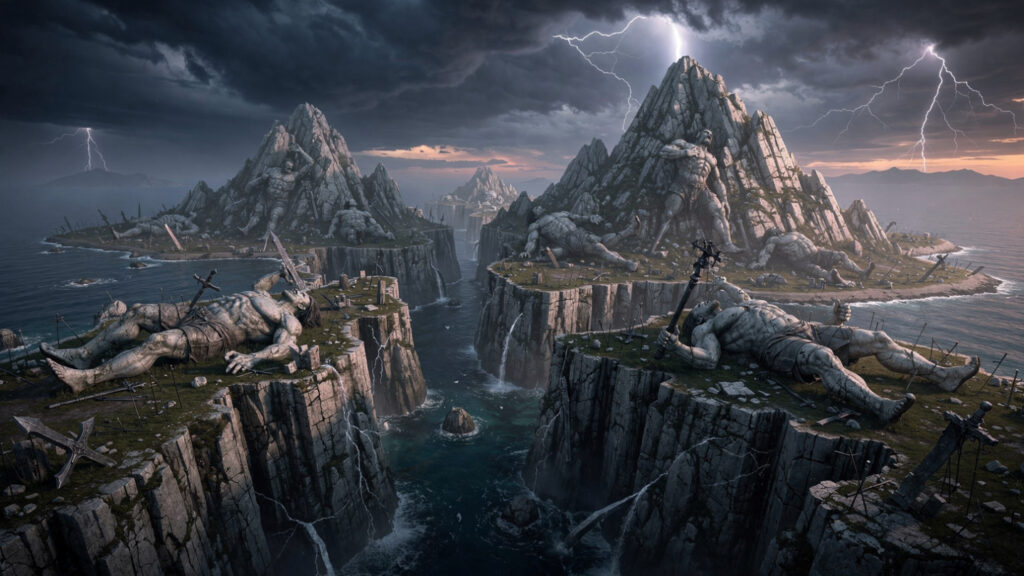
This peninsula was, in their understanding, the primary battleground of the Gigantomachy, the war between the Olympian gods and the Giants born from Gaia and Uranus. The landscape they saw confirmed it. The deep marine trenches off the eastern coast, the granite spines that rise through the pine forest of the middle prong, the massive headland of Mount Athos dropping sheer into the sea from a height of 2,033 metres: these were not geological events in the Greek reading. They were the petrified aftermath of a cosmic conflict, the terrain shaped by the impact of weapons flung between beings of incomprehensible scale.
The Giant Enceladus was crushed beneath the western prong by Athena. The Giant Athos hurled a boulder at Poseidon, missed, and the rock became the mountain that still carries his name. The middle finger preserves the memory of the Giant Sithon. Each prong is, in the mythological cartography, a burial mound.
This framing is not decorative mythology applied to a landscape that happens to be dramatic. It is the Greek mind performing its characteristic operation: reading the physical world as a record of divine activity and finding in the forms of a geography the story that explains why those forms exist. The three fingers of Halkidiki are dramatic because the Gigantomachy was violent. The geology confirms the myth. The myth explains the geology. Both are true simultaneously and neither requires the other to be false.
To travel through Halkidiki with this understanding active is to move through a landscape that is reading itself to you in real time.
Kassandra | High Frequency
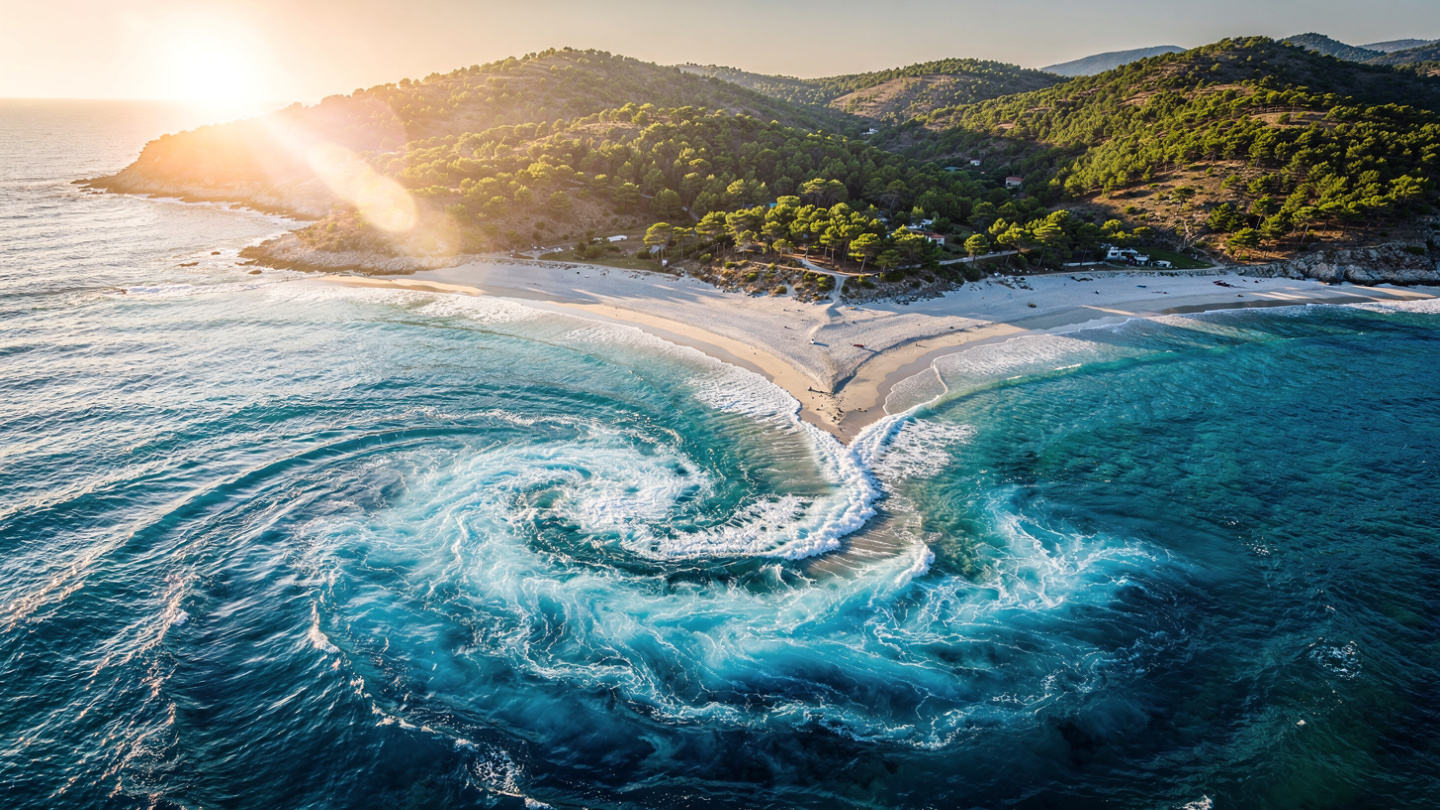
The westernmost prong runs approximately fifty kilometres from its root to Possidi Cape, where a sand spit hooks out into the sea and the converging currents from both sides of the peninsula produce a turbulence visible from above as two different shades of blue meeting in permanent negotiation.
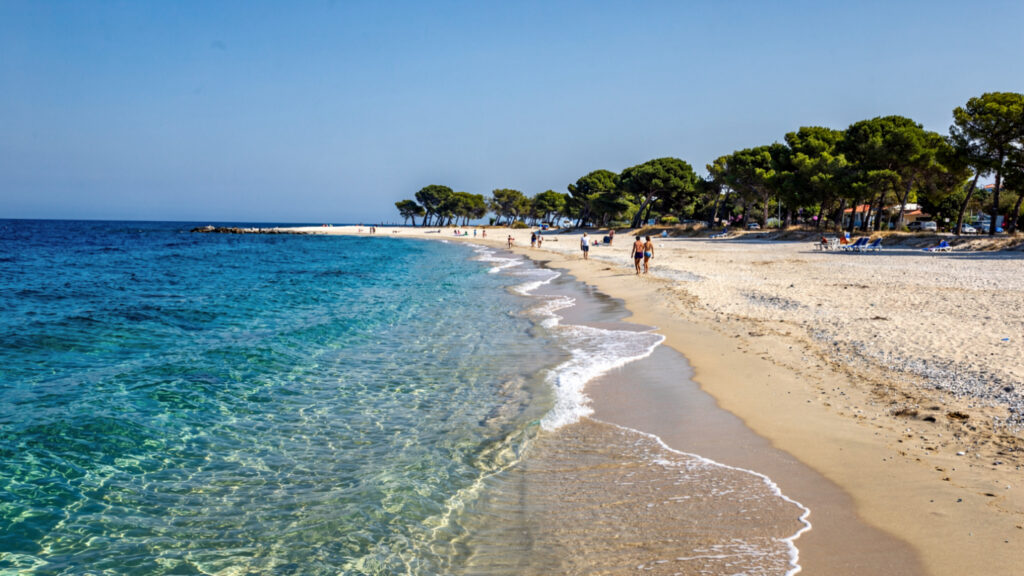
Kassandra is the most altered of the three fingers by human activity, and it carries this alteration with the ease of a place that has always been oriented toward human gathering. The wide beaches of Kallithea and Pefkochori, the pine-backed coves of Haniotis, the villages set back from the coast where the Saturday morning market fills the square with the noise of a community conducting its weekly business: these are the textures of a landscape that the summer concentrates and the shoulder seasons return to their own rhythms.
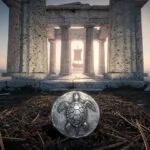
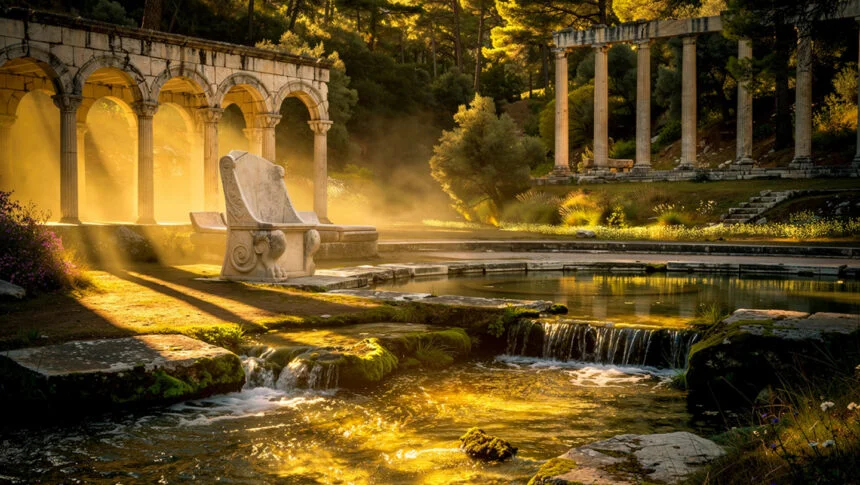
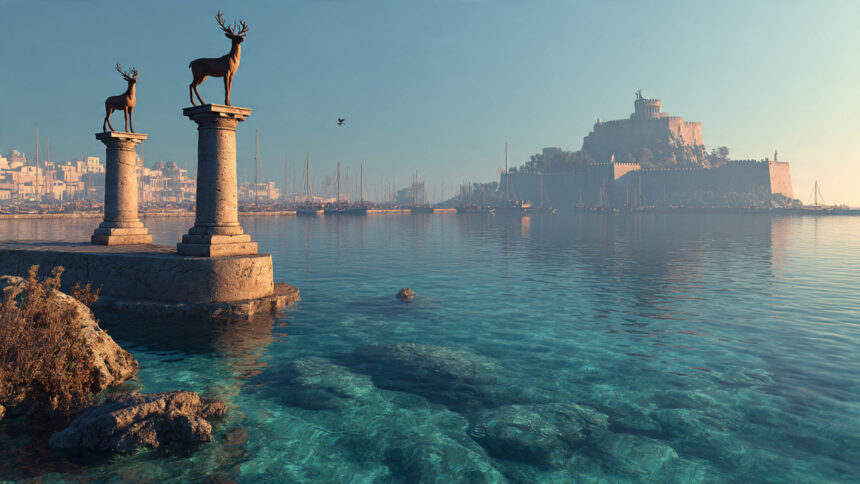
The Temple of Ammon Zeus at Kallithea sits at the water’s edge, its ruins visible from the beach. The ancient Greeks built their sanctuary here, at the literal boundary between land and sea, because the boundary was the point: the place where the human world and the divine world came closest was not a hilltop or a mountain but the shoreline, the line that neither element fully owns. The roar of the surf at this boundary was not incidental to the ritual. It was the ritual’s natural percussion.
Kassandra operates at the highest human frequency of the three prongs. In summer this means the density of bodies and music and movement that the resort culture produces. In May and September it means something more valuable: the sound of a landscape that is alive with human presence without being dominated by it, the taverna at the harbour open because the village needs it open rather than because the ferry schedule requires it, the beach volleyball net still standing but the game being played by people who live here.
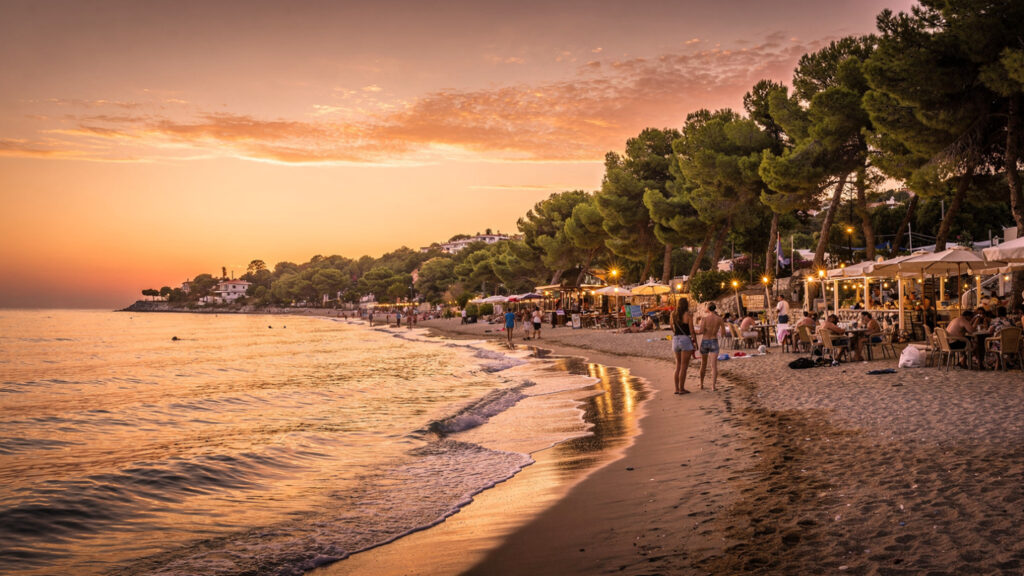
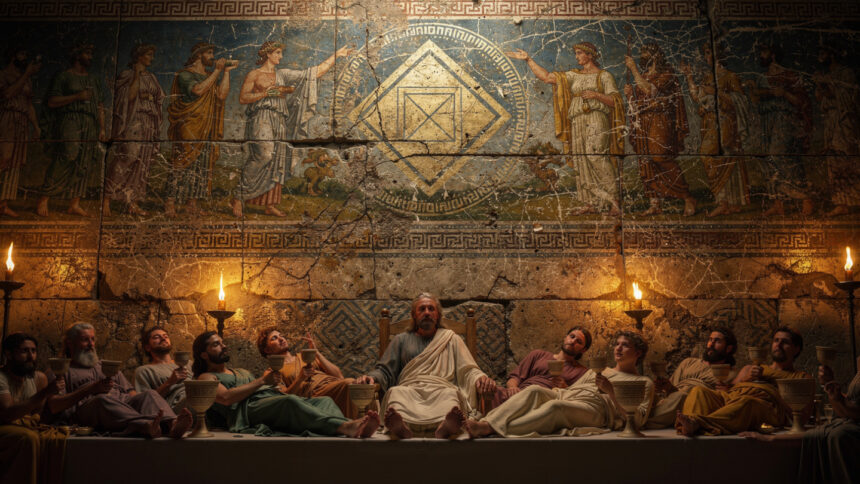
The mythological register of Kassandra is Dionysian, and the attribution is precise. Dionysus was not simply the god of wine. He was the god of the dissolution of boundaries, the force that removed the membrane between the individual and the collective, between the controlled and the released, between the day’s obligations and the night’s freedom. The Kassandra summer, at its most concentrated, is this dissolution enacted at scale. It is not what Olympus Estate’s usual reader comes to Greece for. But understanding what it represents, the living continuation of a category of ancient Greek religious experience, changes what it looks like.
Sithonia | The Middle Finger’s Silence
Cross the narrow neck of land between Kassandra and Sithonia and the frequency drops as completely as if a door has been closed.
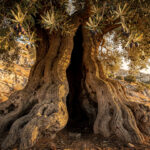
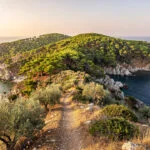
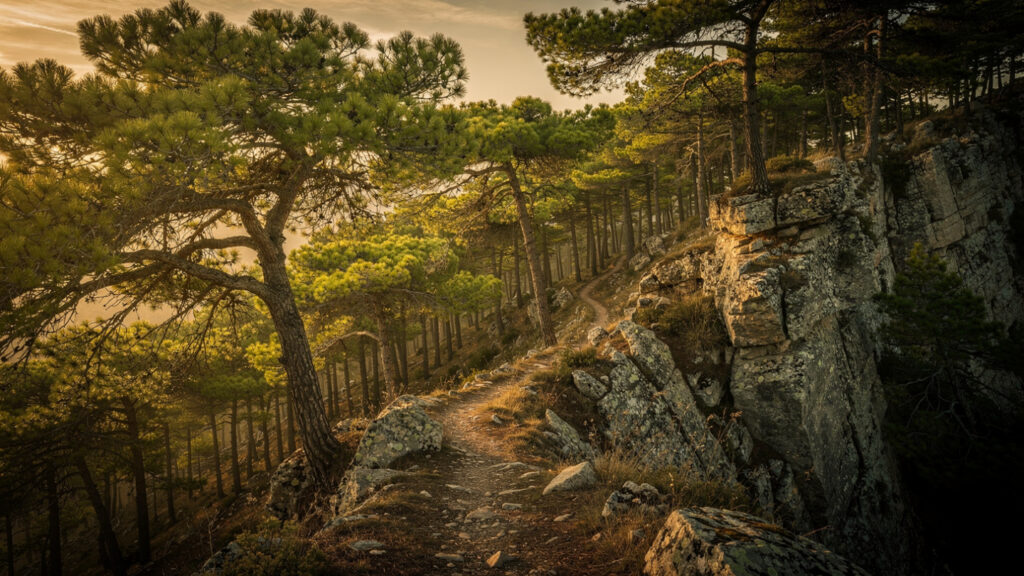
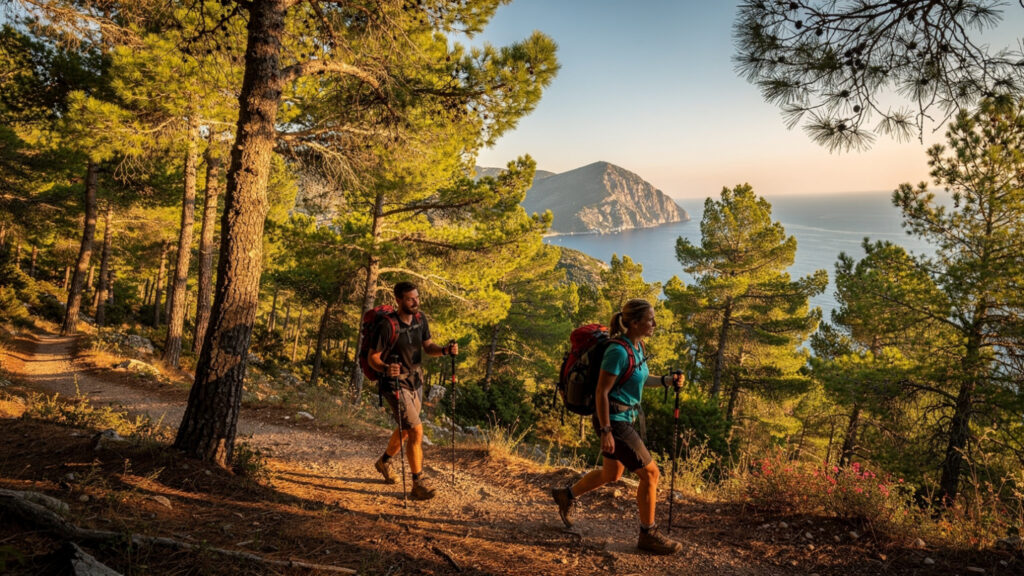
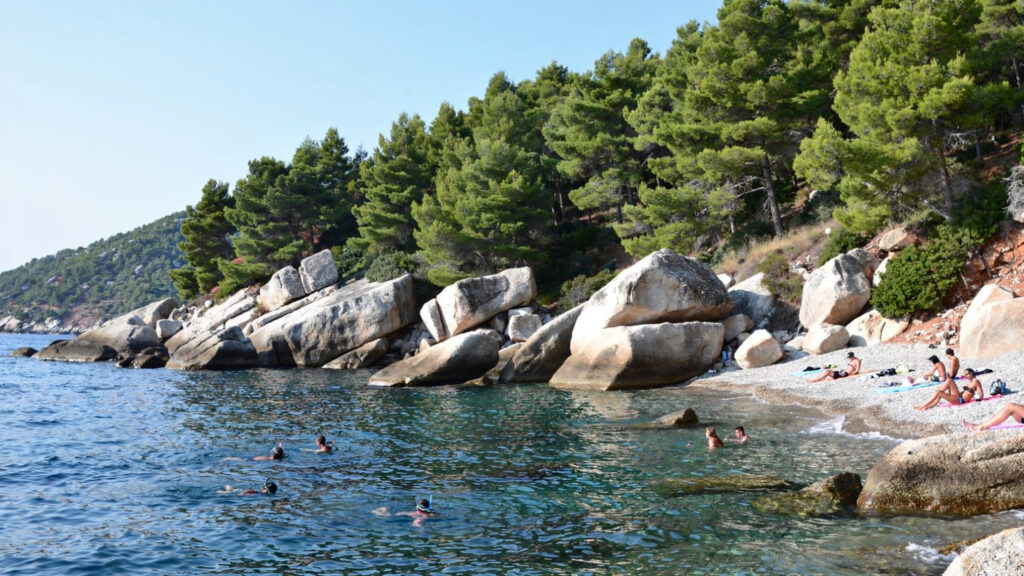
Sithonia is granite where Kassandra was sand, old-growth pine forest where Kassandra was cultivated resort landscape, hidden deep-water coves where Kassandra offered open beaches. The Itamos ridge that forms the prong’s spine is covered in Pinus halepensis, the Aleppo pine, growing at impossible angles from rock faces in the manner of trees that have been negotiating with their substrate for centuries and have arrived at arrangements that aesthetically resemble sculpture but functionally represent an optimal solution to the problem of growing in almost no soil above a precipice.
The walk along the Itamos trail, which crosses the ridge from the western to the eastern coast of Sithonia through uninterrupted forest, produces a quality of silence that the Kassandra landscape cannot generate: the silence of a place where the human voice is the anomaly rather than the norm, where the baseline acoustic register is pine needles moving in a wind that has come directly off the sea, and where the occasional cry of a bird of prey overhead arrives as an event rather than an element of background noise.
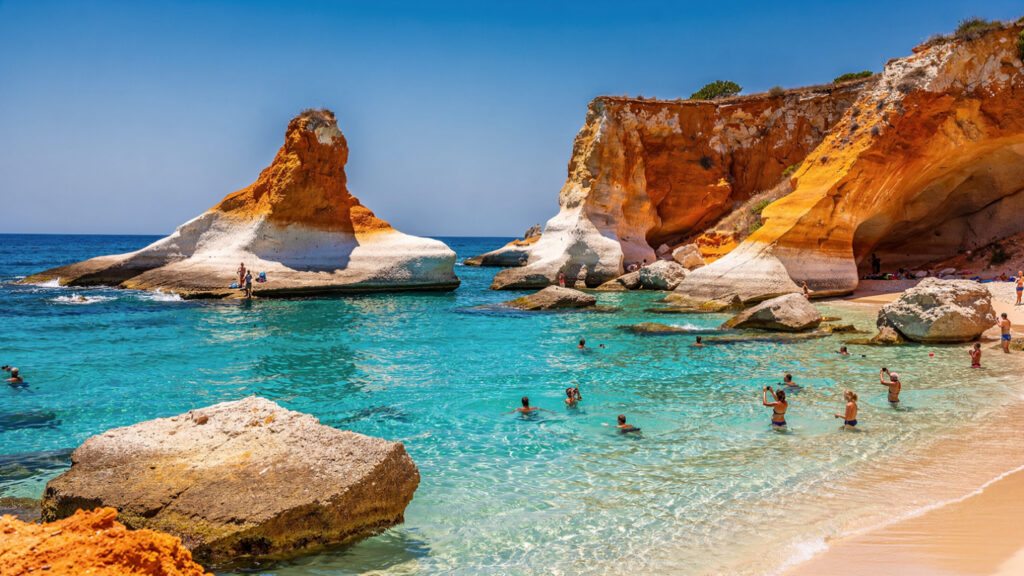
Kavourotrypes, the beach the locals call Orange Beach for the colour of the eroded limestone formations, is the most visually extraordinary natural site on Halkidiki. The sea has spent millennia working the white rock into smooth organic forms that read as both geological and intentional. The water above the limestone floor achieves the colour that clear Aegean water achieves when the bottom is pale and the depth is shallow: a turquoise of such saturation that the first encounter with it produces, in most visitors, a brief disorientation between the perceived and the actual.
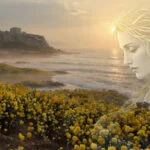
The mythological register of Sithonia is the Sirens, and the attribution is again precise. The Siren’s song was not evil. It was irresistible, which is a different thing. The sailor who heard it and was drawn toward it was not deceived. He was responding to something genuinely beautiful whose beauty contained a danger he could not calculate from inside the experience of hearing it. Sithonia operates by the same mechanism. The landscape is genuinely beautiful. The beauty makes leaving feel impossible. The impossibility of leaving is not a problem until it is, which is not Sithonia’s concern.
Mount Athos | The Third Register
The boat leaves Ouranoupoli before the day has fully committed to being a day.
The Ouranoupoli coastal ferry runs along the western shore of the Athos peninsula, carrying male pilgrims with their diamonitirion, the special permit required to enter the monastic territory, and carrying other visitors, including women, who cannot enter the territory but can observe it from the sea. The observation from the sea is its own category of experience and requires no entry permit.
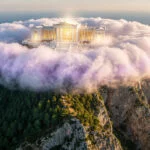
As the boat moves south along the cliff base, the monasteries reveal themselves one by one from behind the headlands. Simonopetra, the monastery whose walls grow directly from a vertical rock face four hundred metres above the water, appears first as a visual impossibility: a multi-storey Byzantine structure cantilevered from a cliff as though the cliff itself decided to become a building. Then Agiou Pavlou, then Dionysiou, each one a different solution to the problem of building a community of prayer on a mountain that drops directly into the sea.
On mornings when the wind is low and the Aegean is flat, which happens more often in the shoulder seasons than in the height of summer, the Simandron carries across the water from the monasteries before the boat is close enough to see the monk striking it. The sound arrives before its source is visible. It is one of the most specifically disorienting acoustic experiences available in Greece: a rhythm with no obvious point of origin, travelling across open water, belonging to a practice that has been continuous since the tenth century.
The Byzantine Empire fell in 1453. On Mount Athos it did not fall. The liturgical calendar, the form of the divine office, the Julian calendar that makes the Holy Mountain’s dates different from those of the world outside its boundaries, the monastic rules that have governed daily life on this mountain continuously for over a thousand years: all of this has been maintained without interruption across every historical disruption that the surrounding world has experienced. Mount Athos is the Byzantine Empire in the present tense.
The classical world dedicated this mountain to Apollo before the monasteries arrived. The summit sacred to the god of light, order, and cosmic harmony became the site of the world’s most sustained experiment in monastic discipline and spiritual contemplation. The continuity between the Apollonian ideal and the monastic one is not an irony. It is a theological argument that the mountain makes through its own history: that the pursuit of the highest available order in human life takes different forms in different centuries but maintains a consistent orientation toward something above the human scale.
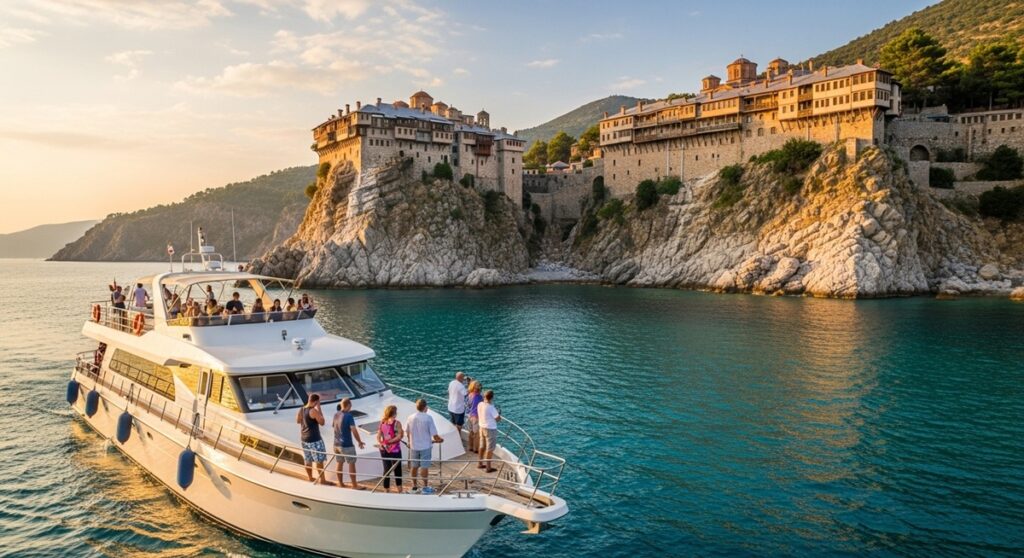
Women cannot enter the monastic territory. This restriction has been in place since at least the tenth century and is protected by Greek law and European Union treaty. The boat tour from Ouranoupoli is the available encounter, and it is sufficient. The architecture visible from the water, the sound that travels from it across the sea, and the quality of stillness that surrounds the peninsula even from a distance: these communicate what the Holy Mountain is without requiring entry.
The Interior | Holomontas and the Forest Register
Halkidiki is not its coastline. The inland region, centred on Mount Holomontas and the forested highland between the three prongs, carries an entirely different architectural and acoustic register from everything on the shore.
The village of Arnaia, in the mountainous interior, is Macedonian-Ottoman in its architectural character: heavy timber frames, overhanging balconies, stone-paved streets that were built for foot traffic and animals and that cars navigate with the careful slowness of vehicles that understand they are the anomaly. The chestnuts harvested from the Holomontas forests in autumn arrive in Arnaia for roasting and selling in the same weekly market that has occupied the village square for longer than the current buildings have stood.
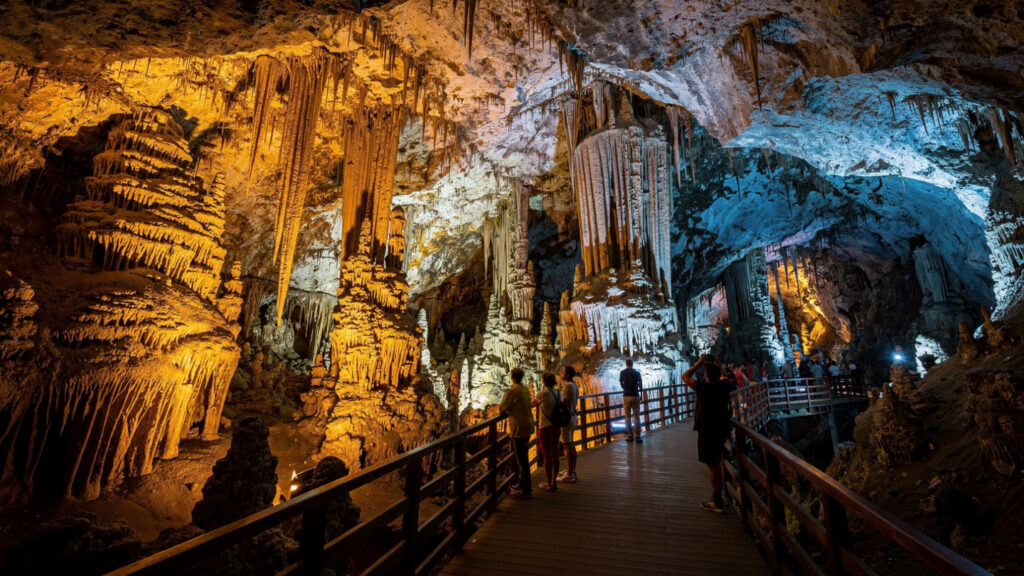
The Petralona Cave, forty kilometres west of the Holomontas massif, contains the oldest human skull found in Europe, dated to approximately 700,000 years old. The cave itself is a network of chambers decorated with stalactite and stalagmite formations whose colours range from bone white to deep ochre to the crystalline translucence that calcium carbonate achieves after centuries of mineral deposition. The skull was found here in 1960. The cave was inhabited continuously for so long that the record of its occupation precedes the concept of memory.
Practical Notes
Thessaloniki’s international airport is the entry point for Halkidiki, approximately one hour by road from the peninsula’s root. A car is essential for Sithonia and Holomontas. Kassandra is accessible enough for those without a vehicle but rewards having one.
Late May through mid-June and September through mid-October are the seasons when Halkidiki is most fully itself: the sea is warm enough for swimming, the landscape is not at maximum human density, and the quality of light in the early morning and late afternoon carries the character of northern Greek autumnal and spring light, cooler and more horizontal than the full summer sun, which does something to pine forest and granite coastline that the high season prevents.
The Ouranoupoli boat tours run daily in season. Booking in advance is recommended for the peak weeks. The boat that leaves earliest, before the day’s wind builds, produces the best conditions for hearing the Simandron.
Petralona Cave maintains standard site hours. The cave temperature is a constant twelve degrees regardless of the season. Bring a layer.
At Olympus Estate, Wanderlust Greece guides you across the sacred and storied terrain of the Hellenic world. Before dawn on the Holy Mountain a monk walks the length of a wooden beam and strikes it with a mallet and the sound travels across the northern Aegean before the first light has found the cliff faces. The Giant Enceladus was crushed beneath the western prong by Athena. The Giant Athos hurled a boulder at Poseidon and missed and the rock became the mountain. The Byzantine Empire fell in 1453. On Mount Athos it did not fall. The cave at Petralona was inhabited continuously for so long that the record of its occupation precedes the concept of memory. Leave Ouranoupoli on the first boat. Bring a layer for the cave.