
Children ask better questions at ancient sites than adults do.
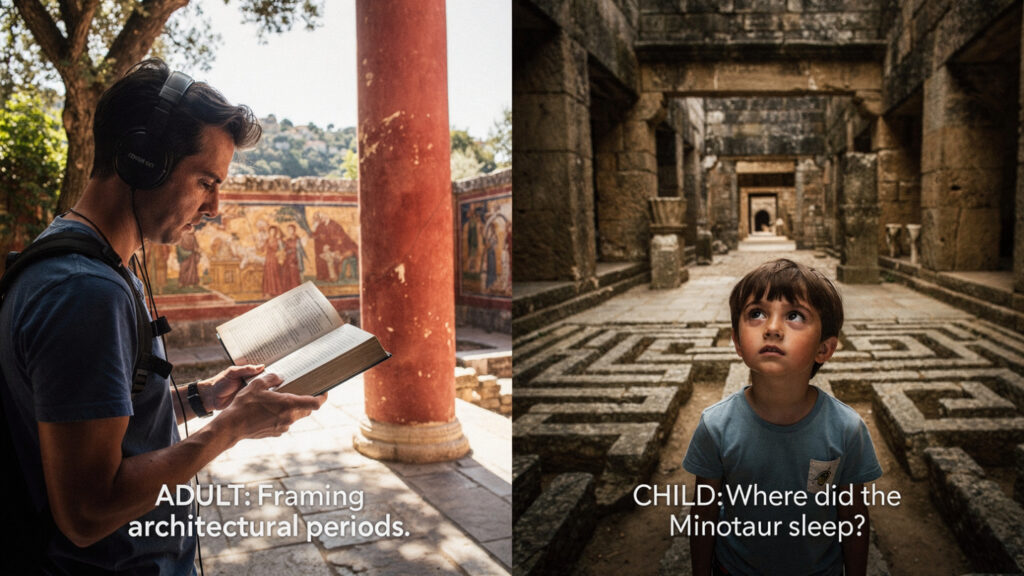
The adult who arrives at Knossos has usually read something about the palace before coming, has a framework of architectural periods and excavation controversies and Evans reconstruction problems, and moves through the site in the way of a person whose framework is being confirmed or adjusted by what they see. The child who arrives at Knossos without a framework asks: where did the Minotaur sleep? Was Theseus afraid? How did Ariadne know which way to go back? These are the questions that the mythology is actually asking, and they are more precisely aimed at the heart of what the site is about than most of the adult questions that the audio guide is designed to answer.
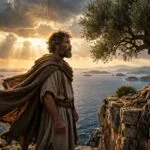
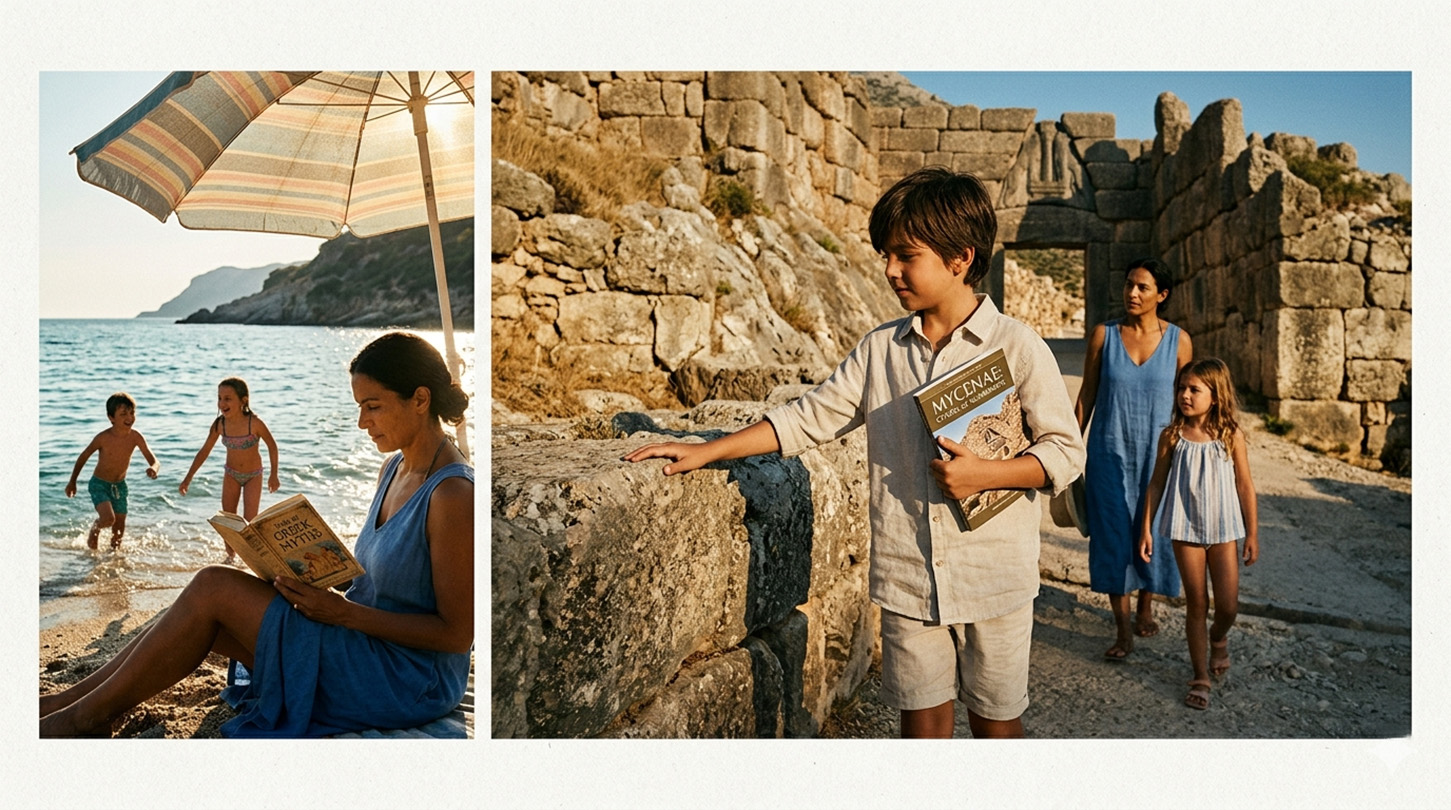
Traveling through Greece with children is not simply a family holiday that happens to take place near ancient ruins. At its best it is the gift of a living story: the experience of encountering the mythology not as a subject studied in a classroom but as the account of things that happened in places that are still there and that can be visited and touched and stood in. The child who has heard the story of Odysseus before sailing between the Ionian islands, and who then stands on the deck of the ferry and looks at the coastline and understands that this is the sea that Odysseus sailed and could not leave, has received something that the classroom cannot provide and that the beach holiday without the story cannot produce.
The preparation is everything. The sites themselves, without the stories, are impressive old stones. With the stories, they are the places where the stories happened.
Before You Go | The Reading That Makes the Journey
The most important preparation for a Greek journey with children is the reading that happens before departure, and the books that provide the most effective preparation depend on the ages of the children and the sites the journey will visit.
For younger children, the Usborne Illustrated Stories from the Odyssey and the equivalent Iliad volume are the versions of Homer that most effectively communicate the narrative drive of the epics without the full complexity that the original demands. The episodes: Odysseus and the Cyclops, Circe’s island, the Sirens, the return to Ithaca, are the episodes that the child who has read them will recognize in the landscape of the Ionian islands and will ask about with the intensity of someone who knows what happened here.
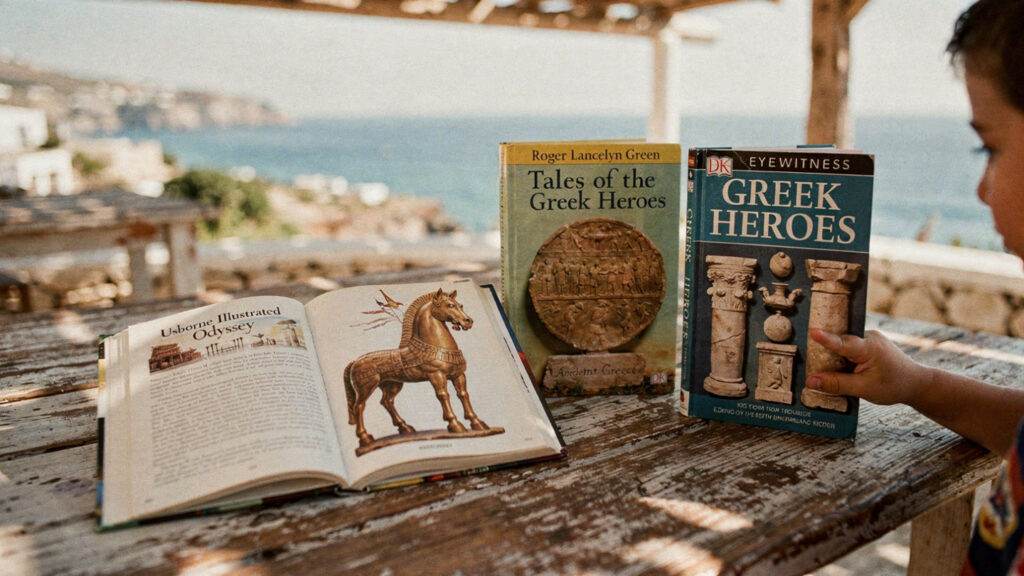
For older children and for parents reading aloud, Roger Lancelyn Green’s Tales of the Greek Heroes is the retelling that has introduced more English-speaking children to the Greek mythological tradition than any other single book since its publication in 1958, and its quality is the quality of an author who understood that the myths are not morality tales but stories about people in extreme situations making choices under pressure. The violence is not removed but it is not dwelt on, and the emotional complexity of the myths, Achilles‘ grief for Patroclus, Orpheus’s look back, Ariadne’s abandonment, is preserved in a form that the older child can receive and the adult will not find condescending.
For the journey itself, the books to carry are the books about the sites being visited: the Usborne See Inside Ancient Greece for the physical layouts of the sites, and the Dorling Kindersley Eyewitness guides for the archaeological detail that the older child can use as a reference on the site itself. The child who arrives at Olympia with the Eyewitness guide’s floor plan of the sanctuary already familiar will navigate the site more confidently than the adult with the site’s own audio guide.
Olympia | Where Children Run the Ancient Track
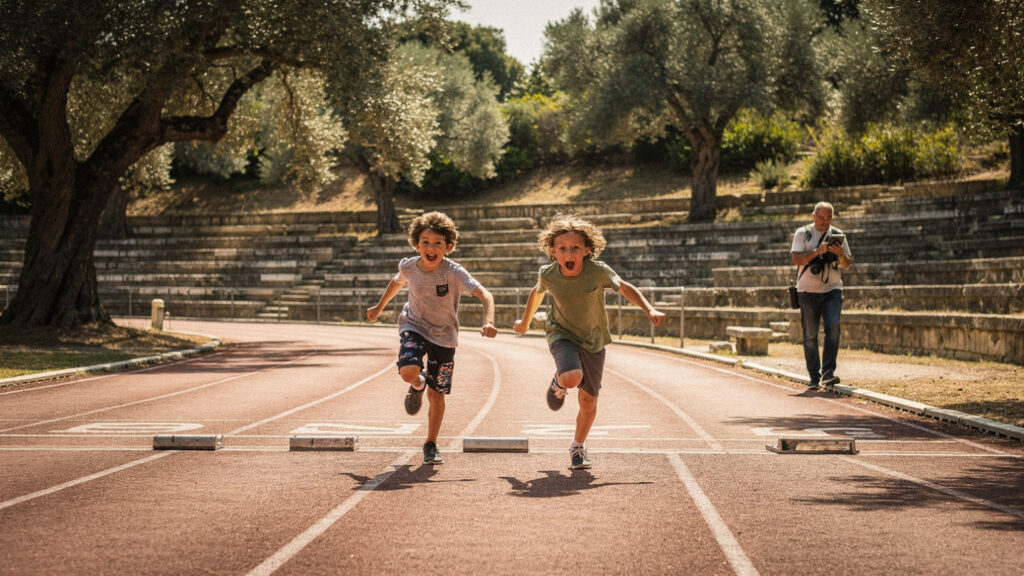
The ancient stadium at Olympia, the 192-meter running track where the ancient athletes competed for the victory that made their names permanent in the tradition, is the single site in Greece that produces the most spontaneous and most completely appropriate child response of any ancient site in the country.
Children run it.
Not because they are asked to, not because the site management has designed an activity around it, but because the sight of the long empty track with the starting blocks still in place at both ends, and the grass banks on either side where the ancient spectators sat to watch, is a sight that communicates its purpose to anyone who sees it, including and especially the child who has not yet learned to approach ancient sites with the inhibition of adult cultural deference. The child who runs the Olympia track from the starting blocks to the opposite end, turns around, and runs back, has understood something about what the Olympics were and what they meant in the way that no classroom explanation of Panhellenic athletic competition can communicate.
The site’s layout, the way the sacred precinct of the Altis, the sanctuary of Zeus, relates to the stadium through the tunnel entrance that the athletes walked to enter the track, is the layout that gives the child the experience of the sequence that the ancient athlete experienced: the sanctuary first, the religious offering before the competition, and then the passage through the dark tunnel to the track where the competition would determine whether the offering had been accepted. Walk through the tunnel with the child before they run the track. The transition from the sanctuary to the stadium through the tunnel is the transition that the ancient athlete made, and the child who makes it understands the relationship between the sacred and the competitive that the Olympic tradition maintained.
The Archaeological Museum of Olympia, on the site’s north edge, holds the pediment sculptures from the Temple of Zeus, whose scale and whose narrative content, the preparations for the chariot race of Oinomaos and the battle of the Lapiths and Centaurs, are the sculptures that the child who has been told the stories can read rather than simply look at. The central figure of the east pediment, Apollo with his arm extended in command, is among the most powerful surviving examples of early classical sculpture, and the child who has been told that Apollo is the god of light and music and prophecy and that he is here commanding order in the chaotic moment of the Centaur battle will look at the sculpture differently from the child who has only been told that it is very old and very important.
The site opens early, and the early morning visit before the coach tours arrive from the coastal hotels is the visit that allows the child to run the track without an audience and to stand in the sanctuary without managing a crowd. The ancient olive trees of the Altis, whose relationship to the sacred wild olive from which the victors’ crowns were cut the ancient tradition documents, are at their best in the morning light.
Delphi | The Place That Answered the World’s Questions
The approach to the Delphi sanctuary from the road below, when the Phaedriades cliffs first become visible above the valley of the olive trees and the sanctuary’s position on the mountainside between the cliffs and the valley is first legible, is the approach that most directly communicates to the child why this place was chosen as the navel of the world.
The claim to ask before entering the sanctuary: if you could ask the oracle one question, what would it be? The child’s answer to this question, whatever it is, is more revealing about what the child is thinking about than anything they will say in the classroom that week. The oracle’s characteristic, the ambiguous answer that the questioner must interpret, is the characteristic that most directly engages the child’s intelligence rather than simply their receptivity: the child who is told that the oracle told Croesus he would destroy a great empire and that Croesus got the answer wrong will spend the walk up the Sacred Way working out what the oracle actually meant and why Croesus misunderstood.
The Sacred Way, the processional route that the ancient pilgrims walked from the entrance of the sanctuary to the Temple of Apollo, is a walk of approximately ten minutes for the adult and considerably longer for the child who is reading the plaques at each treasury site and calculating which city-state had contributed the most impressive dedication. The Treasury of the Athenians, the small building whose reconstruction in the early twentieth century gives it the most completely restored appearance of any building in the sanctuary, is the building that the child who has been told about the Battle of Marathon can connect to the historical event whose spoils paid for it: the Athenians built this to thank Apollo for the Persian defeat, and the inscription on its south wall names the Athenians who distinguished themselves in the war.
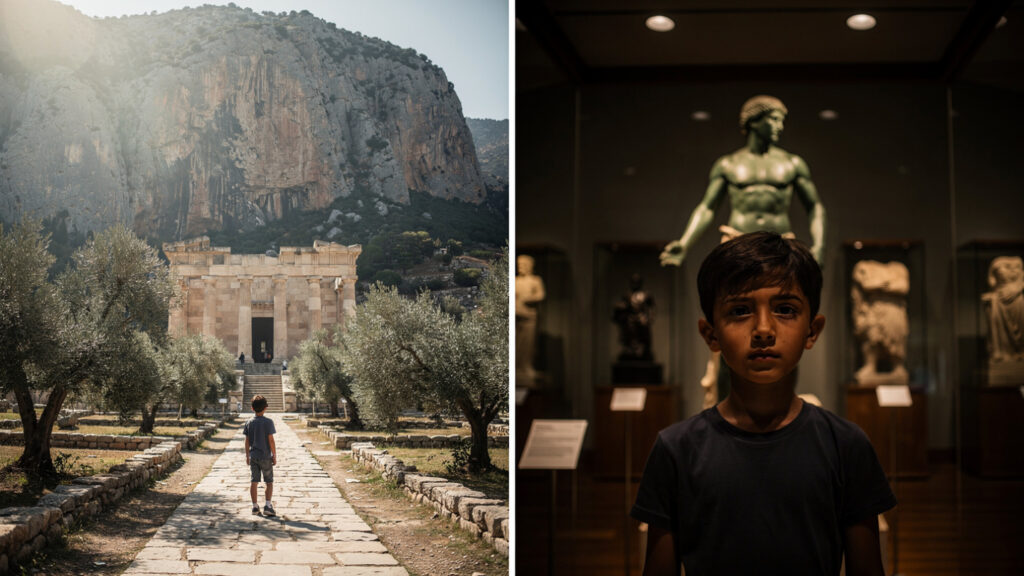
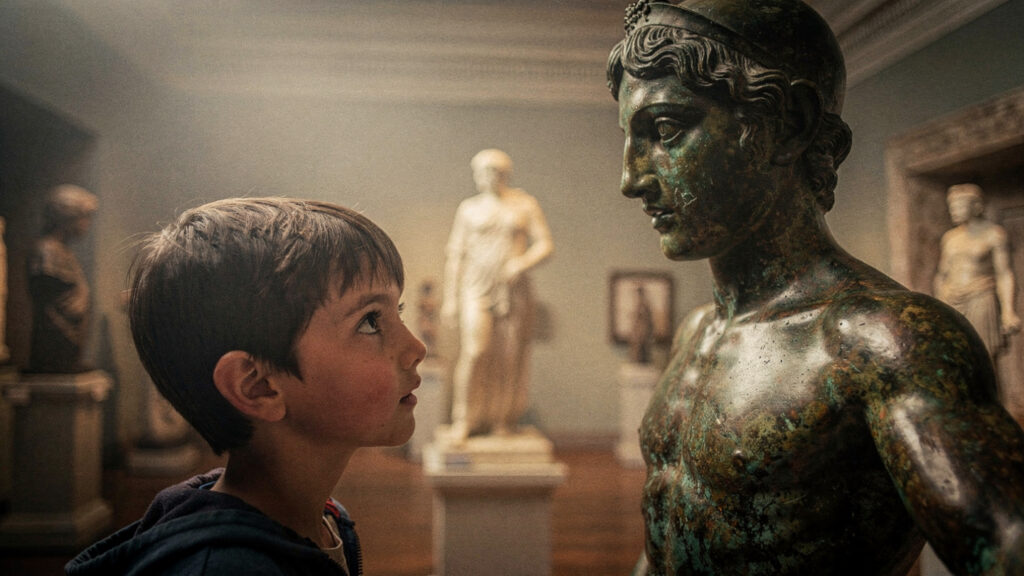
The Delphi Archaeological Museum at the sanctuary entrance, which the Delphi travel guide in this collection recommends visiting before the site rather than after, contains the Charioteer: the bronze statue of approximately 470 BCE whose glass eyes look directly at the person standing in front of him with the directness that the ancient bronze portrait could achieve and that the marble copies cannot replicate. The child who stands in front of the Charioteer and meets the glass eyes will not forget the quality of the encounter, which is the quality of looking at a face from 2,500 years ago that looks back.
Knossos | The Child’s Questions Are the Right Questions
The Knossos palace, as the dedicated travel guide in this collection develops, is a reconstruction: Arthur Evans’s reinforced concrete stabilization and partial rebuilding of the Bronze Age palace using his interpretation of the fragmentary evidence. The adult visitor who knows this holds the reconstruction and the ancient site in a productive tension. The child visitor who does not yet know this simply experiences the palace.
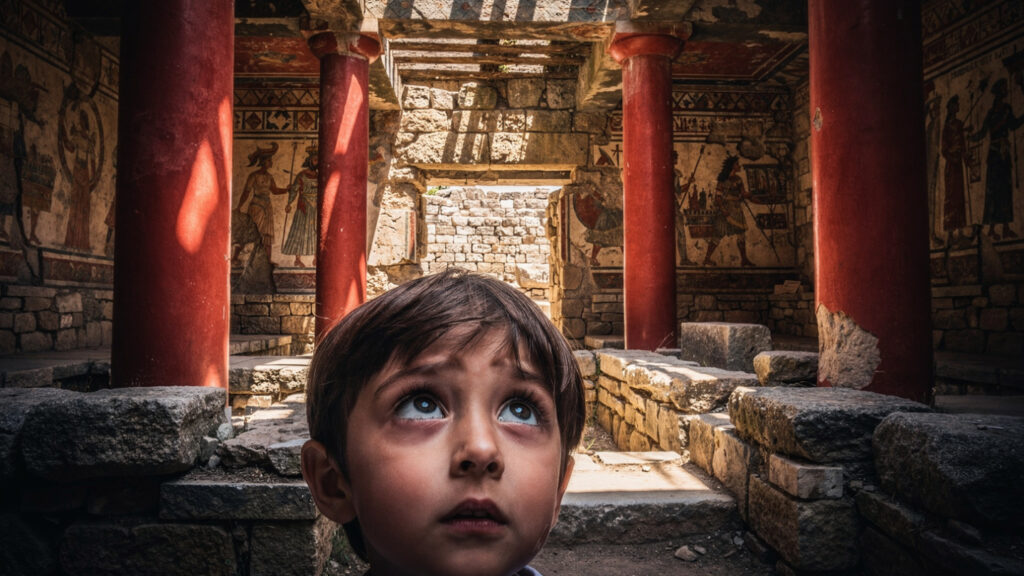
This is not a deficiency in the child’s experience. It is, in a sense, an advantage: the child experiences the palace as the Minoans experienced it, without the archaeological self-consciousness that prevents the adult from simply being in the space. The red columns and the frescoes and the quality of the palace’s organization around the central courtyard communicate the palace’s character to the child in the direct way that the palace’s designers intended architecture to communicate: through the experience of moving through spaces rather than through the intellectual evaluation of the evidence.
Tell the Theseus and the Minotaur story before entering the site, not as the site’s official mythology but as the story that the palace generated in the Greek imagination: the labyrinth built by Daedalus beneath the palace to contain the monster, the Athenian tribute of young men and women, Ariadne’s thread, the combat, the return. The child who walks through the palace with the myth in their mind will look at the complexity of the corridors and the storerooms and the staircases in the way that the myth was designed to be seen: as the architecture that generated the labyrinth idea, not because the palace contained a literal labyrinth but because the palace’s real complexity was more labyrinthine than anything a designer of mazes would have produced.
The Central Court is the site’s best moment for the child: the open rectangular space around which the entire palace is organized, with the surrounding buildings in their Evans-reconstructed form visible on all four sides, is the space that most clearly communicates the palace’s scale and its quality of enclosure. Stand in the middle of the Central Court and ask the child to find the most likely direction from which the Minotaur would approach. The answer they give will reveal how carefully they have been listening to the story and how completely the space has engaged their spatial imagination.
The Heraklion Archaeological Museum visit, which the guide recommends for the afternoon after the morning at Knossos, contains the original frescoes and the Phaistos Disc and the gold jewelry, and the child who has spent the morning in the palace will recognize the frescoes in the museum as the originals of the reconstructions they saw on the walls. The moment of recognition, the child pointing to the Dolphin Fresco in the museum and saying that is the one from the Queen’s room, is the intellectual satisfaction that the sequenced visit is designed to produce.
Mycenae | The Door That Heroes Walked Through
The Lion Gate at Mycenae, the entrance to the palace citadel of Agamemnon’s Mycenae, is the site that most directly and most powerfully communicates to children the truth about the ancient world that the adult has often forgotten: it was made by people working with tools, and it is still there.
The three monolithic lintel stones above the Lion Gate passage, each weighing tens of tons, were placed there by workers in the thirteenth century BCE using techniques that did not include mechanical assistance beyond levers and ramps and the organized effort of many people. The scale of the stones is a scale that the child can measure against their own body by standing in the gate passage and looking up: the scale that the ancient workers achieved with pre-mechanical technology, the scale that the later Greeks processed as the work of the Cyclopes, is the scale that tells the child something true about what human beings are capable of when the organization and the motivation are sufficient.
Tell the story of Agamemnon before the visit: the king who led the Greeks to Troy, who sacrificed his daughter Iphigenia to get the wind for the fleet, who was killed by his wife Clytemnestra when he returned home. The child who knows this story and stands in the Lion Gate that Agamemnon walked through understands something about the relationship between the mythological tradition and the physical world that the adult visitor who has studied the Mycenaean period without the mythology does not have access to: the myth and the archaeology are not two different accounts of the same thing. They are the two dimensions of the same place, and the place is more comprehensible with both than with either alone.
The shaft graves inside the Lion Gate, the graves from which Heinrich Schliemann recovered the gold death masks and the inlaid bronze daggers and the amber beads from the Baltic, are now empty but their shape and their arrangement just inside the citadel entrance communicate the character of the Mycenaean royal burial tradition to the child who is told that the people buried here were buried with the gold of the entire Aegean world. The National Archaeological Museum in Athens holds the objects themselves, and the child who sees the gold masks in the museum after seeing the shaft graves at Mycenae will understand the relationship between the burial site and the objects in a way that either visit alone would not produce.
The Practical Organization of the Mythic Journey
The Greek itinerary organized around the mythological sites rather than around the beach holidays is an itinerary that requires more planning than the resort holiday but that produces a different order of experience. The sites in this article, Olympia, Delphi, Knossos and Heraklion, Mycenae, are each accessible from different bases and can be organized into different sequences depending on the age of the children and the time available.
The ages that engage most productively with the mythological sites are approximately seven through twelve: old enough to follow the narrative of the myths and to make connections between the story and the place, young enough to be physically unselfconscious in the space and to ask the questions that the adult has learned not to ask. The child under seven can benefit from Olympia’s track and from Knossos’s palace spaces, but the narrative connection requires a level of story-following that develops later. The teenager who has already studied the ancient world has a different relationship to the sites that requires a different kind of preparation.
The most important practical principle is the sequence: read the myth the evening before the site visit, not at the site. The child who arrives at Delphi having heard about the oracle the previous evening will use the site to place the story they already know rather than receiving the story as an addition to what they are seeing. The story comes first. The place confirms it.
The second practical principle is the ratio: two mythological sites to every beach day is the sustainable ratio for most children. The mythological sites require the quality of attention that the sun and the sea dissipate, and the beach days are not the opposite of the mythological visits but their necessary complement: the child who has run the Olympia track in the morning is the child who swims in the Ionian Sea in the afternoon with the understanding that this is the sea that the Odyssey was about.
Greece is the only place in the world where this educational gift is available, and it is available in the form of a holiday rather than a classroom: the child walks through the Lion Gate and the Lion Gate is real. The story and the place are the same place. This is the gift that the Greek journey with children provides, and it is not available anywhere else on earth.
At Olympus Estate, Wanderlust Greece guides you across the sacred and storied terrain of the Hellenic world. Read the myth the evening before the site visit. Ask the child what question they would ask the oracle before entering Delphi. Let them run the Olympia track. Stand with them in the Lion Gate. The child who asks where did the Minotaur sleep is asking the right question. Greece will answer it. The answer is the place. Go there.