





The Acheloos functions as the primary hydrological artery of western Greece, a boundary the ancient world treated as much more than a line on a map. Its discharge is fed by the Pindus mountain range, where annual precipitation exceeds 2000 mm in the highest sectors, a volume that creates a river system genuinely aggressive in its geography. According to Hesiodic genealogy, Acheloos is the eldest of the three thousand sons of Tethys and Oceanus. This seniority manifests physically as much as mythologically: the river’s alluvial deposits have extended the Greek coastline by over three kilometers since the Bronze Age.
The struggle between Heracles and Acheloos describes, in mythic terms, the process of land reclamation through the diversion of water. The river’s unique thermal stability today supports endemic fish species such as the Barbus peloponnesius, and Acheloos remains the biological anchor of the region it drains. At the Stratos dam, the water generates a persistent mechanical hum. The air carries a heavy scent of wet limestone and mountain silt. In winter, the flow rate increases with a violence that makes concrete structures feel temporary. The ancients understood this as the movement of a god who could shift his form from bull to serpent.
Engineering Abundance through the Bull Horn

The myth of the struggle between Heracles and the river god reads, beneath its surface, as a record of environmental management. Heracles wrestled Acheloos to win the hand of Deianeira. During the combat, the hero broke off one of the river’s horns. This was a structural transformation in the myth’s own logic. The horn became the Cornucopia, the vessel of infinite plenty, and in practical terms the story describes the successful irrigation of the Aetolian plain.

When a river is dammed or diverted, the land responds with growth. The Greeks recognized that the river had to be defeated to be utilized. The bull horn represents the power of the flood. By taming the flood, the ancients gained the harvest, a bargain the myth renders as combat rather than engineering because the outcome felt, to the people living downstream, exactly as consequential as a fight between a hero and a god. The river provides the energy. The human provides the form. Acheloos remains a source of wealth because its strength has never diminished.
Karstic Logic of the Alpheios
In the central Peloponnese, Alpheios performs a different movement. Its myth describes a god who fell in love with the nymph Arethusa. To escape him, she fled under the sea to Sicily. Alpheios did not stop. He carved a channel beneath the Ionian Sea to merge his waters with hers. This story explains a real geological phenomenon known as a karstic system.

The limestone of Greece is porous. Rivers frequently vanish into sinkholes, or katavothres, traveling through hidden subterranean caves before emerging miles away as springs. Alpheios is a master of this hidden travel. The ancients observed that objects thrown into the river in Arcadia would supposedly appear in the spring of Arethusa in Syracuse, a claim that reads today as fanciful but recorded, in its own way, a genuine intuition about the connectivity of underground water across enormous distances. The underground journey protects the water from the surface heat of summer and the freezing winds of winter. When the river re-emerges, it brings the temperature of the deep earth with it, creating microclimates along the riverbanks where distinctive vegetation can thrive.
Acoustic Traps of the Acheron Gorge

Acheron in Epirus is defined by its opacity. The water does not reflect the sky. It absorbs the light, a quality caused by the depth of the gorge and the mineral composition of the riverbed. The Greeks identified this as the entrance to the Underworld. This was the river of sorrow. To cross it was to leave the sun behind.
The gorge of Acheron is a narrow incision in the rock. The walls are vertical. The trees lean over the water, creating a tunnel of green shadow. The sound of the river is amplified by the stone into a low, rhythmic pulse. The Necromanteion, the Oracle of the Dead, sits on a hill overlooking the river. Pilgrims came here to contact the shades. The river provided the psychological and physical barrier between the living and the dead, and the natural acoustics of the gorge, the way the stone walls trap and amplify every sound, meant the site itself produced an atmosphere no priest needed to manufacture.
Tectonic Ruptures in the Vale of Tempe
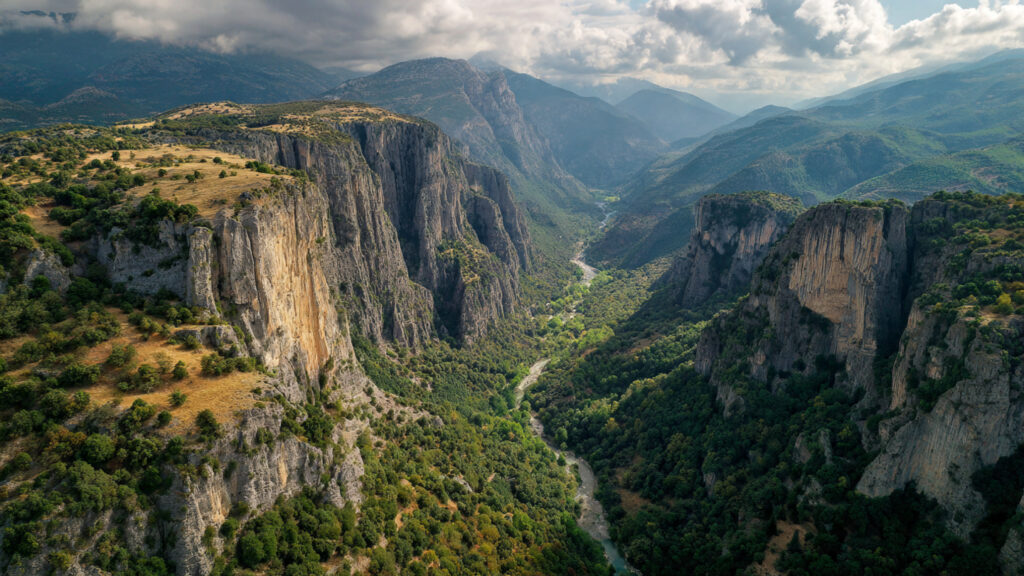
In Thessaly, Peneios flows through the Vale of Tempe. This valley is a geological anomaly. It looks as though the mountains were sliced open with a blade. The myth says that Poseidon struck the land with his trident to allow the river to reach the sea. In reality it is a tectonic fault line, and the river simply found and used the fracture already available to it to escape the Thessalian basin.
Peneios is the lifeblood of the grain fields of central Greece. Its waters are heavy with the minerals of Mount Olympus. In winter, the river swells with meltwater from the summit, carrying the cold of the mountain down to the warmth of the plain, a redistribution of energy the mountain begins and the river completes. The sediment deposited by Peneios is unusually fertile, carrying the disintegrated limestone of the mountains it drains and producing soil high in calcium and minerals. Ancient farmers in the region depended on this flooding cycle exactly as Egyptian farmers depended on the Nile, without needing a myth to explain why the fields nearest the river outperformed every other plot in the valley.
Hidden Currents of the Ilissos
In Athens, Ilissos is largely invisible. It has been covered by the asphalt of the modern city. Yet it still flows. It moves beneath the Callirrhoe spring and the temple of Olympian Zeus. This was the river of the philosophers. Socrates walked its banks. He noted the clarity of the water and the shade of the plane trees, in the opening scene of Plato’s Phaedrus, one of the few passages in the entire Platonic corpus in which Socrates is shown outside the city walls at all, drawn there specifically by the beauty of the riverbank.

The concealment of Ilissos says something about the modern relationship with the rivers that shaped ancient Athens. The city built over the source and largely forgot its location. During the heavy rains of winter, Ilissos makes itself known anyway. The drains cannot contain it. The water rises from the earth, flooding the basements of the city. Even when covered, the river maintains its ancient course, following the natural gradient of the Athenian basin exactly as it always has. The moisture it provides still supports the old trees that stand in the city center, feeding roots that draw on a river most residents of Athens do not know is beneath their feet.

Winter is the time of the rivers’ return. When the first rains hit the dry soil, the rivers regain their voice. They grow wide. They become dangerous. The power returns to the earth. The mountains shed their weight, and the rivers carry it downstream. The river is not just a feature of the landscape. It is the landscape in motion.
At Olympus Estate, Sacred Geography moves through the deeper currents of the Greek tradition. Acheloos is the eldest of the three thousand sons of Tethys and Oceanus, and his alluvial deposits have physically extended the Greek coastline by over three kilometers since the Bronze Age. The struggle between Heracles and Acheloos describes the process of land reclamation through the diversion of water: the broken horn became the Cornucopia, the vessel of infinite plenty. Alpheios fell in love with the nymph Arethusa and carved a channel beneath the Ionian Sea to merge his waters with hers in Syracuse, a myth that records the real karstic system of limestone katavothres through which Greek rivers vanish underground and emerge as springs miles away. The Acheron gorge is a narrow incision in the rock where the sound of the river is amplified by stone into a low rhythmic pulse, the water absorbing the light rather than reflecting it, a natural acoustic architecture the Oracle of the Dead relied on without needing to manufacture the atmosphere itself. The Ilissos is buried beneath the asphalt of Athens yet still flows, and it was on its banks, in Plato’s Phaedrus, that Socrates was drawn outside the city walls for one of the only times the dialogues record. The river is not just a feature of the landscape. It is the landscape in motion.