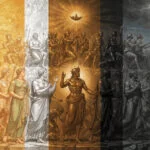

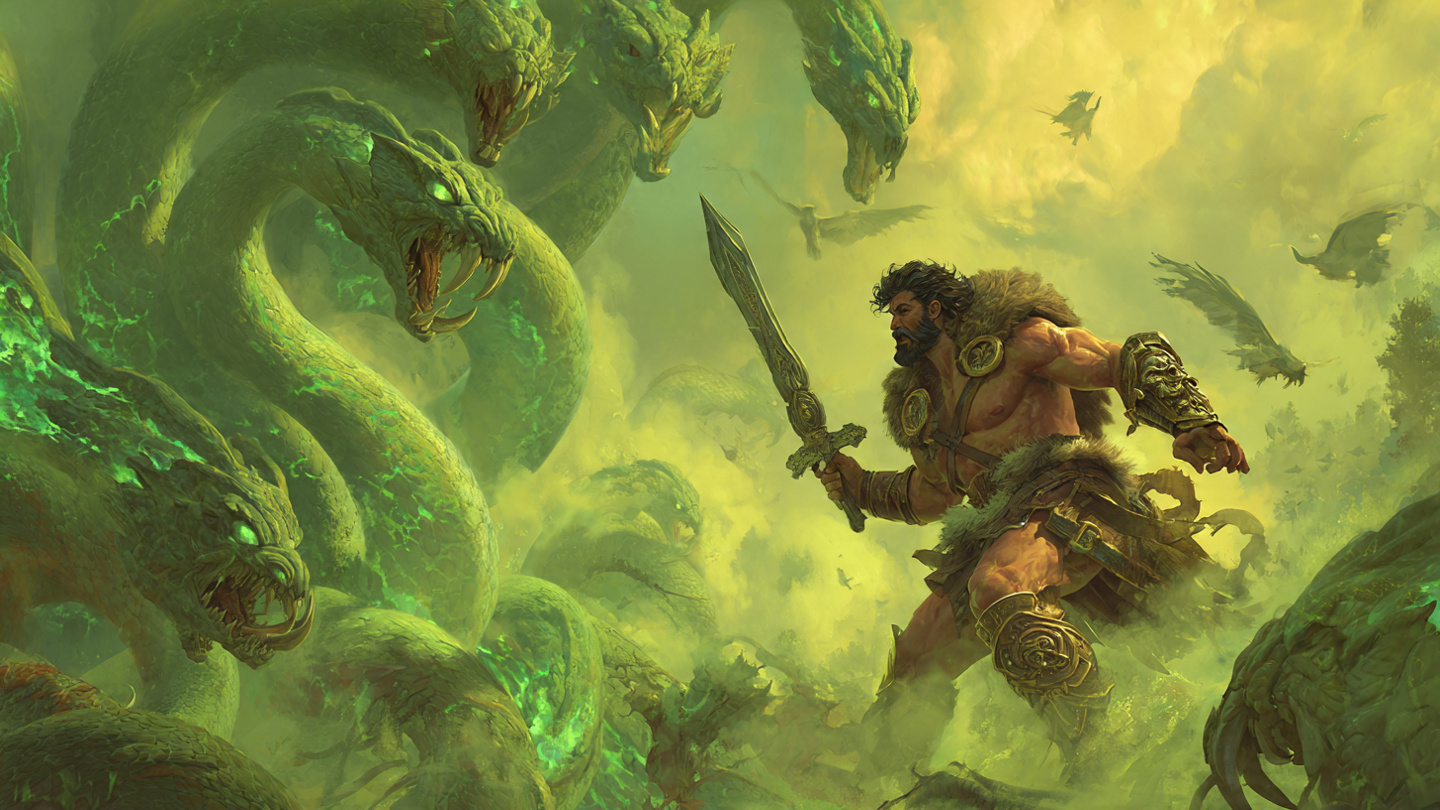
The Hydra haunted the swamps of Lerna. For each of her heads that Heracles decapitated, two more sprang forth.
This detail, preserved across every ancient source that records the second labor, is usually read as the description of a particularly difficult monster: a creature whose regenerative capacity made the standard solution, decapitation, counterproductive. The hero eventually solved the problem by applying fire to the severed stumps, preventing regeneration, and burying the immortal head under a boulder on the road between Lerna and Elaius where it remains, in the mythological geography, still alive beneath the stone.
Eurystheus refused to count it.
The disqualification is usually presented as evidence of the king’s bad faith: he had set the labors as impossible tasks with the intention of destroying Heracles, and when the hero found a way through, Eurystheus simply moved the goalposts. This reading makes Eurystheus a villain and misses the philosophical precision of his objection.
His objection was structural. Heracles had not overcome the Hydra. He had contained it. The distinction between these two things is the subject of the second labor, and it is the reason the labor remains, among the twelve, the one whose resolution carries the most genuinely unresolved consequence.
What Lerna Was
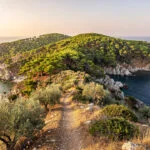
Lake Lerna was a well-known entrance to the underworld and a holy site sacred to Demeter, where locals would pray for fertile soil and clean water. The Hydra did not make its lair near Lake Lerna by accident.
The springs of Amymone, at whose source the Hydra nested, were named for one of the Danaids, daughters of Danaus, who had been sent to find water for the parched land of Argos. Poseidon revealed the spring to her after rescuing her from a satyr at the site, and the spring became the sacred source of Lake Lerna. The place was a threshold, recognised as such by the entire mythological tradition: the Alcyonian Lake nearby was the point through which Dionysus descended to retrieve his mother Semele from the underworld, and through which Hades had abducted Persephone in some regional variants of the myth. The swamp at Lerna was not simply a geographic feature. It was a pressurised boundary zone, a place where the distinction between the surface world and what lay beneath it was structurally unstable.
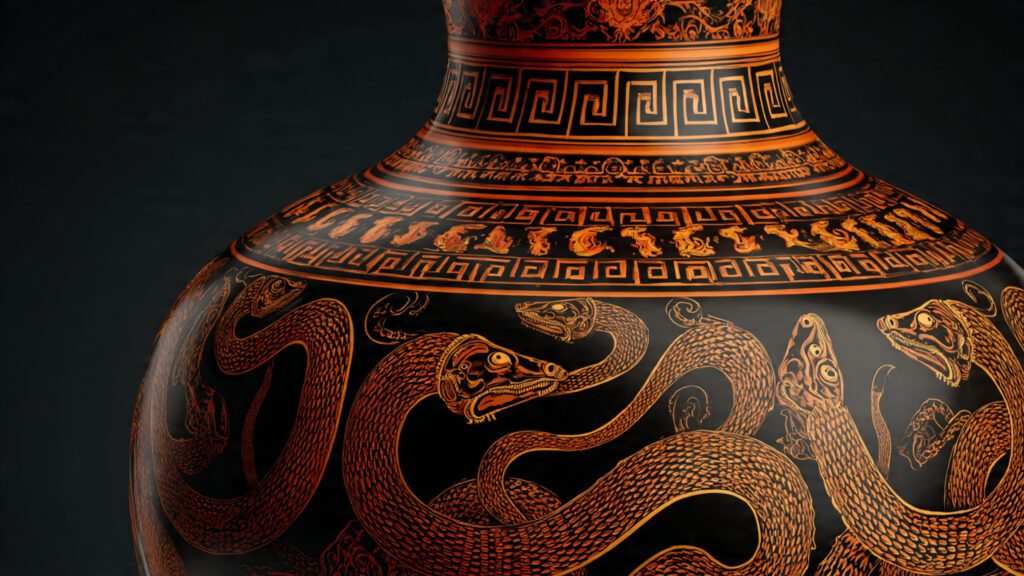
The Lerna site itself yields Mycenaean pottery with serpent motifs, suggesting pre-Homeric cult worship at the Heroön shrine, where Hydra blood may have ritually poisoned the Alcyonian Lake. The cult at Lerna preceded the myth. The swamp was sacred and dangerous before Heracles arrived. The Hydra was not placed there to create a challenge for a hero. The Hydra was what the swamp was: the living expression of a geological and theological zone that refused to be stable, that processed the energy directed at it and returned it multiplied.
Hesiod records that Hera nurtured the Hydra. The detail is usually read as evidence of Hera’s vendetta against Heracles, and it is that, but it is also something more precise. A goddess of Hera’s theological domain, the goddess of the ordered household, of marriage and legitimate succession, of the bounded and the protected, would specifically nurture an entity that undermined the ordered world. The Hydra embodied the principle that Hera’s domain was always working against: the principle that structure, once punctured, does not heal but proliferates its wound.
The Failure of Force
Herakles was instructed to slay the Lernaian Hydra. The beast was nurtured in the marshes of Lerna, from where she would go out onto the flatland to raid flocks and ruin the land. The Hydra was enormous, with eight mortal heads and an immortal ninth one in the middle.
Heracles arrived at Lerna with the approach that had solved the first labor: the direct application of overwhelming physical force. The Nemean Lion had been strangled because it was a physical problem requiring a physical solution, a body that could be destroyed by a body of sufficient strength. The reasoning that produced this approach was sound for the Nemean Lion. It was catastrophically wrong for the Hydra.
The Hydra’s defining property was not its strength or its venom or the number of its heads. It was its recursive response to force. Every decapitation provided the kinetic input that the regenerative mechanism required. Heracles was not fighting a creature that resisted his force. He was operating the creature’s own reproductive system. The sword that removed a head was the instrument of the Hydra’s multiplication. Each blow was a gift.
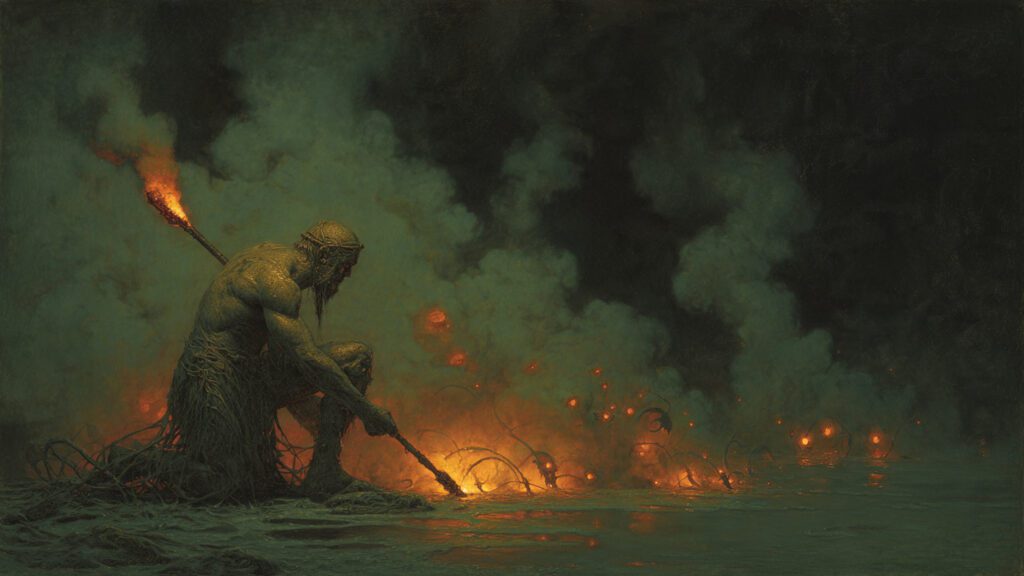
This is the quality of the second labor that makes it structurally different from all the others: it was the only labor in which the hero’s primary competence, the application of directed physical force, was the mechanism that sustained the problem rather than resolved it. Every other labor required Heracles to do what Heracles did best, with adjustments for the conditions of each challenge. The second labor required him to recognise that what he did best was, in this environment, the wrong tool. The swamp converted his strength into the Hydra’s growth.
The ancient sources are careful about the scale of the failure. The Hydra could shoot its venom and its breath was toxic. Hercules took precautions to protect himself from the Hydra’s poisonous fumes by covering his mouth and nose with a cloth. He arrived at the problem aware that the environment itself was hostile, aware that the air around the creature carried its lethality beyond its bodies. He covered his face. He drove to the site rather than walking. He took precautions. And then he applied his sword to a creature whose biology treated each severed head as an instruction to produce two more, because he had no other instrument available to him and because the logic of his previous success told him that the direct approach, modified by precautions, would work.
It did not.
The Crab and the Logic of the Threshold
In the battle he also crushed a giant crab beneath his heel which had come to assist the Hydra.
The crab is usually treated as a footnote in the second labor, a minor additional hazard that Heracles disposed of while managing the primary problem. But the crab’s presence carries a theological meaning that illuminates the nature of what Lerna was.
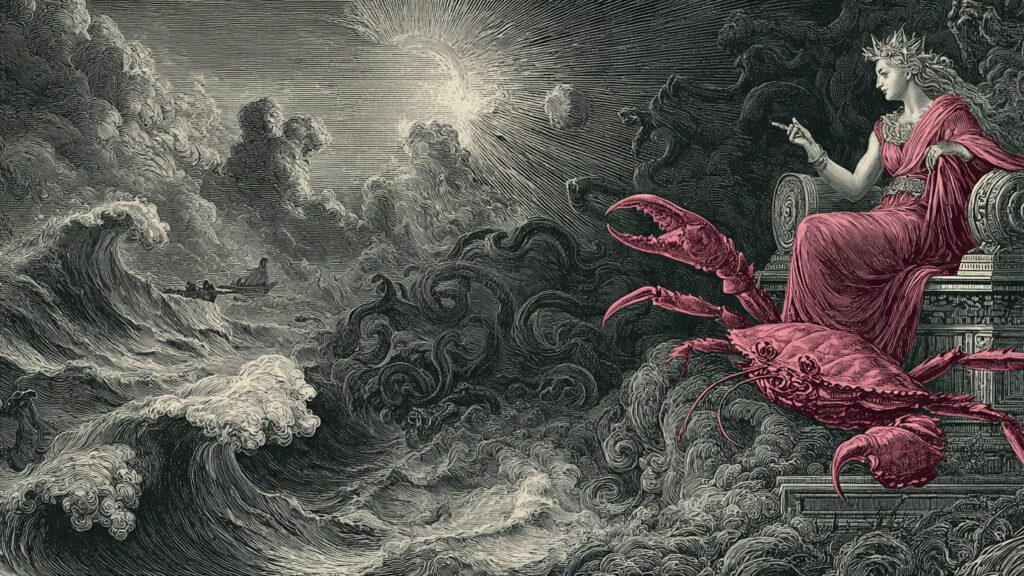
The crab came from below. It emerged from the swamp, from the threshold zone, drawn by the disturbance that the battle was creating at the boundary between the surface world and the underworld. It moved sideways, the lateral movement of a creature that does not progress in the direction it faces, that advances through evasion rather than through direct approach. It attacked Heracles’s foot, the lowest point of his body, the point closest to the ground.
Hera placed the crab in the stars as Cancer when it was crushed. The elevation of a minor scavenger to a constellation is the mythological tradition’s way of marking the theological significance of even the smallest participant in a cosmologically important event. The crab was not incidental. It was the swamp’s second line: when the Hydra’s recursive mechanism failed to destroy Heracles through multiplication, the threshold sent something else, something that moved in a direction the hero’s fighting style did not easily accommodate.
The cosmos of Lerna had redundancy built in.
Iolaus and the Nature of the Solution
Iolaus was Heracles’s nephew and charioteer, present at every labor in the supporting role that the hero required: someone to drive, to hold, to manage the logistics of an enterprise whose physical demands exceeded what a single person could coordinate.
At Lerna, he became something different.
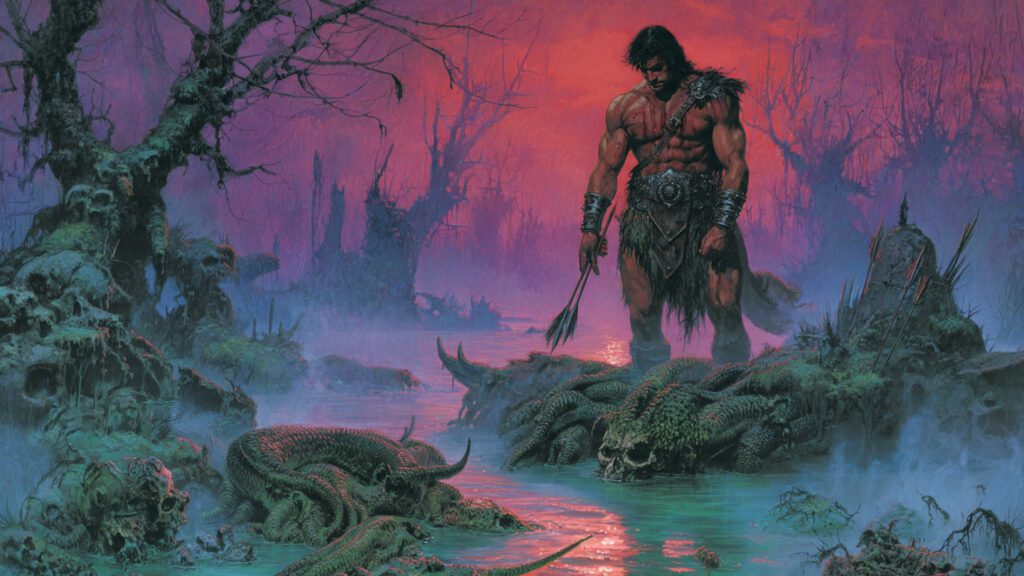
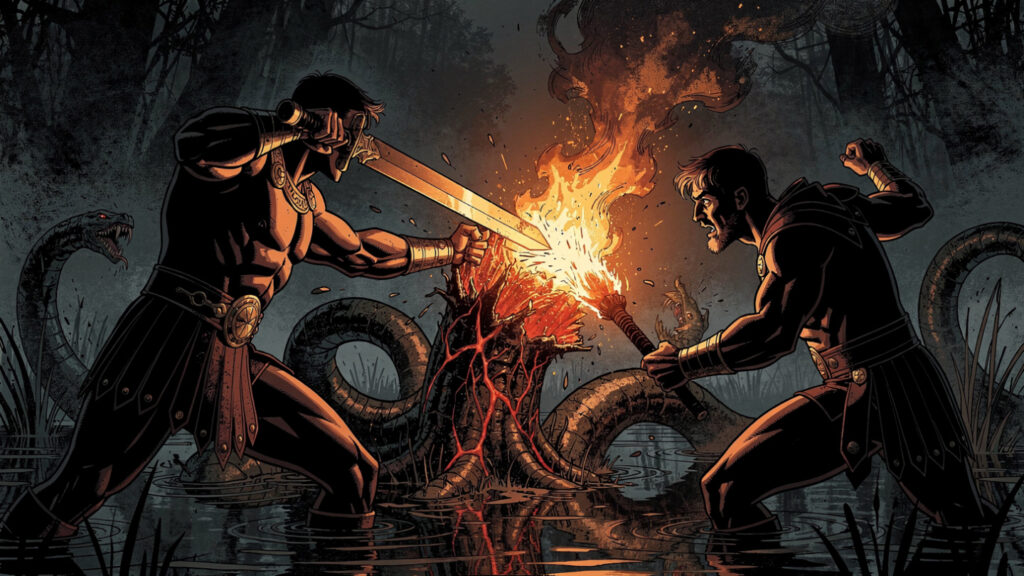
The cauterisation strategy is attributed in the sources to Athena’s counsel or to Iolaus’s own initiative depending on the version. Hera’s constellation honors for the Hydra and Carcinus framed defeat as celestial apotheosis. What all versions agree on is that the strategy required two operators working in coordinated sequence: Heracles severing heads, Iolaus applying fire to the stumps before the regeneration could begin. The solution was not a modification of Heracles’s approach. It was a system, a two-person process in which each operator performed a function that the other could not perform simultaneously.
The fire interrupted the Hydra’s recursive mechanism. Cauterisation sealed the wound before the biological instruction to multiply could execute. The stump, deprived of the open interface through which the regenerative process initiated, could not produce the two replacements. The system that had been converting Heracles’s force into Hydra-growth was interrupted at the point between the severing and the response.
This was not heroism. It was a technical intervention against a biological mechanism, and it required the sustained presence of a second operator to implement. Eurystheus declared the victory unlawful, as Heracles had won it with the aid of Iolaus.
The precise nature of Eurystheus’s objection: the labor was a test of Heracles’s divine nature against the challenges that Hera had designed to destroy him. The test was whether the hero’s inherent constitution, his strength, his intelligence, his divine inheritance, was sufficient to overcome what the divine world had placed against him. The answer that the Hydra returned was no: Heracles alone, applying his own capacities to the problem, could not solve it. The solution required an external component, a second person and a technology, fire applied by that person’s hand.
Eurystheus’s disqualification was not capricious. It was a precise reading of what had occurred: the hero had not demonstrated mastery of the problem. He had demonstrated that the problem required more than the hero possessed.
The Immortal Head Under the Stone
Heracles buried the writhing immortal head deep underground next to the main road through Lerna and placed a boulder over it, trapping it forever.
The central head, the ninth, the one that could not be destroyed by conventional means, was the core of the system. Heracles cut off the last head using a golden sword given to him by Athena. Having severed it, he placed it under a rock on the road between Lerna and Elaius. The head is alive. The ancient sources are explicit about this: the head was buried, not destroyed, because it was immortal and destroying it was not possible.
The geography is precise and deliberate. The sacred road between Lerna and Elaius was a travelled route, a path through the landscape that people used. The immortal head was buried beneath it, placed in the earth at the threshold that the road crosses, under a boulder that marked the location. Anyone who knew the mythology and walked that road knew they were walking over an undestroyed thing, over the still-living core of the entropy engine that Heracles had contained but not eliminated.
The containment was the best available solution to a problem that did not have a complete solution. The head could not be destroyed. It could be separated from the body and sealed under stone on the road that connected the threshold site to the next settlement. The solution acknowledged its own incompleteness. It did not pretend that the thing was gone. It placed a marker above where the thing was contained and let the landscape carry the record.
The rock is still there in the mythological geography. The head is still there under it.
The Arrows and the Synthesis
The final act of the second labor is the one that the tradition consistently treats as Heracles’s genuine achievement in a labor that formally went unrecognised.
Having thus conquered the monster, he poisoned his arrows with its bile, whence the wounds inflicted by them became incurable.
The Hydra’s venom was the most lethal substance in the mythological world. It killed on contact. It could not be neutralised or treated. A wound made by the Hydra’s bite, or by anything that had carried the Hydra’s toxic blood, was permanently mortal regardless of the victim’s nature. After defeating the Hydra, Heracles dipped his arrows in the poisonous blood of the severed and still alive head before hiding it under a boulder. This act would later have unintended consequences, as the Hydra’s venom would play a role in his death.
The synthesis was the recognition that the entropy engine’s most characteristic product, its venom, the substance that made it lethal beyond what its physical form required, could be extracted and concentrated and applied to a weapon of precision. The arrows that Heracles poisoned at Lerna became the most effective weapons in the subsequent labors and in his entire heroic career. The Hydra’s chaos, the runaway feedback loop that had defeated his direct approach, was converted into a tool that precision governed.
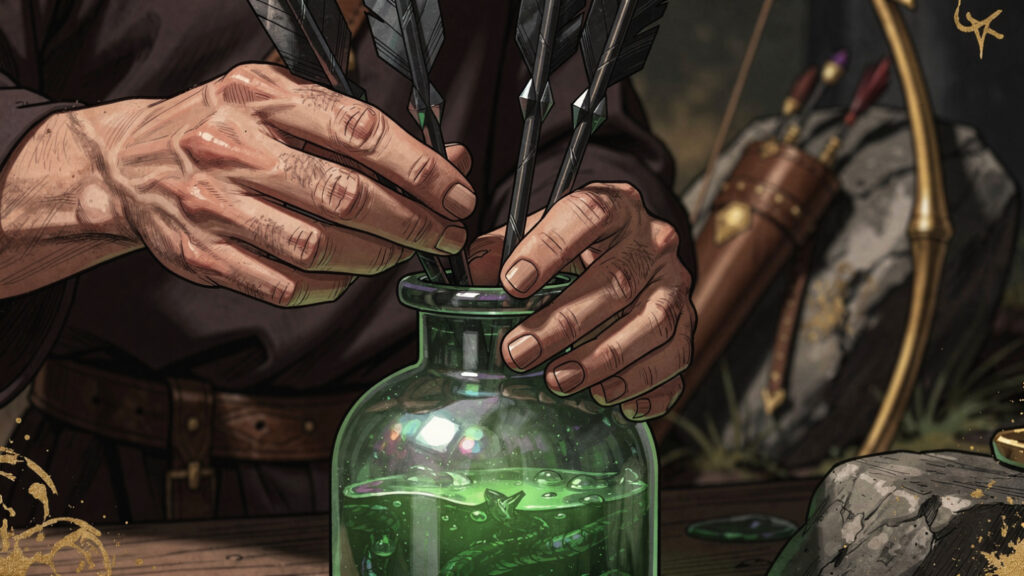
This is the philosophical pivot of the second labor: what the hero could not destroy, he could carry. The lethality that had been distributed across an impossible number of regenerating heads was extracted from the severed immortal head and transferred to the arrows. The Hydra stopped being an environment of uncontrollable multiplication and became a substance under Heracles’s control, applied at the moment he chose, to the target he selected, in the quantity the arrowhead could carry.
The labor was uncounted. The arrows were used for every labor that followed.
What Eurystheus Understood
The disqualification of the second labor is the mythological tradition’s most precise statement about the nature of mastery and the nature of genuine victory.
Eurystheus refused to count the Hydra because the solution required Iolaus. But the deeper reason, the one that the tradition encodes in the disqualification without stating directly, is that the solution did not eliminate the Hydra. The immortal head remained alive under a stone. The entropy engine of Lerna was sealed, not dismantled. The swamp remained a threshold to the underworld. The springs of Amymone continued to flow. The second labor left behind it an immortal head and a set of poisoned arrows, one of which would eventually kill the hero who made them.
The labor failed because the system was not destroyable by any means available to a being operating within the constraints of mortal existence, however divine his origins. The Hydra’s immortal core was not a monster with a weakness that sufficient heroism could find and exploit. It was a feature of the cosmos that the mythology placed at the boundary between the surface world and the underworld: a self-replicating expression of the principle that the boundary zone does not resolve.
Heracles contained it. He extracted what was useful from it. He buried what could not be destroyed and continued. Eurystheus, applying the cold logic of a test designed to measure divine nature against divine opposition, correctly identified what had occurred: not mastery, but management. Not dissolution, but a patch applied to an open wound in the fabric of the world.
The patch held. The arrows worked. The immortal head remained under its stone on the road between Lerna and Elaius, and the venom from it traveled into every subsequent labor and eventually returned to destroy the hero who had harvested it.
The entropy engine of Lerna was not defeated. It was redirected.
At Olympus Estate, Mythic Essays moves through the deeper currents of the Greek tradition. Eurystheus refused to count the second labor not because he was acting in bad faith but because he was making a precise philosophical distinction. Heracles had not overcome the Hydra. He had contained it. The Hydra was what the swamp of Lerna was: the living expression of a geological and theological threshold zone that processed the energy directed at it and returned it multiplied. Heracles was not fighting a creature that resisted his force. He was operating the creature’s own reproductive system. Each blow was a gift. The immortal head is still under its boulder on the road between Lerna and Elaius. The labor was uncounted. The arrows were used for every labor that followed. The entropy engine of Lerna was not defeated. It was redirected.