



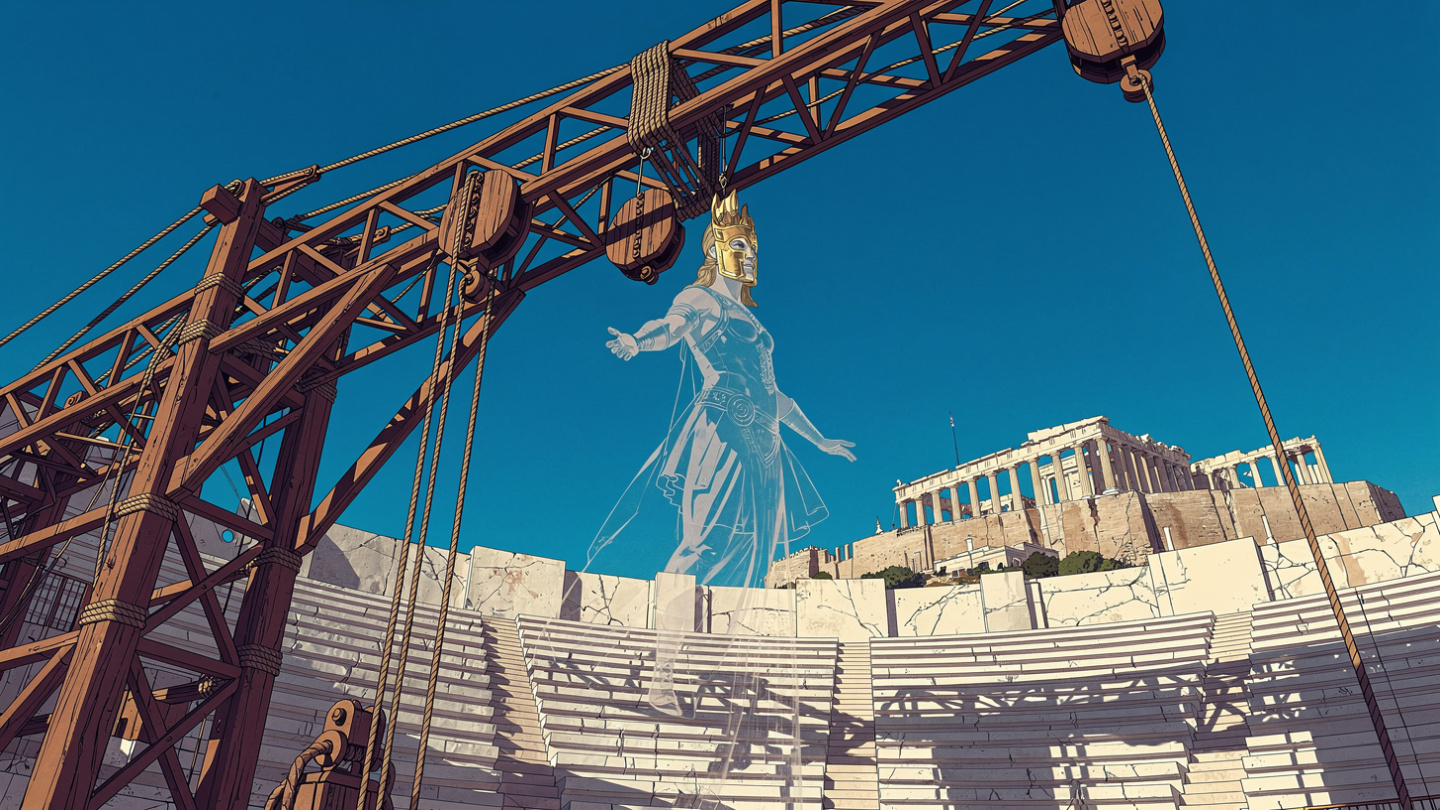
Somewhere in the Theatre of Dionysus on the southern slope of the Acropolis in Athens, around the middle of the fifth century BCE, an actor playing a god was lifted into the air by a wooden crane, swung out over the stage, and lowered into the drama unfolding below.
The audience watched this happen. They knew it was a crane. They knew the actor was a man in a mask and costume. They were watching a machine make a mortal pretend to be a god descending from the sky, in a theatre where the actual sky was visible above them and the real Acropolis was visible behind the stage.
And it worked.
Not despite the visible mechanics, but partly because of them. The Greeks who watched the god descend from the mechane did not need the illusion to be seamless. They needed something more interesting than seamlessness: the quality of theological meaning produced when a machine that you can see operating generates an experience that the machine alone cannot account for. The god was constructed from wood and rope and a man in costume, and the audience understood this completely, and the god was still divine.
This is the most sophisticated thing that Aeschylus contributed to the history of human thought about the divine, and it is hiding inside a theatrical stage device that the Latin translation of its Greek name, deus ex machina, has reduced to a phrase meaning a lazy plot resolution.
This article is about what the mechane was actually doing, and why Aeschylus, who invented it, was doing something with it that went considerably deeper than spectacle.
What the Mechane Was
The mechane was a crane.
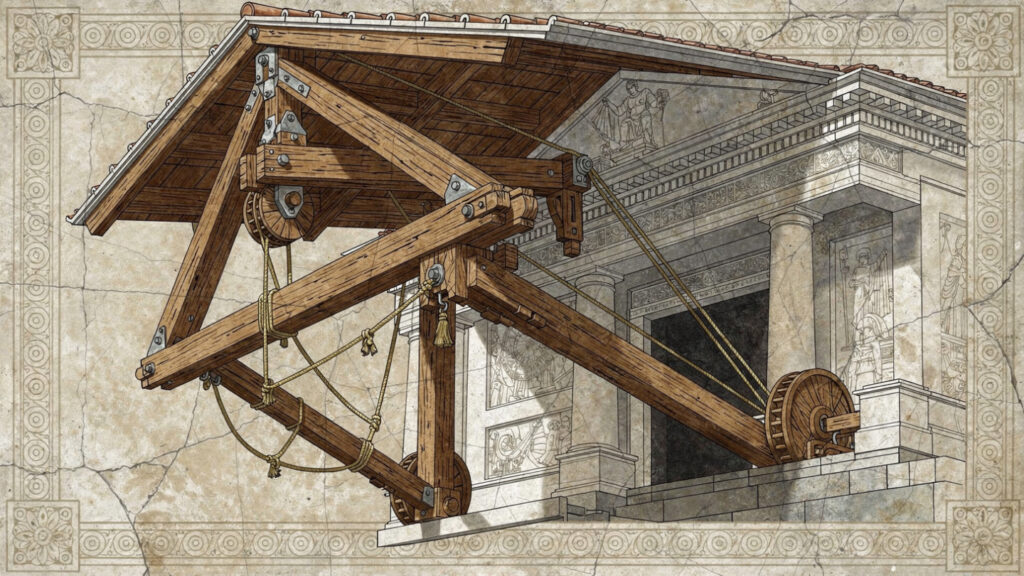
In physical terms: wooden beams, a system of pulleys, ropes, a harness capable of supporting the weight of a costumed actor, and the structural capacity to swing that actor from the roof of the skene building out over the stage area and then lower them to the level of the other performers. The device was installed at the side or rear of the stage structure and operated by stagehands whose presence was understood but not foregrounded.
Made of wooden beams and pulley systems, the mechane was used to lift an actor into the air, usually representing flight, and was particularly used to bring gods onto the stage from above, giving rise to the Latin term deus ex machina, god from the machine.
The earliest known use of the mechane is assigned to Aeschylus, who introduced the idea of a god emerging suddenly from above the skene building to resolve the action of the drama. He did not simply inherit a theatrical convention and deploy it. He invented the convention, and the invention was a theological argument as much as a theatrical technique.
The word mechane itself, in the Greek of Aeschylus’s period, was relatively new in the sense that concerns us here. The word had existed in Homer’s Iliad to describe political manipulation, the figurative machinery of human scheming. Aeschylus’s innovation was to apply it to a literal physical device, and in doing so he created a connection between the human craft of building machines and the divine capacity for appearing in the world that the plays were designed to explore.
The machine made gods visible. This was not a small claim. It was the central theological problem of Greek religion given a physical form.
The Problem the Mechane Was Solving
Greek theology had a structural problem that the theatre was uniquely positioned to address.
The Olympian gods were simultaneously present everywhere and visible nowhere. They governed weather and war and desire and the outcomes of human lives with an authority that was felt constantly but perceived directly only at moments of divine intervention: an eagle appearing at the right moment, a storm arriving with suspicious timing, a dream that came true in a way that ordinary dreams did not. The experience of divine presence was real and common. The sight of divine form was exceptional, reserved for heroes and for the moments in myth when the gods chose to be seen.
This created a representational problem for the dramatic tradition. How do you put a god on stage? The mask and the costume were the fundamental solution: the actor was not Athena, but the mask of Athena was Athena, in the representational convention that the theatre had established. But the mask and the costume alone could not represent the defining quality of divine existence that distinguished gods from mortals: the capacity to move between the divine realm above and the human realm below, to descend and ascend, to be of the sky and yet to be present on the earth.
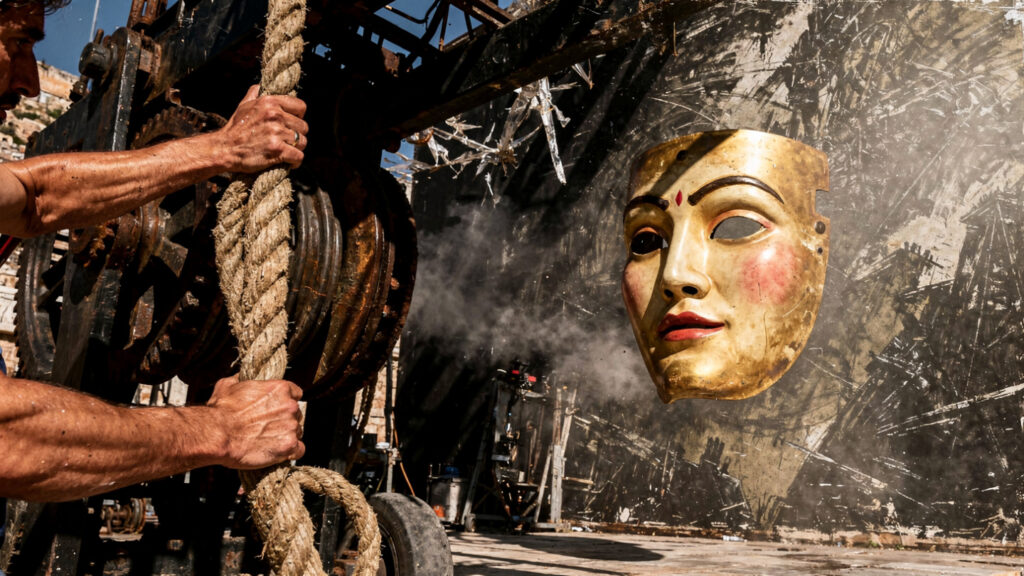
The mechane solved this. It did not simply move the actor through space. It moved the actor between realms: from the height that represented the divine sphere to the level that represented the human one, with the motion of the descent visible to the audience as the crossing of a boundary that no unassisted human body could cross in that direction.
The audience who watched a god descend from the mechane was watching, with full knowledge of the mechanical means, a visual argument about what divine intervention looks like: not a seamless magical appearance, but a movement from a higher sphere to a lower one, achieved through means that require both the divine will to descend and the human capacity to represent that descent with whatever technology is available.
Prometheus Bound | When the Machine and the Theology Meet
The most philosophically rich deployment of aerial imagery in Aeschylus is Prometheus Bound, and it is the play where the relationship between the theatrical machine and the theological argument it was making becomes most explicit.
The play’s central figure is chained to a rock: a god of craft and intelligence, the benefactor of humanity, immobilised by the supreme authority of Zeus as punishment for giving fire to mortals. Prometheus cannot move. The entire dramatic world of the play comes to him.
Into this world of enforced stillness, the Oceanids arrive.
They are the daughters of Oceanus, and they describe their arrival in a winged vehicle, a flying chariot, that brought them from their father’s realm to the Caucasian rock where Prometheus is bound. The quality of the vehicle description in the play is worth attending to: they do not simply arrive. They arrive in something that moves through the ether, the pure upper air, the medium that Greek cosmology placed between the terrestrial atmosphere and the divine sphere above it. Their vehicle is not a metaphor for speed or power. It is a description of a mode of transport appropriate to beings who exist at the boundary between the divine and the mortal worlds.
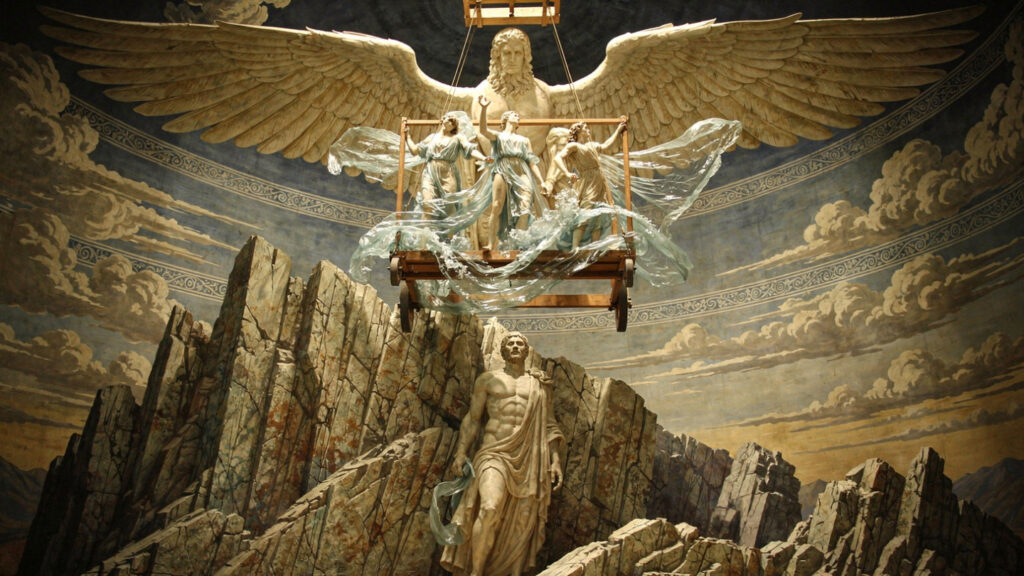
If the mechane was used to lower the Oceanids onto the stage, which the scholarly evidence strongly suggests, then the audience of Prometheus Bound was watching something of considerable philosophical complexity: divine beings, arriving in winged vehicles that the text describes in detail, being represented by actors suspended from a wooden crane, descending from the visible sky above the theatre to the level of the stage where the chained Prometheus waited.
The text described the theology. The machine enacted it. The audience held both simultaneously.
The mechane was connected, literally, to the divine: if used in Prometheus Bound, it would have transported the god Oceanus. The text describes the potential mechane not as a piece of technology but as a divine vehicle.
This is the precise quality of the theatrical moment that makes Aeschylus’s use of the mechane philosophically significant rather than merely spectacular. He did not use the crane to produce illusion. He used it to produce an experience of the relationship between craft and divinity: the god arrives in a vehicle the text calls divine, and the vehicle the theatre uses to represent this is demonstrably a machine. The gap between the two is not a failure of the representation. It is the representation’s most precise content.
The Eumenides | When the Machine Resolved a Cosmic Crisis
The Oresteia, the only complete trilogy of Greek tragedy that survives, ends with the Eumenides: the play in which Athena descends to Athens to resolve the conflict between Orestes, pursued by the Furies for the murder of his mother, and the Furies themselves, the ancient chthonic forces of divine retribution who predate the Olympian order.
Aeschylus used the mechane in his Eumenides, and it became an established stage machine with Euripides. The Athena who descends to the Areopagus to preside over the first murder trial in human history arrives from above. She says as much in the text: she has come from Troy, responding to the prayers of the Athenians from a great distance, and her arrival is both immediate and from a height.
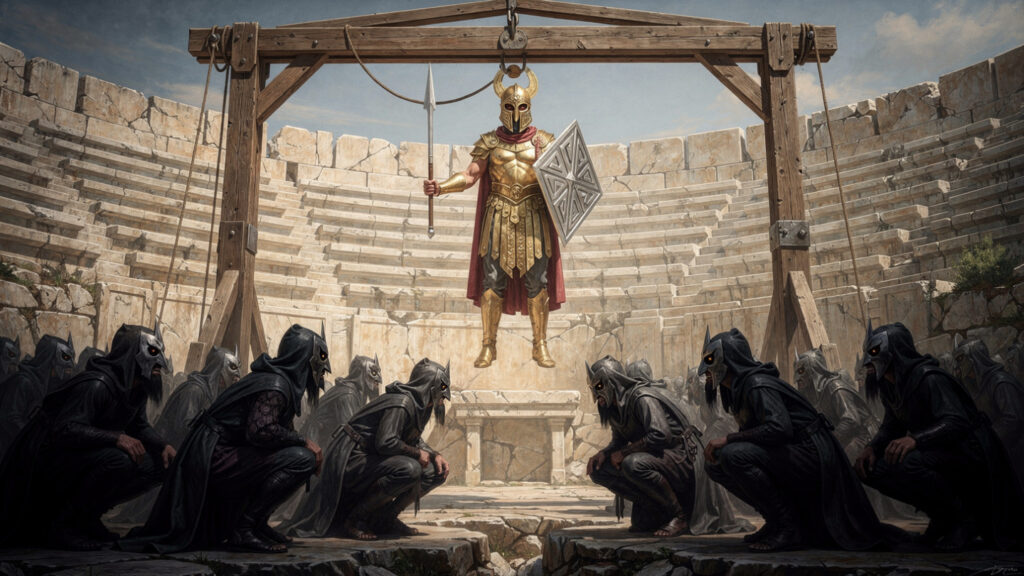
What the mechane does in the Eumenides is specifically charged by the context of the play. The entire drama is about the relationship between the old divine order, the Furies and their chthonic law of blood vengeance, and the new Olympian order, the justice system that Athena institutes. The Furies move through the earthly level of the drama with the heaviness of ancient powers: they are rooted, terrestrial, of the underworld. Athena arrives from above, from the divine sphere, from the direction of Troy and the Olympian intervention in human affairs.
The physical direction of divine authority in the play is vertical: the old powers move horizontally through the human world, the new power descends from above. When Athena appears on the mechane and descends to the stage level of the Areopagus, the machine is not simply moving an actor. It is performing the argument of the entire Oresteia about the relationship between the chthonic order and the Olympian one: the gods of the sky intervene in the affairs of the earth by descending into them, and when they do, the direction of their approach is inseparable from their authority.
What Aerial Imagery Meant in Aeschylus’s Theology
The flight imagery that runs through Aeschylus’s surviving plays is not a consistent set of references to a single concept. It is a repertoire of different ways in which movement between realms serves the theological argument of each play.
In the Agamemnon, the first play of the Oresteia, the chorus’s odes use images of birds, eagles, and divine messengers moving through the air to represent the communication between the divine and human spheres: the eagle as Zeus’s instrument, the heron as Athena’s. These are not vehicles in any technological sense. They are the Greek tradition’s way of imagining how divine intelligence communicates itself to the human world: through the creatures that occupy the space between earth and heaven, that move through both without belonging entirely to either.
The Eumenides uses the Furies’ wingless flight as a marker of their quality of divine presence: they pursue without the conventional apparatus of divine movement, without the wings that gods and divine messengers typically require, because their authority is not Olympian but chthonic, not from above but from within. The absence of wings in their movement is itself a statement about what kind of divine force they are.
In the Suppliants, the ship that carries the Danaids to Greece is described with the vocabulary of winged movement: swift, capable of traversing the vast distances between the worlds they are moving between. The maritime journey and the divine journey are expressed in the same language because both involve the crossing of boundaries between different orders of existence, and the Greek poetic tradition had a single vocabulary for this crossing regardless of the medium through which it occurred.
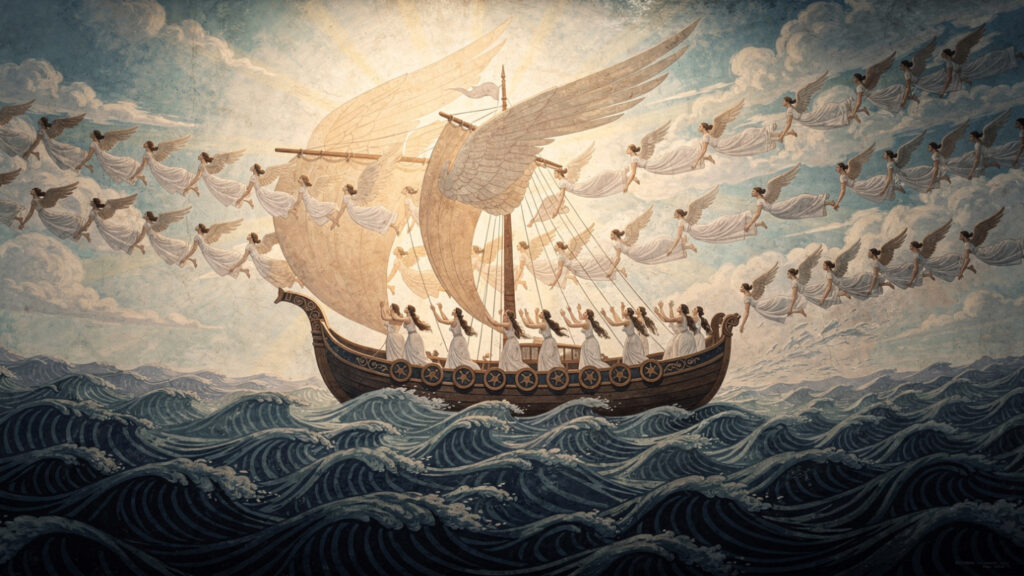
What unifies these varied deployments is the consistent theological claim that the space between divine and human existence is not empty but traversable, and that traversal is always significant: it marks a moment when the two orders are in communication, when divine authority makes itself available to human experience in a form that human experience can register.
The Mechane’s Paradox | Seeing the Machine Seeing the God
The most interesting question about the mechane is the one that modern scholarship has increasingly focused on: what did it mean that the audience could see the crane?
Ancient Greek theatre was performed in daylight, in an open-air space, with the sky visibly present above the performance and the Acropolis visible beyond it. The mechane was not hidden behind scenic devices or concealed by theatrical darkness. It was a visible piece of wooden engineering that an audience sitting in the Theatre of Dionysus could observe operating.
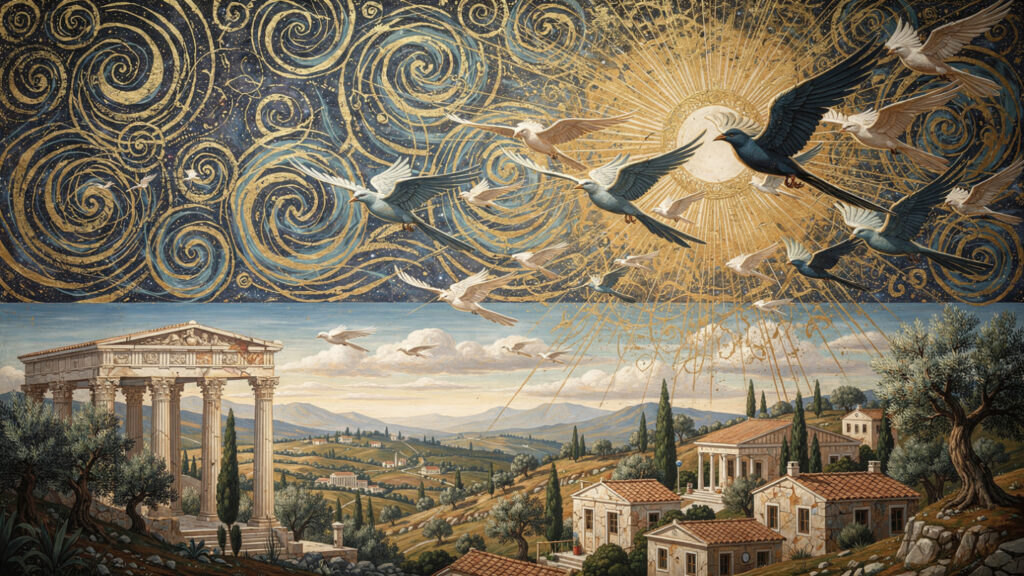
Vital to the success of the mechane as a mode of visual epiphany was the challenge to the viewer to recognise divine intervention as well as the mechanics that constructed and enabled it.
This is the paradox at the heart of the device. The audience was invited to see both the machine and the god simultaneously, to hold in their attention the wooden crane with its pulleys and ropes and the divine being that the crane was bringing to earth. The mechane did not ask for suspension of disbelief. It asked for something more sophisticated: the capacity to recognise that the divine reveals itself through means, and that the means do not diminish the divinity.
This is a fundamentally different relationship to theatrical representation from the one that most subsequent Western theatrical traditions have adopted. The realistic tradition, from the Renaissance through the naturalist stage of the nineteenth century, requires the audience to forget the machinery so that the illusion can be maintained. The ancient Greek theatre, at least in Aeschylus’s deployment of the mechane, required the audience to see the machinery as part of the meaning. The god arrives by means of a device, and the device is part of how you understand what divine arrival is.
The philosophical position encoded in this convention is not naive. It is precisely the position that Greek philosophy was developing in the same century: that the divine is not separate from the material world but operates through it, that the logos, the rational principle that governs the cosmos, expresses itself through the mechanisms of nature rather than despite them. The god on the crane is the theological argument of the Stoics given a theatrical form fifty years before the Stoics formulated it.
Aristophanes Knew What Aeschylus Was Doing
The clearest evidence that the Athenian audience understood the mechane’s theological function is the use that Aristophanes made of it in comedy.
Aristophanes deployed his own version of the device, called the krade in the comic tradition, repeatedly in his plays, specifically to deflate and mock the conventions of tragic performance. When a comic character arrives on the mechane in an Aristophanes play, the joke is precisely the gap between the solemnity of the tragic convention and the absurdity of its comic deployment: the crane is too visible, the actor too obviously a mortal, the arrival too clearly mechanical to sustain the dignity that the tragic convention attributed to it.
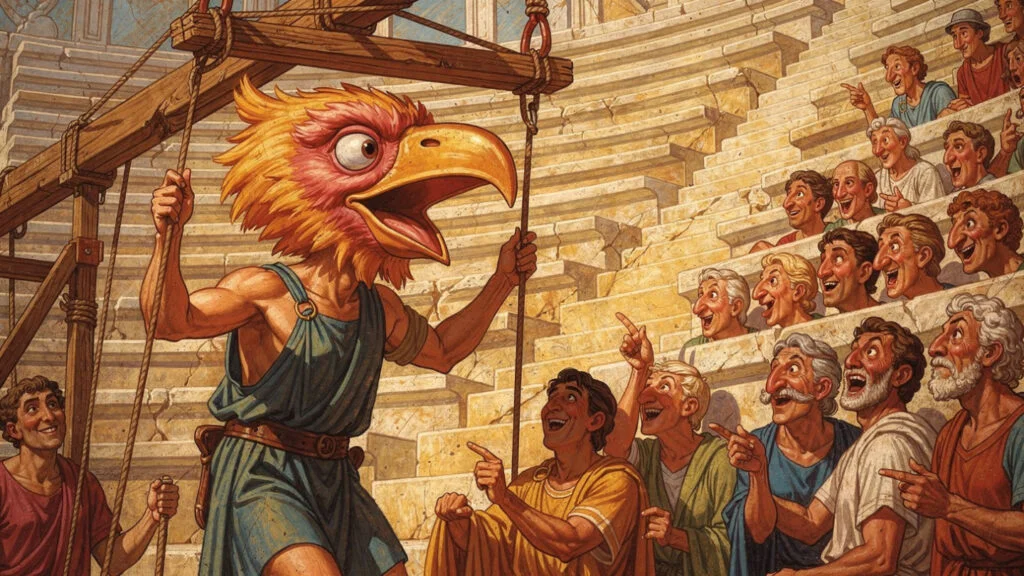
The comedy only works if the audience understood what was being parodied. You cannot deflate a convention that your audience does not recognise. Aristophanes’s repeated comic use of the crane device confirms that the Athenian audience was entirely familiar with the tragic mechane and its implications, and that they could hold the comic deflation and the tragic original in their minds simultaneously.
What Aristophanes mocked was exactly what Aeschylus had made: a theatrical convention that asked the audience to see the divine in and through a visible mechanism. The comedy said: look, it is just a crane and a man. The tragedy said: yes, and through the crane and the man, something divine is made visible. Both positions were available to the same audience in the same city at the same time, and the dialogue between them is one of the most sophisticated pieces of theatrical theology that the ancient world produced.
What This Means for Reading Aeschylus
When you read Aeschylus with the mechane in mind, the aerial imagery of the plays changes its character entirely.
The winged vehicles, the flying chariots, the beings who descend from the ether: these are not evidence of ancient technology, not encoded references to spacecraft or extraterrestrial contact, not metaphors waiting to be decoded by modern interpreters with different frameworks. They are a precise and sophisticated theatrical and theological vocabulary for representing the movement between divine and human existence that is the central subject of Greek tragic drama.
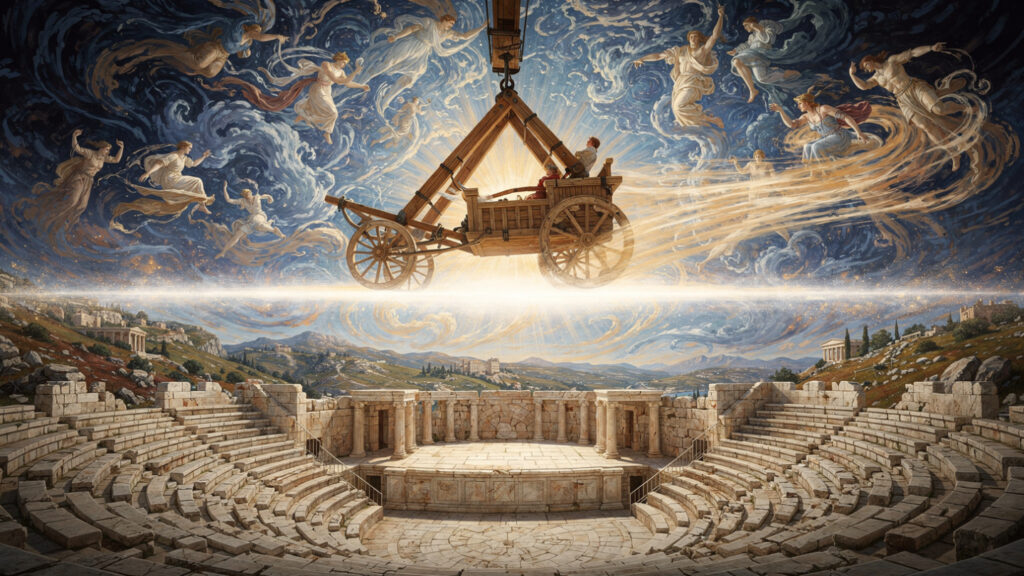
Every instance of flight in Aeschylus is a statement about the relationship between the divine and the human: about how the gods communicate with the world below, about the quality of divine authority that requires descent to make itself felt, about the boundary between the two orders of existence and what happens when that boundary is crossed.
The mechane was the device that made this theology visible in performance. When it lowered Oceanus to the stage in Prometheus Bound, it was enacting the proposition that the divine chooses to descend into the human world, and that this choice is what distinguishes divine intervention from divine indifference. When it brought Athena to the Areopagus in the Eumenides, it was demonstrating the argument of the entire Oresteia: that the Olympian order resolves the contradictions of the chthonic order not by destroying them but by incorporating them into a larger structure of justice, and that this resolution comes from above.
The wooden crane with its pulleys and ropes was, in the hands of Aeschylus, a machine for thinking about God.
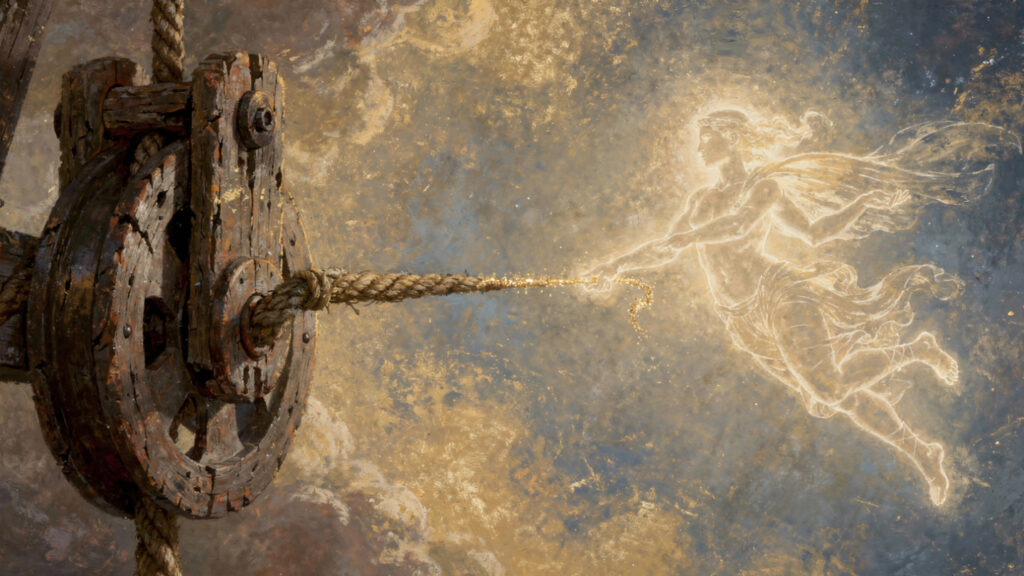
That is a more interesting thing than a spacecraft. It is also a more interesting thing than a metaphor. It is what it actually was: a piece of theatre in which the visibility of the machinery was inseparable from the meaning of the theology, in which the audience was asked to see both simultaneously and to understand that both were true.
The Machine is How the Miracle Becomes Visible
The word that we use to describe a theatrical or narrative resolution that arrives from outside the logic of the story, the deus ex machina, carries within it the memory of a theatrical device that was doing something considerably more demanding than resolving plots.
Aeschylus built a crane to lower gods onto a stage. He was the first to do this. The decision to make divine descent visible, to represent it through a piece of engineering that the audience could observe operating, was a theological position as much as a theatrical one: the claim that the divine makes itself available to human experience through means, and that the means are part of the meaning rather than an obstacle to it.
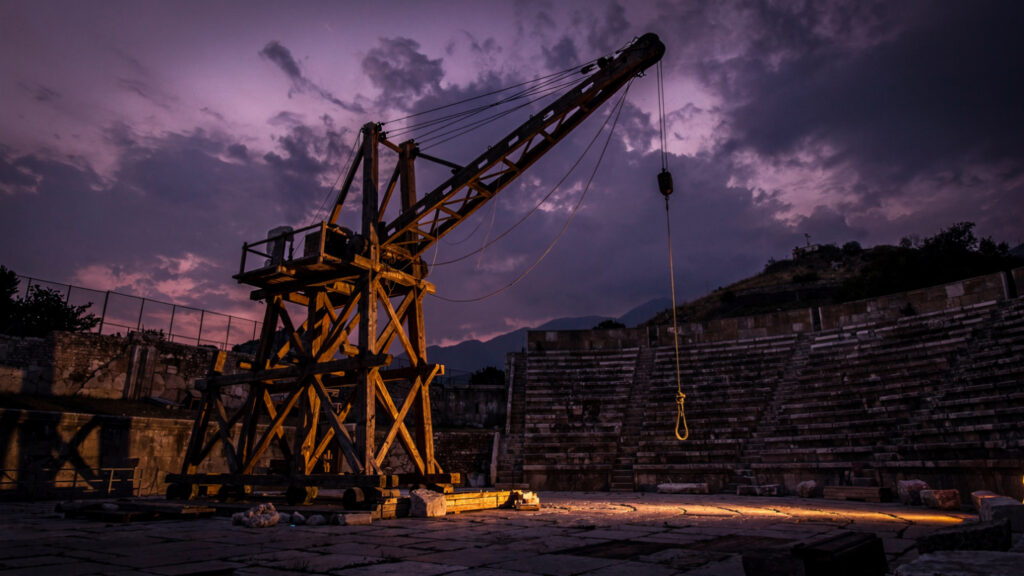
When the Oceanids descended to Prometheus on the crane of the Theatre of Dionysus, the audience was holding several truths simultaneously: the wooden mechanism, the human actor, the divine character, the winged vehicle the text described, and the sky above the open-air theatre through which the fictional chariot had supposedly traveled. All of these were present at once. The tragedy asked the audience to let all of them be true.
This is what Aeschylus understood about the relationship between craft and divinity that the simpler readings of his imagery miss: that the gods do not fly in spite of the mechanics. They fly through them. The machine is not a substitute for the miracle. The machine is how the miracle becomes visible.
It is still, in its way, the most honest representation of divine intervention ever staged.
At Olympus Estate, Mythic Essays moves through the deeper currents of the Greek tradition. Aeschylus built a wooden crane to lower gods onto a stage. The audience could see it operating. The god was still divine. The comedy said: look, it is just a crane and a man. The tragedy said: yes, and through the crane and the man, something divine is made visible. The wooden crane with its pulleys and ropes was, in the hands of Aeschylus, a machine for thinking about God. The deus ex machina was not a lazy plot resolution. It was a theological argument. It is still the most honest representation of divine intervention ever staged.