





Abdera produced two of the most consequential thinkers of the fifth century BCE, and the two positions they developed were in direct opposition to each other, and the tension between those positions has been the governing tension of Western philosophy ever since.
Democritus of Abdera argued that the world was made of atoms and void, that the atoms moved through the void according to mechanical necessity, that the qualities we perceive, the colours and the tastes and the temperatures and the sounds, were not properties of the atoms themselves but arose from the interaction between the atomic configurations of objects and the atomic configurations of our sensory apparatus, and that the divine beings had nothing to do with any of it.
Protagoras of Abdera, the sophist who was Democritus’s exact contemporary and possibly his fellow citizen, argued that man is the measure of all things: of things that are, that they are, and of things that are not, that they are not.
The Democritean position was that the world had a structure independent of human perception, and that the human being’s task was to understand that structure through reason. The Protagorean position was that the world as it appeared to the individual human perceiver was the world that was, because there was no available standard of measurement outside the human perceiver against which the perception could be checked.
These two positions, developed in the same city at the same time by two men who almost certainly knew each other, defined the philosophical problem that the subsequent tradition has been working on: whether there is a world independent of human perception and, if there is, whether human intelligence has the capacity to understand it. Plato devoted his philosophical career to refuting the Protagorean position and vindicating the Democritean one, though not in the form Democritus had developed it. Epicurus built his entire philosophical program on the Democritean foundation. Aristotle refined both. The argument they started has not been resolved.
What the Atom Was
The Greek word atomos means the uncuttable, the indivisible, the thing that cannot be divided further. The claim that Leucippus of Miletus first proposed and that Democritus developed into the complete philosophical system was the claim that matter had a lower limit of division: that if you divided any material object repeatedly, you would eventually reach a particle that could not be divided further, because dividing it further would be dividing nothing, which was the definition of the void rather than of matter.
The void was the other component of the atomist universe: the empty space through which the atoms moved. The importance of the void in the Democritean system was the importance of the concept that many of Democritus’s contemporaries found most philosophically disturbing: the claim that nothing, the empty space, the absence of material, was as real as something, the atom. The Parmenidean tradition, which had argued that what is not cannot be and that therefore the world was a single undivided plenum with no empty spaces, was the tradition that the atomist void most directly challenged.

Democritus’s response to the Parmenidean challenge was the response that the empirical observation of motion most directly supported: things move, which means they move from one place to another, which means the place they were is now empty and the place they are is now occupied, which means there must be empty space, which means the void is real. The movement of any material object was, for Democritus, the direct empirical evidence for the reality of the void.
The atoms moved through the void according to the mechanical necessity that their size and shape and weight and the nature of their collisions determined. There was no divine guidance. There was no purpose. There was no teleological direction toward any outcome. The atoms moved because they were moving, and the configurations they formed from their collisions and combinations were the configurations that the mechanics of the collisions had produced rather than the configurations that any divine intention had designed.

The world, in the Democritean account, was the product of necessity operating on chance configurations of atoms in infinite void. Not design. Not divine intention. Not the rational order of the Logos that Heraclitus was developing in Ephesus across the strait from Samos at roughly the same time. The collision of atoms and the void between them.
The Qualities That Were Not Properties
The philosophical claim in the Democritean atomism whose anticipation of the modern scientific distinction between primary and secondary qualities is most precisely observed was the claim about the nature of the perceptible qualities of material objects.
Democritus argued that the atoms themselves had only three properties: shape, size, and position. These were the actual properties of the atoms, the properties that were real regardless of any perceiving subject. The sweetness of honey and the bitterness of wormwood and the heat of fire and the cold of ice and the redness of blood: these were not properties of the atoms that constituted the honey or the wormwood or the fire or the ice or the blood. They were the effects that the atomic configurations of those materials produced when they interacted with the atomic configurations of the human sensory apparatus.

The honey did not have sweetness the way it had mass. The honey had the atomic configuration that interacted with the atomic configuration of the human tongue in such a way that the interaction produced the quality of experience that the perceiving subject called sweetness. The sweetness was real. But it was not a property of the honey. It was a property of the interaction between the honey and the perceiver.
The formulation Democritus preserved for this distinction is one of the most precise philosophical statements in the pre‑Socratic tradition. By convention sweet, by convention bitter, by convention hot, by convention cold, by convention color. In truth atoms and void.
This distinction, between the properties that objects have by convention in the sense of the properties that arise from the interaction between the object and the human sensory apparatus, and the properties that objects have in truth in the sense of the properties that the atoms themselves have regardless of any perceiving subject, is the distinction that the seventeenth-century philosophical tradition articulated as the distinction between primary and secondary qualities. John Locke’s distinction between the primary qualities of matter whose existence is independent of perception and the secondary qualities that exist only in the mind of the perceiver is the same distinction Democritus made in the fifth century BCE.
Protagoras and the Measure of All Things
Protagoras of Abdera was born approximately twenty years before Democritus in the same city, and the intellectual trajectory that took him from Abdera to Athens, where he became the most successful and the most influential of the sophists, was the trajectory of the thinker whose question was the question that the Democritean physics most directly provoked.
If the honey’s sweetness is not a property of the honey but a property of the interaction between the honey and the human perceiver, then the honey’s sweetness is different for different perceivers whose atomic configurations produce different interactions with the same honey. The honey is sweet for the person whose sensory apparatus interacts with it in the way that produces the experience of sweetness. It is not sweet for the person whose sensory apparatus interacts with it in the way that produces no experience of sweetness or a different experience entirely. Both experiences are valid. Neither is false. The honey’s sweetness is what it is for each perceiver, and there is no external standard against which the different perceivers’ experiences can be checked to determine whose experience is the correct one.
Man is the measure of all things: of things that are, that they are, and of things that are not, that they are not.

The Protagorean position was not the position of the shallow relativist who claimed that truth was merely a matter of preference. It was the position of the rigorous thinker who had followed the Democritean physics to its most radical available conclusion: if the qualities of objects are properties of the interaction between the object and the perceiver rather than properties of the object itself, then the perceiver is the standard against which those qualities are measured, and the claim that there is a standard external to the perceiver against which the perceiver’s measurement can be checked is the claim that requires the philosophical demonstration that neither Democritus nor any of his contemporaries had provided.
Plato understood this. The Theaetetus, Plato’s most sustained engagement with the theory of knowledge, begins with the examination of the Protagorean claim that knowledge is perception, and the refutation that Plato develops through Socrates’s questions is the refutation of exactly the philosophical trajectory that begins with the Democritean distinction between the atomic properties and the perceptible qualities and arrives at the Protagorean claim that the perceiver is the measure.

Plato’s refutation required the Forms: the entities whose existence was independent of any particular perceiver, whose properties were not properties of their interaction with any sensory apparatus, and whose knowledge by the philosophical intellect was the counter-claim to the Protagorean position that only the individual perceiver’s perception could be the measure. The Forms were the answer to the Protagorean question. The Protagorean question was the answer to the Democritean physics. The argument ran from Abdera to Athens in both directions simultaneously.
Epicurus and the Democritean Inheritance
The Epicurus article in this collection develops Epicurus’s philosophical program through the argument about the fear of death and the argument about the gods’ non-involvement in human affairs, naming both as the conditions of the ataraxia whose achievement was the goal of the Epicurean philosophical program. What the Epicurus article does not develop is the reason that the Democritean atomism was the necessary foundation for both of those arguments.
The argument about the gods required the physics that demonstrated that the world operated according to natural mechanical principles rather than divine governance. If the atoms moved through the void according to mechanical necessity, and if the configurations that the atoms’ collisions produced were the configurations that the mechanical necessity of the collisions determined rather than the configurations that divine design had intended, then the divine beings had no role in the operation of the world. The gods existed, in the Epicurean account, but they existed in the intermundia, the spaces between the worlds, in the condition of the perfectly blessed existence that was perfectly undisturbed by any engagement with the affairs of the world whose atomic mechanics they had not designed and did not govern.

The argument about the fear of death required the physics that demonstrated what the soul was. If the soul was composed of atoms, as the Democritean account proposed, and if the atoms of the soul dispersed at death in the same way that the atoms of any material configuration dispersed when the mechanical forces that had held them in their configuration no longer operated, then there was no soul that survived death to suffer the post-mortem condition that the fear of death anticipated. The dissolution of the soul’s atomic configuration at death was the end of experience for the soul’s individual existence, which was the premise from which the Epicurean argument that where death is the person is not followed as a direct logical consequence.
The Democritean atomism was not simply a physical theory that Epicurus found useful. It was the physical theory whose content was required to provide the physical foundation for the arguments whose conclusions Epicurus had identified as the conditions of the philosophical liberation from fear that the good life required. Epicurus needed the Democritean physics because the Epicurean ethics required a world in which the divine did not govern and in which death was the dissolution of the soul’s atomic configuration rather than the transfer of the soul to a condition in which it could be punished.
The argument that began in Abdera with Democritus’s atoms and Protagoras’s measure ran through Epicurus’s garden to Lucretius’s poem De Rerum Natura, the first-century BCE Latin poem whose preservation through a single medieval manuscript and whose rediscovery in 1417 by Poggio Bracciolini was the event that Stephen Greenblatt’s The Swerve identifies as one of the catalysts of the Renaissance.

The atomism of Abdera reached the Renaissance through the Latin poem, reached the seventeenth-century scientific revolution through the Renaissance, and reached the modern physics of Dalton and Rutherford and Bohr through the seventeenth century. The argument has been running for twenty-five centuries and has not been resolved.
Abdera and What Survives
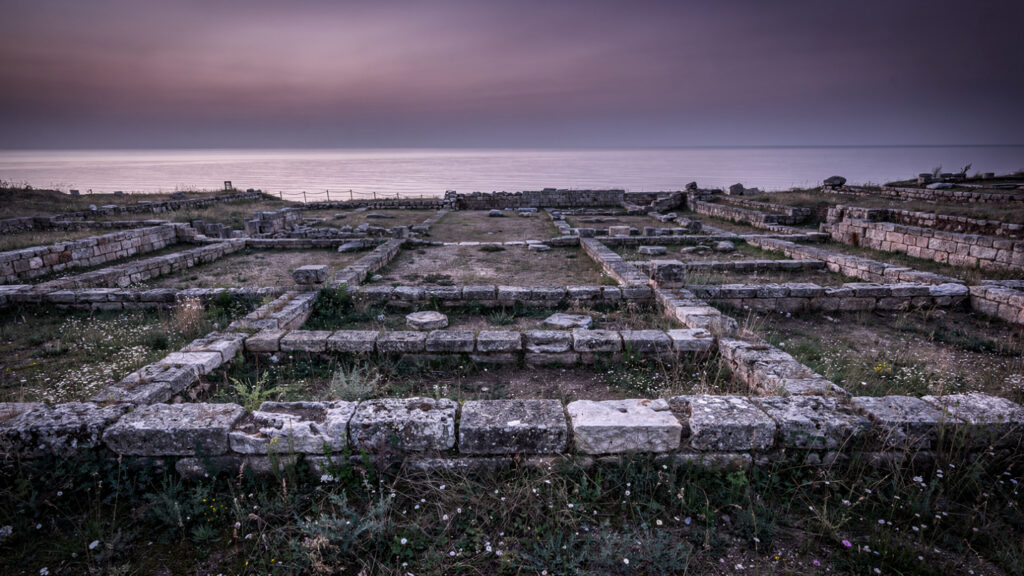
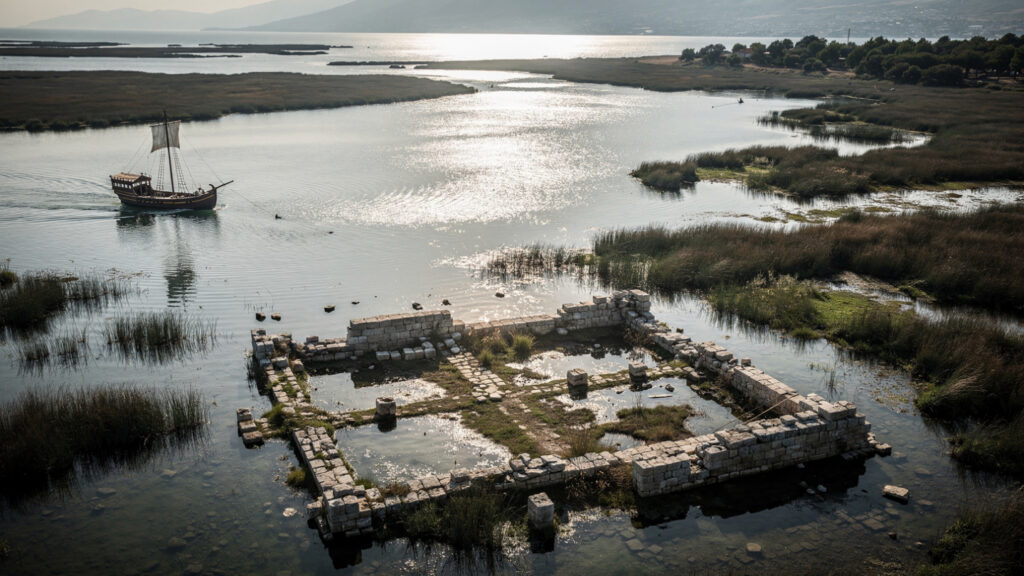
The archaeological site of modern Avdira in the Xanthi regional unit of eastern Thrace preserves the material record of the ancient city whose intellectual tradition produced the two most consequential philosophical positions of the fifth century BCE. The site is not developed for large-scale tourism in the organized sense of the Delphi or Olympia or Epidaurus sites, which is the condition that preserves its quality of the serious archaeological site whose content is available to the visitor who has prepared for the encounter rather than the visitor who requires the organized infrastructure of the major tourist destination.
The ancient city walls, the theater, the agora, and the residential quarters excavated since 1950 by the Greek Archaeological Service give the site its spatial character: the organization of a city of significant commercial and intellectual importance in the fifth century BCE, whose position on the Thracian Gulf gave it the maritime trading connections that brought the intellectual traffic of the eastern Mediterranean to this stretch of the Thracian coast.
The Archaeological Museum in the modern village holds the material culture of the ancient city in the form that gives the Democritean tradition its concrete historical context: the pottery and the coins and the sculpture and the inscriptions whose character reflects the commercial prosperity that funded the intellectual activity whose product was the atomist philosophical tradition. The museum is the necessary companion to the outdoor site and the essential preparation for understanding what the city actually was in the fifth century BCE rather than what the philosophical tradition has retrospectively made it.
The proximity to the Nestos River estuary and the lagoon system of the Thracian Gulf gives the site its landscape character: the wetland and coastal terrain that the ancient city occupied at the junction of the agricultural hinterland and the maritime commercial routes is the terrain whose ecological character the collection’s Greek wilderness article develops through the Dadia forest that the same region of Thrace preserves.
Thrace’s Character
Thrace, the northeastern Greek region that Abdera occupied, is the region whose character as the borderland between the Greek world and the Thracian world, between the Aegean coast and the continental interior, between the Greek and the Ottoman and the Bulgarian cultural traditions, gives it the particular quality of the place where multiple civilizational traditions have left their simultaneous traces in the same landscape.
The Samothraki article in this collection develops Samothrace, the island visible from the Thracian coast, through the sanctuary of the Kabeiroi and the discovery of the Nike of Samothrace and Philip II’s meeting with Olympias at the sanctuary where he met the woman who would be the mother of Alexander. The island is the most concentrated available expression of the Thracian coastal tradition whose mainland expression the Abdera site and the Xanthi inland city together constitute.
Xanthi, the nearest significant city to the Abdera archaeological site, is the example of the Ottoman-Greek urban tradition that survived in the northeastern Aegean region more completely than in most of the rest of Greece: the Old Town’s neoclassical mansions and narrow lanes and the tobacco warehouses that the nineteenth-century commercial prosperity built and the multicultural character of a city where the Orthodox and the Muslim and the secular Greek traditions coexist in the same urban space is the character that the political and demographic history of the region produced across the Ottoman period and the population exchange of 1923 and the subsequent development of the modern Greek state’s northeastern border territory.

What the Argument Means
The argument that Democritus and Protagoras started in Abdera has been running for twenty-five centuries because the question it raises is the question that cannot be answered by the methods available to the human intelligence that is asking it.
If the atoms are the fundamental structure of the world, and if the qualities we perceive are the products of the interaction between the atomic configurations of objects and the atomic configurations of our sensory apparatus, then the question of whether our perception of the world is an accurate representation of the world as it actually is, independent of our perception, is the question that cannot be answered from inside the perception whose accuracy is being questioned.
Democritus saw this. The formulation by convention sweet, by convention bitter, by convention hot, by convention cold, by convention color, but in truth atoms and void, is the statement of a philosopher who understood that the gap between the conventional qualities and the truth of atoms and void was a gap the human perceiver could not cross without using the very perceptual apparatus whose relationship to the truth was the gap’s content.
Protagoras drew the conclusion that Democritus’s physics made available: if the gap between the conventional qualities and the truth cannot be crossed, then the conventional qualities are the available measure, and the human perceiver who experiences them is the measure of the available measure.
The atomism and the sophism were not opposed positions. They were the two available responses to the same philosophical problem. Democritus proposed that the problem could be solved by the development of the rational understanding that penetrated beneath the conventional qualities to the atomic truth. Protagoras proposed that the problem could not be solved because the only available tool for solving it was the sensory and intellectual apparatus whose relationship to the atomic truth was the problem’s content.
Plato built the Forms to answer Protagoras. The Forms were the entities that the rational intellect could know independently of the sensory apparatus, whose existence was independent of any particular perceiver, whose knowledge was the counter-claim to the Protagorean position that the individual perceiver’s measurement was the only available standard.
The argument has not been resolved. The atoms are real. The perceiver is real. The relationship between what the atoms are and what the perceiver experiences remains the philosophical question that the two most consequential thinkers Abdera produced began arguing about in the fifth century BCE.
At Olympus Estate, Mythic Essays moves through the deeper currents of the Greek tradition. Abdera produced Democritus who argued the world was atoms and void and Protagoras who argued man was the measure of all things and the two positions were in direct opposition and both followed from the same physics. By convention sweet, by convention bitter, by convention color. In truth atoms and void. Epicurus needed the Democritean physics because the Epicurean ethics required a world in which the divine did not govern and death was the dissolution of the soul’s atomic configuration. Lucretius preserved the atomism in Latin and Poggio Bracciolini found the manuscript in a German monastery in 1417 and it helped start the Renaissance. The argument has been running for twenty-five centuries. The archaeological site at Avdira is not crowded. Go there.