




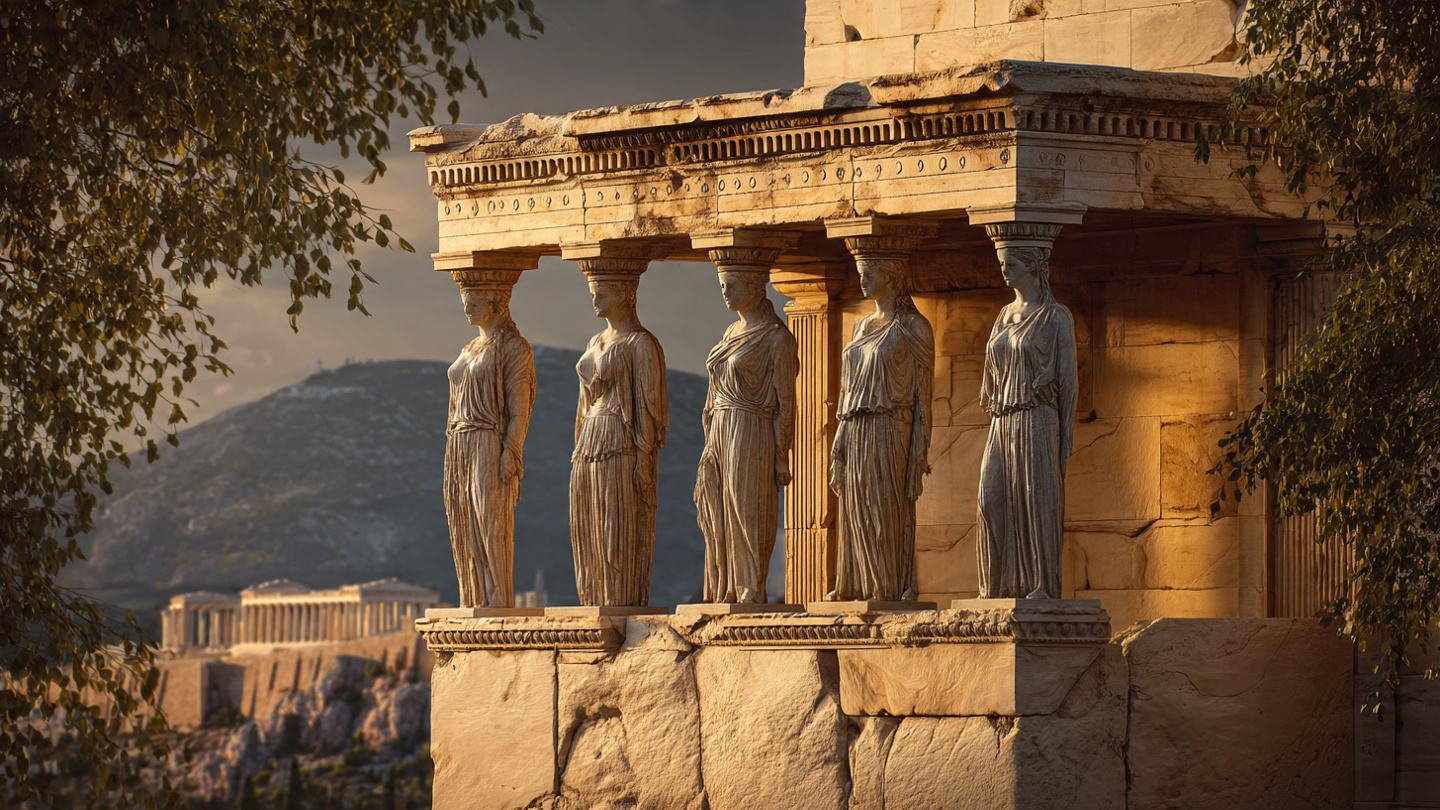
The women holding up the Erechtheion are not carrying the weight of the temple.
This is the observation that unlocks how to actually read the Caryatid figures correctly. The six figures of the Erechtheion’s southern porch are not the Greek version of the Atlas figure, not beings whose punishment is the eternal support of what they fought against. The Atlas article in this collection develops the Titanomachy punishment as isolation at the world’s edge, the conscription of the defeated into maintaining the order they had opposed. The Caryatids are different.
Their knees are slightly bent. Their weight is distributed with the ease of someone who has trained for the physical task, whose performance requires not brute force but the postural intelligence of a body that understands the biomechanics of the load. Their gaze is level. Their expression carries the attentiveness of a being fully present in the task, without the visible strain of someone near the limit of their capacity.
They are not struggling. They are standing.
The difference between struggling and standing is exactly what the myth of Carya encodes in the architectural form that bears her name. To understand why the architects of the Erechtheion chose the female form for the structural function of the southern porch, and why that form is the standing woman rather than the straining one, requires understanding the myth the architecture was translating into marble.
Carya and the Dionysian Gift
Dionysus traveled through the Peloponnese and was received with hospitality by King Dion of Laconia and his wife Iphitea. The hospitality was correct: a divine visitor properly acknowledged, given exactly the welcome the guest-friendship customs of the age demanded.
In return, Dionysus gave the gift of prophecy to the three daughters of the household. The gift came with a condition: the daughters must never betray the gods or seek to know what was forbidden.
Carya, the youngest, understood the weight of the condition. Her sisters did not. When the sisters violated it, Dionysus transformed them into stone, not the living stone of the mountain whose geological character gave it presence, but the dead stone of punishment, removed from the living world entirely.
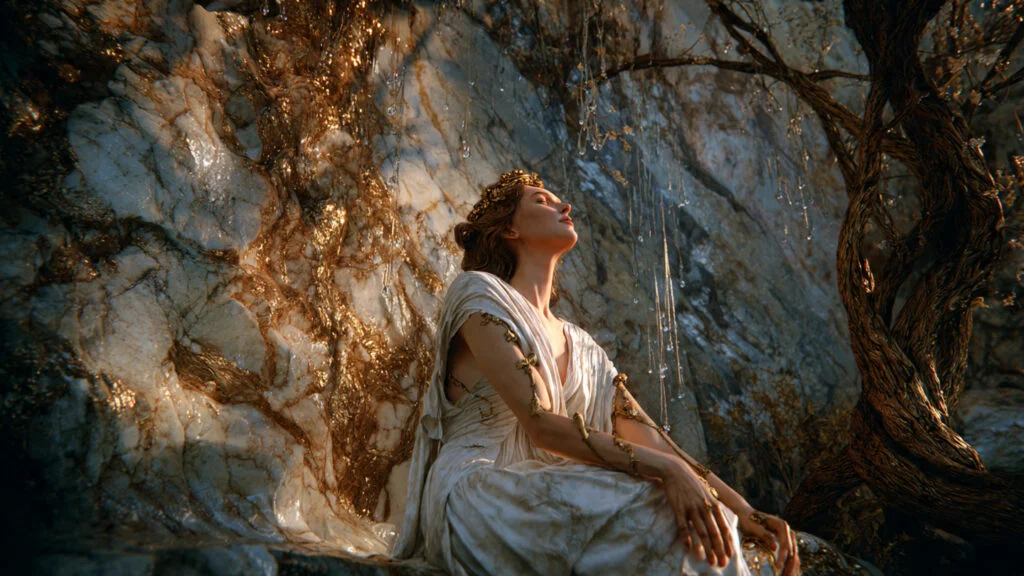
For Carya, who had maintained the integrity the condition required, a different transformation was reserved.
She died. And Dionysus transformed her into a walnut tree.
The character of this transformation sets it apart from every other Dionysian change on record and gives the whole architectural form that followed its real theological content. The transformation was not punishment but preservation. The plant Carya became was not the vine, not the Dionysian plant of fermentation and temporary dissolution whose theology the Lycurgus article in this collection develops. The walnut was something else entirely: the plant of sustained support rather than temporary dissolution.
The Walnut and Its Character
The walnut tree, karya in Greek, is the plant whose real botanical character gives the Carya transformation its meaning.
Its root system is among the deepest and most laterally extensive of any tree in the Laconian highlands. The roots go down into the bedrock and hold the hillside against the gravitational and hydrological forces that steep incline and seasonal rainfall would otherwise convert into erosion. The walnut tree does not ornament the hillside. It holds it.

The walnut’s fruit carries a bilateral symmetry ancient writers repeatedly noted for its resemblance to the brain, giving the tree its symbolic association with intellectual depth. The bark is rough in the way of skin. The canopy provides the dense shade a Laconian summer demands. The trunk combines height, girth, and a rootedness that gave the tree its architectural presence in the landscape long before any architect ever looked at it that way.
Carya became the tree whose character was the character of a being who sustains rather than dissolves, who stabilizes rather than disrupts, who provides the enduring support a landscape and the community living on it actually require.
Karyae and the Dance That Became the Column
The village of Karyae in the Parnon mountains of Laconia maintained the sanctuary of Artemis Caryatis, the actual transmission point between the mythological transformation of Carya and the architectural form of the Caryatid column.
The sanctuary’s annual ritual was a dance performed by the young women of the community. The Karyatides danced in honor of Artemis Caryatis with baskets of sacred plants balanced on their heads.

The physical discipline the dance required was the discipline of posture itself: an upright spine whose alignment distributed the weight of the basket across the skeletal structure, so the load could be carried without the muscular tension a poorly aligned body would produce under the same weight. The basket was carried not by force but by the intelligent alignment of the spine along the vertical axis. The training was training in intelligent weight-bearing, not in the endurance of strain.
The architects of the Erechtheion saw this and understood the Karyatid dancers as the most precisely available material model for the architectural function they needed: long-duration weight-bearing that required not maximum compressive strength but the intelligent distribution of load along a structural geometry aligned with gravity’s own vertical axis.

The basket became the capital. The braided hair became the structural element at the neck, not a decorative addition but the thickening at the most heavily loaded point of the figure’s geometry, where the entablature’s weight transmits through the neck into the trunk, and from the trunk into the base, and from the base into the foundation. The architects understood exactly where the load concentrated and provided additional material at that point. The myth named the structural principle. The dance embodied it. The architecture translated it into marble.
Vitruvius’s Rival Account, and Why It Doesn’t Hold
Any honest account of the Caryatids has to address the other, darker origin story that most visitors to the Acropolis actually hear first, because for centuries it was the version Western architecture believed.
The Roman architect Vitruvius, writing in the first century BCE, offered a different explanation entirely: that the women of Karyai had sided with the Persians during the invasions of the early fifth century BCE, that the victorious Greeks killed the men of the town and enslaved the women, and that female figures bearing architectural loads were introduced afterward specifically to commemorate this punishment, condemning the women’s image to an eternity of visible burden. Vitruvius’s account is vivid, morally legible, and was for centuries the standard explanation reproduced in architectural treatises from the Renaissance onward, illustrated by artists including Raphael once printed editions of his text began circulating after 1486.
It is also almost certainly false. Female figures used as architectural supports appear in Greek and Near Eastern architecture well before the Persian Wars Vitruvius blames, which makes the punitive chronology impossible on its own terms. Modern scholars, from the eighteenth-century critic Lessing onward, have treated the story as an invented etiology, a dramatic explanation Vitruvius supplied for a form whose real origin, the Karyai dance in honor of Artemis Caryatis, was simply less useful to him as a moral lesson about betrayal.
The dance and the Carya transformation together give a far more coherent account of the form actually standing on the Acropolis. A punished slave does not stand with a level gaze and an unstrained expression. A trained dancer carrying a ritual basket does exactly that. The Erechtheion’s Caryatids have the poise of the second figure, not the first, and the postural evidence in the marble itself argues for the dance and the myth over the invented Roman morality tale that eventually eclipsed them both.
The Erechtheion and the Completed Translation
The southern porch of the Erechtheion is the most complete material expression of what the Carya transformation and the Karyae dance had already developed.
Six figures, each slightly different from the others in the details of the drapery, the facial features, the arrangement of the hair. The Greek architecture article in this collection develops the Erechtheion as the architectural response to a site holding multiple sacred claims at once: the olive tree of Athena, the saltwater spring of Poseidon, the tomb of Erechtheus, and the altar of Zeus all required accommodation within the building’s asymmetrical plan.
The Caryatid porch translates a specifically Laconian myth into an Athenian civic context. The figures are not generic representations of the female form. They are the Karyatides: the women of the Laconian sanctuary, whose dance the architects translated directly into architectural form.
They stand. They do not struggle. The slightly bent knee of each figure is the visible evidence that the structural load is managed by intelligent alignment rather than the maximum application of compressive strength. The bent knee is the living intelligence of the structural form itself, a figure that could step off the plinth if the occasion required it.

This is the contrast with Atlas that gives the Caryatids their most concentrated philosophical content. Atlas strains. The Caryatids stand. The difference is the difference between strength conscripted into maintaining what it once tried to destroy, applied right at the limit of its own capacity, and strength cultivated through years of disciplined dance into a postural intelligence whose whole operation is managing the load efficiently, without ever announcing itself.

The Caryatid column is the architectural form of strength that does not announce itself.
The Laconian Landscape and the Living Continuity
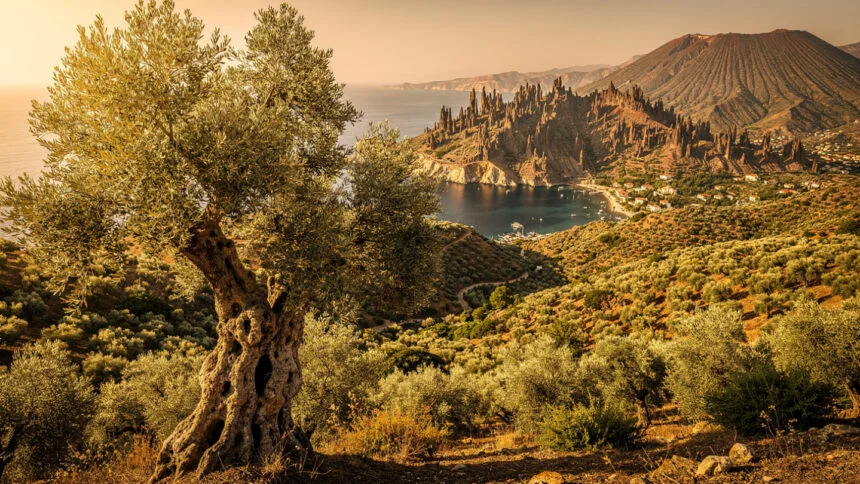
The walnut trees still grow in the Laconian highlands. In winter they stand against the limestone with the grey-silver character of the bare deciduous tree, branches against the winter sky carrying the same architectural presence without the vegetative cover of summer foliage.
The Laconian character ancient writers consistently noted, brevity of speech and intensity of action, the very character that gave the English language the word laconic as shorthand for people who said only what was necessary, is the character the Carya myth encodes in its most accessible form.

The transformation of Carya was never an elaborate dramatic narrative. It was the most efficient available translation of a theological idea into the most enduring available material. The walnut tree was chosen not for symbolic richness but for architectural relevance: the most precisely available natural model for the structural principle Laconian builders valued most.
The Caryatid column is Laconia’s export to the Athenian civic world. It carried a Laconian architectural principle in the most available material form: the standing woman whose postural intelligence gives visible expression to a structural idea whose mythological origin is a Laconian princess transformed into the single most architecturally relevant tree available to her.

The walnut tree in the Laconian highlands still supports the hillside. The Caryatid on the Acropolis still supports the entablature. The same structural principle in two different materials, expressing the same underlying idea.
The princess became the tree. The tree became the column. The column became the most enduring visible expression of a structural principle whose real theological content was the preservation of a being who had kept faith with the divine.
She is still standing.
At Olympus Estate, Property Pantheon explores the architecture, restoration, and living heritage of the Greek built world. The Caryatids are not struggling. They are standing. The difference encodes the myth. Dionysus transformed Carya into a walnut tree not as punishment but as preservation, a tree whose deep roots stabilize the hillside and whose kernel ancient writers associated with the depth of intellectual capacity. The Karyatides of the Karyae sanctuary danced with baskets on their heads, trained in exactly the posture the architects later translated into marble. Vitruvius offered a darker rival story, women of Karyai enslaved for siding with Persia, but the chronology does not hold, since female architectural supports predate the Persian Wars entirely. The braided hair of the Erechtheion figures is not decorative but structural: the thickening at the most loaded point of the figure’s own geometry. The walnut tree still supports the Laconian hillside. The Caryatid still supports the entablature. She is still standing.