



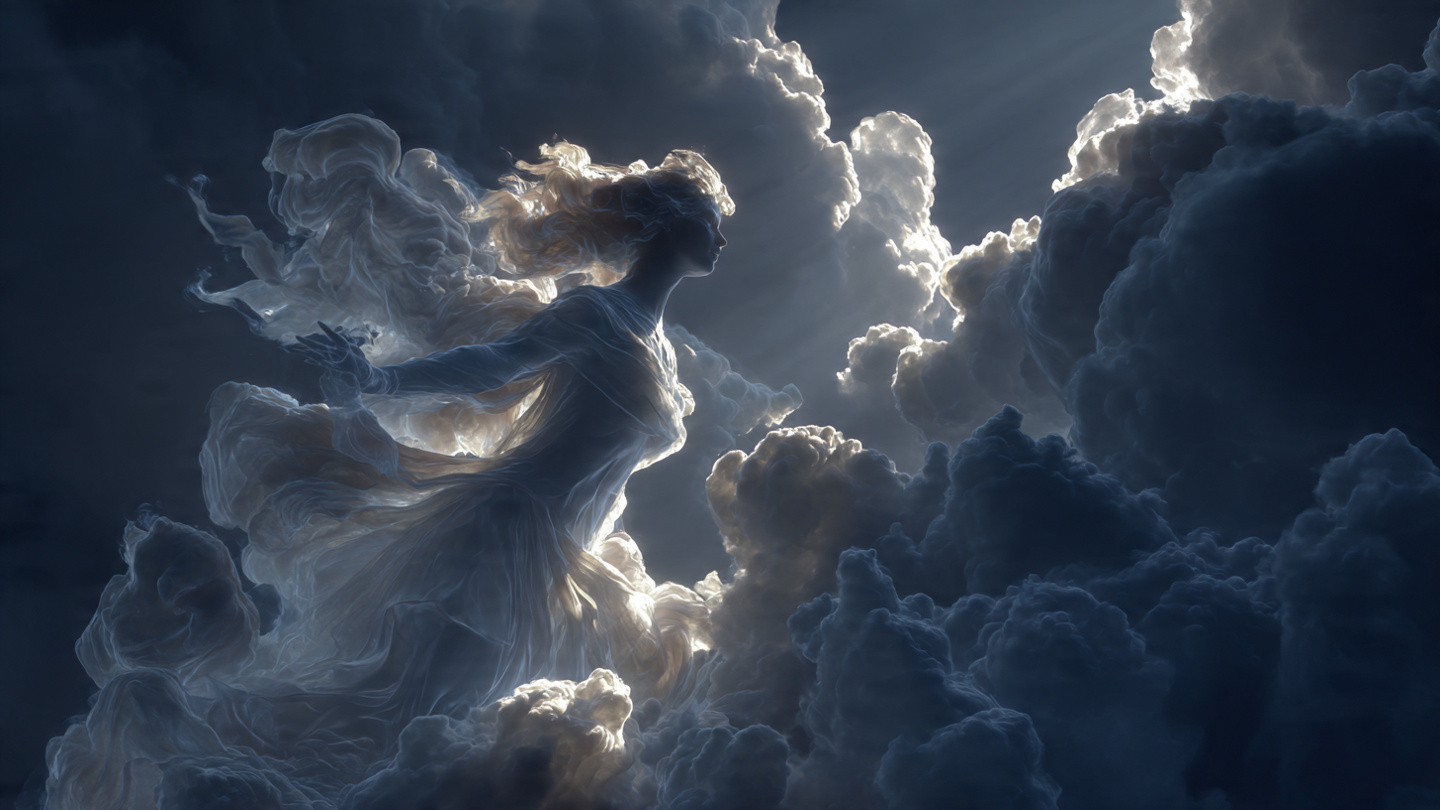
Nephele was never meant to last. She was shaped from vapor for a single purpose, to deceive a king for one night, and then she should have dissolved back into the sky she came from. Instead, she became the mother of monsters and the savior of children, and both of those legacies still shape the way the Greek imagination understands what mist and illusion can produce.
Her name means simply “cloud.” She has no genealogy of her own, no parents among the Titans or the Olympians, no place in any of the standard divine councils. She exists because Zeus needed her to exist, shaped in a single act of celestial improvisation, and that origin as a deliberate fabrication rather than a born thing is the key to understanding everything that follows in her story.
The Trap Built for Ixion
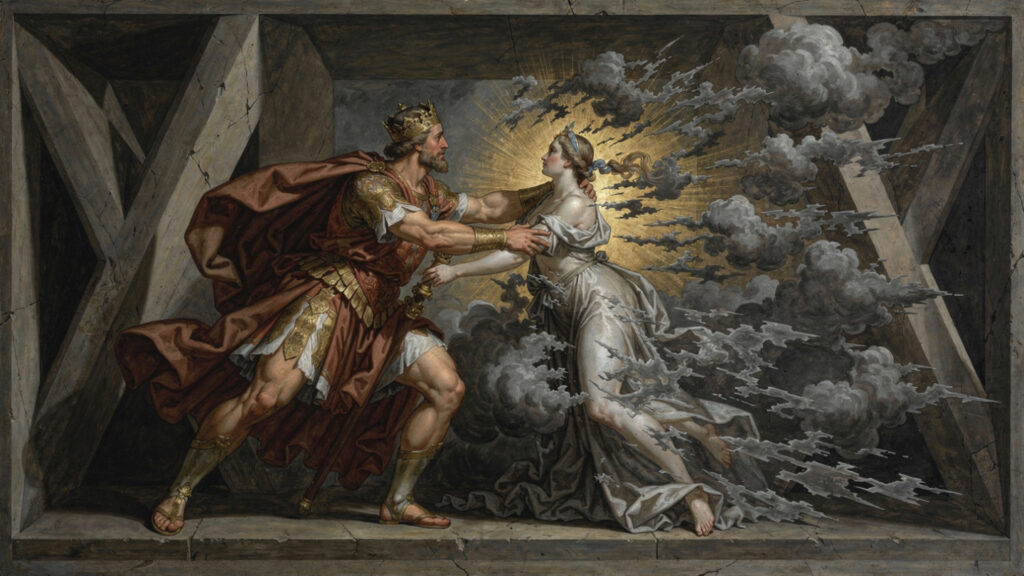
Ixion was a Thessalian king whose crimes against the order of hospitality and kinship were severe even by the standards of a mythology that catalogues such offenses extensively. He had murdered his father-in-law, the first recorded kin-slaying in Greek myth, and no mortal or god would perform the purification ritual that could cleanse him of the blood-guilt. Zeus, in an act of mercy that the tradition consistently frames as a mistake, purified Ixion himself and brought him to Olympus to dine among the gods.
Ixion repaid this mercy by desiring Hera. Not admiring her from a respectful distance, as countless figures in Greek myth do without consequence, but actively pursuing the wife of the king of the gods while a guest at his table, the single greatest violation of the hospitality code the Greek world possessed.
Zeus did not simply punish him outright. He tested him first, and the test was Nephele.
He gathered cloud and shaped it into Hera’s exact likeness, down to the texture of her presence and the timbre of whatever divine quality made her recognizably herself rather than simply a beautiful woman. He placed this cloud-Hera where Ixion could find her, and Ixion took the bait completely. He believed he had succeeded in seducing the queen of Olympus. He boasted about it afterward, which was the final piece of evidence Zeus required.
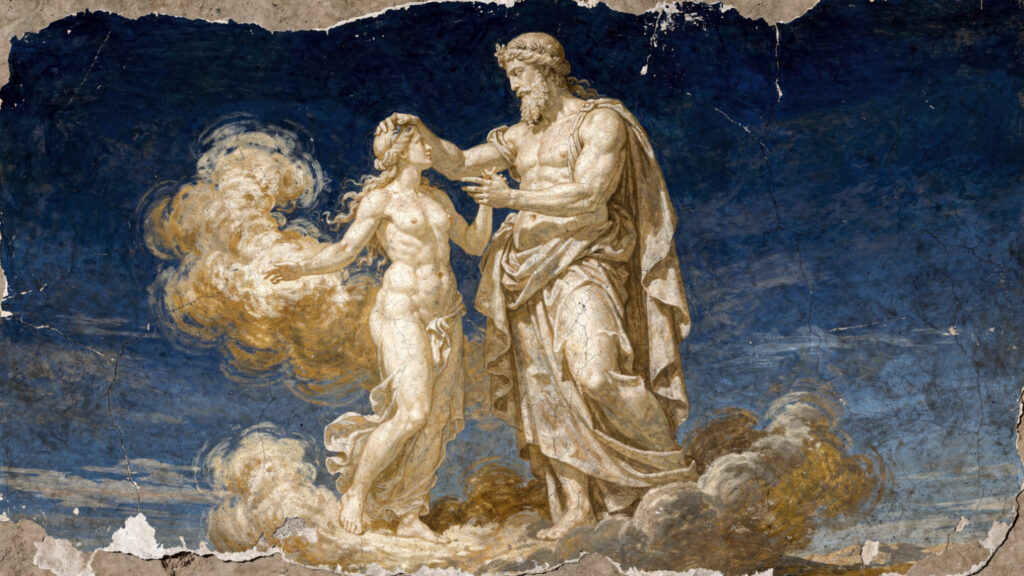
The punishment that followed, Ixion bound eternally to a flaming wheel, spinning forever through the sky, is one of the most vivid images of eternal torment in the Greek tradition. But the punishment is not Nephele’s story. Her story begins at the exact moment Ixion’s hands closed around something that was never her, that was never anyone, that was deliberately built to be mistaken for someone else.
What a Lie Can Father
Nephele did not disappear after the deception succeeded. She was already pregnant.
From the union between Ixion and the cloud shaped to resemble Hera, the Centaurs were born, sometimes through Nephele directly, sometimes through an intermediary figure named Centaurus who was himself her offspring with Ixion and who then mated with the mares of Mount Pelion to produce the race proper. The genealogical details shift across different ancient sources, as genealogies of monstrous races often do, but the consistent core is this: the wild, half-human, half-horse beings who occupy the boundary between civilization and the untamed wilderness throughout Greek myth trace their origin to a deception, a phantom, a thing that was never meant to be a person and became a mother anyway.
This is worth sitting with. The Centaurs are not the offspring of a true union between a god and a mortal, the pattern that produces the heroes, nor of two mortals, the pattern that produces ordinary humanity. They come from a mortal man’s desire for something that did not exist, made briefly, catastrophically real. Their nature as creatures split between the rational and the bestial, capable of wisdom in figures like Chiron and capable of catastrophic violence in figures like the Centaurs who attacked the Lapiths at a wedding feast, mirrors the split at their origin: born from an act that was simultaneously punishment, illusion, and genuine conception.
The wildness of the Centaurs, the storms that sweep the Greek mountain interior where they were said to roam, the whole later image of the centaur as the embodiment of nature’s ungovernable edge, all of it traces back to a cloud given a face for one night and then left to bear the consequences alone.
The Second Life
What the tradition rarely lingers on is what happened to Nephele afterward. A being created for a single act of deception does not typically receive a second narrative arc. Nephele did.
She became, in a later and separate strand of myth, the wife of Athamas, king of Boeotia, and the mother of two children, Phrixus and Helle. This is presented in the sources as though it requires no explanation, the cloud-phantom simply continuing to exist, now in a different register entirely, no longer the instrument of a god’s trap but a queen and a mother in her own right.
Athamas eventually set her aside for a second wife, Ino, and Ino wanted her own children to inherit the kingdom rather than Phrixus and Helle. She arranged a famine, secretly roasting the seed grain before it was sown so the crops would fail, and then bribed or manipulated the oracle Athamas consulted into declaring that the famine would only end if Phrixus were sacrificed.
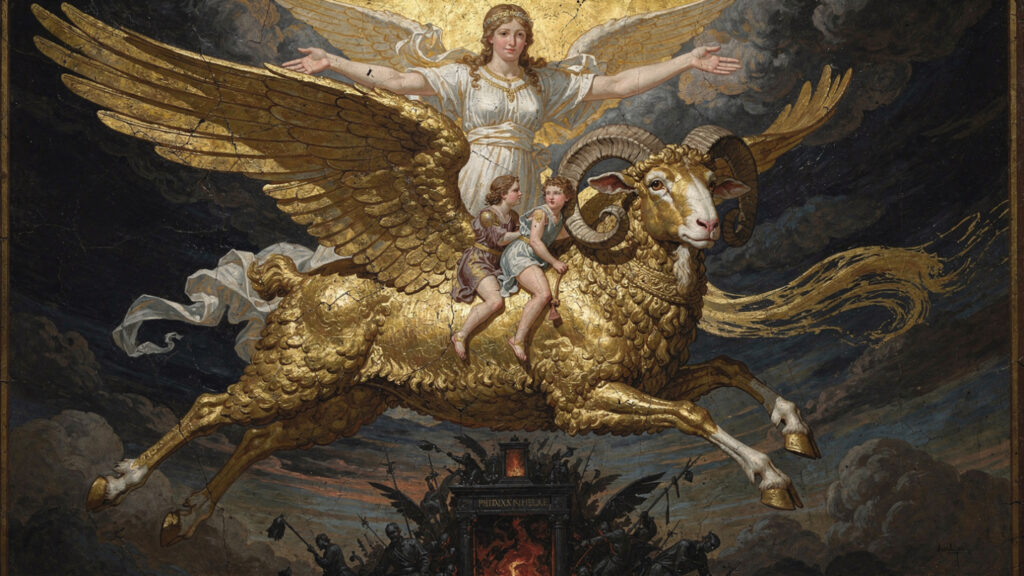
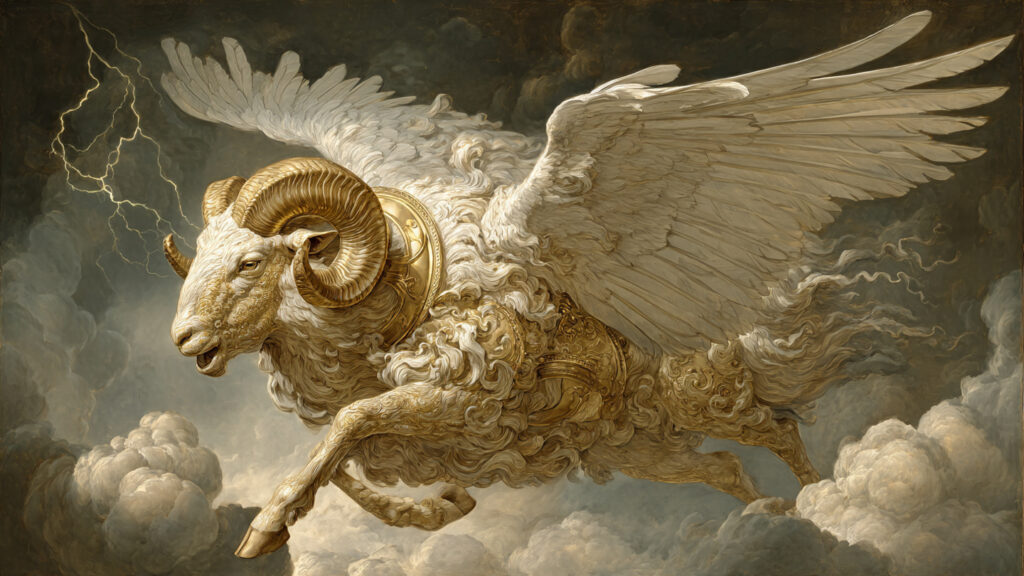
This is the moment the tradition asks us to believe that a being made of mist could feel something fierce enough to override a king’s religious obedience and a rival wife’s careful plot. Nephele intervened. She summoned a ram with fleece of pure gold, winged, sent by Hermes in some versions, and placed her children on its back as the sacrificial altar was being prepared.
The Fall of Helle and the Naming of the Sea
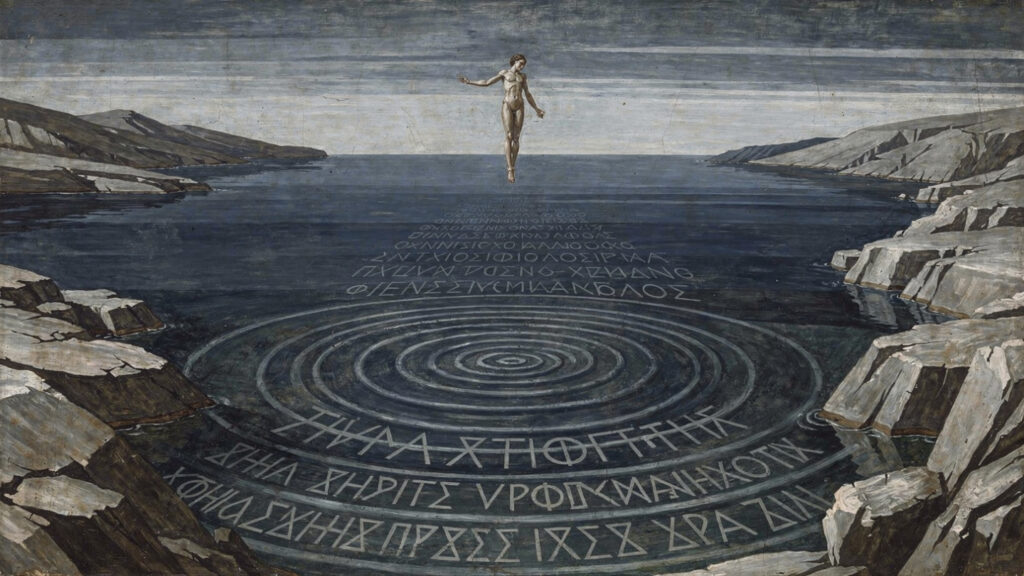
The ram carried Phrixus and Helle east, away from Boeotia, toward Colchis at the eastern edge of the Black Sea. Somewhere over the narrow strait that separates Europe from Asia, Helle lost her grip and fell into the water below.
The strait has been called the Hellespont, Helle’s Sea, ever since. It is one of the most consequential pieces of water in ancient history, the channel Xerxes bridged to invade Greece, the channel Leander supposedly swam nightly to reach Hero, the channel that controlled access between the Aegean and the Black Sea trade routes for the entire span of Greek antiquity. A child falling from the back of a golden ram gave a major strategic waterway its name, and that name persisted in continuous use for roughly three thousand years.
Phrixus survived the crossing and reached Colchis, where he sacrificed the ram in gratitude and hung its golden fleece in a sacred grove, guarded by a dragon that never slept. That fleece became the object of the entire Argonautic expedition, the quest that defines Jason’s heroism, that brings together the greatest assembly of heroes in Greek myth before the Trojan War, that produces Medea as one of the most complex and consequential female figures in the entire tradition.
All of it begins with Nephele’s second act of maternal intervention. The cloud that was made to deceive a king became, a generation later, the cloud that saved her children and in doing so set in motion the myth that the Greek world considered its other great heroic saga, the one that stands beside the Trojan War rather than beneath it.
What She Actually Is
Nephele never speaks in any surviving source. She has no dialogue, no interiority that any ancient author bothers to render directly. She acts twice, decisively, at the furthest possible distance from any humanizing detail, and both times the consequences of her action outlast her by millennia.
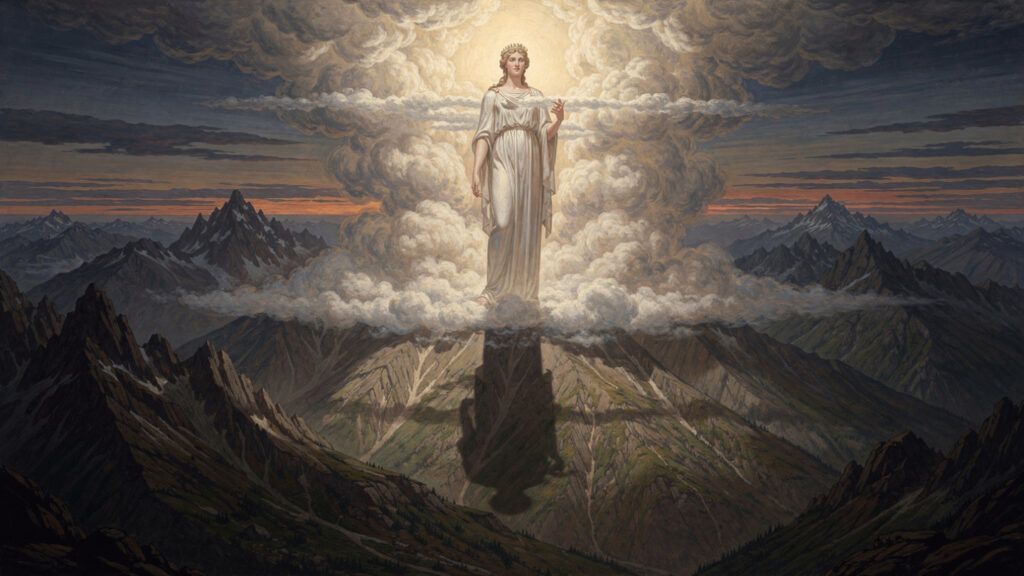
This absence of voice is not an oversight. It is consistent with what she is throughout the tradition: a figure defined entirely by function rather than character, by what she does rather than who she is, because she was never meant to be a who in the first place. She is what happens when illusion is given enough substance to act, and the Greek tradition’s answer to what such a being would do, given the chance, is remarkably consistent across both of her appearances. She protects. First inadvertently, by becoming the unwitting instrument of Ixion’s downfall and the unwitting mother of the Centaurs. Then deliberately, with full maternal intention, when her own children’s lives were at stake.
The Greeks understood something in Nephele that the modern reception of the myth tends to flatten: that the boundary between the real and the illusory is not where moral consequence lives. A cloud shaped like a queen can still found a race. A phantom can still love her children enough to defy a king and an oracle simultaneously. The mist that hides the mountain path is, in the deepest layer of the tradition that produced her, the same substance that once carried two children toward survival on the back of a golden ram.
She dissolved, eventually, the way clouds do. But the Centaurs kept galloping through the Thessalian storms, and the Hellespont kept its name, and the Golden Fleece kept hanging in its grove until Jason came for it. None of that required her to remain solid. It only required her, once, to act as though she were real.
At Olympus Estate, Mythic Essays traces the deeper currents of Greek myth. Nephele was shaped from cloud to deceive a king, yet what came from that single act of illusion outlasted her by three thousand years: the wild bloodline of the Centaurs, the naming of the Hellespont, and the golden fleece that sent Jason and his crew to the edge of the known world.