



Most Greek monsters have a fixed shape.
The Minotaur is always a man with a bull’s head. Medusa is always a woman whose hair is serpents. The Cyclops is always one-eyed and enormous. Greek mythology is populated, for the most part, by beings whose monstrousness is stable and legible: you know what you are dealing with, which means you can prepare for it, name it, paint it on a vase, carve it into a pediment, and hand the finished image down to the next generation intact.
The Empousa is not like this.
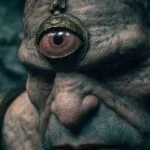
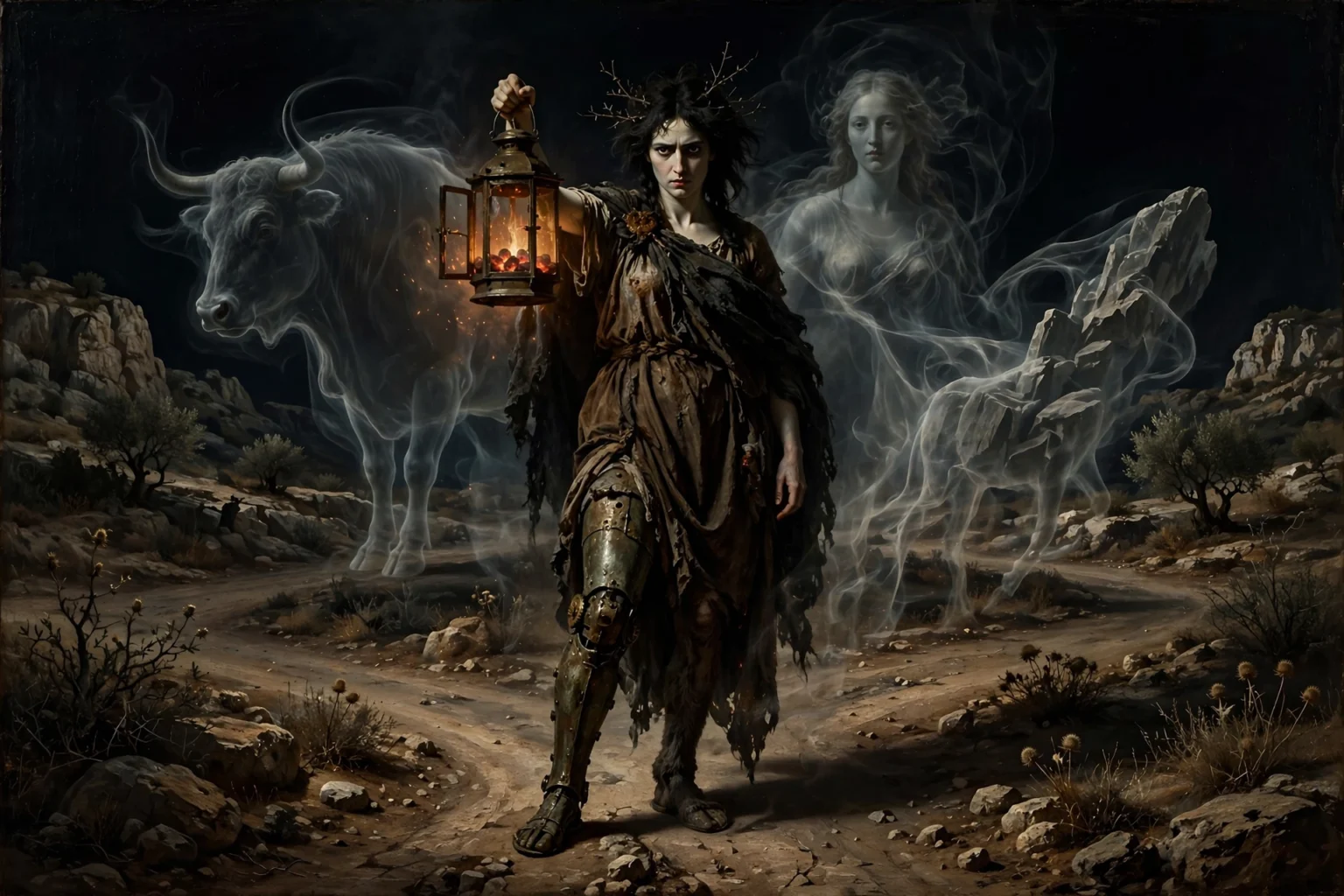
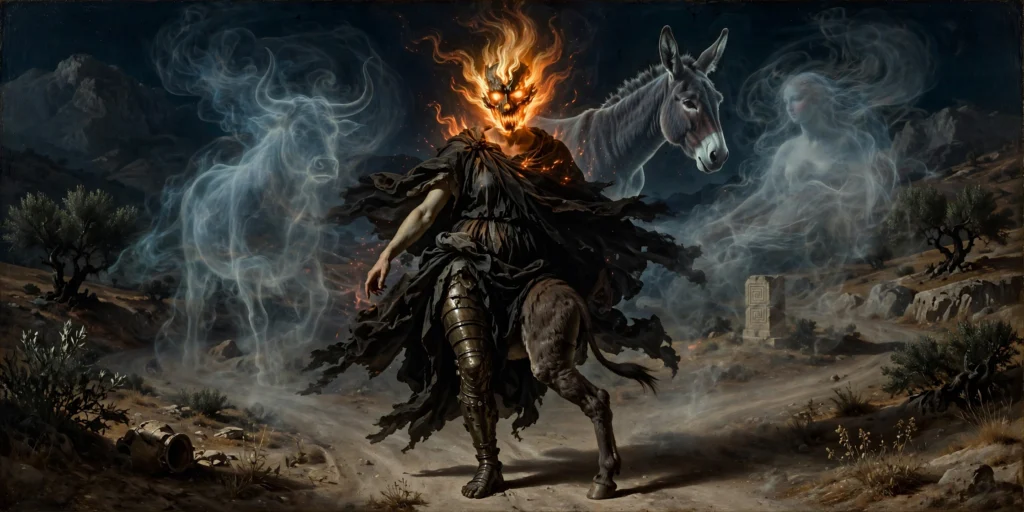
She has one leg of bronze and one leg of a donkey, according to most sources, though some say the second leg is made of cow dung instead. She has a face lit with fire. She can appear as a cow, a mule, a dog, a beautiful woman, an ordinary stone, and she can move between these forms quickly enough that a traveler who sees a beautiful woman waiting at a crossroads may find, by the time he has crossed to her, that she has already become something else. She feeds on young men, and the ancient descriptions of exactly how she feeds, the draining of blood, the consumption of flesh, the seduction that precedes both, describe a being modern readers would immediately recognize as a vampire, though the Greeks who feared her had no such word available to them.
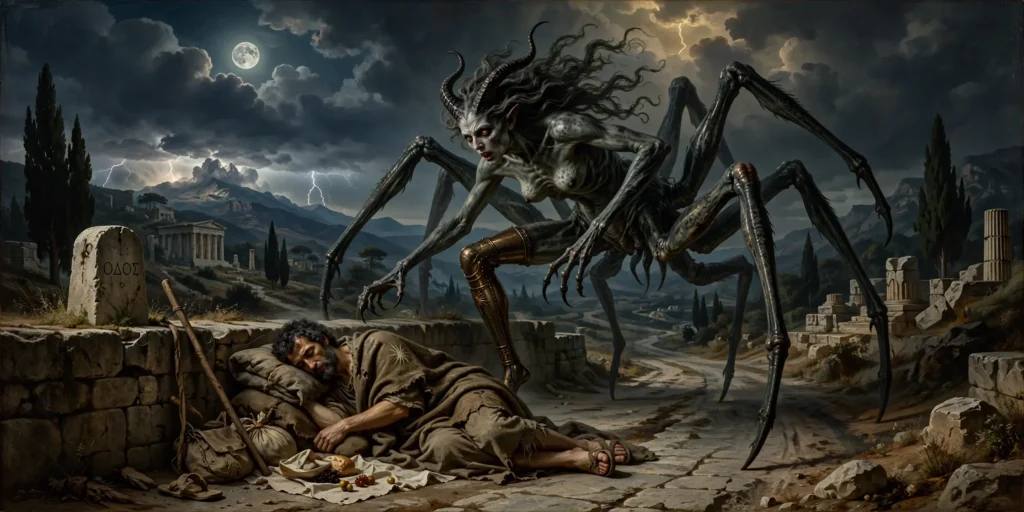
She is sent by Hecate. Or she is Hecate herself, in one of the goddess’s own transformable guises. Or, in one late and characteristically strange tradition, she is Hecate’s daughter, fathered by the shadowy spirit Mormo, a demigoddess in her own right who once made a catastrophic error of judgment. She came upon a man sleeping by the roadside and moved to attack him, not recognizing that the sleeper was Zeus, king of the gods. No source records what happened to her afterward. But the structure of the story tells you everything you need to know about what the Empousa actually is: a being whose entire power depends on failing to recognize what stands in front of her, who once aimed that power at the single most dangerous target the cosmos contained, simply because in the dark, on a quiet road, he looked like anyone else.
The ancient sources cannot agree on her parentage. The uncertainty is not a gap in the record. It is the point.
A monster with a stable form can be catalogued, anticipated, prepared for. The Empousa’s power is instability itself: she is whatever the dark road requires her to be, in order to produce the exact quality of fear that belongs to Hecate’s own domain, the threshold, the crossroads, the night.
The Name and Its Uncertain Origins
The name Empousa appears in the Greek record from at least the fifth century BCE, when Aristophanes used it in two of his surviving comedies. Its etymology is genuinely uncertain, and modern scholarship now treats it as presumably pre-Greek: older than the language that eventually housed it, a name that may have entered Greek folk religion from a substrate culture predating the Hellenic settlement of the Aegean.
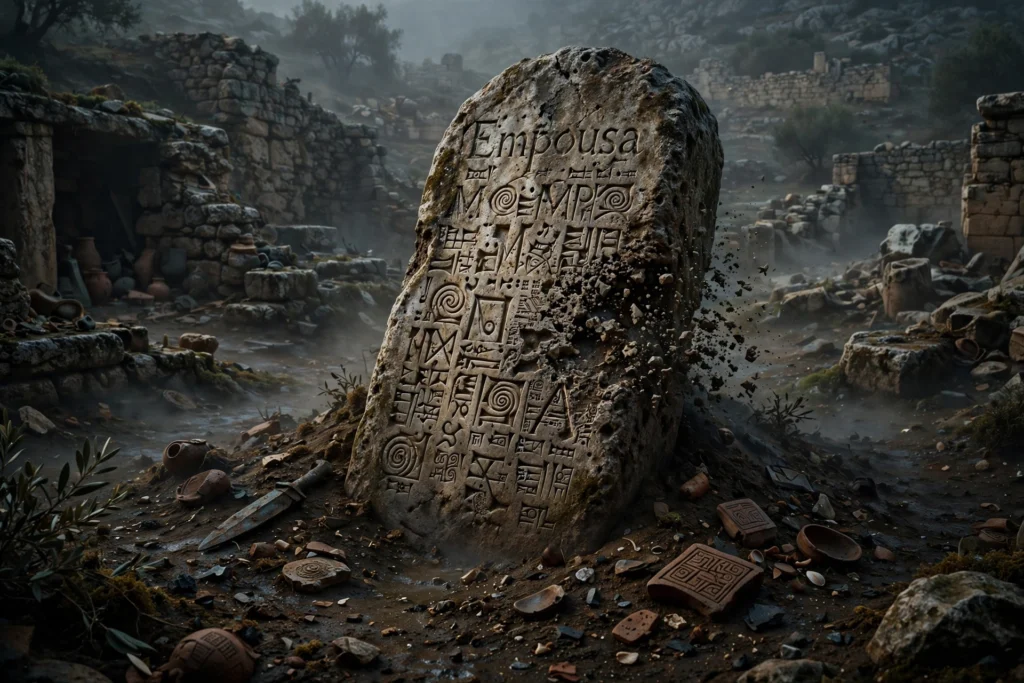
The Suda, the vast tenth-century Byzantine encyclopedic lexicon that preserves an enormous amount of otherwise-lost ancient material, offers its own explanation: the name derives from the phrase heni podizein, to move on one foot, a direct reference to the creature’s mismatched legs. The Suda also preserves a second, competing explanation within the same entry, that the name came from her habit of appearing suddenly out of dark places to the initiated. Whether either etymology reflects the word’s genuine origin, or whether both are the kind of folk etymology later compilers invented to explain a word whose real origin had already been forgotten, is a question that remains unresolved. The same entry records two further epithets for her, drawn from her most consistent physical feature: Onokole and Onoskelis, both meaning roughly donkey-legged, and a third name, Oinopole, the wine-seller, whose connection to her character is less immediately obvious and has never been fully explained.
What is clear is that the Empousa did not originate within the Olympian system. The gods of Olympus, however terrifying their capacity for punishment, operate inside a comprehensible framework of divine authority and motive: you may not survive an encounter with Apollo’s arrows, but you can at least understand why they were loosed. The Empousa belongs to a different stratum of Greek religious imagination entirely, the daimones, supernatural beings occupying the space between gods and mortals, active in the marginal territories where Olympian authority gives way to something older and considerably less organized. The Greeks themselves never settled on a single fixed word for this category of being. They were reaching, the way every culture reaches, for vocabulary adequate to something that resisted clean classification from the start.
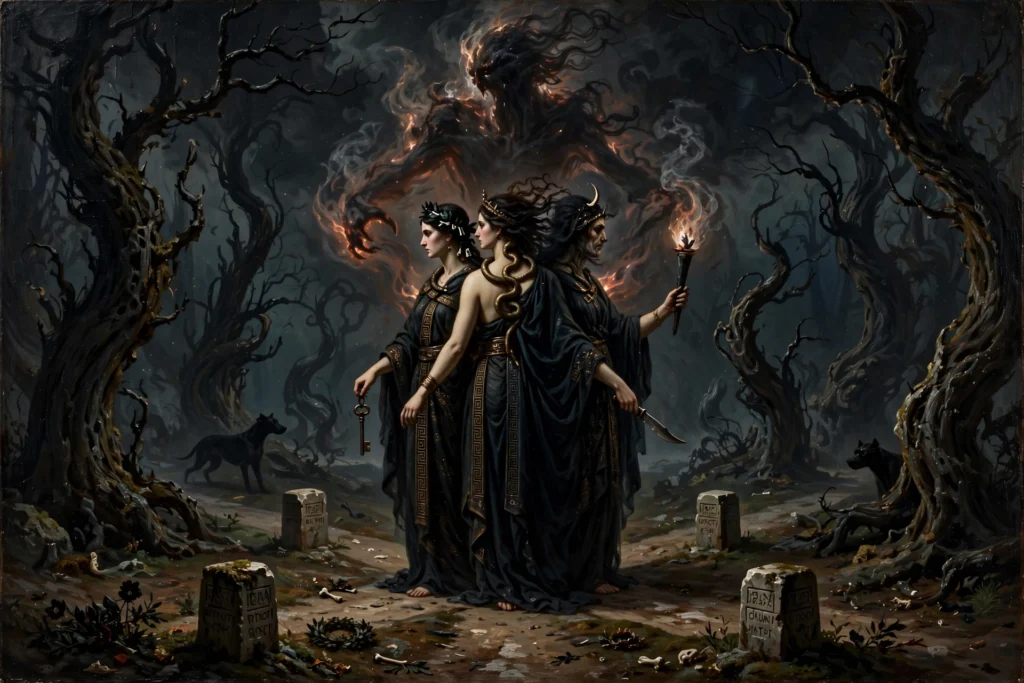
She appears in the sources as part of Hecate’s retinue, one of the beings that accompany the goddess of the night along the dark roads and crossroads of the Greek world. But the relationship is more entangled than simple service. A fragment from a lost Aristophanes play, the Tagenistae, preserved in an ancient commentary, suggests the Empousa was not merely sent by Hecate but was Hecate herself, appearing in one of the goddess’s own transformable forms. A separate scholiast commenting on the Frogs takes the opposite position: the Empousa is a being dispatched by Hecate, distinct from the goddess, entirely under her command. Neither reading displaced the other. Both survived side by side in the ancient tradition, an unresolved theological question about where a goddess of the threshold actually ends and the creature she sends through it begins. If Hecate’s own domain is the space where identities blur and forms shift, then the being most characteristic of that domain would naturally share something of the goddess’s own indeterminate nature.
What the Empousa Looked Like
The physical descriptions preserved in the ancient sources share a particular quality of grotesque inconsistency that reads as deliberate rather than confused.
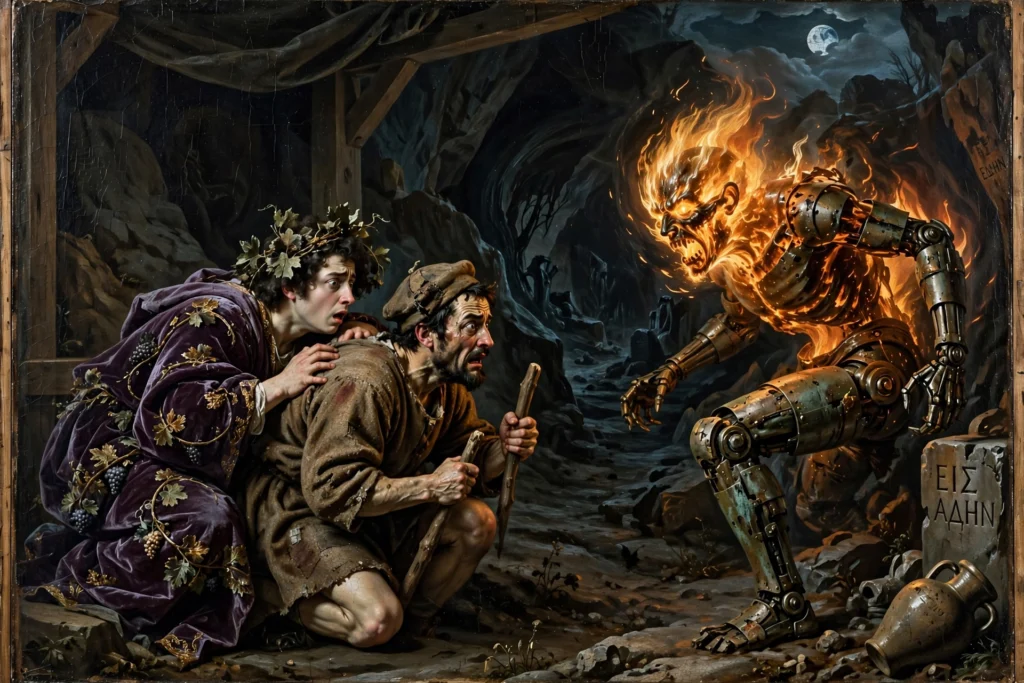
Her legs are the most stable feature across the sources, and even here the details disagree. Aristophanes, in the Frogs, gives her one leg of bronze and one of cow dung. Other sources give the second leg as that of a donkey or an ass instead. Her face is consistently described as blazing with fire, a detail preserved in the single most specific ancient account of a direct encounter, the scene in Aristophanes’s comedy in which the god Dionysus and his slave Xanthias, traveling to the underworld, encounter something terrifying on the road in the dark.
Beyond these relatively stable features, her appearance is genuinely fluid: a bull, a mule, a beautiful woman, a dog, an ordinary stone by the roadside. These were never understood as separate monsters. They are the same being in different presentations, chosen, it seems, according to what each specific encounter requires: the bull for raw intimidation, the mule for confusion and mockery, the beautiful woman for seduction and the particular trap desire sets, the dog for an approach that does not immediately register as a threat at all, the stone for the complete disappearance of any visible presence into the ordinary landscape.
This last transformation is the most unsettling of all. A creature capable of becoming a stone on a road is a creature potentially present on every road, indistinguishable from the ordinary world for as long as she chooses to remain so.
Aristophanes Knew Her Face Was Funny and Terrifying at Once
The earliest and most detailed ancient encounter with the Empousa survives in a comedy, and this matters more than it might first appear.
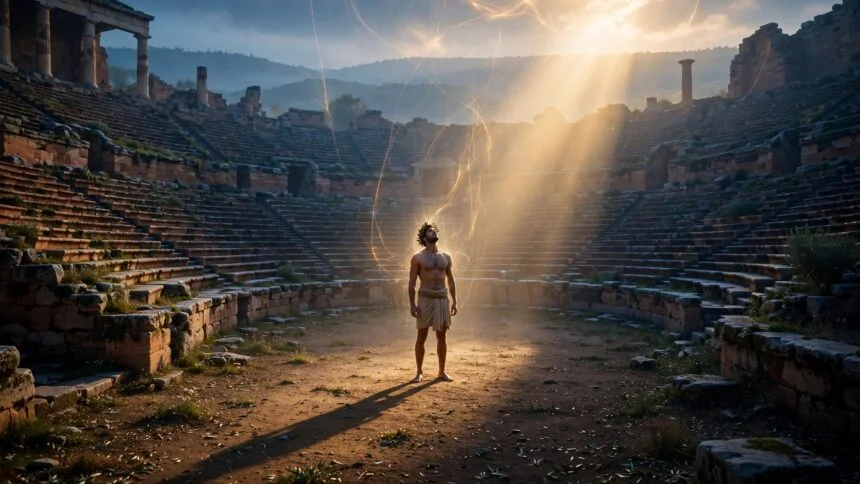
In the Frogs, performed in 405 BCE, Aristophanes sends the god Dionysus and his slave Xanthias down to the underworld on a comic errand. Their route requires crossing through the same borderland territories Hecate’s beings inhabit. Xanthias hears something behind them first. Then sees something. His description accumulates in real time: a bull, then a mule, then the loveliest girl he has ever seen, then a dog. He confirms the mismatched legs, one of bronze. He reports the blazing face. Dionysus, terrified, recognizes exactly what is being described.
What follows is played entirely for comedy: Dionysus hides behind Xanthias, then reverses their positions, then hides again, the god of ecstatic release reduced to undignified scrambling by something arriving from outside his own Olympian order. The humor lives in the cowardice of a god confronted by exactly the kind of force his own domain is supposed to command. But Aristophanes was not writing a myth textbook for a classroom. He was writing for an Athenian audience who would only have laughed at this scene because the Empousa was already a genuine object of folk fear, not a literary invention performing fear for the first time. A culture cannot satirize a dread its audience does not already carry.
The comic treatment tells us something real about the Empousa’s place in ordinary Athenian life. She was believed in enough to be genuinely frightening and familiar enough to be openly mocked in the theater of Dionysus itself, at his own festival. She occupied the specific register of folk fear that works on a child while still allowing an adult to acknowledge its absurdity without ever fully shaking the discomfort underneath. The same mismatched legs said to have drained the blood of young men were, in the right hands, on the right stage, a punchline the whole city could laugh at together.
Philostratus and the Two Encounters
The fullest ancient engagement with the Empousa comes from a very different register entirely: the Life of Apollonius of Tyana, written by Philostratus in the early third century CE, a lengthy account of the travels of Apollonius, a Neopythagorean philosopher and reputed miracle-worker who lived in the first century CE. What the text actually preserves is not one encounter but two, in different books, with two different outcomes, and later retellings have often blurred the pair into a single scene. Philostratus himself kept them separate.
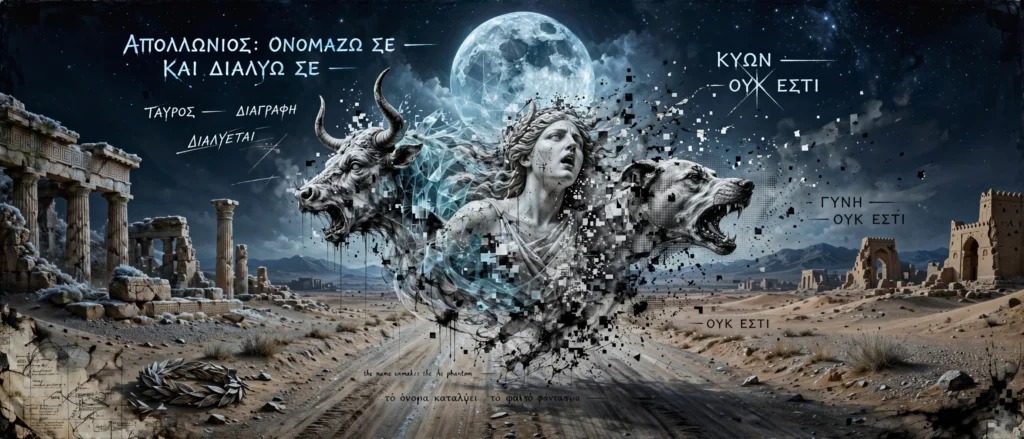
The first encounter occurs during Apollonius’s journey from Persia toward India, traveling by moonlight through remote terrain. A phasma, a phantom, appears before the party, changing rapidly from one form to another and occasionally vanishing altogether. Apollonius recognizes it immediately for what it is and responds with a method that has no parallel anywhere else in Greek monster-lore: he heaps abuse on it directly, and instructs his companions to do the same, insisting this is the correct remedy for exactly this kind of visitation. The phantom flees, shrieking, the way ghosts do.
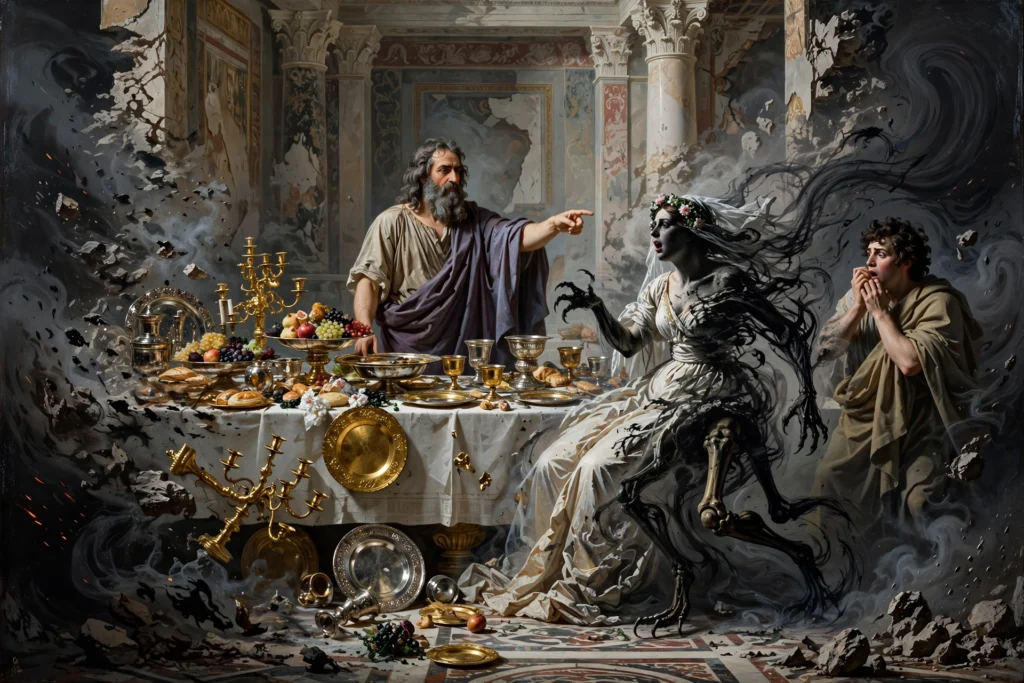
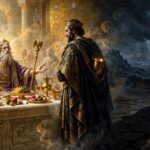
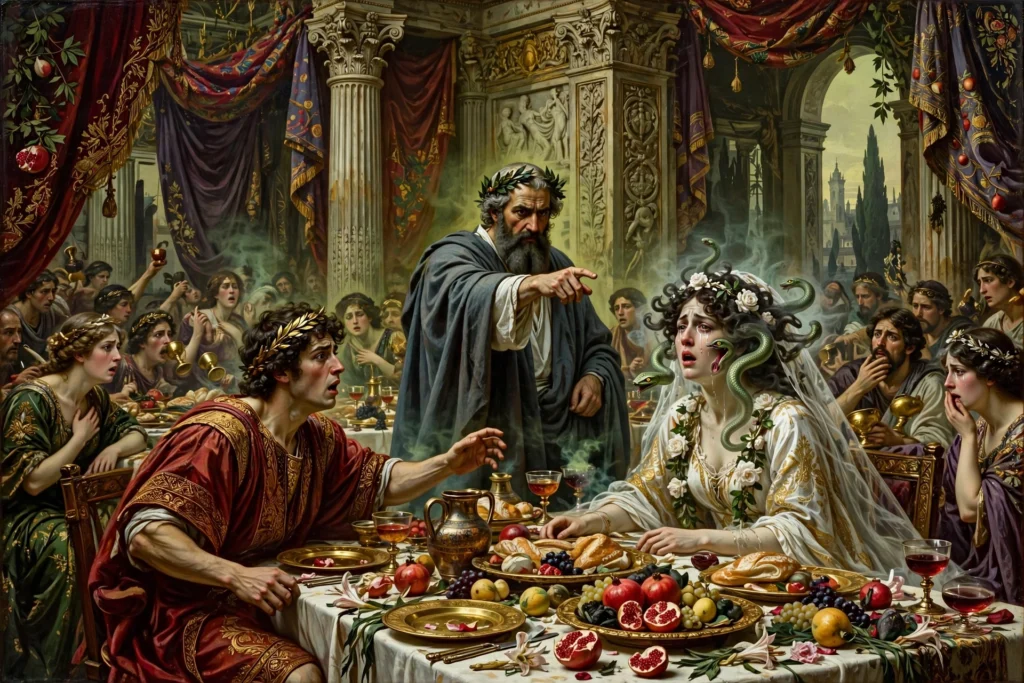
The second encounter is the far better known of the two, and it belongs to a different book of the same work entirely, set later, in Corinth. A young philosophy student named Menippus, walking alone toward Cenchreae, meets a striking woman who takes his hand, declares she has loved him for a long time, and invites him to her house that evening. He is a strenuous philosopher in general, Philostratus notes, but not entirely immune to the tender passion, and he accepts. He becomes a regular visitor, still unaware that what he is visiting is not, in the ordinary sense, a woman at all. Apollonius, examining Menippus the way a sculptor examines a subject, recognizes the pattern immediately and confronts the bride directly at their own wedding feast. She denies what she is, then weeps, then finally confesses under sustained questioning: she has been fattening Menippus with pleasure specifically in order to consume him afterward, since the blood and flesh of the young and beautiful, she explains, are purer and stronger than any other kind. The feast dissolves. The gold and silver plate dissolves. The house itself dissolves. Everything Menippus had believed was substantial had been, from the beginning, phantom.
Philostratus’s own text is notably loose about which name belongs to this second creature. In places he calls her an Empousa. Elsewhere in the same work he groups Empousa, Lamia, and Mormolykeion together as effectively interchangeable terms for the same underlying category of being, the way an ordinary person of his own day might use any of the three words without distinguishing carefully between them. What the text is clear about is the mechanism of her defeat: not insults hurled at a shrieking phantom on a moonlit road, but sustained, direct interrogation, forcing the disguise to collapse under the weight of its own contradictions until the creature has no choice left but confession.
Two encounters, two methods, one underlying principle common to both. In the Persian desert, abuse and mockery broke the phantom’s hold. In Corinth, patient exposure did the same work more slowly. Unlike most Greek monsters, defeated by the sword, by cunning, or by the direct intervention of an allied god, the Empousa in both of Philostratus’s accounts is undone by something closer to clear sight itself: naming her correctly, refusing the illusion its due credit, and declining to let uncertainty about what stands in front of you pass for acceptance of it.
Apollonius did not need a sword in either encounter. He needed philosophical clarity, the capacity to see the world as it actually was rather than as a shapeshifting phantom had chosen to present it. That was the only weapon that worked, twice, in two different countries, against two different appearances of the same underlying threat.
The Empousa, the Lamia, and the Mormo
The Empousa did not exist in isolation within Greek folk religion. She belonged to a cluster of related female nocturnal predators the ancient world already tended to group together, and that modern scholarship now recognizes as forming a genuinely coherent category of Greek folk monster.
The Lamia, in the fuller mythological tradition, was a queen of Libya whose children were taken from her by a jealous Hera, and whose grief drove her to steal and devour the children of other women in turn. She became, in folk tradition, a whole category of being rather than a single figure: the lamiai, female monsters who lured the young and consumed them. The Mormo was a frightening ghost-woman invoked specifically to threaten disobedient children into behaving, the direct ancestor of every later bogeyman a parent has ever used to get a child to bed on time. One later tradition, drawing these separate strands together, makes Mormo the Empousa’s own father and Hecate her mother, the predatory creature born directly from the union of the goddess of the threshold and the oldest bogey of childhood fear.
Philostratus used empousa, lamia, and mormolykeion largely interchangeably, as noted above. The Suda, compiled roughly seven centuries later, treated the three as a genuine family with overlapping definitions rather than as sharply distinct creatures. The consolidation only accelerated through the medieval period: in modern Greek folk tradition, lamia became the umbrella term for nocturnal female predators generally, gradually absorbing both the Empousa and the Mormo into a single, broader category.
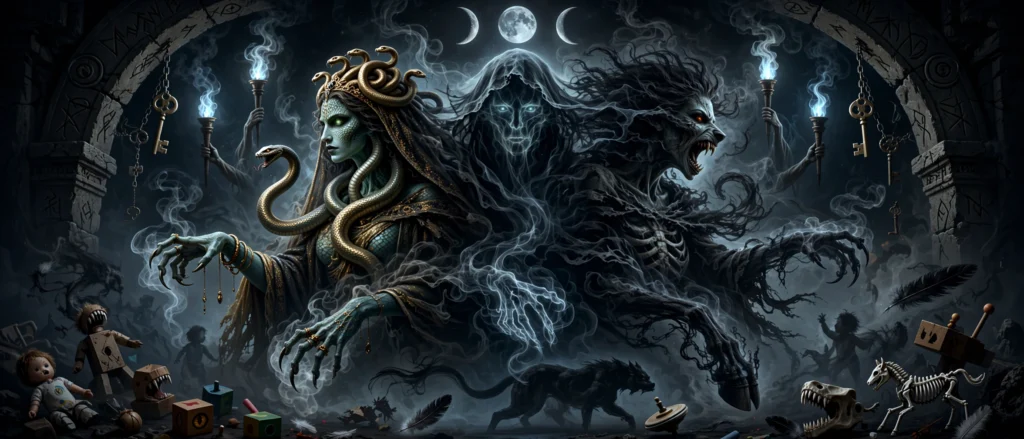
The vrykolakas, the Greek revenant that eventually became the modern Greek vampire, owes part of its own genealogy to this same cluster, though the word itself is a Slavic loan, from vurkolak, that eventually displaced the older native Greek terms in most regional speech. The name changed. The underlying function persisted almost unaltered: a being that feeds on the living, crosses the boundary between death and life, and can be repelled by specific, culturally recognized means.
Keats Found Her Worth a Poem
The Empousa’s literary afterlife runs directly through one of the major works of English Romantic poetry.
John Keats, in 1819, during the same extraordinarily productive period that produced his great odes, wrote Lamia, a narrative poem drawing directly on this same mythological cluster: a serpent-woman, beautiful and apparently entirely human, who seduces a young man named Lycius and is exposed at their own wedding feast by the philosopher Apollonius, the very same Apollonius of Tyana whose Corinthian encounter Philostratus had recorded some sixteen centuries earlier. In Keats’s telling, the unmasking destroys Lamia outright and kills Lycius too, undone by the shock of finally seeing clearly what he had loved.
Keats inherited, whether consciously or not, the same structural logic that runs through both of Philostratus’s ancient episodes: the philosopher’s clear sight as the single force capable of collapsing the creature’s power, recognition itself functioning as the weapon. But he gave the ancient daimon a Romantic interiority the ancient sources never once granted her, a genuine capacity for love that turns her unmasking into tragedy rather than simple triumph. The Empousa and her cousin Lamia survived into the nineteenth century not merely as folklore preserved in dusty compendia but as serious literature, because the underlying psychological structure, the seductive uncertainty of the threshold, the catastrophe of finally seeing clearly, remained exactly as urgent to a Romantic poet writing in 1819 as it had been to a fifth-century Athenian comedian or a third-century Neopythagorean biographer.
Hecate Trioditis and the Logic of the Triple Form
Hecate herself was worshipped, at crossroads across the Greek world, under the specific title Trioditis, she of the three roads, and her cult images at these sites were carved not as a single figure but as three, standing back to back, facing outward in three directions at once, so that a traveler approaching from any of the three converging roads met a goddess already looking directly at him.
This triple form was never simply an artistic convention for representing a goddess of crossroads efficiently. It was itself a theological claim about what a crossroads actually is: not one location but three futures held in unresolved tension at a single point, three directions equally available, equally uncommitted, until the traveler’s own choice collapses the multiplicity into the single road he will actually walk. Hecate Trioditis watches all three roads simultaneously because the crossroads itself has not yet decided which road it will become for the person standing at its center.

The Empousa’s own instability reads, against this background, as a mobile version of the same principle carried out along a single road rather than at its meeting point. Where the goddess stands still at the crossroads and holds three directions open at once, the creature she sends moves along whichever direction has already been chosen and holds open, instead, the question of what exactly waits at the end of it: woman, or bull, or dog, or stone, three or four or five possibilities collapsed only at the final moment of encounter, exactly as the crossroads itself collapses only at the final moment of choice. Hecate is multiplicity fixed in space. The Empousa is multiplicity set loose in time, and time is a harder thing to prepare for than space, because a traveler can see three roads diverge ahead of him and choose deliberately, but he cannot see a single figure approaching him on the one road he has already chosen change what it is before it arrives.
This is very likely why so many ancient sources kept the question of the Empousa’s exact relationship to Hecate permanently unresolved, messenger, or alternate form, or daughter. A being whose entire nature is to hold multiple identities in suspension until the moment of encounter is not a being whose own relationship to her source goddess should be expected to resolve cleanly either. The ambiguity surrounding what the Empousa is, in relation to Hecate, is not a failure of the mythological record to settle its own details. It is the mythological record behaving exactly the way the goddess of the threshold would require it to behave.
What Hecate’s Messenger Was Actually Doing
Return to the question of what the Empousa is actually for, within the wider theological framework of Hecate’s own domain, and the creature becomes considerably more coherent than a simple catalogue of frightening attributes would suggest.
Hecate governs the threshold: the crossroads, the space between worlds, the exact moment of transition from one state to another. The crossroads is where the Empousa appears, and this is not coincidence. It is the physical location where the world opens into multiplicity and a traveler must commit to a single direction, the point of maximum vulnerability in the Greek understanding of any journey: the moment of being most between rather than most somewhere, most exposed to whatever moves through the dark along the roads that meet there.
Her shapeshifting is pedagogical, in the specific sense that Hecate’s whole territory is pedagogical: the threshold teaches by exposing the traveler to exactly what they thought they already knew. The beautiful woman is what the young man hoped to find. The bull is what the confident traveler feared he might meet instead. The dog is what neither one expected at all. The stone is the lesson that the presence had been there the entire time, indistinguishable from the ordinary world until it finally chose to reveal itself.
Even the Empousa herself was never immune to this same lesson. If the tradition making her Hecate and Mormo’s daughter is right, and she once mistook the sleeping Zeus for an ordinary man, then the creature who exists to expose mortal misrecognition was herself capable of exactly the same failure, at the single highest possible stakes available anywhere in the cosmos. The threshold does not discriminate between whoever is testing it and whoever is being tested in turn. It is dangerous in both directions at once.
Apollonius survived both his own encounters because he recognized what stood in front of him each time. The young men who did not survive, in the wider folk tradition, did not fail because they were weak. They failed because they saw a beautiful woman waiting at a crossroads after dark and never once stopped to ask whether a beautiful woman waiting at a crossroads after dark was actually what she appeared to be.
She Was Also, Occasionally, Mildly Absurd
This needs to be said plainly, because the ancient tradition itself was honest about it, and that honesty is part of the Empousa’s genuine character rather than a flaw in the record.
A leg made of cow dung is funny. No amount of scholarly apparatus can make a cow-dung leg genuinely terrifying on its own, and Aristophanes clearly knew this perfectly well. Misbehaving children were threatened with a visit from the Empousa in more or less the same register later cultures would use for the bogeyman. She occupied precisely the zone of folk fear that works on a child while still letting an adult acknowledge the absurdity out loud, without the acknowledgment ever quite dissolving the underlying discomfort completely.
And she could be routed by insults, in the Persian desert at least, according to Philostratus. Shouting abuse at her caused her to shriek and flee outright. This is not the behavior of a creature that demands to be taken with total seriousness at every turn. It is the mechanism of a folk fear the culture had genuinely learned to manage, to domesticate to some real degree, to fold into its wider repertoire of survivable horrors, the kind that could be laughed at precisely because laughing at them was, in the end, one of the few things that actually worked.
The Empousa is both genuinely disturbing and, in the right light, faintly ridiculous, and holding both of those things true at once is a more honest account of how nocturnal folk fear actually operates than most monster mythology ever manages to give you.
She Is Still Out There
The dark phase of the moon, Hecate’s own particular time and the period when the Empousa’s power was understood to reach its greatest strength, still produces exactly the same quality of darkness on Greek roads it has always produced. The crossroads where three roads meet, which the ancient Greeks understood as the single point of maximum liminal danger anywhere in the landscape, still exist throughout Greece in precisely the geographical form they always have.
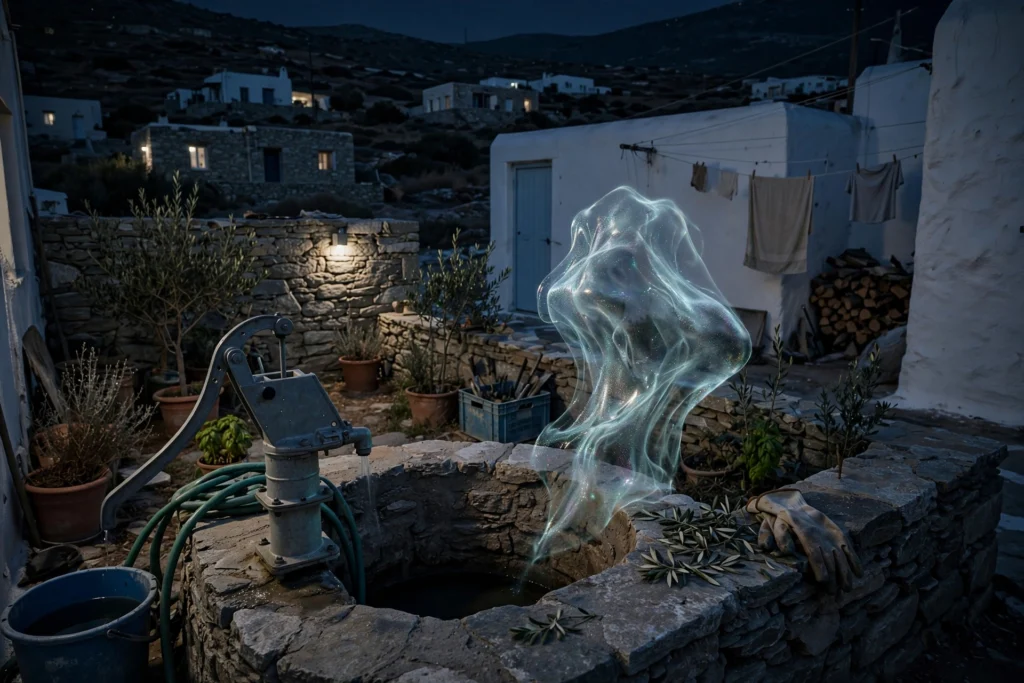
The name itself has mostly gone quiet. The anthropologist Charles Stewart’s 1991 study of Greek village religion, based on fieldwork conducted on the Cycladic island of Naxos, documents the wider modern category the Greeks call exotika, mermaids, dog-form creatures, and a whole range of malevolent beings that occupy exactly the marginal locations, outlying streams, wells, remote roads, that once belonged to figures like the Empousa. Stewart’s fieldwork found these beliefs alive and structurally coherent in contemporary village cosmology, tightly interwoven with Orthodox religious practice rather than existing as some separate, residual folklore. The specific ancient name Empousa is rarely, if ever, the word a contemporary villager actually reaches for. But the creature described under other names, the lamia of the modern village tradition above all, the nocturnal female being encountered on dark roads, has not disappeared at all. The Greek folk imagination has stayed genuinely continuous in this respect in a way the literary tradition has not: the ancient monsters did not simply die when the ancient world ended. They merged with the medieval demonology that overlaid the older system, took on new names to fit the newer vocabulary, and kept walking the same dark roads in whatever body the culture required them to inhabit next.
Hecate sends something ahead of her into the night.
Not as a weapon exactly, and not as a simple messenger either. As a demonstration: the embodied argument for paying real attention at the threshold, the physical evidence that a crossroads is never neutral ground, the creature that proves, by her sheer capacity to become anything at all, that accepting surface appearances at the exact moment of decision is not philosophy. It is philosophy’s absence.
The Empousa is the shapeshifter who reveals the shape beneath every shape. Hecate’s domain was the in-between, and the in-between admits no fixed forms at all. The creature she sent through it was, appropriately, necessarily, irreducibly multiple.
Bull, mule, beautiful woman, dog, stone. Bronze leg, cow-dung leg, blazing face, a shriek in the dark the moment she is named for what she is. The god of wine cowered from her on his own road to the underworld. The philosopher drove her from a Persian roadside with nothing but abuse, and exposed a second one in Corinth with nothing but patient questioning. A poet, sixteen centuries later, gave her tragedy she had never once been granted in antiquity. And in one telling, she herself once reached for a sleeping man on a dark road and discovered, far too late, that he was the king of the gods.
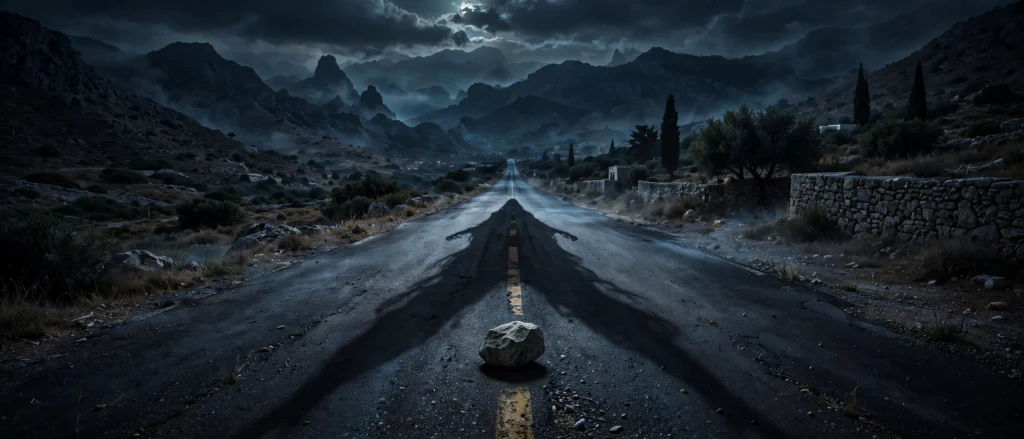
Stand at a Greek crossroads after dark, where three roads meet on a night the moon has abandoned, and something about the particular quality of that darkness will tell you exactly why the ancient world gave a name to what it felt there.
The Empousa does not need you to believe in her. She only needs you to look away for a moment.
At Olympus Estate, Mythic Essays moves through the deeper currents of the Greek tradition. Most Greek monsters have a fixed shape. The Empousa does not. She has one leg of bronze and one of a donkey or of cow dung, a face lit with fire, and the ability to become a bull, a mule, a beautiful woman, a dog, or an ordinary stone. Aristophanes staged her for laughs in the Frogs in 405 BCE, and the laughter only worked because the fear underneath it was already real. Philostratus records two separate encounters with her kind, one on a moonlit road in Persia driven off with insults, one in Corinth exposed by patient interrogation until the whole illusion, feast, house, and bride together, dissolved into nothing. Keats gave her cousin Lamia a Romantic tragedy sixteen centuries later. She is sent by Hecate, or she is Hecate, or she is Hecate’s own daughter by the spirit Mormo, and the ancient sources never resolved which. That unresolved uncertainty is not a flaw in the record. It is exactly what she is.