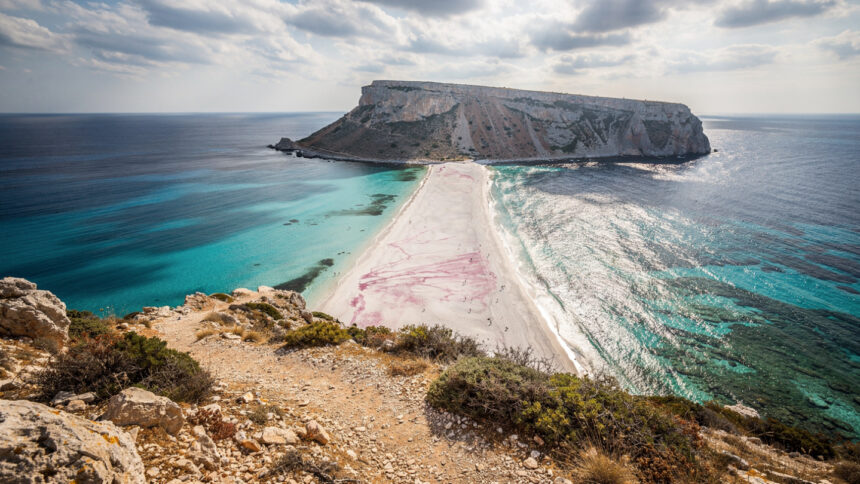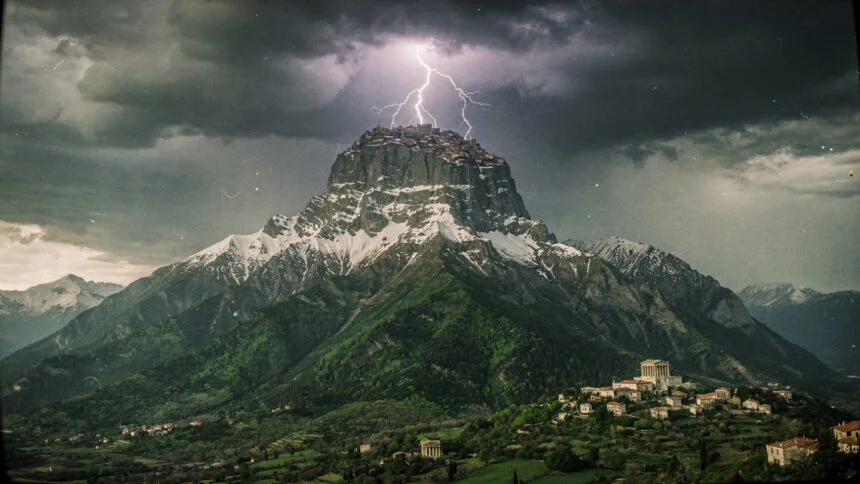
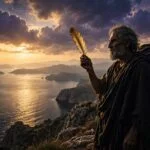
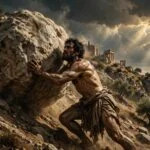
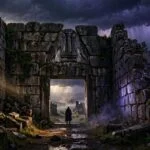
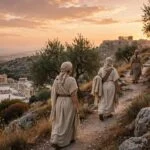
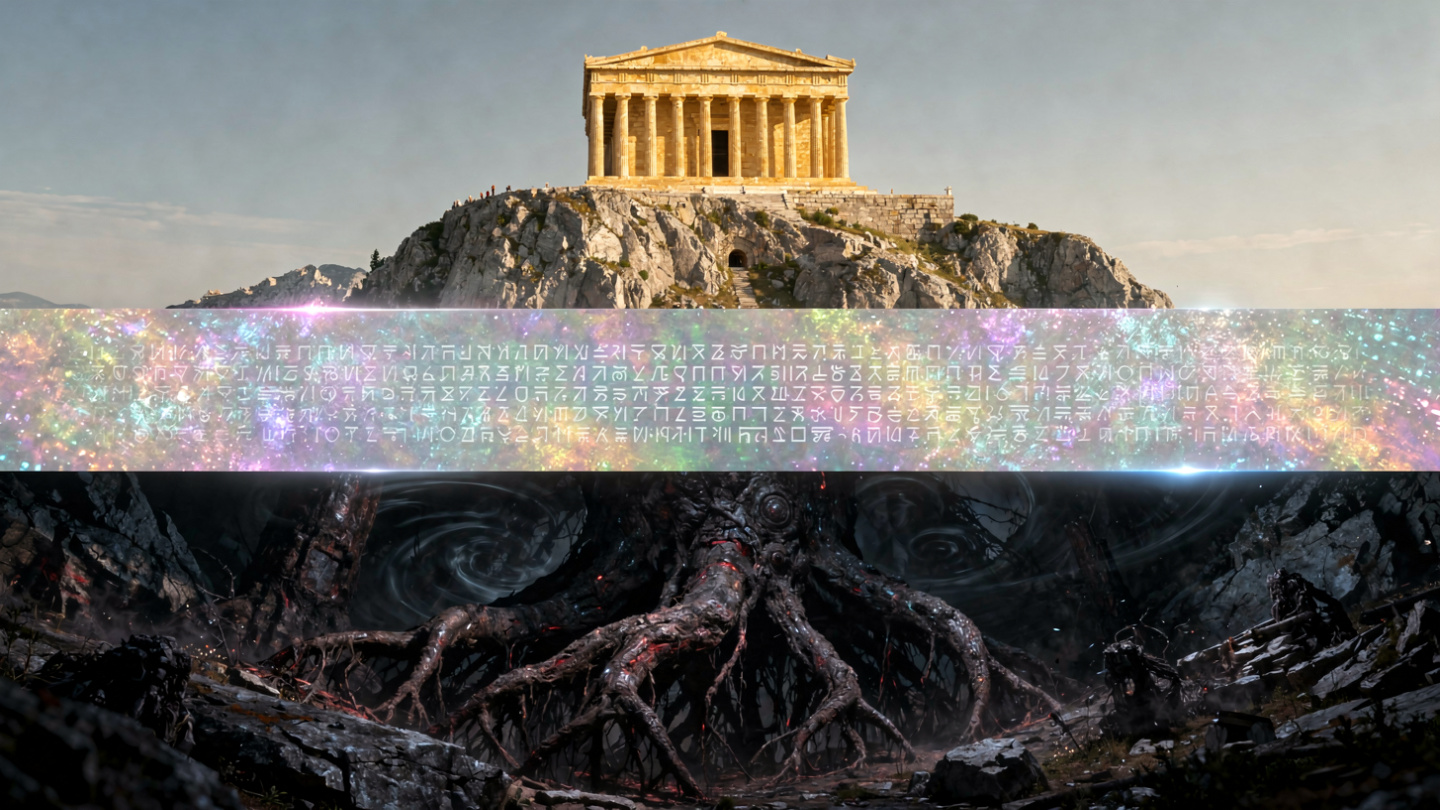
The map of sacred Greece has two layers.
The visible layer is the one that the standard itinerary follows: the Parthenon for Athena, the sanctuary at Delphi for Apollo, the Heraion at Olympia for Hera, the Poseidon temple at Sounion above the Aegean. This is the map of the twelve Olympians, the divine administration that Zeus established after the Titanomachy and that the Greek world of the historical period honored in its major sanctuaries and its civic religion.
The invisible layer is older. It is the map of the generation that preceded the Olympians, the Titans whose reign Hesiod’s Theogony places before the ordering of the cosmos into the structure that the Olympian mythology assumed and that the visible sacred geography expresses. The Titans were not simply the bad guys who lost the divine succession war. They were, in the theological understanding of the Greek heritage, the undifferentiated cosmic forces whose subordination by the more specialized Olympian powers was the creation of the cosmos as a livable and comprehensible place: the movement from the Titanic to the Olympian was the movement from raw undifferentiated power to the articulated functions that made the world navigable.
The sacred sites that preserve the trace of the Titanic layer, the caves and the gorges and the ancient springs and the coastal promontories that the pre-Olympian heritage associated with the Titans before Apollo and Athena and Poseidon arrived to reorganize them, are among the most atmospherically powerful in Greece precisely because they carry the quality of something older than the Olympian order. They were not built. They were recognized as already being what they were before the human heritage arrived to name them.
What follows is a journey through that older map, organized around the Titans whose heritages are most directly legible in the landscape.
Crete | Cronus and the World Before Zeus
The Cave of Zeus on the Dikte massif in eastern Crete, the Dikteon Andron that the mythological tradition identified as the birthplace of the Olympian king, is simultaneously the most visited Titanic site in Greece and the site most often understood as an Olympian one. The cave is famous as the place where Rhea hid the infant Zeus from his father Cronus, who was swallowing his children as they were born in the parental dread of the prophecy that one of them would overthrow him.
What the standard account of the site as the birthplace of Zeus obscures is the Cronus dimension: the cave is the place that exists because Cronus’s power required circumvention. The theology of the Cronus tradition is the theology of a cosmic order that devours its own production, that cannot permit what it has created to mature and supersede it. Cronus swallowed his children not out of malice but out of the kind of fear that attaches to power that has been gained through the displacement of a predecessor: he knew that what had happened to Uranus could happen to him, and his response was the response of a cosmic principle that has not yet learned to allow what it generates to develop independently of itself.
The cave in the mountain that Rhea found to hide the infant Zeus is the geographical expression of the Titanic cosmos’s one weakness: there are places within it that it cannot fully control, and it is in those places that the new order gestates. The cave, the interior of the mountain, the darkness that is not the darkness of Kronos’s undifferentiated power but the protective darkness of Gaia’s body sheltering what Cronus would destroy, is the place where the Olympian order begins.
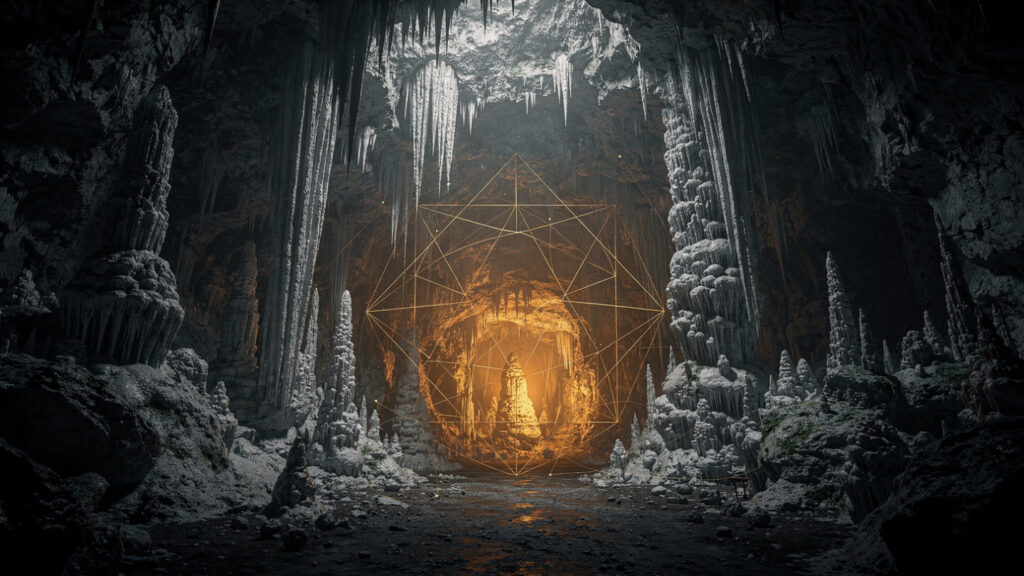
Visiting the Dikteon Cave with this dimension in mind changes the experience of the descent into the cave: the stalactites forming over geological time, the chamber where the offerings to the infant Zeus were deposited across the Bronze Age and the Minoan period, the quality of the cave’s air and darkness and enclosure, are not simply the decorative setting for a charming mythological story. They are the physical expression of the moment in the cosmic narrative when the Titanic order’s totality was first interrupted.
The Idaion Andron on the summit plateau of Mount Ida, the alternative cave that some ancient sources name as the birthplace of Zeus and that others identify as the cave where the Kouretes armed dancers made noise to drown the infant’s cries from Cronus, is less accessible than the Dikteon Cave but carries a more austere quality that the higher altitude and the more remote approach produce: the mountain’s sacred character in the Minoan and Mycenaean periods, documented in the bronze shields and bronze drums and figurines deposited in the cave across the second millennium BCE, predates the Zeus mythology and reflects the Cretan tradition’s engagement with the mountain as a sacred space in its own right.
The Cretan landscape’s association with the Titanic generation extends beyond the Zeus birth caves: the island’s position at the southern edge of the Aegean, its distance from the Greek mainland, and the antiquity of its agricultural and palace civilizations gave it the character of a place that preserved the pre-Olympian order in a form that the mainland had already superseded. The Minoan civilization that the Knossos Palace represents, which was developing its sophisticated culture in the period that the mythological tradition places as the age of the Titans, is the historical culture that the Titanic mythology of Crete was built around.
Getting there: The Dikteon Cave is accessible from the village of Psichro at the edge of the Lasithi Plateau in eastern Crete. The descent into the cave requires approximately twenty minutes on foot and the cave floor is uneven: bring shoes with grip and allow your eyes to adjust as the electric lighting is minimal in the lower chambers. The Lasithi Plateau itself, the high agricultural plain ringed by the mountains of the Dikte massif, is among the most complete examples of traditional Cretan upland agriculture accessible to the visitor, and the morning market at the village of Tzermiado is worth the arrival the evening before.
Delphi | Themis and the Oracle Before Apollo
The sanctuary at Delphi, one of the most visited archaeological sites in Greece and the site whose atmosphere of the mountain ravine with the Phaedriades cliffs above and the olive-filled valley below and the Gulf of Corinth in the distance manages to communicate something of its sacred character even under the conditions of the summer tourist density, was not always Apollo’s oracle.
Themis sat there first.
The heritage that preserves this, documented in Aeschylus’s Eumenides where the ghost of Clytemnestra invokes the Themis oracle as the predecessor of Apollo’s, and in Pindar and in the later mythographical heritage, is the heritage that the Delphi sanctuary had been a place of oracle before Apollo took it over, and that the oracle before Apollo was the oracle of Themis, the Titan of divine law and cosmic order. The sequence in some heritages placed Earth, Themis, and then Apollo in the Delphi succession, which encodes the theological argument that the oracle at Delphi was not simply a divine communications technology that Apollo happened to control but a kind of knowledge whose character differed depending on which divine principle was its source.
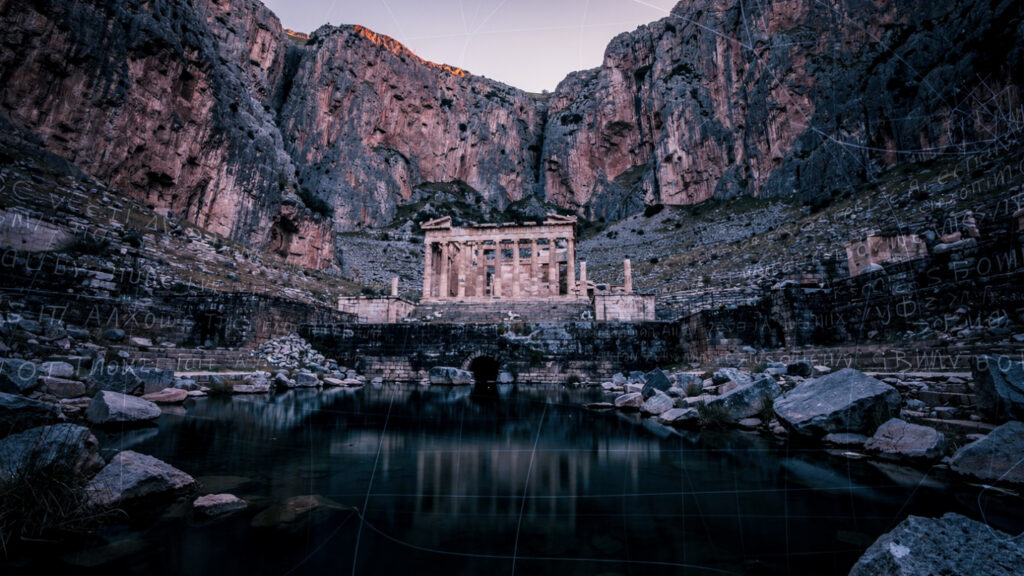
Themis’s oracle was the oracle of the natural law that underpinned the Olympian order: not the contingent will of a god but the structural necessity of what had to be. Themis was the Titan whose name meant divine law or established custom, and she was the mother of the Horai, the Seasons, and the Moirai, the Fates: the divine principles that governed time’s progression and the distribution of individual destinies within the overall structure of the cosmos. Her oracle at Delphi was therefore the oracle of the deep structure rather than the oracle of divine preference or divine instruction.
Apollo’s arrival at Delphi and his killing of the Python, the chthonic serpent that guarded the sanctuary’s prophetic spring, was the Olympian tradition’s account of how the older oracle was superseded by the newer: the chthonic serpent associated with the earth’s direct prophetic power was replaced by the more mediated prophecy of Apollo’s Pythia, the human channel through whom the god’s knowledge was transmitted in the form of the riddling ambiguous utterance that the historical Delphic oracle consistently produced.
Walking the Sacred Way of the Delphi sanctuary with this layered history in mind produces a different engagement with the site than the standard archaeological tour provides: the Treasury of the Athenians, the polygonal wall, the temple of Apollo, and the theater on the slope above all belong to the Olympian layer of the sanctuary’s history. The geography of the ravine, the Castalian Spring where the consultants performed their ritual ablutions before approaching the oracle, and the Corycian Cave above the sanctuary on the Parnassian slopes, all carry the trace of the older sacred tradition that preceded the sanctuary’s Apollonian organization.
The Corycian Cave, a large limestone cave on the high plateau of Parnassus above Delphi accessible by a walking path that climbs through the fir forest above the sanctuary, was sacred to Pan and the Nymphs and to the older earth powers of the mountain tradition: it is the dimension of the Delphi sacred landscape that the standard visit to the archaeological site does not reach and that the visitor who has time and the willingness to climb finds to be the most atmospherically powerful single site in the entire landscape.
Getting there: Delphi is three hours from Athens by bus from the Liosion terminal, or two hours by car via the Lamia highway. The site opens early and the atmosphere of the early morning in the sanctuary before the tour coaches arrive, the mist in the olive valley below and the Phaedriades cliffs in the first light above, is the visit that the photographs are attempting to capture and that the photographs cannot. Stay in Arachova the night before. The Corycian Cave requires a full morning’s walk and comfortable footwear: allow four hours round trip from the sanctuary.
Cape Sounion | Oceanus and the Edge of the World
The Temple of Poseidon at Cape Sounion, the white marble promontory temple on the southernmost point of Attica where the Aegean and the Saronic Gulf meet, is the Olympian site that most directly occupies a location whose pre-Olympian sacred character is still legible in the geography.
Oceanus, the Titan of the great world-river that the ancient cosmological tradition imagined encircling the earth, was the divine principle associated with the limit of the navigable world: the point beyond which the known sea gave way to the unknown outer water was the point at which Oceanus’s presence was most directly felt. Cape Sounion was that point for the sailors of the Saronic Gulf: the last land they would see as they set out south into the open Aegean, and the first land they would see as they returned from the south.
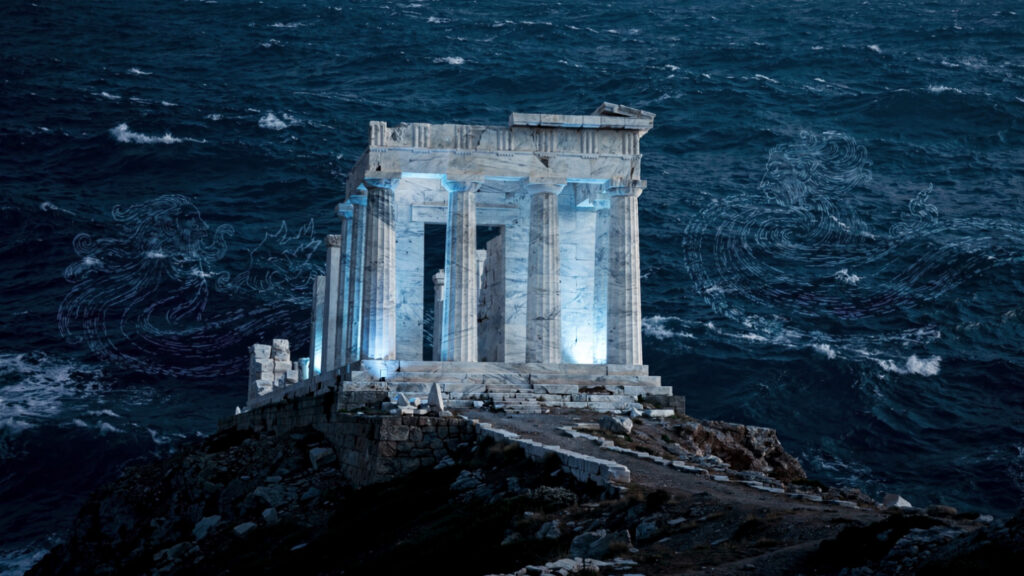
Oceanus in the Hesiodic heritage was the Titan who did not participate in the Titanomachy: he remained in his domain at the world’s edge while his brothers fought Zeus and lost, and his neutrality was the Titanic quality that allowed his heritage to survive the Olympian succession with less disruption than the other Titans experienced. The rivers and springs that were his children, the Oceanids and the river gods, populated the Greek landscape in the same way that the Olympian gods populated the sky and the sea and the underworld: they were the divine presences that the landscape’s water carried, and they were present wherever water moved through the earth.
The quality of the Cape Sounion location, the promontory dropping two hundred feet to the sea on three sides, the wind that the cape’s exposure to the open Aegean produces at almost every time of year, and the visibility of the horizon in every direction that the elevation and the exposure achieve, is the quality that made it the appropriate site for a sanctuary at the world’s edge. The Poseidon temple that now occupies it is the Olympian re-appropriation of a liminal geography that the pre-Olympian tradition had understood as the place where the human world encountered the cosmic boundary that Oceanus represented.
The columns of the Temple of Poseidon, sixteen of the original thirty-four surviving in the warm white of the Attic limestone that the centuries of Mediterranean light have bleached to something approaching alabaster, are best seen at the moment of the late afternoon when the western light comes across the Saronic Gulf and catches the column surfaces at the angle that reveals the texture of the stone. This is also the angle at which the sea turns the deep cobalt that the late afternoon Aegean produces in the summer months, and the combination of the white columns against the deep blue water and the open sky is the view that the ancient sailors who had been at sea would have seen as they rounded the cape and understood that they were almost home.
Byron carved his name in one of the columns. The carving is visible and should perhaps be understood as the final expression of the visitor’s impulse to leave a mark at the edge of the world, which is the impulse that the sanctuary at the edge of the world had always accommodated in the form of the votive offering.
Getting there: Cape Sounion is seventy kilometers south of Athens by the coastal road through Vouliagmeni and Varkiza, a journey of approximately ninety minutes in normal traffic and one of the most scenic coastal drives in Attica. KTEL buses run from Pedion Areos in Athens. The site is best visited for the afternoon and sunset: the late afternoon light on the columns and the sunset over the Saronic Gulf are the experiences the site provides and that the morning visit, facing the wrong light, does not.
Arcadia | Hyperion and the Landscape Before the Sun Gods
The highland plain of Arcadia in the central Peloponnese is the region that the European pastoral heritage, from Virgil’s Eclogues to the Renaissance’s nostalgic imagining of innocent nature, chose as its primary image of the world before civilization had arrived to complicate it. The Greeks understood the choice: Arcadia was the region that Hermes was born in, that Pan inhabited and haunted, and that the oldest of the Peloponnesian religious heritages associated with the period before the Olympian reorganization of the divine world had fully reached the mountain communities of the interior.
Hyperion, the Titan of light and radiance whose name meant “he who goes before” or “he who moves above,” was the divine principle associated with the quality of light before Helios the sun god took over the function of driving the sun’s chariot across the sky. The distinction between Hyperion and Helios in the ancient heritage is the distinction between the principle of luminosity and the mechanism of the sun’s daily transit: Hyperion was the Titanic force of light as a cosmic quality, Helios was the Olympian-adjacent personification of the celestial body.
The Arcadian light has a quality that the lowland visitor notices and that the landscape’s altitude, the mountain enclosure that keeps the valley air clear of the coastal haze, and the quality of the sky at 1,000 meters above sea level produce. The sunrise over the Arcadian plain from the summit of any of the surrounding mountains is the sunrise in the quality of light that the high altitude and the clear air produce, without the diffusion that the coastal lowland’s atmosphere imposes. This is the light that the ancient heritage associated with the pre-Olympian cosmic order: the raw, unmediated luminosity that the Titanic principle represented before it was organized into the mechanism of Helios’s chariot.
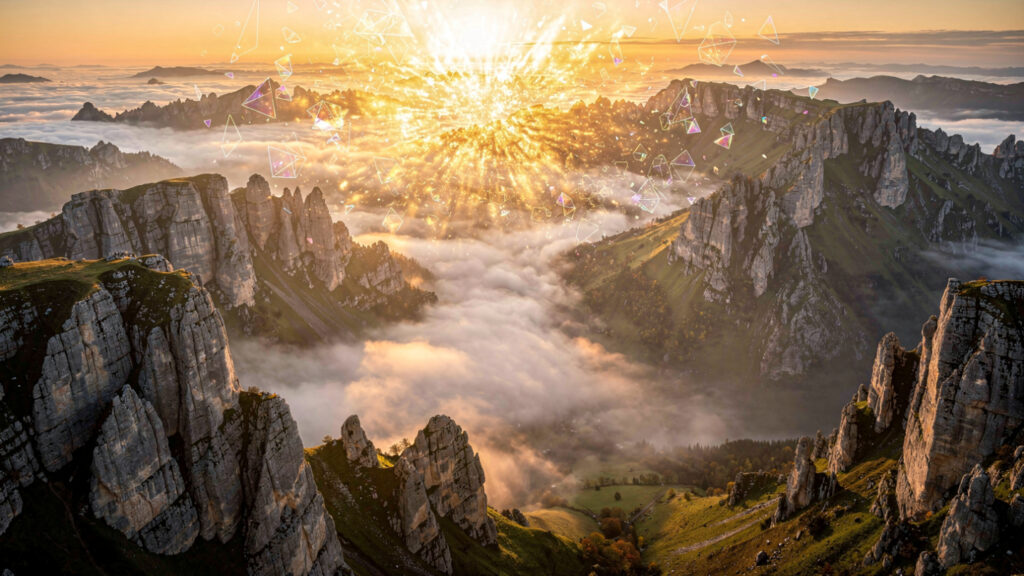
The Temple of Apollo Epikourios at Bassai, the Doric temple that Iktinos designed in the late fifth century BCE in the remote highland of the southwestern Peloponnese, is the Olympian monument placed in the Arcadian landscape whose remoteness and light quality are its most memorable characteristics. The temple itself is now protected under a tent that preserves it from weather damage and that reduces the experience of encountering it in its landscape: the tent is necessary and the preservation imperative justifies it, but the photographs from before the tent was installed show a temple standing alone in a mountain landscape at 1,131 meters above sea level with the quality of the Arcadian light on its stone that the protected enclosure now prevents the visitor from experiencing directly.
The Menalon Trail, the long-distance walking route through the villages of the Arcadian highlands that the natural heritage article in this collection discusses, is the route through the Arcadian landscape that most directly encounters the quality of light and the quality of landscape that the Hyperion heritage was encoding in the Arcadian association.
Getting there: Arcadia’s central villages are accessible by car from Tripoli, which is two hours from Athens on the Athens-Corinth-Tripoli motorway. The Bassai temple is an additional hour southwest of Tripoli toward Andritsaina. The approach to Bassai through the highland landscape of the Peloponnese is among the most dramatically beautiful drives in mainland Greece: the road climbs through the fir forests of the Lykaion range before descending to the Nedas valley and climbing again to the temple’s height.
Mount Olympus | The Titanomachic Landscape
Mount Olympus is the mountain most associated with the Olympian gods and specifically with Zeus, and the travel guide to Mount Olympus in this collection develops the approaches, the refuges, the geological character, and the endemic plant life of the mountain in full. What the travel guide necessarily does not develop at length is the dimension of the Olympus landscape that the Titanomachy heritage gives it: the mountain whose summit Zeus occupied after the Titans were defeated was the territory that had to be won before it could be dedicated to Zeus, and the violence of the taking was the precondition of the serenity that the Olympian mythology placed at the summit.
The gorges that cut through the Olympus massif, the Enipeas gorge and the Mavratzi gorge and the approaches from Litochoro, carry the quality of geological violence, the deep cutting of the Pierian limestone by the rivers that drain the mountain, that the mythological heritage encoded as the character of the Titanomachy’s battlefield. The stones that the Titans and the Olympians hurled at each other in the ten-year war were understood to have produced the chaotic topography of the mountain’s lower approaches, and the journey from the coastal plain to the summit through these approaches is the journey from the ordered human world through the zone of Titanic violence to the summit where the Olympian order was finally established.
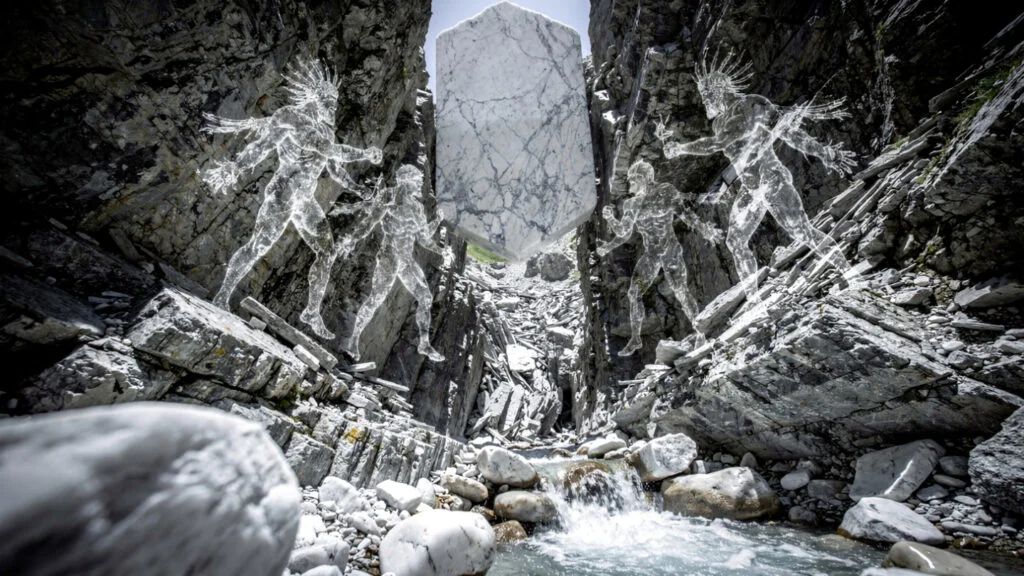
This reading does not require the traveler to abandon the geological and ecological account of what they are seeing: the gorge was cut by water acting on limestone over geological time, and the endemic species of the summit zone are the products of altitude and climate conditions. But it adds the dimension of the mythological heritage’s engagement with this landscape to the experience, which is the dimension that the ancient world that created the mythology was responding to when it looked at the same landscape and saw the battlefield of the Titans.
Getting there: See the dedicated Mount Olympus travel guide in this collection. The Enipeas gorge walk from the monastery of Agios Dionysios to the Prionia trailhead takes approximately three hours and is the approach that most directly encounters the gorge’s geological character at close range.
The Journey Through the Older Layer
The sites in this article do not constitute a single itinerary: they are distributed across Greece from Crete to the northern Aegean, and assembling them into a single journey would require several weeks and the motivation of a visitor who has organized the trip around the Titanic heritage deliberately.
But they are connected by the quality that each of them carries: the quality of a place that the human heritage recognized as sacred before it knew which divine power to attribute the sacredness to, and that the subsequent Olympian mythology organized by giving a god’s name to what the landscape had been producing on its own. The cave in the mountain that sheltered the infant Zeus from Cronus was a cave before Zeus was born in it. The ravine at Delphi that carried the prophetic quality of the earth’s knowledge was a ravine before Themis sat there and before Apollo superseded her. The cape at the world’s edge was the world’s edge before Poseidon’s temple was built on it.
The Titanic layer of the sacred map of Greece is the layer of the landscape itself, before the human heritage arrived to name what it found. These are the places where the landscape was already doing what the mythology would later attribute to the divine powers, and visiting them with the mythological heritage’s account of the pre-Olympian order in mind is visiting them with the clearest available account of what made these places sacred before the names were added.
At Olympus Estate, Wanderlust Greece guides you across the sacred and storied terrain of the Hellenic world, from the Olympian layer of the visible map to the Titanic layer beneath it. The cave on the Cretan mountain, the ravine at Delphi, the cape at the world’s edge, the highland light of Arcadia: these were sacred before they were named. The names were the human tradition’s attempt to explain what was already there. Go to the places. The landscape explains itself.