




The cabbage came from grief.
Its origin myth belongs to Lycurgus, the Thracian king who refused Dionysus and lost everything to that refusal. Apollodorus preserves the story, along with fragments of older Homeric material: Lycurgus met the god’s retinue moving through his kingdom and tried to drive it out. He forced the god’s own nurses into the sea. He chased Dionysus himself until the god took refuge in the water beneath the waves. He imprisoned the maenads and the votaries, trying to restore the order his kingdom had known before the god’s procession arrived to disrupt it.
The gods do not forget a refusal like that. Zeus struck Lycurgus blind for it. Then the madness arrived.
This was not the madness Dionysus gives to those who embrace him, the ecstatic dissolution of self the Bacchae article in this collection develops as the god’s actual domain. It was the opposite: the madness that follows a refusal of that dissolution, the particular derangement of someone who tried to hold the ordered world’s boundaries against a force no ordered world can actually contain, and who lost, in that effort, the ability to tell the real from the apparent.
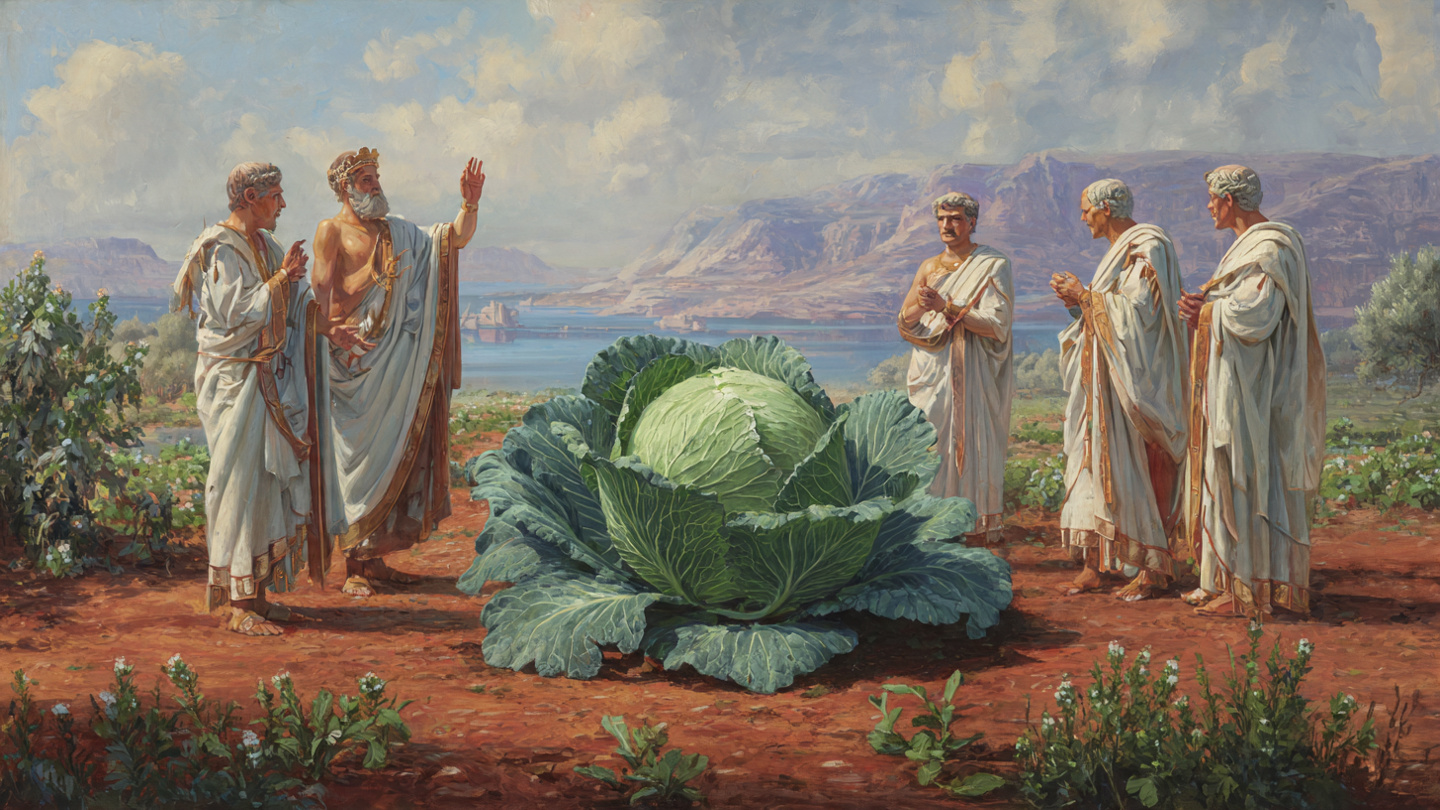
In the grip of this madness, Lycurgus mistook his own son for a grapevine and cut him down with an axe. When the madness cleared and the king understood what he had done, he wept. The Thracian earth received those tears, and the first cabbages grew from them.
The Theological Content of the Origin
The myth casts the relationship between two plants as a conflict between two principles.
The grapevine belonged to Dionysus. The fermentation of its fruit into a substance that dissolves the self, if only temporarily, was the most exact material expression the god’s own domain could take. The vine was the plant of a force the ordered world could never fully hold, the same force Icarius received when Dionysus taught him to make wine.
The cabbage was the anti-vine. Growing from the tears of a king who had tried and failed to hold the ordered world against Dionysus, it carried the character of grief rather than triumph, the character of an earth absorbing the consequences of defeat rather than celebrating a victory over the god. The cabbage never beat Dionysus. It was what remained after the man who tried to beat him had already lost.
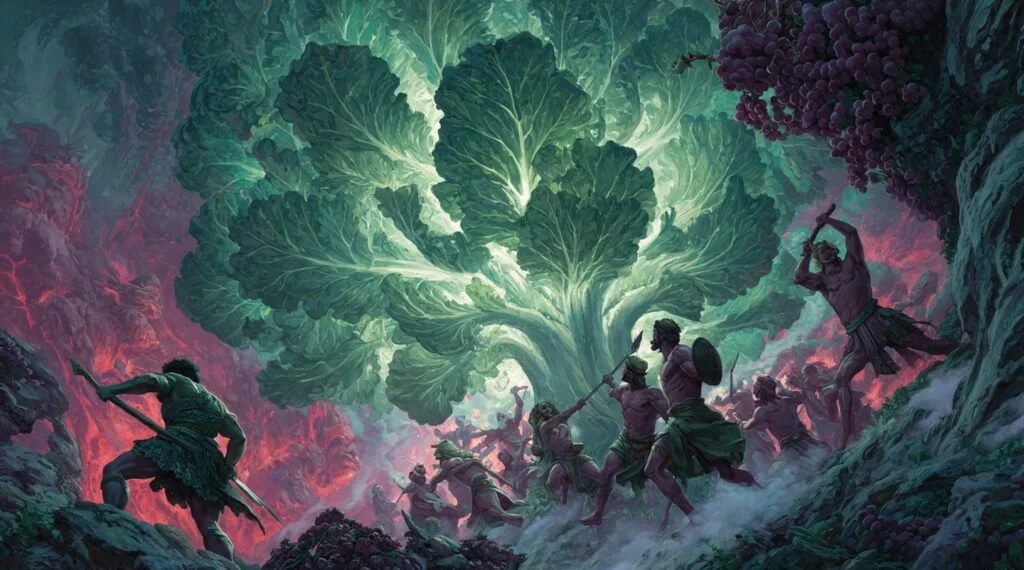
This origin gave the cabbage its place in Greek botanical thought: not the plant of celebration or divine ecstasy but the plant of the morning after, the sober ground left standing once Dionysian intoxication had passed, the plant of the grief and clarity that follow an encounter with a force one has tried and failed to contain.
The ancient Greeks watched the natural world closely, and read its features as material expressions of theological realities their myths had already named. What they noticed most consistently in the cabbage was its cooling, sulfurous quality, standing in direct material contrast to the grape’s warmth and fermentation. The biological antagonism between the two plants gave physical form to the theological antagonism the Lycurgus myth had already described.
What Theophrastus Observed
Theophrastus, Aristotle’s student and the figure the pharmakeia article in this collection develops as the most systematic ancient observer of the Greek landscape’s plants, documented a real antagonism between the grapevine and the cabbage with the patient, sustained attention that was his method.
The vine turns its tendrils away from the cabbage. Its tendrils, which normally seek out the nearest available support, consistently avoided the cabbage whenever both grew in the same garden, reaching instead for any other structure within range, as though the cabbage’s presence itself were the obstacle to route around.

Modern botany explains this through allelopathy: the glucosinolates the cabbage releases into the soil inhibit the vine’s growth within their chemical reach. The same compounds give the cabbage its sulfurous character when cooked and the cooling bite of its raw leaf.
Theophrastus had no word for allelopathy. He had only the philosophical vocabulary available to him, and within it, the vine’s avoidance of the cabbage read as the material expression of a theological enmity the Lycurgus myth had already encoded. The plant carried the story. The story explained the plant. Ancient Greek thought never fully separated these two registers of understanding.
Aristotle, the Symposion, and the Cabbage Before the Wine
The most practically developed use of the cabbage-vine antagonism in ancient Greece was the custom of eating cabbage before drinking wine at the symposion.
Aristotle recorded the mechanism as his contemporaries understood it: the cabbage’s cooling quality, applied against the heat wine produced in the body, moderated the Dionysian intoxication that an orderly symposion required. The symposion itself was never a surrender to Dionysus. It was a controlled encounter with his force, staged inside the civic gathering, the setting Plato and Xenophon both developed as the occasion for philosophical conversation that needed exactly the right measure of the wine’s own loosening effect without losing the capacity for argument the wine threatened to dissolve.
Eating cabbage before the wine put the myth’s own insight into practice: the earth had produced a plant capable of tempering the vine’s force. The cooling quality born of Lycurgus’s grief moderated the heating quality born of Dionysus’s gift. Grief at a failed resistance had, without anyone intending it, produced the tool for engaging that same force under control.

The practice itself was simple: eat the cabbage raw, or eat its seeds, before the wine is poured. Modern science explains the cooling, sulfurous quality of raw cabbage through the effect its compounds have on the gastric lining and on the rate at which alcohol is absorbed, but the effect itself, moderating the wine enough to keep philosophical conversation intact at a convivial gathering, is exactly what the practice was built to achieve.
The myth named the relationship. Aristotle gave it a practical application. The symposion turned that application into a standing dietary custom ahead of every controlled encounter with the god.
Diogenes, Aristippus, and the Freedom of the Simple Meal
The Diogenes article in this collection develops Cynic philosophy through a figure who identified the actual minimum a human life requires and built his entire existence around providing exactly that minimum, nothing more.
Diogenes Laertius preserves the exchange most consistently associated with this idea, and its usual form is worth stating precisely: Diogenes was eating a simple meal of bread and lentils when Aristippus, a fellow philosopher who had won himself a comfortable position at a tyrant’s court through steady flattery, remarked that if Diogenes would only learn to flatter the king, he would not need to live on lentils. Diogenes answered that if Aristippus would only learn to live on lentils, he would not need to flatter the king. Cabbage does not appear in the earliest and best-attested version of this story. What belongs to cabbage is the same philosophy Diogenes lived by whenever he ate it: the winter garden’s plainest, cheapest vegetable was, for him, exactly enough.

The philosophy behind the exchange is autarkeia, self-sufficiency: a person whose needs are only what the earth provides without any help from organized society is free of the social obligations anyone with greater needs must discharge to get them met. The lentils, or the cabbage, were never a symbol of poverty for the Cynics. They were a symbol of freedom. Whoever could live on so little needed no court, no patron, no institution, and none of the performance that comes with depending on any of them.
Diogenes ate simply not because it was all he could afford but because it was all he required. The requirement itself was the freedom.
The Lahanosalata and the Winter Table
The lahanosalata, shredded raw cabbage dressed with lemon and olive oil, is the winter salad the Greek table has kept in essentially unbroken form from antiquity through the Byzantine period into the present kitchen. Its preparation preserves, more directly than any other dish, the old theology of the cabbage as the anti-vine.
It is eaten raw for a reason Aristotle himself would have recognized: the cooling, sulfurous quality that moderates wine is at its strongest in the raw leaf and drops substantially once heat is applied. The salad stays raw because raw is what preserves the very quality that made the cabbage useful in the first place.

Lemon adds the brightness that lifts the cabbage’s earthiness into something the winter table needs. Since its introduction to the Mediterranean, lemon has served the Greek kitchen as the winter’s brightening counterpoint to the heavier, earthier root vegetables and brassicas that dominate the cold months.
Olive oil, Athena’s gift, dresses the raw salad and ties the lahanosalata to the single most continuous thread in all of Greek cooking.
The lahanosalata sits on every winter table in Greece because it is good, because it is simple, and because cabbage reaches its best in December and January. It also sits there because the Lycurgus myth, Aristotle’s dietary observation, and the Cynic argument for self-sufficiency have all, over centuries, settled into a single ordinary habit: a winter salad that carries every one of those ideas without needing to say any of them aloud.
The whole history is in the salad. The salad does not know this. It does not need to.
The Thracian Earth and the Living Continuity
Thrace was, in the Greek geographical imagination, the region most closely tied to Dionysus himself: the homeland Orpheus came from, the route by which Dionysian worship first arrived from the east, a borderland between the ordered Hellenic world and the wildness of the Thracian interior, where forest, mountain, and hard northern cold made the meeting between order and the forces that exceed it unusually direct. The Macedonian sanctuaries at Dion preserved this same northern connection to the god.

The cabbage of Lycurgus came from this same region. The tears of a king who had tried and failed to hold the ordered world against Dionysus fell on Thracian ground and grew into a plant carrying the character of that failure. From Thrace it spread into gardens across the ancient Greek world, and from those gardens into the winter markets of Athens and Thessaloniki and the village squares of the Peloponnese.
The plant on every Greek winter table came from the tears of a king who tried to drive Dionysus into the sea. The vine that produces the wine on the same table belongs to the god that king failed to drive away. Both plants are still there together. The antagonism Theophrastus observed in the garden is still present in the food. Aristotle’s practice of cabbage before wine has not vanished from Greek cooking. It has simply become the salad that arrives at the table before the wine is poured.
The cabbage came from grief. The vine came from celebration. They are still on the same table. They have been on the same table for three thousand years.
At Olympus Estate, Food and Seasonal Life traces the Greek table from the ancient harvest through the Byzantine kitchen to the contemporary table. The cabbage came from grief. Lycurgus drove Dionysus into the sea, imprisoned his followers, and in the madness that followed killed his own son, mistaken for a grapevine. His tears produced the first cabbages. Theophrastus observed that the vine turns its tendrils away from the cabbage in the garden. Aristotle documented that eating cabbage before wine moderated the wine’s force, making it the tool for a controlled encounter with Dionysus at the symposion. Diogenes lived on the plainest food available, lentils in the best-attested version of his story, because the person who needs the least owes the least to anyone else. The lahanosalata is eaten raw because raw preserves the cooling quality at its peak. The vine and the cabbage are still on the same Greek table. They have been for three thousand years.