

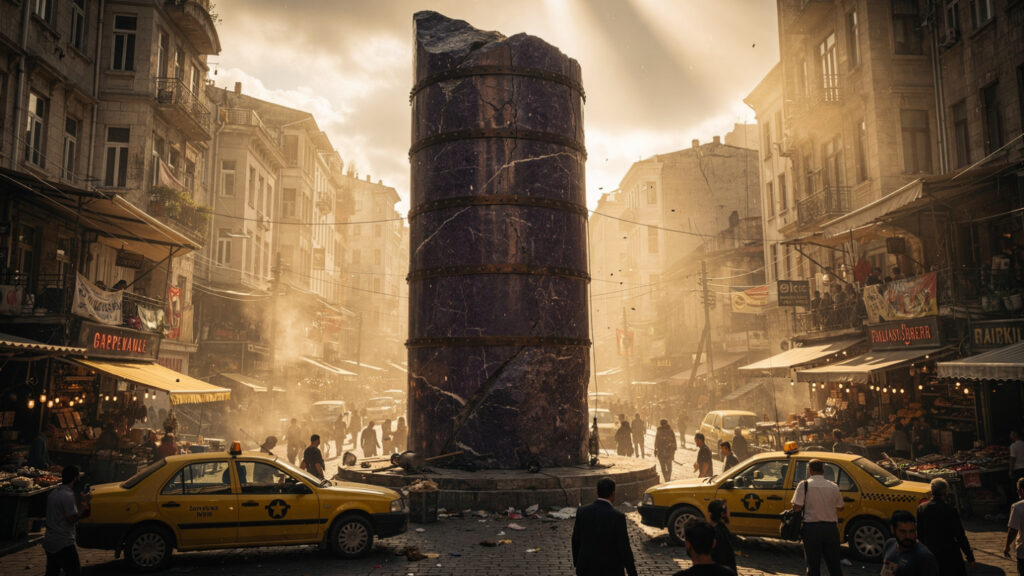
There is a street in Istanbul’s oldest district where the modern city moves at full speed: taxis, vendors, the compressed noise of a market quarter that has been a market quarter for seventeen hundred years. If you are not looking for it, you will walk straight past it.
But it is there.
A column of deep purple porphyry stone, sixty feet tall, its drums held together by iron hoops that give it its Turkish name: Çemberlitaş, the Hooped Stone. Scorched by fires. Shaken by earthquakes. Stripped of the statue that once crowned it. Surrounded now by the street level of a city that has risen around it for over sixteen centuries, so that what you see above the pavement is perhaps half of what Constantine the Great erected in the year 330 when he stood in his new forum and declared that this city, built on the bones of a Greek colonial town called Byzantium, was the new centre of the Roman world.
The column is a UNESCO World Heritage Site. It is visited by thousands of people each year. Most of them photograph it and move on.
Very few of them think about what is beneath it.
Because beneath Constantine’s Column, if the sources are to be believed, and the sources span nine centuries of Byzantine testimony, there lies one of the most extraordinary collections of sacred objects ever assembled in a single location. Objects from three of the world’s great religious traditions. Objects whose origins stretch back beyond Christianity, beyond Rome, beyond even the world of the Greeks who built the city Constantine chose to transform.
And at the centre of that collection, according to the historians who recorded it with the most conviction: the Palladium itself. The wooden statue of Pallas Athena. The object that once protected Troy, then Rome, and was finally carried to this column by the first Christian emperor of the Roman world, who buried it in the foundations of his new capital and said nothing publicly about having done so.
The question of whether it is still there is not merely archaeological. It is the question of what an object means when the civilisation that understood its meaning is gone.
A Column at the Centre of Everything
To understand why Constantine chose this particular column as the vessel for what he buried, you need to understand what the column was designed to mean.
The Forum of Constantine was not a marketplace or a civic gathering space in the conventional Roman sense. It was an ideological statement built in stone, and the column at its centre was the statement’s axis.
The forum was circular, unusual in the Roman tradition, and the column rose from its exact centre. On top of the column stood a statue of Constantine himself in the form of Apollo, the sun god, his face altered to resemble the emperor’s own, a radiate crown on his head whose rays, some sources claim, incorporated nails from the Passion of Christ. He held a spear in his left hand and a globe in his right. The globe, according to certain accounts, contained a fragment of the True Cross.
Consider what this image was doing.
Constantine was not simply depicting himself as a powerful ruler. He was positioning himself at the intersection of two theological worlds: the pagan Olympian tradition in which Apollo ordered the visible cosmos through light and reason, and the new Christian revelation in which Christ’s sacrifice had reordered the cosmos through a different kind of light entirely. The statue was not Apollo. It was not Christ. It was the emperor himself, standing between them, claiming sovereignty over both.
This is the kind of move that only a man of extraordinary theological confidence, or extraordinary theological ambition, would attempt.
And this is the column beneath which he chose to bury the most sacred objects available to him.
What the Sources Say Is Down There
The Byzantine sources are not shy about the contents of the column’s foundations. They are, if anything, extravagantly specific, and they grew more over the centuries as each generation of chroniclers added to the inventory.
By the time the Byzantine tradition had fully elaborated what Constantine had placed beneath his column, the list included the following.
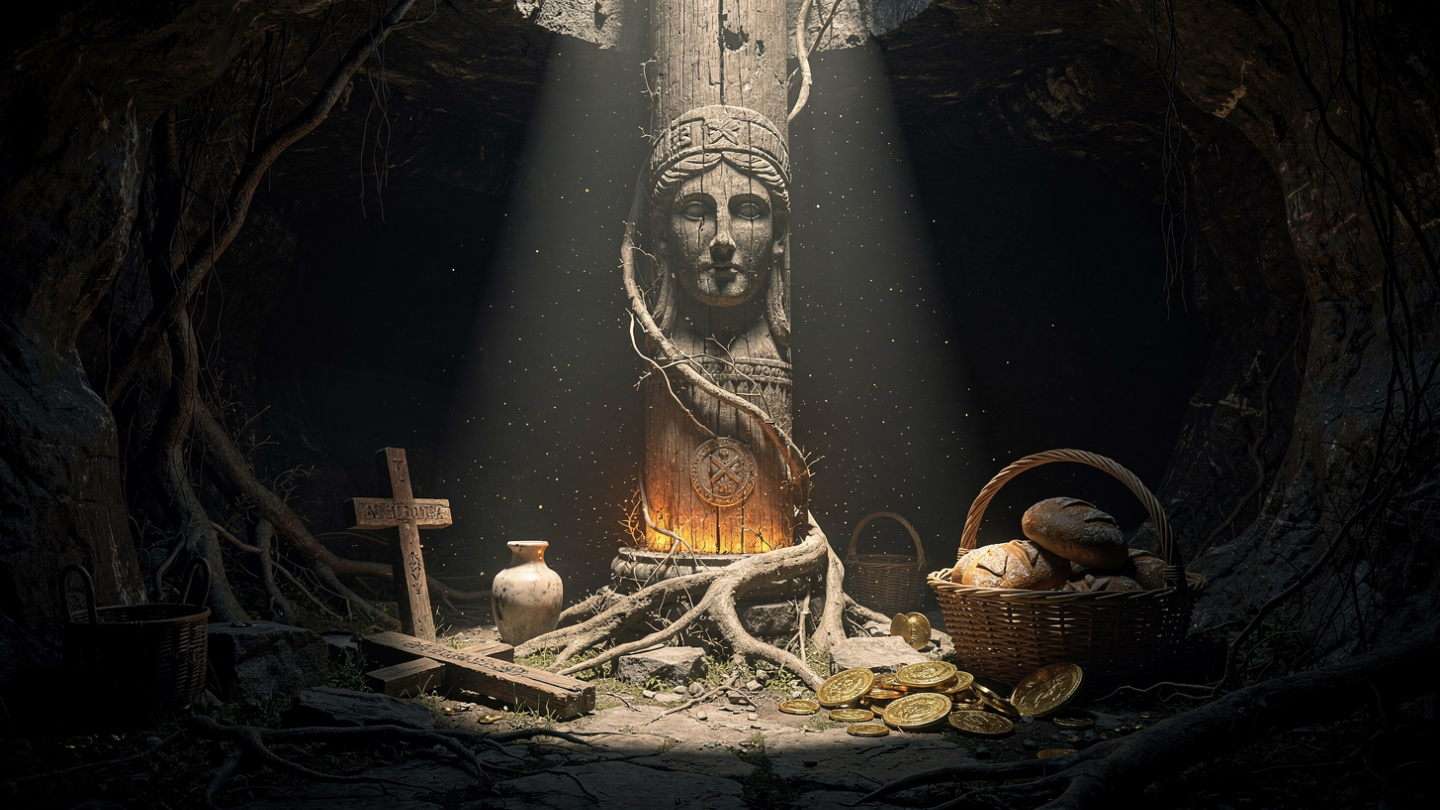
A portion of the True Cross, discovered in Jerusalem by Constantine’s mother Helena on her pilgrimage to the Holy Land around 326 CE. The twelve baskets of bread left over from Christ’s multiplication of the loaves, recorded by the ninth-century chronicler George Hamartolos and confirmed by George Kedrenos in the eleventh century. The axe used by Noah to build the Ark. The rock from which water sprang at the command of Moses. Nails from the Passion of Christ, beyond those already incorporated into the crown. Wood from the crosses of the two thieves crucified alongside Jesus. An alabaster jar of ointment used by Mary Magdalene to anoint Christ’s feet. Relics of saints. Gold coins stamped with the likeness of Constantine as symbols of the city’s prosperity.
This is a staggering inventory. It is also, from a strictly historical standpoint, almost entirely unverifiable.
What scholarship has established is that the Christian relic list accumulated over time, with many items added by later Byzantine writers keen to enhance the column’s sacred significance retrospectively. The earliest sources, those closest to the founding of the city in 330, mention relatively few objects. The list grew as Constantinople grew, as the column’s symbolic importance expanded, and as the Byzantine theological imagination found in it an increasingly powerful focus for the city’s identity as the New Jerusalem, the New Rome, the eternal capital of the Christian world.
But there is one object on the list that most scholars treat differently from the others. One object that appears in the earliest sources rather than the later accretions. One object whose presence beneath the column is attested not by pious Christian chroniclers but by the Greek historian Hesychios of Alexandria, by the chronicler John Malalas, and by the Chronicon Paschale: a compilation made in Constantinople itself in the seventh century, within living memory of the city’s greatest power.
That object is the Palladium.
How a Pagan Statue Ended Up in a Christian Foundation
The Palladium’s journey from Troy to Rome to Constantinople follows a logic that is not religious so much as imperial.
Rome had claimed the Palladium as its own protective talisman since at least the third century BCE, when the tradition solidified that Aeneas, the Trojan prince and mythological ancestor of the Roman people, had carried the statue from burning Troy to the shores of Italy. There it had resided in the Temple of Vesta in the Roman Forum, tended by the Vestal Virgins, visible to almost no one, its existence a matter of faith rather than verification, the unseen guarantor of Rome’s eternity.
Constantine, when he decided to move the imperial capital from Rome to his new city on the Bosphorus, faced a theological problem of considerable delicacy.
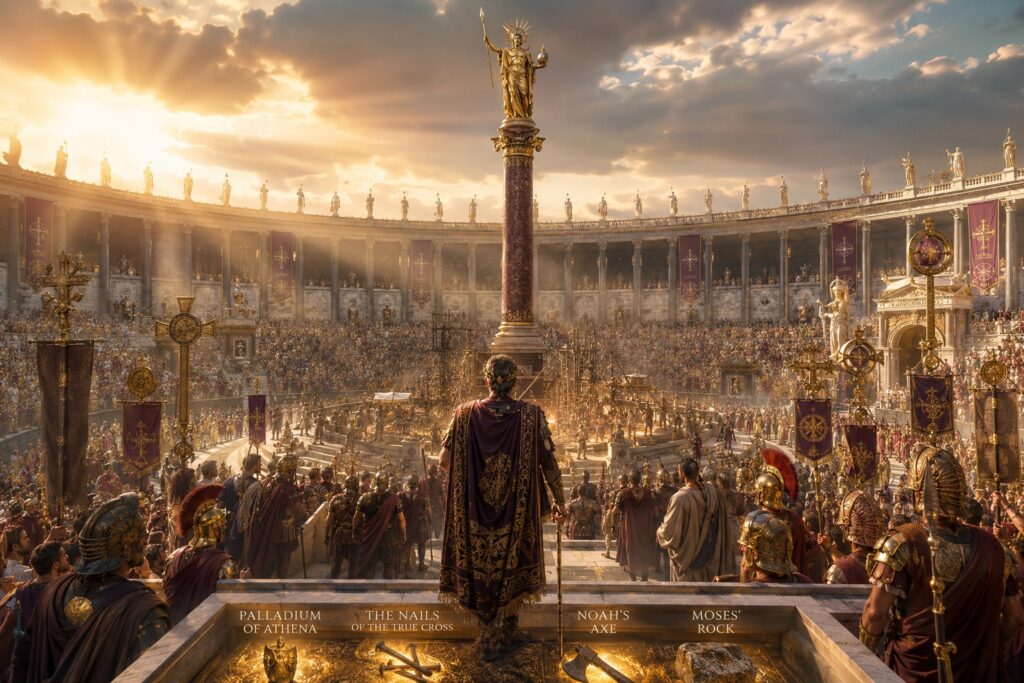
Rome’s claim to eternal supremacy rested in part on the Palladium. If Constantinople was to be Rome’s successor, its equal or its superior, it needed the protection that the Palladium represented. Simply building a larger forum and a more strategically located harbour was not sufficient. The new city needed to inherit Rome’s divine protection along with its political authority.
John Malalas records that Constantine secretly removed the Palladium from Rome and transported it to Constantinople, where he placed it in the foundations beneath his column. The Chronicon Paschale confirms this account. The word both sources use for the manner of its removal is telling: he took it secretly, or covertly. This was not a public transfer of a civic treasure. It was something closer to the act Odysseus and Diomedes had performed on a smaller stage nine hundred years earlier: the removal of a city’s divine protection under cover of darkness, or at least under cover of official silence.
The parallel is not lost on the sources that record it. Constantine, the first Christian emperor, performed at the founding of his new capital a gesture that was entirely pagan in its logic: he stole the protection of the old city and gave it to the new one.
The Column as Axis Mundi
The choice to bury these objects specifically beneath the column, rather than in a church or a palace vault, reflects a cosmological understanding that runs directly through the Greek philosophical tradition.
The column was designed as an axis mundi, a world-axis, the point at which heaven and earth were connected. This concept is older than Christianity, older than Rome, present in every significant ancient culture from the Norse world-tree to the Hindu Mount Meru to the Greek omphalos at Delphi, the navel of the world where Pythia spoke the oracle of Apollo.
By placing sacred objects in the foundations of this column and a solar deity on its summit, Constantine was constructing a vertical axis that ran from the deepest buried past, where the relics and the Palladium lay, through the living present of the city built around it, up to the divine order that governed the sky above. The emperor standing at the column’s base, or processing around the forum in the annual ceremony held on May 11 each year to celebrate the city’s founding, was physically positioning himself at the centre of this axis.
The annual ceremony is worth pausing on. Every year on the anniversary of Constantinople’s founding, a gilded wooden replica of Constantine’s statue was carried in procession through the city and brought to the forum, where the emperor of the day would bow before it. This ritual continued for centuries. It was, in effect, a yearly acknowledgement that the city’s identity was bound to the column and to what the column contained.
The people of Constantinople did not know exactly what was buried beneath it. What they knew was that something was there, something from before their time, something that connected their city to a chain of sacred objects stretching back through Rome, through Troy, through the deep mythological past that their Greek heritage had preserved. This knowledge, imprecise and layered with legend, was itself a form of protection. A city that believes its foundations are sacred behaves differently from a city that does not.
What the Fires and Earthquakes Left
The column’s physical history is a record of almost everything that can happen to a monument that refuses to fall.
In 416, less than a century after its construction, the drums began to separate and iron hoops were added to hold them together. A violent windstorm in 1106 toppled the statue of Constantine from the summit, the solar Apollo crashing to the forum floor after seven and a half centuries of watching over the city. Emperor Manuel I Komnenos replaced it with a large cross, and the column acquired a new name: the Column of the Cross.
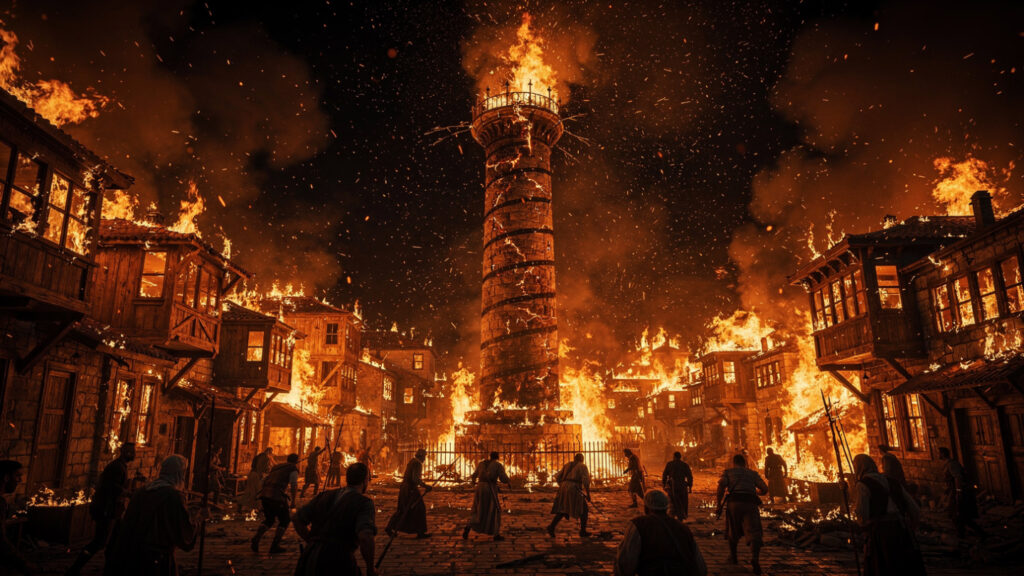
Fires were the column’s most persistent enemy. Constantinople burned repeatedly across its history, and the column stood at the centre of a dense commercial district where wooden buildings packed tightly against each other provided ideal conditions for catastrophe. The Burnt Column, as foreign visitors came to call it, bears the scorch marks of these fires in its stone, a darkening and scarring of the porphyry that gives it a grim and weathered quality quite unlike the gleaming civic monuments of the forum as Constantine intended it.
The Crusaders who sacked Constantinople in 1204 stripped the city of everything portable and of value. Whether they found or disturbed anything in the column’s foundations is not recorded. The silence on this point is itself a kind of testimony: either they did not know to look, or they looked and found nothing they recognised, or they found something and removed it without recording what it was.
The Ottomans who took the city in 1453, ending eleven hundred years of Byzantine rule, treated the column with a respect that the Crusaders had not. Sultan Mehmet II, who understood the symbolic architecture of the city he had conquered, left the column standing. His successors maintained it. The Ottoman Sultan Mustafa III added new iron hoops in the eighteenth century after earthquake damage. The column’s current stone base was added in the late eighteenth century by Sultan Abdülhamid I after a particularly destructive neighbourhood fire.
Throughout all of this, nobody excavated the foundations. Nobody looked.
The Last Emperor and What He May Have Known
On May 29, 1453, the Byzantine emperor Constantine XI Palaiologos died fighting near the St Romanos Gate in the Theodosian walls as Ottoman forces entered the city. He was the last Roman emperor. His death ended a political tradition that traced its unbroken line back to Augustus.
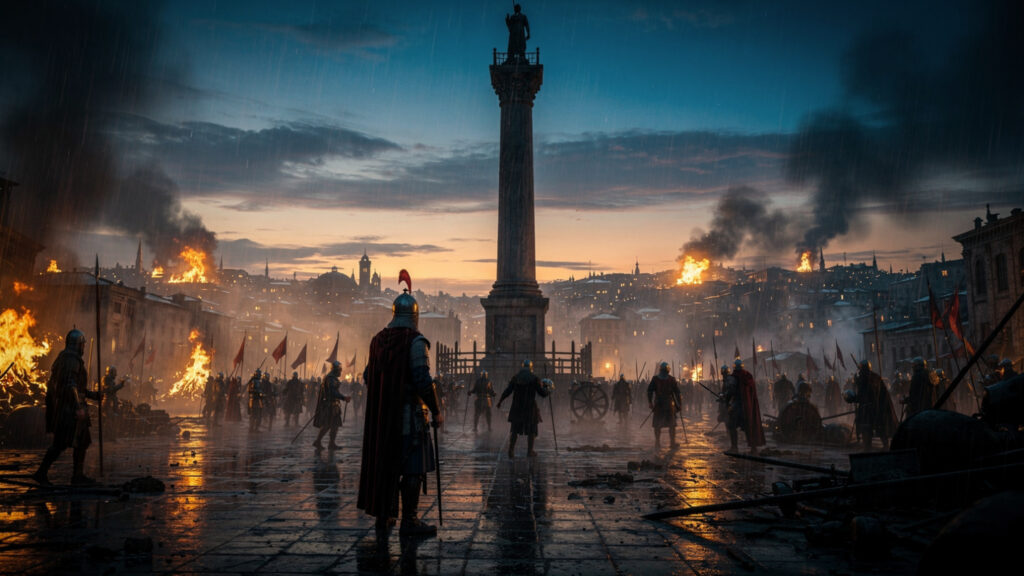
In the days before the final siege, with the city’s fall clearly imminent, a question must have presented itself to the Byzantine court: what to do with the sacred objects that had defined Constantinople’s identity for over a thousand years.
Some relics were carried out of the city before the walls were breached. The head of John the Baptist, the right arm of Saint John the Apostle, various fragments of the True Cross: these were distributed among the churches of the surviving Christian world in the desperate weeks before the end. Some reached Venice. Some reached Rome. Some went east.
What happened to the Palladium, if it was still in the column’s foundations and had not been quietly removed at some earlier point, is unknown.
The Byzantine scholar George Sphrantzes, who survived the fall and wrote the most detailed contemporary account of the city’s last days, does not mention it. The Ottoman sources that describe the conquest in detail do not mention it. The absence of any record of its fate is the loudest possible silence in a story that is otherwise very well documented.
Three possibilities present themselves.
The first is that the Palladium had already been removed from the foundations at some point in the thousand years between Constantine’s burial of it and the Ottoman conquest, perhaps during one of the fires, perhaps during the 1204 sack, perhaps quietly relocated to a safer location by a Byzantine emperor who understood what it was and feared its loss.
The second is that it remained in the foundations in 1453, survived the conquest undiscovered, and remains there still, twelve metres below the modern street surface of Istanbul, beneath seventeen centuries of accumulated urban sediment, waiting for an excavation that has never been authorised.
The third is that it was found and removed in the chaos of the conquest, taken east, and now exists in a location that the historical record does not disclose.
What the Archaeologists Can and Cannot Tell Us
Here is the honest state of the archaeological question.
The foundations of Constantine’s Column have never been properly excavated. The column stands in the middle of a busy street in one of Istanbul’s most densely occupied historic districts. Excavation would require closing a significant stretch of a major urban artery, working through seventeen centuries of accumulated street level, and penetrating foundations that have been shored up repeatedly over the centuries with new masonry that complicates the task of reaching what Constantine originally placed there.
The archaeological record of Byzantine Istanbul is, in many ways, fragmentary precisely because the city has been continuously occupied. Unlike Pompeii, which was sealed by disaster and preserved intact, or the ancient sites of mainland Greece, which were abandoned and could be excavated without disturbing living communities, Istanbul sits on top of itself. Every basement in the old city potentially contains Byzantine-era structures. Every new construction project risks encountering remains that stop the work for months while the archaeological service assesses what has been found.
What excavations in the vicinity of the forum have confirmed is that the original street level of Constantine’s Constantinople lies approximately ten to twelve metres below the modern surface. The column, which appears to be about thirty-five metres tall today, was significantly taller when it was built, its base surrounded by a forum whose pavements are now deep underground. The sheer scale of what the city has buried above its own founding layer is, in its own way, extraordinary.
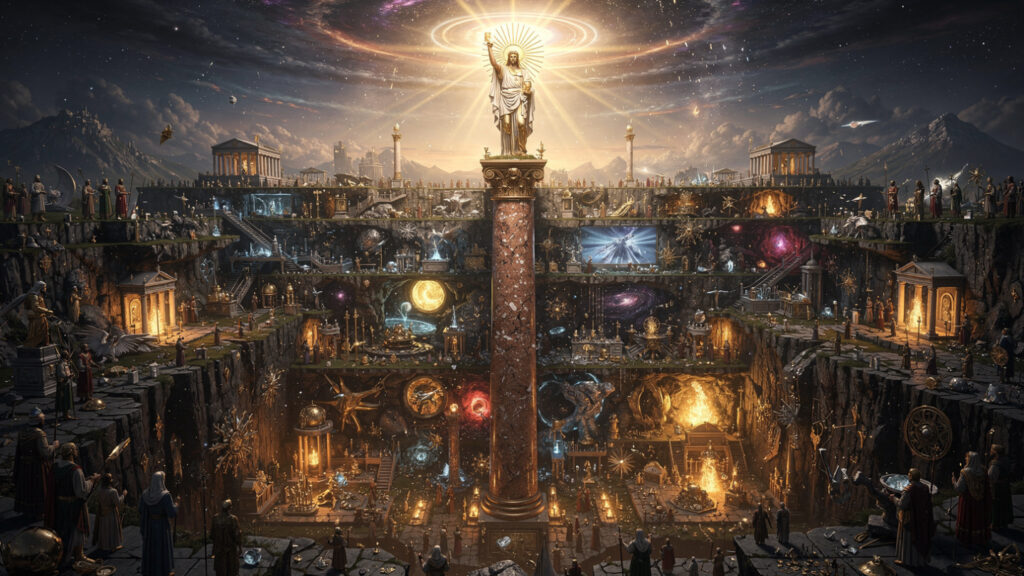
The scholarly consensus on the Palladium question is careful. Byzantine historians from the ninth century onward record the tradition that it was placed beneath the column. The earlier sources, Hesychios and Malalas, provide the most direct and credible testimony. Most modern scholars treat the Palladium’s presence as historically plausible: consistent with what we know of Constantine’s theological project for the city, consistent with the logic of imperial succession from Rome, and consistent with the way Byzantine collective memory chose to understand the column’s significance across a millennium of continuous use.
What no scholar can say, because no excavation has been done, is whether it is still there.
A City Built on Deliberate Mystery
There is a pattern worth noticing across the history of the Palladium from Troy to Rome to Constantinople.
In Troy, its location in the temple was known to the priests and to the royal family but not broadcast to the population at large. In Rome, it was held in the Temple of Vesta and seen by almost no one. In Constantinople, Constantine buried it silently, without public ceremony, without announcement: the sources use the word secretly for a reason.
Each city that held the Palladium chose to hold it invisibly.
This is not carelessness. It is a deliberate theological strategy. The protection of a city is most powerful when its source cannot be located and therefore cannot be targeted. The Palladium’s effectiveness as a guardian depended precisely on the uncertainty of its presence: you could not know whether it was really there, and that uncertainty was itself a form of protection.
Troy lost its protection not when the Palladium was taken but when the Trojans lost the certainty that it was still in its temple. Rome’s claim to eternal protection rested on a tradition that nobody could verify. Constantinople built its identity as the eternal Christian capital partly on the knowledge that something immeasurably old, connecting the new faith to the deep mythological past, lay beneath the column at the centre of its founding forum.
The column did not need to be opened for this to work. It needed only to be there.
Whether it is There or Not
Constantine’s Column is still there.
Walk down Divan Yolu in the Fatih district of Istanbul, past the covered bazaar and through the Beyazit neighbourhood, and you will find it at the edge of the Çemberlitaş quarter, standing in the traffic with the patient indifference of something that has survived every catastrophe the city could produce. It is smaller than you expect, or the street has grown taller around it. The iron hoops are visible. The porphyry is dark. The base is Ottoman masonry, not the original forum pavement.
Stand in front of it for a moment and consider what the column has witnessed from this spot. The founding of a city intended to outlast Rome. A thousand years of Byzantine liturgy and imperial ceremony. The Crusaders who sacked the city in the name of the faith whose relics were buried beneath it. The final emperor dying at his walls. The Ottoman conquerors who left the column standing when they could have demolished it. Seventeen centuries of fire and earthquake and the ordinary relentless accumulation of urban life.
And beneath all of it, according to the sources that knew the city when it was alive: a wooden statue, old even when Constantine buried it, carved from grief and washed in divine tears, the last physical object in the chain of sacred things that connected the fall of Troy to the fall of Rome to the foundation of a city that called itself eternal.
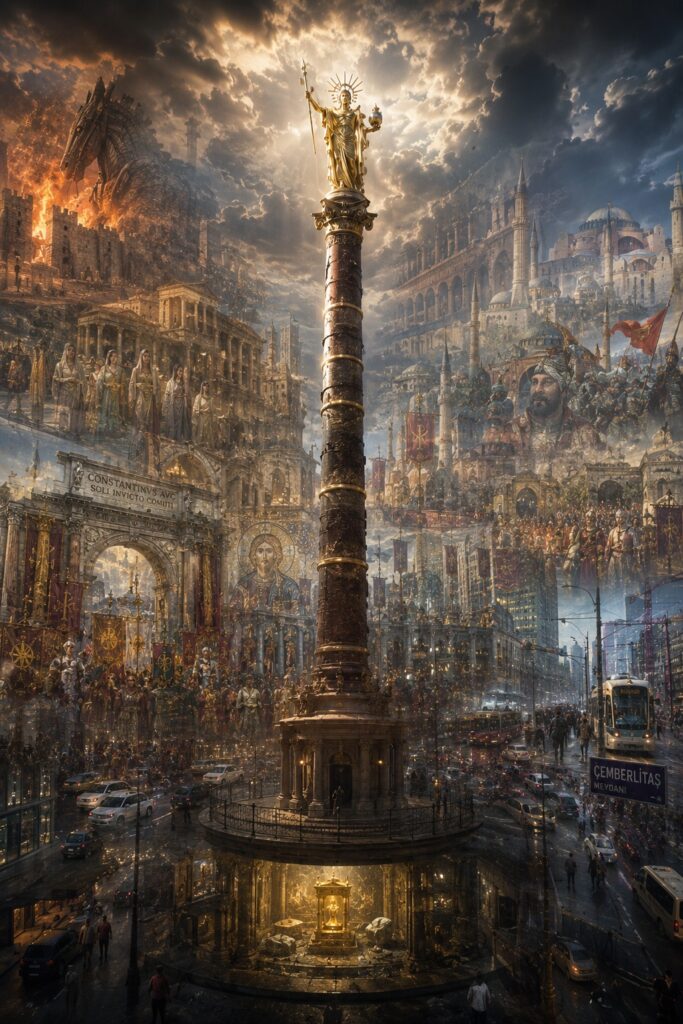
Whether it is there or not, the question is worth asking. Not because the answer would change anything in the material world, but because it asks us to consider what we mean when we talk about a city’s soul: whether a civilization’s sense of its own sacredness lives in its visible monuments or in the invisible foundations beneath them.
The column is a stone. The forum around it has been underground for seventeen hundred years. But the question of what Constantine buried there, and why, and what it means that nobody has looked, is one that the street above it has not yet finished asking.
Where to Stay Near Constantine’s Column
Explore the heart of Istanbul’s ancient forum with this interactive map of nearby stays: a simple way to anchor your visit beside one of the city’s most enigmatic monuments.
At Olympus Estate, Sacred Geography explores the places across Greece where landscape, history, and myth read as a single text. Constantine’s Column still stands in Istanbul, fire-blackened and hooped in iron, the last surviving marker of the city’s Roman foundation point. What the first Christian emperor of the Roman world buried in its foundations, the Palladium of Troy among other objects of the old world’s sacred order, he buried without public acknowledgement. The question of whether it is still there is not merely archaeological. It is the question of what an object means when the civilisation that understood its meaning is gone.