



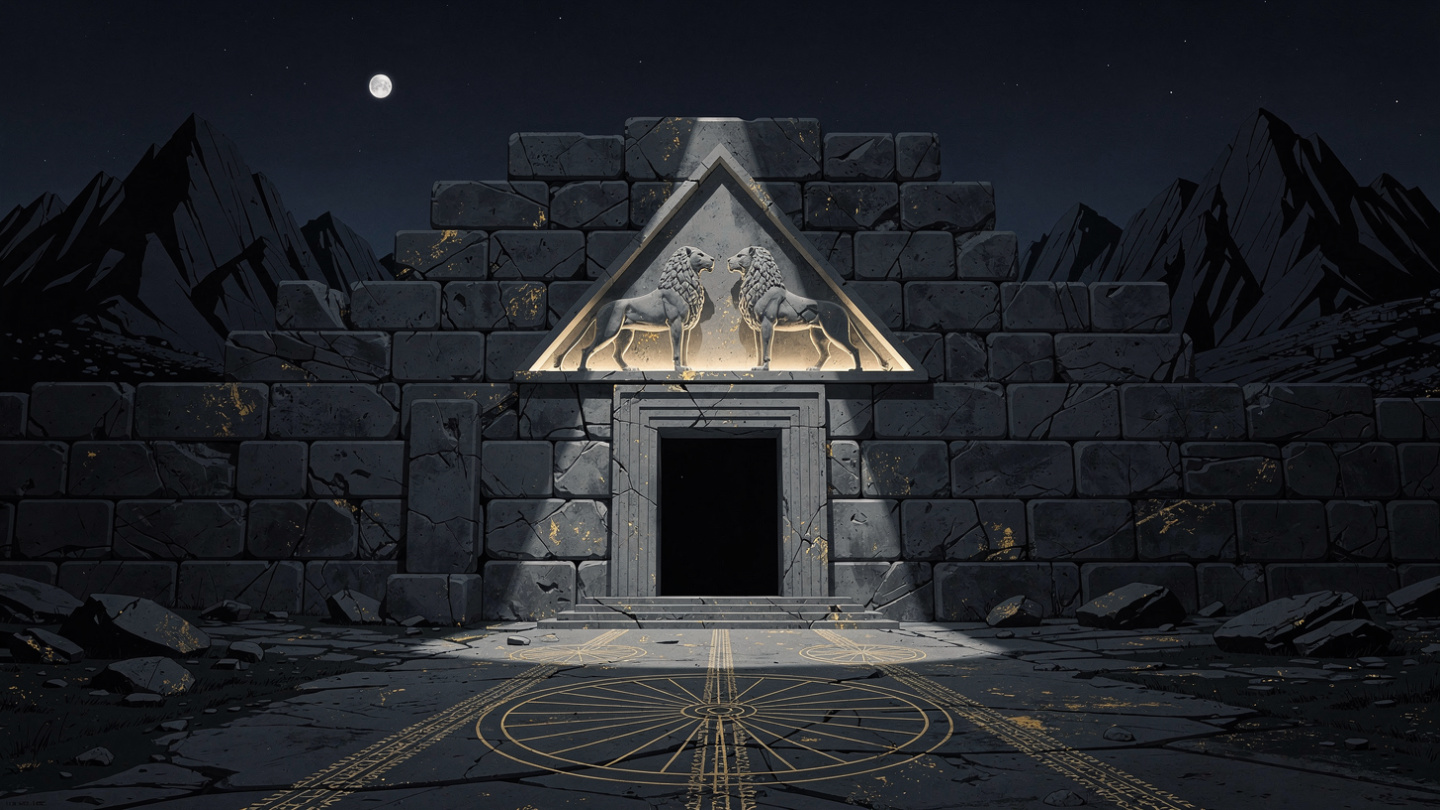
The gate has been visible above ground throughout recorded history.
Every other major monument of the Bronze Age Aegean world, the palaces of Knossos, the citadels of Tiryns and Pylos, the tholos tombs scattered across the Peloponnese, required excavation to find. The Lion Gate at Mycenae was never lost. Medieval travellers described it. Ottoman visitors sketched it. The French antiquarian Guilletière drew it in the seventeenth century with sufficient accuracy that his illustration is still recognisable. The gate that the Mycenaean builders set into the northwest corner of their citadel wall around 1250 BCE was too massive and too well-built to be buried by anything short of a catastrophe that never arrived.
The first formal archaeological work at the site was conducted in 1841 by the Greek archaeologist Kyriakos Pittakis, who cleared the area around the gate’s base and documented what was already partially visible above ground. Heinrich Schliemann arrived thirty-five years later, in 1876, and found what lay inside the walls. Most accounts give Schliemann the discovery. Pittakis found the gate.
This distinction matters in the way that accurate attribution always matters in a site whose history has been so thoroughly shaped by the ambitions and self-mythologising of the people who worked on it. The Lion Gate belongs to Mycenae and to the Bronze Age civilisation that built it, not to the modern figures who excavated it. Starting with the building rather than the excavators is the only honest way to encounter it.
What the Gate Actually Is
The Lion Gate is the oldest surviving monumental sculpture in Europe.
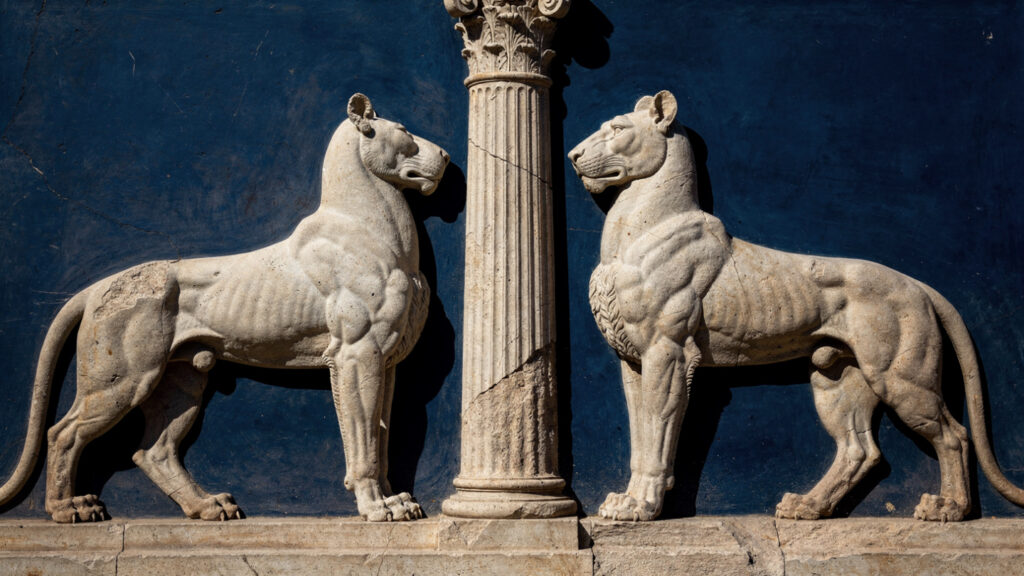
The statement deserves its weight. Not the oldest in Greece, not the oldest in the Aegean: the oldest in Europe. The carved relief above the gate’s lintel, two figures flanking a central column in the heraldic arrangement that the Mycenaean artists adapted from the Minoan tradition, was placed in its position around 1250 BCE and has remained there for thirty-two centuries. Nothing in the European built environment that carries monumental sculpture predates it by any significant margin.
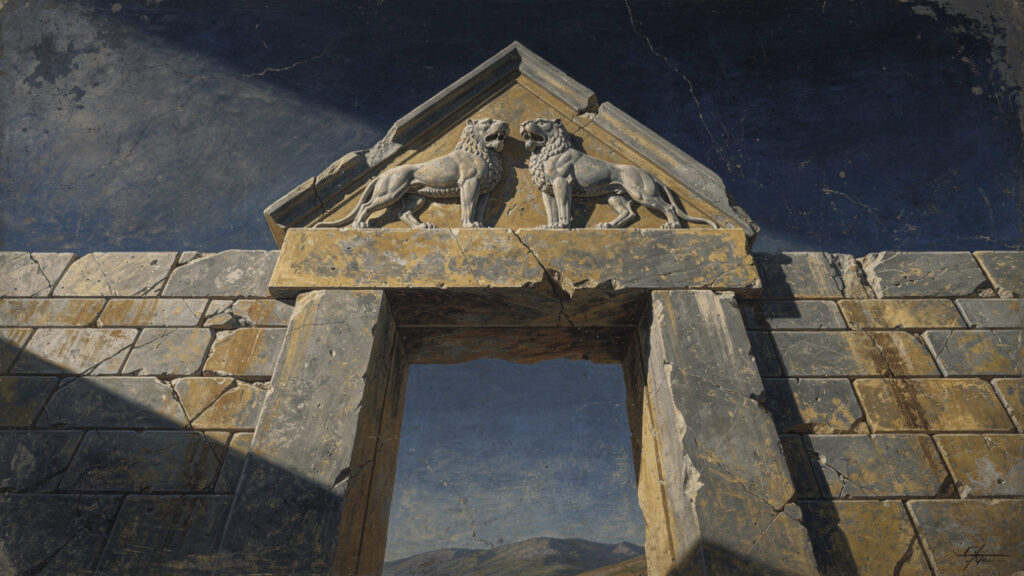
The gate’s engineering is the foundation of the sculpture’s survival. The construction uses a corbelled arch technique above the entrance to lighten the load on the lintel and the supporting posts, creating the relieving triangle within which the carved relief sits. This triangular void above the massive lintel stone distributes the weight of the wall above it outward into the jambs rather than downward through the lintel, preventing the lintel from fracturing under a load it could not otherwise have borne. The relieving triangle is simultaneously a structural solution and the space that the sculpture required.
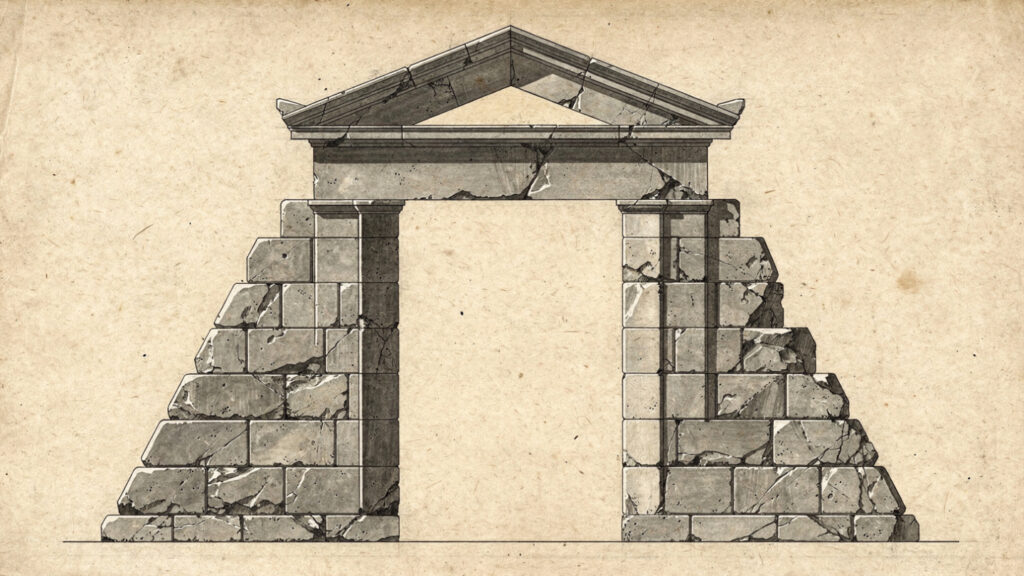
The lintel itself is a single stone estimated at around twenty tons. The jambs are monoliths of comparable weight. The wall into which the gate is set is cyclopean masonry: massive uncut or roughly shaped boulders fitted together without mortar, their stability achieved through the precision of their fitting and the weight pressing each stone against its neighbours. The walls of Mycenae have survived thirty centuries of Peloponnesian earthquakes. The engineering deserved the longevity.
The gate’s dimensions are specific and functional. The entrance is approximately 11.5 feet high and 10 feet wide, reduced to roughly 9 feet just below the lintel, flanked by huge stone blocks whose mass on either side created a defensible defile: an approach corridor that forced attackers to advance in a narrow column that could be defended by a small number of people from positions above and to either side. The gate was the point of maximum vulnerability in the citadel’s perimeter and was designed to convert that vulnerability into a tactical advantage. To pass through the Lion Gate under hostile conditions was to enter the most dangerous thirty feet of approach available in the Bronze Age Peloponnese.
The Figures Above the Door
They are lionesses.
The distinction matters and was established through careful art-historical analysis rather than simple observation: the figures lack the mane that Mycenaean artists consistently included when depicting male lions, and their physical type corresponds to the female of the species rather than the male. The gate is named for lions. The animals above it are lionesses.
This is not a minor correction. The choice of female rather than male animals connects the gate’s iconography to a specific tradition whose most developed expression was Minoan rather than mainland Greek. Mycenaean art from about 1450 BCE was greatly influenced by the Minoan civilisation once the Mycenaeans had set foot on Crete, and the heraldic composition of two animals flanking a central column is a Minoan organisational principle that appears on seal stones, frescoes, and architectural decoration throughout the Cretan palatial tradition. The column at the centre of the Lion Gate composition, whose base and capital are still visible though the shaft is missing, is a Minoan-type sacred column: a pillar that represents the divine presence or the palace itself as the seat of divine authority.
Nicholas Blackwell’s 2014 study in the American Journal of Archaeology examined the tool marks preserved in the carved surface of the relief and confirmed both the Bronze Age date of the carving and the presence of foreign influence in the technique. The artists who made the Lion Gate relief were working in a tradition that had absorbed Minoan methods along with Minoan compositional conventions.
The heads of both figures are missing. The ancient sources suggest they were made separately from a different material, possibly bronze or another stone, and attached to the body. The neck stumps that survive show the attachment points. The gate stood for centuries with these heads present, the two animals gazing outward over anyone who approached, before they were removed or fell and were not replaced or recovered. Their absence has become part of the gate’s character: the two headless bodies in permanent heraldic stance, their missing faces the most eloquent evidence of the Bronze Age collapse that ended the civilisation that made them.
What Lay Inside the Gate
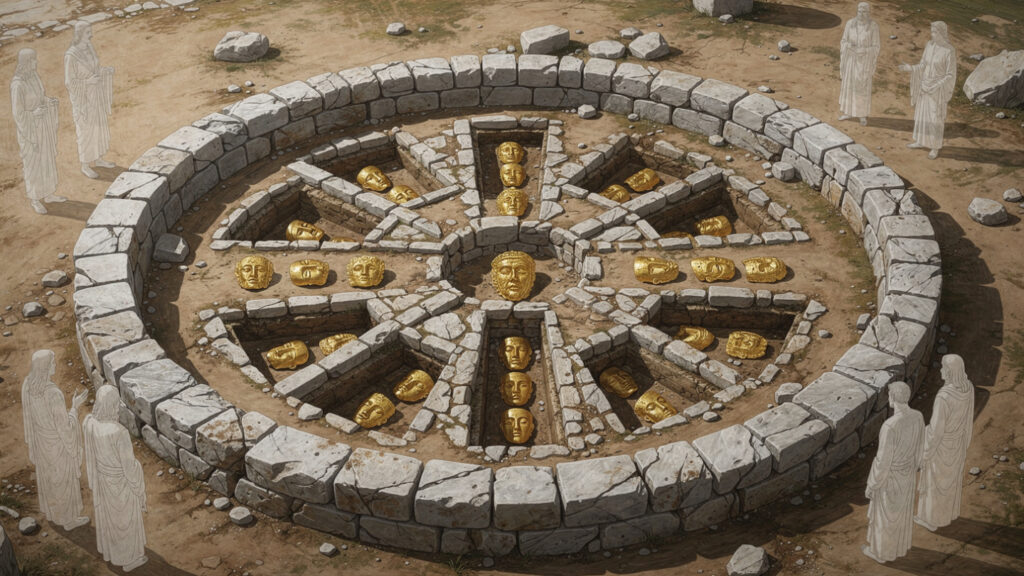
Through the Lion Gate and immediately to the right, inside the citadel walls, lies Grave Circle A.
Schliemann excavated Grave Circle A in 1876 and found there the densest concentration of gold in the Bronze Age Mediterranean world: among the fine weaponry, ornate libation vessels, and other grave goods, some fifteen kilograms of gold was unearthed within the burial site, including five gold death masks placed over the faces of the dead, dozens of gold ornaments, inlaid bronze daggers whose decoration includes hunting scenes of extraordinary quality, and the full range of objects that a Mycenaean elite burial required to equip the dead for whatever came after.
The masks were placed over the faces of the dead at the time of burial. They are repoussé work, the gold sheet hammered from behind to produce a relief that approximates the features of the person whose face it covered. Gold death masks were commonly placed over the face of the wealthy deceased to record the main features of the dead, and the five masks from Grave Circle A represent the most significant surviving group of Bronze Age Greek portraiture.
One mask is different from the others. The mask that Schliemann attributed to Agamemnon differs significantly in its design from the other masks found at the site. It has a pointed beard and a style of moustache that does not align with other Mycenaean imagery of the era’s fashion. It is also unique in having cut-out ears and a three-dimensional appearance. David Traill, examining the evidence accumulated over more than a century of scholarship, proposed that the mask could be a forgery or could be genuine but altered by Schliemann himself.
The controversy has never been resolved. What the physical evidence demonstrates is that the mask designated NM 624, the one in the National Archaeological Museum of Athens that every visitor photographs under the name Mask of Agamemnon, is unlike every other mask from the same grave circle. Whether this makes it Agamemnon’s mask, or a modern addition to the ancient material, or a genuine Mycenaean object of unusual quality whose uniqueness simply reflects the exceptional status of the person it covered, is a question that the available evidence cannot definitively answer.
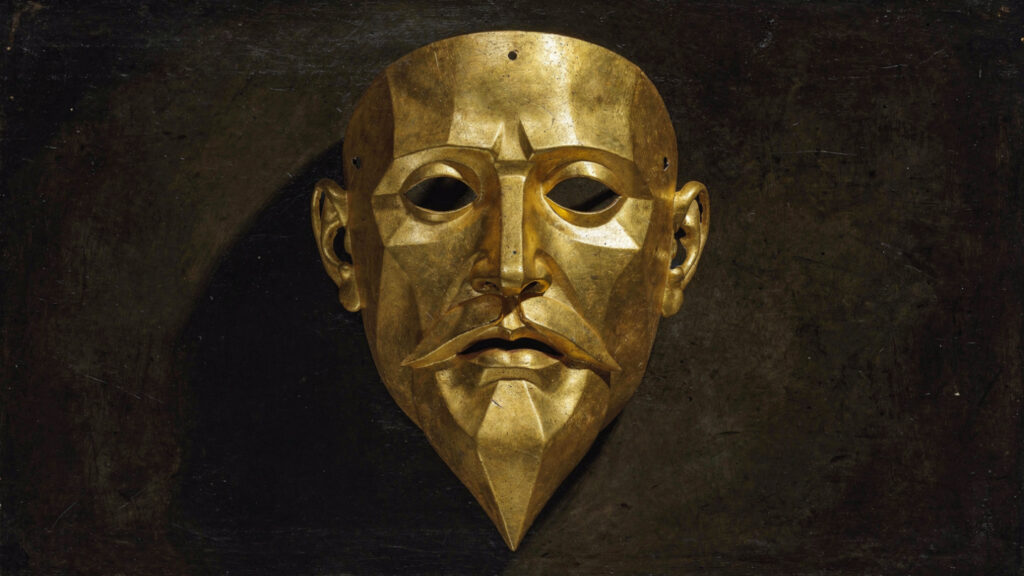
Schliemann telegraphed the Greek king on the day of the mask’s discovery: “I have gazed upon the face of Agamemnon.” The dating of the graves in Grave Circle A places their construction between 1600 and 1500 BCE. The mythological Agamemnon, king of Mycenae and commander of the Greek forces at Troy, belongs to a tradition that places the Trojan War in approximately the thirteenth century BCE, three hundred years after the shaft graves were dug. Whoever the mask covered, it was not Agamemnon.
The name has nonetheless attached itself permanently to both the object and the site. This is not simply Schliemann’s error persisting through inertia. It is the mythological tradition doing what it consistently does to the physical remains of the Bronze Age: asserting its presence in the landscape with a force that archaeological precision cannot fully dislodge.
The Curse That Presided Over the Gate
The mythology that the Lion Gate presides over is the darkest sustained narrative in the Greek tradition.
The House of Atreus, the dynasty whose seat was Mycenae and whose crimes accumulated across three generations until Orestes stood trial at the Areopagus in Athens, begins with an act of hospitality violated and a divine curse accepted. Tantalus, the founder of the line, served the gods the flesh of his own son Pelops at a divine feast, either to test whether the gods were truly omniscient or from the specific madness of a man who had been given too much divine favour and did not know what to do with it. The gods restored Pelops to life and cursed the family that the transgression had produced.
Every subsequent generation paid the cost. Atreus killed the children of his brother Thyestes and served them at a feast of supposed reconciliation. Thyestes cursed the house. Agamemnon sacrificed his daughter Iphigeneia at Aulis to obtain the winds that would carry the Greek fleet to Troy. Clytemnestra spent the ten years of the Trojan War waiting for the husband who had killed their daughter and planning what she would do when he returned. When he returned, she killed him in his bath.
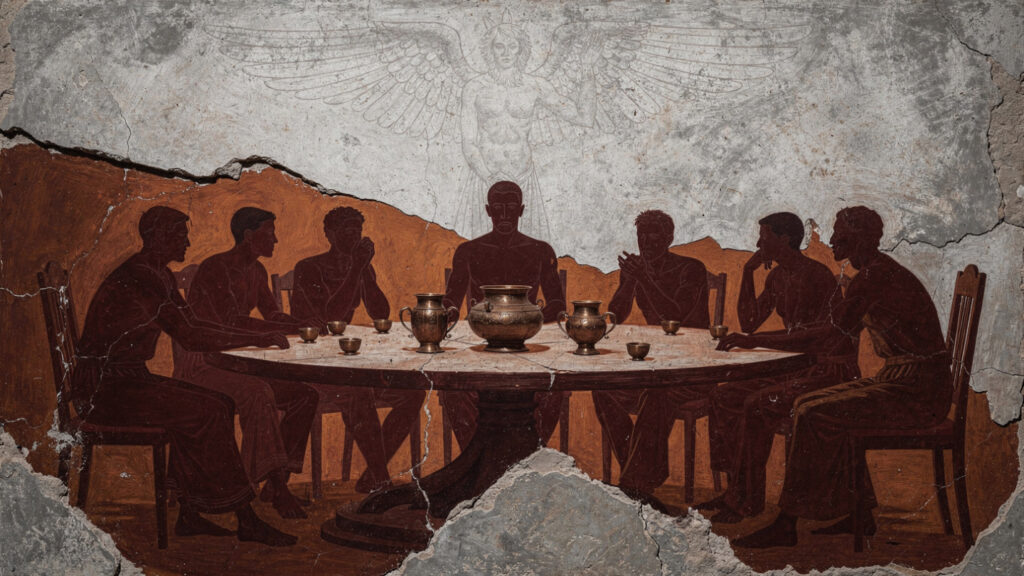
Their son Orestes killed Clytemnestra to avenge his father. The Furies, the oldest enforcers of divine justice in the Greek tradition, pursued him for the murder of his mother. He was tried at Athens, acquitted by Athena’s deciding vote, and the Furies were transformed into the Eumenides, the kindly ones, incorporated into the Olympian order as protectors of the city rather than pursuers of the guilty.
Aeschylus dramatised this sequence in the Oresteia, the only complete tragic trilogy that survives from the fifth century BCE and the work that the Greek critical tradition consistently treated as the highest achievement of the tragic form. The three plays cover the murder of Agamemnon, the revenge of Orestes, and the transformation of the Furies, and they trace through a single family’s history the transition from the older chthonic law of blood vengeance, which required the murder of a murderer regardless of circumstance, to the civic law of the polis, which evaluated actions in context and acknowledged the possibility of acquittal.
The Lion Gate is the address at which all of this happened. The gate that the Mycenaean builders set into the northwest wall of the citadel in the thirteenth century BCE presided, in the mythology that subsequent Greeks built around this place, over the comings and goings of every figure in the Oresteia: Agamemnon returning from Troy in his chariot, Clytemnestra greeting him at the threshold with the purple carpet she spread beneath his feet, Cassandra the Trojan prophetess refusing to enter the palace whose future she could see and whose present she could not prevent.
Standing at the Lion Gate with the Oresteia in mind is the fullest available encounter with what Mycenae was in the Greek cultural imagination: the seat of the power that launched the Trojan War, the palace where the war’s commander was killed on his return, the place where the oldest and most consequential conflict in the Greek legal and moral tradition was staged and where its resolution pointed toward everything that Athens would eventually build.
The Treasury of Atreus
Three hundred metres south of the Lion Gate, outside the citadel walls, the tomb known as the Treasury of Atreus stands in the hillside below the road.
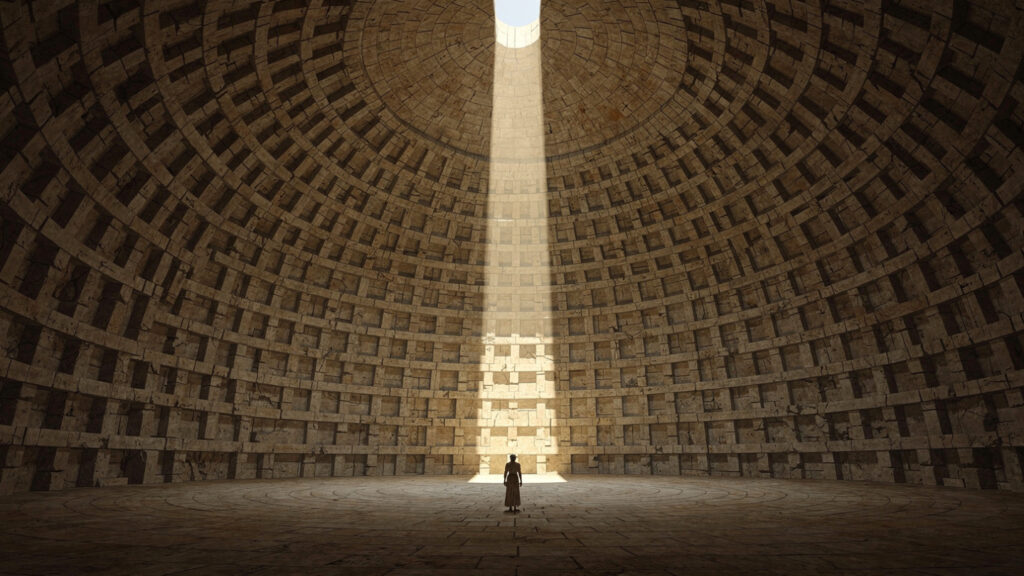
The Treasury of Atreus is the finest of the Mycenaean tholos tombs and one of the most perfectly preserved examples of Bronze Age Greek architecture in the world. Its construction date, around 1250 BCE, is contemporary with the Lion Gate’s, suggesting that it was built as part of the same programme of monumental construction that gave the citadel its final form.
The approach is through a long open corridor, the dromos, cut into the hillside: roughly thirty-six metres of exposed limestone rising to either side, its walls once decorated with green stone pilasters and red porphyry engaged columns whose bases are still visible. The doorway at the end of the dromos is the second largest Bronze Age doorway in the world after the Lion Gate itself, its lintel a single stone weighing approximately 120 tons, among the heaviest single stones placed in any Bronze Age European building.
Inside, the tholos: a corbelled dome of 33 courses of cut limestone, each course slightly smaller than the one below it, the whole rising to a point at roughly 13.5 metres above the floor in a curve whose geometry was calculated to maintain stability without mortar across the nearly three thousand years it has been standing. The interior diameter is approximately 14.5 metres, and the acoustic property of the dome’s geometry amplifies sound from the floor in a way that anyone who speaks inside it discovers immediately: the chamber was built to make sound carry.
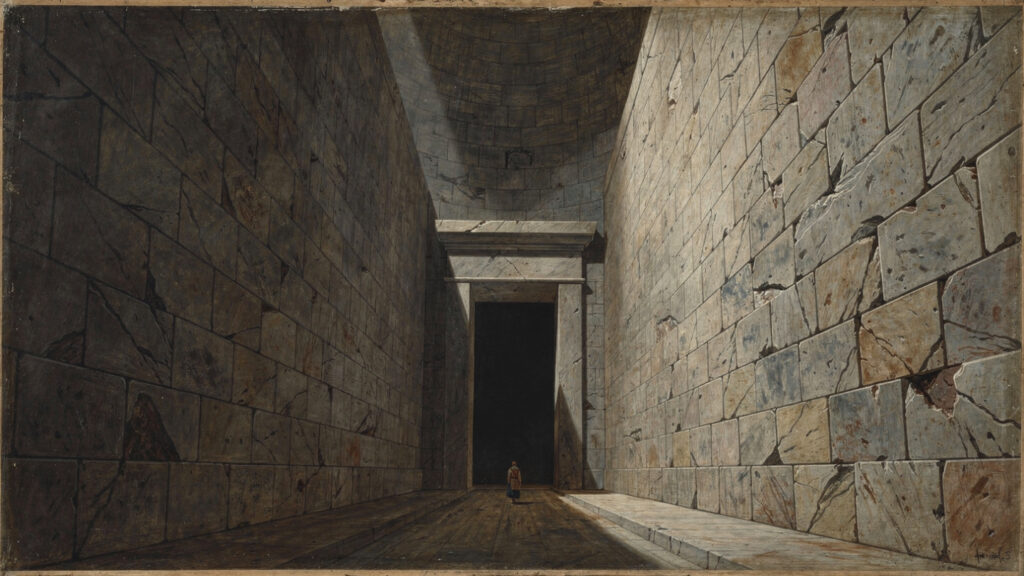
Whether it was used for the rituals that the name Treasury of Atreus implies, whether it ever held the treasures of the House of Atreus or was simply a royal burial chamber, cannot be determined from the archaeological record. The tomb was empty when the first modern investigators entered it. Whatever it contained was removed in antiquity.
Practical Notes
Mycenae is in the Argolid, roughly 120 kilometres southwest of Athens by the motorway that crosses the Corinth Canal and enters the Peloponnese. The site keeps standard archaeological site hours with reduced hours in winter. Confirm current opening times and ticketing before travelling, since these are adjusted periodically. A combined ticket typically covers the citadel, the archaeological museum on site, and the Treasury of Atreus.
Allow at minimum three hours. The Lion Gate deserves time on its own terms before you pass through it: stand back from the gate and look at the composition of the relief, the relationship between the two figures and the column, the scale of the lintel and the jambs, the relieving triangle above the lintel that made all of it possible. Then walk through. The Grave Circle is immediately to your right. The museum holds the original material from the excavations, including the material that is not the Mask of Agamemnon and which is, for that reason, more instructive about what Mycenaean goldwork actually was at its consistent best.
The Treasury of Atreus is a separate short walk outside the main site. Do not skip it. The interior of the tholos is among the most completely preserved Bronze Age interior spaces in Europe, and the proportional relationship between the doorway, the dromos, and the dome inside is one of the most sophisticated spatial sequences the Bronze Age Aegean world produced. Stand in the centre of the dome and speak normally. Understand that this acoustic effect was not accidental.
The best time to visit is at opening, before the tour buses arrive from the coastal resorts. The citadel’s position on its hill catches the morning light from the east in a way that the midday brightness does not produce, and the long shadows from the cyclopean walls give the site its most accurate atmospheric character before the day’s heat has erased the quality of the early air.
The Gate Outlasts the Story
The gate has been there for thirty-two centuries. The heads of the lionesses above it have been missing for most of that time, their absence becoming part of what the gate is rather than a deficiency in what it was. The stones that the Mycenaean builders placed without mortar in 1250 BCE have not required mortar in the thirty-two centuries since.
What the gate presided over, the civilisation that built it, the dynasty that the mythology placed inside it, the war that the dynasty launched, the murders that followed the war, the trial that resolved the murders, the legal and moral order that the resolution inaugurated: all of this is gone. The mythology is the record of it, preserved by the poetic tradition through the Greek dark ages that followed the Bronze Age collapse, given its definitive dramatic form by Aeschylus, transmitted to every subsequent century of Western culture through the specific persistence of the tragic tradition.
The gate is still there. Once you pass through the Lion Gate, the entire fortified citadel opens before you in the same sequence it opened for everyone who passed through it in the thirteenth century BCE. The approach, the corridor, the gate, the grave circle to the right, the palace ascending the hill ahead: the spatial sequence is unchanged.
The headless lionesses watch over the threshold in the same posture they have held since the Mycenaean artists placed them there.
The gate does not need embellishment. It has the House of Atreus.
At Olympus Estate, Sacred Geography explores the places across Greece where landscape, history, and myth read as a single text. The Lion Gate is the oldest surviving monumental sculpture in Europe, carved around 1250 BCE and never lost to excavation. The figures above its lintel are lionesses, not lions, carrying a Minoan compositional tradition into the heart of Mycenaean power. Inside the gate, Grave Circle A yielded the richest concentration of Bronze Age gold in the Mediterranean, including the so-called Mask of Agamemnon, an object that predates the Trojan War tradition by three centuries. The mythology of the House of Atreus, the curse, the sacrifice, the murders, the trial that founded civic justice at Athens, was staged by later Greek imagination at exactly this threshold.