



The gods were never simply theological propositions to be accepted or rejected.
In Greek religion, the Olympians were not primarily beings who demanded worship in exchange for supernatural intervention. They were explanations. They gave the Greek world a vocabulary for an observable fact: different places produce different human types. The person formed by the rocky independence of the Mani carries a different character than the person formed by the argumentative civic life of Athens. The sailor who navigated the borderlands between East and West moved through the world with a different intelligence than the warrior who defended the mountain passes of Thermopylae.
The gods explained this, and not metaphorically or as a polite literary device. Centuries of concentrated attention to the relationship between landscape and character had already established, with real precision, that people who lived under certain landscapes became certain kinds of people, and that the kind each landscape most reliably produced was the kind most precisely described by whichever divine figure most fully expressed that landscape’s own domain.
Athena was never the goddess of wisdom in the abstract. She was the explanation for Athens. The city’s civic character, its emphasis on planning and argument, its refusal to act until the strategy was refined, was the character the landscape and generations of accumulated practice had produced, and the name given to that character was the name of the goddess whose own domain was exactly the combination of strategic intelligence and civic craft the city most distinctively expressed.
To say that Athena loved Athens was to make an observable claim about the relationship between a divine character type and a human community. The claim was that the community’s character was the character the older naming had already identified. And the claim was correct: Athens was the city that produced Socrates and Thucydides and Pericles, the argumentative, architecturally precise, legally sophisticated civic world the name Athena described most exactly.
What Happened to the Gods
Greek religion did not end. It transformed.
The transformation that gives Greek culture its particular quality of living depth is not the standard account of paganism giving way to Christianity: one theological system replacing another, the old gods defeated and the new God triumphant, temples converted to churches, the divine population of Olympus retired to the status of literary figures preserved in old texts.
The actual transformation was more interesting and more complete than that account allows. The gods did not retire. They dissolved, into the habits and temperaments and aesthetic preferences and social patterns of populations who had organized their whole understanding of themselves around these divine character types for so long that the divine vocabulary and the human reality had become indistinguishable.
The islands that organized their aesthetic life around Aphrodite, the cultivation of beauty and timing and the power of the atmospheric encounter, did not stop producing people whose excellence was the excellence of the beautiful and the well-timed once formal worship of the goddess ended. The quality of encounter that Ionian light and Aegean water and island social life produced in the people who lived within it was exactly the quality the older Aphrodite naming had cultivated, and it persisted because the landscape and the social patterns that shaped it persisted too.

The gods dissolved into the people because, over centuries of active practice, the people had become the human expression of the divine character types their own worship had been cultivating all along. The worship ended. The people it had shaped remained, carrying in their habits, their excellences, and their characteristic failures the same character types that older naming had given form to.
The names became less explicit. The temples became churches. The festivals changed their theological framing. But the character persisted. It persists still.
Athens and the Athena Character
The character Athens produced, and Athena named, was defined above all by a refusal to act until the thinking was complete.
This is not a generalization about Greek intellectualism. It is an observable claim about a city built on argument, the law court, the philosophical school, and the architectural plan drawn and redrawn until the proportions were exactly right. The Parthenon is not simply a beautiful building. It is the material expression of an Athenian character defined by refusing to leave anything to chance that precise thought could address instead.
The entasis of the Parthenon columns, the slight convexity that counteracts the optical illusion of concavity perfectly straight columns would otherwise produce under Attic light, is this same character expressed in its most concentrated material form. The architects did not simply build a beautiful temple. They identified an optical problem the light of the site itself produced, and solved it with a geometric correction whose precision demanded exactly the quality of attention Athena’s name had always stood for.
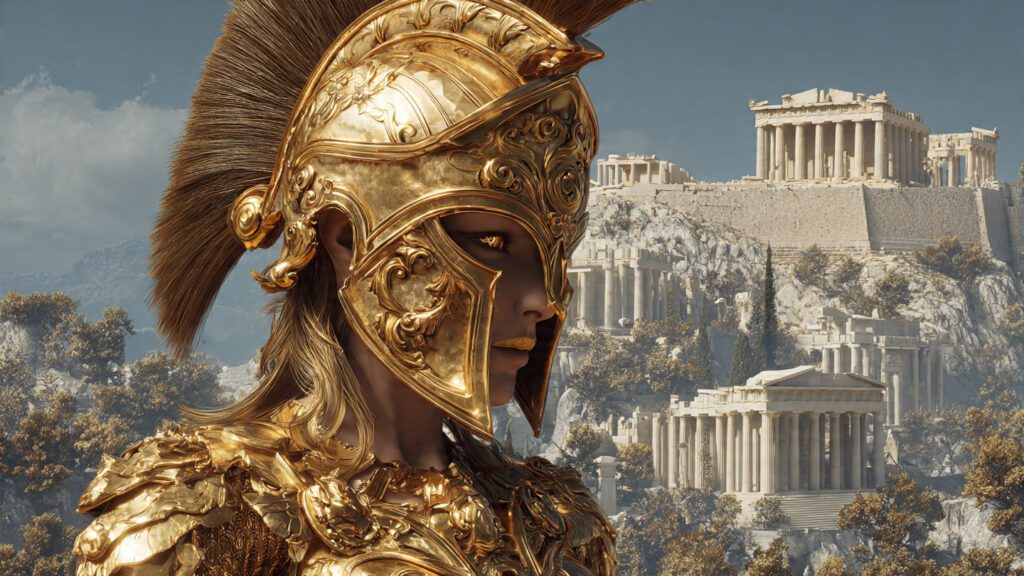
The Greek architecture article in this collection develops the entasis observation directly. The intellectual capacity it requires, identifying a problem ordinary perception misses and solving it with a correction that produces the appearance of what was not actually there, is the Athena character in its most precise technical expression. The city that built the Parthenon was the city centuries of this same character had already shaped.
The children of Athena are still in the law courts and the architectural studios. They speak little but precisely, measuring their words the way a mason measures a block of marble, observing a room before they enter it. Their power lives not in noise but in the quality of attention they bring to whatever problem they have decided to solve.
The Islands and the Aphrodite Character
The character of the islands is harder to pin down with the precision Athena allows, because it is the character of the atmospheric and the beautiful rather than the argued and the planned, and the atmospheric resists exactly the kind of articulation argument produces so naturally.
But the observation still holds: certain Greek islands, where light, water, and the social patterns their geography shaped meet, reliably produce the kind of human excellence Aphrodite’s name once captured.
The Aphrodite character understands timing, atmosphere, and the power of presence without explanation. It is the person who makes themselves available to what a moment offers rather than imposing a plan on it, for whom beauty is not decoration but the organizing principle whose presence or absence is the single most important fact about any situation.

Kythira, the island closest to the myth of Aphrodite’s own arrival, and Cyprus, the island most consistently associated with her ancient cult, share the quality of light her mythology describes most precisely: the light that falls on the water at early morning and late afternoon, when the sun’s horizontal angle produces exactly the color and refraction older naming recognized as the goddess’s own presence.
People who live long enough inside that particular light develop the same sensitivity to atmosphere the name once described. Not through anything mystical. Through the accumulated experience of living inside an environment whose own qualities demand exactly that kind of attention from anyone who inhabits it.
The Mountains and the Artemis Character
The Artemis character is a fierce independence that does not require the organized civic community’s approval to know its own value.
The regions of Greece most consistently linked to Artemis were mountain regions whose landscapes demanded self-sufficiency and rewarded anyone capable of reading the natural world well enough to survive inside it. Epirus, the Pindus range, and the pastoral highlands of Arcadia are the places this collection’s articles on the Zagori, the Vikos Gorge, and the Arcadian pastoral world all develop, from both a geographical and a cultural angle.
The Artemis character appears in these regions as people most comfortable at the margins, resistant to the confinement of organized civic space, who value the cold air and silence of the heights the way the older naming valued the goddess’s own domain. The Sarakatsani and Vlach pastoral communities, whose transhumance cycle the trahanas article in this collection presents as living continuity of the pastoral calendar, are the most complete contemporary expression of this character: communities whose whole way of life requires independence from fixed settlement, the excellence of a being who belongs to the wild rather than the city.

The danger in the Artemis character is exactly the danger the collection’s articles on the Arcadian world consistently acknowledge: isolation deep enough that the warmth of human community starts to feel like a constraint rather than a resource. At its best, the mountain character is fierce and self-sufficient. At its worst, it is a community contracted down to the point where only its own inherited patterns remain legible at all.
The Borderland and the Hermes Character
Greece’s entire history has been the history of a borderland: the position between East and West, ancient and modern, continental and maritime, fixed and mobile.
The Hermes character is exactly what this civilizational position most reliably produces: someone who moves between worlds with the ease of a being for whom crossing is not a challenge but a natural mode of existence. The merchant, the sailor, the translator, the diplomat, the person who belongs everywhere and nowhere, fluent in many languages both literal and social, who finds real opportunity in the gaps between things rather than at the centers of established power.

Greek history is, in a real sense, a Hermes story. It is the story of the sailors who built the Mediterranean trading network whose reach the amphora distributions and the shipwreck record still document as the most extensive material evidence of the ancient world’s economic integration. It is the story of philosophers whose thought traveled from Athens to Alexandria to Rome to the Islamic world to the Renaissance without ever losing its essential character, precisely because that thought had been shaped inside a civilizational position that demanded transmission without loss, exactly the quality the Hermes character represents most clearly.
The excellence of the Hermes character is the ability to carry something valuable across a boundary separating one world from another without losing it or changing it into something else. The failure this character risks is becoming so accustomed to crossing that the very center, the identity the crossing was meant to serve, gets lost somewhere in transit.
The Volcanic Depth and the Hades Character
The Hades character is the hardest to name without real context, because its defining quality is precisely the invisible: depth beneath the surface, an influence that shapes the present without ever appearing in it, the weight of what has been lost giving the present its particular gravity.
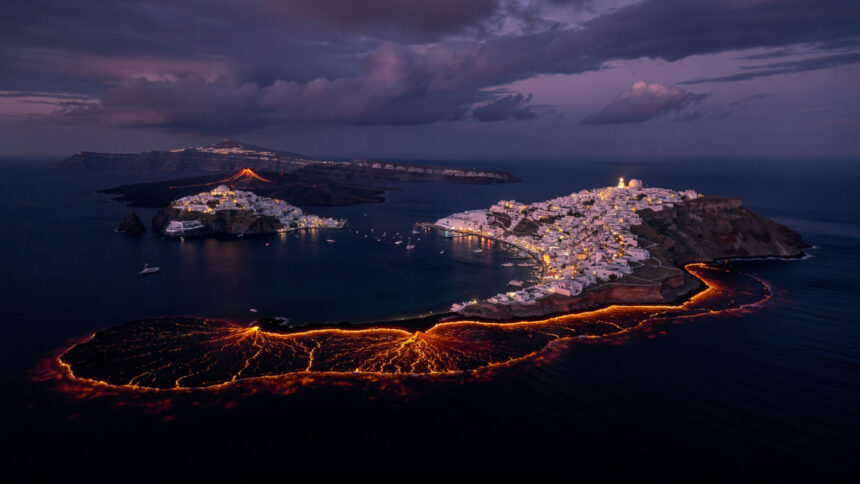
The Greek landscapes most consistently associated with Hades are exactly the landscapes whose own character expresses this depth beneath the surface most directly: the volcanic soil of Santorini and the volcanic arc, whose theological-geological encoding the volcanic arc article in this collection develops, the abandoned stone villages of the Mani, whose character the Mani Peninsula article develops through its tower houses and blood-feud culture and a landscape stripped of all ornament, and the ancient cemeteries where cypress trees stand as living markers of the boundary between the above-ground and the underground.
People who live long enough inside these landscapes develop exactly the quality of attention to depth Hades’s name once described. Not the morbid preoccupation of someone fixated on death, but the attention of someone who understands that the visible surface of any situation is the smallest part of it, and that whatever determines what happens in the visible present is mostly at work in the invisible depth the surface simply sits on top of.

This character is drawn to the difficult truths others prefer to ignore, understanding that the most significant transformations happen invisibly, that the above-ground beauty of the Greek landscape is itself produced by geological violence occurring in the depths, and that a human community’s most significant qualities are, in the same way, produced by losses and transformations its visible surface never displays.
The Dissolution and Its Evidence
The claim running through this whole article, that the gods dissolved into the people and became the descriptive vocabulary for the observable character of regions and the human types they produce, is not a mystical claim. It is a historical and cultural one, and its evidence is simply the continuity between the old divine character types and the human character types these same regions keep producing.

Athens remains the city where argument is the primary civic art. The islands shaped by Aphrodite’s legacy still cultivate the sensitivity to atmosphere her name once captured. The mountain regions formed under Artemis’s influence continue to produce the fierce independence that landscape demands. And the maritime borderland civilization still gives rise to the Hermes character, people who move between worlds with a natural ease, carrying ideas, languages, and possibilities across every boundary they encounter.
The gods did not leave Greece. They changed form, from the explicitly theological to the implicitly cultural. The temples became churches, then ruins, then the sites this collection’s Wanderlust Greece articles document, places where the old divine character types are most directly legible in the quality of the landscape and the quality of the people it has formed.
To visit Delphi is to visit the site where the Apollonian character, a clarity that tolerates no confusion, is most directly legible in the quality of the light, the quality of the silence, and a landscape organized entirely around orientation toward the truth that once belonged to the god of light. To walk the Zagori is to walk through the living landscape of the Artemis character. To stand in the Mani is to stand in the landscape of the Hades character.

The gods are still there. They are in the landscape that formed the people. They are in the people that landscape formed. They are in the character of the human types these regions keep producing, generation after generation, because the landscape that first produced these divine character types has not changed, and the people who live inside it are still shaped by exactly the qualities that were first given a name when someone named the gods.
The naming described what it observed. What it named has not stopped being observable.
At Olympus Estate, Cultural Chronicles traces the practices and institutions that defined Greek civilization from the inside. The gods were not primarily theological propositions but explanations for the observable fact that different landscapes produced different human types. Athena was the explanation for Athens: the city of the argument and the architectural precision and the refusal to act until the strategy was complete. The islands shaped by Aphrodite still produce the sensitivity to the atmospheric and the beautiful. The mountain regions shaped by Artemis still produce the fierce independence that resists confinement. The borderland maritime civilization still produces the Hermes character in the people who move between worlds as their natural mode. The Hades character is most legible in the volcanic soil of Santorini and the stripped landscape of the Mani. The gods dissolved into the people. The naming described what it observed. What it named has not stopped being observable.