





The Greek mythological tradition understood desire as a force of transformation.
This is the claim that distinguishes the Greek treatment of the erotic from the romantic traditions that derived from it: in the Greek understanding, desire did not simply produce emotional states, the longing of the desiring subject and the discomfort or pleasure of the desired object. It produced physical transformations, literal metamorphoses that changed what the persons involved were rather than simply how they felt. The nymph who flees the pursuing god does not simply escape and return to her life unchanged: she becomes a tree, or a spring, or a constellation, or a reed bed. The god whose desire is frustrated does not simply experience disappointment: he makes the transformed object sacred, or he follows the transformed object by transforming himself, or he fashions the transformation into an instrument and uses it to make the music that his desire had been reaching toward.
The transformations are the myth’s account of what desire does at its most extreme: it changes the nature of what it touches, and the change is permanent and visible in the world in the form of the natural phenomenon or the cultural artifact or the sacred object whose origin the myth explains. The laurel that Apollo wears, the pipe that Pan plays, the voice that Echo cannot stop from repeating, the spring at Ortygia that flows beneath the Sicilian sea: these are not symbols of what the desire felt like. They are the desire in its transformed and permanent form, the residue that the erotic encounter left in the world when the encounter itself was over.
Ovid’s Metamorphoses, the first-century BCE Latin poem that collected and elaborated the Greek tradition’s transformation myths in the most complete surviving account, understood this organizing principle of the tradition and made it the explicit theme of the poem: the fifteen books of the Metamorphoses are fifteen books about transformations, organized around the claim in the poem’s opening lines that the poem will trace the continuous history of the world from its origin in Chaos to the present moment of Ovid’s own Roman world as a history of forms becoming other forms. The erotic myths of transformation constitute the largest single category of the poem’s material, which reflects the tradition’s own understanding that desire was the force most consistently productive of transformation.
Apollo and Daphne | The Laurel That Would Not Be Touched
The myth of Apollo and Daphne is the myth whose structure most economically expresses the governing logic of the erotic transformation tradition: a deity desires a mortal or divine figure, the desired figure flees, the pursuit ends in a transformation, and the deity in whom the desire remains unresolved makes the transformed figure into a sacred object whose form preserves the memory of the desire that produced it.
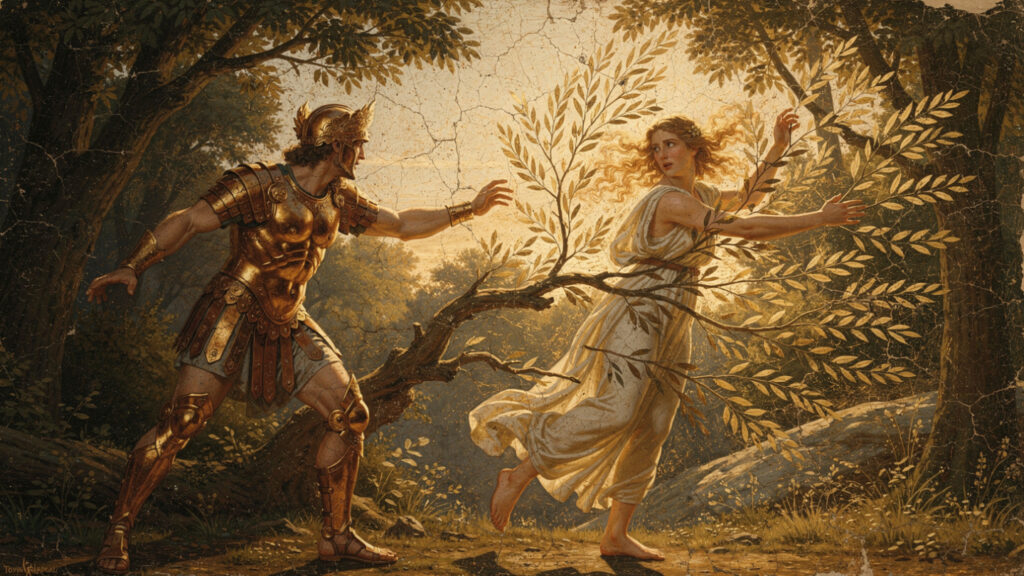
Eros shot Apollo with a golden arrow that produced desire, and Daphne with a leaden arrow that produced aversion, and the asymmetry of the two effects, desire in one party and aversion in the other in response to the same encounter, is the myth’s account of how desire can exist without the possibility of reciprocation built into the situation from the beginning. Daphne’s aversion to Apollo was not a response to Apollo’s desire: it preceded the encounter, imposed by the same divine force that produced the desire. The myth is not a story about a god whose inappropriate desire drove away a figure who might otherwise have responded differently. It is a story about the condition in which desire and aversion are simultaneously present in the same encounter as a divine arrangement, and what that condition produces.
The pursuit is the central action of the myth, and Ovid’s account of it in the first book of the Metamorphoses develops it through the comparison that makes its quality most vivid: Apollo runs as the greyhound runs, and Daphne runs as the hare, and the distance between them closes as the greyhound’s jaws approach the hare’s flank in the final moment before Daphne calls to her father Peneus for transformation. The comparison is not simply a way of saying that the pursuit is fast: it is the comparison that captures the quality of the erotic pursuit as the Metamorphoses understands it, the gap between desire and its object narrowing toward a closure that the transformation prevents.
Peneus transforms his daughter into a laurel tree at the moment of Apollo’s arrival, and Apollo, whose embrace closes on the bark where Daphne’s skin was, feels the heart of the tree still beating. He declares the laurel sacred, makes it his own tree, and decrees that it will crown the victorious general and the winning poet: the transformation does not end the desire but relocates it, transferring the sacred quality of the desired figure onto the transformed figure’s permanent form. The laurel wreath at the Pythian Games and the laureate poet of the literary tradition are both carrying the trace of the desire that produced the transformation: the desire in its permanent and public form, made into the instrument of honor and of recognition that the quality of the original desired figure had suggested.
Orpheus and Eurydice | The Look That Ended Everything
The myth of Orpheus and Eurydice is the myth whose structure is the most complex in the tradition of the erotic encounter: it is not a story about desire and transformation but about the power of music as the medium through which desire can accomplish what no other human capacity can accomplish, and about the quality of the condition it imposes on the lover who uses it.

Orpheus descended to the underworld after Eurydice’s death from a snake bite and sang to Hades and Persephone: the myth is consistent across all its ancient versions that he persuaded the rulers of the dead through the medium of his music rather than through any physical capacity or divine assistance. The myth’s claim is that the music was more powerful than the boundary between the living and the dead, that the beauty of the Orphean song could move what was otherwise immovable, and that the permission to return with Eurydice was the underworld’s acknowledgment of this power.
The condition that Hades imposed, that Orpheus must not look back at Eurydice until they had both reached the surface, is the condition that the myth has accumulated the most commentary about, because its apparent arbitrariness, why should looking back undo the permission, conceals a theological logic that the ancient and modern interpreters have consistently unpacked differently.
The most resonant reading is the reading that the condition’s logic develops: Orpheus traveled to the underworld by the power of his music, which was the power of his desire transformed into an art that could cross the boundary between the worlds. The condition that he not look back was the condition that his desire remain in its transformed artistic form for the duration of the crossing rather than returning to its direct and unmediated form. The look back was the moment when the desire stopped being the art and became the direct yearning for the person: the moment when Orpheus could no longer sustain the quality of the music that had accomplished the impossible and reverted to the ordinary desperate desire of the bereaved lover who cannot wait any longer.
Virgil, in the fourth Georgic, gives Orpheus the motivation of madness, furor, the divine madness of the lover that could not sustain the condition. Ovid, in the tenth book of the Metamorphoses, is less interested in the motivation than in the consequence: Eurydice vanishes back into the underworld saying nothing except farewell, and Orpheus is left at the threshold between the living and the dead with the boundary restored and the music insufficient now to cross it again. The ferryman will not carry him across the Styx a second time.
The quality of Orpheus’s singing after the second loss, which Ovid develops in the tenth and eleventh Metamorphoses, is the quality of the music that has lost its object and continued anyway: the songs that Orpheus sings in the wilderness after Eurydice’s second departure are the songs about the loves that ended badly, the Catalogue of Losses that occupies the rest of the tenth book of the Metamorphoses, which is the tradition’s account of what the great musician did with his desire after it could no longer accomplish what it had previously accomplished. He made it into art. Which is what he had done before the descent, and what the art had always been.
Apollo and Cassandra | The Gift That Was Also a Curse
The myth of Apollo and Cassandra is the myth that develops the erotic logic of the gift most completely: the god who desires gives the desired figure what the figure wants in exchange for what the god wants, the exchange is partially completed, the god’s desire is refused after the gift is given, and the god in whom the desire remains converts the gift into its opposite without withdrawing it.
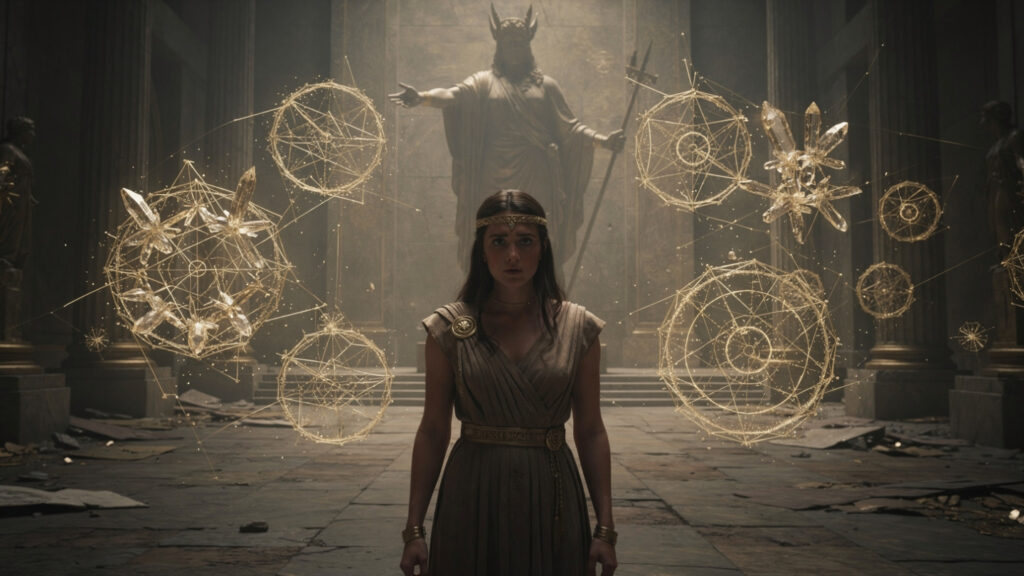
Apollo gave Cassandra the gift of prophecy: the capacity to see what would happen before it happened, to know the truth of future events with the accuracy and the certainty that the divine knowledge of time possessed. The gift was given in exchange for Cassandra’s love, and Cassandra accepted the gift and refused the exchange. What happened to the gift after the refusal is the myth’s contribution to the tradition’s understanding of what happens when the divine desire is refused after the instrument of the desire’s satisfaction has already been delivered.
Apollo could not withdraw the prophecy. The gift was a permanent alteration of Cassandra’s nature, not a revocable object. What he could do was add to it the condition that transformed it from a gift into its opposite: he breathed into her mouth, and thereafter her prophecies, though accurate, would not be believed. The capacity to see the truth was given. The capacity to communicate the truth in a form that would be received was removed.
Cassandra in the last years of Troy was the figure in whom the most complete knowledge of what was happening coexisted with the complete inability to make that knowledge useful to anyone, including herself. She saw the Trojan Horse for what it was and said what it was and was not believed. She predicted the fall of Troy and was dismissed as mad. She knew what Clytemnestra would do to Agamemnon at Mycenae and walked into the palace knowing it and could not prevent it and was killed alongside him. The prophecy was perfectly accurate at every point. The curse was perfectly effective at every point.
The myth is the ancient heritage’s most sustained account of the form of suffering that is produced by the coexistence of certain knowledge and complete inefficacy: the suffering of the person who knows the truth and cannot make the truth matter, who sees what is coming and cannot deflect it, who has the most important information available and is structurally prevented from transmitting it in a usable form. Apollo’s gift was the gift that turned its recipient into the most isolated figure in the heritage: the person who knows most is the person whom no one believes.
Salmacis and Hermaphroditus | The Body That Could Not Be Divided
The myth of Salmacis and Hermaphroditus, developed most completely in the fourth book of Ovid’s Metamorphoses, is the myth that takes the transformation logic of the erotic to its most literal and most extreme conclusion: the desire for union with the beloved produces not the conventional union of lovers but the literal physical merging of the two persons into a single body that is neither what either was before.
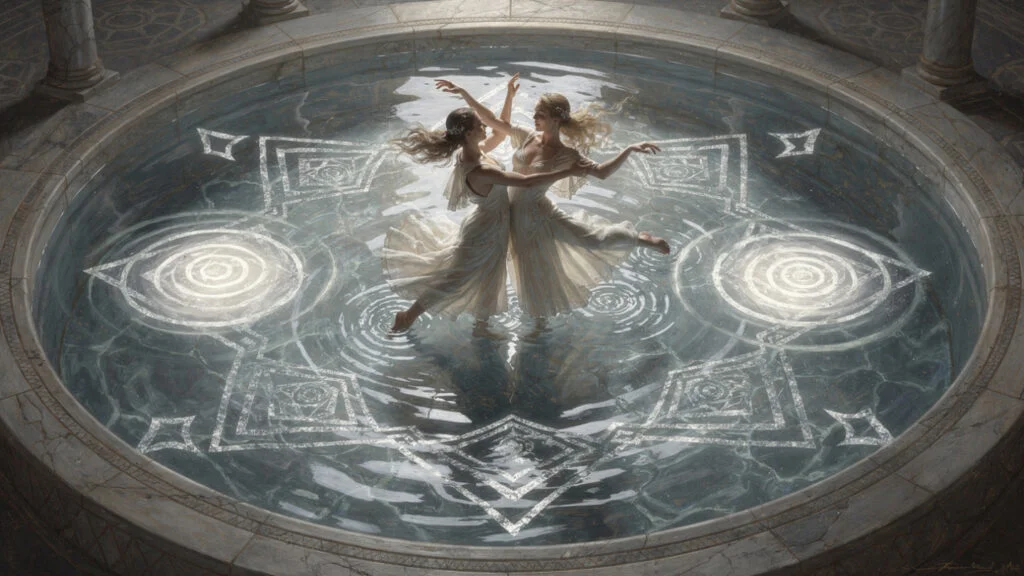
Hermaphroditus was the son of Hermes and Aphrodite, which gave him the combination of divine beauty from his mother’s side and divine swiftness and intelligence from his father’s, and which made him the figure whose appearance in the world was the divine combination of the qualities most associated with desire and the qualities most associated with the intelligent management of desire in a single person. At fifteen, wandering through Caria, he found Salmacis’s pool: the spring in the forest whose quality, that the water made men who bathed in it soft and unmanned, was the reputation that the ancient tradition gave the pool before Ovid provided the aetiological myth that explained it.
Salmacis saw Hermaphroditus and desired him completely: Ovid’s account of her desire is the account of a desire that cannot accommodate any distance between itself and its object, that finds the space between the desiring subject and the desired object intolerable and seeks to eliminate it. Her prayer to the gods was the prayer that they never be separated, which was not a prayer for love but a prayer for merger: not the mutual relation between two persons but the elimination of the twoness.
The gods answered the prayer literally: the two bodies, Salmacis’s clinging to Hermaphroditus’s in the water, merged into a single body that was neither the woman nor the man who had entered the pool but something that combined both and was neither completely. Hermaphroditus’s own prayer in response was the prayer that any man who bathed in the pool would undergo the same softening transformation, which is the myth’s aetiological explanation for the pool’s reputation.
The myth is the transformation tradition’s most extreme statement about the logic of desire that seeks complete union: union with the beloved can be achieved if what is meant by union is the literal elimination of the distinction between the two parties, but what is produced by that elimination is not the satisfaction of either party’s desire but something that was not desired by either and that cannot be undone. The transformation is permanent. The pool still softens.
Calypso and Odysseus | The Love He Had to Leave
The Calypso episode in the Odyssey, in which the nymph Calypso keeps Odysseus on her island of Ogygia for seven years and offers him immortality if he will stay as her lover, is the myth that develops the tension between the divine erotic offer and the mortal’s attachment to what he already has most fully and most sympathetically.
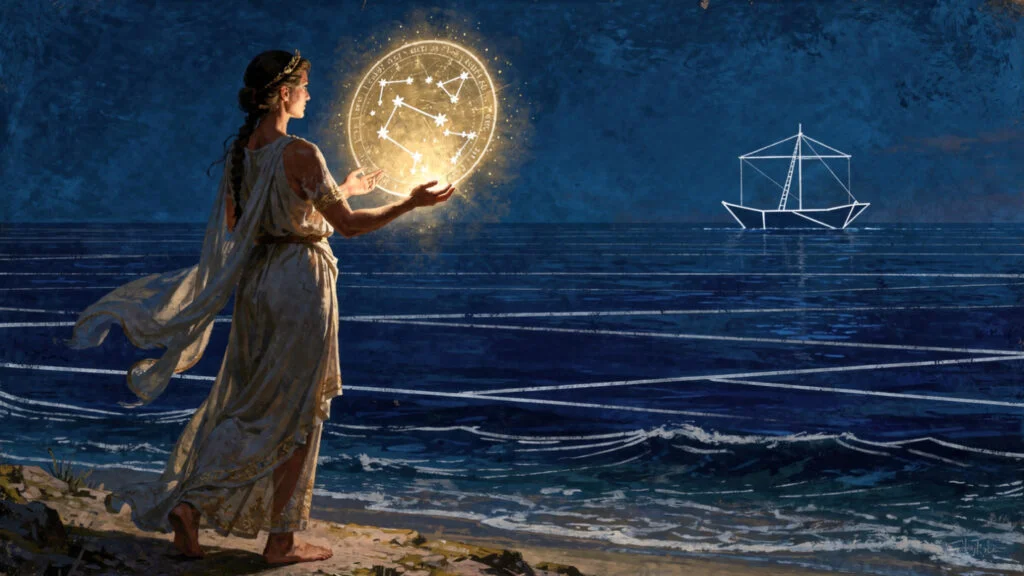
Calypso loved Odysseus. The Odyssey does not present her love as possessive delusion or divine arrogance: it presents it as genuine, and it presents Calypso’s grief when Hermes arrives with the divine instruction to release Odysseus as the grief of a person who has loved genuinely and is losing what she loves through no failure of her love. Her complaint to Hermes is the complaint of the one who has been treated unjustly by a double standard: the male gods take mortal women as lovers without consequence, but when a female deity takes a mortal man as a lover she is forced to release him by the divine administration on the grounds that the mortal’s own wishes, and his wife’s prior claim, supersede the goddess’s offer.
The immortality that Calypso offered Odysseus was the erotic offer that the divine can make and that the human tradition consistently presents as the offer that defines what the mortal’s choice actually reveals about them: the choice between immortality with the divine lover and mortality with the human wife is the choice between a life that is unambiguously better by every material measure and the human life that the mortal actually has, with its people and its place and its limitations. Odysseus wept on the shore every day for Ithaca. He went to Calypso’s bed each night because the alternative was more painful than her company. He chose Penelope every morning when he sat on the shore and looked toward home.
The quality of Calypso’s release of Odysseus, which Homer describes with the detail of a navigator’s instruction, the celestial reference points and the direction and the duration of the journey, is the release of the beloved who understands that the beloved cannot stay and gives them what they need to leave. Her love is not diminished by the release: it is expressed in the practical form of the navigator’s guidance. The most complete expression of Calypso’s love for Odysseus in the Odyssey is the instruction she gives him about which stars to keep on which side as he sails northeast toward Ithaca.
Pan and Syrinx | Desire Becomes the Instrument
The myth of Pan and Syrinx, which appears in Ovid’s Metamorphoses in the first book as the story that Hermes tells Argus to put him to sleep, is the shortest of the erotic transformation myths in the canonical collection and the one whose transformation most completely expresses the governing logic of the tradition: the desire that cannot reach its object becomes the instrument that produces the art.
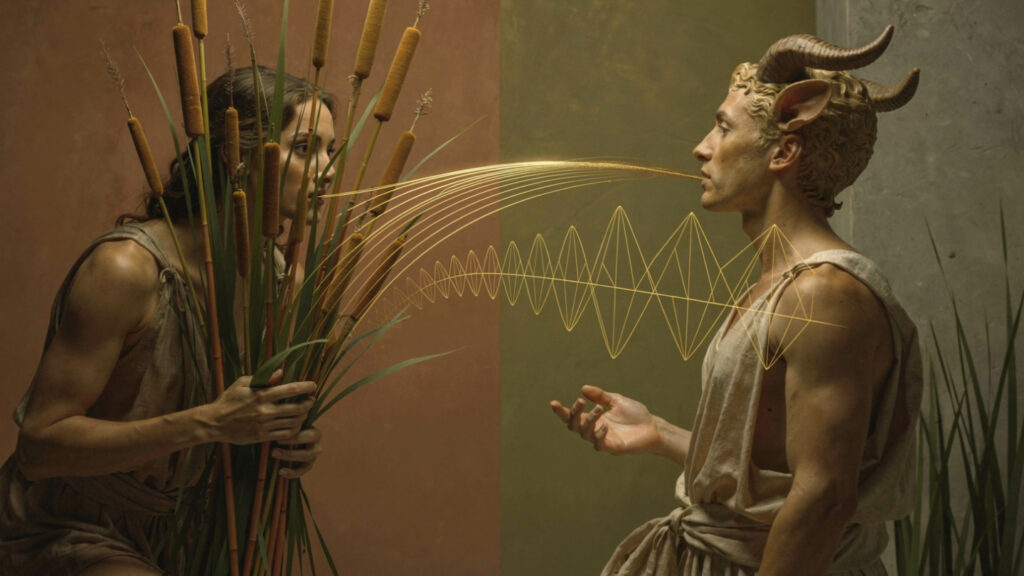
Pan pursued Syrinx through the Arcadian forest. She was a follower of Artemis, devoted to chastity, and she had the quality that made her most attractive to Pan and most determined to remain unattainable: she looked like Artemis herself. The pursuit ended at the river Ladon, where Syrinx called to the water nymphs and was transformed into reeds in the moment before Pan’s hands closed on her.
Pan’s hands closed on the reeds. He breathed a sigh of disappointment, and the sigh passing through the uneven reeds of different lengths produced a sound. The sound was the first music that the pan flute would produce, and Pan, hearing the beauty of what his own breath through the reeds of the transformed Syrinx made, cut them and tied them together and fashioned the syrinx, the pan flute that bears her name.
The logic of this transformation is the logic that the entire tradition has been reaching toward: the desire that cannot reach its object, that is interrupted by transformation at the last possible moment, becomes the art that the desiring subject makes from the transformed remains of what it desired. Pan plays the syrinx and the music that emerges is the breath of his desire passing through what Syrinx became, and the music is more beautiful than any embrace could have been because the transformation concentrated the quality that the desire was reaching toward into a form that the art could sustain and reproduce and carry into the world.
Hermes tells this story to Argus to put him to sleep: the myth of desire and transformation, told in the form of a story whose beauty is soporific, is the story within the story that the Metamorphoses uses to demonstrate the power of narrative to do what Orpheus’s music could do: to move the resistant listener toward a state they would not voluntarily enter. Argus fell asleep listening to the story of how desire becomes music. The story was the music.
What the Transformations Were For
The six myths developed here share the logic of the transformation tradition without being the same myth in different settings: Apollo desires Daphne and Daphne becomes the laurel that crowns achievement. Orpheus desires Eurydice and the desire becomes the music that crosses the boundary between the worlds and then fails to sustain the crossing. Apollo desires Cassandra and the desire becomes the gift that is also the curse. Salmacis desires Hermaphroditus and the desire eliminates the boundary between the two persons completely. Calypso desires Odysseus and the desire becomes the navigation instruction that allows the beloved to leave. Pan desires Syrinx and the desire becomes the instrument that makes the music.
In each case, the transformation is the permanent form that the erotic encounter leaves in the world. The laurel, the music, the curse, the merged body, the star chart, the flute: these are not the consequences of the encounters in the external world. They are what the encounters were, in their most compressed and most permanent form. The Greek mythological tradition’s account of desire was the account of a force that changed what it touched into something that would last.
At Olympus Estate, Mythic Essays moves through the deeper currents of the Greek tradition. Ovid’s Metamorphoses opens with the announcement that the poem will trace the continuous history of forms becoming other forms. The erotic myths constitute the largest single category of the poem’s material because the tradition understood desire as the force most consistently productive of transformation. Pan’s breath through the reeds of the transformed Syrinx produced the first music of the pan flute. The desire became the instrument. The instrument made the music. The music outlasted both of them.