



The myth of Phaethon begins not with a chariot but with a taunt.
A schoolmate, or a rival, or simply someone who found the claim worth challenging, told Phaethon that he was not the son of Helios. That the story his mother Clymene had told him about his divine paternity was the kind of story that mothers tell. That no evidence supported it. That Phaethon was, despite his name meaning the shining one, the son of no one important, and his certainty about his own divine origin was the certainty of a person who had never been required to prove it.
He went to his father.
This detail, which Ovid develops at length in the Metamorphoses and which earlier versions of the myth establish as the myth’s founding condition, is the one that changes the entire meaning of what follows. Phaethon did not seek to drive the solar chariot out of ambition or recklessness or the desire to surpass the gods. He sought it because it was the only proof available to him. His divine parentage could not be demonstrated by resemblance alone: the son of a sun god looks like a mortal because his mother was mortal. It could not be demonstrated by his mother’s testimony alone: she had cause to say what she said regardless of its truth. The only demonstration that would carry the weight the challenge required was an act that only a son of Helios could perform, and the act that only a son of Helios could perform was to drive the chariot.
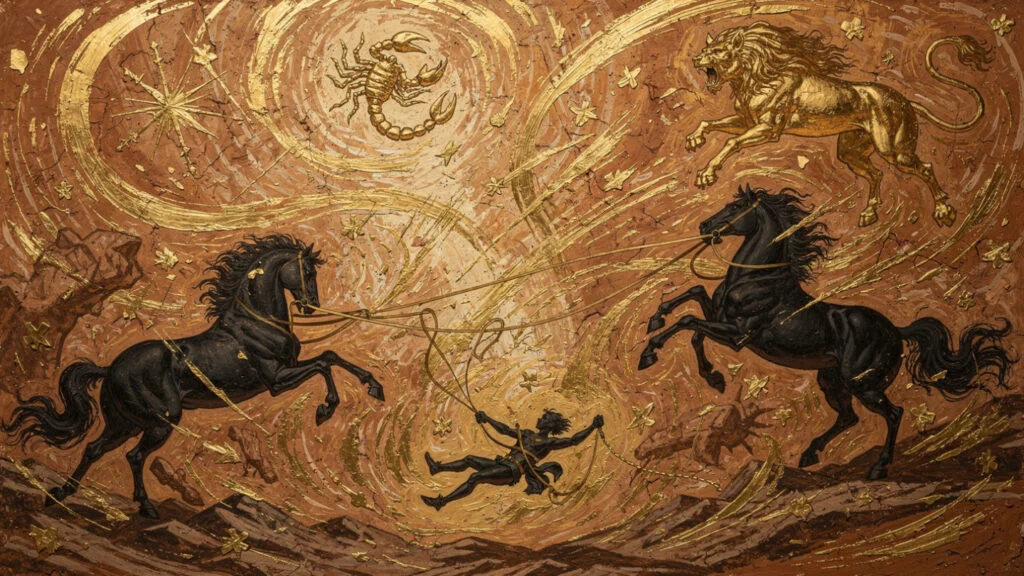
He asked his father for this proof. Helios, whose love for his son was real and whose understanding of the chariot’s danger was equally real, tried to refuse. He described in detail what the route required: the horses’ temperament, the altitude of the ascent, the vertigo of the descent, the zones of the path where the scorpion and the bull and the other celestial creatures lurked close enough to the road to cause the horses to shy. He told his son everything that made the request impossible.
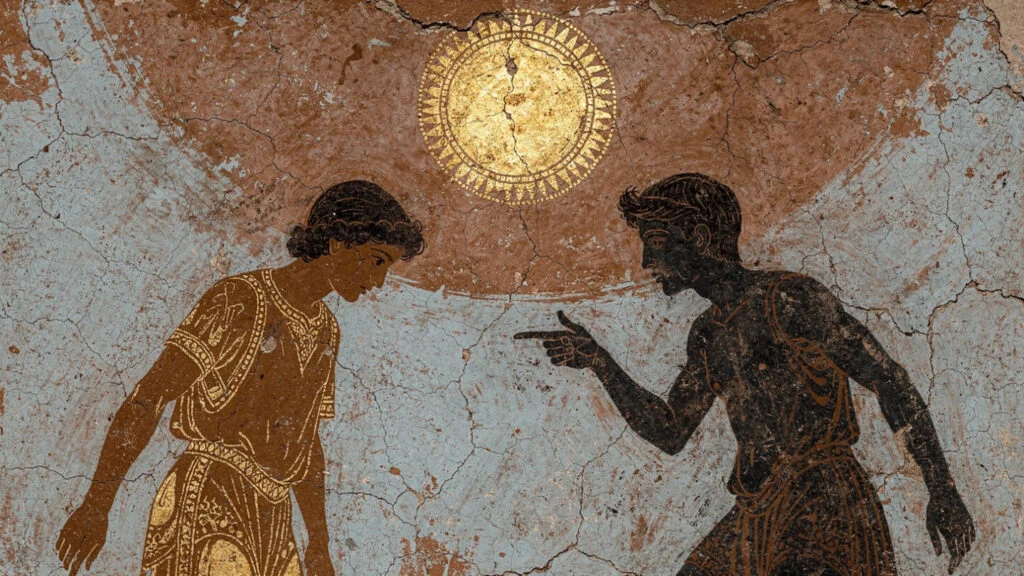
Phaethon did not withdraw it. He was not asking for the ride. He was asking for proof of his parentage, and the chariot was the only proof available.
Helios had made the mistake before the conversation began. He had sworn by the Styx, the most inviolable oath in the divine world, to grant his son whatever he asked. The oath was sworn out of love, the love of a father who had been absent from his child’s life and who was trying to compensate for the absence with an extravagance of parental generosity.
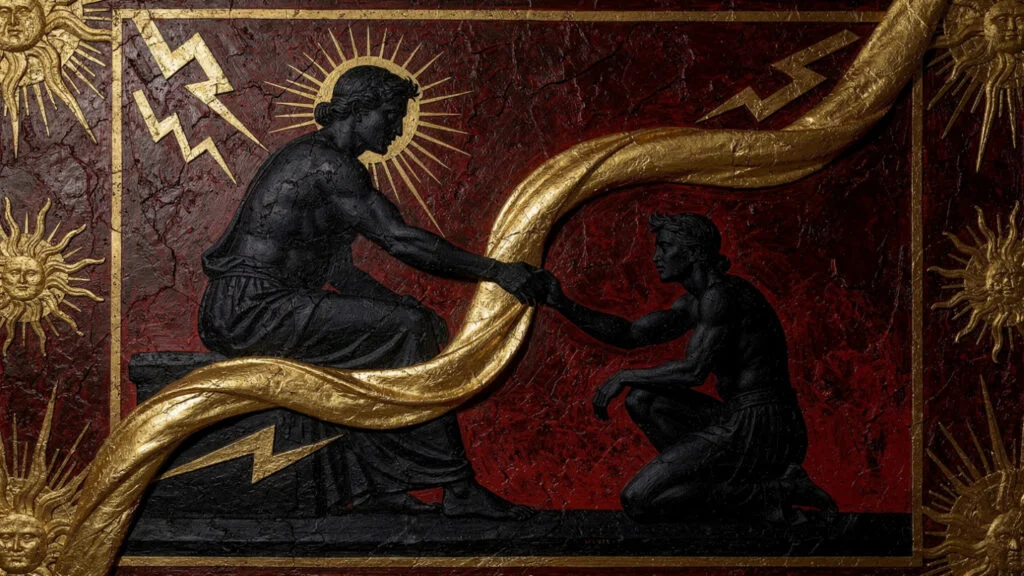
The Styx oath could not be revoked. The thing Phaethon asked could not be given safely. Both of these things were true simultaneously, and the myth’s tragedy was already established before Phaethon touched the reins.
The Chariot and What It Was
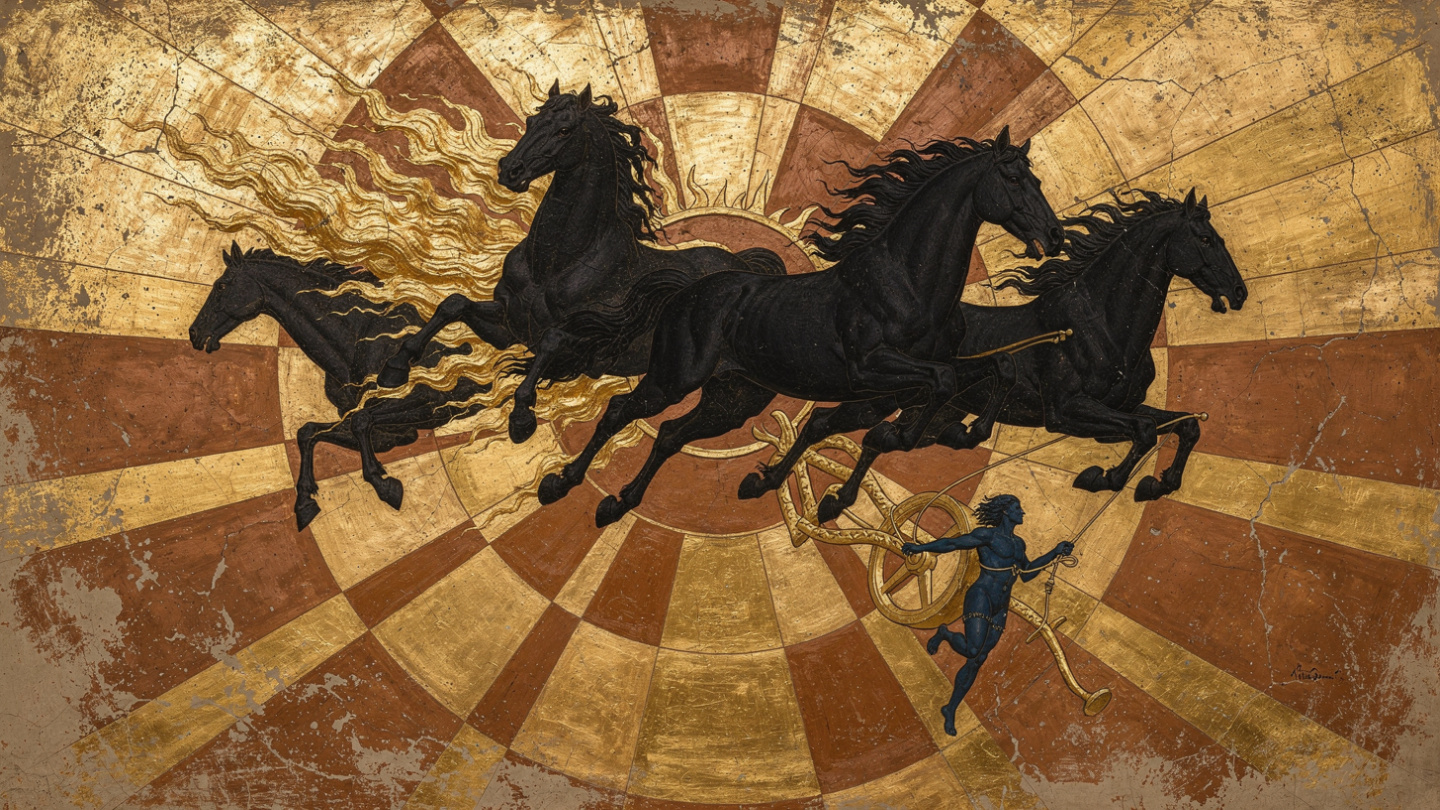
The solar chariot of Helios was not a vehicle of transportation. It was the mechanism by which the sun crossed the sky.
The horses that drew it, described in the ancient sources as fire-breathing, barely controllable even by their divine master, were the physical embodiment of solar force: the energy that produces light and heat and the violence of the Mediterranean summer at its maximum intensity. Helios controlled them through a combination of divine authority and long practice, the accumulated mastery of a being whose entire existence was organised around this single task performed once each day for all of time.
Phaethon had neither. He had the chariot, granted by a father who could not refuse. He had the route, described in detail by that father in the hope that the description would discourage the request. He had the reins in his hands and the horses responding to the weight that guided them and the sudden, total recognition that the weight they were responding to was not the weight they expected.
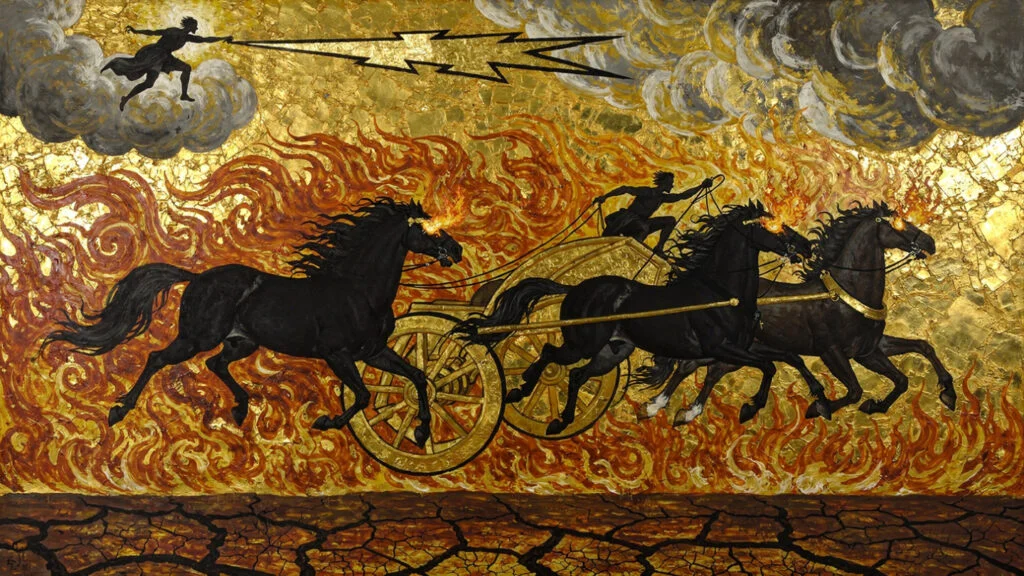
Ovid’s account of the moment when the horses understand that the driver is not Helios is the most precise description in the Metamorphoses of the relationship between divine nature and divine task. The horses feel the difference. The reins are lighter than Helios’s hands. The chariot has the wrong gravity. The horses, which had carried the sun across the sky in perfect order under their master’s guidance, feel the absence of that mastery immediately and respond to it by doing what fire does when the hand that tends it is removed: they expand into every available direction.
Phaethon pulled the reins. The horses ignored the reins. He was too high and then too low and then Africa was burning and the earth was scorching and the Nile dried back toward its source and the darkness of the earth’s shadow was interrupted by fires that Helios had never intended and could not now reach to extinguish.
Zeus watched the earth burn. He made the only calculation available to him: the boy would kill the world attempting to save his own pride, and the world was worth more than the boy’s proof of parentage. The thunderbolt struck. Phaethon fell from the chariot into the river Eridanos, his body still smouldering, the river exhaling a heavy vapour from his wound for long afterward, so that no bird could fly over that water without falling dead in the heat that rose from it.
The proof he had sought destroyed him before it could be delivered. The schoolmate’s taunt was never answered.
What Helios Did After
The account of Helios’s grief is the part of the myth that the moralising tradition, which wants the story to be about a reckless boy justly punished, most consistently omits.
After Phaethon fell, Helios refused to drive the chariot.
For days, the ancient sources report, the sun did not rise. The earth was plunged into cold and darkness. The sequence of light and dark that the entire world depended on stopped because the god who produced it was too consumed by grief to resume his work. The crops that had survived Phaethon’s fire began to die from cold and absence of light. The humans who had survived the burning were now dying from the cessation of the warmth that burning had so recently threatened to destroy.
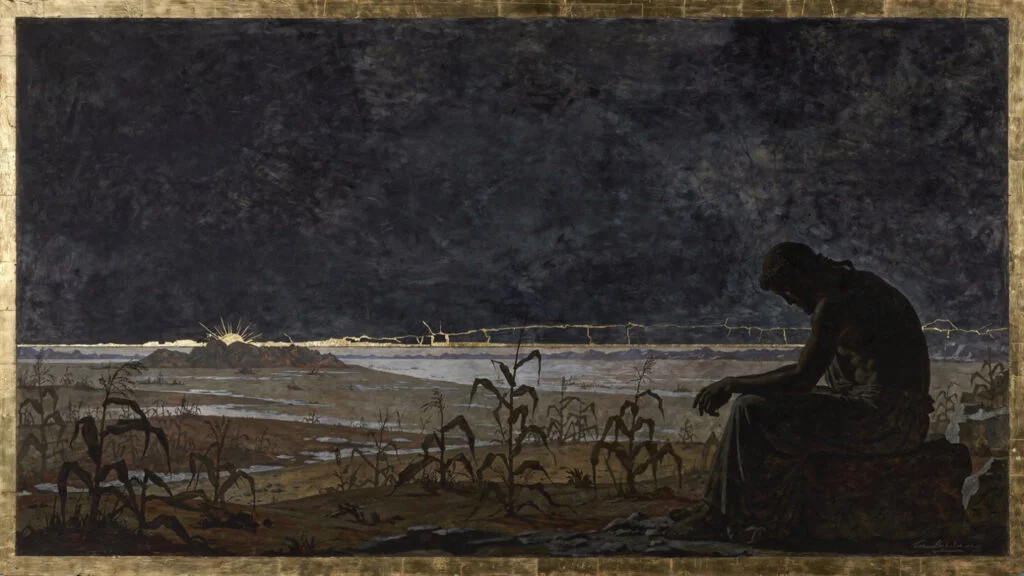
The gods pleaded with Helios to return to his duty. It required many of them and some considerable time before he agreed to resume the route. When he did, the accounts suggest that it was not because the grief had passed but because the grief had been accepted as permanent and the world’s need was sufficient to require his continuation despite it.
This detail reframes the entire myth. The punishment was not primarily directed at Phaethon. It was a consequence that the entire world bore. The boy’s death produced a grief in his father that was itself cosmologically significant: the sun god’s mourning had the same effect on the world as the sun’s absence, because they were the same thing. Helios was the sun in the mythological register, not simply its driver, and his grief was the sun’s withdrawal.
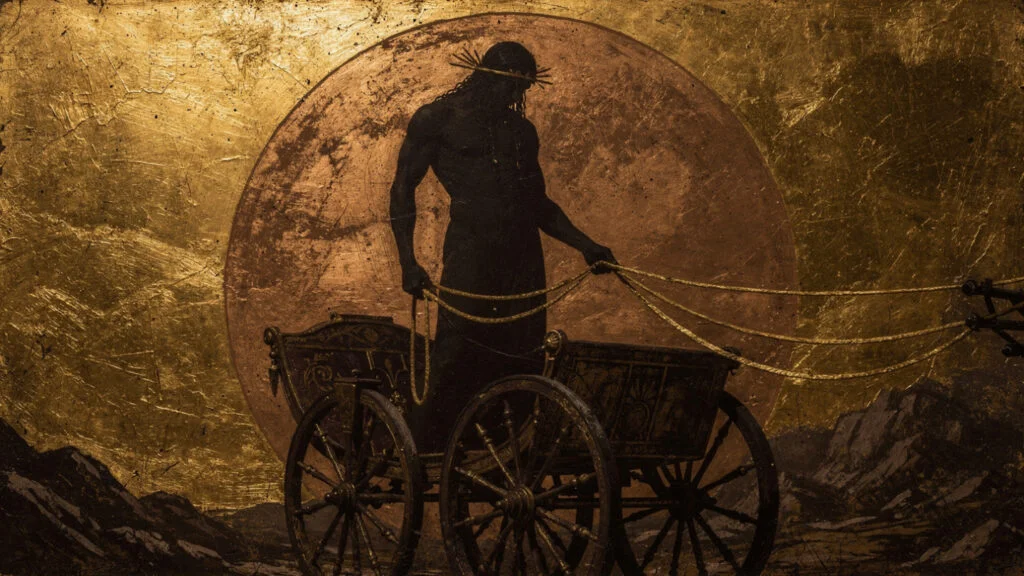
The myth of Phaethon is, at this level, also a myth about what happens to the world when a parent loses a child. The scale is cosmic but the emotion is not. The sun that does not rise because its driver is too destroyed by grief to lift the reins again is the psychological reality of bereavement given cosmological form.
The Heliades and the Amber
On the banks of the Eridanos, Phaethon’s sisters gathered.
The Heliades, daughters of Helios, stood at the edge of the river where their brother’s body had fallen and mourned him. They did not leave. Days passed, and then more days, and the sisters remained at the riverbank, their grief undiminished, their refusal to accept the finality of what had happened expressed in the simple act of continuing to be present at the place where it had happened.
The gods, watching this sustained and immovable grief, transformed them. Their feet took root in the riverbank. Their arms rose and spread into branches. Their hair became leaves. They became poplar trees, rooted permanently at the site of their mourning, unable now to leave even if they had wanted to.
And their tears continued. The amber that forms in the bark of the black poplar, the golden resin that seeps from the wood and hardens in the air, is in this myth the tears of the Heliades: the weeping that began at the river’s edge and that the transformation into trees did not stop, only changed in form. The amber found on the banks of rivers identified with the Eridanos, including the Po in northern Italy, was understood throughout the ancient world as the preserved grief of Helios’s daughters.
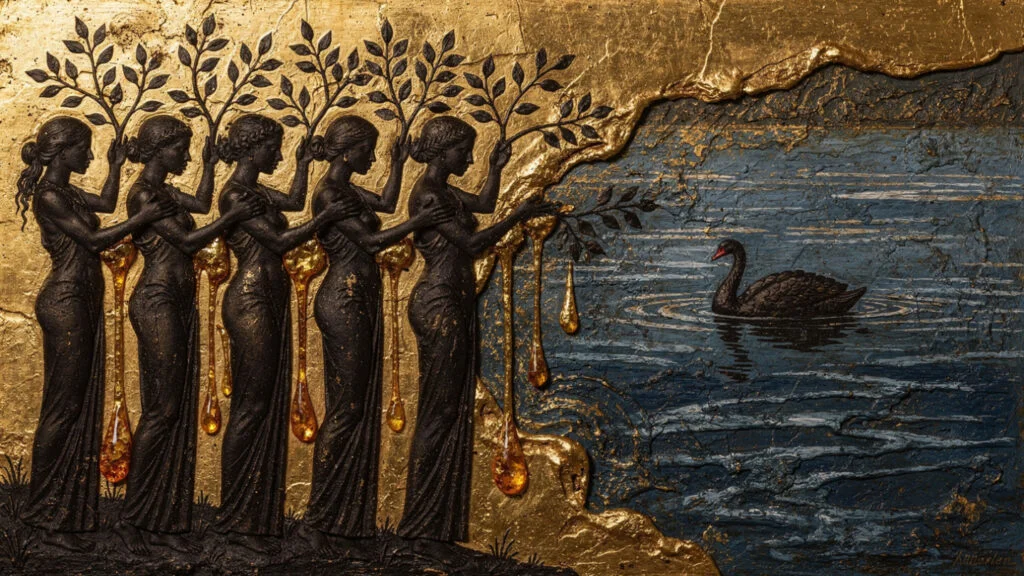
The Greek word for amber is elektron, and the sun is called Elector, the shiner. The connection between the substance that preserves and transmits light, that catches and holds the sunlight in a golden translucency, and the grief of the daughters of the sun god for their fallen brother, is not a fanciful etymology. It is the myth’s most precise statement: that the grief of the Heliades became light, that mourning which cannot be released is transformed into something that holds and carries illumination forward through time.
Amber traps what was living. The Heliades’ tears, hardened into amber at the riverbank where their brother fell, trap the grief that could not be expressed any other way and preserve it in a form that continues to carry light.
Cygnus and the One Who Stayed Low
Among the mourners at the Eridanos was Cygnus, Phaethon’s closest friend.
His mourning at the riverbank was such that the gods transformed him too, but differently from the Heliades. He became a swan, a creature capable of flight, capable of reaching the sky that the solar chariot had crossed on its fatal day. But Cygnus does not fly high.
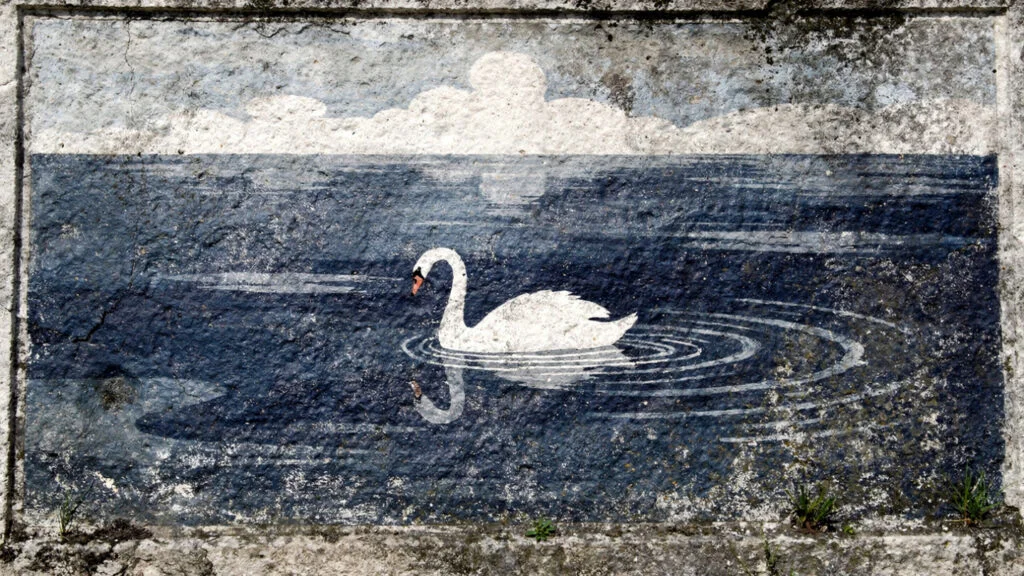
Ovid’s account is precise and painful: the swan flies low over water, haunts the spacious lakes and pools and streams, because Cygnus remembers the fire. He remembers the sky as the place where his friend was killed. He has wings and the capacity to reach the height where the chariot fell, and he chooses not to use that capacity, because the sky is where the thing he cannot forget happened, and the water below is where his friend’s body came to rest.
The swan who skims the surface of still water, whose natural habitat is the lake and the river rather than the open sky that its wings could reach, is in this myth the permanent expression of the kind of grief that does not produce memorial but avoidance: the grief that organises itself around the space of loss by staying as far from it as the wings allow.
Cygnus was placed among the stars as the constellation of the same name, the Swan, whose brightest star is Deneb and whose form stretches across the Milky Way. The ancient Greeks called this band of stars the road burned by Phaethon’s chariot. The swan who would not fly high was placed in the sky at the precise location that his grief prevented him from reaching in life: the strip of sky that still carries the mark of the fire that killed the one he mourned.
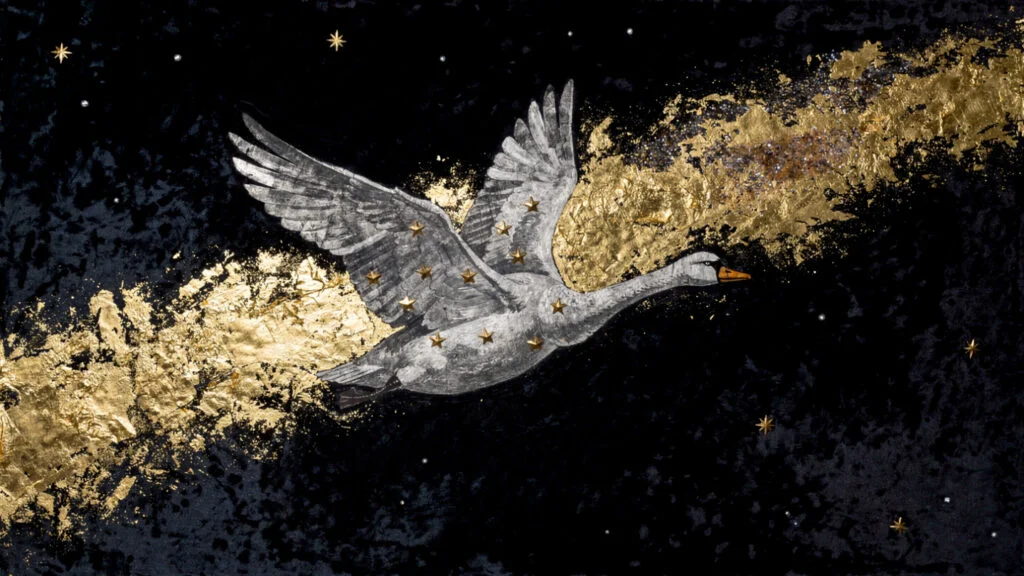
The myth does not resolve this paradox. It simply places it in the stars, where it remains.
What the Myth Was Actually About
The moralising tradition, which received its fullest expression in the Renaissance painters who depicted Phaethon’s fall as the just punishment of reckless ambition, reduced the myth to a lesson: do not overreach. Know your place. The boy who tried to drive the sun chariot deserved what he got.
This reading is available in the myth. It is also the shallowest reading available.
The deeper structure of the Phaethon myth is not about a reckless boy. It is about a configuration of love, obligation, inheritance, and proof that the Greek tradition understood as genuinely tragic rather than simply cautionary. The tragedy is not that Phaethon was too ambitious. The tragedy is that the situation had no solution from the moment Helios swore his oath.
Helios loved his son. He granted the oath from that love. The oath made refusal impossible. The chariot was the only proof of parentage available. The proof required a capacity that the son did not inherit with the parentage. The father could not refuse. The son could not succeed. The world burned because two people loved each other and the love produced an obligation that could not be met without destruction.
Zeus’s thunderbolt was not punishment. It was the only intervention that stopped the burning from consuming everything. He is not presented in the ancient sources as righteous or satisfied. He was the being responsible for the world’s continuation, and the world required an action he took. The tragedy is not mitigated by the necessity. The necessity is the tragedy.
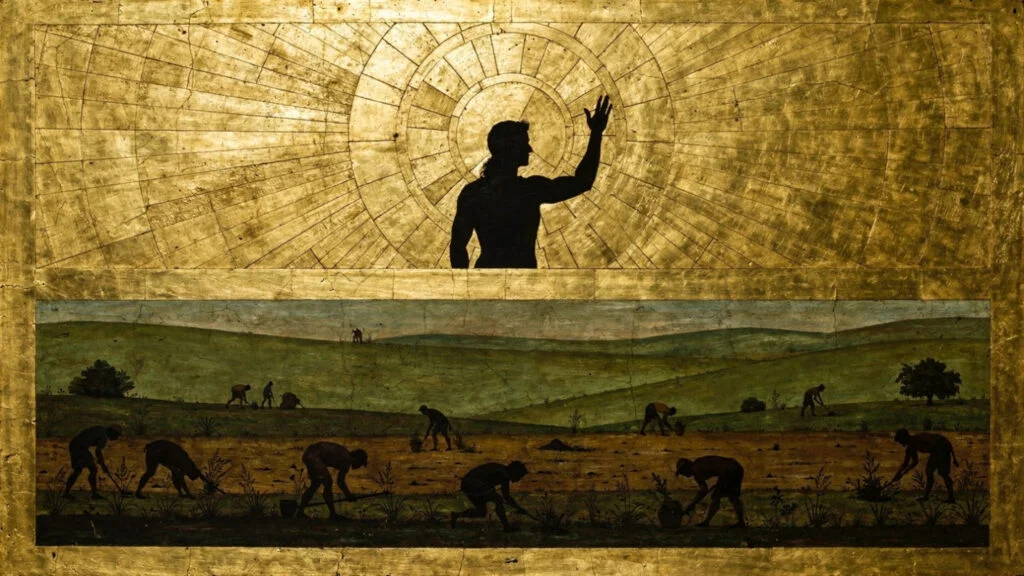
The schoolmate who issued the original taunt is never mentioned again after Phaethon sets out to find his father. The proof that cost Phaethon his life was sought to answer a challenge whose source the myth does not even dignify with a name. The challenger’s question, which started everything, remains unanswered in the myth’s resolution, because the answer was burned up in the attempt to provide it.
His name remains: the shining one. His river: the Eridanos, which still exhales a vapour from his smouldering wound. His sisters: permanent in their grief at the riverbank, their tears in the amber that holds the sun’s light in the dark. His friend: flying low over water, remembering the fire. His father: returning to the chariot after days of darkness, driving the sun across the sky for the rest of time with the knowledge of what the sky cost him.
The myth does not offer comfort. It offers precision.
At Olympus Estate, Mythic Essays moves through the deeper currents of the Greek tradition. The tragedy of Phaethon had no available solution from the moment Helios swore the Styx oath. The schoolmate who issued the taunt is never mentioned again. The proof was burned up in the attempt to provide it. The Heliades’ tears hardened into amber at the riverbank. Cygnus was placed in the strip of sky that still carries the mark of the fire that killed the one he mourned. Helios returned to the chariot after days of darkness and drove the sun across the sky for the rest of time with the knowledge of what the sky cost him. The myth does not offer comfort. It offers precision.