



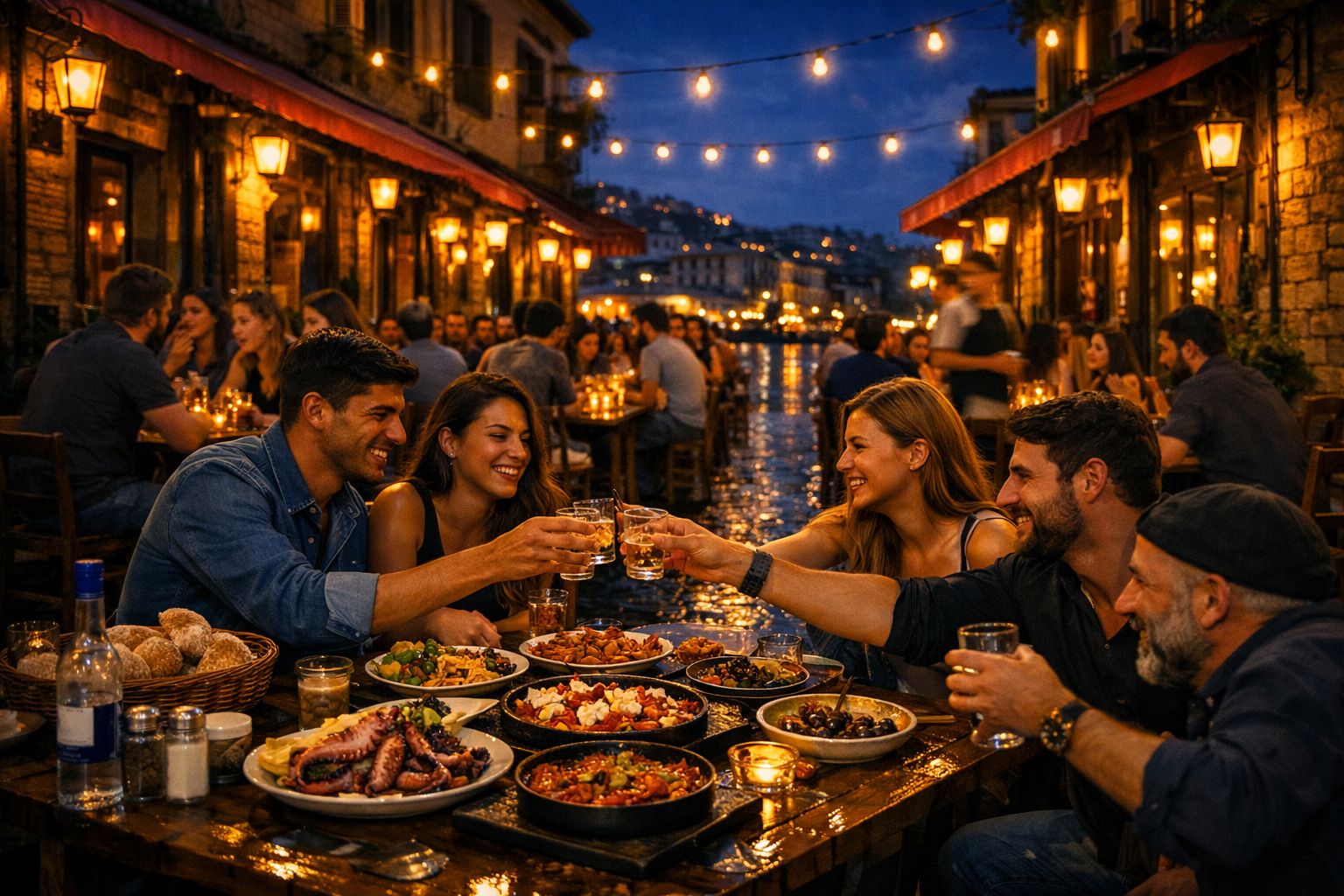
Greeks will tell you, if you ask them honestly and away from polite company, that Thessaloniki out-eats Athens.
Not loudly. Not with the combativeness that the ancient rivalry between the two cities occasionally produces. But with the quiet confidence of a person who knows something that most visitors to their country have not yet discovered and who is genuinely pleased, rather than competitive, about sharing it.
Athens is magnificent. Its archaeology is unsurpassed. Its energy is the energy of a capital city that has been a capital for a long time, dense and complex and rewarding for those willing to push past the tourist surface. Nobody who spends a week in Athens properly comes away unaffected.
But Thessaloniki has something that Athens, for all its greatness, does not have in the same measure: a table that was built by the convergence of more distinct culinary traditions than any other city in Greece, in a culture where eating is not simply the conclusion of a day but its central social architecture.
This city was founded in 315 BCE and named after Thessalonike, the half-sister of Alexander the Great. In the centuries that followed it was, in roughly this order: an important Macedonian city, a Roman provincial capital, the second city of the Byzantine Empire, the only Jewish-majority city in the world for several centuries, an Ottoman metropolis, and the birthplace of Mustafa Kemal Ataturk, the founder of modern Turkey. In 1922 it received hundreds of thousands of Greek refugees from Asia Minor who brought with them the recipes of Smyrna and Pontus that had nowhere else to go.
Every one of these layers is still visible in the city. Most of them are still edible.
This is the guide for your first time in Thessaloniki. Go hungry.
Before the Food | What Kind of City This Is
Let the character of Thessaloniki settle on you before you eat anything.
Walk to the waterfront first. The Nea Paralia, the seafront promenade, stretches for five kilometres along the Thermaic Gulf, and on a clear morning or evening it offers the single most clarifying view the city has: the White Tower at the eastern end of the promenade, the gulf stretching south toward the Aegean, and to the southwest, visible on the right days when the air is clean and the light is horizontal, the white mass of Mount Olympus on the horizon.
The White Tower is the symbol of the city in the way that the Eiffel Tower is the symbol of Paris: reproduced on every postcard, visible from most points of the centre, and genuinely beautiful rather than simply famous. It was built in its current form in the fifteenth century, a Byzantine-era fortification rebuilt by the Ottomans after their conquest of the city in 1430, and it stands at the precise point where the city’s Ottoman and Byzantine identities are most completely superimposed.
Stand beside it and look back at the city behind you.
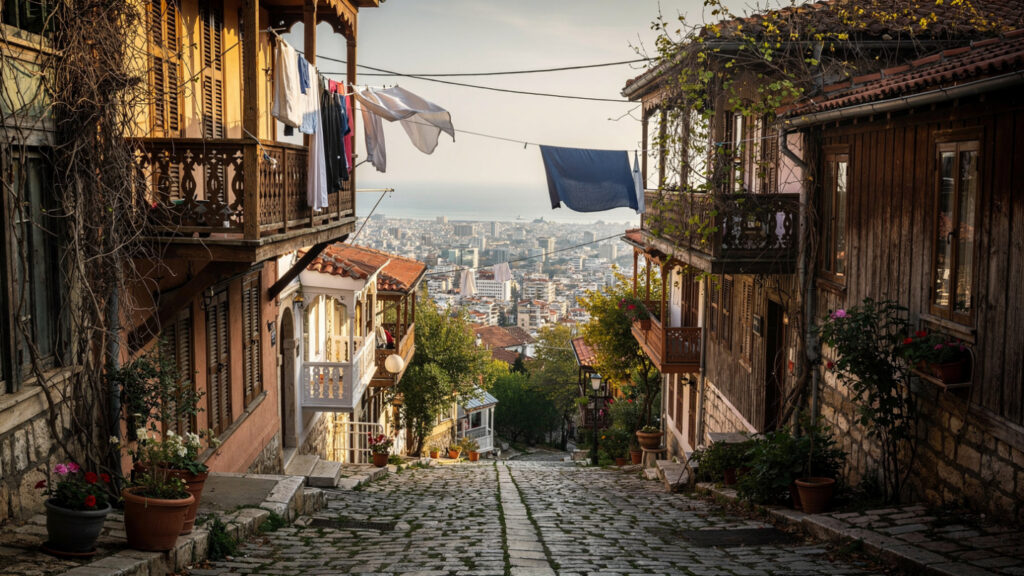
What you see is a skyline without a dominant landmark: no Acropolis, no single site pulling all the visual energy upward. Thessaloniki spreads horizontally rather than vertically, from the waterfront up through the mid-city grid toward the Byzantine walls and the Ano Poli, the upper town, which climbs the hill above the modern centre in a tangle of cobbled lanes and Ottoman-era houses that survived the catastrophic fire of 1917 that destroyed most of the lower city.
This horizontal quality is the city’s personality. It does not perform grandeur for visitors. It presents itself as a place people actually live, densely and convivially, and invites you to join rather than observe. The ratio of bars and cafés to population is, by some measures, the highest of any city in Europe. The university, the Aristotle University of Thessaloniki, is the largest in Greece and gives the city a permanent current of young energy that does not diminish in the way that seasonal tourism diminishes in other Greek cities when October comes.
Thessaloniki in November, which is entirely the wrong time to visit any Greek island, is a very good time to be in Thessaloniki. The International Film Festival fills the cinemas. The food is the same as it is in August. The streets belong to the people who live in them.
The History You Can Taste
Food cities earn their reputations through accumulation, and Thessaloniki’s accumulation is more varied and more historically grounded than most people expect.
The Byzantine layer is in the spice profile: the warm cumin and cinnamon notes that appear in stewed dishes, the honey-forward pastries, the lamb preparations that move between savoury and sweet with an ease that has its roots in medieval Greek cooking. The city was the second most important city of the Byzantine Empire after Constantinople, and its ecclesiastical and culinary traditions ran in parallel for a thousand years.

The Ottoman layer is in the coffee, in the sesame-heavy street food, in the preserved meat traditions and the börek-adjacent pastries that sit on the boundary between the Greek and Turkish culinary worlds without belonging entirely to either. Thessaloniki was under Ottoman rule from 1430 until 1912, and four and a half centuries of shared urban life produced a table that does not easily separate into Greek and Turkish components because at this intersection of history and geography they were never fully separate.
The Sephardic Jewish layer is the one that most visitors know least about and that gives the table its most distinctive depth. From 1492, when Ferdinand and Isabella expelled the Jews of Spain and Sultan Bayezid II welcomed them to the Ottoman Empire, Thessaloniki became the destination for tens of thousands of Sephardic Jews who brought with them the culinary vocabulary of Castile, Andalusia, Catalonia, and Portugal. By the early sixteenth century Jews constituted more than half the city’s population, making it the only Jewish-majority city in the world. The port of Thessaloniki was effectively closed on Shabbat and Jewish holidays because Jewish workers dominated its operations.
The influence of this community on what the city eats is diffuse and hard to isolate precisely, which is partly the point: six centuries of shared cooking does not produce clearly labelled influences but a general deepening and flavouring of the whole. The sweet-savoury combinations, the layered pastry traditions, the particular way of using dried fruits and spices in meat dishes: these are the traces.
The Asia Minor refugee layer is the most recent and the most dramatic. In 1922, following the catastrophic Greek military defeat in Turkey and the subsequent population exchange between Greece and Turkey, hundreds of thousands of Greek refugees from Smyrna, Pontus, Cappadocia, and the Aegean coast of Anatolia arrived in Thessaloniki and the surrounding region. They came with nothing except their memories, their communities, and their recipes.
Soutzoukakia, the spiced meatballs in tomato sauce that are one of Thessaloniki’s signature dishes, came from Smyrna. The way of making bougatsa that the city now considers its own arrived with refugees who brought it from the Anatolian interior. The tsipouradiko tradition, where tsipouro is served with rotating meze in the fashion of the meyhane of western Anatolia, has its roots in the displaced communities of 1922.
When you eat in Thessaloniki, you are eating all of this at once. The city is too honest to separate it into neat categories. It simply puts it on the table and lets you work it out.
Breakfast | Start Here and Start Nowhere Else
The bougatsa is not optional.
This is the first rule of Thessaloniki. Not a suggestion, not a preference, not a local speciality worth trying if you happen to be passing. The bougatsa is the way you begin to understand what the city thinks about food and about the morning.

What it is: phyllo pastry, stretched by hand to a translucent thinness, wrapped around a filling of warm semolina custard, folded and baked until the exterior is shatteringly crisp while the interior remains soft and faintly sweet. It arrives on the counter dusted with icing sugar and cinnamon. You eat it standing up, or at a marble counter on a stool, with a small coffee alongside. The combination of the hot custard and the cold morning air is a physical pleasure that the city has been providing at this hour for a very long time.
The bougatsa exists elsewhere in Greece. It is not the same elsewhere. The Thessaloniki version has a crispness and a lightness of phyllo that the versions made with pre-rolled pastry sheets cannot replicate, and the custard is less sweet, more eggy, more honest about being a breakfast food rather than a dessert in disguise.
Bantis is the name you will encounter most often, a family operation since 1969 now run by the founder’s grandson with the same recipe and the same hand-stretched technique. The queue at Bantis on a weekend morning is orderly and entirely worth the wait.
For the trigona panoramatos, the other non-negotiable pastry encounter in Thessaloniki, make the twenty-minute journey to the suburb of Panorama, where the Elenidis family has been making their custard-filled phyllo cones according to the recipe Giorgos Elenidis created in the 1960s. These are not bougatsa. They are their own thing: cone-shaped phyllo shells, dunked in syrup until they glisten, filled with cream that is lighter than it looks and sweeter than you expect. The view of the city from the Panorama hill is also worth the trip, particularly at dusk when the lights of the gulf spread out below you.
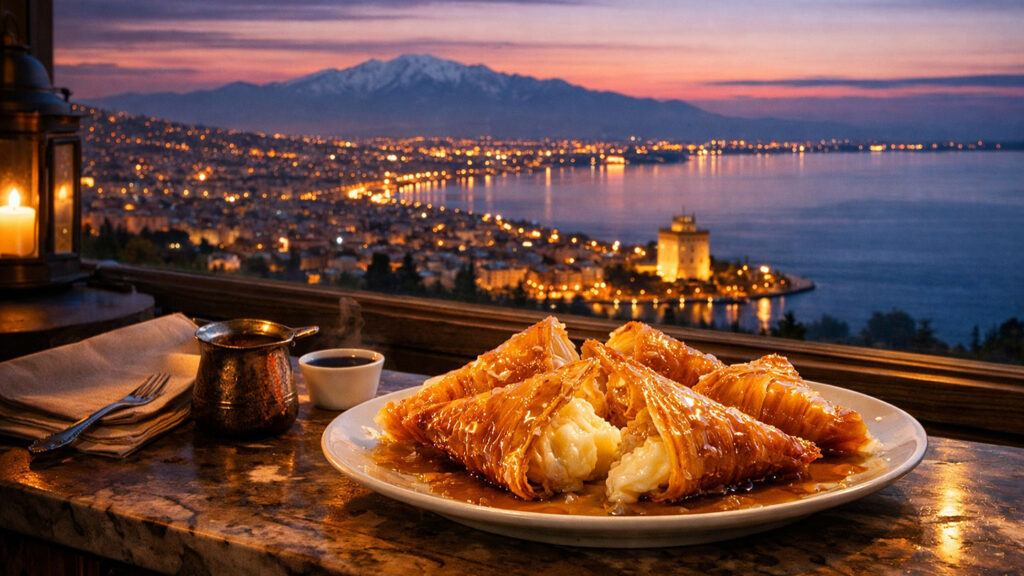
The koulouri, the sesame-covered bread ring sold from baskets by street vendors at dawn, is the city’s pocket-sized version of its pastry tradition: affordable, portable, deeply satisfying in the way of simple things made correctly for a long time. Buy one on the waterfront and walk east toward the White Tower. This is the correct beginning to a Thessaloniki morning.
The Markets | Where the City Feeds Itself
Before you eat in a restaurant, go to a market. Thessaloniki’s markets are not curated tourist experiences. They are where the city buys food, and the difference in atmosphere between a functioning market and a tourist market is the difference between watching something real and watching a simulation of the real thing.
The Modiano and Kapani markets sit in the centre of the city within a few hundred metres of each other, and together they cover the full range of what Thessaloniki eats. The Modiano is the older and more atmospheric of the two, housed in a covered market hall from the early twentieth century with stalls selling olives, spices, cheeses, cured meats, fresh fish from the Thermaikos Gulf, and dried goods of the kind that take an hour to buy properly because every merchant wants to explain why their product is superior.
The Kapani is rawer, louder, more working-class in its energy: the covered section opens into an outdoor section where the produce overflow spills onto the pavement and the vendors call to each other across the narrow lanes. The cheese stalls at Kapani are where you find the northern Greek varieties that do not travel south: the local feta, aged and sharp, the graviera of the Macedonian interior, the trahanas, the dried fermented grain preparation that thickens soups with a sourness that is unlike anything in the southern Greek culinary tradition.

Walk through both markets in the morning before the business of the day has fully settled. Buy something to eat. Talk to someone at a stall. The markets reward exactly the kind of unhurried wandering that the rest of Thessaloniki also rewards, and they will give you a more accurate understanding of what the city eats than any restaurant visit can.
The Meze Table | What Thessaloniki Does Better Than Anywhere Else
The tsipouro session is the purest expression of what Thessaloniki believes a meal should be.
Tsipouro is the pomace spirit of northern Greece, clear and unaged, less sweet than ouzo, without the anise note, direct and clean in the way of spirits that are not trying to be anything other than what they are. In Thessaloniki it is served at tsipouradika, the establishments that have evolved from the meyhane tradition of Ottoman tavern culture into something distinctly their own: small rooms, close tables, a constant movement of small dishes that arrive uninvited alongside each round of the spirit.
The key principle is this: you do not order the food. It comes. Each glass of tsipouro is accompanied by a meze that the kitchen decides, rotating through the session in a sequence that is at once spontaneous and deeply considered. You might begin with a small plate of feta, olives, and bread. Then grilled peppers. Then a portion of soutzoukakia, those refugee meatballs from Smyrna, in their dark tomato sauce. Then fried fish from the gulf, small and crisp, eaten whole. Then perhaps a bouyiourdi, the baked feta with tomato and chilli that is a Thessaloniki standard, arriving hot and bubbling from the oven.
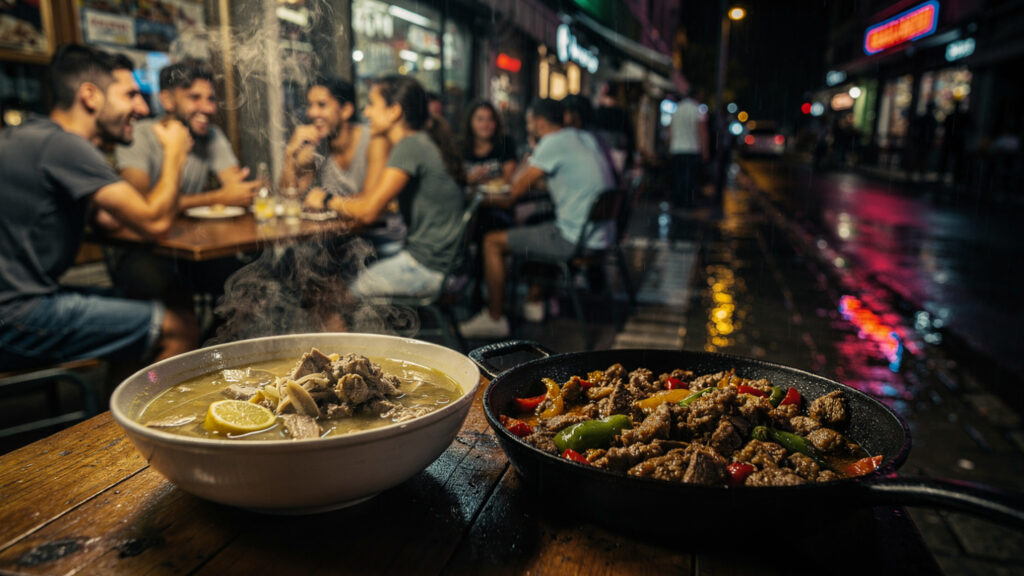
The session has no fixed end point. It ends when the people at the table decide it ends, which in Thessaloniki tends to be later than you planned and never feels like it was long enough.
The Ladadika district, the old warehouse quarter near the port whose name means “the olive oil district” from its Ottoman commercial history, is dense with tsipouradika of varying authenticity and quality. The rule that applies throughout Thessaloniki applies here with particular force: avoid anywhere with a translated menu on an A-frame sign outside. The places worth entering have handwritten menus, or no menus at all, and the owners will tell you what you are eating as it arrives.
The Bit Bazaar, a cluster of small tavernas in a covered arcade near the Modiano market that has been operating in various configurations since the early twentieth century, is the other essential destination for meze eating. It operates on older hours than the Ladadika establishments and its clientele tends toward the local rather than the visiting.
The Dishes You Need to Find
Thessaloniki has dishes that do not exist in quite the same form elsewhere, and finding them is one of the primary purposes of a visit.
Soutzoukakia Smyrneika are the meatballs that the refugees brought from Asia Minor in 1922: ground beef, heavily spiced with cumin, shaped into elongated cylinders, simmered in a tomato sauce enriched with cinnamon and red wine. They are served as a main course or as a meze, and they carry in their spice profile the entire history of their origin. A dish with a homeland that no longer exists on the same terms, preserved in the cooking of the people who left it.
Bougiourdi is the baked feta preparation that Thessaloniki made its own: a block of feta topped with sliced tomato and whole green chilli peppers, drizzled with olive oil, baked in a small clay pot until the cheese is soft and the peppers are blistered and the whole thing requires bread for the sauce that forms in the bottom of the pot. It is made everywhere in the city and nowhere outside it with quite the same conviction.
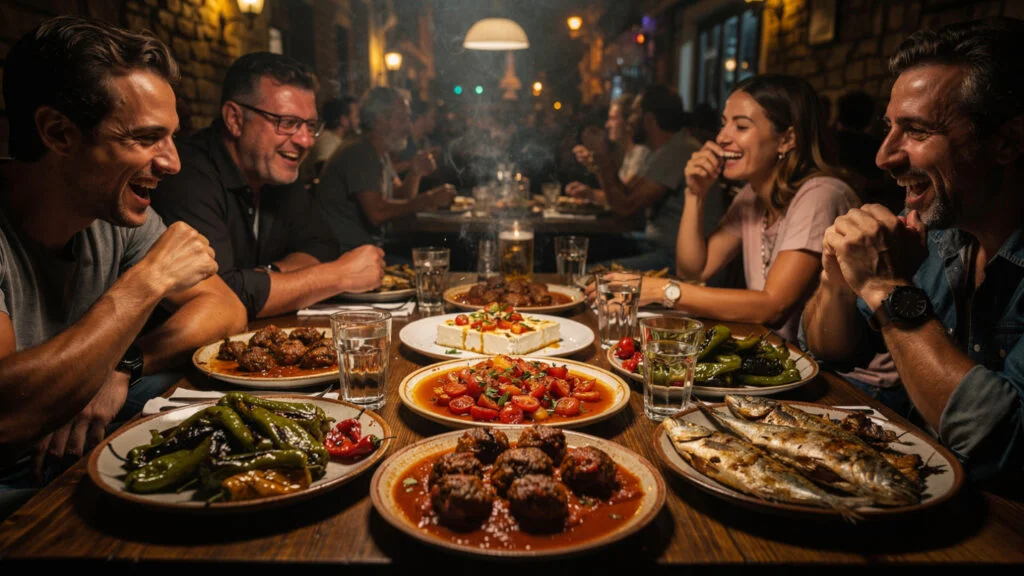
Tigania is the fried pork dish of the north: cubed pork shoulder, cooked fast in a very hot pan with sliced peppers and mustard until the exterior is crisped and the interior remains tender. It arrives at the table in its pan, still sizzling, with bread to soak up the fat. It is not a delicate dish. It does not pretend to be.
Patsas, the tripe soup served late at night or very early in the morning, is the city’s own version of a Greek tradition: collagen-rich, garlicky, deeply savoury, eaten by people finishing a long night and by butchers starting a long day, both of whom know something the rest of us are still learning about when a bowl of soup is the correct response to the hour.
Sardeles pantremenes, stuffed sardines, are the city’s signature seafood dish: sardines opened flat and filled with feta, capers, and herbs, then closed back up and grilled. They appear on summer menus at the seafood restaurants of Kalamaria, the coastal neighbourhood east of the centre where the fishing boats come in and the tables are close enough to the water that you can hear the hull knocking against the dock.
The Neighbourhoods | Where to Walk
The Waterfront and White Tower is your orientation point and the city’s public living room. The five-kilometre promenade is where Thessaloniki walks, cycles, meets, argues, and falls in love at every hour of the day. Come here at dusk when the light on the gulf turns the water the colour of rose gold and the White Tower catches the last of it from the west.
Ano Poli, the upper town, is where you go when you want to understand what the city looked like before the fire of 1917 destroyed most of it. The fire did not reach this high, and the Ottoman-era houses with their wooden balconies and narrow lanes survive in a state of comfortable dishevelment that is more honest than a carefully restored old town would be. The views from Ano Poli over the whole city and the gulf below are the best in Thessaloniki. Go on a weekday morning when the lanes are quiet. Bring comfortable shoes: the cobblestones are genuine.
Ladadika, near the port, is the evening district: tsipouradika, wine bars, live music, and the energy of a city that takes its nightlife as seriously as its food, which is to say very seriously indeed. The warehouses of the former olive oil district have been converted into eating and drinking establishments with enough variety that a full evening spent moving between them never produces the feeling of having seen everything.
The Rotonda and its surroundings is the historical core of the Roman and Byzantine city: the Rotonda itself, a circular Roman building of the fourth century CE that served successively as a mausoleum, a church, and a mosque. Beside it stands the Arch of Galerius, a triumphal arch carved with battle scenes from a campaign against the Persians. A few hundred metres to the northwest is the Church of Agios Dimitrios, the largest church in Greece and the burial site of the city’s patron saint. These three monuments within walking distance of each other represent more than a thousand years of continuous historical occupation.
The Jewish Quarter area, behind the port near the old Ladadika, carries the traces of the community that was almost entirely destroyed in the Holocaust. Of the approximately fifty thousand Sephardic Jews living in Thessaloniki in 1943, nearly all were deported by the German occupiers to Auschwitz-Birkenau, where the great majority were murdered. The Holocaust memorial on Eleftherias Square, the monument erected in 1997 on the site where the 1942 roundup of nine thousand Jewish men took place, is not a comfortable visit. It is a necessary one.
Practical Matters
Getting there: Thessaloniki has an international airport with direct connections to most European cities. Trains run from Athens in approximately four to five hours on the intercity service. The city is also the natural starting point for the Vergina-Dion pilgrimage route described elsewhere on this site.
When to go: Almost any time. Spring brings the bougainvillea and the clarity of light that makes the Olympus view from the waterfront its sharpest. Autumn brings the film festival and the best of the mushroom and game season in the northern markets. Summer is hot but the city does not empty the way the islands empty: this is a city that lives in summer, not one that is defined only by it. November and March are the times when you have it most to yourself.
Where to stay: The waterfront strip running from the port east to the White Tower offers the best access to the city on foot. The Ladadika district for evening proximity. Ano Poli for character and the morning view, with the trade-off that you will walk uphill to get back to it after dinner.
One rule above all others: Do not eat dinner before nine in the evening. The city is not ready for you before then, and you will be eating in a room that is waiting to become what it actually is rather than in the thing itself. Come at nine. Stay until the conversation has finished. Order more tsipouro than you planned to.
Why Thessaloniki Now
There is a moment arriving for Thessaloniki that has been quietly building for a decade.
The city has been one of Europe’s best-kept secrets for long enough that the secret is beginning to circulate. Food writers who have eaten across the Mediterranean have started writing about it with the enthusiasm of people who have found something genuinely new in a landscape they thought they knew. Direct flight connections from European cities have expanded substantially. The kind of traveller who has done Athens and the islands twice and is looking for the Greek experience that goes deeper has started finding their way north.
The window in which Thessaloniki is simultaneously extraordinary and not yet overrun is not infinite. Cities at this stage of discovery have a quality of aliveness: the restaurants are full of locals because tourists have not yet tipped the balance, the prices reflect the actual cost of things rather than the premium for foreignness, and the people who own the tavernas and the markets have not yet been required to simplify what they offer for an audience that might not understand its complexity.
Go now, before the rest of the world catches up.
The bougatsa will be waiting for you at seven in the morning, at a marble counter, in a city that has been making it this way since before it fully knew what it would become.
Where to Stay in Thessaloniki
Find your base in Greece’s most delicious city. This interactive map highlights stays across the waterfront, the markets, and the old upper town, helping you settle in so you can focus on eating your way through Thessaloniki.
At Olympus Estate, Wanderlust Greece goes beyond the obvious itinerary to find the places where Greece is most completely and most honestly itself. Thessaloniki has been waiting for a long time for the attention it deserves. It is remarkably patient about it.