





The word music is Greek.
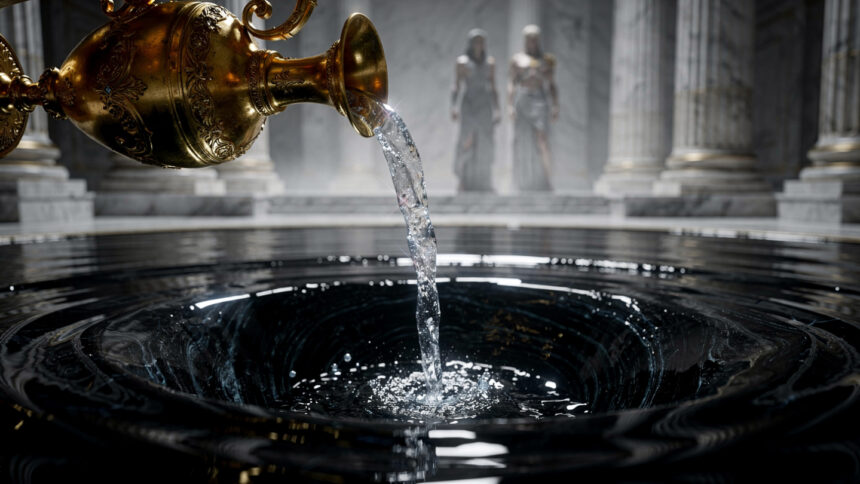
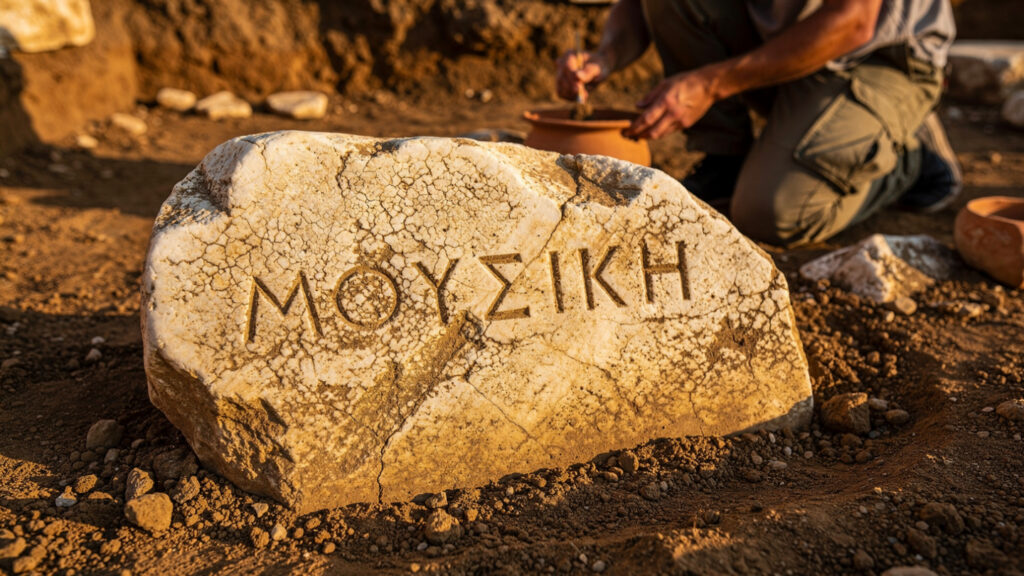
Not in the etymological sense in which many English words have Latin or Greek roots at several removes, but in the direct sense that the ancient Greek word mousike, the art of the Muses, was adopted into Latin as musica and passed through the Romance languages into English with only the minimal changes that centuries of phonological evolution required. The same is true for melody, harmony, and rhythm. These Greek terms entered the vocabulary of Western music theory as part of the conceptual framework that the ancient Greek musical world developed for thinking about what music was and how it worked.
The ancient Greek world was not the origin of music. Human beings have been making music for at least forty thousand years, and the civilizations of Mesopotamia and Egypt developed sophisticated musical cultures centuries before the Greeks began to theorize their own practice. What the Greek world originated was the systematic intellectual engagement with music as a subject for philosophical and mathematical investigation. It produced the theoretical framework, the identification of intervals and their mathematical ratios, the doctrine of modes and their ethical characters, and the understanding of music’s relationship to the mathematical structure of the cosmos that the Pythagorean tradition developed and that the Western intellectual world has been working with in various forms ever since.
This is the claim that Plato makes when he calls music the gymnastics of the soul: not simply that music is morally improving in a vague sense, but that the mathematical relationships between the tones of the musical system are the same mathematical relationships that govern the movements of the celestial bodies and the organization of the just city and the proper ordering of the human soul. Music was not entertainment in the ancient Greek understanding. It was physics, ethics, and cosmology simultaneously.
The Instruments and Their Divine Origins
The ancient Greek tradition attributed the invention of its primary musical instruments to divine figures, and the attributions were not arbitrary mythology but the theological encoding of the cultural associations that the instruments carried.
Hermes crafted the lyre from a tortoise shell: the Homeric Hymn to Hermes narrates the invention in detail, the infant god finding the tortoise, killing it, stretching strings of sheep gut across the shell, and playing the resulting instrument. Hermes gave the lyre to Apollo as payment for stealing his cattle, and Apollo’s subsequent identification with the lyre was the identification of the divine principle of rational order and intellectual clarity with the instrument whose acoustic character, the clear individual tones of the plucked string whose pitch and duration are precisely controlled by the player’s fingers, made it the instrument most suitable for the precise musical relationships that the Pythagorean tradition was identifying as the mathematical foundation of music.
The aulos, the double-piped wind instrument that produces its sound through the vibration of a double reed, was attributed to Athena, who was said to have invented it and then discarded it when she saw her reflection in a pool while playing and observed how the effort of blowing the instrument distorted her face. Marsyas, the Phrygian satyr, found the discarded aulos and played it with such skill that he challenged Apollo to a musical contest in which each competitor played and the Muses judged. Apollo played the lyre. Marsyas played the aulos. The Muses awarded the victory to Apollo, and Apollo punished Marsyas for the hubris of challenging the divine musician by flaying him alive, stretching the skin from his body while he was still living.
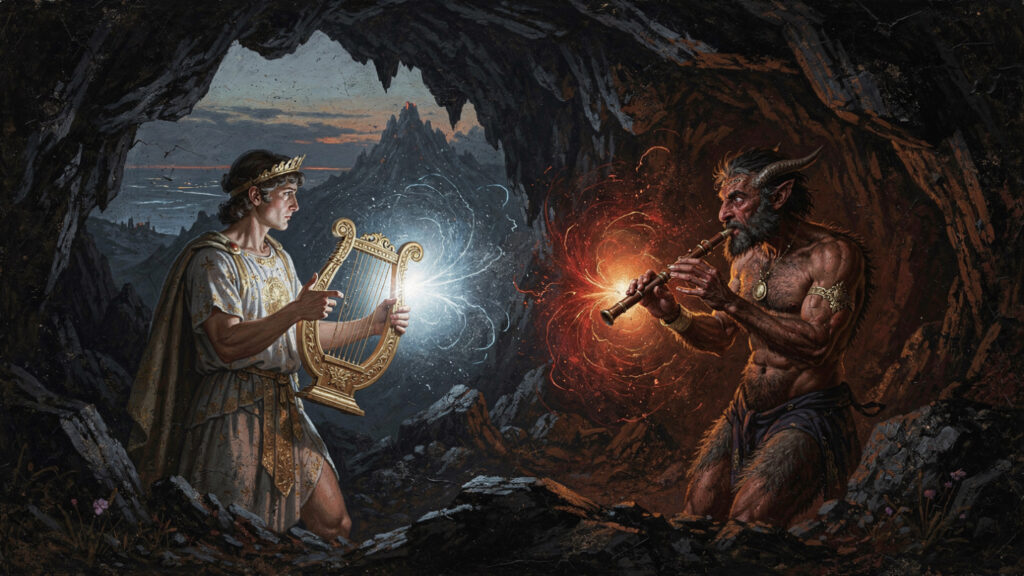
The story is the theological argument in mythological form: the aulos, associated with Dionysian ecstasy and the loss of rational control that the reed instrument’s breathing technique produces in the player, was incompatible with the Apollonian rational order that the lyre embodied. The contest between Apollo and Marsyas was the contest between the two musical principles that the ancient Greek world consistently opposed: the Apollonian clarity of the plucked string against the Dionysian urgency of the breath instrument, the individual precise control of the lyre against the communal ecstatic quality of the aulos in the Dionysian procession.
Plato draws the same conclusion without the myth when he excludes from the ideal city of the Republic the musical modes appropriate to the aulos while retaining the modes appropriate to the lyre and the kithara: the modes that produce lamentation, softness, and intoxicated pleasure are excluded, while the Dorian mode, which Plato associates with the courage and steadiness of the warrior, and the Phrygian mode, which he associates with the moderation and self-discipline of the citizen at peace, are retained. The exclusion of the aulos from the ideal city is the philosophical restatement of the Apollo-Marsyas myth’s theological argument.
Pan’s syrinx, the panpipes whose invention the mythology places in the moment when Syrinx was transformed into reeds at the riverbank and Pan cut the reeds and tied them together and blew across them, is the instrument whose acoustic character, the breath across the open pipe producing a sound that cannot be precisely controlled in the way that the lyre’s strings can be controlled, makes it the instrument of the pastoral and the natural world rather than the city and the civic life. The mythological essays in this collection develop the Pan and Syrinx tradition in full: the claim that the desire that cannot reach its object becomes the instrument that produces the music is the claim that the panpipes’ sound, plaintive and carrying across the open hillside, encodes.
The Instrument Catalogue
The ancient Greek musical world used a wider range of instruments than the primary lyre–aulos opposition suggested by the theoretical schools, and the instruments themselves document the range of social contexts in which music was performed.
The kithara, the larger and more structurally complex version of the lyre whose additional strings and heavier resonating body gave it the volume and tonal range required for public performance in the theater and the competition stadium, was the instrument most associated with the virtuoso performer and the formal musical contest. The kitharode, the singer who accompanied himself on the kithara, was the performance category honored with the most prestigious competitions at the Panathenaic Games and the Pythian Games. The names of the winning kitharodes were preserved in the ancient records in the same way that the names of athletic victors were preserved, as the record of individual excellence in the competitive world of Greek music.
Terpander of Lesbos, who lived in Sparta in the seventh century BCE, is credited with extending the kithara’s strings from four to seven, a technical innovation that expanded the instrument’s modal range and allowed Greek music to develop the system of modes that later theorists would codify. His connection to the drinking‑song repertoire and his role in the early development of the kithara make him the first named figure in Greek musical history who can be linked to technical innovation rather than simply to legendary status.
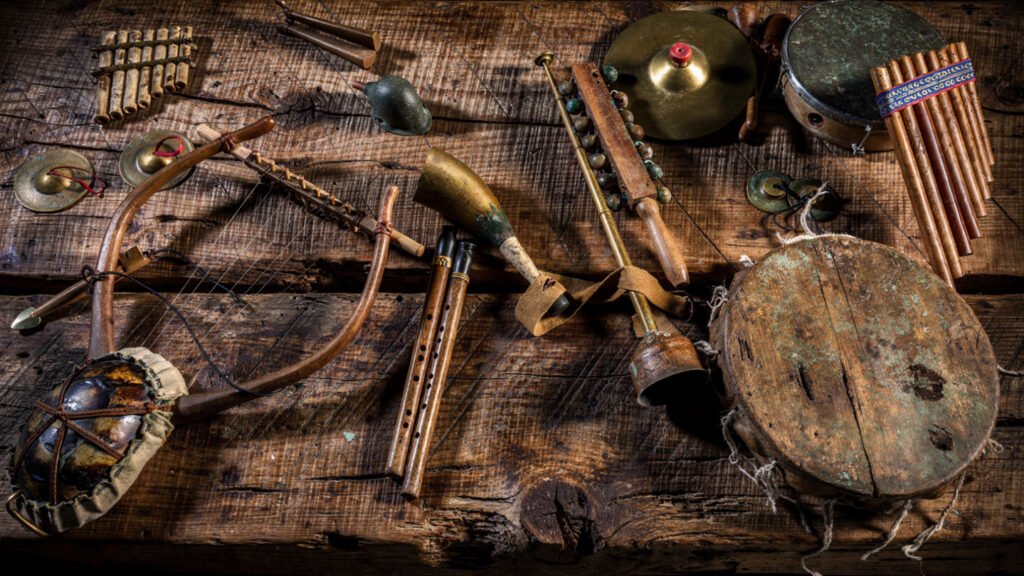
The barbiton, a longer‑necked version of the lyre whose deeper tuning gave it the bass register that the kithara’s higher tuning did not cover, was the instrument most closely associated with the lyric poetry of the archaic period. Sappho and Alcaeus of Lesbos and Anacreon of Teos, the poets whose surviving fragments preserve the most personal and emotionally intense poetry of early Greece, were linked to the barbiton in the ancient sources. The emotional register of the instrument, its deeper and more intimate sound compared to the kithara’s projection, corresponds to the intimate emotional register of the lyric poem rather than the public world of kithara performance.
Percussion instruments in ancient Greek music included the tympanum, the frame drum whose beating kept time in the Dionysian procession, the krotala, the castanets used in dance accompaniment, and the cymbala, the small paired cymbals of the Cybele cult. The hydraulis, the water organ whose mechanism used water pressure to maintain a constant air supply to the pipes, was invented in the third century BCE by Ctesibius of Alexandria. It was the most technically sophisticated musical instrument of the ancient world, appearing at the very end of the period when Greek musical thought was at its most fully developed.
The Surviving Music and What It Sounds Like
The most unsettling fact about ancient Greek music, for any visitor to the ancient world who comes with expectations formed by the Western musical tradition, is that the music that scholars have reconstructed from the surviving notation does not sound like anything in the Western canon.
The ancient Greek musical tradition has left approximately sixty fragments of actual notation, of varying completeness and preservation quality. Among the most complete are the Seikilos epitaph, a short song inscribed on a stele from the first century CE whose complete notation survives and whose text advises the reader to drink and be merry since life is short, the Delphic Hymns of approximately 128 BCE whose partially surviving notation documents the modal and melodic character of the Apollonian cult music at Delphi, and an excerpt from the chorus of Euripides’ Orestes whose notation was discovered on a papyrus in the early twentieth century.
The reconstructions of these pieces, produced by scholars of ancient Greek music using the surviving notation systems and the interval relationships documented by the theoretical schools, yield music that is recognizably sophisticated, recognizably organized around melodic and rhythmic principles, and recognizably different from anything in the Western European musical world that ultimately drew on Greek theory. The modal system of ancient Greek music was not the major–minor tonal system of Western Europe from the seventeenth century onward. It was a set of distinct scalar patterns, each with a character or ethos that ancient theorists associated with emotional states and social contexts, and the intervals used in these modes were not all identical to the intervals of the Western European equal‑temperament system.
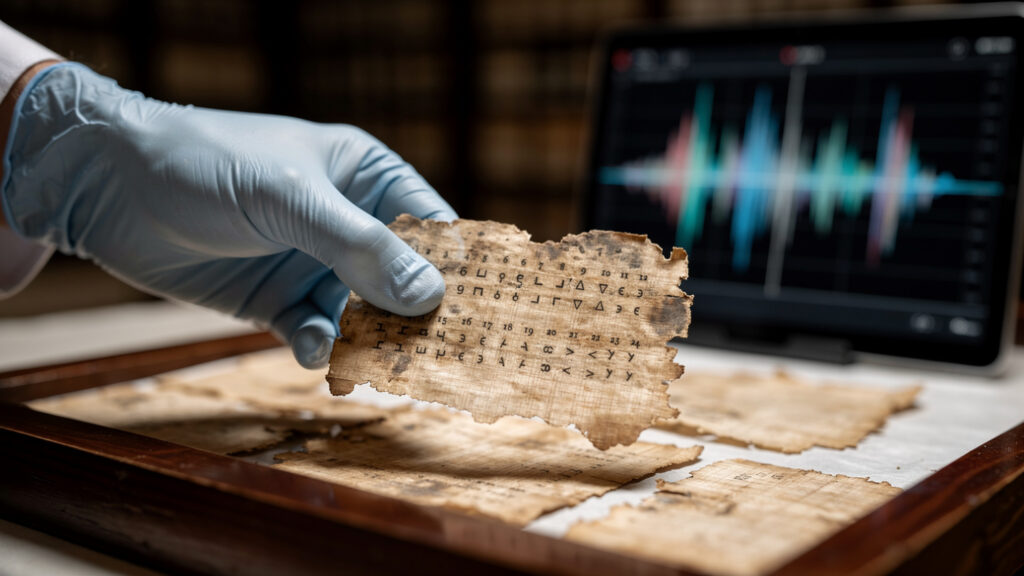
Armand D’Angour of Oxford University, whose reconstructions of ancient Greek music have been the most widely disseminated in the contemporary period, has described the experience of working with the ancient notation as the experience of recovering something that is structurally familiar yet sonically alien. The mathematical relationships identified by the Pythagorean schools in the intervals are the same relationships that Western music theory inherited and developed, but the sound of a reconstructed ancient Greek melody played on a reconstructed aulos or kithara does not correspond to any position in the development of Western musical practice.
The strangeness is the most honest thing that can be said about ancient Greek music as sound rather than as theory. We know a great deal about the theory, the philosophy, the social function, and the instruments, and the small amount of actual music that survives gives us a glimpse of a sound world connected to ours by a chain of theoretical inheritance yet separated from ours by the two thousand years of musical evolution that lie between the ancient world and the contemporary one.
The Doctrine of Ethos and Its Consequences
The doctrine of ethos, the ancient Greek claim that different musical modes have different ethical characters and produce different effects in the souls of the people who hear them, is the doctrine that most directly explains the intensity of the ancient philosophical engagement with music as a political and educational concern rather than simply an aesthetic one.
Plato’s engagement with the doctrine of ethos in the Republic and the Laws is the most extended and most systematic ancient engagement with the claim: the modes he associates with lamentation and intoxication and softness are the modes he excludes from the education of the ideal city’s citizens, while the Dorian mode, which he associates with courage and martial steadiness, and the Phrygian mode, which he associates with voluntary discipline and philosophical seriousness, are the modes he retains. The practical consequence of the doctrine is the political claim that the music a city permits in its public life shapes the character of the citizens who grow up hearing it: the city that permits the modes of lamentation and intoxication is the city that produces lamenting and intoxicated citizens.
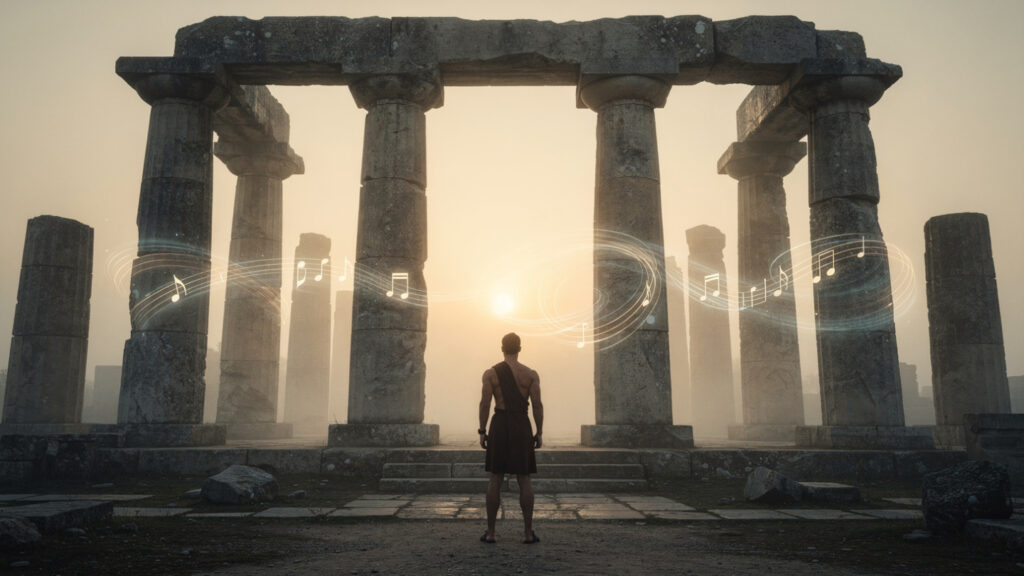
Aristotle’s engagement with the doctrine in the Politics and the Poetics is more nuanced than Plato’s: where Plato excludes the emotionally powerful modes from the ideal city’s musical life, Aristotle argues for a distinction between the music appropriate for education and the music appropriate for entertainment and catharsis, which can use the more emotionally powerful modes because the emotional release they produce in the audience has a purifying rather than a corrupting effect. The concept of catharsis, the purification of the emotions through the aesthetic experience of tragedy, applies equally to music as to drama: the person who experiences the full emotional impact of the Lydian mode in a musical performance and emerges having discharged the emotional pressure that the mode both evokes and releases is a better-functioning citizen than the person who has suppressed that pressure without any outlet.
Sacadas at Delphi | Program Music Before the Modern Period
The Pythian Games at Delphi, held every four years in honor of Apollo, included musical competitions alongside the athletic competitions, and the aulos competition of the sixth century BCE is the context for the single most remarkable preserved account of an ancient Greek musical performance: the Pythikos Nomos, the Pythian nome for solo aulos, performed by Sacadas of Argos at the 586 BCE Pythian Games and at two subsequent celebrations, making him the first three-time winner in the documented record of the Pythian musical competition.
The Pythikos Nomos was the programmatic musical narrative of Apollo’s battle with the Python, the chthonic serpent that had occupied the Delphi oracle before Apollo killed it and took possession of the sanctuary. The ancient sources, particularly Pollux, describe the formal sections of the composition in terms that allow a partial reconstruction of its programmatic structure: the prelude that established the setting, the sections representing the challenge, the combat, the death of the Python, and the paean of victory. This is the earliest example of program music, music composed to represent a narrative sequence, in the Western tradition, predating the sophisticated Romantic program music of Berlioz and Liszt by approximately two and a half millennia.
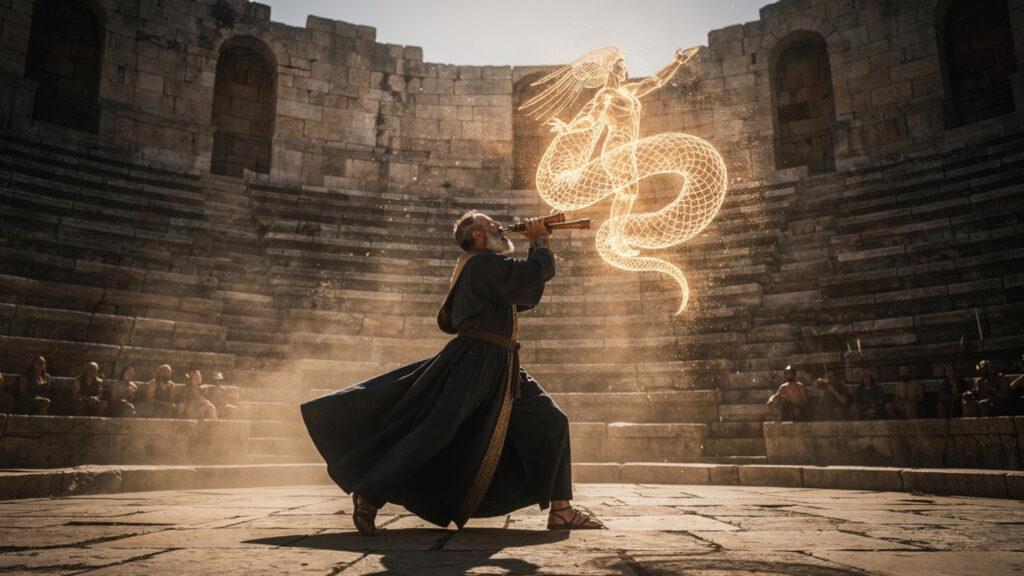
The choice of the aulos as the instrument for this narrative composition is not arbitrary: the aulos’s tonal range and its breathing technique, which allows the player to produce continuous sound through circular breathing in a way that the plucked string instruments cannot, made it the instrument most capable of the sustained narrative quality that the programmatic composition required. The association of the aulos with Dionysian ecstasy was here subordinated to its acoustic capacities in the service of an Apollonian narrative.
Pythagoras and the Harmony of the Spheres
The Pythagorean contribution to music theory is the element that most clearly explains why the ancient Greek engagement with music produced the Western theoretical framework rather than remaining a self‑contained ancient system. The identification of the mathematical ratios that govern the consonant intervals gave Greek music a foundation that was at once a theory of sound and a theory of the universe.
Pythagoras, working in the sixth century BCE, discovered or systematized the observation that the consonant intervals of Greek music, the octave, the fifth, and the fourth, correspond to simple mathematical ratios. The octave is 2:1, the fifth is 3:2, and the fourth is 4:3. The claim that these ratios were not merely the proportions of string lengths that produced these intervals but the proportions of a universal mathematical order that governed the cosmos, that the planets in their orbits were separated by intervals corresponding to the same ratios as the musical intervals, was the claim the Pythagorean schools called the harmony of the spheres. The music produced by the movement of the planets was the music of the cosmos, inaudible to the human ear because the ear was habituated to it from birth, yet present and real and organized according to the same mathematical principles identified in the relationships between tones.
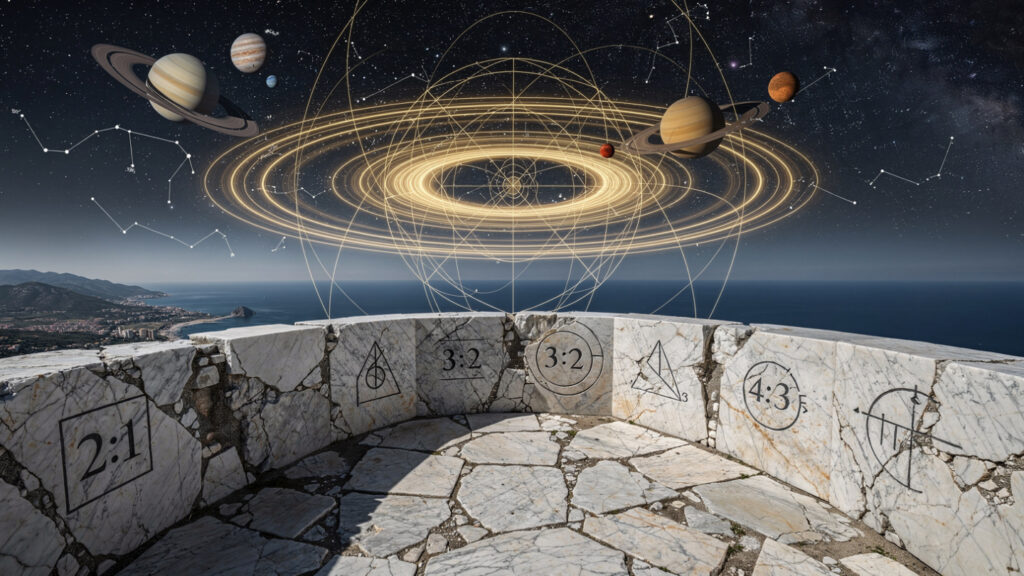
The harmony of the spheres is not a minor embellishment of Pythagorean mathematics. It is the central claim that turned the mathematical theory of music into a theory of everything rather than a theory of one cultural practice. The inheritance of this idea through Plato’s Timaeus, through the Neoplatonist commentators, through Boethius, and through Kepler’s Harmonices Mundi in 1619, in which Kepler explicitly developed the musical ratios corresponding to the planetary orbits he had calculated, is the intellectual lineage that connects the ancient Greek discovery of the ratios governing the consonant intervals to the development of mathematical physics in the seventeenth century.
Music in Drama and the Sung Theater
The ancient Greek theater was a sung theater to a degree that the modern experience of Greek tragedy as a spoken text consistently obscures: the portions of the dramatic text performed by the chorus were sung and danced, not spoken, and the relationship between the musical mode of the choral ode and the emotional content of the ode was the relationship that the doctrine of ethos predicted and the playwright deliberately constructed.
The tragedy, whose etymological connection to the Greek words for goat and song the ancient sources discuss without reaching consensus on the exact original referent, developed from the dithyramb, the choral hymn to Dionysus that the festival tradition of the city Dionysia had been performing before the innovation of the individual actor who stepped forward from the chorus and engaged with it in dialogue created the dramatic form. The movement from the purely choral dithyramb to the drama with individual actors and a chorus was the movement from pure music and dance to the form that combined the spoken individual voice with the sung collective voice.
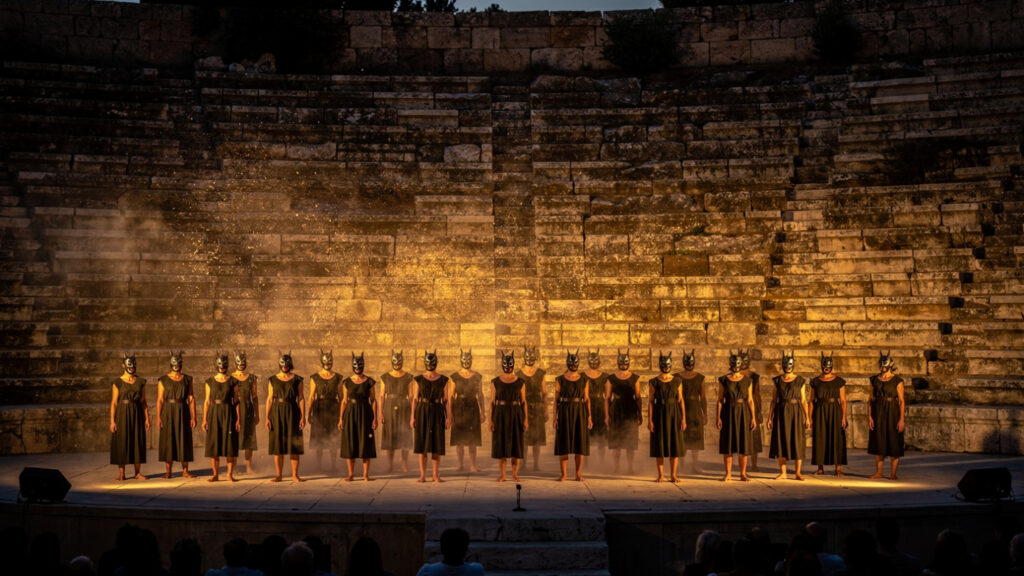
The Euripides Orestes papyrus fragment, with its surviving musical notation for a section of the chorus, is the single most direct surviving connection between the ancient dramatic text and the musical sound that the theater audience heard when the chorus performed. The melodic line that the notation preserves, when reconstructed, is not the melodic line that anyone who has read the Orestes in English or modern Greek translation would have imagined the text required: it is an ancient Greek melody in an ancient Greek mode, and its relationship to the text is the relationship of a musical tradition entirely unlike our own to a dramatic text that we have been reading without its music for two thousand years.
Experiencing the Tradition Today
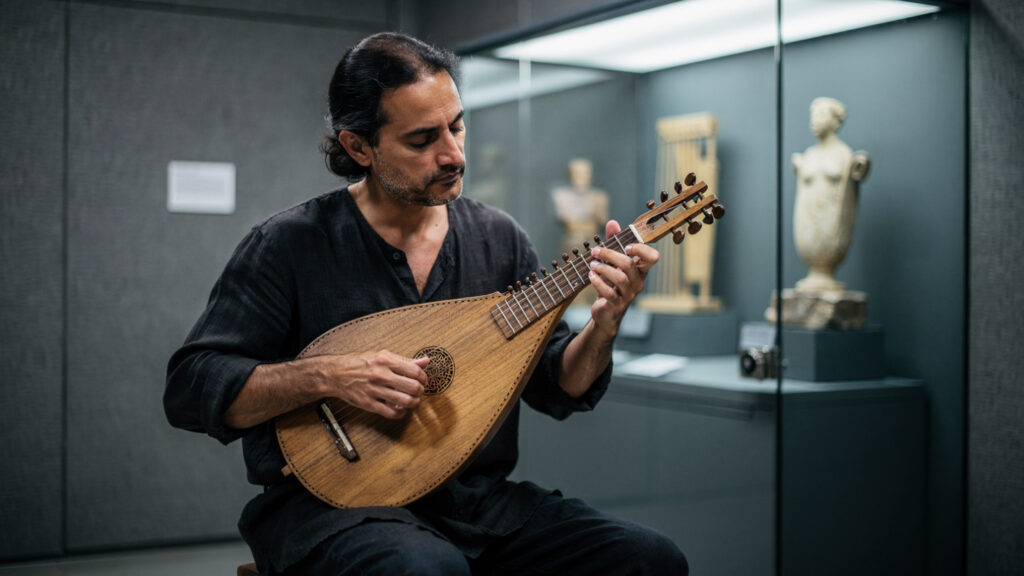
The Archaeological Museum of Ancient Greek Musical Instruments in Thessaloniki, whose collection includes reconstructed versions of the primary instruments played in the conditions for which they were designed, offers the most direct encounter available with the sound of ancient Greek music. The reconstructed aulos played by a musician trained in the ancient technique, the reconstructed kithara tuned according to the system documented by the theorists, and the acoustic quality these instruments produce in the museum’s performance space are the closest approach we have to what the ancient musical world sounded like.
The Epidaurus theater in the summer performance season, where the Athens Epidaurus Festival presents ancient Greek drama in the original performance space, provides the complementary encounter: not the music reconstructed and performed in isolation but the theatrical context in which the music functioned, the drama that the music accompanied, performed in the acoustic space that the ancient architects designed for exactly this purpose.
At Olympus Estate, Cultural Chronicles traces the practices and institutions that defined Greek civilization from the inside. Music was not entertainment in the ancient Greek understanding. It was physics and ethics and cosmology simultaneously. The mathematical ratios that Pythagoras identified in the consonant intervals were the same ratios that governed the planetary orbits and the structure of the just city and the proper ordering of the human soul. The surviving notation is approximately sixty fragments of varying completeness, and the music reconstructed from it sounds like nothing else in the Western tradition. It sounds like what it is: the beginning of something that became everything else, heard across the distance of two and a half millennia, strange and recognizable at once.