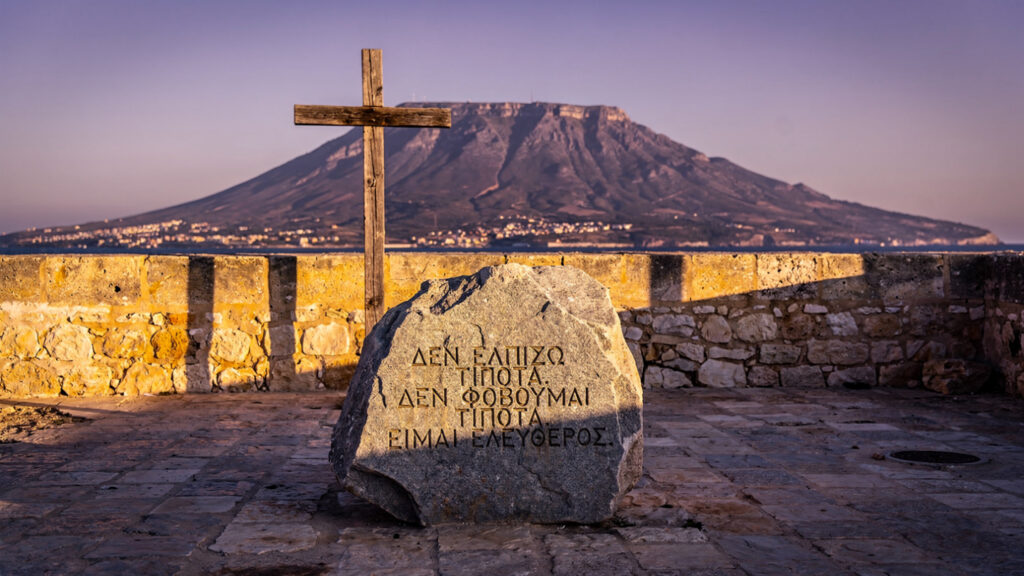
If you climb to the highest point of the Venetian walls guarding the city of Heraklion on the island of Crete, you will find a grave.
It is not in a churchyard. There are no marble angels, no liturgical crosses, no sacred ground in the institutional sense. There is a rough block of Cretan stone, a wooden cross made from unhewn logs, and an inscription carved into the rock in the simple declarative form of a man who has finished arguing with the world and has arrived at his conclusion.
I hope for nothing. I fear nothing. I am free.
Look south from this bastion and you will see Mount Juktas on the horizon: a ridge that in profile looks exactly like a sleeping man’s face, and that Cretan tradition has always described as the head of the dead and buried Zeus. The buried god and the free man, facing each other across the rooftops of Heraklion. Kazantzakis could not have arranged a better view if he had tried. He arranged it anyway: he chose this spot himself, before he died, because a man who spent his entire writing life trying to liberate God from the prison of matter deserved to rest in sight of the place where the mythology said God was buried.
To the global public, Nikos Kazantzakis is the man who created Alexis Zorba: the larger-than-life Macedonian who taught the world to dance in the face of tragedy. To the Greek Orthodox establishment of his time, he was something far more dangerous: a theological dissident who took the most foundational claim of Christianity and treated it with the kind of psychological seriousness that the institution could not tolerate. To the Nobel Prize committee, he was the candidate they nominated nine times and never honoured, losing the 1957 prize to Albert Camus by a single vote.
He was all of these things. He was also, underneath all of them, the most completely Cretan writer who ever lived: a man formed by a specific island’s specific light and a specific history of resistance to every power that tried to domesticate it.
The City That Made Him
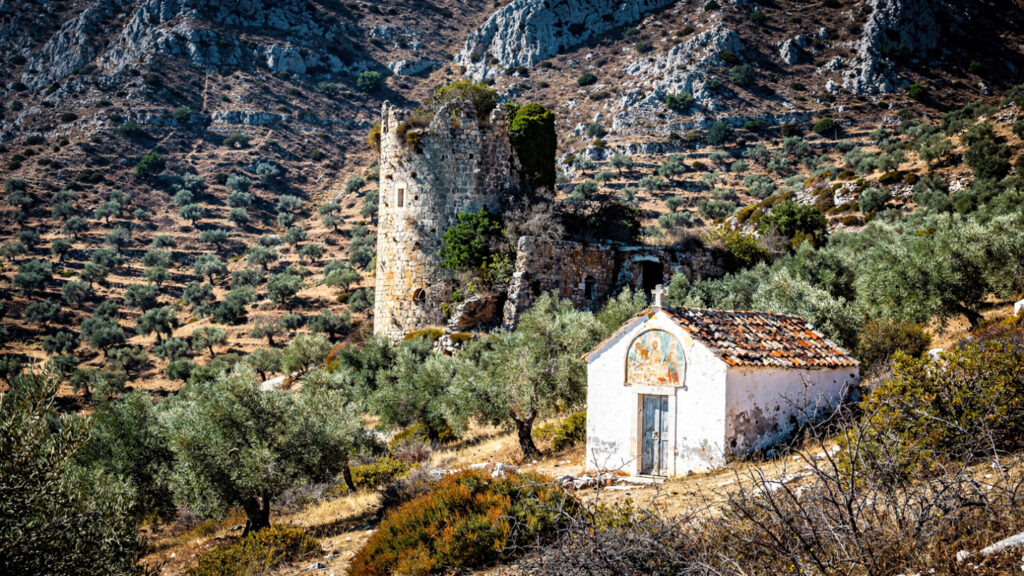
Heraklion in 1883, the year of Kazantzakis’s birth, was still called Candia and was still under Ottoman occupation. The minarets of the mosques competed with the bells of the Orthodox churches for the morning air. The island that would not officially become part of Greece until 1913 was a place where empires overlapped and none of them entirely prevailed, where freedom was not a political abstraction but something that people bought with specific sacrifices in specific years.
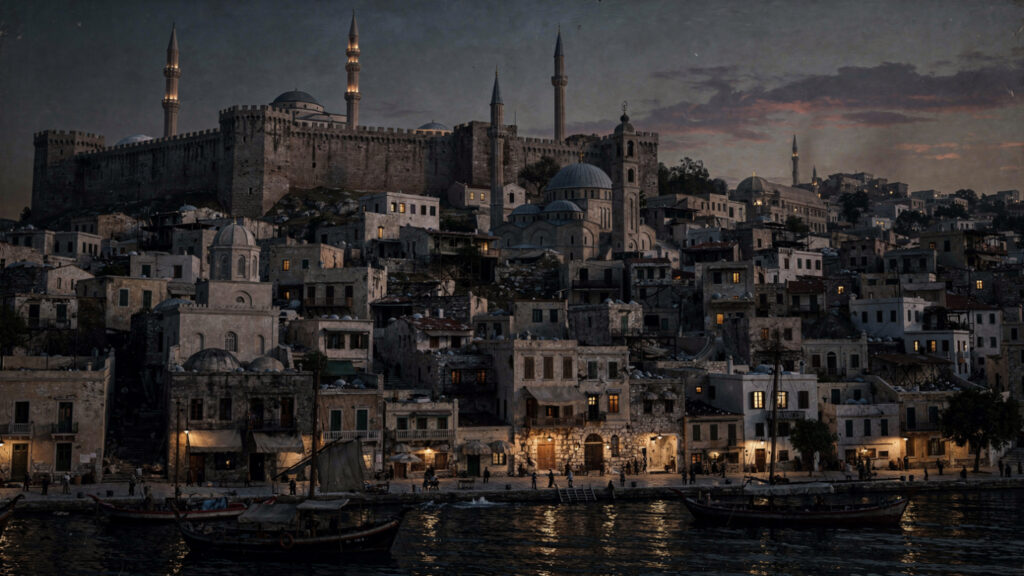
This city has produced two of the most significant figures in Western visual and literary art, separated by three centuries. El Greco, born Domenikos Theotokopoulos in 1541, was first trained in the icon painting tradition of Heraklion before going to Venice and then to Toledo, where he developed the elongated, flame-like figures and the incandescent light that made him one of the most distinctive painters in European history. Kazantzakis was born in the same city 342 years later, into the same culture of Byzantine icon painting and Ottoman occupation and Cretan pride, and he did with language what El Greco had done with pigment: he took the Byzantine tradition of intense spiritual expression and subjected it to the pressure of the modern world until it produced something unprecedented.
Both men left Crete. Both men carried Crete with them everywhere they went. Both men produced work that their respective establishments found difficult to accommodate: El Greco’s altarpieces were rejected by Philip II of Spain because the figures were too strange, too visionary, too clearly the product of a mind that had seen something the institutional church could not quite endorse. Kazantzakis’s novels were placed on the Index of Forbidden Books.
The city produced both, and it kept the record of both, and it is a city worth arriving in with this history in mind.
The Truth About the Excommunication
Before the philosophy, the facts deserve correction, because the story of Kazantzakis and the Greek Orthodox Church has been so thoroughly distorted by repetition that most accounts of his death are substantially inaccurate.
The widely repeated claim is that Kazantzakis died excommunicated, was denied a church burial, and was consigned to the Venetian walls because no consecrated ground would receive him. The reality is more complicated and more interesting.
The Holy Synod of Greece did formally condemn several of his books, including The Last Temptation of Christ, Christ Recrucified, and Freedom and Death. A campaign for his excommunication, gathering pace through the mid-1950s, eventually reached the Ecumenical Patriarch Athenagoras in Constantinople, who declined to act with the finality the campaign demanded, recognising the international stature of Kazantzakis and the consequences of making a martyr of the most famous living Greek writer. The Church of Crete, semi-independent under the Patriarchate, never formally broke its relationship with him.
To the clergy and bishops who pursued the excommunication campaign, Kazantzakis is widely reported to have replied, in the original Greek: you gave me a curse, holy fathers, I give you a blessing in return. May your conscience be as clear as mine, and may you be as moral and as religious as I am. The line has been quoted and requoted across Greek cultural memory for seven decades, in close to identical wording across every source that records it, which is itself a kind of evidence: a reply this consistently remembered earned its permanence by being exactly the right thing to say.
When Kazantzakis died of complications following an inoculation against smallpox and cholera, in the clinic of Freiburg University on October 26, 1957, the Archbishop of Athens refused to allow his body to lie in state in the capital. The refusal was the Synod’s last available gesture of disapproval.
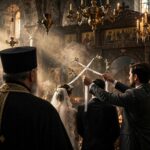
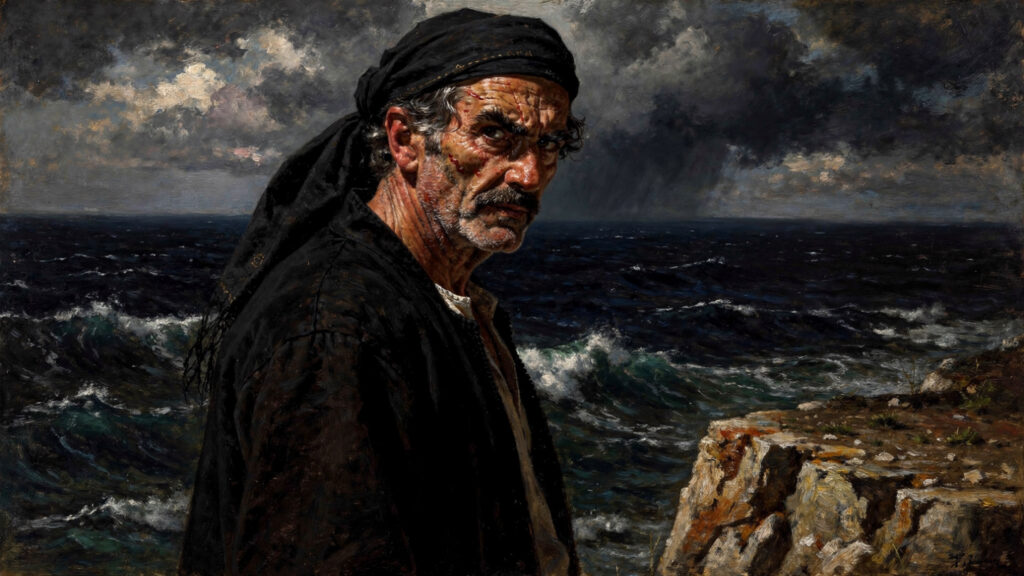
Aristotle Onassis provided the plane to fly the coffin to Heraklion. The Archbishop of Crete Evgenios, and fifteen other priests, were present at the funeral. The people of Heraklion filled the cathedral of Saint Minas to pay their respects. They then carried his coffin on their shoulders to the Martinengo Bastion, past the Venetian walls that the same city had built five centuries earlier to protect itself from precisely the kind of external authority that was now trying to determine where its most famous son could rest.
Outside the cathedral, as the funeral proceeded, fanatics burned his books in the street.
He was buried where he had asked to be buried, in sight of the sleeping god on the southern horizon, with the epitaph he had composed for himself and the wooden cross he had requested. The Archbishop of Crete was present. Fifteen priests were present. The Church of Crete did not abandon him. The Church of Athens made its position clear. Kazantzakis, as was his habit throughout his life, existed in the space between the institutions that were arguing about him.
The Cretan Glance | A Philosophy Forged in the Borderlands
To write about God the way Kazantzakis wrote, you need to understand the specific soil that formed him.
Crete is not simply an island. It is a landscape where the accumulated pressure of successive conquests, Byzantine, Venetian, Ottoman, each with their own theological vocabulary and their own claim on the population’s allegiance, produced in the Cretan character something that can only be called the simultaneous capacity for absolute faith and absolute refusal. The Cretan believes with full intensity in whatever he believes in, and he refuses with equal intensity whatever he refuses, and the church hierarchy and the political authority have consistently found this combination difficult to manage.
Kazantzakis called his own version of this disposition the Cretan Glance: a philosophical posture that looks directly into the abyss of death and darkness without blinking, and then chooses, from that position of complete awareness of what exists in the abyss, to live and create with maximum ferocity. It is not optimism. It is not faith in the conventional sense. It is the specific stance of a person who has made their peace with the worst available truth and discovered that the worst available truth is not a reason to stop.
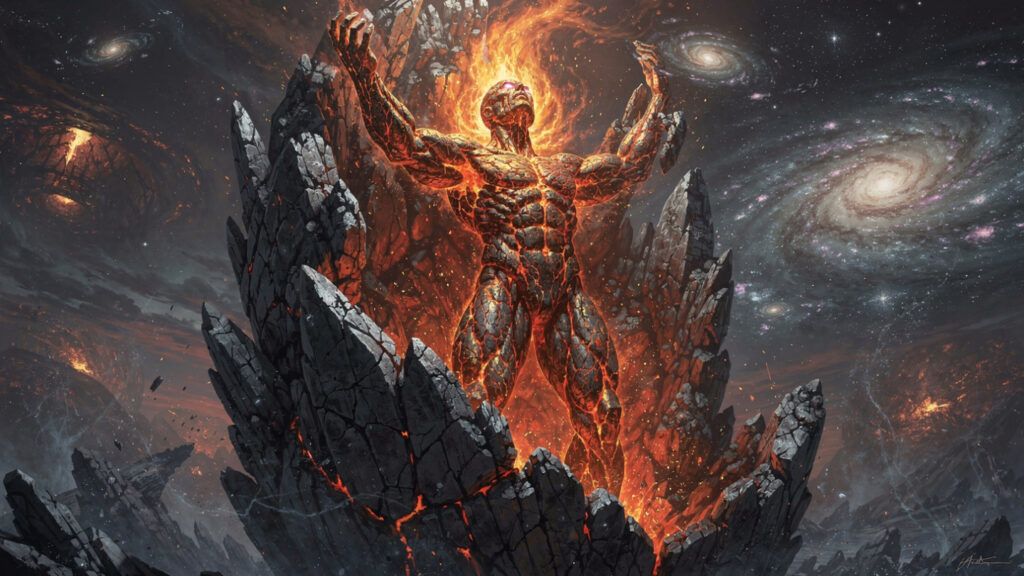
For Kazantzakis, God was not a benevolent authority dispensing reward and punishment from above the clouds. God was a flame: an evolutionary, upward-surging energy trapped inside the matter of the universe, struggling to be liberated by human consciousness. The relationship between humanity and the divine, in his understanding, ran in the opposite direction from the institutional version. We do not need God’s help to survive. God needs our help to be free. By living with maximum intensity, by transmuting our animal instincts into art and thought and love and courage, we liberate the divine spark that is imprisoned in matter.
This inversion of the conventional theological relationship is the key to understanding everything he wrote, including and especially the book that caused the most trouble.
Paris and the Productive Misreading of Nietzsche
In 1907, in the reading rooms of the Bibliothèque Sainte-Geneviève in Paris, a young law graduate from Heraklion was studying philosophy at the Sorbonne under Henri Bergson. A woman in the library, startled by his physical resemblance to a photograph she had seen, handed him a copy of Thus Spoke Zarathustra. She thought he looked like Nietzsche.
He did not simply read the book. He went to war with it.
What followed was two years of intense engagement that produced his doctoral dissertation: Friedrich Nietzsche on the Philosophy of Right and the State. It is a work of serious philosophical combat: the young Cretan arguing with the dead German across every dimension of the German’s thought, accepting certain propositions, violently rejecting others, transforming what he accepted into something the original would not have recognised.
Here is the hidden paradox that deserves its full elaboration: Kazantzakis did not read Nietzsche directly. He read Nietzsche through the French commentators of the early twentieth century, particularly Henri Lichtenberger, whose interpretations had softened and mystified the German’s fierce anti-metaphysical materialism into something closer to a grand cosmic romanticism. The French Nietzsche, as Kazantzakis encountered him, was less the philosopher who proclaimed the death of God and the necessity of the will to power, and more a prophet of evolutionary spiritual struggle, a visionary who saw the human being as a temporary form that existence was using on its way toward something higher.
This misreading was creative rather than merely erroneous. Kazantzakis took the misread Nietzsche and combined him with Bergson’s concept of the élan vital, the vital impulse that drives all life toward greater complexity and greater freedom, and produced from the combination something that neither source contained: a spirituality of maximum effort, a theology of striving rather than submission, a God who was not above the human struggle but inside it, requiring it, depending on it.
Where Nietzsche saw a godless universe in which the strong must create their own values, Kazantzakis saw a universe saturated with divine energy that required human consciousness to liberate it. Where Nietzsche’s Zarathustra descended from the mountain to teach the Superman, Kazantzakis’s God cried out from inside matter for someone to climb toward it. The direction of movement was reversed, and in that reversal, the entire theological structure changed.
He was too spiritual for the atheists and too heterodox for the Christians, which is precisely where the most interesting thinkers tend to live.
The Last Temptation | Why It Mattered
The novel that brought the Holy Synod to its feet was not, in Kazantzakis’s own understanding, an attack on Christianity. It was a defence of it.
The foundational dogma of orthodox Christianity states that Christ was simultaneously fully divine and fully human. The tradition has always found the human part easier to acknowledge in principle than to explore in practice. A Christ who is depicted as genuinely tempted, genuinely afraid, genuinely pulled toward the ordinary warmth of an ordinary life, is a Christ who becomes difficult to worship in the manner that the institutional church prefers. The plaster saint is easier to manage than the man of bone and blood and doubt.
Kazantzakis’s argument was precise: if Christ did not feel the full weight of human temptation, then the choice he made on the cross was not a choice. A god who cannot sin cannot choose virtue. A being for whom the ordinary pleasures of life are not genuinely desirable cannot genuinely sacrifice them. The cross is only meaningful if the alternative was real, if the domestic life with Mary Magdalene, the children, the slow death of old age in a warm house, was a genuine possibility that genuine desire pulled toward.
The last temptation of the title is the dream that comes to Jesus while he is dying on the cross: an angel appears, tells him his mission is complete, releases him from the cross, and shows him the life he could have had. He marries Mary Magdalene. He grows old. He watches his grandchildren play. He dies peacefully. Then he wakes to find it was a dream sent by Satan, the final deception, and he chooses the cross again with full knowledge of what he is choosing.
In Kazantzakis’s reading, this is the most complete demonstration of Christ’s love for humanity available: the choice made not from the safety of divine certainty but from the full terror of human vulnerability, knowing exactly what is being given up, choosing to give it up anyway.
The church preferred the version without the doubt. Kazantzakis gave them the version with the doubt because he believed the doubt was the point.
Zorba | The Autobiography Nobody Recognised as Such
The world reads Zorba the Greek as a celebration of Mediterranean hedonism. It is actually a confession.
The narrator, the unnamed intellectual who encounters Zorba on a boat to Crete and hires him to manage a lignite mine in the Mani, is a thin man buried in manuscripts of Buddha and Nietzsche, a man for whom experience has always been mediated by thought, who has spent his entire life reading about life rather than living it. He is Kazantzakis, and the self-portrait is not flattering.
The real George Zorbas was a Macedonian labourer named Giorgos Zorbas, whom Kazantzakis hired in 1916 to manage an actual lignite mining venture in Stoupa in the Mani peninsula of the Peloponnese. The two men spent months together on a beach where the mine machinery was being constructed and the business was slowly failing. The physical environment Kazantzakis uses in the novel is precise: the dark claustrophobic mine descending into the earth below, the vast and liberating blue of the Messenian Gulf stretching to the horizon above. The mine is the intellectual’s mind: productive in principle, underground, cut off from the sky. The sea is what Zorba dances toward.
The scene that became the emblem of an entire philosophy arrives when the timber line for the mine collapses catastrophically, the entire business venture failing in a single public moment of falling wood and broken cable. Kazantzakis, in the novel, expects to weep. Instead he finds himself laughing. And Zorba, seeing the laughter, begins to dance.
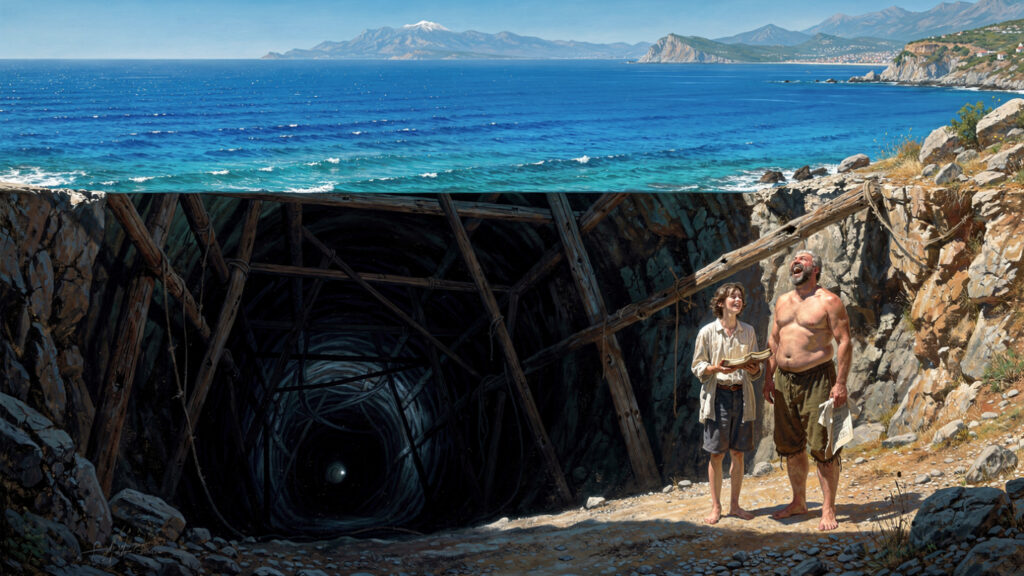
The dance is not a celebration of failure. It is the discovery of what remains when everything constructed has been destroyed: the body, the breath, the ridiculous and magnificent fact of still being alive on a beach with someone you love while the enterprise you built together lies in ruins around you. The intellectual had spent his life trying to achieve something. Zorba teaches him that the something is already here, in the moment of laughing on the beach.
The paradox of the novel is that the intellectual narrator learns the lesson and then forgets it, or cannot hold it, or finds that knowing it intellectually is not the same as knowing it in the body. Kazantzakis knew this about himself. He was always more Bookworm than Zorba, and he knew it, and the novel is the honest account of a man who understood a wisdom he could not quite fully inhabit.
The Literary Map | Where to Find Him on Crete
The novels of Kazantzakis are rooted in specific Cretan geography, and the geography rewards visiting with his words in mind.
Myrtia, fifteen kilometres south of Knossos, was his paternal ancestral village. The Nikos Kazantzakis Museum here is not a static collection of manuscripts behind glass: it is an actively curated space that follows the arc of his thinking across his entire life, from the childhood in Ottoman-controlled Heraklion through the Paris years and the Soviet journeys and the final exile. The village itself provides the human material that the novels draw from: the stone-arched houses, the specific quality of the summer afternoon in an inland Cretan village, the olive groves on the hillside above.
The Martinengo Bastion in Heraklion is the visit that closes the understanding rather than opening it. Go there after you have read something: a passage of the Saviors of God, the ending of Zorba, the first chapter of Report to Greco. Climb to the tomb in the late afternoon, when the light is horizontal and Mount Juktas is clear on the southern horizon. Stand at the grave and read the epitaph in Greek if you can: Den elpizo tipota. Den fovoumai tipota. Eimai eleftheros. Six words in Greek. The distillation of a philosophy that took him his entire life to arrive at.
Look south to the sleeping god in the mountain. Look north to the sea that is still the same sea. Consider the man who spent his life trying to liberate God from matter, buried on a Venetian bastion with a wooden cross and a view of the buried Zeus.
Then consider what it means that both are still here.
The Paradox of Kazantzakis Today
He was too Eastern for the Western academics who wanted their Nietzsche without the Byzantine mysticism. He was too Western for the Greek nationalists who wanted their literature without the French philosophy. He was too spiritual for the communists, who found his Marxist period unconvincing even during it. He was too radical for the conservatives. He was too Christian for the atheists and too heterodox for the church.
This comprehensive refusal to fit any available category is precisely what makes him the right writer today.
The generation that has inherited the digital world’s insistence on positioning, on knowing which side you are on, on the reduction of complex thought to identifiable tribe membership, finds in Kazantzakis a model of what it looks like to refuse all of that without retreating into either comfortable relativism or comfortable certainty. He held contradictions simultaneously: the faith and the doubt, the body and the spirit, the East and the West, the Greek tradition and the European philosophy, the Christ he loved and the church he argued with.
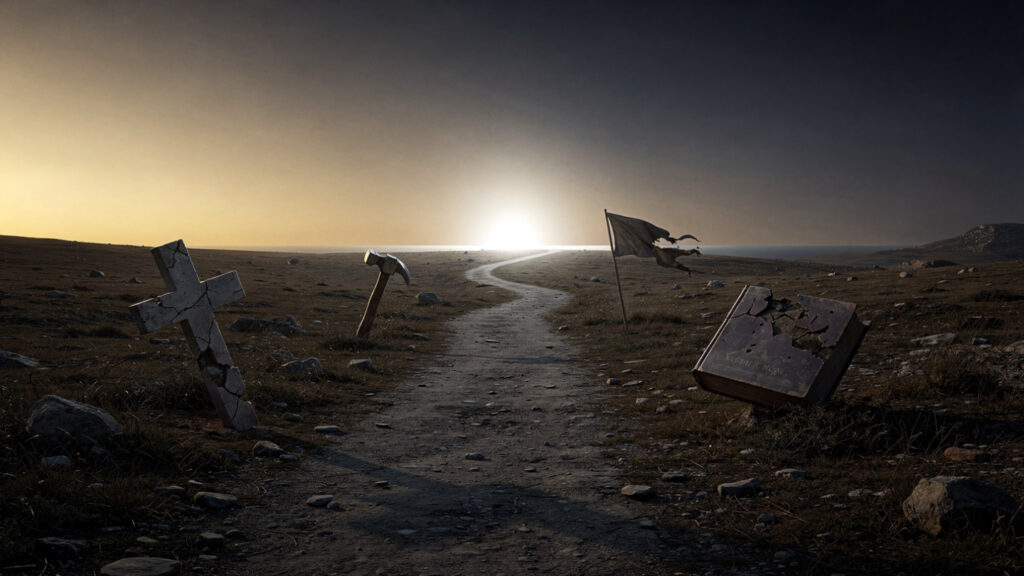
He did not resolve these contradictions. He lived in them, and wrote from them, and produced from them work that has been read in dozens of languages by people who are not Greek, not Orthodox, not Cretan, because the contradictions he inhabited are not specifically Greek. They are specifically human.
The epitaph on the bastion is not a statement of nihilism. It is a statement of the freedom that exists specifically on the other side of hope and fear: the freedom available to someone who has looked at the worst available truth and decided to keep working anyway.
He was nominated nine times for the Nobel Prize in Literature. In 1957 he lost it to Albert Camus by a single vote in the Swedish Academy’s deliberation. Camus is widely reported, in accounts repeated consistently across Greek and international sources, to have said afterward that Kazantzakis deserved the honour a hundred times more than he did himself.
These things happen. The work remains.
He was free
He was born in a city under Ottoman occupation, educated in Athens and Paris, forbidden entry to his own country for long periods, and died in exile in a German clinic from a complication of a routine inoculation. Aristotle Onassis flew his body home. The Archbishop of Athens refused him the capital. The Archbishop of Crete stood by his grave with fifteen priests.
His books were burned in the street outside the cathedral where his coffin lay.
From the Martinengo Bastion, he can see the whole of it: the city he was born in, the sea that separates it from everything that made him what he was, the mountain on the southern horizon where the mythology buried its god and where he can keep watch over the burial without fearing it.
He hoped for nothing. He feared nothing. He was free.
That is what freedom looks like when it has cost everything to arrive at: a rough stone on a Venetian bastion, a wooden cross, six words in Greek, and a view of the buried god on the mountain.
Go to Heraklion. Read the books. Climb to the bastion in the late afternoon when the light is right and the mountain is clear. Stand at the grave and understand that the man who wrote God was not excommunicated by God.
He was excommunicated by men who preferred a plaster saint to the one that bled.
At Olympus Estate, Cultural Chronicles explores the architects of the Greek cultural consciousness. Nikos Kazantzakis did not write to comfort his readers. He wrote to set them on fire. He proved that the heritage of Greece is not a static museum of marble statues but a living, dangerous current of inquiry that refuses to bow to the walls of the establishment.