




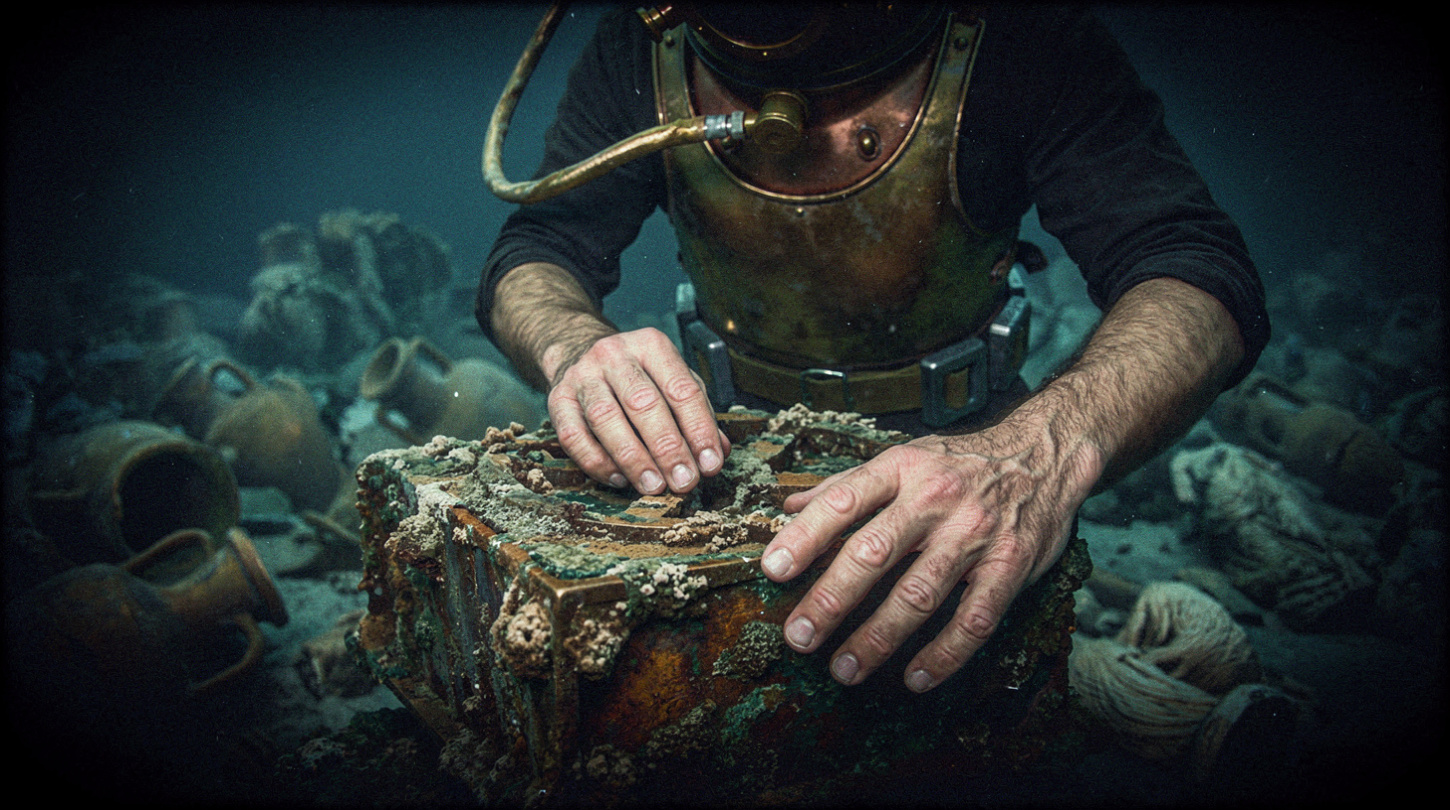
In 1900 a group of sponge divers sheltering from a storm near the small island of Antikythera, in the passage between the Peloponnese and Crete, found a Roman shipwreck on the seabed at a depth of approximately 45 metres. They reported it to the Greek government. The following year, a salvage operation recovered from the wreck the largest collection of ancient bronze and marble statuary ever found underwater, along with glassware, amphorae, coins, and jewellery. The objects dated to the first century BCE, and the ship appeared to have been carrying them from the eastern Mediterranean to Rome, most likely as the luxury cargo of a wealthy Roman patron.
Among the recovered objects was a corroded lump of bronze whose significance was not immediately apparent. It was roughly the size of a large shoebox, encrusted with marine growth, and looked, at first, like nothing more than a damaged piece of metalwork. It sat in the National Archaeological Museum in Athens largely unexamined until 1902, when an archaeologist named Valerios Stais noticed that one of its fragments had gear teeth. The object had been a machine.

What the following century of research revealed about that machine changed, in the most fundamental sense available, what we understand about ancient Greek intellectual life and where it actually drew the line between theory and practical engineering.
What the Mechanism Did
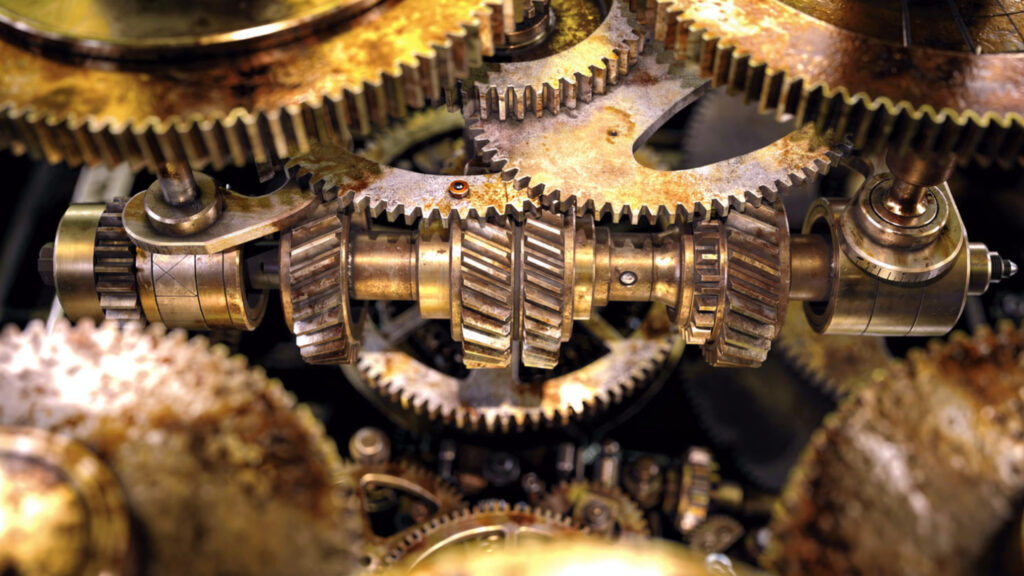
The Antikythera Mechanism was a bronze computing device built to predict astronomical events across several calendrical cycles at once. A single hand-turned shaft drove its system of interlocking bronze gears, of which at least 30 survive and which reconstruction research estimates numbered around 37 originally, translating that one rotation into simultaneous readouts across a series of dials on the mechanism’s front and back faces.
The front face displayed the sun’s and moon’s position in the zodiac and in the Egyptian calendar, and indicated the moon’s phase. The upper back dial displayed the Metonic cycle, the 19-year span in which 235 lunar months correspond almost exactly to 19 solar years, giving the Greek world its most accurate available method for reconciling lunar and solar time. The lower back dial displayed the Saros cycle, the 18-year, 11-day span across which solar and lunar eclipses repeat in the same order, allowing eclipses to be predicted from records of earlier ones.
A secondary pointer on the upper back dial tracked the Callippic cycle, the 76-year period, equal to four Metonic cycles, that the astronomer Callippus of Cyzicus developed in the fourth century BCE to correct the six-hour-per-cycle drift the Metonic cycle otherwise accumulated. A subsidiary dial within the same upper back face tracked the four-year Olympiad cycle, identifying which of the four years hosted the Olympic Games, the Pythian Games, the Nemean Games, and the Isthmian Games.
Producing all of these outputs from one single input required a genuine engineering breakthrough: the differential gear, a mechanism that takes one input and splits it between two independent outputs able to move at different rates from each other. This is precisely what let the mechanism track the moon’s synodic period, the cycle of its phases, independently of its sidereal period, its actual orbit around the earth. No later engineer is known to have rediscovered this same solution until the clockmakers of thirteenth- and fourteenth-century Europe worked it out again on their own.
The Antikythera Mechanism contains the world’s oldest known differential gear. It was built around 100 BCE.
The Astronomical Knowledge the Mechanism Encoded
The astronomy the mechanism computed was never the general educated knowledge of its day. It was the most advanced quantitative astronomy the Hellenistic world had produced, most closely associated with a single figure: Hipparchus of Nicaea.
Hipparchus worked on the island of Rhodes in the second century BCE, roughly the period the mechanism’s own astronomical program has been dated to. He compiled the first systematic star catalogue in the Greek world, fixing the position and brightness of some 850 stars on a six-magnitude scale astronomers still use today in essentially its original form. He also discovered the precession of the equinoxes, the slow rotation of the earth’s axis that shifts the apparent position of the stars relative to the equinoxes by roughly one degree every 72 years, completing a full cycle in about 26,000 years, a discovery that required comparing star positions across centuries of prior observation and whose actual mechanism went unexplained until Newton addressed it in the Principia Mathematica in 1687.
Hipparchus also developed the mathematical tools, including the systematic use of trigonometry and methods for calculating the sun’s and moon’s positions from observed motion, that the mechanism’s own gear trains render directly in bronze. The Antikythera Mechanism Research Project, whose X-ray computed tomography of the surviving fragments has produced the fullest account yet of the device’s structure, has identified in its gear ratios the exact astronomical parameters Hipparchus calculated for the moon’s irregular motion, the variation in its speed across the sky produced by its elliptical orbit.
The gear ratio governing the mechanism’s lunar motion reproduces Hipparchus’s own value for the moon’s anomalistic period with a precision no later astronomers matched until Islamic astronomy caught up to it in the ninth and tenth centuries CE. The Antikythera Mechanism was never encoding generic ancient astronomy. It was encoding the single most advanced quantitative astronomy the second-century BCE Greek world had to offer.
The Shipwreck and the Problem of Transmission
The mechanism’s own existence raises a question it cannot answer on its own: how many of these devices were actually built?
Ancient writers already knew such devices existed. Cicero, writing in the first century BCE, in the generation right after this particular mechanism was built, describes in his De Re Publica a device built by Archimedes, or by Archimedes’s own followers, that replicated the motions of the planets and displayed their positions and cycles. He says he saw it himself. Cicero was not describing a philosophical toy or a theoretical model. He was describing a working computational device that produced real outputs for the positions of the celestial bodies.
The Archimedes connection pushes the history of such devices back into the third century BCE, roughly a century before this particular mechanism was built. The Samos article in this collection develops Aristarchus of Samos and the Eupalinos tunnel as further evidence that Hellenistic mathematics and engineering had reached a level of sophistication no later era matched for centuries. The Antikythera Mechanism is the one surviving object that makes this same claim in a form anyone can physically examine, measure, and test.
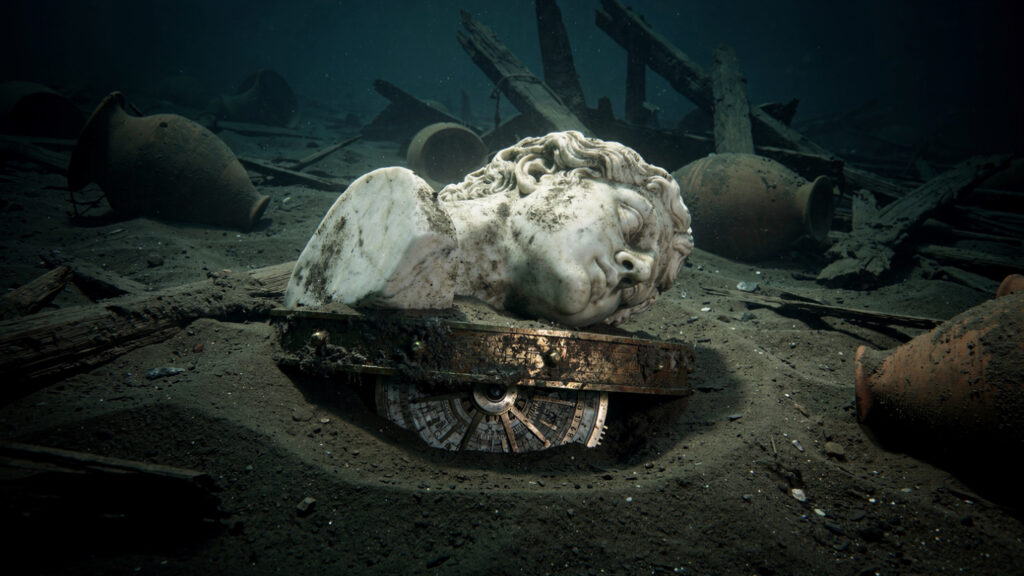
Cicero’s testimony raises the possibility with the most consequential implications for how we understand ancient Greek intellectual life: that this mechanism was never unique. That enough devices like it existed for a Roman aristocrat to own one and for Cicero to describe another from firsthand observation. That the Roman shipwreck in the Antikythera straits was not carrying the only device of its kind ever built, but one surviving example of a whole class of devices whose other examples simply have not survived.
This is the implication that actually changes the picture. The standard account of ancient Greek intellectual life treats it as the work of philosophers and mathematicians who developed theoretical knowledge without ever translating it into devices of comparable sophistication. The Antikythera Mechanism refutes that account as directly as physical evidence can: it is Hipparchus’s own theoretical astronomy translated into working bronze engineering, at a precision that demanded, in effect, the invention of the differential gear.
The Recovery of the Text
The mechanism’s bronze gears and dials are not its only surviving content. It also carried inscriptions in ancient Greek, progressively recovered through the X-ray computed tomography and polynomial texture mapping the Antikythera Mechanism Research Project has applied to the surviving fragments.
These inscriptions include what looks like a user manual: a text describing each dial’s function and the astronomical cycle each pointer tracked, written in the technical vocabulary of Hellenistic astronomy. Recovering this text has been one of the research project’s most important achievements, since it gives named context to the gear outputs physical analysis had already identified.
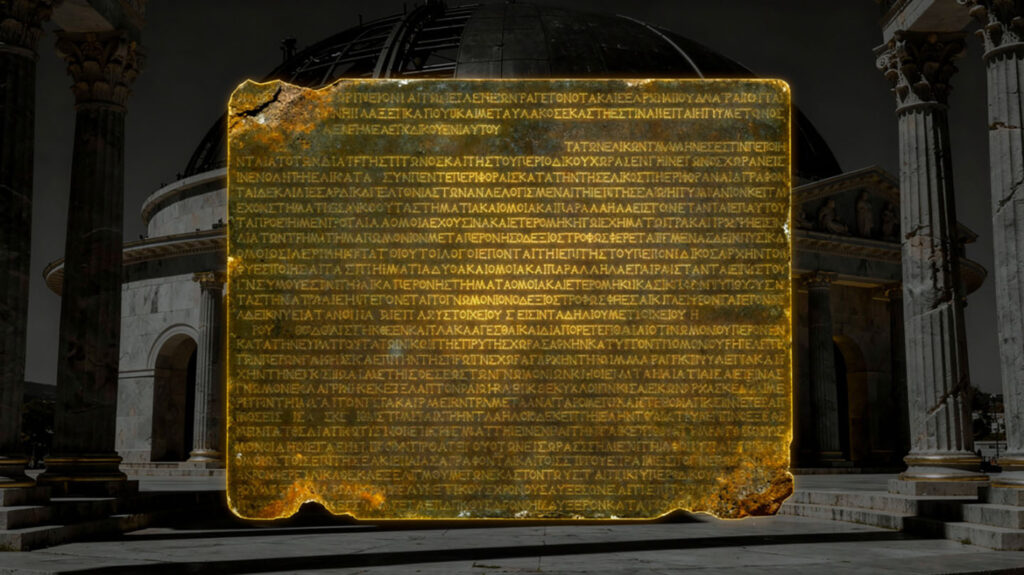
Inscriptions on the mechanism’s back cover plate describe planetary motion in enough detail that a 2021 analysis by the Antikythera Mechanism Research Project concluded the mechanism’s front face likely displayed the positions of all five planets known to antiquity, Mercury, Venus, Mars, Jupiter, and Saturn, alongside the sun and moon. The surviving front-face gear trains are not complete enough to reconstruct this planetary display with certainty, but the textual evidence suggests the mechanism was tracking all seven celestial bodies at once, from a single input shaft.
If this reconstruction holds, the Antikythera Mechanism was never simply a calendar computer. It was a mechanical model of the solar system, its computational demands requiring seven independent astronomical cycles integrated into one coherent mechanical output, an engineering feat medieval Europe’s clockmakers and instrument-builders were still working toward a thousand years later.
The National Archaeological Museum and the Object Itself
The Antikythera Mechanism is in the National Archaeological Museum in Athens, in the room devoted to the Antikythera shipwreck, alongside the wreck’s other recovered contents, the bronze Youth of Antikythera, marble statues, glassware, and coins, all offering material context for what kind of cargo the vessel that carried the mechanism to the bottom of the strait was actually transporting.
The mechanism’s surviving fragments, displayed in cases that let visitors see the gear teeth, the inscribed text, and the dial faces corrosion and marine growth have nonetheless allowed to survive, are not the kind of object that explains itself the way a statue or a vase does. They are pieces of a machine, and neither their function nor their real complexity is legible from the material alone, without the knowledge decades of reconstruction research have built up about how these fragments relate to each other and to the mechanism’s original structure.
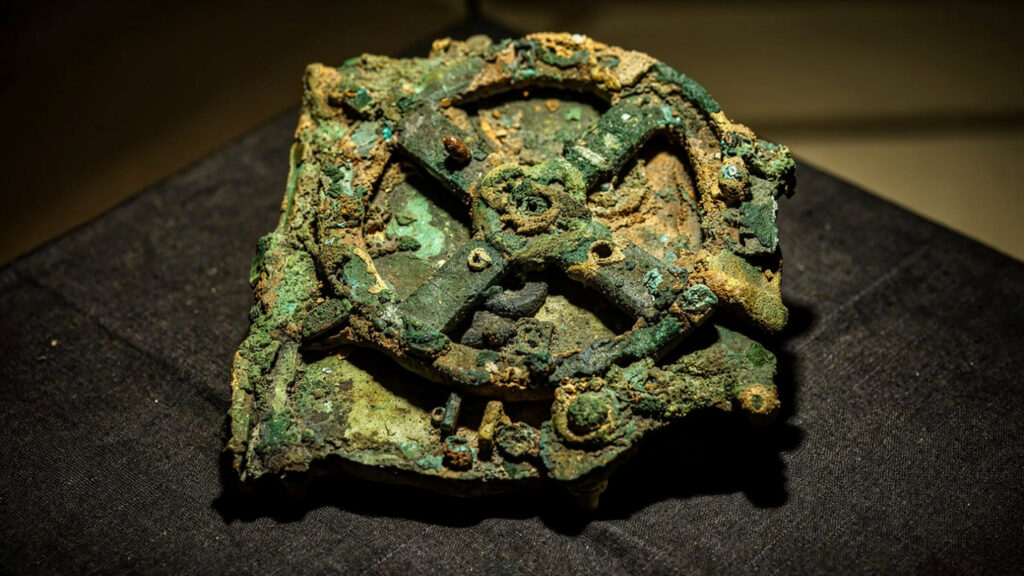
The museum’s own display gives visitors that context directly, and the reconstruction models on view, including the working bronze replica the horological researcher Michael Wright built, along with later reconstructions from the Antikythera Mechanism Research Project and other researchers, give visitors the visual and mechanical understanding the surviving fragments alone cannot provide.
What the fragments themselves offer that no reconstruction model can replace is the direct encounter with the real object: the bronze alloy reflecting Hellenistic metallurgical practice, the tool marks left by the craftspeople precise enough to cut the mechanism’s smallest gears, and the corroded surfaces whose original form modern tomography has managed to recover, a scientific achievement the fragments themselves still physically carry.
The island of Antikythera, where the wreck was found, is reachable by ferry from Kythera and from the Peloponnese. Fewer than a hundred people live there today, a remote, sparsely inhabited island that happened to sit exactly where a Roman ship went down, holding the most significant archaeological discovery in the history of ancient technology on the seabed for two thousand years before a storm sent sponge divers looking for shelter nearby.
What the Mechanism Means
The Antikythera Mechanism means that ancient Greek intellectual life was never quite what the standard account claims, a world of philosophers and mathematicians who built theoretical knowledge without ever translating it into practical engineering of comparable sophistication. It means that at least some of that world’s most advanced theoretical astronomy was translated into a practical computing device complex enough to demand the invention of the differential gear.
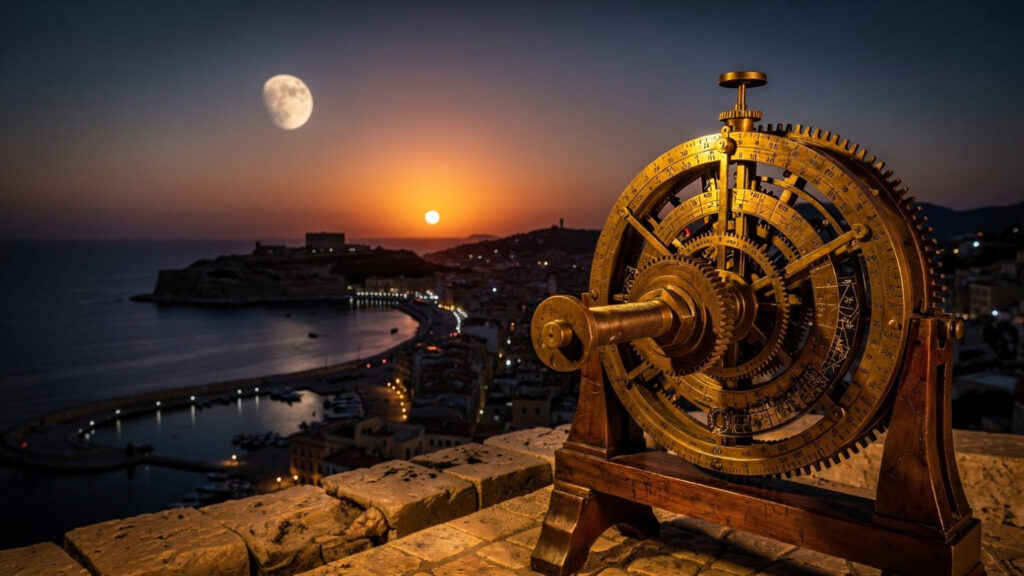
It means the boundary between ancient Greek theory and practical engineering never sat where later Western thought assumed it did. The philosophers, mathematicians, and astronomers of the Hellenistic Greek world were also, in at least some documented cases, and quite possibly in more cases the surviving record simply cannot confirm, the builders of devices mechanically more sophisticated than anything the following thousand years produced.
It means the combination of theoretical ambition and practical capability that the Copernican revolution and the scientific revolution of the seventeenth century are usually credited with inventing had already existed once before, and was simply rediscovered rather than invented from nothing. That earlier achievement had been real. The mechanism is the surviving proof of exactly how far it had actually gone.
The Saros eclipse cycle the mechanism encoded had originally been developed by Babylonian astronomers before Hipparchus folded it into Greek astronomy. The Metonic cycle its upper back dial tracked was the same cycle Meton of Athens had announced publicly in the agora in 432 BCE. The differential gear at the mechanism’s mechanical core solved the problem of computing two different astronomical periods from a single input in a way no other known device achieved again until medieval clockmaking rediscovered it independently.
The mechanism sits in its case in the National Archaeological Museum in Athens. The gear teeth are visible. The inscribed text is partially legible. The corrosion is two thousand years old.
The conversation between theory and practice this mechanism represents began the moment the Hellenistic Greek world asked what the sky was actually doing, and then built a machine that could answer.
At Olympus Estate, Cultural Chronicles traces the practices and institutions that defined Greek civilization from the inside. Sponge divers found it in 1900. The corroded lump of bronze sat in the National Archaeological Museum until 1902, when someone noticed it had gear teeth. The gear ratio for the moon’s motion reproduces Hipparchus’s own value for the anomalistic period with a precision no one matched again until the ninth century CE. The mechanism contains the world’s oldest known differential gear. Cicero said he had seen a device like it. X-ray tomography recovered inscriptions suggesting the mechanism tracked all five known planets simultaneously from a single input shaft. The mechanism sits in its case in Athens. The gear teeth are visible. The Hellenistic world that built it had gone further than anyone knew.