

Mykonos makes no apology for what it has become.
The island that was a fishing community of modest means for most of its history became, in the course of a few decades in the late twentieth century, one of the most internationally recognized leisure destinations on earth. The windmills that once ground grain are now the backdrop for photographs taken by visitors who have flown from every continent. The lanes of Chora that the fishermen’s families walked between their houses and the harbor are now lined with gallery spaces and luxury boutiques. The beaches where fishing boats were dragged up from the water are now organized around beach clubs that charge for the same view the fishermen saw for free.
This transformation is the island’s story, and it is worth understanding rather than avoiding, because the Mykonos that exists now is not a corruption of something more authentic. It is what the island has made of its own qualities under the conditions of late twentieth century global tourism, and the result, whatever its relationship to the fishing community that preceded it, is a place of genuine energy and beauty that has no equivalent anywhere in Greece.
The mythology that frames the island’s landscape runs beneath the contemporary surface with a depth that the party culture has not dissolved. Delos, visible from Mykonos’s southern coast, is the birthplace of Apollo and Artemis in the mythological tradition, the sacred island that the ancient world treated as the geographic center of the Cyclades and as a site of such religious significance that the dying and the pregnant were not permitted to remain there, so that no birth and no death would occur on its sacred ground. The relationship between the sacred, uninhabitable Delos and the secular, maximally inhabited Mykonos across the narrow channel between them is one of the more pointed contrasts the Aegean offers.
Chora and What the Town Is
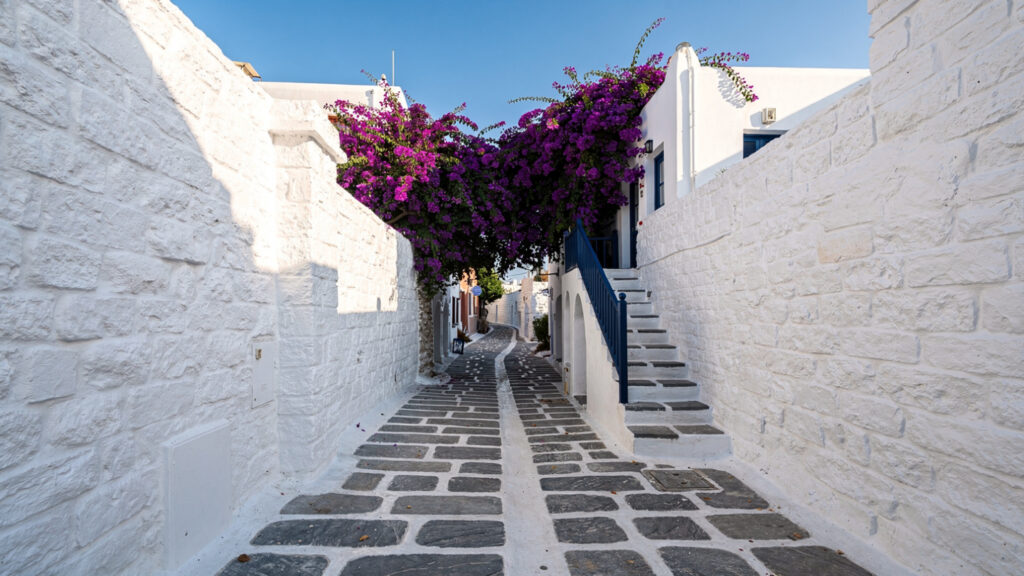
Mykonos Town, Chora in the Greek usage that applies to the main settlement of any Greek island, is a maze built by the logic of medieval fortification combined with the practical spatial arrangements of a seafaring community whose wealth came from commerce and whose danger came from pirates.
The lanes that appear to visitors as charmingly random were designed to disorient anyone moving through them without local knowledge. The Cycladic town plan of tightly packed white buildings with narrow, winding passages between them was a defensive arrangement as much as an aesthetic one: a pirate force entering the town would lose the cohesion and speed that made raiding effective, slowed by the turns and dead ends of the alleys into a situation where the defenders’ local knowledge was decisive. The whitewash that covers every surface is both aesthetic and practical: lime whitewash is an effective antimicrobial agent in warm climates, and the annual reapplication of lime to the buildings’ surfaces was a collective hygiene practice as much as a visual tradition.
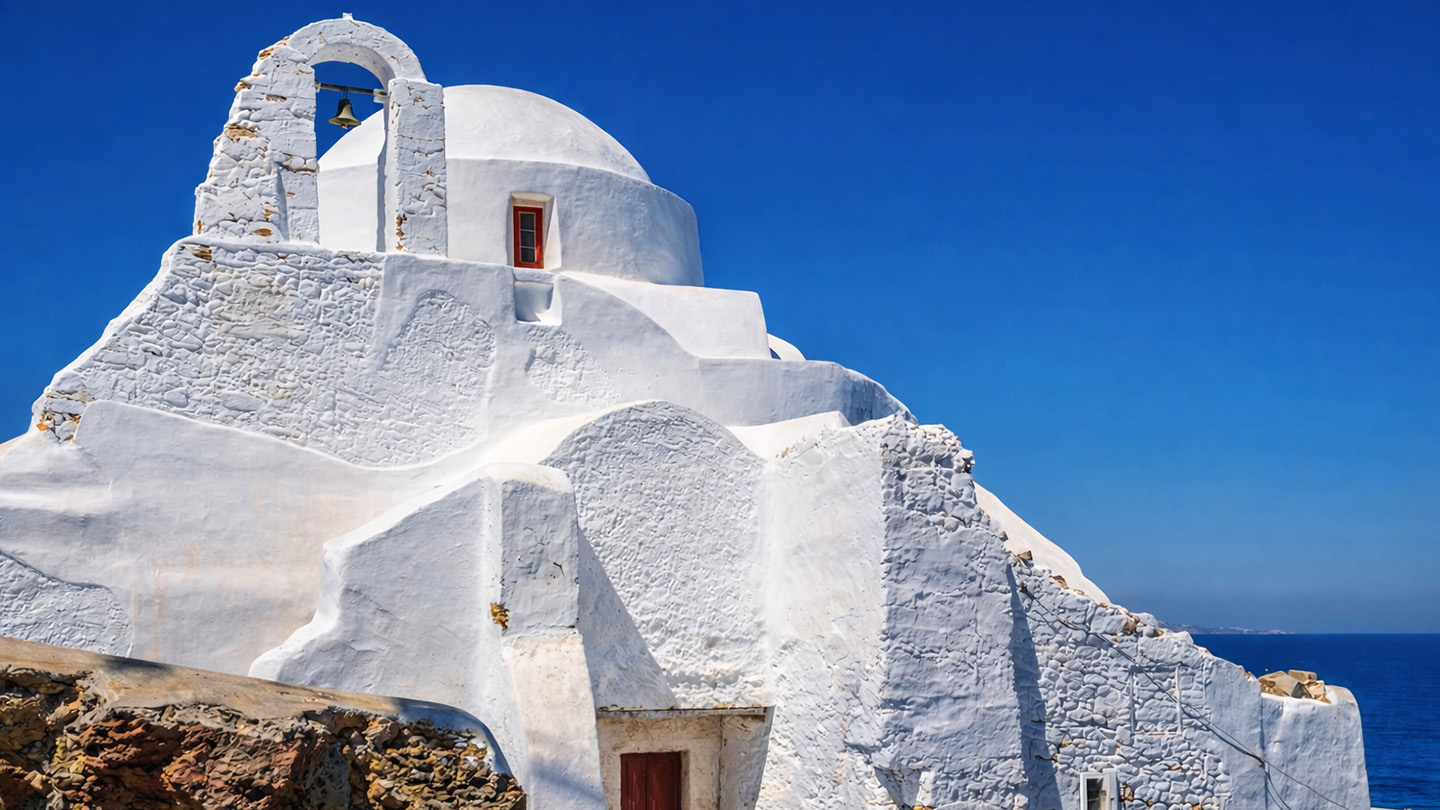
Panagia Paraportiani, the church complex at the edge of the Kastro neighborhood, is the most photographed building on the island and one of the most distinctive pieces of vernacular religious architecture in the Cyclades. It consists of five interconnected churches built over four centuries, beginning in the fifteenth century, accumulated organically rather than designed as a unified complex, the result of successive additions that each generation attached to what existed. The whole has been whitewashed into visual unity but retains, on close inspection, the different structural logics of its component parts: the separate domes, the irregular plan, the varying heights that the successive additions produced.
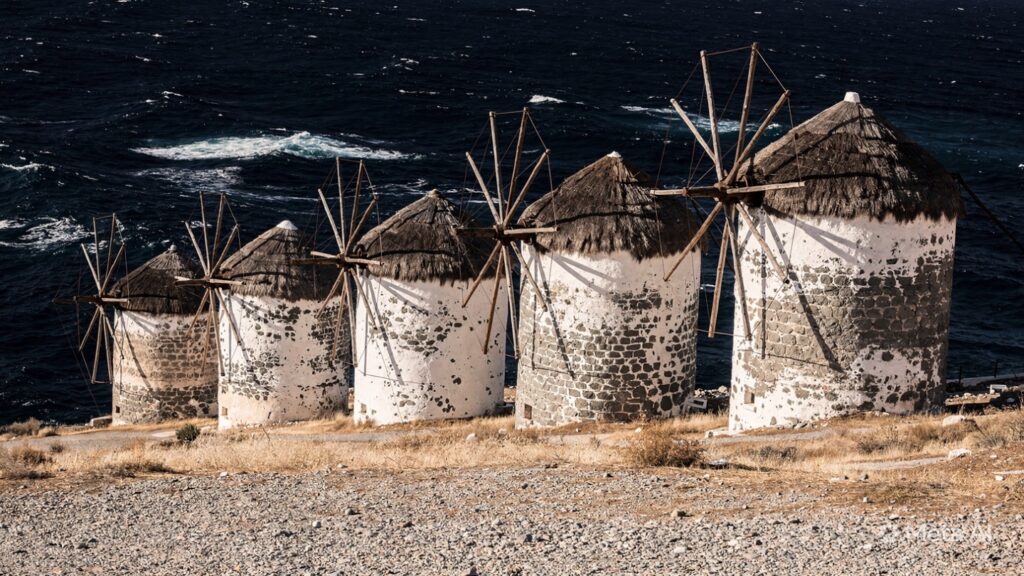
The windmills at Kato Mili, on the hill above the harbor, were built by the Venetians in the sixteenth century to process the grain that arrived in Mykonos’s harbor from the more fertile islands of the Cyclades. Mykonos was never a grain-producing island in the quantities that the windmills suggest: the terrain is rocky and the rainfall is insufficient. The windmills were built to serve the island’s role as a commercial hub, processing grain brought from elsewhere for redistribution across the Aegean trade networks that the Venetian administration organized. They are now non-functional, maintained as landscape features, but their presence on the harbor hill establishes the island’s commercial history with the precision of a purpose-built structure: Mykonos was always about exchange rather than production.
Little Venice, the neighborhood at the western edge of Chora where a row of buildings extends over the sea on supports, with their lower levels touching the water at high tide, is the section of the town most directly associated with the wealthy sea captains who made their fortunes in the Aegean trade of the eighteenth and nineteenth centuries. The buildings are genuine: the houses of people who had enough money to build on the waterfront and who designed their ground floors to allow small boats to dock directly beneath their living quarters. The bars and restaurants that now occupy these buildings are the contemporary use of a structure whose domestic function has been displaced, but the structure itself is historical.
Delos and the Sacred Island
The relationship between Mykonos and Delos is the most important geographical fact for understanding the island’s mythological significance.
Delos is five kilometers from Mykonos by boat, small enough to be circumnavigated on foot in a day, and significant enough to have been one of the most important religious and commercial sites in the ancient Aegean world. The island was understood in the ancient tradition as the birthplace of Apollo and Artemis, the twin children of Zeus and Leto, born here because Hera’s prohibition on Leto giving birth on any land that the sun touched had been satisfied by the floating island of Delos, which was anchored to the sea floor by the birth of the divine twins and became fixed in place as the sacred island of the Cyclades.
The sanctuary of Apollo at Delos was a Panhellenic pilgrimage site, visited by worshippers from across the Greek world in the way that Delphi was visited for its oracle. The commercial activity that pilgrimage generated made Delos one of the most important trading ports in the eastern Mediterranean, a place where Greek, Phoenician, Egyptian, and Roman merchants conducted business in the shadow of the temples that justified the market’s existence. The geographer Strabo claimed that Delos, at its height, could handle the sale of up to ten thousand slaves in a single day, a figure most modern historians treat as rhetorical exaggeration rather than a literal count, though the scale of the trade itself is not in doubt.
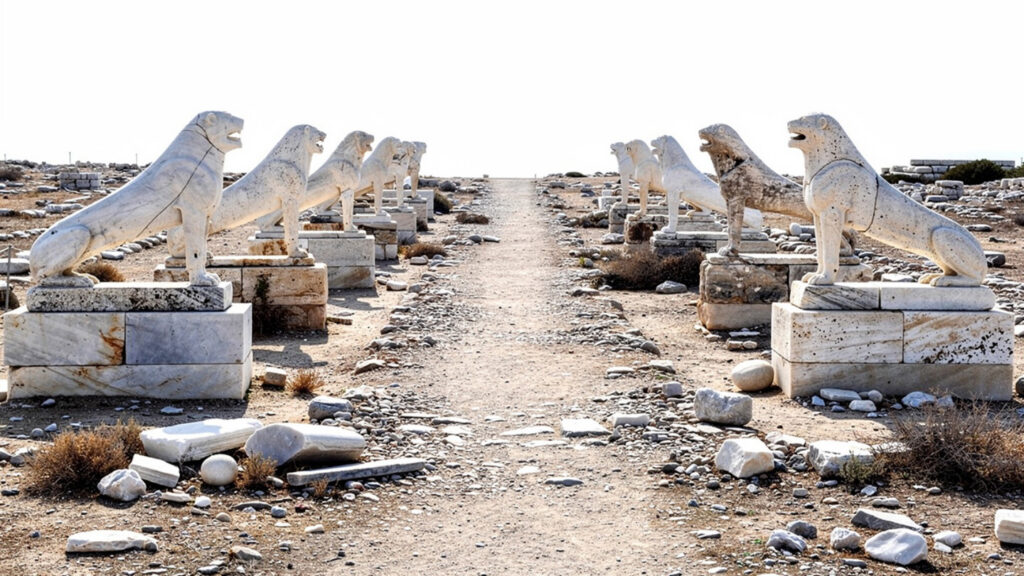
The ruins that survive on Delos are the most extensive and the best-preserved in the Cyclades: the temples of Apollo, the houses of the wealthy merchants, the mosaics in their floors, the Terrace of the Lions where the marble guardians still face each other across the Sacred Way, the sanctuary of the foreign gods where Egyptian and Syrian deities received worship alongside the Greek ones. The site is accessible only as a day trip from Mykonos, since no overnight accommodation is permitted on the island, and the boats that make the crossing depart from the old harbor in Chora in the mornings and return in the afternoons. The site requires at minimum three hours if the major structures are to be seen, and considerably more if the detail of the houses and the mosaic floors is to be given proper attention.
The Delos day trip is the single most important thing a visitor to Mykonos with any interest in the ancient world can do, and it is consistently underprioritized in comparison to the beach and nightlife activities that the island’s contemporary reputation emphasizes. The ancient world’s sacred center is visible from the island that hosts the largest gay festival in the Mediterranean. That contrast, which would have been incomprehensible to any ancient visitor and which coexists without apparent friction in the contemporary context, is itself a form of information about how thoroughly Mykonos has transformed its relationship with its own surroundings.
Ano Mera and the Interior
The village of Ano Mera, six kilometers from Chora in the island’s interior, is the only settlement of any significance on Mykonos that has not been comprehensively organized around the tourist economy.
The village square, with the monastery of Panagia Tourliani at its center, functions on the schedule of a working Greek village community: the kafeneion opens early for the people who live there, the tavernas serve lunch to people who are hungry rather than to people who have timed their arrival for a particular experience, and the pace of movement through the square is the pace of people who are going somewhere rather than looking for something.
The monastery itself was founded in 1542 and rebuilt in its current form in 1767, with subsequent additions and restorations in the nineteenth and early twentieth centuries. The iconostasis inside the main church is a significant piece of Cycladic decorative woodcarving, covered in the Baroque-inflected floral and figural carving that the eighteenth-century Cycladic craftsmen developed. The icon of the Virgin that the monastery is named for is one of the most venerated on the island and is the object of the feast day celebrations on August 15th that constitute the island’s major annual religious event.
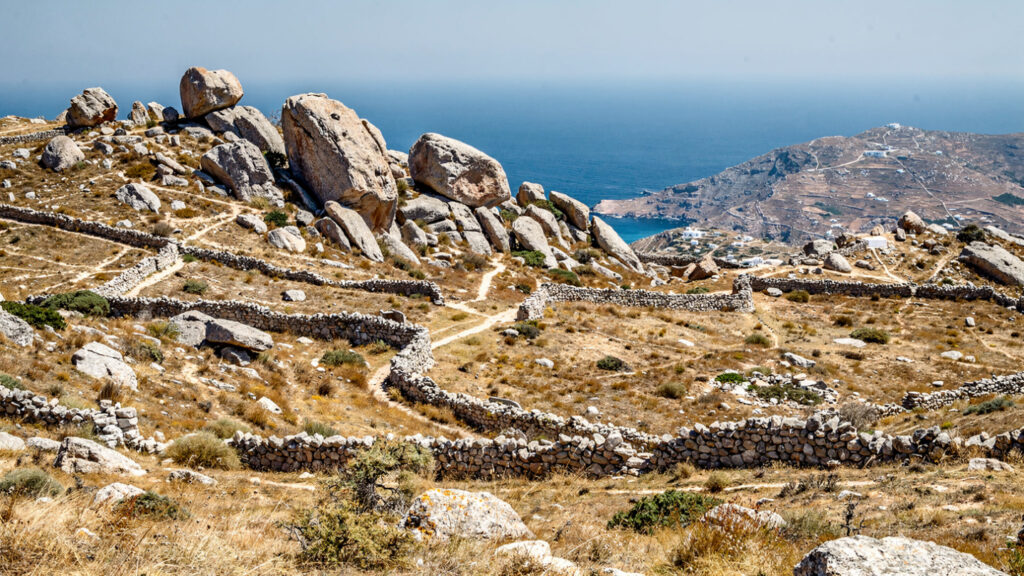
The road from Chora to Ano Mera passes through the inland landscape of Mykonos that the coastal visitor rarely sees: the granite outcrops, the low walls of piled stone that divide the agricultural land into the field patterns established over centuries, the dry stone terrain that the island’s geology produces. The island is not green in the way that the Ionian Islands are green. It is the color of granite and dry grass in summer, with the whitewash of the buildings providing the contrast against the landscape that the photographs emphasize.
The Beaches and What They Each Are
Mykonos has more than twenty beaches, each with a sufficiently distinct character that the choice between them is a genuine decision rather than a matter of proximity.
Paradise and Super Paradise, on the southern coast and accessible by boat from the old harbor in Chora or by road from the main routes, are the beaches on which the island’s international reputation as a party destination is most substantially built. The beach clubs that operate on both beaches run continuous music from mid‑morning through the night during the peak summer weeks, with international DJs performing at the clubs attached to them on a schedule that is published months in advance and that attracts visitors who plan their Mykonos trips around performance dates. The beaches themselves are sandy and the water is clear. The organization around the beach clubs means that unstructured beach time is technically available but atmospherically subordinated to the events programming.
Psarou, four kilometers from Chora, is the beach most consistently associated with the celebrity and luxury end of the Mykonos visitor economy. The tavernas and beach clubs on Psarou operate at price points that reflect the positioning of the beach in the island’s hierarchy of visible affluence, and the clientele at the height of summer includes a sufficient density of internationally recognizable figures that the beach’s reputation for celebrity sighting is self-reinforcing.
Elia, in the southeastern part of the island, is the largest beach on Mykonos and the one most associated with the island’s naturist tradition. The beach is long enough that the different sections of it have distinct atmospheres, from the more organized areas near the facilities at the northern end to the quieter southern section. The water at Elia is clear and the surrounding terrain of low hills provides a visual boundary that gives the beach a contained quality that the more open beaches lack.
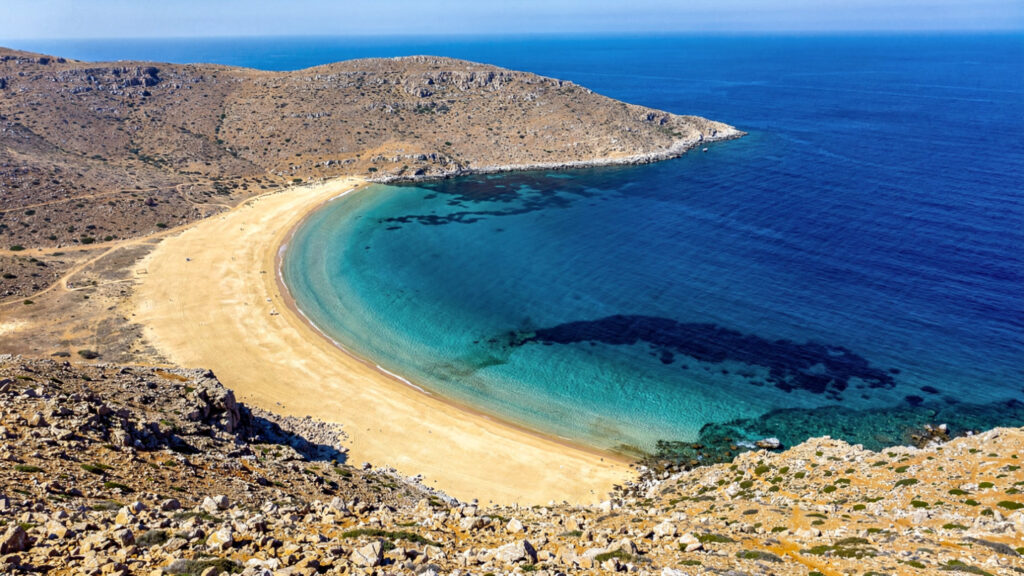
Agrari, adjacent to Elia and accessible by the same road, is the beach that the people who want to avoid all of the above tend to know about. It is small, relatively undeveloped, and not on the standard bus or boat routes that distribute visitors across the island’s major beaches. The people who go to Agrari have usually made a decision to do so.
Ornos, on the bay of the same name south of Chora, is the beach that the island’s family and resort visitors use most heavily, combining calm water, proximity to the main road network, and a concentration of hotel and apartment accommodation within easy walking distance. The beach infrastructure is extensive, with water sports equipment available for hire, and the bay’s orientation provides protection from the Meltemi wind that makes the more exposed southern beaches uncomfortable on windy days.
The Food of Mykonos
The culinary tradition of Mykonos, before the international restaurant scene of the contemporary island replaced much of it as the primary eating experience available to visitors, was built from the products of an island with limited agricultural land and exceptional access to the sea.
Kopanisti is the cheese most specifically Mykonian: a soft, spicy, pungent cheese produced by a fermentation process that develops the characteristic heat in the final product. The production requires conditions that the island’s climate provides, and the kopanisti that is made on Mykonos has a distinct character from imitations produced elsewhere. It is used as a spread on bread and as an ingredient in the local version of the baked dishes that the Cycladic kitchen produces, and its intensity means that small quantities carry significant flavor.
Louza is the cured pork product that the island’s domestic pig-rearing tradition produced in the period before refrigeration. The meat is cured with salt, seasoned with black pepper and other spices, and air-dried in the conditions of the Cycladic winter, which provides the cold and dry air that the curing process requires. The result is a dense, intensely flavored cured meat that is consumed in thin slices, in the way that good prosciutto is consumed, rather than cooked.
Amygdalota, the almond cookies that appear in the sweet shops of Chora and in the confectionery of Ano Mera, are the island’s characteristic sweet: made from ground almonds, sugar, and rosewater, formed into the almond shape that the name describes, and soft inside the thin outer crust that the baking produces. They are the Cycladic almond cookie in a form that Mykonos shares with Hydra and several other Aegean island communities, each version with its proportions of almond to sugar and its scent of rosewater.
The seafood that the island’s fishing boats bring in is the foundation of the traditional taverna menu in the harbor and in the seafood restaurants that line the old harbor front: fresh fish grilled simply, octopus that has been dried in the sun and then grilled over charcoal, the small fried fish that appear as a meze before the main course, the sea urchin roe that is available when the urchins are in season and that the best fish tavernas serve simply on bread with lemon.
When to Come
The island’s peak season runs from late June through August, and during this period it operates at a level of activity and visitor density that makes several things simultaneously true: the weather is at its best, the beach clubs and nightlife venues are at their most complete, the ferries and accommodation are at full capacity, and the island’s more contemplative qualities, the Delos crossing, the Ano Mera village square, the quiet beaches, are least accessible without deliberate effort.
Late May and June provide the beach weather, the water temperature, and the full operation of the island’s facilities at a visitor density that is significantly lower than August. The Meltemi wind, which blows from the north in summer and which can make the southern beaches choppy and the outdoor spaces uncomfortable on strong days, is typically less intense in June than in July and August.
September is the month that the Mykonos regulars tend to regard as the best: the sea water has been warmed by three months of sun and is at its highest temperature of the year, the crowds have thinned from the August peak, and the island’s facilities remain fully operational through mid-October. The light in September has the quality of the Cycladic autumn, sharper than the summer haze and with a warmth of color that the high summer months do not produce.
The winter months reduce Mykonos to its year-round population and produce the island’s most honest version of itself: the kafeneion in Ano Mera, the fishermen working the harbor, the whitewashed walls in the winter light without the summer crowds moving between them. The facilities that operate year-round are limited, but the island in winter is available to anyone willing to seek it out.
At Olympus Estate, Wanderlust Greece guides you across the terrain of the Hellenic world, from the sacred ruins of Delos where Apollo was born to the whitewashed lanes of Chora where the windmills ground grain for a trade network that predated the beach clubs by four centuries. Mykonos knows what it is. The question is what you are looking for.