
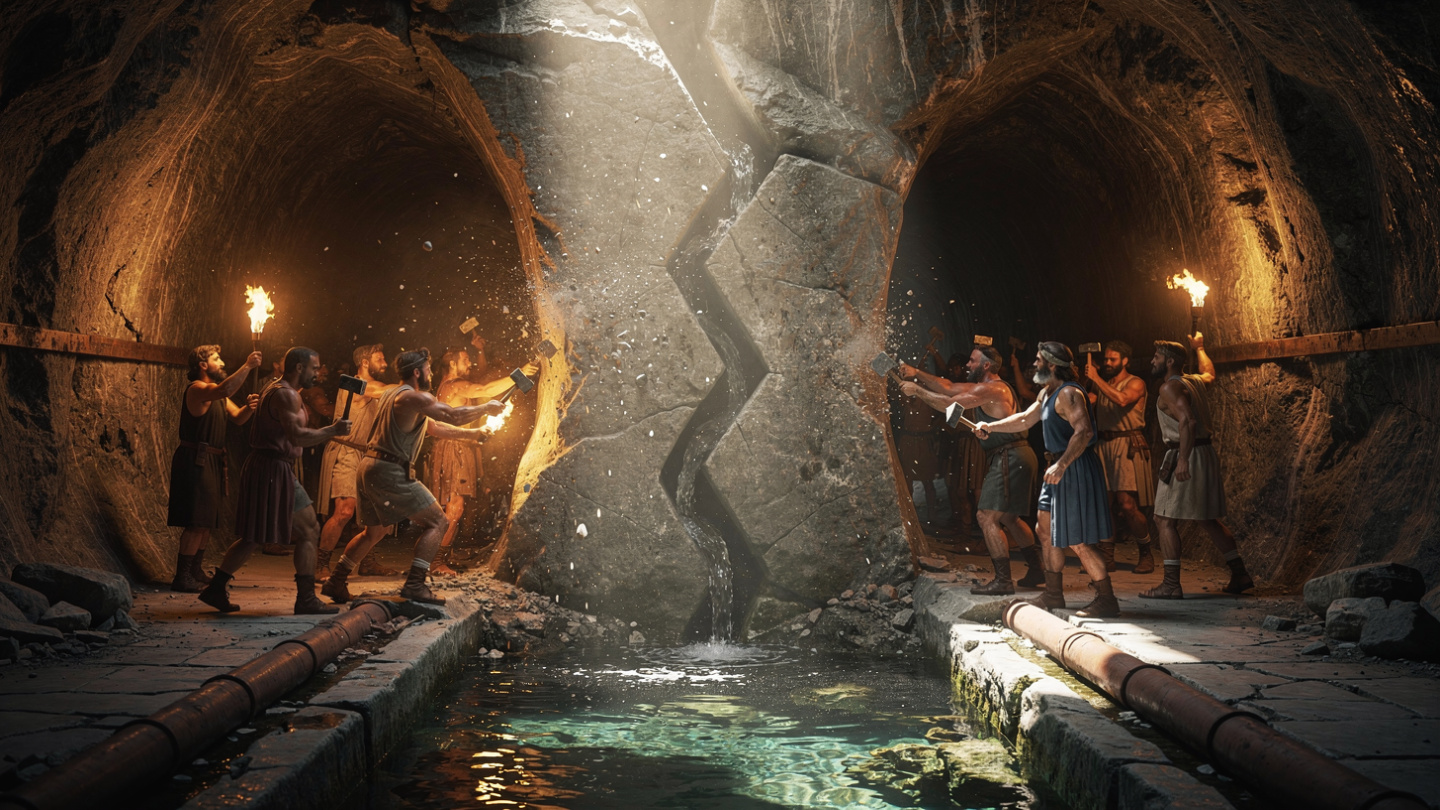
Two teams of workers entered a mountain on Samos from opposite sides in approximately 550 BCE and dug toward each other through solid rock.
They had no instruments beyond measuring rods and right angles and the geometric principles that the island’s most famous son was, at roughly the same moment, applying to the structure of the cosmos. Each team had no way of knowing where the other team was inside the mountain. They could not hear each other through the rock. They could not see each other. They knew only the mathematics of their approach, the angles and distances that the engineer Eupalinos of Megara had calculated before the first hammer fell.
They met. Not perfectly: the two tunnel halves arrived at slightly different levels, and Eupalinos corrected the discrepancy with a dog-leg turn in the middle, a right-angle adjustment that brought the two approaches into alignment without either team having to abandon their line. The adjustment is still visible in the tunnel today. The spring still flows. The two teams met in the middle with nearly perfect precision, and the water still collects in an ancient aqueduct system feeding into a reservoir located beneath a small chapel in the village of Agiades.
Herodotus called the tunnel of Eupalinos the first of the three greatest constructions of all the Greeks, listing it before the great harbour works and before the Temple of Hera, one of the largest Greek temples ever built.
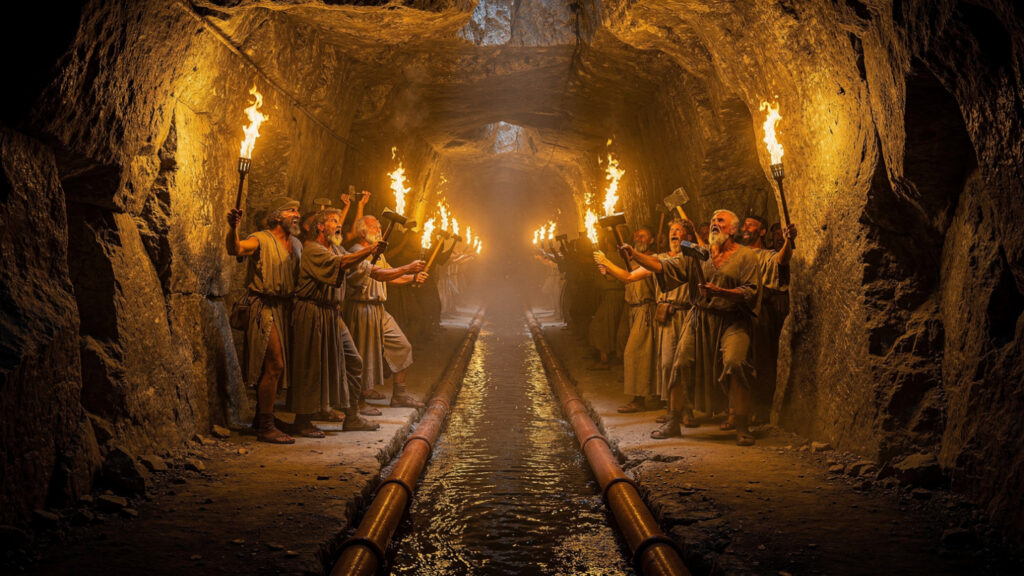
Pythagoras was living on Samos when this happened. He would have known the work. He may have known Eupalinos. The island where he was developing the proposition that numbers are the fundamental substance of reality was simultaneously the island where an engineer was proving it, driving geometry through a mountain with hammer and chisel and demonstrating that mathematical truth was not a philosopher’s abstraction but a physical force capable of making two teams of workers find each other in the dark.
The Island and Its Particular Character
Samos sits in the northeastern Aegean, separated from the Turkish coast by a strait of two kilometres at its narrowest point. The proximity is not incidental to the island’s intellectual history. The Ionian coast visible from the eastern shore of Samos was, in the sixth century BCE, the most intellectually fertile landscape in the Greek world. Miletus was where Thales and Anaximander and Anaximenes were developing the first purely naturalistic accounts of the cosmos. Ephesus was where Heraclitus was working on the relationship between fire, logos, and the structure of change. Halicarnassus was where Herodotus would eventually be born.
Samos was part of this world rather than separate from it. The island’s position at the junction of the Aegean and the Anatolian coast, at the point where the Greek world met the Persian world and the Egyptian world and the Babylonian world beyond it, made it a transit point for ideas as well as goods. Pythagoras’s extensive travels before founding his school, to Egypt, to Babylon, and possibly further east, were not the eccentric journeys of an isolated genius. They were the natural extension of an education that began in a city already saturated with the intellectual traffic of the ancient Mediterranean.
The island is 477 square kilometres of dramatically varied terrain: the volcanic mass of Mount Kerkis rising to 1,434 metres above the western coast, the gentler agricultural landscape of the interior where the Muscat vines produce the wine that has been made here since Pythagoras’s time, the long beaches of the north coast facing the Turkish mountains across the Mycale Strait. The wine alone connects the island’s present to its ancient character: Aristarchus of Samos, who proposed the heliocentric model of the solar system in the third century BCE and was ignored for seventeen centuries until Copernicus, made his calculations on an island whose vineyards had been producing wine for as long as the island had produced thinkers.
Pythagoras | The Proposition and Its Source
Born around 570 BCE in what is now Pythagoreio on the island’s southeastern coast, Pythagoras spent his early life in an environment that combined Ionian rationalism with the Eastern mathematical and astronomical traditions that the island’s trading position made accessible.
His father Mnesarchus was a gem engraver, which placed the family in the intersection of the artisanal and the mercantile world: a craftsman who worked with mathematical precision, cutting gems to specified proportions for clients who came from across the Mediterranean world. The child who grew up watching his father calculate the angles and proportions of carved stone was, from the beginning, inside a practice in which mathematical relationships had physical consequences.
The proposition that Pythagoras developed and that his school transmitted to the subsequent philosophical tradition was not simply the theorem that bears his name, which was known in Babylon and Egypt centuries earlier. It was something more radical: the claim that numbers are not instruments for describing the world but the substance of the world, that the relationships between numbers are not abstractions but the actual structure of physical reality.
He arrived at this through music. The discovery that musical intervals correspond to simple numerical ratios, that the octave is the ratio 2:1, the perfect fifth 3:2, the perfect fourth 4:3, was for Pythagoras the demonstration that the mathematical relationships his mind could perceive were the same relationships that the universe expressed in sound. If the relationship between the length of a string and the pitch it produces is a mathematical ratio, and if that ratio corresponds to the qualitative difference between consonance and dissonance that the ear perceives as beauty and ugliness, then the mathematics is not a description of the sound. The mathematics is what the sound is made of.
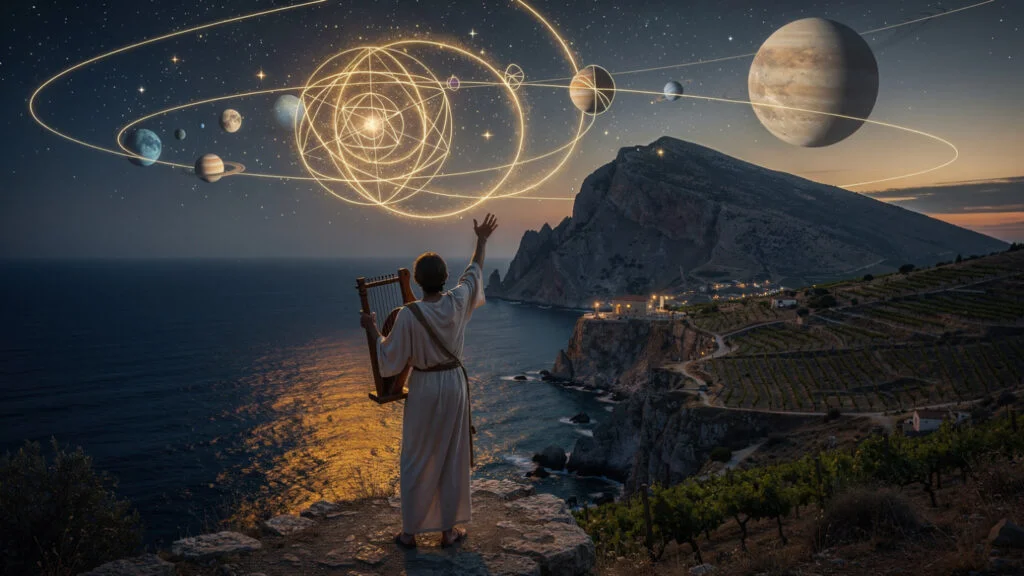
From this the cosmology followed with the inevitability of a proof. If musical harmony is mathematical proportion, and if mathematical proportion is the structure of reality, then the movements of the planets must also express mathematical ratios. The planets moving in their courses must produce, in their proportional relationships to each other, something equivalent to the musical intervals that the string produces. This is the harmony of the spheres: not a poetic metaphor but a logical consequence of the initial proposition about the relationship between number and reality.
Only those with purified souls could perceive it, because the perception required the soul to have aligned itself with the mathematical structure of the cosmos rather than remaining absorbed in the noise of material existence. The Pythagorean practices of silence, dietary discipline, and mathematical contemplation were the methods of alignment. They were not ascetic theatre. They were the practical curriculum of a school that understood perception as requiring preparation.
The Tunnel Pythagoras Would Have Known
Using principles of geometry that Euclid would not codify for another several centuries, Eupalinos calculated how to drive two teams through a mountain from opposite sides and bring them together at a predetermined meeting point inside the rock.
The engineering problem was one of sustained mathematical precision under physical conditions that would have made precision difficult. The workers hammering through the limestone of Mount Kastro could not verify their position relative to the opposing team. They had only their measurements and their geometry. The mathematics had to be correct not as an abstract exercise but as the sole means by which the two halves of the tunnel would find each other, which was the sole means by which the city of Samos would have water during a siege, which was the condition of the city’s survival.
The aqueduct was used for more than 1,000 years, before it began to silt up in the seventh century AD, and the tunnel was later used as a defensive refuge when the southern entrance portal was fortified against pirates.
The tunnel is 1,036 metres long, 1.8 by 1.8 metres in cross-section, sloped at 0.6 percent to allow water to flow by gravity through clay pipes embedded in the floor. These specifications were not established by trial and error. They were calculated in advance using the geometric knowledge that Eupalinos brought from Megara, refined by whatever mathematical understanding was available in the sixth century BCE at the most intellectually active point in the Greek world.
Pythagoras may have been in Egypt during the years of the tunnel’s construction, undergoing the training in geometry that the priests there had developed across millennia of architectural and astronomical practice. When he returned to Samos he returned to an island that had just completed the most geometrically ambitious engineering project in the Greek world. The two intellectual traditions, the philosophical and the engineering, were operating on the same island within the same generation, applying the same mathematical principles at different scales and for different purposes and arriving at the same conclusion: that the relationships between numbers were not merely useful but constitutive, not merely descriptive but causally operative in the physical world.
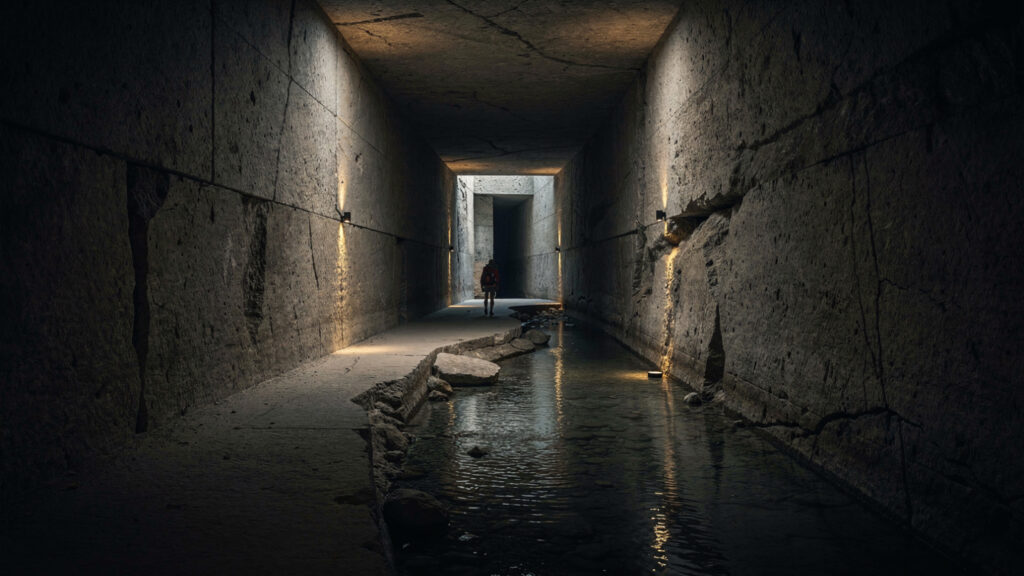
You can walk the full length of the tunnel today. The entrance is near Pythagoreio, the UNESCO-listed town built over the ancient capital. The interior is lit and the floor is levelled for visitors, but the proportions of the original cutting are intact, and at the point where the dog-leg adjustment occurs, where the two teams’ lines of approach are reconciled into a single continuing passage, there is a visible deviation in the wall that is the physical record of the moment when geometry proved itself inside a mountain twenty-five centuries ago.
The Heraion | Scale as Theology
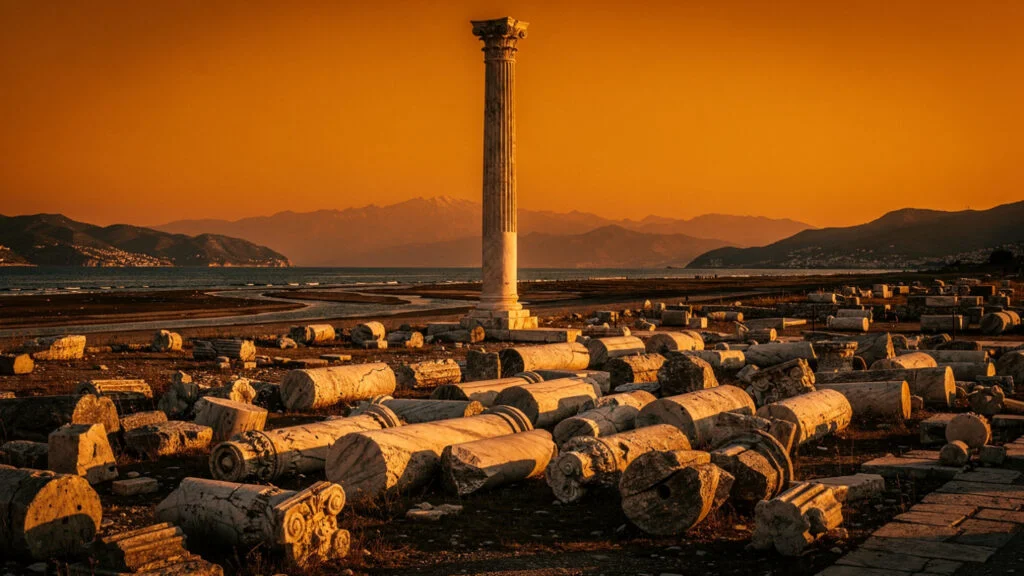
Three kilometres west of Pythagoreio, at the edge of the coastal plain where the Imbrasos River reaches the sea, the Temple of Hera stands in the condition that two and a half millennia of earthquake and stone-robbing have left it: a single column remaining of what was originally a forest of them, surrounded by the fallen drums and capitals that give the site its quality.
The Heraion was among the largest temples ever built in the Greek world. The final version, begun in the sixth century BCE under the patronage of Polycrates, was 108 by 55 metres and carried a double colonnade of 155 columns. It was left unfinished when Polycrates was killed, and it was never completed. The scale of what was attempted is legible in the foundations and the fallen material: this was a building designed to express the same relationship between proportion and divinity that the tunnel expressed between proportion and engineering.
Hera was born on Samos, according to the island’s tradition, under a willow tree on the bank of the Imbrasos River. The sanctuary marks the site of her birth and of her sacred marriage to Zeus, and the cult maintained here was one of the oldest and most significant in the Greek world. The votives deposited here across eight centuries of use, which the archaeological museum in Pythagoreio holds in abundance, came from across the Mediterranean: bronze figurines from Egypt, ivory carvings from the Near East, ceramic vessels from Corinth and Attica and the islands. The Heraion was a pan-Mediterranean sacred site in the same period that Samos was producing its most significant intellectual contributions to the world.
Stand at the single remaining column in the afternoon when the light is horizontal and the Aegean is flat and the Turkish mountains are clearly visible across the narrow strait. The plain around the column is full of fallen stone: the remains of the greatest temple ever attempted on this island, stopped in mid-construction by the death of the man who ordered it, left in its unfinished state for twenty-five centuries. The scale of what was attempted is in the quantity of what is still lying there.
The Cave and the Mountain
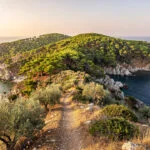
Mount Kerkis dominates the western end of Samos with the authority of a mountain that rises directly from the sea to 1,434 metres without the gradual approach that most mountains offer. Its slopes carry pine forest and wild herbs and the quality of isolation that high terrain above sea level produces: at altitude on Kerkis, the Aegean is visible in three directions simultaneously, the Turkish coast to the east, the Dodecanese chain to the south, the open sea to the west.
The Cave of Pythagoras is on the eastern slopes of the mountain above Marathokampos village: two caves in the rock, one upper chamber suited to the extended meditation that the Pythagorean tradition of silence required, one lower chamber with a spring. The approach is a three to four kilometre walk from the village, gaining altitude through terrain that in the sixth century BCE would have been outside the settled world of the ancient city.
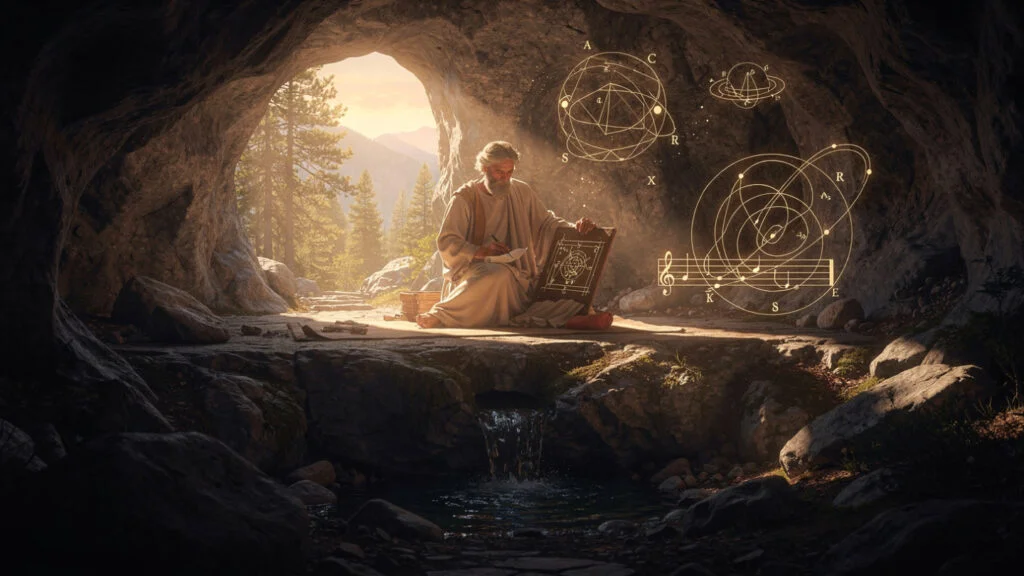
Whether Pythagoras actually used this cave is not documented in the ancient sources with certainty. What is documented is that the Pythagorean school practiced extended periods of silence as part of its curriculum, and that retreat to remote locations for contemplation was a standard element of ancient philosophical practice. The cave is real. The tradition is real. The landscape is precisely the landscape that the ancient tradition associated with the kind of sustained solitary thought that the Pythagorean curriculum required.
The walk to the cave begins near the village and gains altitude through olive groves and scrub before entering the pine forest that covers the upper slopes. In the spring, the path carries the fragrance of wild sage and thyme releasing their volatile compounds into the warming morning air: the smell of a Greek mountain in April that no preparation adequately describes and that the body recognises as something it has been looking for. Allow three to four hours for the round trip. Bring water. Begin early.
The Muscat and What It Has to Do With Anything
The sweet Muscat wine of Samos, produced from the Muscat Blanc à Petits Grains grape that has been cultivated on the island since antiquity, is made by the Union of Samos Cooperatives in a tradition of collective production that goes back to 1934. The wine is golden, richly fragrant, with a combination of orange blossom and apricot and honey that reflects the island’s soil and its warm, dry summer.
Aristarchus of Samos, who proposed in the third century BCE that the earth orbited the sun rather than the reverse, and who calculated the relative sizes of the earth, sun, and moon from observations made on this island, was working in a tradition that Pythagoras had established two and a half centuries earlier. The island that produced the first heliocentric model of the solar system was the island where the philosophical framework for understanding the cosmos as mathematically ordered had been developed.
The Muscat connection is not simply local colour. The vines that produce the wine are planted on the same volcanic and limestone terrain that Pythagoras walked, at altitudes that range from sea level to nearly five hundred metres on the mountain slopes, and the wine they produce carries in its flavour profile the mineral and organic character of that terrain. To taste it is to taste the island’s soil expressed through a form that has been continuous since the ancient period.
The cooperative’s facilities at Malagari, near Vathy on the northern coast, are open for visits and tastings. The production process, from the late August harvest of the botrytised grapes through the controlled fermentation that produces the sweetness without excessive alcohol, is explained with the precision of a tradition that has been refining its method for decades.
Practical Notes
Samos has an international airport at Vathy with direct connections to Athens and seasonal direct connections to several European cities. The ferry from Piraeus takes approximately eight to ten hours. A car is useful for exploring the full range of the island’s sites and landscapes, though Pythagoreio and the immediate area around it, including the Eupalinian tunnel and the Heraion, are walkable from each other.
The Eupalinian tunnel is open standard archaeological site hours and charges a modest entrance fee. Walking the full length takes approximately forty minutes at a gentle pace. The section near the dog-leg where the two teams’ approaches are reconciled is the most archaeologically revealing part of the visit and is easily identified by the slight change in the tunnel’s direction.
The Heraion is a few kilometres from Pythagoreio along the coastal road and is open standard hours. The archaeological museum in Pythagoreio is the essential companion to both sites: it holds the votive deposits from the Heraion and the finds from the ancient city, and two hours here before visiting the outdoor sites produces a substantially richer experience of them.
Mount Kerkis and the cave approach from Marathokampos on the southwest coast require a car to reach the trailhead. May and early October are the ideal months: the heat is manageable at altitude and the vegetation is at its most varied.
The Muscat wine is available from the cooperative and from wine shops throughout the island. The early harvest version, the Nectar, aged in oak, carries a complexity that the standard version does not, and is worth seeking out specifically.
The Harmony of the Spheres
The tunnel is still there. The spring still flows into the reservoir under the chapel at Agiades, 2,500 years after two teams of workers found each other inside a mountain using geometry alone.
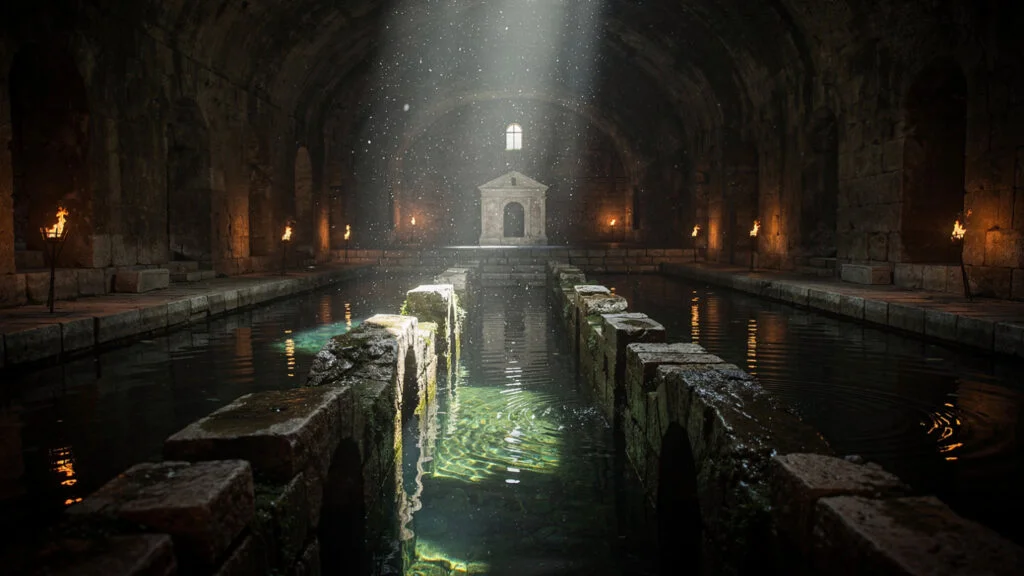
The proposition that this demonstrated was the proposition that Pythagoras was developing on the same island at the same time: that mathematical relationships are not tools for describing the world but the actual structure of the world, that the harmony perceivable in music and in the movements of planets and in the angle at which two tunnel headings must approach each other to meet at a predetermined point inside solid rock is the same harmony, operating at different scales, expressing the same underlying order.
Herodotus placed the tunnel first among the three greatest constructions of all the Greeks. He placed it first not because it was the most beautiful but because it was the most precise: the most complete available demonstration that human intelligence, applied with mathematical rigour to a physical problem, could produce results that the physical world had no means of refusing.
The island that produced this demonstration also produced the philosopher who made it a cosmology.
Walk the tunnel. Stand at the dog-leg where the two teams’ geometry converged. Then walk out into the light above Pythagoreio and look across the two kilometres of water to the Turkish coast, where the Ionian tradition was developing simultaneously, and understand that the harmony of the spheres was not a poetic fantasy.
It was the conclusion available to a mind that had watched a mountain opened from both sides by mathematics and seen the two halves meet.
At Olympus Estate, Wanderlust Greece guides you across the sacred and storied terrain of the Hellenic world. Two teams of workers entered a mountain on Samos from opposite sides in 550 BCE and dug toward each other through solid rock. They had no instruments beyond measuring rods and right angles and the geometric principles that Pythagoras was applying to the cosmos at the same moment. They met. The adjustment where their lines converged is still visible in the tunnel wall. Herodotus placed it first among the three greatest constructions of all the Greeks. The spring still flows. Aristarchus proposed the heliocentric model on this island and was ignored for seventeen centuries. The tunnel is still there. Walk it. Stand at the dog-leg. Then walk out into the light and look across two kilometres of water to the Turkish coast where the Ionian tradition was developing simultaneously. The harmony of the spheres was not a poetic fantasy. It was the conclusion available to a mind that had watched a mountain opened from both sides by mathematics and seen the two halves meet.