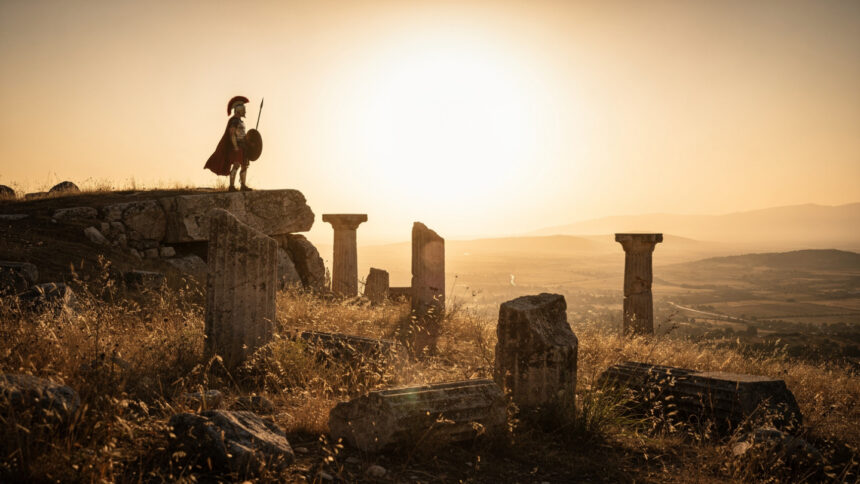

The first Greek poet whose personal voice survives in any complete form, rather than filtered through the third-person grandeur of epic, tells us, without apparent shame, that he ran away from a battle.
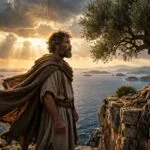
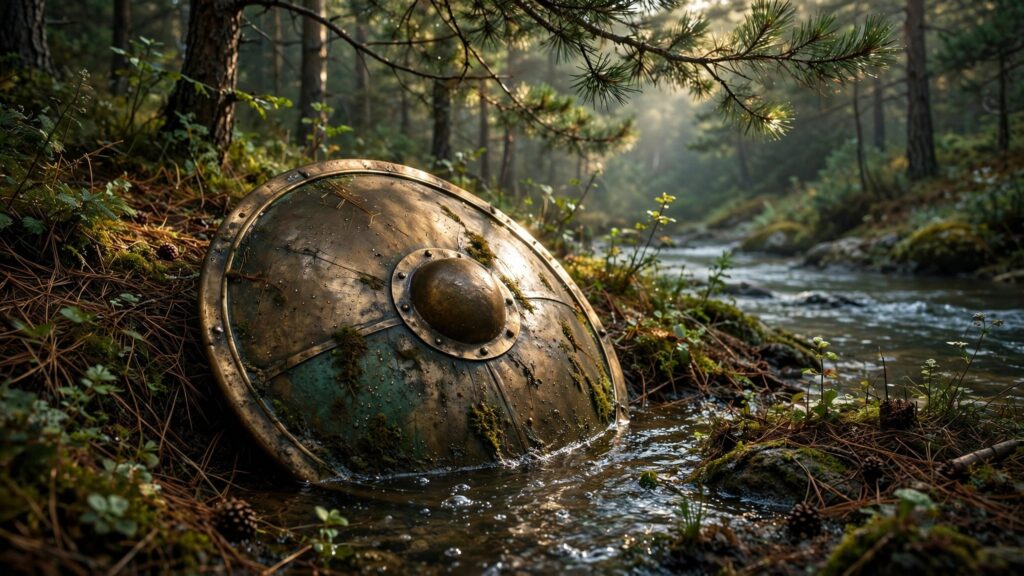
I lost it in the woods by the Saian river, Archilochus writes, of his own shield, abandoned somewhere in a minor skirmish against an indigenous Thracian tribe in the seventh century BCE. The Saians, he adds, are delighted to have it. As for me, I escaped death. Let the shield go. I’ll get another one just as good.
A Spartan who lost his shield in battle was, by the iron logic of that city’s military culture, finished: stripped of citizenship, an object of permanent public contempt, because the Spartan shield protected the man beside you in the line and abandoning it was understood as abandoning him. Archilochus, writing as a citizen of the new Greek colony on the island of Thasos, says the opposite thing entirely, in public, in verse, and the island that produced him preserved his words rather than burying them. This single fragment, more than any ruin or any quarry, tells you something true about the place: Thasos was never going to be Sparta. It was a colony built by traders and miners on an island already rich enough, before the Greeks arrived, that the people who got there first had been Phoenicians chasing gold.
This is the island in the far north of the Aegean, closer to Thrace than to Athens, that the ancients called an ass’s spine crowned with wild wood, that built one of the wealthiest city-states of the Archaic Greek world on gold its own marble has slowly worn smooth ever since, and that today is one of the greenest, least self-consciously photogenic, and most quietly rewarding islands in the entire Greek archipelago, precisely because nobody ever needed it to perform prettiness. It already had gold.
What the Phoenicians Found First
Long before any Greek set foot on Thasos, the island was already attracting people for the single reason that has shaped its entire subsequent history: there was gold in the ground.
Herodotus, who traveled to Thasos specifically to see the ancient mines for himself, reports that Phoenician traders arrived at an early date, drawn by the deposits, and that their leader, a man the tradition names Thasos, son of Phoenix, gave the island its name. These Phoenician settlers founded a temple to the god Melqart, a deity the Greeks who arrived generations later recognized as close enough in function to their own Heracles that the two cults gradually merged into one, the sanctuary of Tyrian Heracles becoming, in the fullness of time, simply the Heracleion that Herodotus himself visited and described, the building still standing in his own day. The fusion of a Levantine god into a Greek hero’s identity, conducted not through conquest but through centuries of shared worship on the same hillside, is exactly the kind of layered religious history that this site has already traced on Cyprus, and Thasos offers, at the northern edge of the Aegean, a smaller but genuinely parallel case: a sacred site whose god changed names without the site itself ever stopping being holy.
Around 680 to 650 BCE, depending on which ancient source is followed, settlers from the Cycladic island of Paros arrived, reportedly on the explicit instruction of the Delphic Oracle, and rapidly took control of the whole island under the leadership of a man named Telesicles, whose own son would grow up to be Archilochus. Within two or three decades the Parian colonists had pushed across the narrow strait to the Thracian mainland itself, founding satellite settlements specifically to control the far richer gold deposits of Mount Pangaion, since the gold actually on Thasos, while real, was a smaller prize than what lay just across the water. The combined annual revenue the Thasians drew from their island and mainland mines together reached, by the fifth century BCE, somewhere between two hundred and three hundred Attic talents a year, a sum that placed this single northern Aegean island among the wealthiest city-states anywhere in the Greek world, its prosperity resting so heavily on bullion that Thasian coinage, appropriately, carried the image of Dionysus and bunches of grapes on one face and, for long periods, a satyr seizing a nymph on the other, wine and gold announced together as the two things this particular Greek colony had decided to be proudest of.
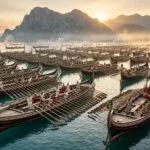
That wealth made Thasos a target, more than once. After the fall of Miletus in 494 BCE during the Ionian Revolt against Persia, the Thasians, sufficiently alarmed by the fate of a fellow Greek city, spent their gold revenues building warships and reinforcing their fortifications, a defensive build-up so visible that it aroused Persian suspicion in turn, and the Persian king Darius simply ordered them to surrender their fleet and tear down their own walls, which they did. Decades later, a dispute over control of the mainland mines and trading posts brought Thasos into open revolt against Athens, by then the dominant power of the Delian League that Thasos had reluctantly joined. The Athenians defeated the Thasian fleet at sea and besieged the city itself for more than two years before it finally fell in 463 BCE, after which the Thasians were stripped of their walls, their ships, their mainland mines, and forced to pay both an indemnity and an ongoing annual tribute.
The lesson did not fully take. Half a century later, in the middle of the long attrition of the Peloponnesian War, Thasos revolted from Athens a second time, holding out from 411 to 407 BCE before Athenian forces recovered the island. Even that was not the end of it: when Athens itself finally fell in 404 BCE, the Spartan admiral Lysander sailed north and seized Thasos outright the following year, installing a garrison and a client government of his own choosing. An island that had been independently wealthy enough to alarm the Persian Empire spent the better part of the following century as a contested prize passed between other people’s empires instead, its own gold never quite enough, twice over, to buy the independence it kept trying to hold onto.
The Marble the Romans Wanted
If gold built the island’s first fortune, marble built the second, and unlike the gold, you can still walk on it.
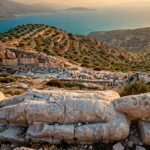
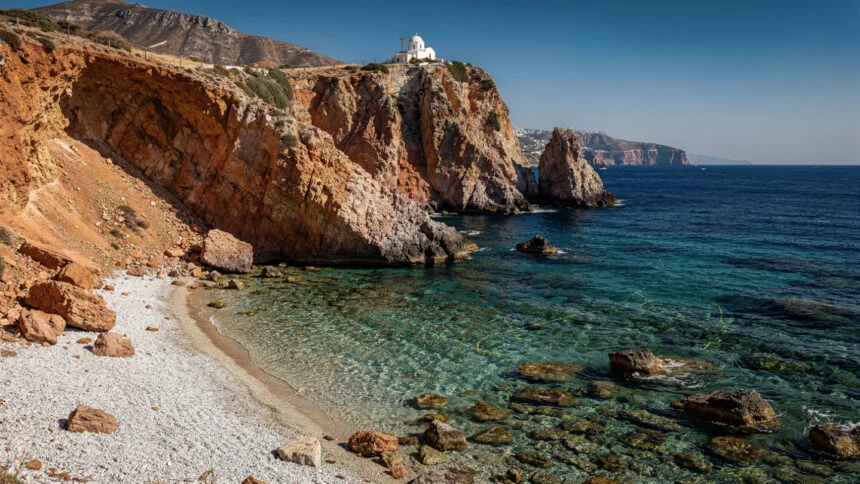
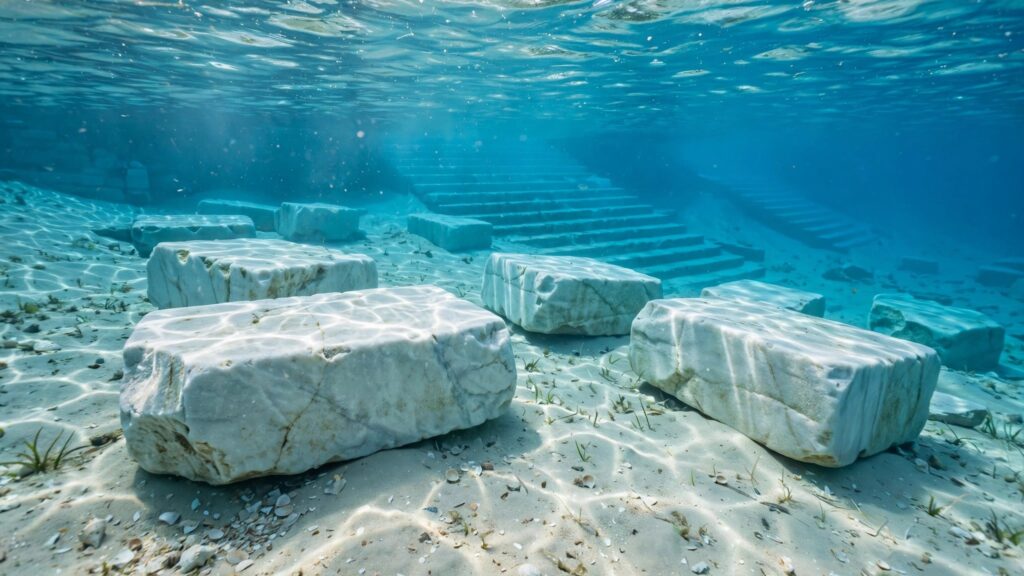
Thasian marble, quarried most extensively from the peninsula at Aliki on the island’s southeastern coast, was prized across the ancient Mediterranean for its brightness and fine grain, and it traveled, by ship, as far as Rome itself, where it was used in temples and palaces by a civilization many hundreds of kilometers away that had its own perfectly serviceable marble and chose this particular northern Aegean stone anyway. The quarries at Aliki operated for more than twelve hundred years, an industrial continuity that very few extraction sites anywhere in the ancient world can match, and what makes the site so remarkable to visit today is not simply that the quarry survives, but that large sections of it now sit partially submerged in the clear water of the bay, the result of centuries of gradual coastal subsidence and sea-level change rather than any deliberate flooding. You can swim directly above sawn marble blocks that have been sitting exactly where ancient workers left them since before the Roman Empire existed, the chisel marks still visible through water clear enough to read them from the surface.
The peninsula at Aliki carries, alongside the quarry itself, the ruins of an ancient sanctuary and the foundations of two early Christian basilicas, built directly on top of and around the older marble-working site in the same pattern of continuous, layered sacred use that the Heracleion at Limenas already demonstrates: a place becomes important for one set of reasons, and successive cultures keep finding new reasons not to leave it. Two beaches sit on either side of the peninsula’s narrow neck, one more developed with tavernas and sunbeds, the other quieter and better suited to actually swimming out toward the submerged stone.
The City That Still Has Its Theatre
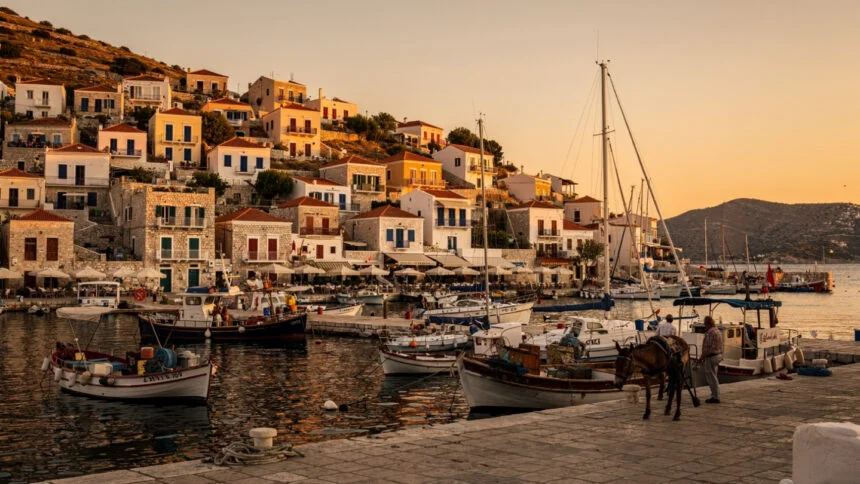
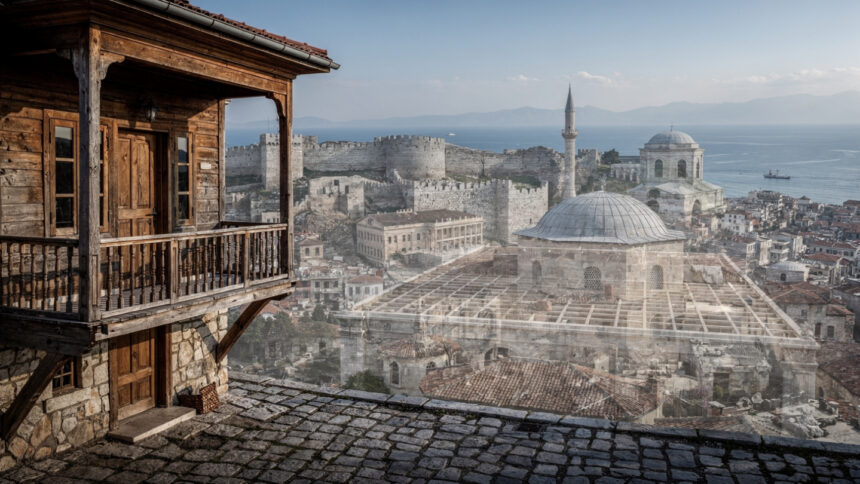
Limenas, the island’s modern capital, sits directly on top of and around the ruins of what was, for the better part of a millennium, one of the most active and prosperous cities of the northern Aegean, and the relationship between the contemporary town and the ancient one is unusually intimate: walking from a café on the modern waterfront to the ancient agora takes about four minutes on foot, because the unpretentious modern settlement was simply built into and over the ancient street plan rather than relocated away from it.
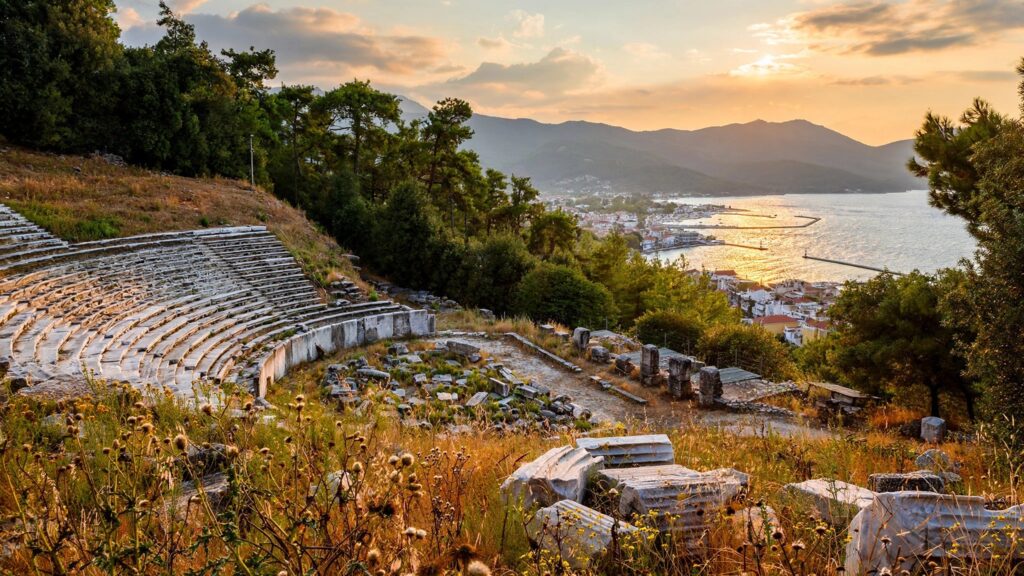
The acropolis rises on twin summits above the harbor, its walls enclosing three separate sanctuaries, dedicated to Pythian Apollo, to Pan, and to Athena Poliouchos, protector of the city, the last positioned with deliberate visibility from the waterfront so that ships entering the harbor would see, immediately, which goddess held this city under her protection. The fifth-century BCE theatre, cut into the hillside along the city’s eastern wall and remodeled by the Romans for use as an arena, has been restored sufficiently that it now hosts open-air performances each summer, an ancient Greek theatre still doing, after two and a half thousand years, more or less the job it was built for. The ancient agora, the harbor fortifications with their carefully drafted Marine Gate, and the Archaeological Museum of Thasos together give Limenas a depth of continuously visible history that few capitals of comparably small modern islands can offer.
The museum’s own centerpiece is difficult to miss: a kouros more than three and a half meters tall, found at the sanctuary of Pythion and dated to around 600 BCE, showing a young man carrying a calf across his shoulders in a pose the Greek world used again and again to represent piety and sacrifice offered in person rather than delegated to a priest. It stands among the earliest and largest surviving examples of Archaic Greek sculpture from anywhere in the northern Aegean, direct physical evidence that the same gold funding the warships and the mainland garrisons was also funding a genuine local school of sculptors capable of working at monumental scale.
One detail recovered from excavations at Kalami Bay, just along the coast, deserves to be mentioned honestly rather than tidied away, because it tells you something real about the texture of ancient Thasian life that the gold and marble alone do not: fifty-eight inscriptions from the late fifth century BCE, studied and published in detail by the French epigraphers Yvon Garlan and Olivier Masson in 1982, were found carved into the rock there, expressions of admiration from older men toward younger ones, the pederastic relationships that formed a recognized, if controversial even in their own time, part of upper-class social and educational life across much of the ancient Greek world. The inscriptions exist, in their sheer number at a single Thasian site, as a piece of evidence rather than a moral verdict, and an honest account of the ancient island includes them rather than only the gold, the wine, and the theatre.
Green Where the Cyclades Are Bare
Approach Thasos expecting another sun-bleached Aegean island and the experience will correct you within the first kilometer off the ferry.
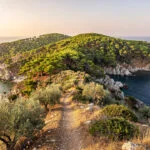
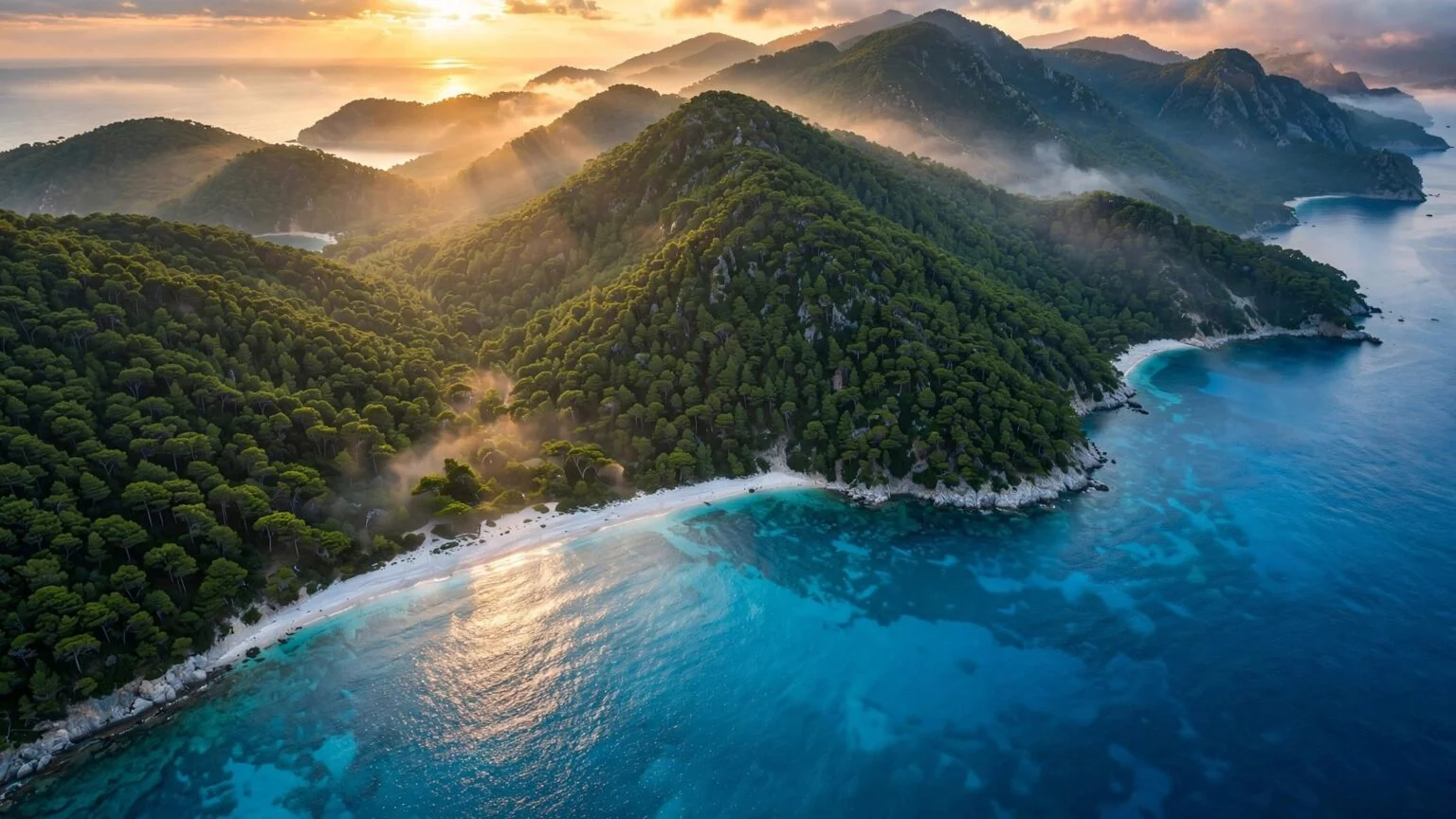
Thasos is locally nicknamed the Emerald Isle, and the name is not marketing exaggeration. Dense pine forest and old olive groves run, in many places, directly down to the waterline, a northern, well-watered greenness that has nothing in common with the dry Cycladic landscapes this site has documented at length elsewhere in the Aegean. The island’s interior climbs to Mount Ipsario, at 1,206 meters the highest point on Thasos, its slopes thick with forest and threaded with hiking trails that connect the coast to a scatter of genuinely well-preserved mountain villages, the kind of settlements that the gold-rush coastal towns of Limenas and Limenaria never needed to become, because their wealth was always agricultural and architectural rather than mineral.
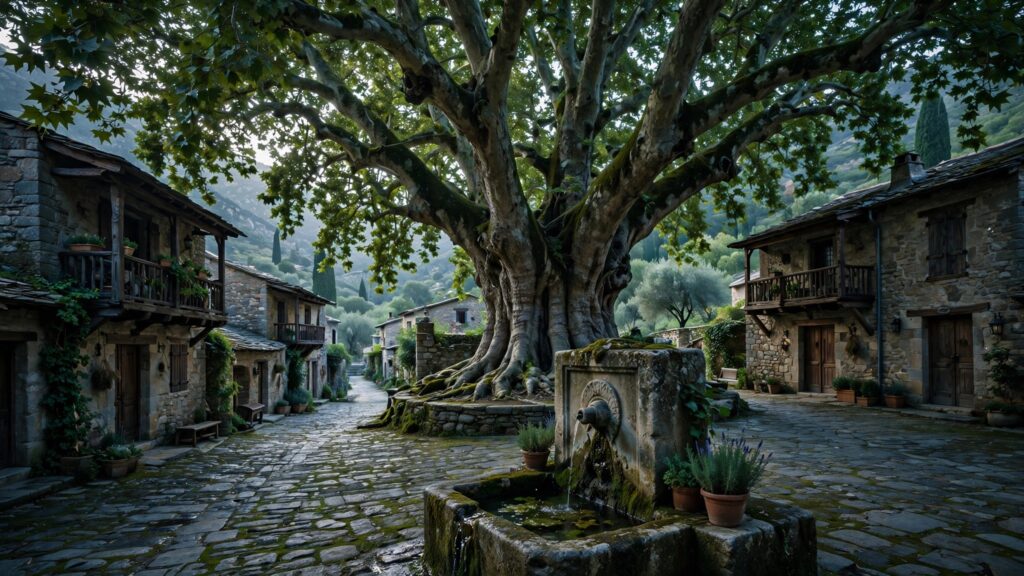
Theologos, in the island’s south, served as Thasos’s capital during the Ottoman period precisely because its inland, elevated position offered protection from the pirate raids that made the coastline dangerous for centuries, and its stone houses with carved wooden balconies, its plane-shaded squares and mountain spring water, preserve the genuine domestic architecture of that era with a completeness the coastal towns, rebuilt repeatedly after fires and Asia Minor refugee resettlement in the 1920s, generally cannot match. Panagia, perched at three hundred meters on Ipsario’s own slopes, and Kazaviti, the island’s oldest village, split across two adjoining settlements with its own small stone theatre still hosting a summer festival of traditional music, complete the picture of an island whose interior has been quietly, continuously inhabited in a register the coast’s beach-resort economy has barely touched.
Aphrodite’s Tear
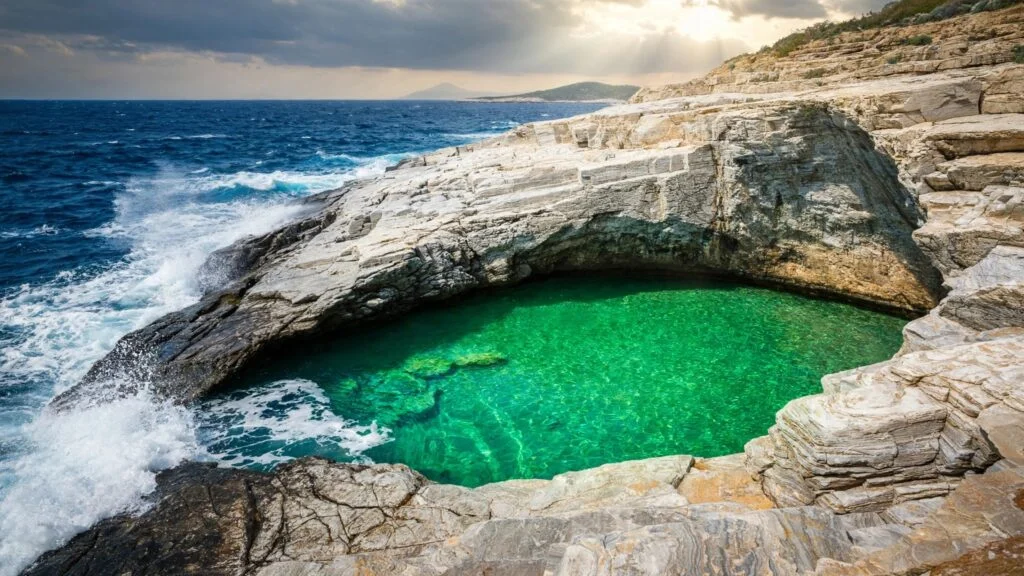
Of everything Thasos offers the contemporary swimmer, nothing has captured the modern imagination quite as completely as Giola, a roughly twenty-by-fifteen-meter natural rock pool carved directly into the marble coastline on the island’s southern tip, connected to the open sea but functioning, to anyone standing beside it, as a separate, self-contained basin with walls rising up to eight meters on its landward side, tall enough to jump from and deep enough to make the jump worthwhile.
Local tradition calls it Aphrodite’s Tear, and the goddess who, on Cyprus, emerged fully formed from sea foam onto a beach, here gets a more intimate, more secretive geography: a single tear, caught in stone, that the sea continues to refill with every wave that breaks against the outer rocks. Reaching it requires a walk of roughly twenty minutes over uneven coastal terrain with no shade along the way, which keeps the crowds at the pool itself somewhat more manageable than the easier, more photographed beaches elsewhere on the island, and the reward, an emerald, faintly mineral-tasting basin surrounded by bare white rock under open sky, is the kind of natural feature that genuinely does not photograph as well as it feels to be inside.
The coastline elsewhere offers a remarkable variety for an island of this size: Saliara, universally known simply as Marble Beach, where the shore is composed not of sand but of small white marble chips eroded directly from the same quarrying tradition documented at Aliki, producing water of an almost artificial-looking turquoise intensity. There is the long sweep of Golden Beach on the eastern coast, the island’s most developed strand and the most straightforward to reach with small children. And there is a long scatter of smaller, pine-shaded coves around the southern and western coast that reward simply driving the island’s well-maintained ring road and stopping wherever the water looks right.
The Olive With Its Own Name
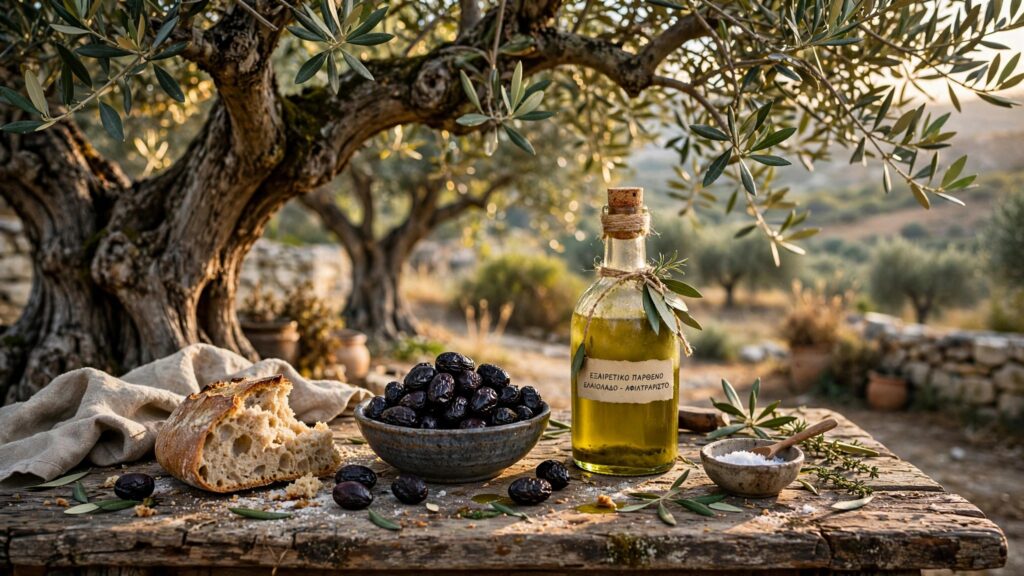
Thasos grows a black olive found almost nowhere else with the same character, the Throumba Thassou, wrinkled and naturally low in bitterness, which now carries Protected Designation of Origin status in recognition of qualities specific to this island’s soil and curing tradition. The Thasos Olive and Olive Oil Museum, set among a planted garden of the island’s varied olive cultivars, gives the product the same serious institutional attention that this site has already documented at the Greek mainland’s major olive-producing regions, and a bottle of genuinely good Thasian oil, purchased here rather than encountered abroad under a generic label, is one of the more honest edible souvenirs the island offers.
The island’s seafood, drawn from the cold, clean northern Aegean waters that separate it from the larger, warmer Cyclades to the south, runs to sardines, anchovies, prawns, sea bream, red mullet, octopus, and squid in genuine local abundance, while the forested, well-watered interior supports a meat tradition, particularly the slow-roasted goat for which Theologos’s tavernas are specifically known, that the drier islands of the southern Aegean simply cannot replicate at the same quality. Local wine, descending in spirit if not unbroken lineage from the vintages that put Dionysus’s face on ancient Thasian coins, completes a table that owes as much to the island’s mountains as to its sea.
Practical Notes
Thasos has no airport of its own and is reached by ferry from Keramoti, the shorter and more frequent crossing, or from the larger port of Kavala on the mainland, both connected by road to Kavala International Airport, which receives seasonal direct flights from several European cities as well as year-round domestic connections from Athens.
A car or scooter is genuinely necessary rather than merely convenient: the island’s excellent ring road makes circumnavigation straightforward in a single day, but the mountain villages, the more secluded beaches, and Giola Lagoon specifically are not realistically reachable on the limited local bus network. Allow four to five days for a serious visit, balancing time between Limenas and its ancient remains, the Aliki peninsula, the southern beaches and lagoon, and at least one full day given over entirely to the mountain interior and its villages.
May, June, and September offer the most comfortable conditions, avoiding both the relative chill of the northern Aegean’s earlier spring and the crowding that the island’s growing but still modest popularity brings in peak August weeks, when it remains, even then, considerably less pressured than the Cycladic islands several hundred kilometers to its south.
What the Island Actually Proves
Archilochus threw away his shield and told everyone about it, and the city that raised him did not punish him for the confession the way Sparta would have. It is worth asking why, and the honest answer is that Thasos was never built on the specific military culture that made survival itself a source of shame. It was built on gold pulled from its own hillsides and from the mainland mountains across the strait, on marble cut so cleanly that Rome wanted it, on wine good enough to put on every coin the island minted, and on a colonial confidence, inherited from Phoenician prospectors before any Greek arrived, that getting rich and staying alive were perfectly compatible ambitions for one place to hold at once.
The gold mines are exhausted now, their shafts mostly blocked, visible to anyone who goes looking but no longer worth excavating. The marble quarries at Aliki sit quietly underwater, their twelve centuries of labor readable only to swimmers willing to put their faces beneath the surface and look. Archilochus’s shield was never found. None of this reads, on Thasos, as loss. It reads as an island that built several genuine fortunes across its history, was conquered or humbled for that wealth at least three separate times by three different powers, and kept going anyway, green and well-watered and entirely unbothered, the way its own most famous poet always insisted a sensible person should.
At Olympus Estate, Wanderlust Greece looks for the places where Greece is most completely and most honestly itself. Thasos, in the far northern Aegean, was already valuable before a single Greek arrived, its gold drawing Phoenician traders who left behind a temple to Melqart that later became a Heracleion. Parian colonists took the island around 650 BCE, grew rich enough on its gold and the mainland deposits of Mount Pangaion to alarm the Persian Empire, and were conquered or humbled for that wealth three times over: by Darius, by Athens after a two-year siege in 463 BCE, and by the Spartan admiral Lysander in 403 BCE. What remains today is a genuinely green, well-watered island whose ancient capital still sits beneath its modern one, whose marble quarries at Aliki lie partly underwater after twelve centuries of continuous use, and whose most famous poet, Archilochus, told the world without shame that he had thrown away his shield and lived. Thasos never needed anyone’s permission to keep going.