

Euripides died before the Bacchae was performed.
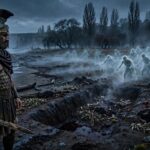
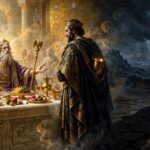
He had written it in Macedonia, at Pella article, the Macedonian capital of King Archelaus, part of a kingdom whose own Dionysian religious traditions ran deep, where he had gone in the last years of his life at the king’s invitation, and he died there in 406 BCE. The play was brought back to Athens by his son or by another member of his household, performed at the City Dionysia in 405 BCE, and won first prize. The audience that watched the Bacchae for the first time was watching a dead man’s final question about the god in whose honor the festival was held, in the theater that bore the god’s name, in the city whose theater the god had founded.
The question the play was asking is one Greek religion had been asking since Dionysus first arrived from the east and had to be accommodated by the existing Olympian order: what happens when the organized civic world refuses to acknowledge the very force whose periodic release makes that world’s continuation possible? What happens when a city denies the god who lets its citizens periodically shed the tensions organized civic life inevitably accumulates?
Euripides’s answer, delivered in the last play he wrote, performed after his death in the god’s own festival in the god’s own theater, was the answer of a man who had spent sixty years watching Athens manage this question and had concluded the management consistently failed in exactly the way the play describes: denial does not prevent the release. It guarantees a catastrophic one.
The Bacchae in Its Theatrical Context
The City Dionysia was the most significant theatrical festival in the ancient Greek world. Held in the month of Elaphebolion, approximately March in the contemporary calendar, it lasted several days, during which Athenian citizens, visiting dignitaries, and allied city-state representatives who had come to Athens for the tribute collection watched theatrical performances in the theater of Dionysus on the Acropolis’s southern slope.
The theater of Dionysus was sacred space dedicated to the god of theater itself: the skene building, the circular orchestra, the rising tiers of seats carved from the Acropolis’s limestone, all sat within the sanctuary of Dionysus Eleuthereus, the Dionysus the Liberator, whose cult had been brought to Athens from the village of Eleutherae on the Boeotian border sometime in the sixth century BCE, and whose festival the Peisistratid tyranny organized into the institution that produced Athenian drama itself.
The actors performing the Bacchae in 405 BCE were performing in the theater named for the god the play was about, in the festival organized to honor that god, before an audience whose very attendance was itself a civic religious act, the acknowledgment of the god that made the whole occasion possible. The play about the city that refused to acknowledge Dionysus was performed at Athens’s own most concentrated act of acknowledging him.
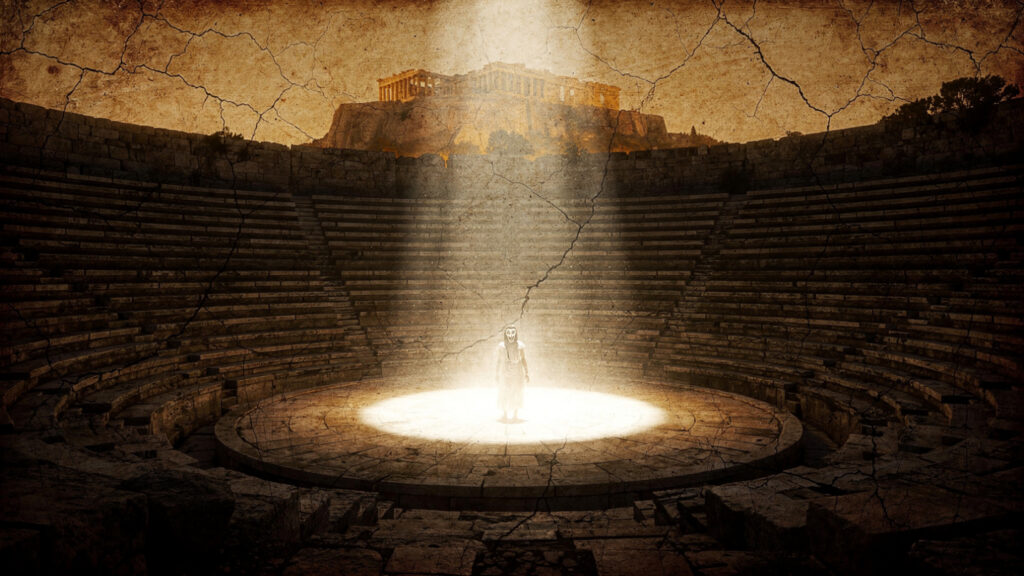
The mechane article in this collection develops the theological relationship between Greek theater and the divine: the theater where the gods descended on the crane, where divine presence was made visible in the most organized and most publicly witnessed form available, was the same theater where the Bacchae was performed, the play about the catastrophic cost of refusing exactly that encounter.
Who Dionysus Was Before He Was the Wine God
The Dionysus of the Bacchae is not primarily the god of wine in the sense the controlled intoxication of the symposion, which the dining article in this collection develops, might suggest. He is the god of ecstatic dissolution: the divine force whose domain was the altered state produced by controlled intoxication at the symposium, by the collective ecstasy of the Dionysian festival, and by the theatrical performance in his own theater alike.
Wine was simply the most conveniently available medium for this theological experience. The controlled intoxication of the symposion, its ratios managed by the symposiarch, was the form in which the organized civic world institutionalized the Dionysian dissolution of the rational individual as an ordinary social practice. But wine was never the content of Dionysian theology. Dissolution itself was the content.
The gift of wine that Icarius received was the same gift whose misuse the Bacchae dramatizes in its most catastrophic form.
Dionysian dissolution made a specific theological claim: that the organized individual, sustained by the structures of household, political community, and democratic deliberation, was not the only available mode of human existence, and that periodically dissolving that organized individual into the collective experience of music, dance, and ecstasy was itself the condition that let the organized individual keep sustaining ordinary existence in between.
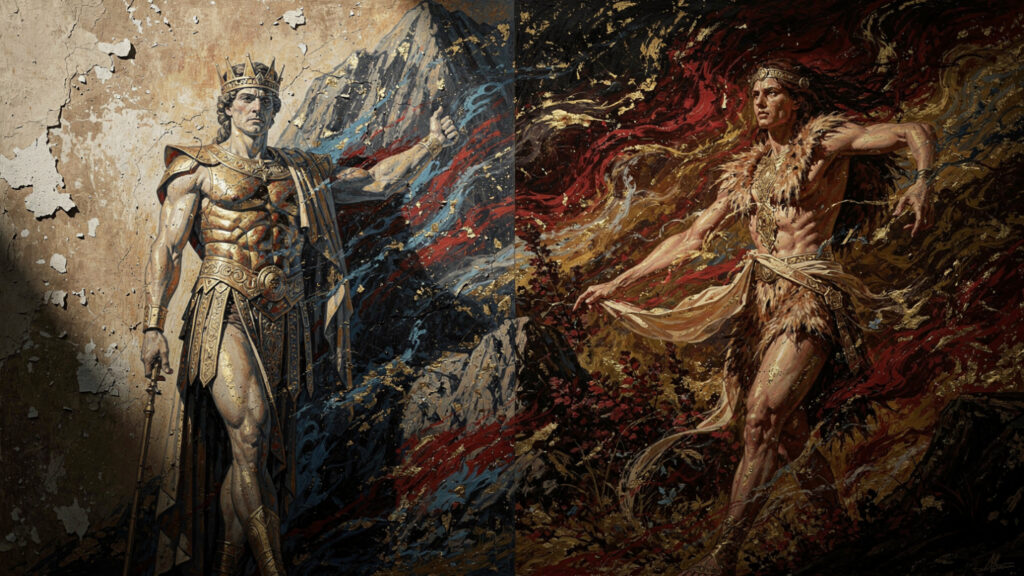
The Apollo article in this collection develops the Apollo-Dionysus opposition as the governing theological tension of Greek religious life: Apollo’s organized rational intelligence and Dionysus’s ecstatic dissolution were the two poles between which the Greek understanding of both the divine and the human condition operated. A person who was only Apollonian let rational order calcify into rigidity, a measure too fixed to accommodate the unmeasurable. A person who was only Dionysian let ecstasy collapse into pure dissolution, a liberation from measure the cosmos itself could not sustain.
Pentheus is the Apollonian principle refusing the Dionysian outright. He is not simply a tyrant refusing to acknowledge a god out of political calculation. He embodies the belief that rational measurement of the organized world is a sufficient and complete account of it, and that the unmeasurable force requiring periodic dissolution is a threat to the organized world rather than the very condition of that world’s continued renewal.
This refusal echoes the older Thracian resistance of Lycurgus, whose story preserves the same anti-Dionysian counterpoint in the botanical theology of the cabbage.
The play is the demonstration that Pentheus is wrong.
The Semele Story and the Twice-Born God
The Theban origin story of Dionysus, which the Bacchae develops through its opening monologue, gave him a particular theological position within the Olympian order: a god born from a mortal woman and saved from fire by the divine father who then carried him to term in his own body.
Semele was the daughter of Cadmus, the founder of Thebes. Her tomb, still standing among the ruins of her house in Thebes, remained green with the ivy and the vine Dionysus’s own divine presence had caused to grow from the ashes of her death.
Hera, whose jealousy of Zeus’s mortal lovers the article on the divine constellation and on Hera’s own mythological character both develop, arranged for Semele’s death by convincing her to ask Zeus to reveal himself in his full divine form, as proof of their relationship. Zeus, bound by an oath he could not break, revealed himself. The lightning and divine fire killed Semele, but Zeus rescued the unborn child, sewing him into his own thigh until the gestation was complete.
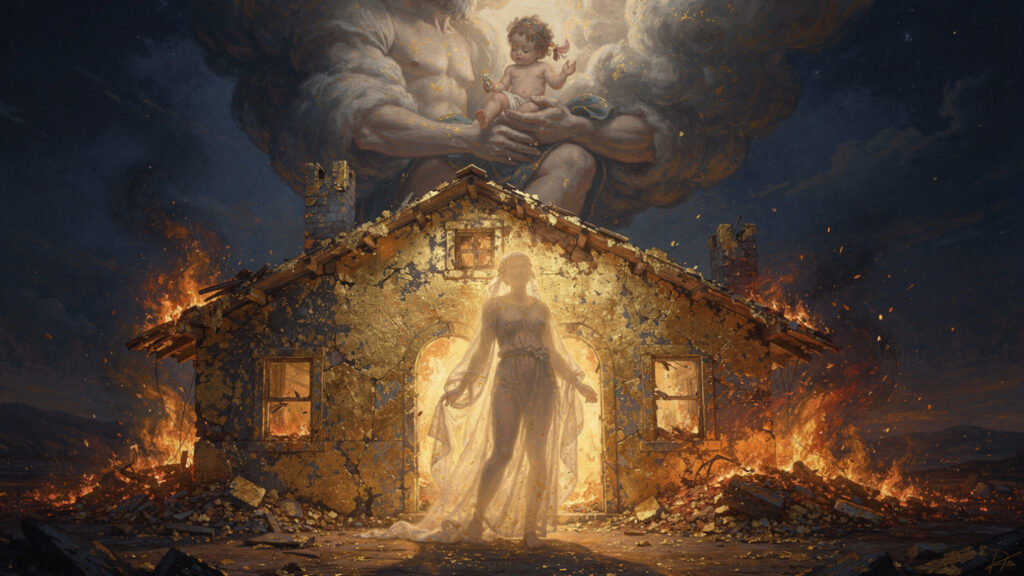
Dionysus was born from a mortal woman who died from her divine encounter, and from a divine father who completed the gestation himself: the twice-born god whose dual origin gave him a theological character bridging the mortal and the divine without fully belonging to either. The god who arrived in Thebes demanding recognition from his own mother’s city was the god whose mortal mother had died in the very act the Bacchae’s central action repeats: Pentheus would die refusing the divine encounter rather than meeting it too directly, but both deaths trace the same underlying structure, a city organized around avoiding the divine encounter rather than accommodating it through the theatrical festival and the Dionysian rites built for exactly that purpose.
Pentheus and the Logic of Suppression
Pentheus is Dionysus’s kinsman: the son of Agave, who was the daughter of Cadmus and the sister of Semele. Dionysus and Pentheus were cousins. The god demanding recognition arrived as the kinsman of the king who refused it, which gives the play’s theological conflict its tragic dimension, family recognition withheld from the family member whose divine status the family’s own history had produced.
Pentheus’s intelligence is not insufficient. It is organized specifically around refusing whatever evidence does not fit the categories it was built to process. He receives reports of the women on the mountain, rivers of milk and honey and wine flowing from the rocks, snakes and wild animals tamed by the Maenad dances’ sacred context, and processes every piece of evidence as confirmation of a threat his categories were already primed to see, rather than as evidence of a divine presence his categories were never built to contain.
The trap Dionysus sets for Pentheus, gradually exposing, under the guise of a stranger devoted to the cult, Pentheus’s own desire to see the women on the mountain for himself, reveals dissolution already at work in the very person most determined to resist it: whoever organizes their whole existence around denying a desire is the person in whom that desire concentrates most, and whose eventual dissolution is most complete.
Pentheus in the women’s dress on the slopes of Mount Cithaeron is Pentheus already dissolved: the organized rational male authority of a king who had imprisoned the stranger and ordered the Maenads’ arrest had already been stripped from a man now wearing fawn skin, a wig, and makeup, walking in feminine attire that itself expressed the collapse of the very masculine authority his refusal had been built to protect.
He was dismembered before he understood he had already been dissolved.
The Sparagmos and What It Was
The sparagmos, the ritual tearing of the victim, is the most disturbing element of the Bacchae, and the one the standard reading of the play as a simple cautionary tale about political oppression most consistently misreads.
Sparagmos and omophagia, the ritual tearing and the eating of raw flesh, were genuine elements of certain Dionysian rites, most closely associated with the god’s Thracian and Anatolian origins, in which the frenzied dismemberment and consumption of an animal, sometimes explicitly identified with the god himself, was the ritual’s central act.
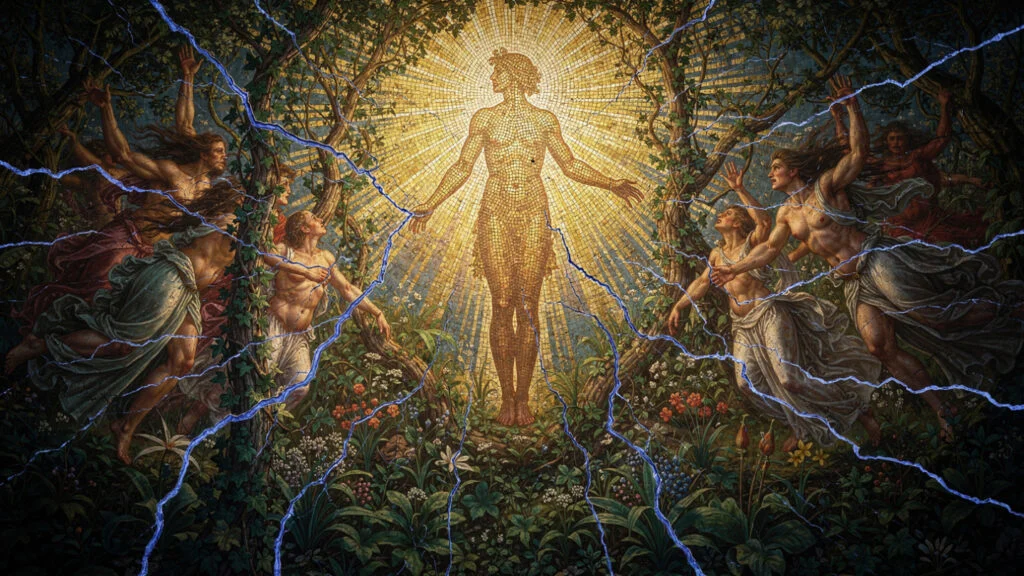
The theological claim sparagmos and omophagia encoded was that encountering the Dionysian divine was never an encounter with an external being who could be kept at a manageable distance through ordinary civic religious practice. It required literal incorporation of the divine into the participant’s own body: eating raw flesh was an act of assimilation, the claim that Dionysian experience was never observed or addressed from a distance but absorbed, taken directly into the body through consumption, until the participant became momentarily indistinguishable from the divine animal just consumed.
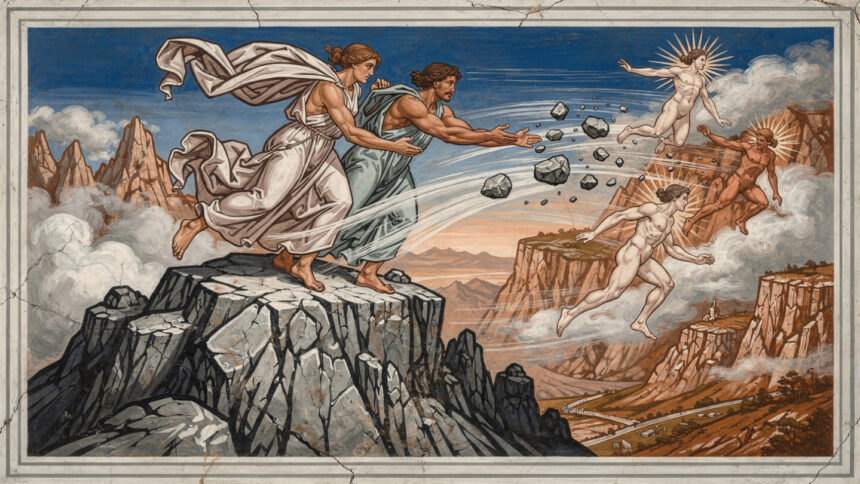
Agave, dismembering her own son on the slopes of Cithaeron, was performing this sacred act in a divine frenzy that had stripped her of the ability to recognize her own victim. She believed she was performing the sparagmos on a lion the sacred context required her to dismember, and the horror that struck her once the frenzy cleared was the horror of someone who had performed the sacred act on the wrong object entirely.
The play is not simply the story of political oppression producing catastrophic revenge. It is the story of what the organized world pays when it refuses to provide the institutional form, the theater, the festival, the controlled Dionysian rite, within which ecstatic dissolution can occur without destroying whatever it dissolves.
The Chorus and the Theological Argument
The chorus of Asian Bacchae, the women who had followed Dionysus from his eastern origins and provide the play’s lyrical commentary, gives the Bacchae its particular theological complexity: they represent genuine Dionysian devotion, worship organized around acknowledging the divine rather than denying it, and their songs supply the theological alternative to everything Pentheus embodies.
The chorus’s great odes carry the content of that genuine devotion directly: the first stasimon celebrates the blessed life of someone who acknowledges the divine gifts, an implicit alternative to Pentheus’s life of refusal, a hymn to holiness and to the person who meets the divine order with recognition rather than defiance.
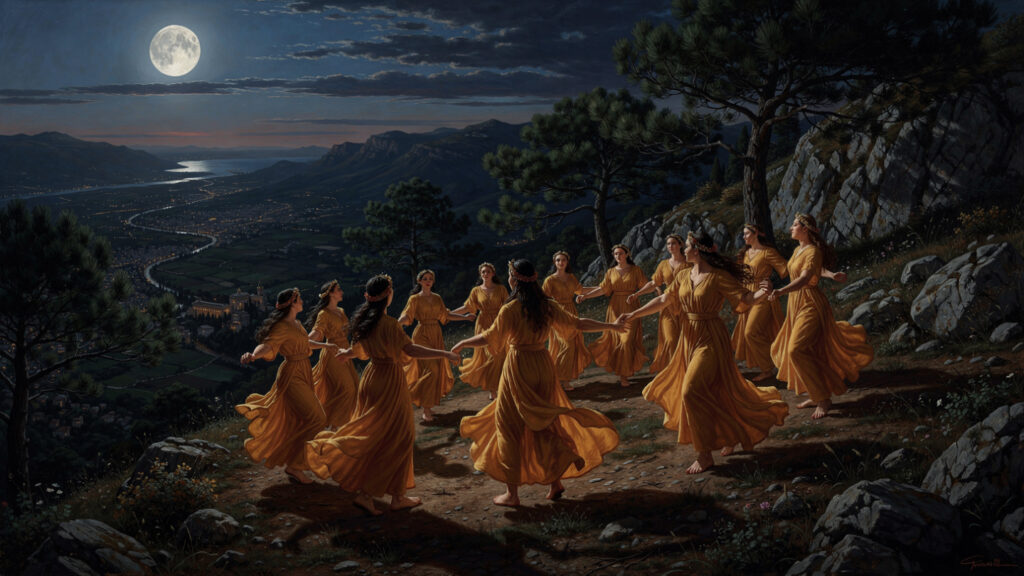
The chorus knows what Pentheus does not: that the force Dionysian worship accommodates is exactly what the organized world must accommodate to keep being an organized world at all. A ruler who refuses the festival, who keeps citizens locked in the daily discipline of civic life without the periodic dissolution the festival provides, is a ruler whose citizens will eventually dissolve anyway, catastrophically, once the pressure the refusal accumulated finds a release the organized channel was never allowed to provide.
Thebes without the Dionysian festival was Thebes accumulating exactly the pressure the festival exists to release through organized theatrical and ritual channels. That pressure released itself through Agave’s hands on the slopes of Cithaeron.
What Euripides Was Doing in Macedonia
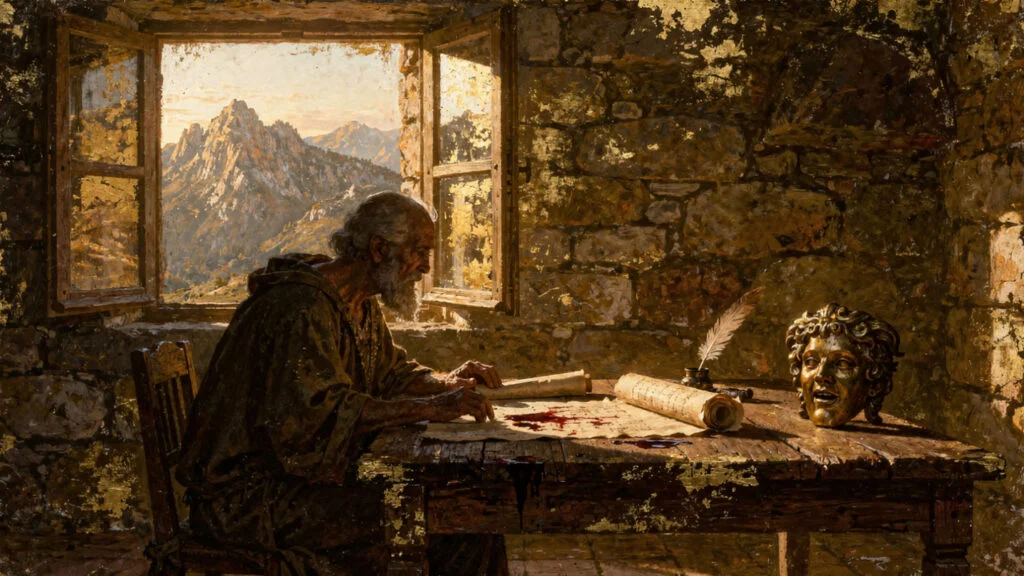
The Bacchae’s composition in Macedonia, where Euripides had gone in the final years of his life and wrote the play that would be performed only after his death in Athens, gives it the particular quality of a final reckoning: a playwright who had spent sixty years in Athenian theater, whose plays had most consistently challenged the assumptions of Athenian democratic and religious life, who had been criticized, mocked, and had won fewer first prizes than his contemporaries, was writing his final engagement with the very question Athenian theater had been built around from the start.
Athenian theater had been organized around the Dionysian festival from its very beginning: the dithyramb, the Dionysian choral performance theater itself grew from, and the theatrical competition at the City Dionysia together produced Athenian drama as an institution combining festival and civic contest in a single form. That theater was itself the organized structure within which Dionysian dissolution was managed: an audience weeping at Hecuba’s grief or shuddering at Oedipus’s recognition was experiencing, inside the theater’s organized space, exactly the emotional dissolution Aristotle would later analyze as the therapeutic function of tragedy, catharsis.
Writing the Bacchae in Macedonia, Euripides engaged most directly with the very question his own theatrical career had been built to manage: the play about the god of the theater his plays were performed in, about the festival whose institutional form had given his work its audience, about the force whose management through that same theater was the actual condition of the theater’s continued existence.
His answer was the answer of someone who had spent sixty years watching the management work: it works only when the city acknowledges what it is managing. When the city denies it, the management fails in exactly the form the play describes.
Visiting the Bacchae’s Landscape
Thebes, the modern Thiva, offers the most concentrated available expression of Greek tragedy’s engagement with the divine-human boundary anywhere: the city of Oedipus, Antigone, Pentheus, and the Sphinx and the Cadmean line, whose mythological history is a history of repeated destruction, each time the consequence of a divine-human encounter met with denial rather than acknowledgment.
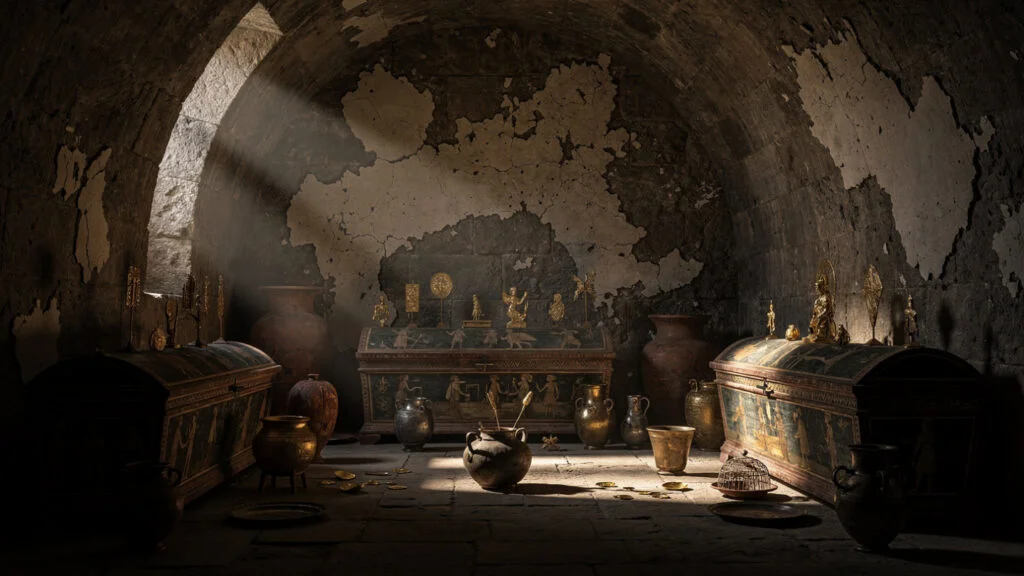
The Archaeological Museum of Thebes holds the material record of a city whose Mycenaean and classical layers ongoing excavations of the Cadmeia keep revealing beneath the modern city’s own reconstruction: Bronze Age painted coffins whose iconography gives the Mycenaean Theban world its particular character, alongside classical and Hellenistic artifacts reflecting the city’s later position within the Boeotian federation.
Mount Cithaeron, the mountain straddling the Attica-Boeotia boundary, rises 1,413 metres, dominating the view over both the Athenian and Theban plains, exactly the visual presence Greek myth consistently exploited: a sacred mountain standing between the organized human world of the plain below and the divine or bestial world of the heights above. It is accessible from the road connecting Eleusina to Plataea through the Theban plain, whose character the Bacchae itself uses as the organized civic world the mountain stands directly opposed to.
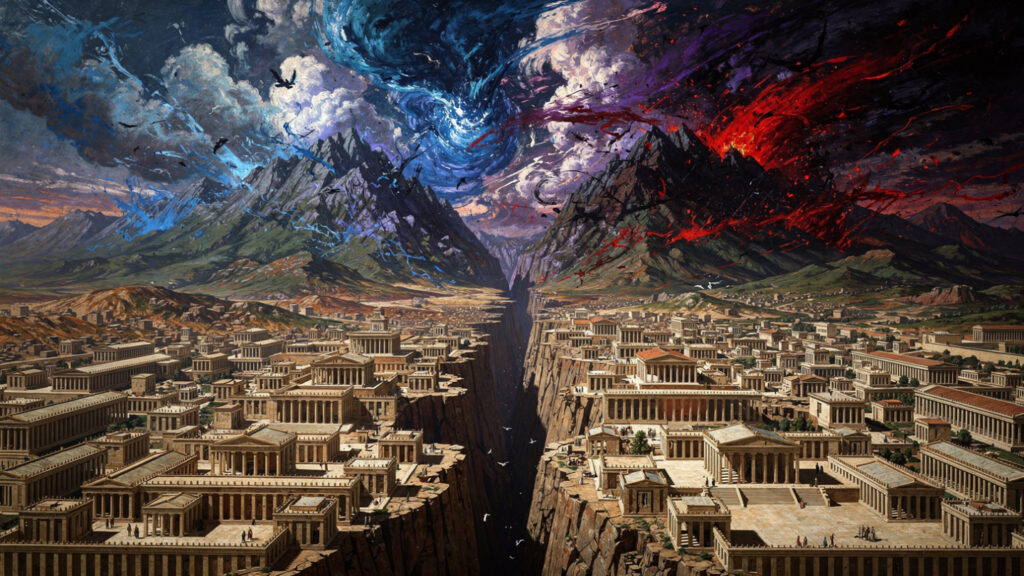
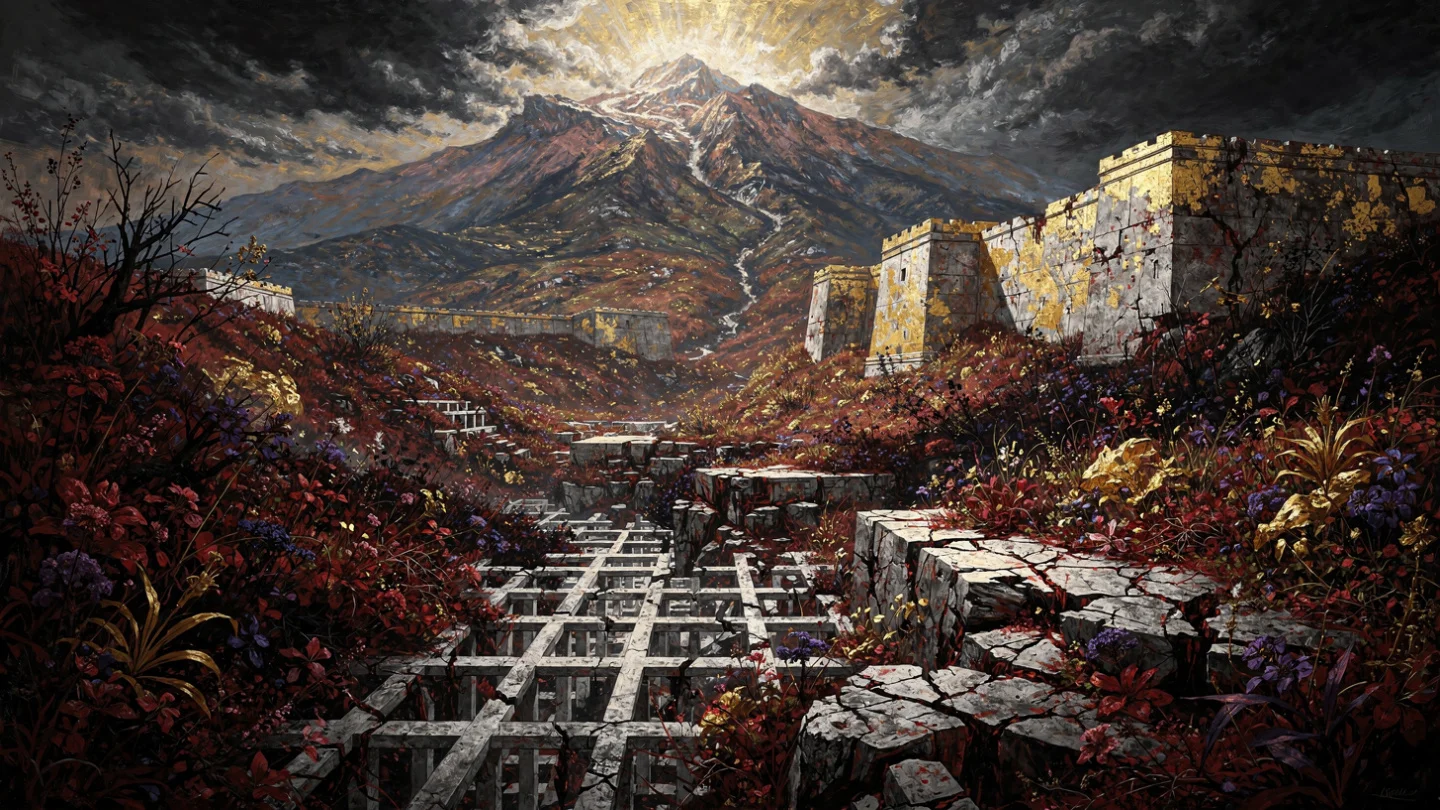
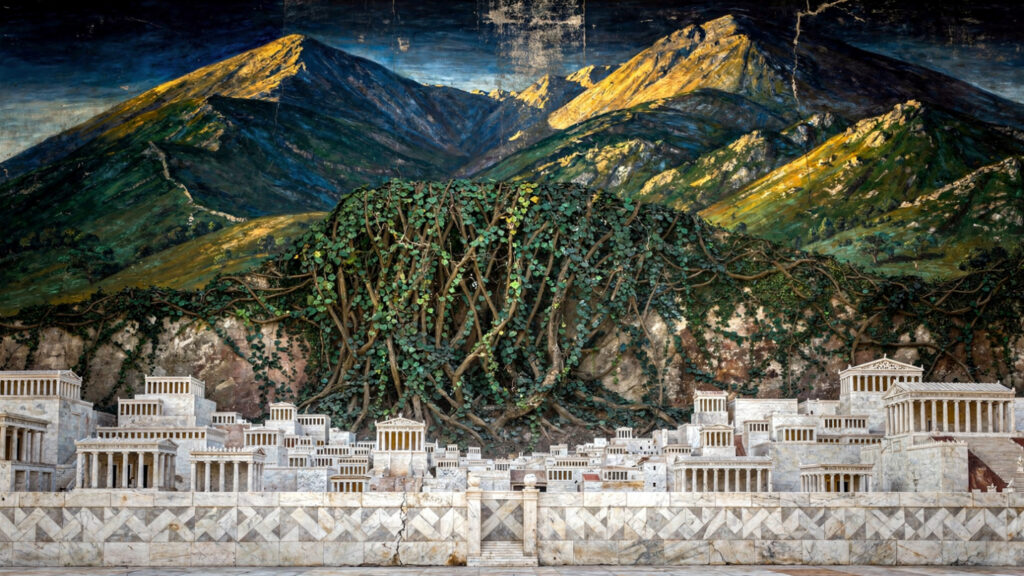
The Bacchae’s landscape is not primarily a landscape of identifiable archaeological sites. It is the landscape of two spatial categories whose opposition drives the whole play: the organized civic space of Thebes below, its agora, palace, laws, and looms embodying the Apollonian order Pentheus represents, and the wild mountain space of Cithaeron above, its pine forests, rocky slopes, and wild herbs embodying the Dionysian space the festival was designed to accommodate within civic life. When that accommodation is denied, the mountain’s own force irrupts into the civic space and destroys the very king who had organized his entire existence around excluding it.
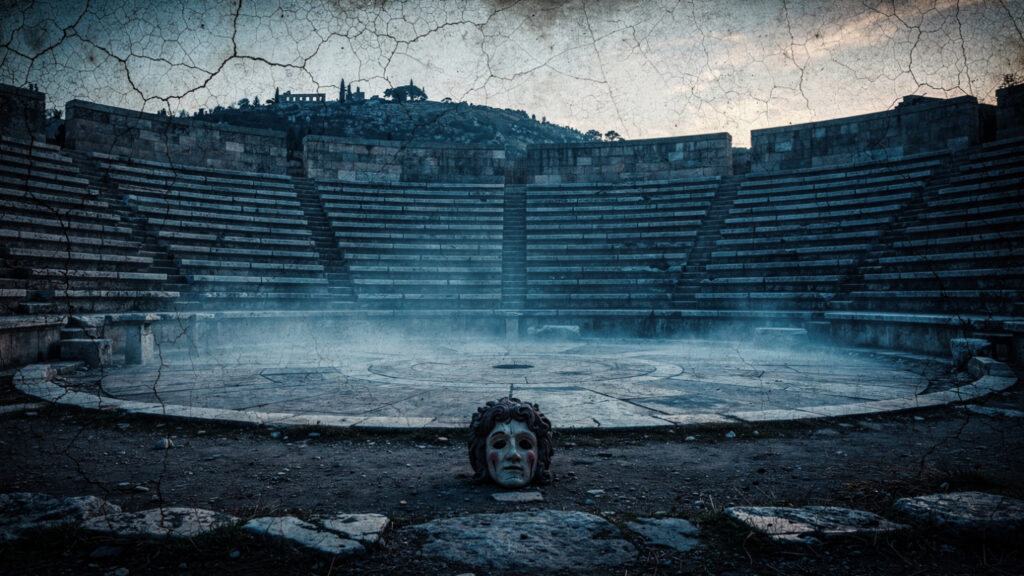
The theater of Dionysus in Athens, its site at the base of the Acropolis’s southern slope revealed by nineteenth- and twentieth-century excavation, orchestra circle, skene foundations, and the auditorium’s retaining wall all visible today, is the very site where the Bacchae was first performed in 405 BCE. Standing there gives a contemporary visitor the closest available experience of the space where this particular question was first asked.
The Question the Play Leaves Open
The Bacchae does not end with the restoration of order. In the play’s final surviving lines, Dionysus pronounces the fates of the surviving Theban royal house: Agave and her sisters are exiled, Cadmus and his wife are transformed into serpents. The city that denied the god is a city whose founding royal house has simply been destroyed, not corrected, not reformed, not reintegrated into a working relationship with the divine force it refused.
The play’s final lines leave a real question unanswered: what now? What does an organized civic world do with the knowledge that suppressing the Dionysian force produces exactly the catastrophic release the suppression was meant to prevent? What does someone who has just watched the Bacchae, in the theater of Dionysus, at the festival of Dionysus, do with the recognition that their own continued attendance is the very thing keeping that catastrophe at bay?
Euripides does not answer this question, because it has no answer in the form of a proposition. The answer was already happening in the theater itself: attending the festival, watching the play, participating in the very institution whose continuation was the condition of Dionysian dissolution being managed rather than accumulated into the catastrophic pressure the play had just described.
The audience who watched the Bacchae and were disturbed by it had already met the first condition of that answer: they had come to the theater of Dionysus, at the festival of Dionysus, and watched a play about Dionysus’s denial, an act of attendance that was itself the acknowledgment the play’s own question demanded.
Euripides died before he could see this happen. He left the question in the play, the play in his household, and his household brought it to Athens, where it won first prize.
The god was satisfied.
At Olympus Estate, Mythic Essays moves through the deeper currents of the Greek tradition. Euripides died in Macedonia and the Bacchae was performed after his death in the theater of Dionysus at the festival of Dionysus in Athens in 405 BCE, and won first prize. The play asked what happens when the organized civic world refuses to acknowledge the force whose periodic release, through the theater itself, is the condition of that world’s continued capacity for self-renewal. Pentheus’s answer was suppression. The play’s answer was sparagmos. The theater of Dionysus at the base of the Acropolis was the space where the question was asked, in the god’s own festival, in front of the citizens whose attendance was itself the answer’s first condition. The audience who watched the Bacchae had already answered the question. The god was satisfied.