

Everyone knows the story of Odysseus and the Cyclops as a story about a clever trick. A hero is trapped in a cave with a man-eating giant. He tells the giant his name is Nobody, blinds him with a sharpened stake and walks out clinging beneath a ram. When the giant howls that Nobody is killing him, his neighbours shrug and go home. It is the best joke in the Odyssey, and it deserves its fame.
Homer does not tell it as a joke. The story is told by Odysseus himself, at a dinner given by strangers, and the narrator is unusually hard on the man he describes. In the middle of the scene he admits that his men begged him to leave and that leaving would have been best. At the end he admits that his own cry of triumph from the ship was what brought the curse down on him. The poem hides none of it. It sets the hero’s best trick and his worst mistake side by side and lets them stand.
Read as a whole, Book 9 holds two tests. The Cyclopes are tested as a society, and they fail every test the Greeks could think of. Odysseus is tested as a man. He passes the test of cunning and fails the test of restraint three times, and the third failure sets the terms of everything that happens to him for the next ten years.
A Country With Everything and Nothing
Start with the place, because Homer does.
The Cyclopes, Odysseus says, are an arrogant and lawless people who never plant with their hands or plough, but trust in the gods. Wheat, barley and grapes grow for them unsown, and the rain of Zeus makes them thrive. They have no assemblies for debate and no established laws. They live in hollow caves on the mountain peaks, and each man lays down the law to his own wives and children and takes no account of the others.
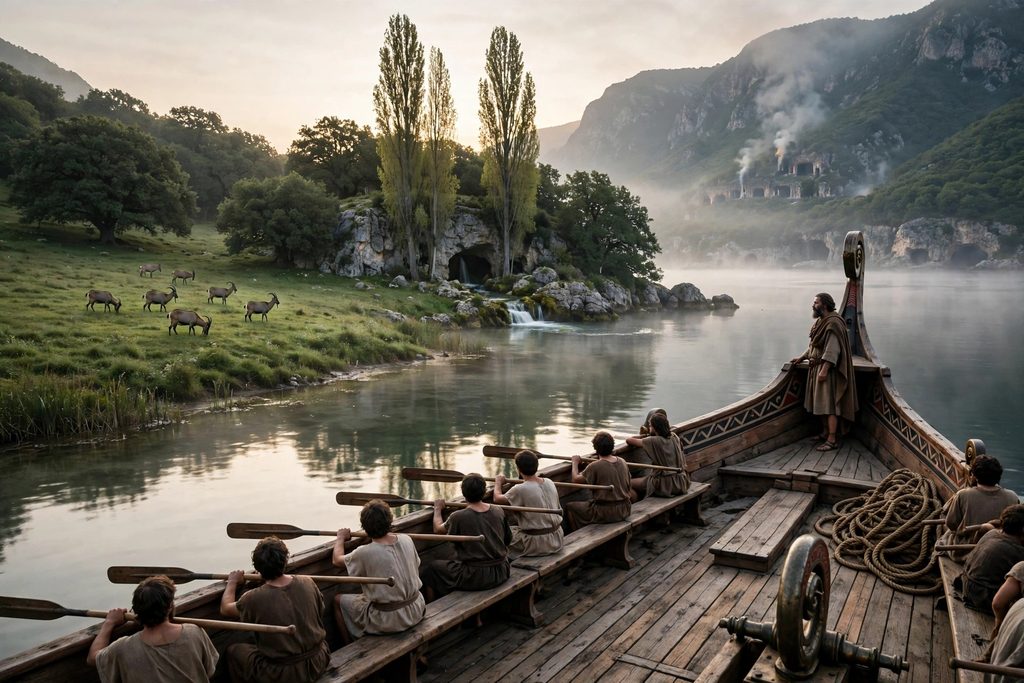
The description goes on to list what is missing. They have no ships and no shipwrights, and no craftsmen of any kind. A wooded island lies just off their coast, full of wild goats, with soft meadows, level land fit for the plough and a harbour so calm that a ship needs no anchor stones or mooring ropes. Yet it is empty, because no Cyclops has the boats or the habit of crossing to it. Men with the skill, Odysseus says, could have made it a fine settlement. Homer’s audience lived in the age of Greek colonisation, and they would have heard those lines as a surveyor’s report on good land and a verdict on the people who left it unused.
So the Cyclopes live in abundance and have none of the institutions that turn abundance into a life. Set them beside the Golden Age of Cronus, the first of Hesiod’s five ages, when the earth also gave its harvest without labour. Later poets added that the golden people needed no laws because they did right of their own accord, and Ovid says exactly that. The Cyclopes have the free harvest and none of the justice. The Golden Age is plenty with no need of law. The land of the Cyclopes is plenty with no law at all, and what grows in that gap is a herdsman who eats his guests.
The Greeks themselves treated the passage as a definition. Plato, in the Laws, quotes the lines about each man giving law to his wives and children as a picture of the earliest form of government, before families joined into larger communities. Aristotle quotes the same line in the Politics to describe the first households, scattered and each ruled by its eldest. In the same book he adds that a being who by nature has no city is either worthless or more than human, and he compares such a creature to an isolated piece in a board game. Polyphemus fits the description with unnerving exactness. The poem says he grazed his flocks alone, kept apart from the others and lived with a lawless mind. He is not the chief of a monstrous tribe. He is a man with no one to answer to.
When Odysseus first looks at the shore, he asks the question the poem has been preparing. Are these people violent, savage and unjust, or kind to strangers and god-fearing? Everything that follows is the answer.
The Man Who Would Not Leave
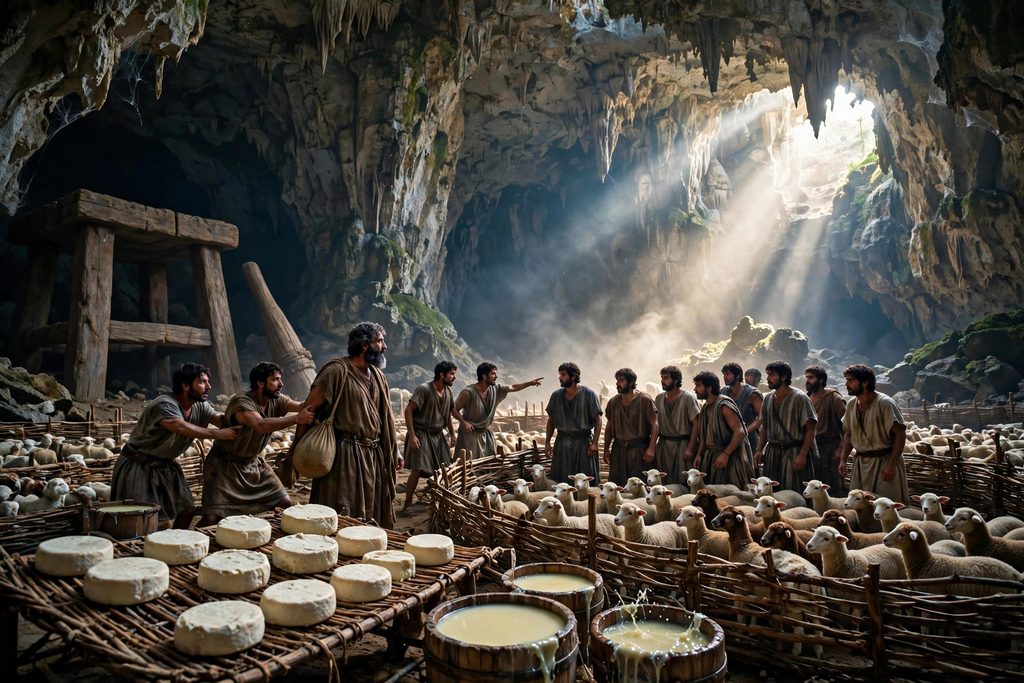
Odysseus goes up to the cave with twelve of his best men and a goatskin of strong wine. The cave is empty. Racks are loaded with cheeses, pens are crowded with lambs and kids, and the pails and bowls are brimming with whey. His men beg him to take some cheeses and go, or to drive the lambs and kids down to the ship and sail away.
He refuses. The poem gives his reason in his own voice. He wanted to see the man himself, and to see whether he would offer a guest-gift. Then he adds the line that hangs over the whole episode. It would have been far better to listen.
That sentence deserves to be read slowly. Odysseus is the narrator, and he is telling his listeners at the outset where the disaster began. It began with his own decision, taken against the advice of his crew, out of curiosity and the hope of a gift.
It is also the second time in a row that the same thing has happened. In the first adventure of his tale, at Ismarus, he sacked the city of the Cicones and ordered his men to leave quickly. They would not listen. They drank the wine and slaughtered sheep on the beach, and at dawn the Cicones of the inland came against them and killed six men from every ship. In the cave the roles are reversed. This time the crew want to leave and the captain stays. The opening lines of the poem blame the crew for their own deaths, and for the cattle of the Sun that is fair. But the two episodes placed side by side in Book 9 show a different pattern. On the way home from Troy, nobody in that fleet knows when to go.
The giant comes home at evening with his flocks and closes the entrance with a doorstone so huge that twenty-two four-wheeled wagons could not have shifted it. When he spots the strangers he asks whether they are traders or pirates. Odysseus answers with the formal speech of a suppliant and calls on the right god. We come to your knees, he says, and Zeus is the protector of suppliants and strangers, and walks beside every guest who deserves respect.
The reply is the most chilling speech in the poem. You are a fool, stranger, or you have come from very far away, says Polyphemus, if you tell me to fear the gods. The Cyclopes care nothing for Zeus and his aegis, or for any of the blessed gods, because they are far stronger. He would not spare Odysseus or his companions to avoid the anger of Zeus, unless his own heart told him to. This is the creed of a world without law, spoken by the creature who lives in it. Strength is its own justification.
Then he seizes two of the men, dashes them against the ground like puppies and eats them. Odysseus’s first impulse is to draw his sword and stab the sleeping giant in the liver. A second thought holds him back. If the giant dies, no one can move the doorstone, and they will all die in the cave. They wait for dawn.
That second thought is the episode’s first lesson, and it is easy to miss. The hero’s first impulse would have killed them all. The poem will come back to it.
Nobody | The Name That Opened the Cave
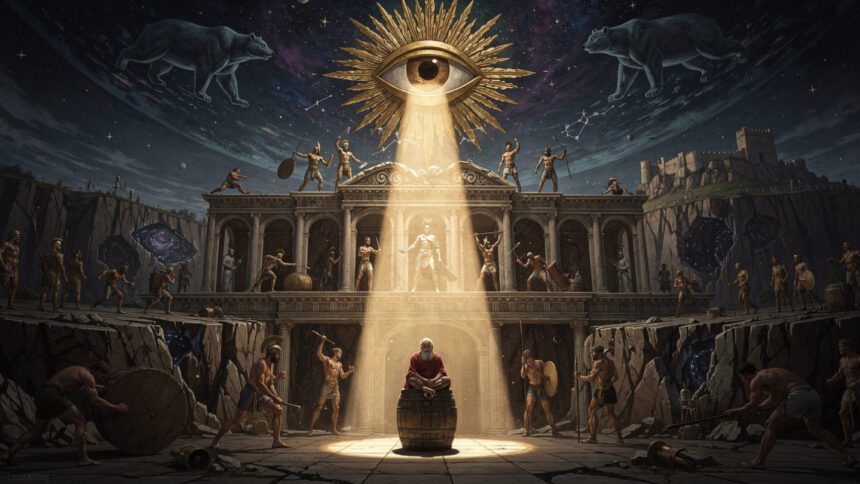
The plan is a masterpiece. Lying by the pens is the giant’s club, a trunk of green olive wood as big as the mast of a twenty-oared ship. Odysseus cuts off a fathom’s length, about six feet, and his men smooth it while he sharpens the point and hardens it in the fire. He hides it under the dung that lies in heaps through the cave. Four men are chosen by lot to help him, and he makes the fifth.
When the giant has eaten two more men, Odysseus offers him a bowl of the wine. It is no ordinary wine. It was given to him by Maron, priest of Apollo at Ismarus, in thanks for sparing him and his family when the city was sacked, and it was so strong that Maron’s household drank it mixed with twenty measures of water to one. Later writers made Maron a son or grandson of Dionysus, which suits a wine that defeats a giant. Polyphemus drinks three bowls, asks for more and asks his guest’s name, promising a guest-gift in return.
Here the poem turns a sacred custom inside out. The guest-gift is what a host owes a visitor, the visible sign that the law of hospitality is being kept. Odysseus, the guest, has already brought a gift in the wine. The host, who has been eating his guests, now offers one in return. My name, says Odysseus, is Nobody. My mother and father and all my friends call me Nobody. The giant’s guest-gift is a joke whose cruelty only he can enjoy. I will eat Nobody last of all his friends, and the others first.
He falls back in a drunken sleep, belching wine and pieces of human flesh. The stake is pushed into the embers until the green wood is about to catch fire. Then the men drive it into his eye, and Odysseus, standing above, leans his weight on it and twists. Homer gives two similes for what follows, both from the workshop. The stake turns in the eye the way a shipwright bores a plank with a drill, his helpers spinning it with a strap. The eye hisses the way an axe hisses when a smith plunges it into cold water to temper it. The giant screams, and the rock rings with it.
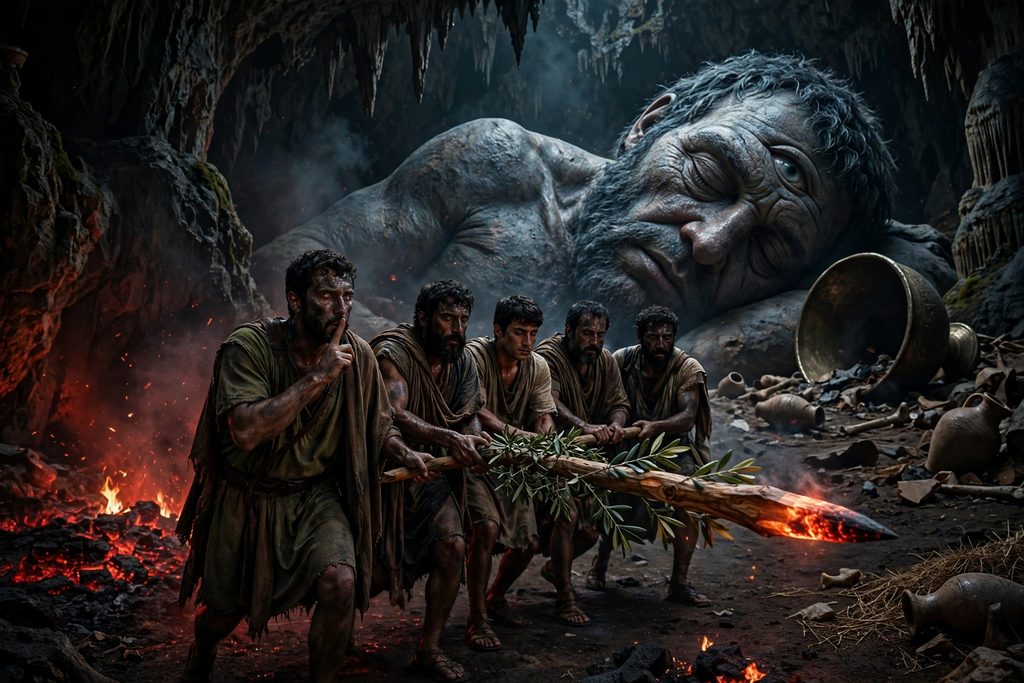
His neighbours come from their caves and stand outside the doorstone. What is wrong, Polyphemus, they ask, that you shout through the night and keep us from sleep? Is some mortal driving off your flocks against your will? Is someone killing you by trickery or by force? The answer comes from inside. Nobody is killing me, my friends, by trickery and not by force. And they reply, reasonably enough, that if no one is attacking you and you are alone, there is no escaping a sickness sent by great Zeus, so pray to your father, lord Poseidon.
They go away.
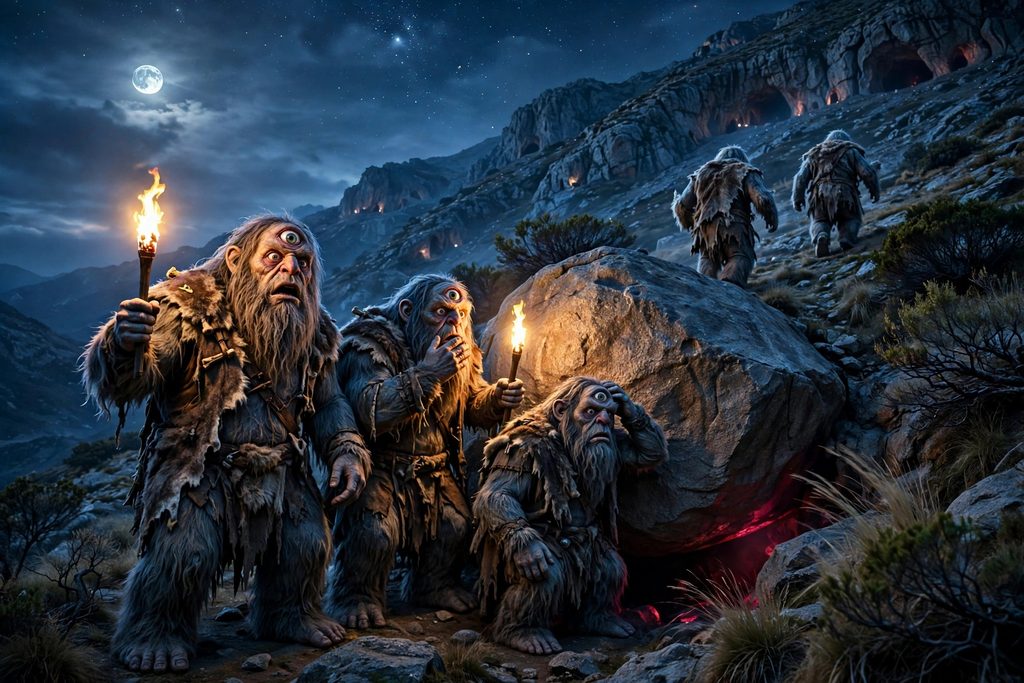
The pun is the famous part, and it works on two levels in Greek. The false name is Outis, Nobody. But when the neighbours answer, they use the other Greek word for no one, mē tis, and mē tis sounds exactly like mētis, cunning intelligence, the quality Odysseus is famous for. Homer makes sure nobody misses it. Odysseus tells his hosts that his heart laughed inside him at how his name and his flawless mētis had tricked them. Even the giant’s name joins in. Polyphemus can mean much spoken of, or many-voiced, and his single famous utterance is the word nobody.
The trick also works on a second level, beyond the pun. The Cyclopes never enter the cave. They stand at the entrance, ask a question, accept the answer and leave. In a Greek town, a man screaming that something was killing him would bring a crowd through the door. In a country where each man lays down the law in his own cave and takes no account of his neighbours, a statement from inside the cave is accepted at face value. The pun is the mechanism, but the lawless society is what lets it work. Odysseus defeats the Cyclops with the Cyclopes’ own way of life.
The Ram
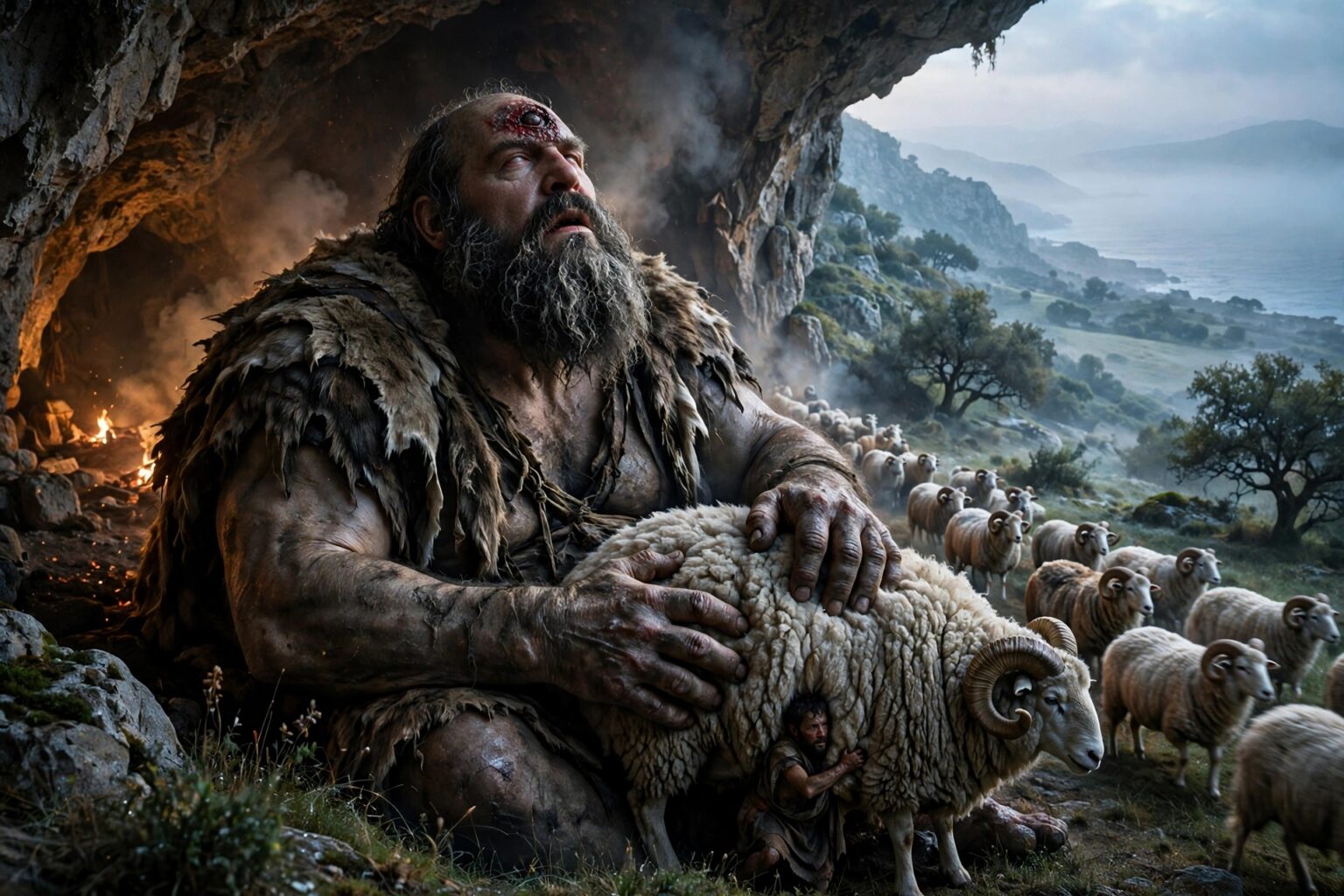
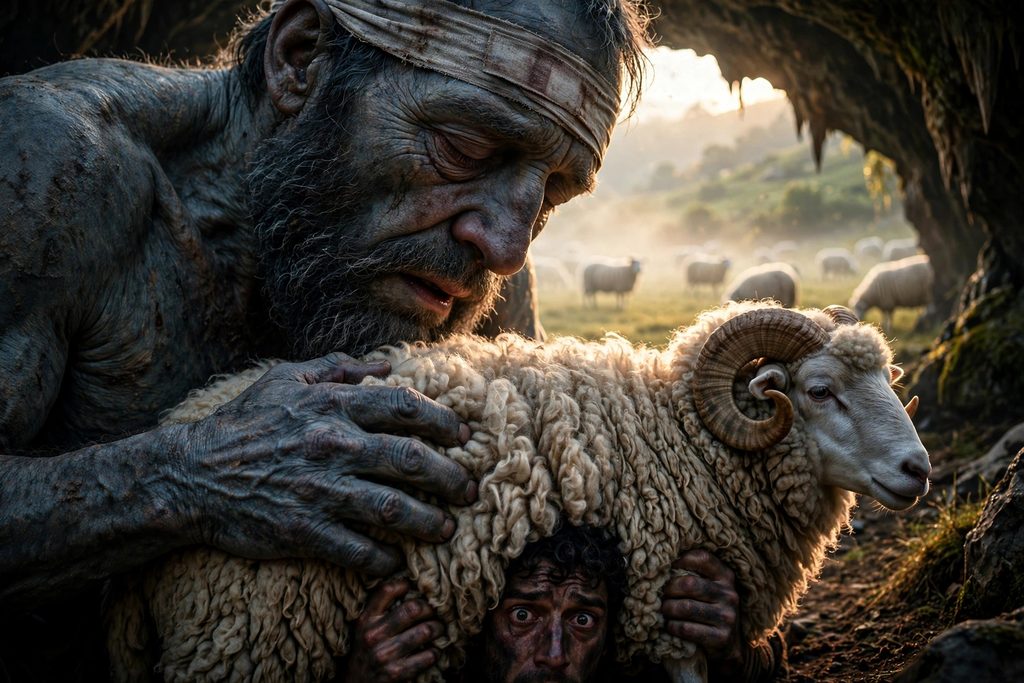
The escape is the second great stratagem. The blinded giant rolls the stone aside and sits in the doorway with his arms spread, hoping to catch anyone who tries to slip out among the flock. Odysseus lashes the big woolly rams together in threes with willow twigs from the giant’s own bed, and a man hangs beneath the middle ram of each three. For himself he takes the finest ram of the flock, curls up under its shaggy belly and grips the fleece. At dawn the rams hurry out to pasture, and the giant runs his hands over their backs as they pass. He never thinks to feel beneath them.
What follows is among the strangest and most humane moments in the poem. The last animal to leave is the great ram, slowed by his heavy fleece and by the man clinging to it. The blinded Polyphemus strokes him and speaks to him. Dear ram, why are you the last of the flock to leave the cave? You were never left behind before. You were always first to the soft grass and first to the river. You must be grieving for your master’s eye, which a wicked man put out with his cursed friends after he had beaten down my wits with wine. If only you could think like me and speak, and tell me where he is hiding. I would dash his brains across the floor, and my heart would find some ease from the pain this good-for-nothing Nobody has given me.
Even here, in agony, he is still saying Nobody. The poem cannot resist the joke. But for the length of that speech the monster is a lonely herdsman talking to the one creature that stays close to him. His neighbours have walked away. His father, as it turns out, will not heal him. The only listener he has is a ram. Later poets pushed this sympathy much further. The Sicilian poet Theocritus turned Polyphemus into a lovesick young herdsman singing to the sea nymph Galatea, and Euripides made the whole episode into a comic satyr play, the Cyclops, the only satyr play that survives complete. Homer plants the seed of all of it in a few lines.
The ram carries Odysseus out, and he does not forget it. When the stolen flock is shared out on the island where the fleet waits, his companions give him the ram as a special prize, and he sacrifices it on the shore to Zeus. Zeus, the poem says, paid no attention to the offering and was already planning how all his ships and companions would be destroyed. The one animal the giant spoke to with love ends as a burnt offering the god will not accept.
Three Failures of Restraint
Everything up to the escape is cunning. What follows is the opposite.
They reach the ship. The crew start to weep for the six men they have lost, and Odysseus stops them with a frown, because there is no time. They drive the sheep aboard and row out. Then, when the ship is as far from shore as a man’s shout can carry, Odysseus shouts back at the giant. So the man whose friends you ate in your cave was no weakling after all. Your cruelty was bound to catch up with you, you brute, for daring to eat guests in your own house, and Zeus and the other gods have paid you back.
The Cyclops breaks off the peak of a great hill and hurls it. It lands just ahead of the bow, and the wave it raises drives the ship back toward the beach. Odysseus pushes off with a long pole, and the men row for their lives. When they are twice as far out, he starts shouting again.
His men try to stop him, and the poem gives their words in full. Why provoke a savage? The rock he just threw nearly drove us back to land, and we thought we were dead. If he hears another sound from us, he will smash our heads and the ship’s timbers with one jagged stone. Their pleading, Odysseus admits, did not persuade his proud heart.
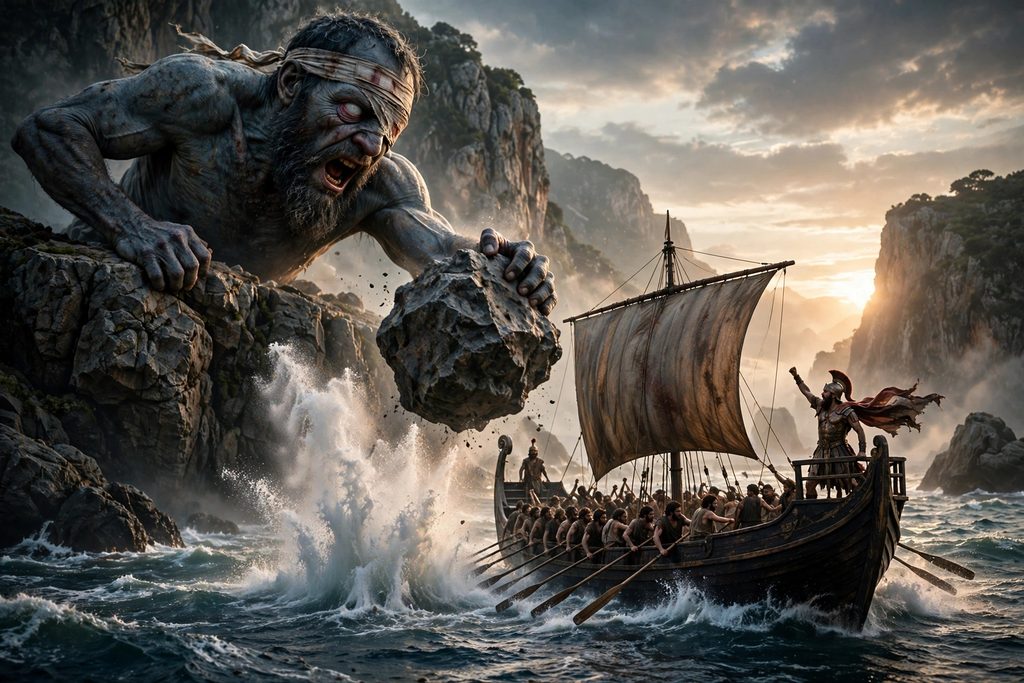
And so comes the third failure, the one that matters. Cyclops, he calls, if any mortal ever asks you how your eye was so shamefully blinded, tell him it was Odysseus, sacker of cities, son of Laertes, whose home is in Ithaca.
Consider what he has done. He has given his name, his father’s name and his home. That was how a Greek identified a man, much as an Athenian father declared a son’s name and parentage when he presented him to his brotherhood at the Apaturia, and it is exactly what a curse needs in order to find its target. On top of it he has added a title of his own choosing, sacker of cities, a boast about Troy.
The giant’s reply shows how completely it has worked. So an old prophecy has come true, he groans. A seer named Telemus once lived among the Cyclopes and told him he would lose his sight at the hands of Odysseus. But he always expected a tall and handsome man of great strength, and instead a small, worthless weakling has blinded him after beating him down with wine. Then he changes his tone. Come back, Odysseus, he says, and I will give you guest-gifts and ask the Earthshaker to send you home, because he is my father, and he alone can heal my eye.
Odysseus answers with a cruelty to match the giant’s. I wish I could rob you of life and send you down to the house of Hades, as surely as not even the Earthshaker will heal that eye.
Polyphemus stretches his hands up to the starry sky and prays. Hear me, Poseidon, if I am truly your son and you claim to be my father. Grant that Odysseus, sacker of cities, son of Laertes, whose home is in Ithaca, may never reach his home. But if it is his fate to see his family again and come back to his house and his own country, let him come late and in misery, having lost all his companions, in another man’s ship, and let him find trouble in his house. And the god of the sea heard him.
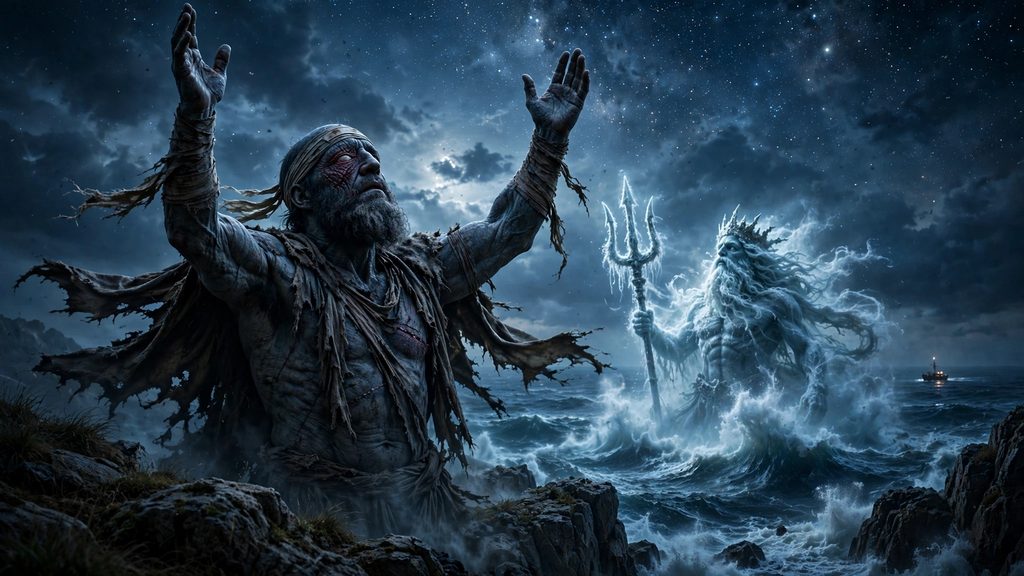
Look at how the curse is addressed. Sacker of cities, son of Laertes, whose home is in Ithaca. Every word of the address was supplied by the man it was aimed at.
The man who had called himself Nobody for as long as it took to be safe could not bear to stay nobody once he was safe. The famous cunning of the episode and its famous folly belong to the same man. The intelligence that thought of the name Nobody also needed the name Odysseus to be known.
The Curse as Plot
The prayer is not a flourish. It is the outline of the rest of the poem, and it comes true clause by clause.
The poem states plainly that this is the engine of the story. In its very first scene, Zeus tells the gods that Poseidon is unrelenting against Odysseus because of the Cyclops he blinded, the godlike Polyphemus, whose mother was the nymph Thoosa. In the underworld, the prophet Tiresias repeats the warning. During the Nekuia he tells Odysseus that the Earthshaker is angry because his son was blinded, and that if his men harm the cattle of the Sun, he will come home late and in misery, having lost all his companions, in another man’s ship, and find trouble in his house. The seer’s words echo the giant’s prayer almost line for line.
The curse starts working at once. The sacrifice of the ram is ignored. Soon after, at Telepylos, the giant Laestrygonians sink every ship in the fleet except one, and that single ship is the one that reaches Circe’s island. When Odysseus finally comes home, he arrives on a ship of the Phaeacians from Scheria, the very people to whom he is telling the story of the cave.
There is a small irony in the throw that follows the prayer. The giant hurls a second, even larger rock. This one falls just behind the stern, and its wave drives the ship forward to the island where the rest of the fleet is waiting. The curse works in the long run, but in that moment it speeds them on their way.
Where the Poem Keeps Going Back
Homer never lets the cave go. It returns twice, and each time it proves something different.
In Book 12, as the ship approaches the strait of Scylla and Charybdis, Odysseus rallies his frightened crew with the memory of the Cyclops. This danger is no worse than when the Cyclops penned us in his cave, he tells them, and even from there we escaped through my courage, my counsel and my mind. I think we will remember this one day too. Here the cave is evidence of what his intelligence can do. It is also the moment when he chooses not to tell his men what Circe has told him, that Scylla will take six of them whatever they do.
In Book 20, on the night before the slaughter of the suitors, the cave returns for a different reason. Odysseus lies awake in the porch of his own hall, disguised as a beggar, and he watches the maids who have been sleeping with the suitors go out laughing together. He is so angry that he considers killing them on the spot. Instead he strikes his chest and speaks to his own heart. Endure, my heart. You endured a worse thing on the day the Cyclops ate my strong companions, and you held firm until cunning brought you out of the cave where you thought you would die.
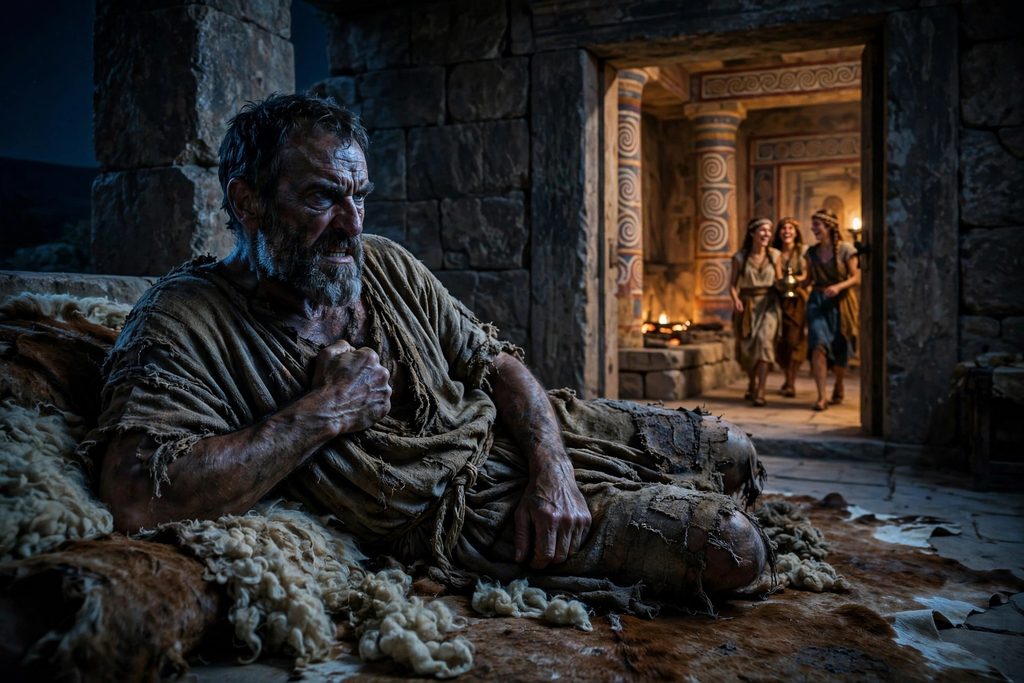
This is the poem’s own commentary on the episode, and here the lesson of the cave is restraint. If Odysseus had followed his first impulse in the cave and stabbed the sleeping giant, he would have died there with his men. If he follows his first impulse now and kills the maids, he will lose the surprise on which his whole plan depends. His home has become a second cave, full of men who eat what is not theirs and ignore every law of the guest. What will get him out is the combination of cunning and self-control that, in the first cave, he showed only half the time.
In his own house he is Nobody again, a beggar no one recognises, and this time he keeps the secret for as long as it takes. The restraint he failed to show on the ship in Book 9, he practises in Ithaca for four long books. He endures the insults of the suitors, a footstool hurled at him, an ox hoof thrown at his head and the sight of his household in ruins, until the bow is in his hands.
Three Kinds of Cyclopes
Homer’s Cyclopes are not the only ones in Greek tradition, and the others help show what he was doing.
In Hesiod’s Theogony, the Cyclopes are three sons of Earth and Sky, brothers of the Titans, named Brontes, Steropes and Arges, Thunder, Lightning and Bright. They have a single round eye in the middle of the forehead, which is what their name means, and they forge the thunderbolt that Zeus uses to win his war against the Titans. Later poets set them to work under Etna as the smiths of Hephaestus. These Cyclopes are craftsmen of the highest order, the opposite of Homer’s herdsmen, who have no craftsmen at all.
A third kind belongs to the landscape. When later Greeks looked at the enormous walls of Tiryns and Mycenae, built of boulders no ordinary crew seemed able to lift, they said the Cyclopes had built them, and archaeologists still call this masonry Cyclopean. Faced with a ruin they could not explain, the Greeks supplied giants.
The story of a man trapped by a one-eyed giant who blinds him and escapes among the flock was not Homer’s invention either. Folklorists have recorded versions across Europe and the Near East, from the giant Tepegöz of medieval Turkic epic to the one-eyed Tartalo of Basque folktale, some with the false name and some without it. Homer’s version is the oldest that survives, and what he added is the frame around it. The Odyssey is the only telling in which the giant’s people are a full portrait of a lawless society, and the only one in which the hero’s escape is followed by a boast that costs him ten years.
The Greeks also tried to find the island on a map. By the fifth century BC the Cyclopes were placed in Sicily, around Etna, and Thucydides records that the Cyclopes and the Laestrygonians were said to be the oldest inhabitants of part of the island, though he admits he cannot say where they came from or where they went. In 1914 the palaeontologist Othenio Abel suggested a different origin for the one eye. The skulls of extinct dwarf elephants, found in caves on Sicily and other Mediterranean islands, have a single large opening in the middle of the forehead where the trunk once attached. To anyone who had never seen an elephant, such a skull could look like the head of a one-eyed giant. It remains an attractive guess rather than a proven link.
What the Story of Odysseus and the Cyclops Is Really About
The Nobody trick is the least of it. It is the most memorable thing in the scene, and it is brilliant, but it is not what the scene is for.
The scene is a double demonstration. The Cyclopes are the Greeks’ negative portrait of a world without institutions, a fertile land where no one owes anything to anyone, and where, as a result, a visitor is food. They have no assembly, no law, no ships, no craftsmen and no regard for strangers or for Zeus. Plato and Aristotle both read their lines as a description of life before the city. Odysseus is the Greeks’ portrait of the clever man, a hero whose mind can get him out of anything except his own hunger to be known.
Cunning, the poem suggests, is half a virtue. It can free you from a cave, and it can make you Nobody. It cannot stop you from shouting your name across the water once you are safe. For that you need the other half, the restraint to leave when leaving is best, the patience to endure, and the sense to know that being nobody is sometimes the only safe thing to be. It is the half Odysseus learns on the long road to Ithaca.
He had been Nobody for exactly as long as it took to get away. Then he wanted to be Odysseus. The next ten years, and the rest of the poem, are the price of that wish.
At Olympus Estate, Mythic Essays read the great Greek stories closely, line by line and from the oldest sources forward. In Book 9 of the Odyssey, Odysseus tells the Phaeacians how he reached the land of the Cyclopes, a fertile country with no assembly, no laws, no ships, no farming and no fear of the gods, which Plato and Aristotle later quoted as a picture of life before the city. Against his men’s advice he waited in the cave of Polyphemus to see whether the giant would give him a guest-gift, and lost six companions. He made the giant drunk on Maron’s wine, told him his name was Nobody, blinded him with a stake of green olive wood and escaped under the belly of the finest ram, while the other Cyclopes went home believing that no one was hurting their neighbour. The pun joins Outis, Nobody, with mē tis and mētis, cunning. Safe at sea, Odysseus shouted his real name, his father’s name and his home, and Polyphemus used those exact words to pray to his father Poseidon that Odysseus would come home late, in misery, without his companions, in another man’s ship and to trouble in his house. Every clause came true. Homer recalls the cave twice more, at Scylla and on the night before the slaughter of the suitors, when Odysseus tells his heart to endure. Hesiod’s Cyclopes forged the thunderbolt of Zeus, later Greeks credited Cyclopes with the walls of Mycenae, Thucydides placed them in Sicily, and dwarf elephant skulls may have helped give the giant his single eye.