

In the decades after the Meiji Restoration of 1868, something remarkable happened in Japanese intellectual life.
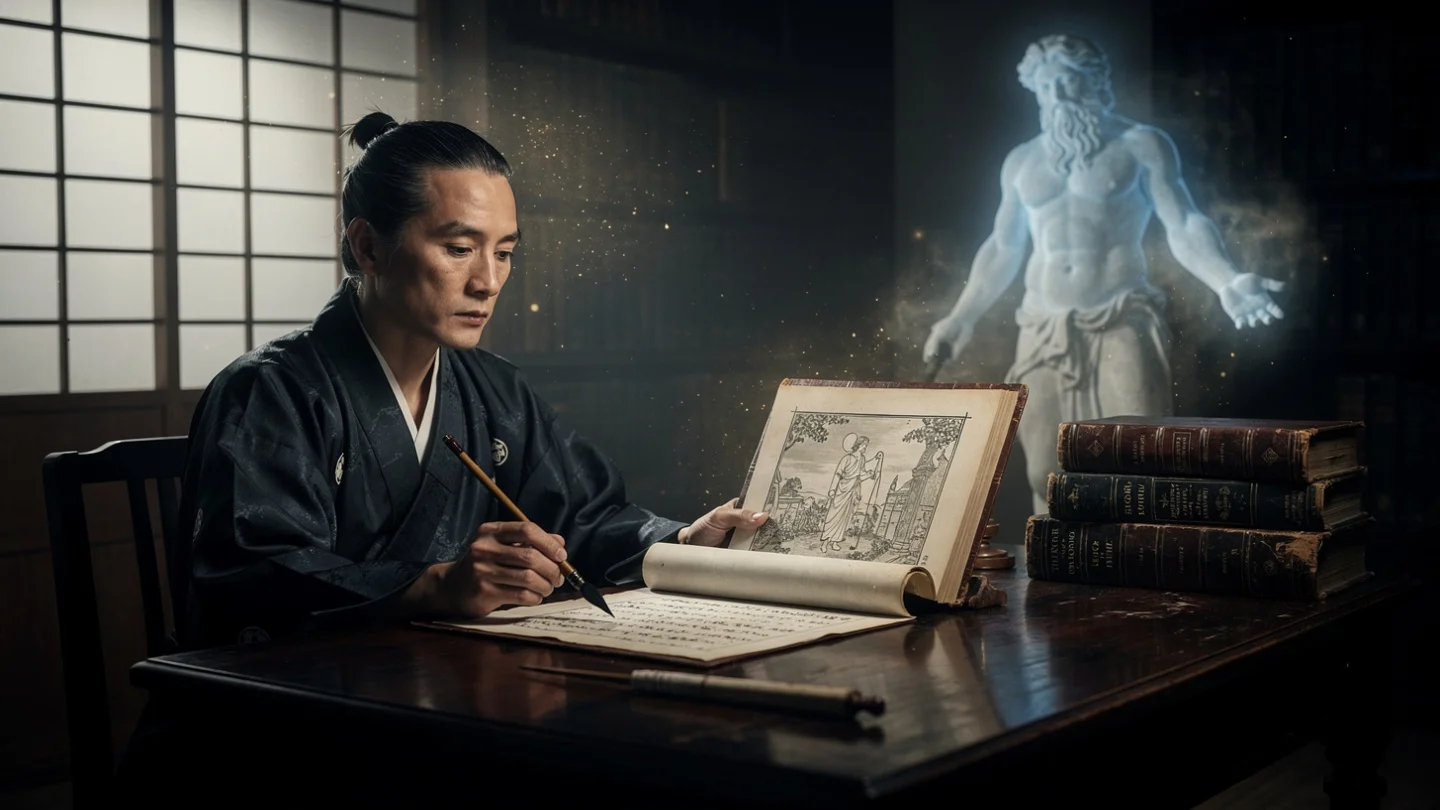
The scholars systematically translating and absorbing Western classical culture as part of Japan’s radical modernization program did not encounter Greek mythology as a foreign cultural product to be catalogued and understood from outside. They encountered it as something that felt, in structural terms, already known. The divine families, the creation from chaos, the storm god who wielded lightning, the descent into the underworld to recover a lost beloved, the trickster who moved between realms, the goddess whose retreat into a cave plunged the world into darkness: these were not alien narratives. They were configurations Japanese mythology, transmitted through the Kojiki and the Nihon Shoki, the eighth-century chronicles of the gods, had already been carrying for over a millennium before the Western texts ever arrived.
This approach to the Western classics gave rise to a characteristic tendency among the Japanese people to consider ancient Greeks and Romans not as the others, but rather as their own people with whom they could identify, and sometimes even feel closer to compared to modern Europeans.
This is an extraordinary claim, and it was not made lightly. It emerged from serious intellectual engagement by scholars equipped to read the Greek sources directly, who found in the structural comparisons not the forced parallels of amateur mythography but real evidence of shared patterns in how two distinct cultures had organized their understanding of the divine world and its relationship to the human one.
The Structural Question
Serious comparative mythology is not the popular exercise of finding gods from different systems who share roughly similar domains, Zeus and Indra both throw lightning therefore they are the same, and concluding from the similarity that all mythology is one story.
The structural question, which the French scholar Georges Dumézil spent his career developing and which the Japanese classicist Atsuhiko Yoshida applied directly to the comparison between Indo-European and Japanese mythology, is considerably more precise. Yoshida explored the possible relationship between Japanese and Western mythology in Japanese Mythology and the Indo-European Trifunctional System, building on Dumézil’s earlier research, and the transmission of mythological elements from the west into Japan, alongside the incorporation of other East Asian myths into early Japanese religion, formed the basis of much of his scholarship.
Dumézil’s trifunctional hypothesis proposed that Indo-European mythological systems share a deep structural pattern, a three-function social and divine organization in which sovereignty and sacred authority form the first function, martial power and physical force the second, and agricultural fertility and material abundance the third. This pattern, Dumézil argued, was not a cultural borrowing but a shared inheritance from a common Proto-Indo-European ancestor, preserved independently across the diverging civilizations of Greece, Rome, India, Scandinavia, and the Celtic world.
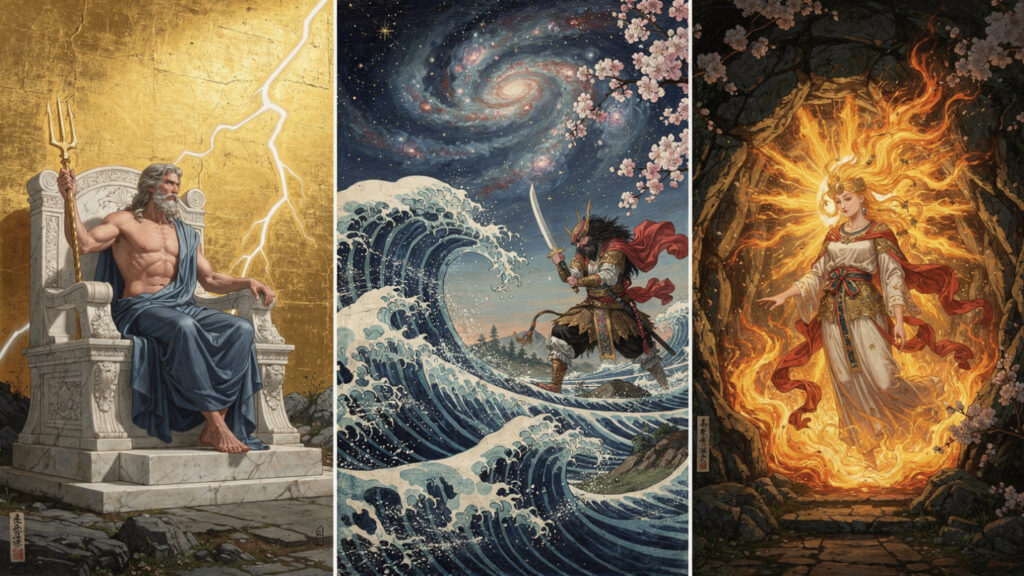
Yoshida’s contribution was showing that this same three-function structure also appears in Japanese mythology, in the Kojiki’s account of the three children Izanagi produced after his return from the underworld: Amaterasu, the sun goddess who governs the sacred and the sovereign, Tsukuyomi the moon god associated with the martial and the measured, and Susanoo the storm god who governs the fertile and the turbulent. The trifunctional pattern Dumézil had identified in Greek mythology, in the three sons of Kronos dividing the cosmos between Zeus, Poseidon, and Hades, appears in Japanese myth in a structurally homologous form.
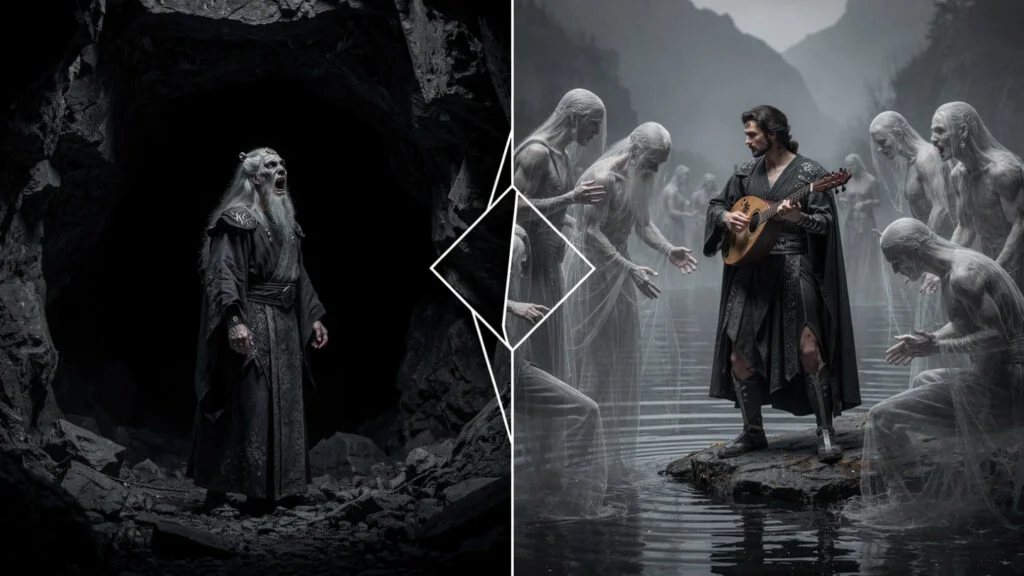
This is not coincidence. Yoshida’s argument is that the structural pattern itself traveled along the trade and migration routes connecting the Indo-European world to East Asia across millennia of Bronze Age interaction, arriving in Japan through the same channels that brought Buddhist iconography and Chinese philosophy into the archipelago. Greek and Japanese mythology share structural DNA not because they are the same body of myth, but because both are products of civilizations connected, at the deepest historical level, to the same original source.
The Cave and the Sun Goddess
The most immediately striking structural parallel between Greek and Japanese mythology appears in the myth of Amaterasu’s withdrawal.
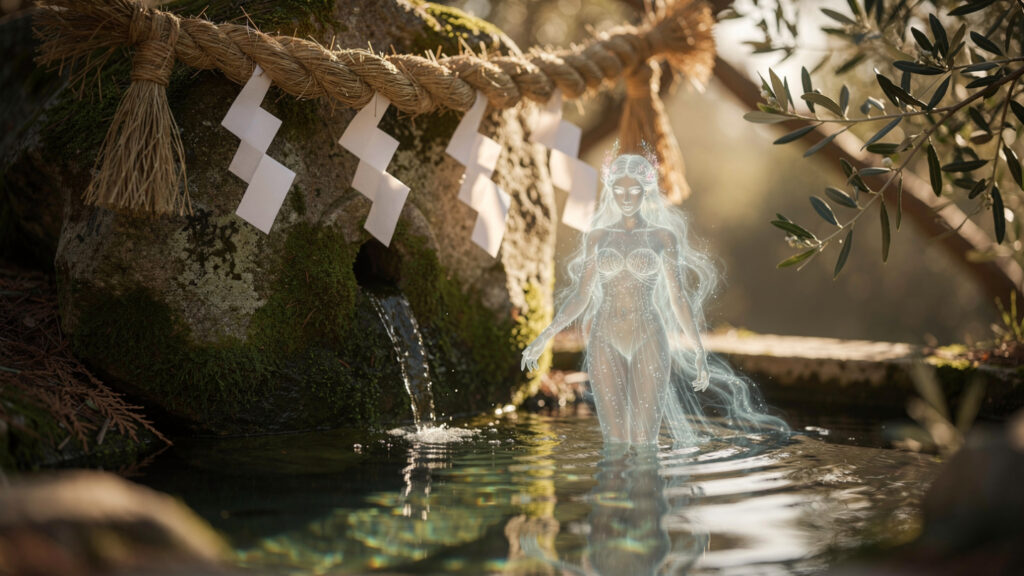
In the Kojiki, the sun goddess Amaterasu retreats into a cave after her brother Susanoo’s violent behavior destroys her sacred rice fields and terrifies her attendants. With the sun hidden, the world plunges into darkness. The other gods gather outside the cave and make loud noise, playing music and dancing, producing a raucous celebration that arouses Amaterasu’s curiosity. She opens the cave door to look out, and a god outside seizes her hand and pulls her into the light. The world is restored.
In Greek myth, Demeter withdraws from the world after Hades abducts her daughter Persephone. With the goddess of grain and harvest gone, the earth turns barren, and the world threatens to become a place where even the gods themselves receive no offerings. Eventually Persephone is partially recovered and Demeter returns.
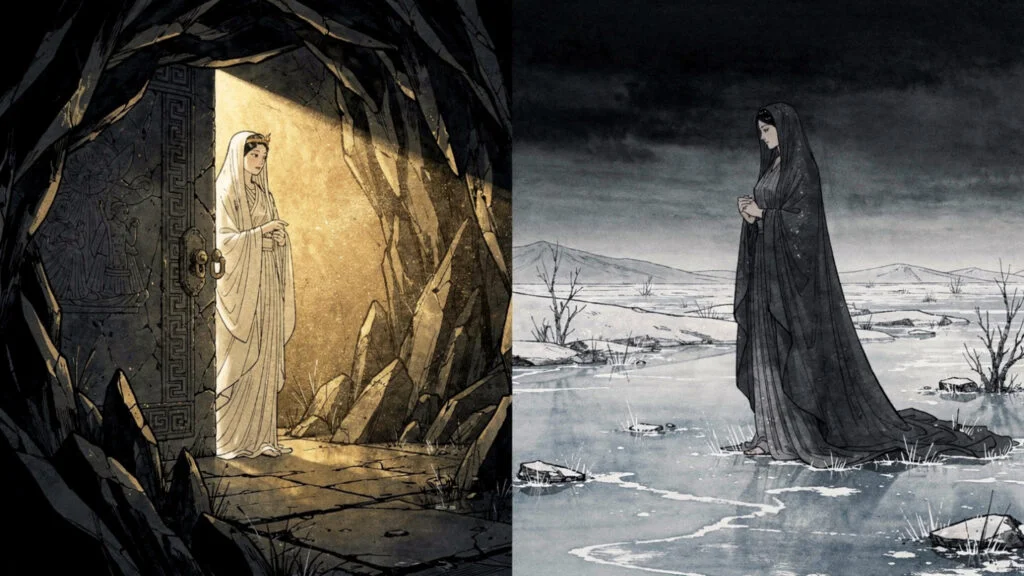
These are not the same myth. The trigger is different, the mechanism of return is different, the theological content is different, the consequences are different. But the structural pattern is identical: a major divine feminine figure withdraws from the world, her withdrawal causes the world to stop functioning, and recovery requires her return to her own function.
Both myths do something no purely local myth actually requires: they give a narrative account of the seasonal withdrawal of the forces sustaining agricultural life, and encode within that narrative the theological claim that the world’s continued functioning depends on the divine’s own continued participation in it. The sun does not simply rise and set as a mechanical process. The harvest does not simply arrive as a function of weather and soil. Both are expressions of a divine will that can, under certain conditions, be withdrawn, and the continuation of the human world depends on maintaining the conditions that prevent exactly that withdrawal.
The structural parallel between Amaterasu’s cave and Demeter’s grief is the parallel between two mythological systems that arrived, independently, at the same theological proposition about the relationship between the divine and the agricultural world, using different narratives and different divine personalities to carry the same underlying structural claim.
The Storm God Problem
Both mythologies have a storm god who creates as much difficulty as he resolves.
In Greek myth, Poseidon the earth-shaker is the Olympian whose domain most resists the rational order Zeus imposes on the cosmos. His earthquakes express an elemental force that precedes the structured world of Olympian governance. He is not evil, but he is ungovernable in a way the other major Olympians are not, and the myths return repeatedly to the tension between his elemental authority and the ordered world Zeus maintains.
In Japanese myth, Susanoo the storm god is the figure whose combination of extraordinary power and emotional instability produces the most dramatic disruption anywhere in the divine world: his grief after his mother Izanami’s death, his weeping that floods valleys and withers mountains, his violent behavior that drives Amaterasu into the cave. He is not evil either, and the story eventually redeems him through his killing of the eight-headed serpent Yamata no Orochi, which earns him an honorable place in the divine world. But the redemption requires a journey through destruction first.
The structural parallel between Poseidon and Susanoo, the storm god as a mythological type across these two systems, is the parallel between two cultures’ attempts to account for storm and earthquake as divine manifestations: elemental, necessary, capable of both destruction and fertility, fundamentally resistant to the kind of rational ordering the sky-god imposes on the rest of the divine world.
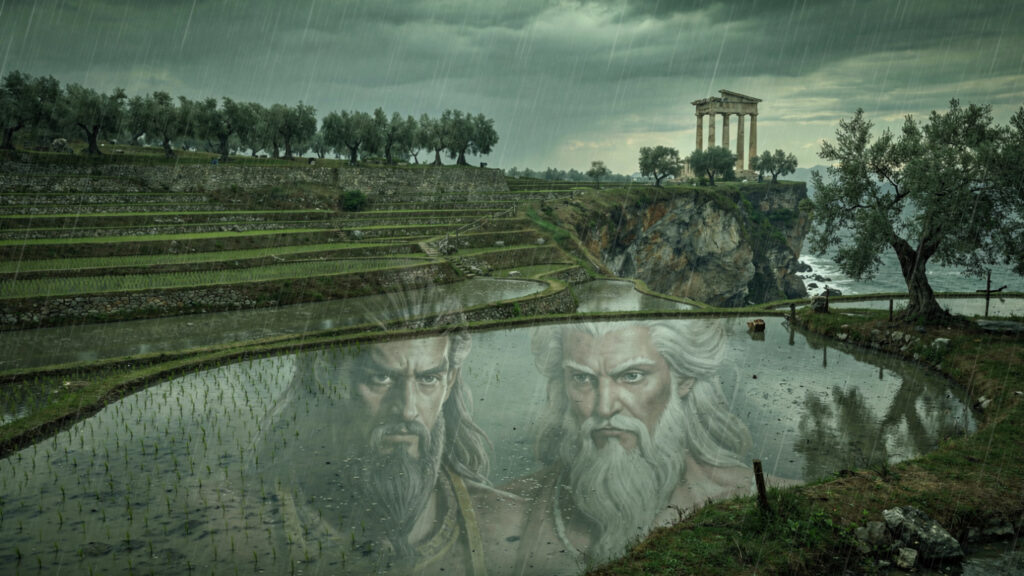
Rain is Susanoo. Rain is also Poseidon. The rain that destroys the harvest and the rain that enables it are manifestations of the same force. The mythological storm god is each culture’s own way of holding this ambivalence in a single figure rather than splitting it between a good rain deity and a bad one. Both traditions chose this solution independently, and chose it in structurally similar ways.
Lafcadio Hearn and the Living Comparison
The most influential single figure in the intellectual history of the Greek-Japanese mythological comparison is not a Japanese scholar at all, but an Irish-Greek writer who became Japanese.
Lafcadio Hearn was born in 1850 on the Greek island of Lefkada to an Irish father and a Greek mother, spent his childhood between Greece, Ireland, and England, emigrated to America, and in 1890 arrived in Japan, where he lived for the remaining fourteen years of his life, took Japanese citizenship under the name Koizumi Yakumo, married a Japanese woman, and became the most significant Western interpreter of Japanese folklore and religion of his generation.
Hearn’s major work, Japan: An Attempt at Interpretation, published in the year of his death, 1904, is particularly worthwhile for anyone studying ancient religion. Throughout it, Hearn constantly refers to classical religion as a yardstick and model for understanding the Japanese case, weaving the nineteenth-century scholarly view of Greek and Roman religion directly into his own history of Japanese religion.
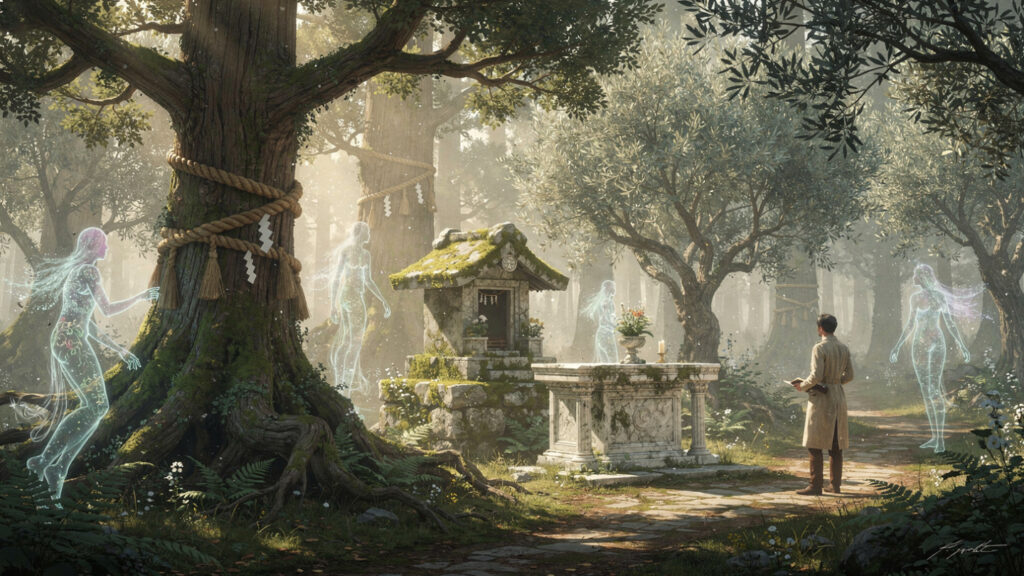
Hearn was, by biographical accident, the ideal comparative observer: a man who grew up in the landscape of Greek folk religion, who absorbed as a child the quality of a culture where the line between the divine and the natural world was genuinely permeable, and who then spent the second half of his life inside a different culture where that same permeability operated under different names and different rituals. He found in Japan what he had already known in Greece: a world where the divine was not distant and architectural but immediate and natural, present in trees and rivers and rocks and the turning of the seasons, addressed through gestures and offerings made at the right time of year.
His comparison between Shinto ancestor veneration and the Greek hero cult, between the Japanese kami, the divine presences inhabiting the natural world, and the Greek nymphs and daimones inhabiting springs and groves and crossroads, was never a scholarly exercise for its own sake. It was the recognition of a man who had actually lived inside both worlds that they were organized around the same underlying interpretation of the relationship between the human and the divine: immediate, local, maintained through continuous small acts of acknowledgment rather than grand institutional ritual.
What the Kojiki and the Theogony Share
The Kojiki, compiled in 712 CE from oral material reaching back to the founding of the Japanese divine order, and Hesiod’s Theogony, composed in the eighth century BCE, are the foundational cosmological texts of their respective mythological worlds. Setting them side by side reveals structural parallels comparative mythologists have documented for decades, but that general cultural writing rarely addresses at all.
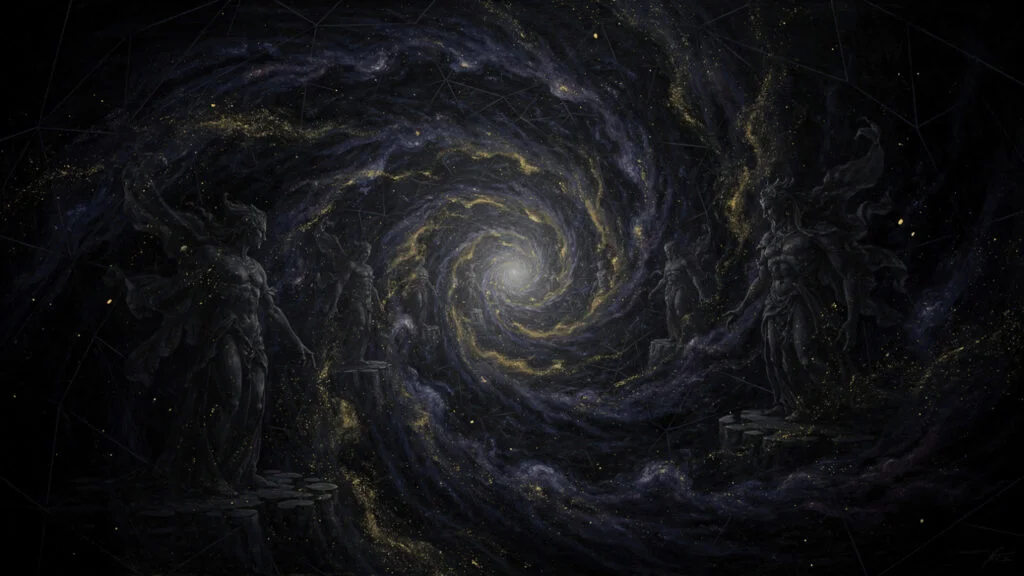
Both texts open with an account of creation from undifferentiated primordial void. The Theogony’s Chaos, the yawning gap from which the first entities emerge, corresponds directly to the Kojiki’s account of the undifferentiated state that preceded the separation of heaven and earth. Both then describe a generation of primordial divine beings that precede the organized divine world: entities that are conditions rather than persons, forces rather than characters, the background against which the more anthropomorphic divine generations will later be defined.
Both accounts describe a succession of divine generations in which each one displaces, sometimes violently, the one before it, until the present divine order is finally secured. The Greek Titanomachy, the war between the Titans and the Olympians, finds its structural counterpart in the Japanese narrative of the earthly kami being superseded by the heavenly kami of the Amatsukami, the celestial settlement of the world that precedes the founding of the Japanese imperial house.
Both cosmologies tie their divine genealogies to the emergence of a political and cultural framework. The Greek world connects the Olympian settlement to the political reality of the city-states and the Panhellenic religious institutions, while the Japanese system connects the divine ancestry directly to the imperial family and the formation of the Japanese state. In neither case does mythology sit apart from politics. It is the ground political legitimacy itself stands on.
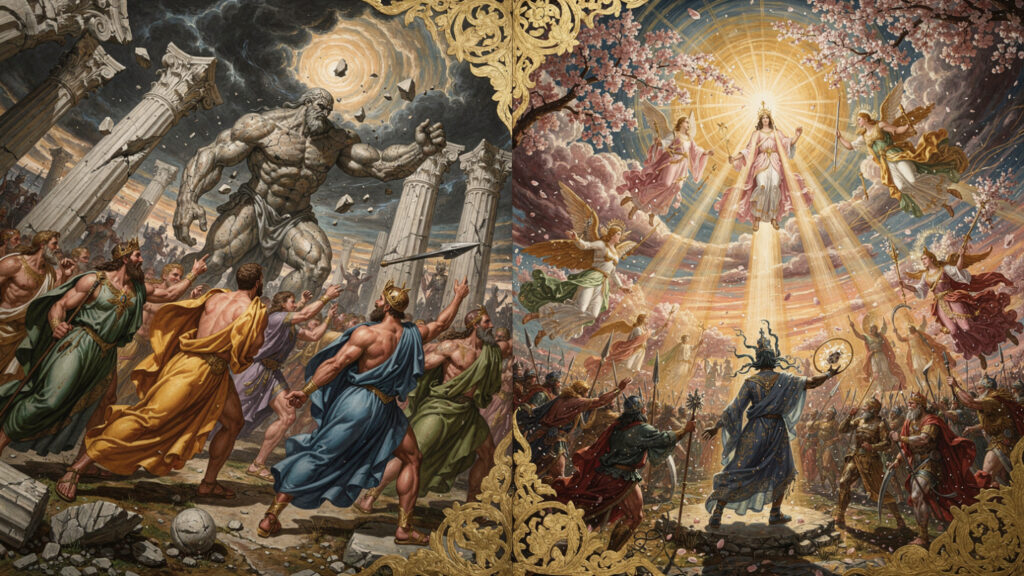
These are not superficial parallels. They are evidence of two mythological systems doing, at their deepest structural level, exactly the same work: explaining how the current order of the world came to be, what divine authority underwrites it, and what obligations the human world owes to the forces that established and maintain it.
The Living Exchange
Japanese scholarly engagement with Greek mythology never stayed at the level of structural comparison. It grew into a serious academic field that continues today, with Japanese universities maintaining departments of classical philology, Japanese scholars publishing on Sophocles, Plato, and pre-Socratic thought in both Greek and translation, and a reading public whose sustained interest in Greek myth has supported a substantial translation and publishing industry for more than a century.
Akiko Kiso of Osaka University became the first Japanese scholar to produce a major study of Sophocles, her reconstructions of the lost plays showing both the philological discipline expected in Western classical scholarship and the interpretive subtlety shaped by Japan’s own long practice of close textual reading in Chinese and Buddhist canonical literature.
The contemporary Japanese appetite for Greek mythological narrative, widely visible and widely discussed, did not emerge spontaneously. It grew from a century and a half of sustained intellectual engagement, beginning with the Meiji-era translations and continuing through the academic culture Kiso and Yoshida represent, work that gave a sophisticated readership the familiarity with Greek mythic material from which popular culture could later develop on its own.
The gods of Olympus feel, to a Japanese reader, already known. They feel known because the structural patterns of Greek mythology, the divine families, the creation from chaos, the storm god’s own ambivalence, the descent into the underworld, the withdrawal of the divine and the world’s consequent darkness, are patterns Japanese mythology had already been carrying for over a thousand years before the first translation of Hesiod ever appeared in a Japanese edition.
What the Comparison Teaches
The parallel between Greek and Japanese mythology is not the comfortable universalism claiming all mythology is really the same story wearing different clothes. It is something more interesting: evidence that two civilizations, developing independently across most of their histories and separated by the full width of the Eurasian continent, arrived at structurally similar solutions to structurally similar problems.
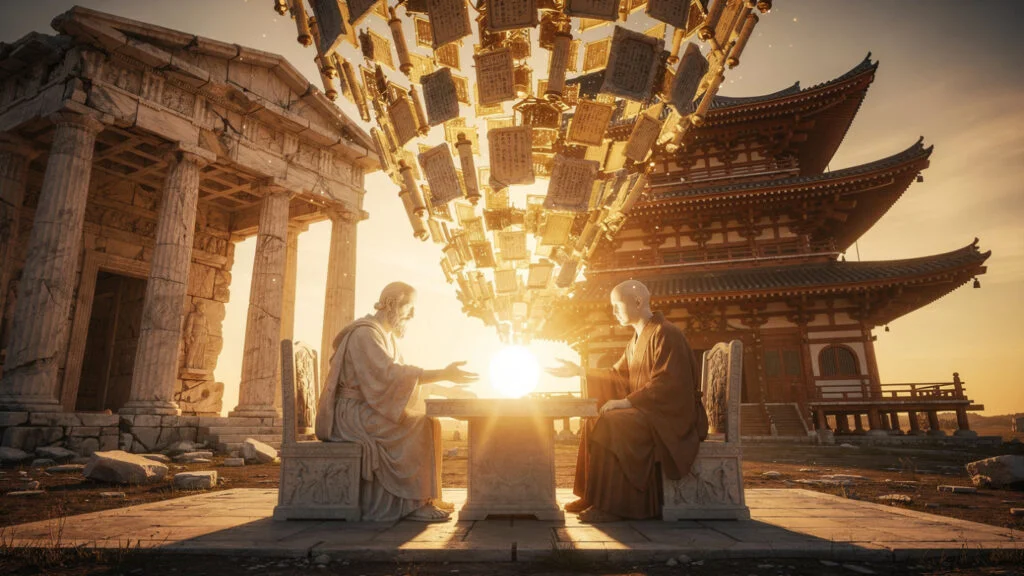
The problems are the ones every human culture faces: how to account for the origin of the world and the divine forces governing it, how to explain the seasonal withdrawal of the forces that sustain agricultural life, how to represent the relationship between elemental violence and productive fertility within a single divine figure, how to connect the mythological genealogy of the gods to the political genealogy of the human institutions that govern in their name.
The Greek world found its answers in the landscape and social fabric of the ancient Mediterranean. The Japanese world found its answers in the terrain and communal structures of the archipelago. That the answers take structurally similar forms is not evidence the two mythologies are identical. It is evidence that the underlying questions are universal, that the human mind, confronting the fundamental problems of existence, gravitates toward certain recurring narrative architectures regardless of whatever cultural material happens to be at hand.
What the Meiji scholars recognized when they first encountered Greek mythology was not an alien system requiring translation. It was a family resemblance: the sense that the questions Greek poets were addressing were the very questions Japanese myth had long been addressing, and that the narrative structures through which both cultures articulated their answers carried the imprint of a shared human need to render the world intelligible through story.
The gods of Olympus felt like relatives because, at the structural level of what mythology does and why cultures need it, they were.
At Olympus Estate, Cultural Chronicles traces the practices and institutions that defined Greek civilization from the inside and through the inside to the outside. Amaterasu retreated into the cave and the world went dark and the gods danced outside until she looked out. Demeter withdrew from the world and the earth became barren until Persephone was recovered. These are not the same myth. The structural pattern is identical. Poseidon and Susanoo are both storm gods who hold the ambivalence between the rain that destroys the harvest and the rain that enables it in a single figure that neither culture could resolve into a simple good or evil deity. Lafcadio Hearn was born on Lefkada and became Japanese and found in Japan what he had known in Greece. The Kojiki and the Theogony both begin with creation from undifferentiated void. The structural pattern was shared before either text was ever written. The comparison teaches that the problems mythology solves are universal even when the solutions are specific.