



The first Greek to think seriously about ruins did not mourn them. He distrusted them.
Near the end of the fifth century BC, the historian Thucydides was defending the old stories of the Trojan War against a sceptic. The objection was that Mycenae, supposedly the capital of the great expedition, was only a small place. How could the king of so modest a town have led a thousand ships? Mycenae had been sacked by its neighbour Argos around 468 BC, some decades before Thucydides wrote, so the sceptic was judging a ruin. Thucydides answered with a thought experiment. Suppose Sparta were deserted, he wrote, and nothing remained but its temples and the foundations of its buildings. Later generations would find it hard to believe the city had ever been as powerful as its fame, because Sparta had no grand temples and lived in scattered villages in the old Greek way. Now suppose the same happened to Athens. From the ruins alone, people would guess that Athens had been twice as powerful as it really was.
His conclusion was practical. Do not judge a city by how it looks. Judge it by what it could do.
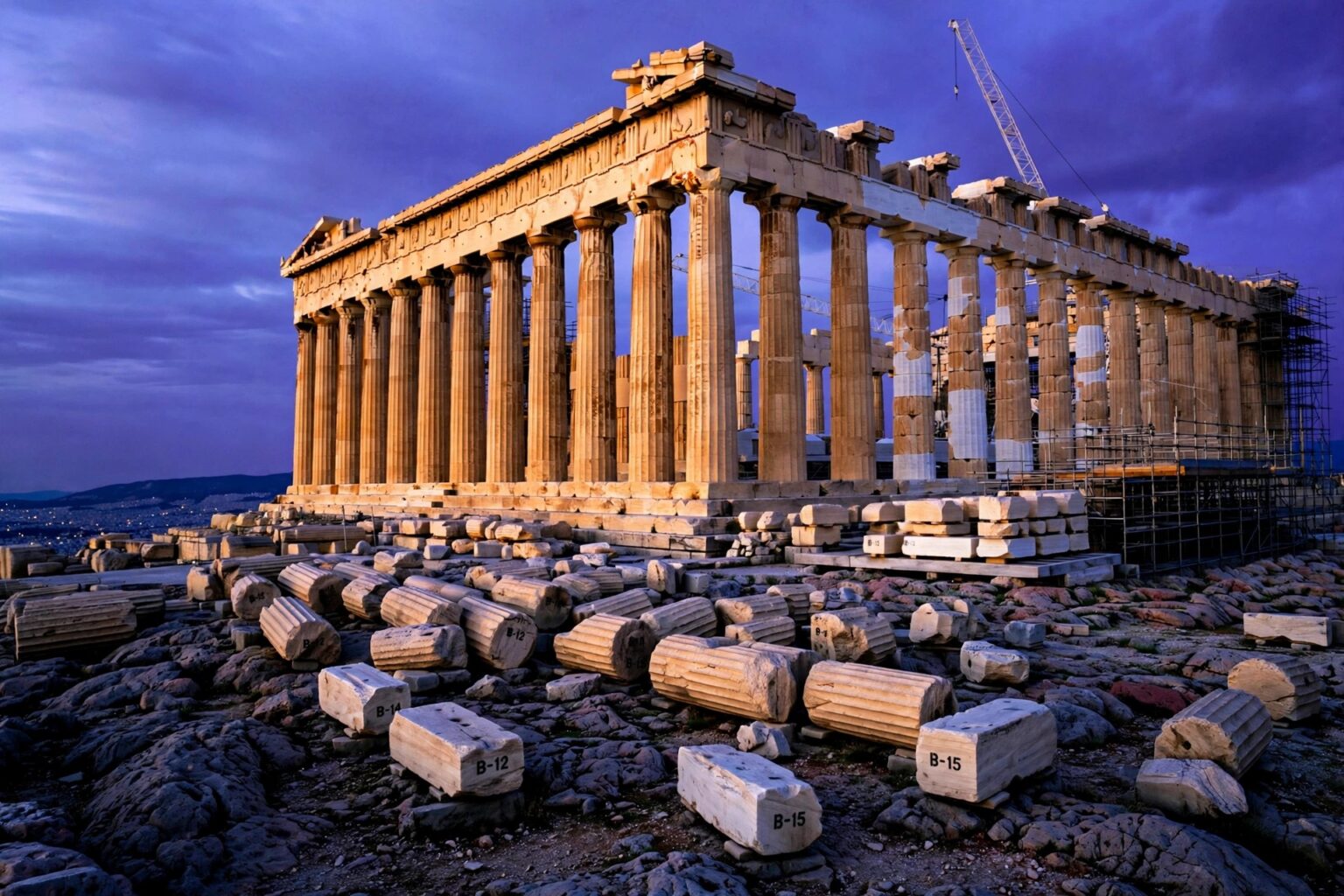
That is where the philosophy of ruins begins, in suspicion rather than in sorrow. We usually approach a ruin as a place for melancholy and the gentle pleasure of loss. Thucydides approached it as a witness who might be lying. Both attitudes are possible, and the second is rarer and more useful. The most famous ruin in the world shows why. The Parthenon was not worn down by time. It was broken in a single evening by the Parthenon explosion of 1687. A ruin is something that happened, followed by a long series of decisions about what to keep.
Thrown Down and Left Over
The Greek language already knew this. The word for ruins, ereipia, still used in Greece today, comes from the verb ereipo, to throw down or dash to the ground. Before it describes a heap of stones, it describes an act. Grammatically, a ruin is something that someone or something has done.
Ancient prose had a second way of speaking about ruins, and it points in the other direction. To talk about the remains of a place, Greek writers spoke of leipsana, what is left over. A ruin in that sense is not an act but a residue, the part that got away.
The whole subject lies between those two words. A ruin is a throwing down and a leftover, an event and its remains, and most confusion about ruins comes from remembering only one of the two. Think only of the leftover, and ruins seem like something time produces on its own, as if stones simply grew old. Think only of the event, and it is easy to forget that what remains has been selected, by accident or on purpose, from everything that might have survived.
The Parthenon Before It Was a Ruin
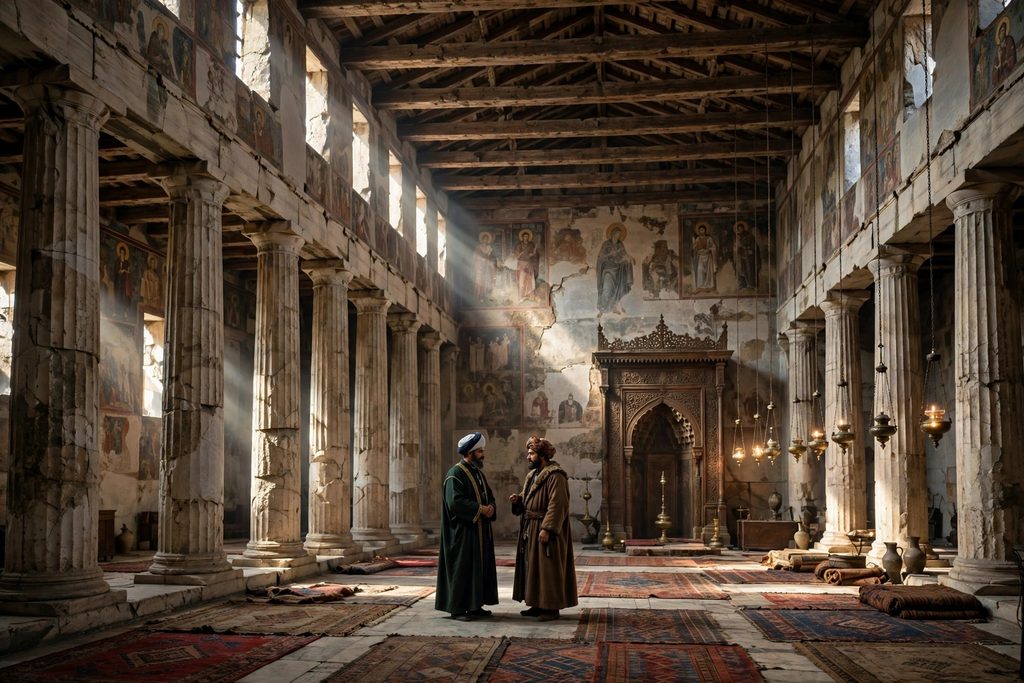
For more than two thousand years, the Parthenon had a roof. It was built between 447 and 432 BC as the great temple of Athena, from marble quarried on Mount Pentelikon. In late antiquity it became a church, and for many centuries Christian Athenians worshipped there, eventually dedicating it to the Virgin Mary, one more layer of the Byzantine heritage that still runs through Greek life. After the Ottoman conquest of Athens in 1458 it became a mosque, with a minaret added at one corner.
Every change left its mark. An apse was built at the east end for the church, windows were cut, and painted saints covered the walls. Yet the building itself survived. Travellers in the seventeenth century describe a temple that, apart from its later fittings, still looked much as it had in antiquity.
Then it became a ruin, on a single day.
The Parthenon Explosion | 26 September 1687
In 1687 Venice was at war with the Ottoman Empire, and the Venetian commander Francesco Morosini laid siege to the Acropolis, where the Ottoman garrison had taken refuge. The defenders stored their gunpowder inside the Parthenon, perhaps believing no Christian army would fire on so famous a building. The risk was not new. Thirty years earlier, a powder store in the Propylaia, the gateway to the Acropolis, had been struck by lightning and exploded.
On the evening of 26 September, a Venetian mortar shell fell through the roof and ignited the magazine. The explosion blew out the interior walls, brought down the roof and threw down columns along both long sides. Some three hundred people sheltering inside were killed. The garrison surrendered two days later. The following spring, before the Venetians withdrew, Morosini tried to take the finest sculptures from the west pediment home as trophies. The tackle broke, and the horses of Athena’s chariot fell and shattered on the rock.
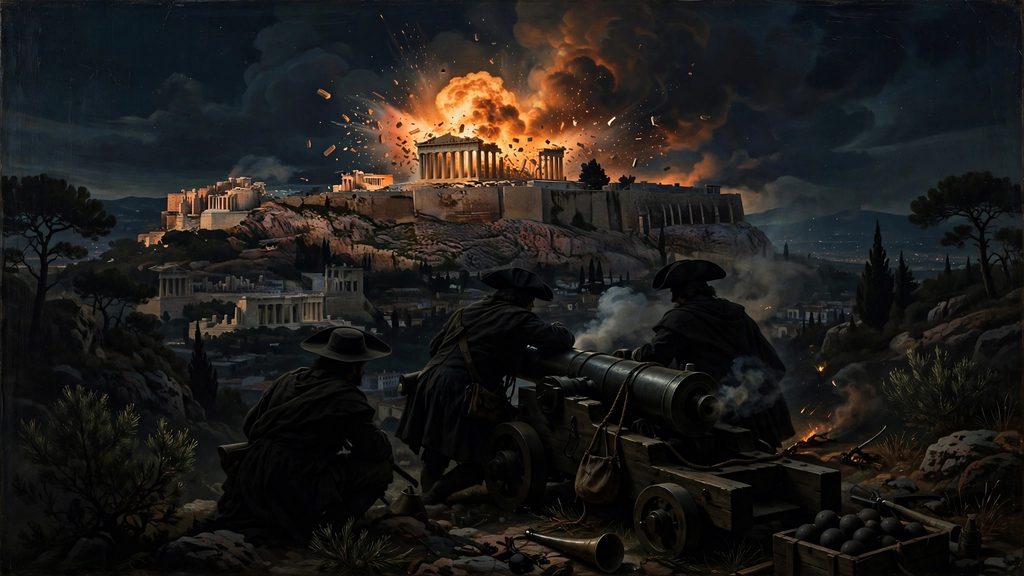
That is how a ruin is made. Not by time, but by a war, a decision about where to keep gunpowder and a gunner’s aim. Damage continued long after. Visitors broke off fragments as souvenirs, and a story told ever since says that during the siege of the Acropolis in the Greek War of Independence, the Ottoman defenders began prising out the lead clamps between the column drums to make bullets, until the Greeks besieging them sent them lead so that they would leave the columns alone.
The popular image of the Parthenon is of a building worn gently by the centuries. In reality, the most admired ruin in the Western world was made in one evening of artillery and then by generations of taking. That does not make it less moving. It makes the feeling worth examining, because what moves us is not quite what we usually say it is.
The Scattered Marbles
The largest taking came next. Between 1801 and 1812, agents of Lord Elgin, the British ambassador to the Ottoman court, removed about half of the Parthenon’s surviving sculpture, including long stretches of the frieze, metopes and figures from the pediments, along with pieces from other buildings on the Acropolis. Elgin claimed Ottoman permission. The British government bought the collection in 1816 and placed it in the British Museum, where most of it still is.
The removal was controversial even then. Lord Byron, who saw the stripped temple, wrote in 1812, “Dull is the eye that will not weep to see / Thy walls defaced, thy mouldering shrines removed / By British hands.” Greece has asked for the sculptures’ return for decades. The British Museum argues that they are displayed there for a world audience and that the law governing its collection prevents their removal. In 2009, Athens opened the new Acropolis Museum below the rock, with a top-floor gallery laid out at the full size of the Parthenon’s frieze, in sight of the temple, where plaster casts stand in for the pieces held in London.
Whatever one thinks of the dispute, it shows the second half of every ruin’s life. After the event comes the question of who keeps what remains, and where.
The Clearing | How Greece Edited the Acropolis
After 1687 the Acropolis went on living. The Ottomans built a small mosque inside the broken shell of the Parthenon, and the rock was crowded with houses and gardens. When Greece won its independence and the Ottoman garrison left the Acropolis in 1833, the new state faced a question few nations have faced so directly. What should its most important monument be?
The answer was classical, and it was carried out. Under King Otto, the Acropolis was cleared of almost everything built after antiquity. The houses went. The small mosque inside the Parthenon was taken down in the 1840s, and a medieval palace was removed from the Propylaia. In 1875 the tall Frankish Tower that had stood beside the gateway for six centuries was demolished, with the archaeologist Heinrich Schliemann paying for the work. Fallen blocks were gathered, and the first reassembly began on the little Temple of Athena Nike, the Erechtheion and the Parthenon itself. The work was enthusiastic, amateur by later standards and limited by the money and knowledge of the time.
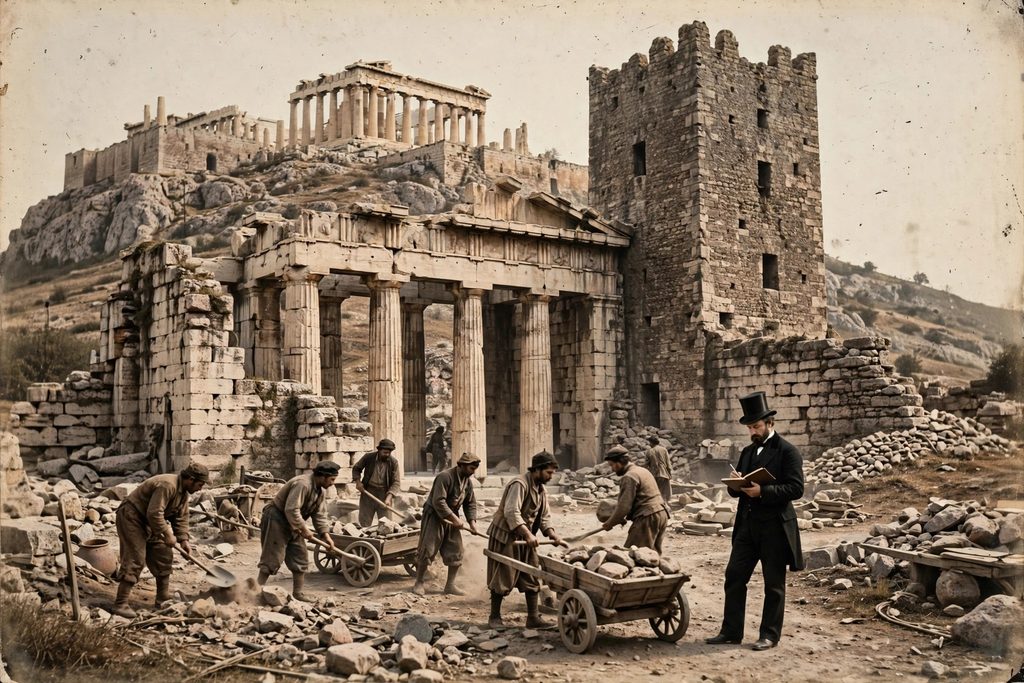
It would be easy to scold the people who did this, and it would be unfair. They were working in the aftermath of a war of liberation, and the classical past was the past Europe was ready to honour in the new country. The Acropolis became the place where Greece was recognised. But the result matters for any philosophy of ruins. The hill that millions of visitors now climb is not simply the hill of Pericles that survived. It is the hill as edited. The church, the mosque, the houses and the tower were not damage. They were history, the record of what actually happened there, and they were chosen away.
Restoring the Restorers
Even the restorations became ruins. Between 1898 and 1933 the engineer Nikolaos Balanos re-erected large parts of the Parthenon and its neighbours, but he joined the marble with iron clamps and set some blocks in the wrong places. Over the following decades the iron rusted, swelled and split the stone it was meant to protect.
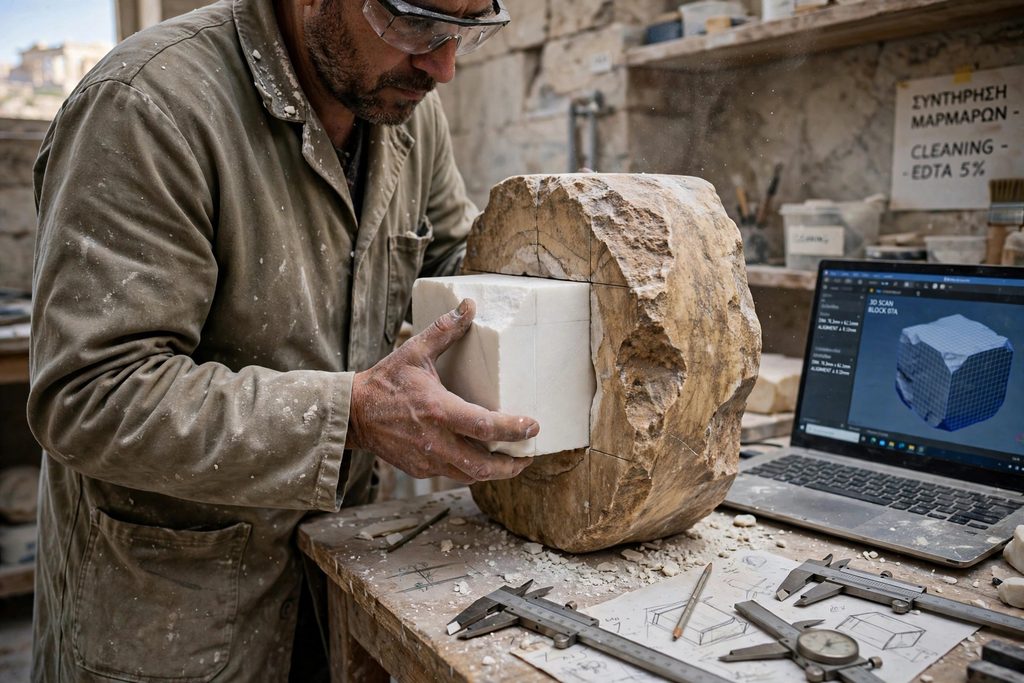
In 1975 Greece set up a permanent committee to save the Acropolis monuments, and a new, slower kind of restoration began. Conservators now dismantle sections block by block, remove the old iron, repair the marble, replace missing pieces with new Pentelic marble cut to fit, and join everything with titanium. Every block is documented and returned to its true position. Cranes and scaffolding have been part of the view from Athens for half a century. The monument is being rebuilt as the city watches.
What a Ruin Cannot Tell You
Now return to Thucydides, because his warning applies directly. A ruin preserves what was built to last, and what was built to last is what a society chose to build in stone for show. Temples, walls and public buildings survive. Houses, workshops and markets of wood, mud brick and cloth, the ordinary arrangements of daily life, vanish. A ruin therefore overstates the part of a society that wanted to be seen and understates the part that simply lived.
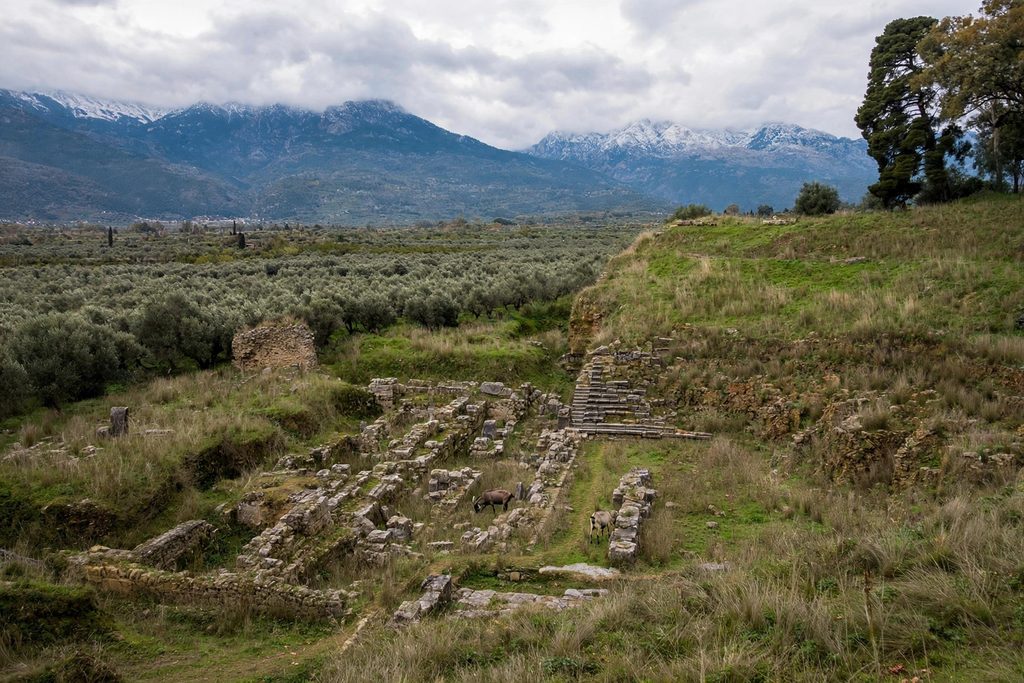
His prediction came true. The remains of Sparta today are low walls and scattered foundations among olive groves, while the Acropolis draws millions of visitors a year. The historian who warned that Athens would look twice as powerful as it was has been proved right by every tour group that climbs the rock. Few people would say they admire Athens partly because it built in marble and Sparta did not, but the surviving evidence pushes everyone that way.
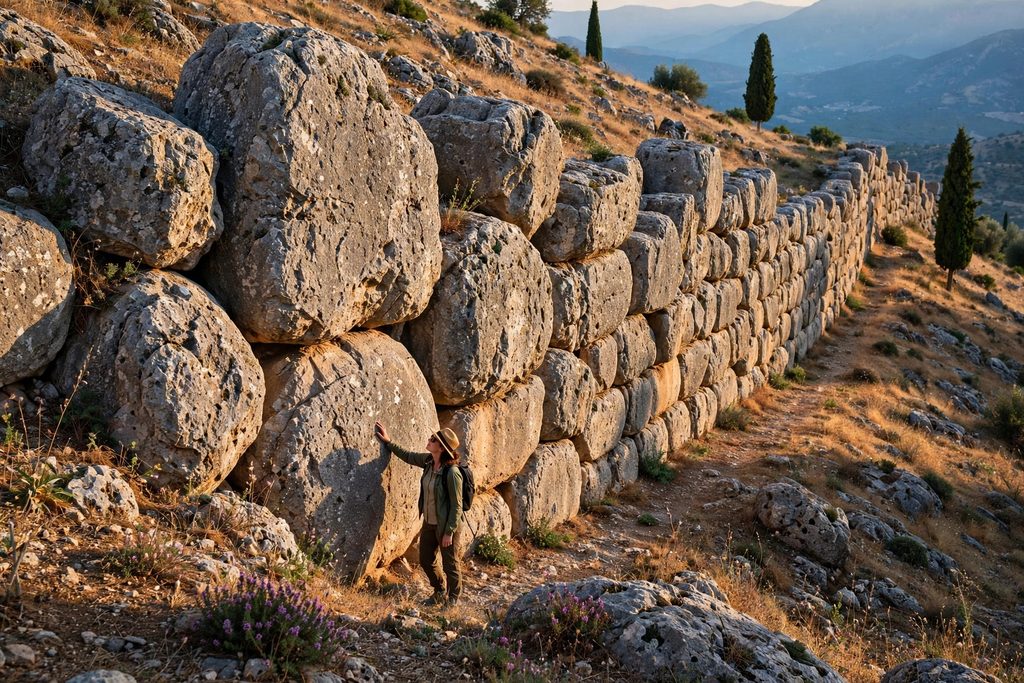
Ruins can even create myths. Later Greeks looking at the enormous walls of Mycenae and Tiryns, built of boulders no ordinary crew seemed able to lift, decided they had been raised by the Cyclopes. The traveller Pausanias repeats the belief in the second century AD, and archaeologists still call the style Cyclopean. Faced with a ruin it could not explain, the imagination supplied giants.
Four Ways to Become a Ruin
Greece offers a small catalogue of the ways a place reaches this state, and each carries its own lesson.
Some places are buried. Pella, where Alexander was born, lost its harbour as its river silted up and lost its importance to Thessaloniki on the coast, and the fields slowly covered it. A visitor today finds the outline of a vast agora in open farmland, with the palace on its hill still being excavated. It has the quiet of a place not yet fully found.
Some places are exploded. The Parthenon belongs here, along with every monument destroyed in war, and its lesson is the harshest. The ruin is a record of people deciding what to destroy.
Some places are emptied. Symi built a harbour of mansions for a sponge-diving population of over twenty thousand people and now has about two and a half thousand. Its buildings are intact, but they were made for a life that has gone, so the architecture stands as a monument to an economy rather than a town. Lakki on Leros, the Italian model town of the 1930s with boulevards built for parades that stopped, belongs to the same family. These are ruins of use, buildings that outlived their purpose. Across Greece, abandoned village houses of the same kind are now bought and restored by newcomers, which turns an emptied ruin back into a home one roof at a time.
And some places were never built to last. Sparta lived in villages and left almost nothing behind. It is the ruin that hardly exists, and Thucydides saw that its absence was itself evidence about a society that distrusted display.
Seen together, these suggest that a ruin is less a kind of object than a question. Why did this place come down to us in this condition, and not another?
Why Ruins Move Us
None of this explains why ruins affect us so strongly, and the question deserves an answer.
The most famous treatment is a short essay by the German sociologist Georg Simmel, first published in 1907. He described the ruin as a moment of peace between two opposing forces. One is the human spirit, which raises a building toward the sky. The other is nature, which pulls every made thing back down to the earth. In a ruin the two are held in balance. The building has not entirely fallen and nature has not entirely won, and in that balance we sense something like the shape of a human life.
It is a beautiful account, and it is half right. It fits many Greek ruins well. A silted agora, the weathered walls of Mycenae, broken columns in a pine forest all have the feel of a slow negotiation between building and earth. It fits the Parthenon badly. Its fall was a shell and a powder magazine, not a gentle wearing down. Critics of Simmel have pointed out that his picture of balance struggles with ruins made by war or by economic collapse, which are events rather than processes.
The French archaeologist Alain Schnapp offers a second view. A ruin, he argues, is unstable by nature, swinging between matter and idea, memory and forgetting. A pile of stones only becomes a ruin when someone recognises it as the work of people who would otherwise be forgotten.
A third observation follows from the Acropolis itself. Ruins invite completion. A broken column hands the eye a missing shape to supply, and part of the pleasure of a ruin is finishing it in the mind. Yet the history of the Acropolis shows that people are rarely content to leave the work in their heads. They set the blocks back up. At Knossos on Crete, Arthur Evans went further in the early twentieth century, rebuilding parts of the Minoan palace in reinforced concrete and painting the walls, so that visitors still walk through his guesses. The feeling that makes us love a ruin and the urge that makes us restore it are the same impulse pulling two ways, toward keeping the loss visible and toward undoing it. The long argument over how much of the Parthenon to rebuild is that quarrel conducted in marble.
Three Questions to Ask at a Ruin
None of this should make a visit to a ruin harder. It should make it better. At any site, from Delphi to a nameless chapel on a hillside, three questions change what you see.
- What happened here? Behind most ruins is an event, a battle, an earthquake, a flood of silt, the collapse of a trade. Finding out which one turns a heap of stones into a story.
- Who decided what stayed? Look for the signs of selection. What has been cleared, what rebuilt, what left to the weeds? Every ruin you can visit has been curated, if only by where the fence was put.
- What would I believe if this were all I had? This is Thucydides’s test. Ask what the ruin makes you believe about the people who built it, then ask which parts of their lives could not have survived to tell you otherwise.
Something That Happened
A ruin that survives those questions is not diminished by them. The Parthenon on its rock, rebuilt block by block under the Athenian sun, is no less astonishing for being the product of a mortar shell, a nation’s ambition, an ambassador’s crates and three generations of conservators. It is more interesting, because it is a human document as well as a beautiful object, and its story runs straight through the history of a city that kept building on itself.
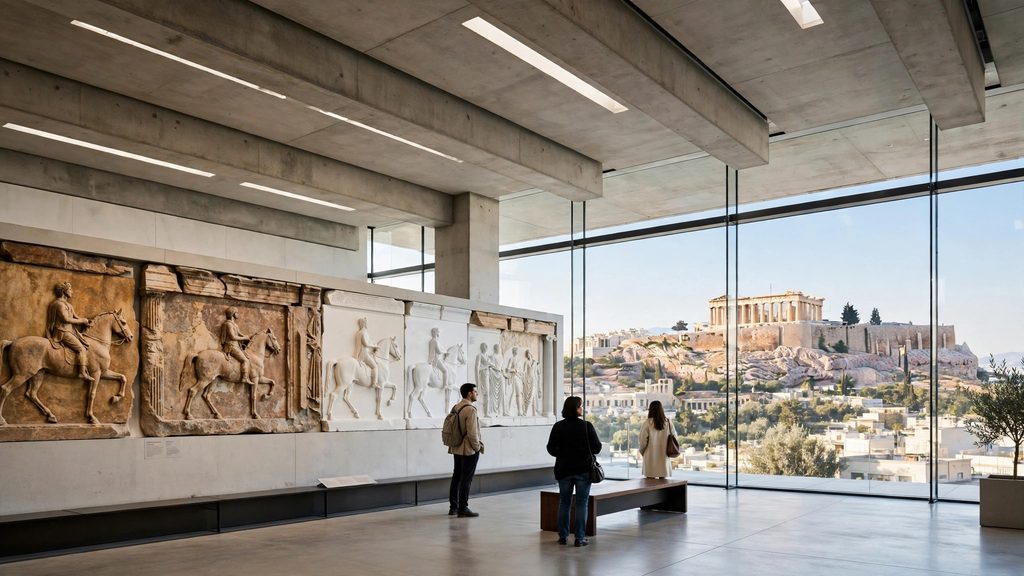
Thucydides imagined his own city as a heap of stones and saw that the heap would flatter it. Twenty-four centuries later the heap is there, and it does. The honest response is neither to scorn the beauty nor to be dazzled by it, but to remember what he warned at the start. A ruin is not what time left behind. It is something that happened, and something that someone chose to keep.
At Olympus Estate, Archaeology and Ancient Sites reads the stones of Greece for the stories they keep and the ones they leave out. Thucydides warned that a deserted Sparta would look weaker than it was and a ruined Athens twice as powerful, the first argument in Greek that ruins can mislead. The Greek word ereipia means something thrown down, while leipsana means what is left over. The Parthenon stood roofed for two thousand years as temple, church and mosque until 26 September 1687, when a Venetian shell fired by Morosini’s army ignited the Ottoman gunpowder stored inside. Elgin’s agents removed about half its surviving sculpture between 1801 and 1812, now in the British Museum and still requested by Greece, whose Acropolis Museum opened in 2009. After 1833 the new state cleared the Acropolis of its later buildings, down to the Frankish Tower in 1875, Balanos’s iron-clamped restorations cracked the marble, and since 1975 conservators have rebuilt it block by block in titanium. Greek ruins can be buried like Pella, exploded like the Parthenon, emptied like Symi or never built to last like Sparta, and Simmel and Schnapp offer two ways to understand why they move us.