



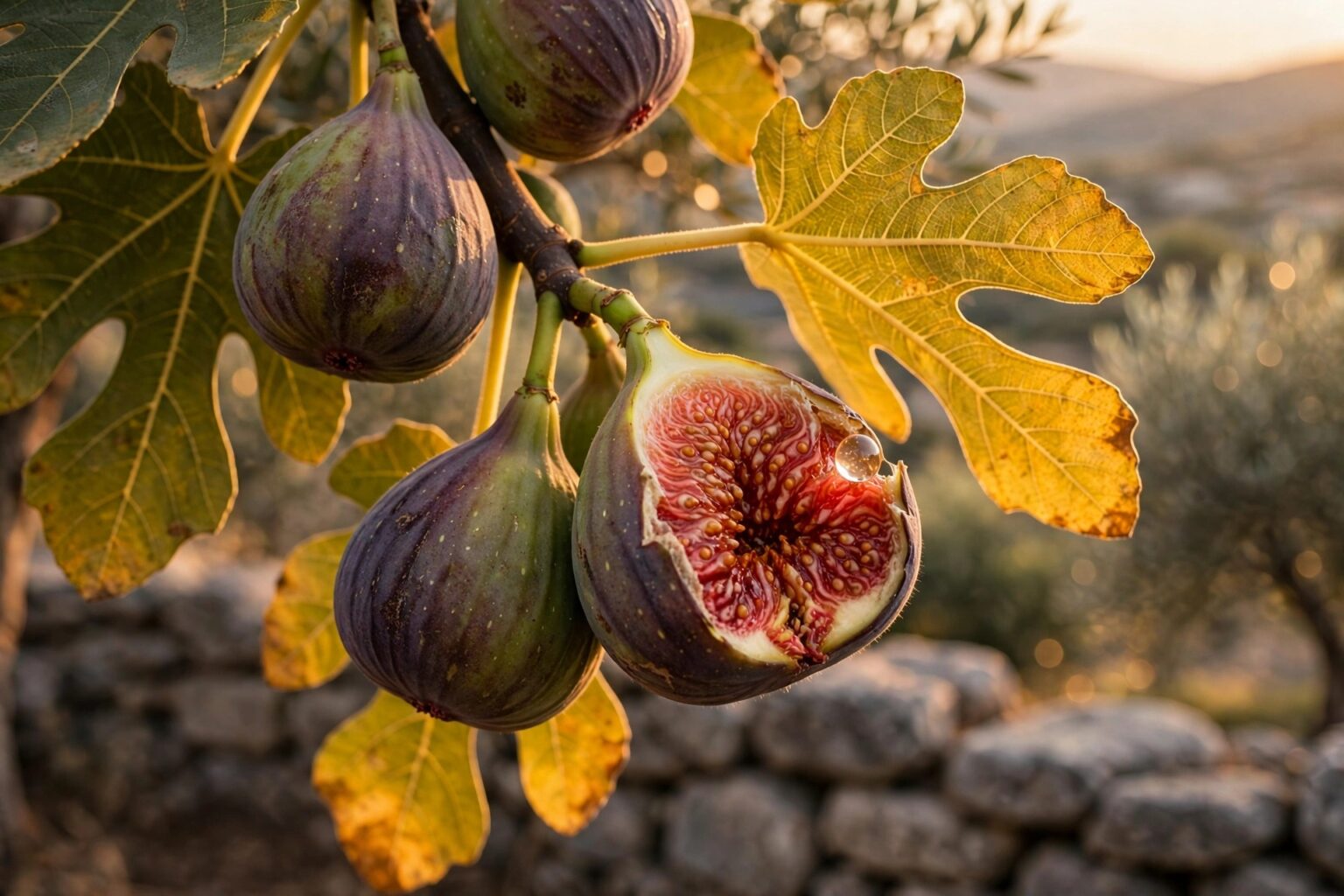
Pick a fig too early and it will never ripen. It can sit in a bowl for a week, softening a little and then shrivelling, but it will never become sweet. Every Greek grandmother knows this, and so did Aristotle. He spent his life asking a question the orchard asks every autumn. What does it mean for a thing to be finished?
His answer begins with a definition that surprises most people. In the fourth book of the Meteorology, he describes ripening as a kind of concoction, the work a thing’s own natural heat does on the moisture inside it. Then he says when the work is complete. A fruit is perfectly ripe, he writes, when its seeds are able to produce another fruit like itself.
Not when it is soft. Not when it is sweet. Those are the parts we enjoy, but for Aristotle they are side effects. A fruit is ripe when it can hand itself on. Out of that one observation grows the idea he is best known for, the distinction between potentiality and actuality, between what a thing could be and what it has become. Autumn is the season when that idea can be seen hanging from every branch.
Opora | The Season That Was Also a Fruit
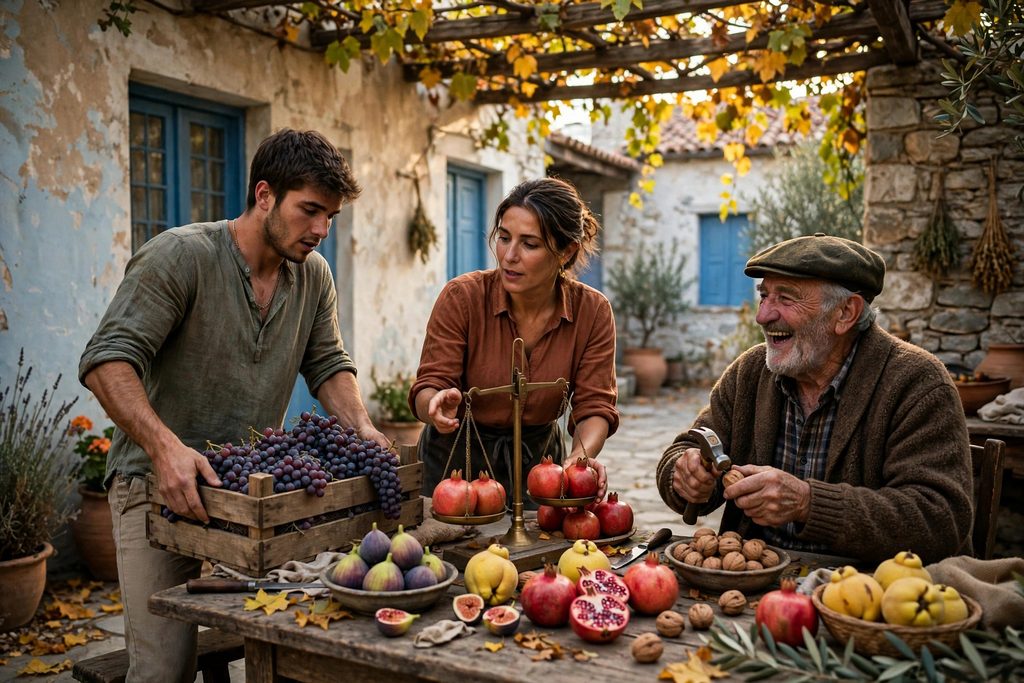
The Greeks had a single word for the season and its harvest. Opora meant late summer turning into early autumn, roughly the weeks between the rising of Sirius in July and the rising of Arcturus in September. It also meant the fruit those weeks produced, the figs, grapes and pears that the season brings to completion. The language did not separate the time from what it yields.
This is the stretch that begins under the Dog Star, when figs split on the branch and grapes swell toward the press. Hesiod told the farmer to cut his grape clusters when Orion and Sirius had climbed to the middle of the sky and Dawn could see Arcturus. The whole farming calendar was a way of asking one question. Is it ready?
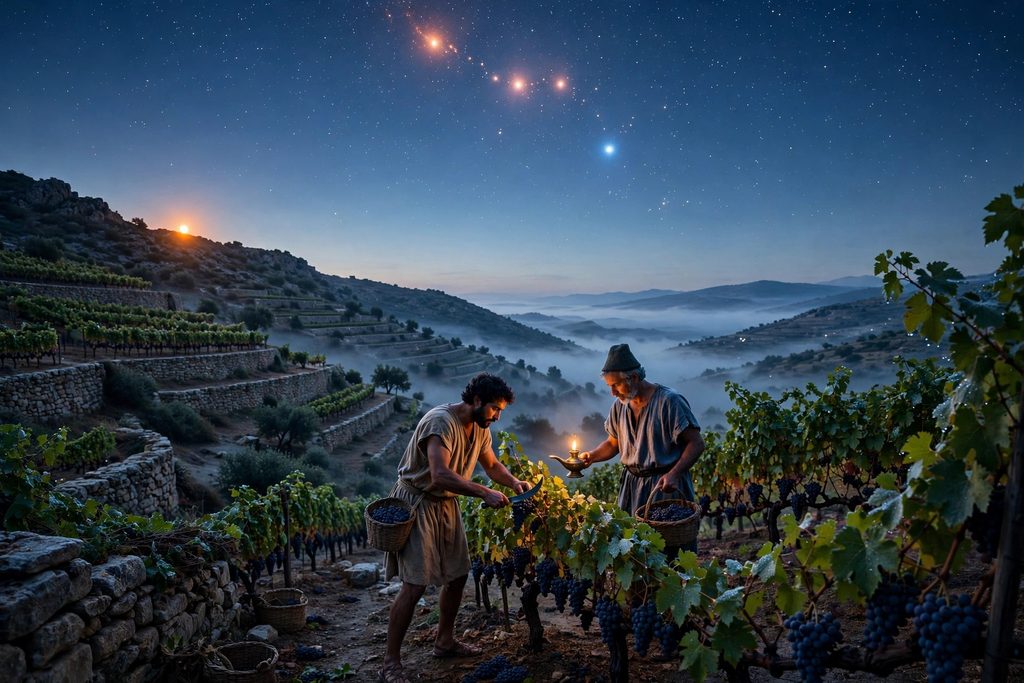
Aristotle was the philosopher who tried to say what ready means.
A Thing That Grows From Within
Start with physis, the word English translates as nature and tends to hear as scenery. In the second book of the Physics, Aristotle defines it as a source of change and of rest that belongs to a thing from within, because of what it is.
To make the point he compares natural things with made ones. A bed, a cloak or a statue has no inner drive toward change. It is shaped from outside. He borrows an argument from the sophist Antiphon. Bury a wooden bed, and suppose the rotting wood sends up a shoot. What grows is a tree, not a bed. A human being is born from a human being, Aristotle adds, but a bed is not born from a bed.
A fig tree is the opposite of a bed. Nothing outside it decides that it will leaf, flower, fruit and drop its leaves. The sequence rises from inside the tree. Aristotle’s word for a thing that carries its own completion within it is entelecheia, usually explained as “having its end inside”. In On the Soul he defines the soul itself as the first actuality of a natural body that has life potentially. The seed is potentially a tree, and the tree is that potential made real. The familiar classroom example of the acorn and the oak says the same thing in simpler words.
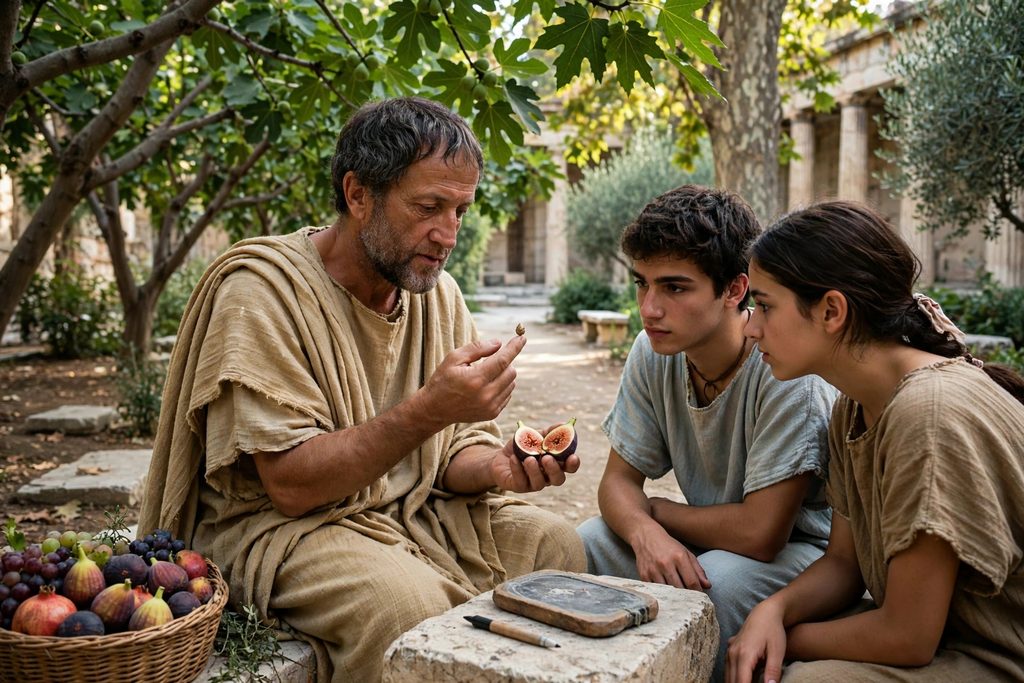
Seen this way, autumn is not something done to a tree by the weather. The weather helps, and Aristotle says plainly that outside influences can contribute. But the ripening is the fruit’s own work, driven from within by the same nature that drove the blossom in spring.
Why the Ripe Comes First
Here Aristotle makes the move that turns an orchard into a philosophy. In the ninth book of the Metaphysics, he argues that actuality comes before potentiality. This is the heart of his teaching on potentiality and actuality, and at first it sounds backwards. Surely the seed comes before the tree and the boy before the man.
In the order of time it does. But Aristotle is asking what explains what. Every seed came from a tree that was already fully grown. Every boy was born of a man. What comes later in the order of growth comes first in the order of understanding, because nobody can say what a seed is without referring to the tree it is a seed of. The man, he writes, is prior to the boy, and the human being to the seed.
Apply that to a fig. The hard green fig on the branch in June is explained by the ripe fig of September. To understand why it grows as it does, why it draws in water, swells, hardens, then softens and sweetens in that order, you have to start from the finished fruit and work backwards. The unripe fig is the ripe fig, not yet.
This is the quiet radicalism of Aristotle’s autumn. Spring does not explain autumn. Autumn explains spring. The completed thing is the key to everything that led up to it, and a culture that celebrates only beginnings has the order of explanation upside down.
Raw, Ripe and Rotten | Aristotle’s Theory of Ripening
The Meteorology works the idea out in detail. Ripening is a form of pepsis, concoction, the perfecting of a thing’s matter by its own proper heat. That heat is not the sun arriving from outside. It is the natural warmth that belongs to the living thing itself, which sets the perfecting going, though outside warmth may help it along. The process is complete when the seeds can make another fruit.
Aristotle sets ripening between two failures, and the three make a striking set.
Rawness, he says, is an imperfect concoction, caused by a lack of proper heat, or rather by too little heat for the moisture it has to work on. A raw fruit is not simply an early fruit. It is one in which the inner warmth has not yet mastered the wetness inside it. Putrefaction, which opens the book, is the opposite failure, the destruction of a thing’s own natural heat by the heat of its surroundings. A rotting fruit is one whose inner life has been overwhelmed from outside.
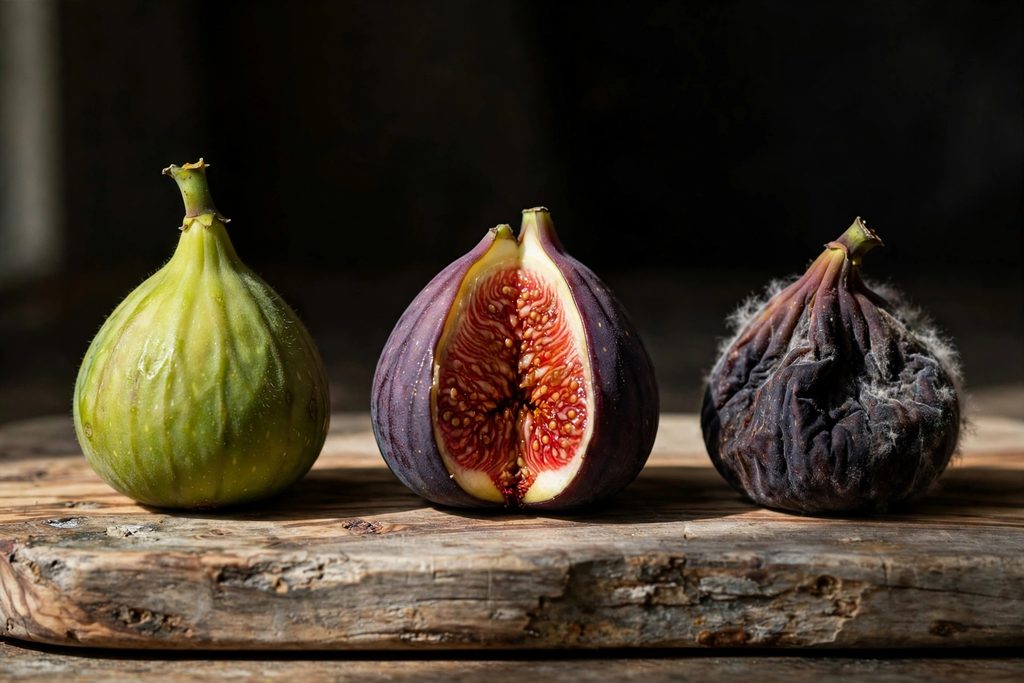
Aristotle does not draw the connection himself, but the shape of raw, ripe and rotten is recognisably his. In the ethics, every virtue sits between a deficiency and an excess. In the orchard, ripeness sits between too little heat and ruin. One caution is fair. Scholars have long debated whether the fourth book of the Meteorology was originally part of the work or a separate treatise from his school. Its vocabulary and method are Aristotelian, and the idea of concoction runs through all his biology, so the theory belongs to his tradition. It is still best not to hang a great deal on a single sentence of it.
The Fig and the Wasp
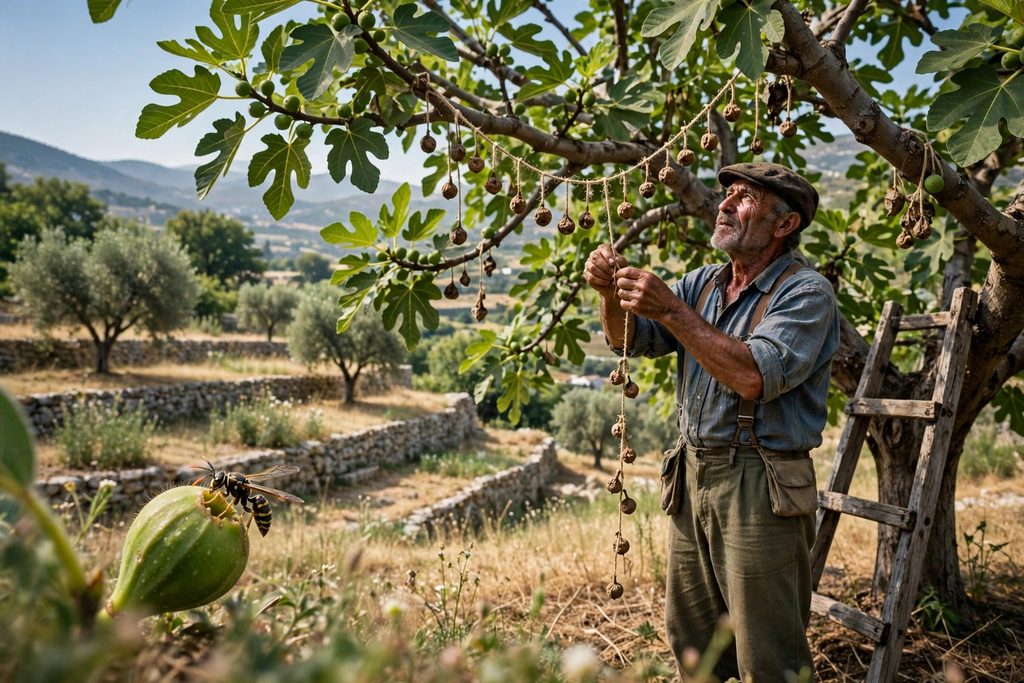
Aristotle and his successor Theophrastus also recorded a stranger kind of ripening, one Greek farmers had practised long before either of them. Some cultivated fig trees drop their young fruit before it can mature. To stop this, farmers cut branches of the wild fig, the caprifig, and hung them in the cultivated trees. Tiny insects, which the Greeks called psenes, crawled out of the wild figs and into the cultivated ones, and the fruit then held on and ripened. Theophrastus describes the practice in detail, and Aristotle mentions the insect in his History of Animals.
Modern botany explains what they saw. The insect is the fig wasp, and it carries pollen from the wild tree to the flowers hidden inside the cultivated fig. Many fig varieties need that pollination before they will set seed and finish their fruit, and the process the Greeks called caprification is still practised in parts of Greece and Turkey. It fits Aristotle’s definition almost too neatly. The fig ripens fully when it has seeds that can make another fig, and for that it needs a visitor from outside. The inner nature does the work, but it cannot always do it alone.
The Ethics of Harvest
What does a fig have to do with how a person lives? For Aristotle, a great deal, and his ethics make the link in his own words.
In the second book of the Nicomachean Ethics, he says that the virtues arise in us neither by nature nor against nature. We are fitted by nature to receive them, and we are brought to completion by habit. This is ripening applied to character. The capacity comes first, like the potential in a seed, and its completion comes only through slow, repeated practice that turns a capacity into a settled state. Nobody becomes generous or brave through a single act, any more than one warm afternoon ripens a fig.
The same book gives virtue its sense of timing. To feel and act well, Aristotle says, is to do so at the right time, about the right things, toward the right people, for the right reason and in the right way. The right act at the wrong moment is a raw fruit or a rotten one.
The first book takes the long view. “One swallow does not make a spring,” he writes, “nor does one day.” The proverb usually reaches English as a swallow and a summer, but Aristotle’s Greek says spring, the season the swallow announces. A single good day does not make a life happy any more than one bird makes a season. Eudaimonia, the flourishing he thought was the aim of human life, belongs to a whole life brought to its own fruiting.
He also says something sharp about youth. The young, he writes, are not good students of politics, because they lack experience of life and tend to follow their feelings. Then he adds that the fault is not a matter of age. Someone can be old in years and young in character, if they live by passion. Maturity, for Aristotle, is not a birthday. It is a state, reached when experience has mastered the raw material of impulse.
That is why patience belongs to the ethics of harvest. You cannot hurry the proper heat, and you cannot pick a fruit into ripeness. But you cannot leave it forever either, because the fruit that hangs past its completion is heading for the third state. The farmer watching for Arcturus was practising a small version of what Aristotle thought a good life requires, attention to the moment when a thing is ready.
Beauty, Age and the Prime of Life
A popular claim online says Aristotle believed maturity, not youth, was the highest form of beauty. It would fit this story perfectly, but it is not what he wrote.
In the Rhetoric, listing the parts of a happy life, he says that beauty differs with age. In a young man it is a body fit for running and contests of strength, which is why all-round athletes are the most beautiful. In a man in his prime it is fitness for the labours of war, with a look both pleasant and formidable. In an old man it is enough strength for the tasks that must be done, and freedom from the disfigurements of age that pain others to see. There is no ranking here. Beauty, for Aristotle, means fitness for the work of each stage of life, so it changes as the work changes.
Where the prime of life does earn special praise is later in the Rhetoric. People in their prime, he says, have a character between that of the young and the old, free from the excesses of both. The young are bold but rash, the old cautious to the point of fearfulness, and those in their prime hold together the good qualities that youth and age divide between them. He puts the body’s peak at thirty to thirty-five, and the mind’s at about forty-nine.
That last figure is the nearest Aristotle comes to an autumn argument about people. The mind ripens later than the body, and its best judgement arrives after the body’s best years have begun to pass. He does not say the mature are more beautiful. He says they are more complete, holding together what the young and the old each hold only half of. His ideas about age belong to his own time and assumptions, but the principle underneath, that the finished thing is the measure of the unfinished, is exactly what the Metaphysics argues.
What Autumn Completes
Put the pieces together and the autumn orchard looks different. The fruit is not decaying. It is arriving. The ripe fig has done what the tree’s inner drive was always aiming at. Its seeds can now begin the whole cycle again, so its completion points beyond itself. In Aristotle’s account, ripeness is not an ending. It is the moment a thing becomes able to begin again.
Greek myth and ritual had been saying the same thing in other language for centuries. The pomegranate seeds that bound Persephone to the underworld, the seed corn of the Thesmophoria, and the mixed pot of beans and grain boiled at the Pyanepsia all treat the seed as the point of the harvest. The Meteorology puts it as a definition. The ripening is for the sake of the seed.
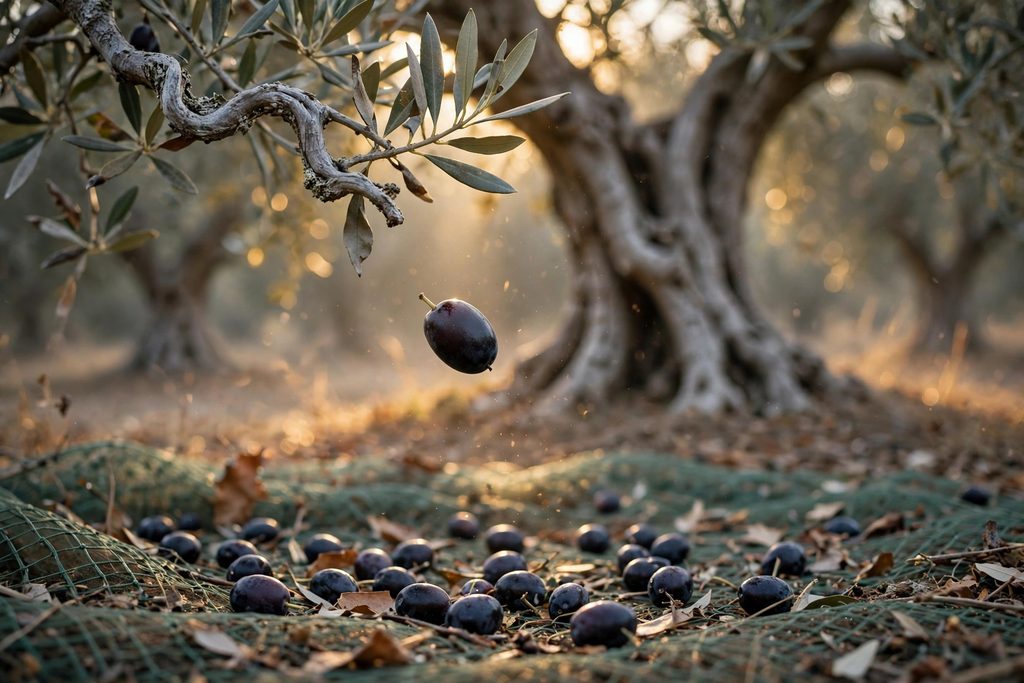
Five centuries later, the Stoic emperor Marcus Aurelius used the same orchard for a different lesson. Pass through life, he wrote, and leave it gently, “as a ripe olive falls, praising the earth that bore it and thanking the tree that grew it.” The Stoics taught how to fall well. Aristotle explains what the falling fruit has already become. The olive on the ground is not a loss. It is a completion carrying its next beginning inside it.
Theophrastus, who inherited Aristotle’s school and his garden, carried the same questions out among the trees. He noticed that the almond comes into leaf early yet sheds its leaves late, breaking the neat symmetry a theorist might expect between spring and autumn. Each tree keeps its own schedule, and the schedule comes from within. It is physis again, a nature that runs from the inside out.
Ripening in Practice
None of this asks for anything elaborate. Aristotle built his philosophy from ordinary orchards, and the best way to understand it is to eat in season. Buy fruit when it is ripe in Greece and let it finish on the branch or in the bowl. Taste the difference between a fig picked early, hard and flat however long you wait, and one allowed to complete itself. Eat grapes in September from the vineyard that ripened them, and you are tasting a summer’s heat brought into proportion.
The olive is the clearest lesson of all. Greek presses make two oils from the same tree, the sharp green agourelaio pressed from unripe fruit in October and the mellow oil of the black olives of December. Neither is wrong. They are two moments of one fruit, each chosen on purpose, which is the kind of judgement Aristotle thought practical wisdom was for.
The same attention works away from the orchard. Some things in a life are raw and need more time. Some are ripe and should be gathered before they spoil. The skill that Aristotle placed at the centre of a good life lies in telling which is which.
The Fruit and the Season
Opora was the season and the fruit at once. The Greeks never separated them, and Aristotle gave that unity a theory. A living thing completes itself from within. Its completion is for the sake of what comes next. And the right moment to gather it is when it can hand itself on.
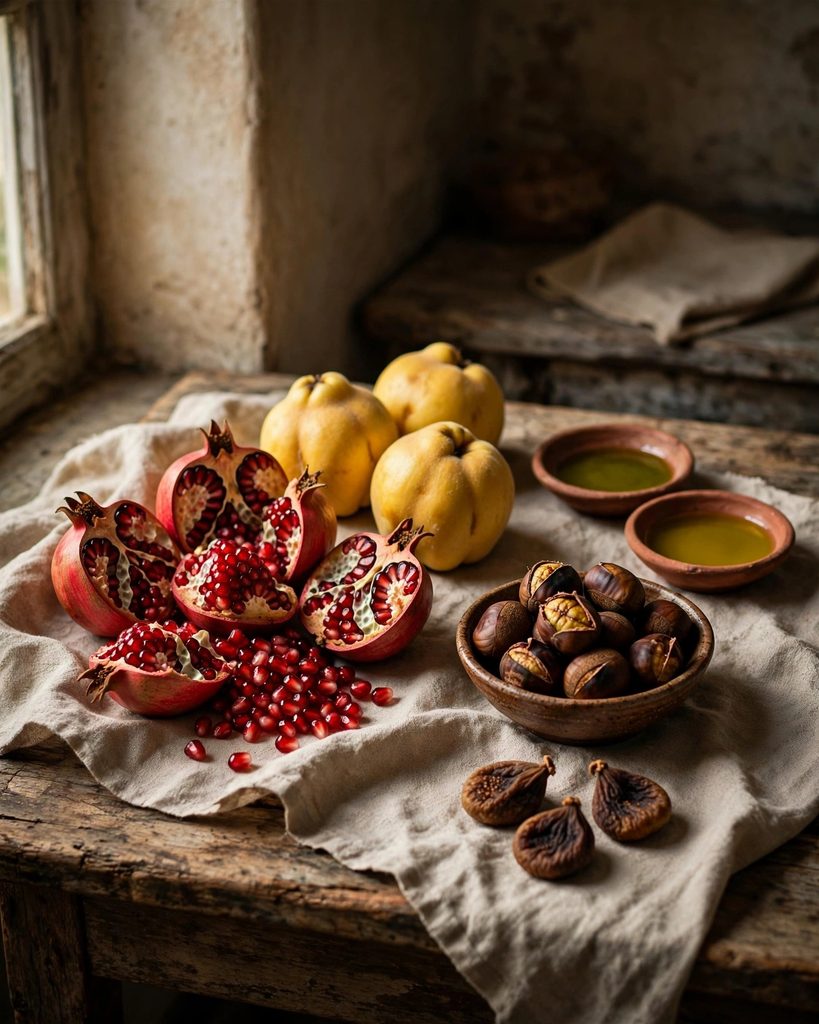
The orchards of Greece are proving it again this month, as the last pomegranates split, the quinces turn gold and the olive nets go down under the trees. Nothing in them is ending. Everything in them is finished.
At Olympus Estate, Mythic Essays read Greek myth and thought closely, from the oldest sources forward. For Aristotle, a fruit is ripe when its seeds can produce another fruit like it, a definition from the fourth book of the Meteorology that sets ripening, the work of a thing’s own natural heat, between rawness, too little heat, and rotting, when that heat is destroyed from outside. The Greeks called late summer and its fruit by one word, opora. Aristotle’s Physics defines nature as change that comes from within, illustrated by Antiphon’s buried bed that sprouts wood rather than a bed, and his Metaphysics argues that actuality comes before potentiality, so the ripe fig explains the green one. He and Theophrastus recorded caprification, the hanging of wild figs so that fig wasps would help the cultivated fruit ripen. The Nicomachean Ethics applies the same idea to character, completed by habit and timing, with one swallow that does not make a spring, while the Rhetoric ties beauty to the work of each age and puts the mind’s prime at about forty-nine. From Persephone’s pomegranate to Marcus Aurelius’s falling olive, the Greek autumn treated ripeness as a beginning.