





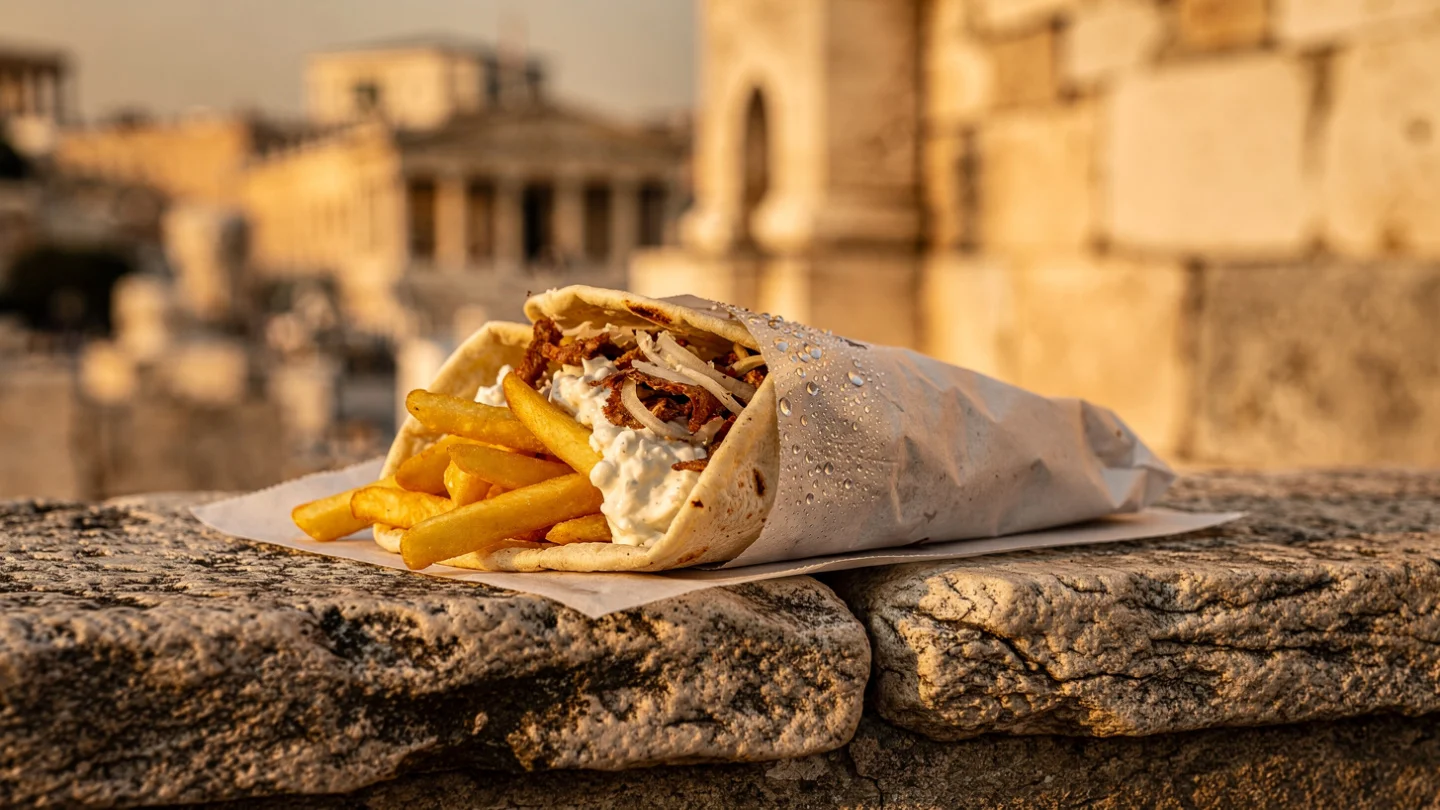
The gyros is the youngest major dish in the Greek culinary world.
This is not a criticism. It is the historical fact that gives the gyros its particular character and that makes its story more interesting than the story of the older dishes in the Greek food world. It is a dish whose form emerged within living memory, whose arrival in Greece was the direct consequence of the most catastrophic episode in modern Greek history, and whose transformation into the national street food of Greece and one of the most widely eaten preparations in the world is the transformation of a refugee food into a global icon.
The gyros was not always Greek. Its origin in the Ottoman Turkish döner kebab world, the vertical rotisserie preparation whose invention the culinary memory attributes to Iskender Efendi in Bursa in the mid‑nineteenth century, is the origin of a technique rather than a dish. It is the method of stacking marinated meat on a vertical spit, rotating it before a heat source, and shaving the outer layer as it cooks to produce the combination of the caramelized outer surface and the warm interior that the vertical rotation creates. This technique was the Ottoman world’s contribution to the preparation.
The Greek transformation of this technique began not after World War II, as the standard account suggests, but in the decade following the Asia Minor Catastrophe of 1922: the Greco-Turkish War of 1919 to 1922 and the subsequent Convention Concerning the Exchange of Greek and Turkish Populations produced the largest forced population exchange in European history to that point, with approximately 1.2 million Greek Orthodox Christians expelled from Anatolia and approximately 400,000 Muslims expelled from Greece. The communities that arrived in Athens and in Thessaloniki and in the port cities of the Greek coast were the communities that had lived in Smyrna, in Constantinople, in the Black Sea coast towns, in the interior Anatolian towns where the lamb doner kebab had been part of the culinary culture for generations. They brought the preparation with them, adapted it to the ingredients available in their new home, and in doing so began the process that would produce the gyros.
The Anatolian Inheritance
The transformation that the Greek adaptation made to the döner world was the transformation that the available ingredients imposed and that the Greek palate endorsed. Pork replaced lamb as the primary meat.
This single substitution is what most clearly marks the passage of the preparation from the Ottoman Turkish culinary world, where pork was absent from the Muslim tradition, to the Greek street food tradition that most closely identifies it as the authentic standard today: pork marinated in the combination of Greek herbs and spices, stacked on the vertical spit, and shaved as it cooks to produce the texture and flavor that the Greek preparation developed from the Ottoman technique.
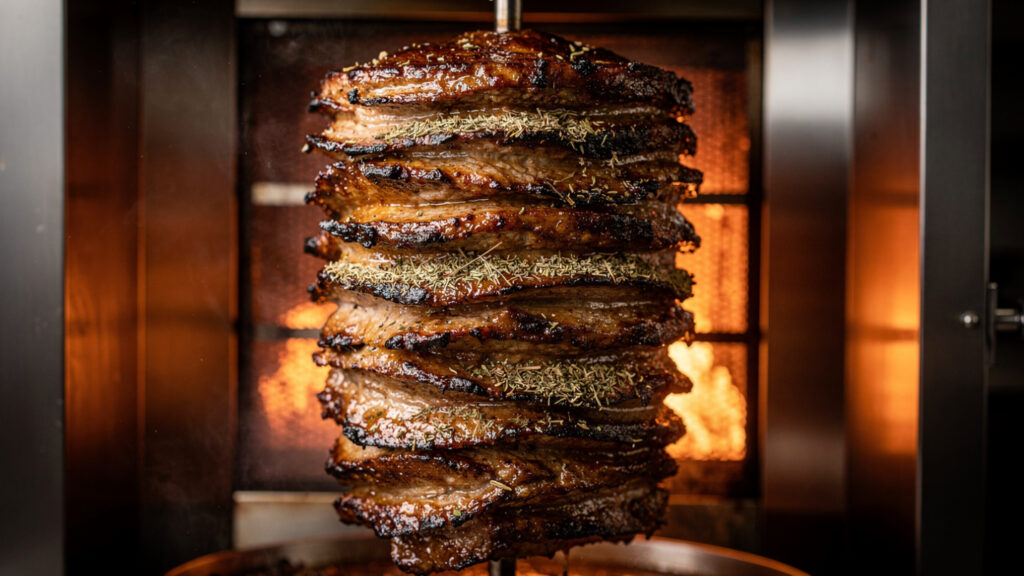
The name gyros, from the Greek gyros meaning turn or revolution, is the name that the Greek tradition gave to the preparation when it had been sufficiently adapted to the Greek ingredient landscape and the Greek culinary character to be understood as a Greek preparation rather than a foreign import. The naming was the formal moment of the preparation’s adoption into the Greek culinary identity: the technique that had arrived with the Anatolian refugees was now the dish that the receiving culture had claimed as its own.
The herbs and seasonings of the Greek gyros marinade, the combination of oregano and thyme and the dried herb palette of the Greek kitchen, the olive oil that the Greek culinary tradition uses as the cooking fat of default, and the balance of the seasoning that the Greek preparation developed, are the features that distinguish the Greek gyros from the döner kebab and from the shawarma and from the other vertical rotisserie preparations of the eastern Mediterranean world. They are the features that the Anatolian refugees and the Greek cooks who learned from them developed in the culinary context of the Greek mainland, adapting the inherited technique to the ingredients and the tastes of the new home.
Athens and the Street Food Revolution
By the 1970s, the gyros had established itself as the dominant Greek street food in Athens, available at the type of small takeaway establishment that the Greek culinary world calls the souvlatzidiko, typically combining the gyros with the souvlaki skewer on the same menu, served in the soft pita that Greek street‑food practice uses as the wrapper and distinguished from the Turkish lavash and the Arabic flatbread by its texture and its relationship to the other ingredients it contains.
The pita of the Greek gyros is the unleavened flatbread whose texture is softer and more yielding than the crispier flatbreads of the eastern Mediterranean world, and whose role in the assembly is the role of the wrapper rather than the plate. The pita in the gyros is folded around the filling and eaten as a parcel rather than being used as a scoop or a separate accompaniment. The assembly of the Greek gyros, the tzatziki spread on the pita first, then the shaved meat, then the tomato and onion, then the French fries that Greek street‑food practice inserts into the gyros in the decision that makes the preparation both a sandwich and a meal simultaneously, is the assembly that the Athens street‑food world developed and that the subsequent global diffusion of the gyros has carried to every city with a Greek restaurant.
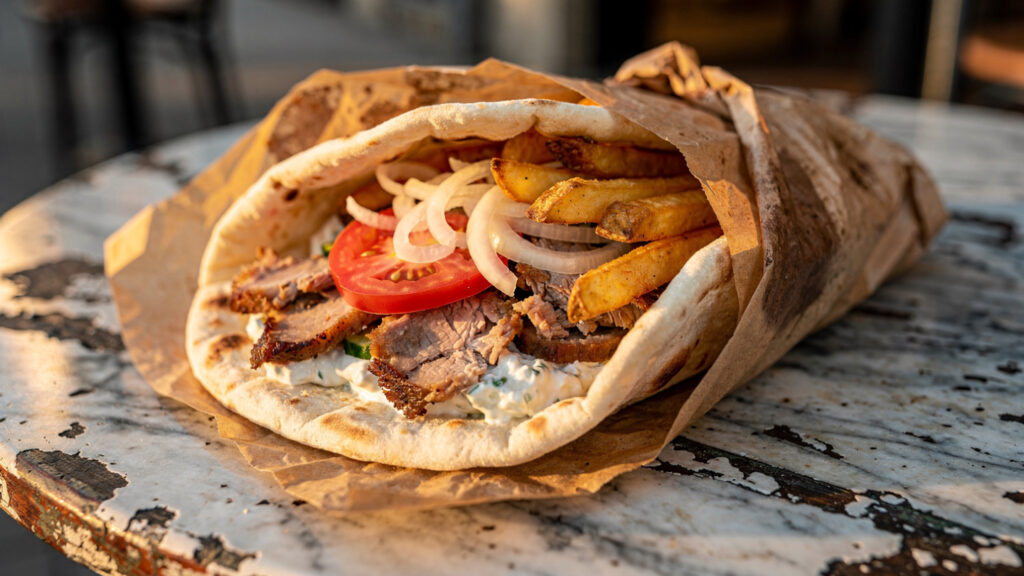
The French fries inside the gyros are the feature of the Greek preparation that the food purist’s sensibility most consistently challenges and that the Greek street‑food world most completely endorses. The chips inside the pita are not an aberration but the feature that makes the gyros a complete meal rather than a snack, that provides the combination of the meat’s protein and the potato’s carbohydrate that the working lunch requires, and that produces the textural contrast of the slightly softened fries against the meat and the cooling tzatziki that the Greek culinary practice has determined is the correct version of the preparation.
The American Dimension
The gyros arrived in the United States through the mechanism of the Greek diaspora communities that had established themselves in the American cities, primarily New York and Chicago, from the late nineteenth century onward: the Greek restaurant operators who served their communities and their neighborhoods brought the preparation from their homeland and introduced it to the American market in the 1960s and early 1970s.
The industrial innovation that transformed the American gyros from a restaurant specialty into a mass market product was the development of the pre-formed meat cone: the pressed and formed cone of seasoned ground meat, primarily beef and lamb, that could be produced in industrial quantities and supplied to restaurants that did not have the skill or the volume of business to make the traditional stacked-meat preparation viable.
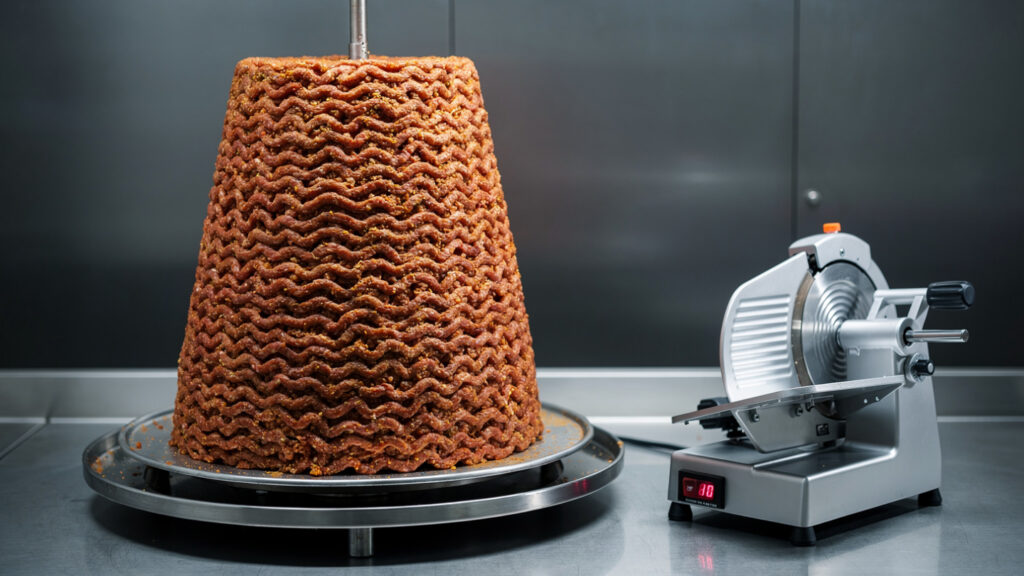
The origin story of the mass-produced American gyros cone, in which Margaret Garlick observed a Greek restaurant owner demonstrating the preparation on the American television program What’s My Line and subsequently developed the industrial production method at a Milwaukee sausage factory in the early 1970s, is the origin story that the American gyros industry consistently cites. The subsequent commercial development through Kronos Foods of Chicago, which became the dominant supplier of the pressed meat cone to the American restaurant market, is the business history that made the gyros available at the scale that the American market’s appetite required.
The American gyros, made from the pressed and formed meat cone rather than from the hand-stacked layered meat of the Greek original, is a distinct preparation from the Greek original rather than a faithful reproduction of it: the texture, the flavor, and the relationship between the cone’s uniform composition and the varied composition of the hand-stacked Greek original produce different results even when the same seasoning and cooking method are applied. The American gyros is the industrial adaptation of the Greek preparation, and its character reflects the conditions of the American market rather than the conditions of the Greek street food tradition.
The Tzatziki
No discussion of the gyros is complete without the tzatziki whose role in the preparation is not the role of a condiment that happens to accompany the meat but the role of the cooling counterpoint without which the gyros’s balance of flavors does not exist.
Tzatziki in the gyros context is not the side dish that the restaurant menu presents alongside the main preparation: it is the first ingredient that goes on the pita, the foundation on which the entire assembly rests, and its combination of the yogurt’s acidity and fat content with the cucumber’s water and the garlic’s heat and the dill’s aromatic is the combination that makes the gyros’s richness of the meat and the starch of the fries and the acidity of the tomato cohere into a single preparation rather than remaining as separate components.
The technique of the tzatziki that the Greek culinary world maintains is the technique whose critical step is the removal of the cucumber’s water. The grated cucumber that is not adequately drained produces a tzatziki that is too liquid to perform the function that the gyros requires, spreading through the pita and making the assembly structurally unstable before the eating is complete. The salted and pressed grated cucumber that the Greek kitchen requires is the preparation step that the domestic cook who makes tzatziki once a year consistently underperforms and the experienced Greek kitchen performs as a reflex.
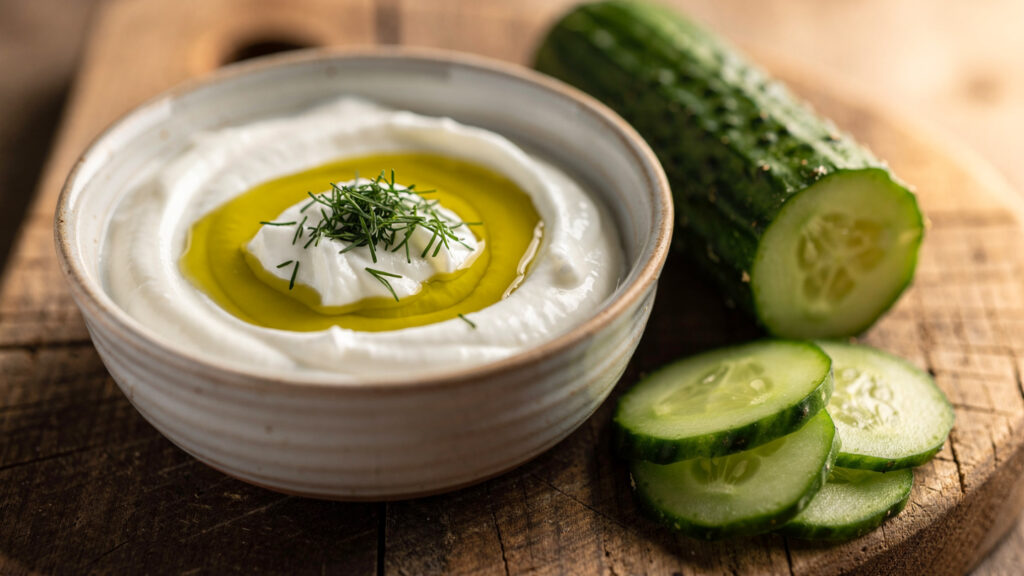
The goat’s milk yogurt that the traditional tzatziki uses is the yogurt whose flavor profile, the acidity and the fat content of the goat’s milk, is what the traditional tzatziki’s flavor is built on. The substitution of the more widely available cow’s milk Greek yogurt produces an acceptable tzatziki but not the same tzatziki: the goat’s milk acidity is the dimension of the flavor that the cow’s milk version lacks, and the difference is most clearly perceptible in the tzatziki used as the gyros’s foundation where the acidity’s role in balancing the meat’s richness is most directly called upon.
What the Gyros Means
The gyros is the dish that most completely embodies the character of modern Greek food culture as a culture organized around the encounter between the ancient and the recent, the inherited and the adopted, the local and the global.
It is a dish that arrived in Greece as a refugee preparation and was transformed by the Greek culinary world into the national street food. It is a dish that carries the history of the Asia Minor Catastrophe in its Ottoman technique and its Greek pork adaptation: the technique from the culture that expelled the refugees, the adaptation from the culture that received them. It is a dish that moved from the streets of Athens to the streets of Chicago and New York and was transformed again by the conditions of the American market into a different version of itself. It is a dish that the Greek street‑food world has maintained in its original form alongside the industrial adaptation, so that both versions exist simultaneously, the traditional and the industrial, each serving the context for which it was developed.
The gyros is the dish that a traveler to Greece can eat three times in a day from three different establishments without feeling that they have eaten the same thing three times: the morning gyros from the neighborhood souvlatzidiko, the lunch gyros from the tourist district establishment with the polished surfaces and the English menu, and the late night gyros from the establishment near the main square whose hours of operation are the hours of the nightlife crowd rather than the lunchtime crowd, will be three different versions of the same preparation, each calibrated to the context and the customer that the establishment serves.
This is the food that the refugee communities brought from Anatolia to Athens and that Athens made into Greece’s own. Eat it standing up, from the paper wrapping, near a busy street corner. This is how it is meant to be eaten. This is how it has always been eaten.
Olympus Estate · Food & Seasonal Life
Classic Pork Gyros with Tzatziki
The national Greek street food. Pork marinated in Greek herbs, shaved from the vertical spit, wrapped in soft pita with tzatziki, tomato, onion, and fries. Make it at home on an oven rack.
The Meat
- Pork shoulder or neck, thinly sliced700 g
- Olive oil3 tbsp
- Dried oregano2 tsp
- Dried thyme1 tsp
- Sweet paprika1 tsp
- Garlic, minced3 cloves
- Salt and black pepperto taste
- Lemon juice1 tbsp
To Assemble
- Greek pita breads, soft flatbread style4
- Ripe tomatoes, chopped2
- Red onion, thinly sliced1
- Potatoes, cut for fries3 medium
- Olive oil for fryingas needed
The Tzatziki
- Full-fat yogurt, preferably goat’s milk400 g
- Cucumber, coarsely grated and well drained1 large
- Garlic, pressed2 cloves
- Olive oil2 tbsp
- Wine vinegar1 tsp
- Fresh dill, finely chopped1 tbsp
- Saltto taste
Method
-
1
Make the tzatziki first
Grate the cucumber coarsely. Salt it, mix well, and leave for 10 minutes. Then squeeze firmly in a clean cloth or fine sieve until as dry as possible: this is the critical step. A wet cucumber produces a liquid tzatziki that will not hold in the pita. Combine with the yogurt, pressed garlic, olive oil, wine vinegar, and dill. Taste and adjust salt. Refrigerate for at least 30 minutes before using.
-
2
Marinate the pork
Combine the olive oil, oregano, thyme, paprika, minced garlic, lemon juice, salt, and pepper. Toss the pork slices through the marinade until evenly coated. Allow to marinate for at least 30 minutes at room temperature or up to 4 hours refrigerated.
-
3
Cook the pork
Heat a cast iron or heavy frying pan to high. Cook the marinated pork slices in batches without crowding, 2 to 3 minutes per side until the edges are caramelized and the meat is cooked through. Rest briefly, then slice or tear into pieces. The caramelized edges are the quality that the vertical rotisserie achieves and that high heat in the home pan approximates.
-
4
Fry the potatoes
Fry the potato strips in olive oil until golden and crisp. Drain on kitchen paper and season with salt immediately. These go inside the pita: this is not optional in the Greek tradition.
-
5
Warm the pita and assemble
Warm each pita in a dry pan for 30 seconds per side until pliable. Spread a generous layer of tzatziki across the center. Add the pork, then the tomato, then the red onion, then the fries. Fold the pita around the filling, wrapping the bottom half in the paper or foil that keeps it together. Eat immediately, standing up if possible.
At Olympus Estate, Food and Seasonal Life traces Greek cuisine as a living calendar and a living history. The gyros arrived with the Anatolian refugees after 1922, the technique from the Ottoman culinary world, the pork adaptation from the Greek culinary world. It became the national street food of Greece within a generation. It became one of the most widely eaten preparations in the world within two. The transformation of a refugee food into a global icon is the character of what food does when it travels: it carries the history of the journey in the flavor of the preparation. The gyros carries the Asia Minor Catastrophe and the Athens street corner and the Chicago pressing machine and the global appetite simultaneously. Eat one. All of this is in it.