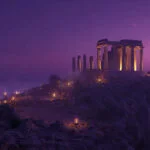






Cold settles differently in Greece. It does not arrive with a heavy silence, but with the, sharp scent of woodsmoke. Metal drums burn on street corners, and vendors wrap their hands around paper cones. The smell of toasted grain, scorched citrus, warmed wine, and ash drifts through the narrow streets of the Plaka or the Ladadika long before any snow appears on the peaks of Parnassus. Winter here has always been answered with food eaten standing up, shared without the weight of ceremony, passed from hand to hand. This is the world of Greek winter street food, and its roots run deeper than the stone foundations of the cities themselves.
Long before the invention of the modern cafe or the taverna menu, the ancient Greek city fed itself in the open air. The agora was not a place of leisure but a site of survival and transaction. Food was simple, portable, and above all, warm. What survives today in the markets of Athens, the ports of Thessaloniki, or the mountain squares of Epirus is not a calculated revival for the sake of tourism. It is a stubborn continuity. The recipes have not frozen in time, but they have adapted without breaking their essential form. The gestures of the vendor and the recipient remain the same as they were in the time of Pericles. The hunger is the same too.

The Ancient Geometry of the Koulouri Ring
Bread has always been the literal backbone of Greek life. In the ancient world, the distinction between a civilized man and a barbarian was often measured by the consumption of processed grain. Barley bread was the staple, often baked into flat or round loaves that were easy to carry. The ancestors of the modern street vendor sold these loaves sliced and dipped in oil or paired with a handful of olives. Today, the koulouri, that sesame crusted bread ring sold at the break of dawn, is the direct descendant of this ancient necessity. The shape is not decorative. It is a piece of engineering. The rings could be stacked on wooden poles or threaded onto a vendor’s arm, allowing them to move through a crowded market while keeping the product within reach.
In the winter, the koulouri becomes more than a snack. It is a form of reassurance. In Thessaloniki, where the wind from the Vardaris river can cut through a coat like a blade, the warmth of a fresh ring of bread is a small victory. The sesame seeds are not just for texture. They add essential calories and a nutty oils that linger on the palate. The exchange is silent and practiced. You offer a few coins, you receive a warm ring wrapped in a scrap of paper, and you keep moving. No conversation is required because the bread speaks a language that everyone understands. It is the taste of the traditional Greek bread that has sustained the city through every siege, every celebration, and every winter for centuries.

The evolution of the koulouri took a significant turn during the Byzantine era, when it became a staple in the streets of Constantinople before migrating back to the Greek mainland with the refugees of the early twentieth century. Yet, even with these historical shifts, the core ingredients remain unchanged. Flour, water, yeast, salt, and the ubiquitous sesame. It is a food that refuses to be complicated. It is the ultimate example of how the Greek food heritage prioritizes the integrity of the ingredient over the ego of the cook.
The Smoke of Pelion in the City Squares
The sound of winter in a Greek city is the sharp crack of a chestnut shell over an open fire. Ancient texts mention roasted nuts sold near sanctuaries and theaters during the colder months, a tradition that predates the modern street cart by two millennia. Chestnuts were the portable energy of the ancient world. They were harvested from the mountain regions like Pelion or the dense forests of Arcadia, where the winter was significantly harsher than in the coastal cities. For the shepherds and travelers moving through these high passes, the chestnut was a lifeline.
The modern street vendor, the kastanas, still uses a perforated metal pan, stirring the nuts with a metal scoop that has been blackened by decades of use. The smell is unmistakable. It is a combination of sweetness, deep woodsmoke, and a grounding earthiness. In ancient belief, the chestnut was associated with endurance. It was the food of the traveler and the soldier, something that could be carried in a tunic and eaten when the fire died down.

Eating a roasted chestnut today on a street corner in Ioannina or Athens is an act of historical participation. The taste has not been softened by modern agricultural techniques. It remains honest, occasionally difficult to peel, and faintly bitter. It is a flavor that demands your full attention. You must work for the reward, cracking the charred shell and picking out the hot, starchy heart. In this small act, you are connected to every person who has ever stood by a fire in the Greek winter, waiting for the warmth to reach their bones.
The Honeyed Offering of the Loukoumades
Winter festivals in the ancient Greek world were rarely solemn affairs. They required food that could be prepared in large quantities and shared quickly among a crowd. Honey and oil were the tools used to transform simple dough into a celebration. The loukoumades, those small, fried dough balls soaked in honey, appear in ancient sources as “honey tokens.” They were given to the victors of the Olympic games and served during seasonal rites that honored the gods of the earth.

When the temperature drops, the appetite for these honeyed spheres increases. They are served in paper cones, the honey still hot and fluid, sticking to the fingers and the corners of the mouth. The scent of cinnamon, which replaced more ancient spices like coriander or pepper, adds a layer of warmth that cuts through the damp winter air. These are not desserts in the modern, sugary sense of the word. They are ritual fuel. They were designed to provide a sudden, intense burst of energy to counter the long nights and the physical demands of a winter festival.
To stand on a sidewalk in the middle of a January rain and eat a hot loukouma is to understand the Greek relationship with the gods. It is a moment of indulgence that feels earned. The crunch of the fried exterior followed by the soft, honey-soaked interior is a sensory experience that has not changed since the first athlete received his prize. It is a taste of the loukoumades tradition that remains as vital and as messy as it was in antiquity.
The Botanical Heat of the Salepi and the Spiced Wine
Perhaps the most unique of all Greek winter street flavors is salepi. It is a drink made from the ground tubers of a wild orchid, a botanical secret that has been used for its medicinal properties since the time of Dioscorides. In the ancient world, the orchid was seen as a symbol of virility and a cure for ailments of the chest and stomach. The drink itself is thick, almost gelatinous, and flavored with cinnamon and ginger.
The salepitzis, the vendor who carries a large brass samovar on his back or on a wheeled cart, is a disappearing figure, yet he remains the ultimate symbol of the Thessaloniki food culture. The drink is served steaming hot, providing a viscous warmth that seems to coat the throat and protect it from the winter chill. It is a botanical history lesson in a cup. The orchid root provides a subtle, earthy base that carries the spices with a weight that coffee or tea cannot match.

Alongside the salepi, the tradition of warmed wine continues to thrive. While the ancient Greeks usually diluted their wine with water, in winter they would often heat it and add spices or honey to create a medicinal tonic. This practice survives today in the form of rakomelo, a potent mix of raki and honey heated with cloves and cinnamon. It is passed from hand to hand in small, thick glasses that warm the palms before the liquid warms the chest. Dionysus wine tradition was never just about intoxication. It was about the communal experience of the drink, the way it could turn a cold street corner into a shared hearth.
The Mycenaean Roots of the Skewered Meat
While meat was a luxury in the ancient Greek world, usually reserved for the aftermath of a religious sacrifice, the method of cooking it was remarkably consistent with what we see today. Archaeologists have discovered stone grill supports from the Mycenaean period that were specifically designed to hold skewers over hot coals. These “fire dogs” are the ancestors of the modern souvlaki grill.
The souvlaki is perhaps the most famous of all Greek street foods, but in winter, it takes on a different character. The smoke from the grill is thicker in the cold air, and the salt and fat of the meat provide a necessary satisfaction that a summer salad cannot offer. The traditional way to eat it remains the simplest: meat on a skewer, seasoned with salt, oregano, and lemon, wrapped in a piece of grilled pita bread with a few slices of onion.
Its close cousin, the gyros, tells a very different story, one that begins not in the Bronze Age but on the docks of Piraeus in the 1920s.

There is no need for the elaborate garnishes that have crept into the modern versions of the dish. The ancient palate was one of clarity and contrast. The heat of the meat against the coolness of the onion, the acidity of the lemon cutting through the fat, and the chew of the bread. This is the souvlaki in its most elemental form, a meal that has been sold in the streets for thousands of years because it cannot be improved upon.
The Street as a Living Agora
In the ancient world, the street was a sacred space. It was where the life of the city happened, where the laws were debated, and where the gods were honored. Eating in public was not a sign of low status. It was a sign of participation in the life of the polis. This understanding remains deeply embedded in the Athens street food winter scene. You do not see people rushing away with their food as if ashamed to be eating it. They stand by the cart, they lean against a stone wall, and they occupy the space.
This social texture is what gives the Greek winter its warmth. Even when the sky is grey and the marble of the sidewalks is slick with rain, the street remains a communal kitchen. The vendors are the keepers of this fire. They are the ones who remember the rhythms of the neighborhood, who know which day the chestnuts will be at their best, and who can predict exactly when the first salepi vendor will appear on the corner.

This is a culture that has resisted the clinical, packaged convenience of the supermarket. The Greeks still prefer to buy their bread from a man who has been standing in the same spot for twenty years, and their honey from a vendor who can tell them which mountain the bees visited. It is a choice to remain connected to the source, to the season, and to each other.
Why the Ancient Recipes Endure
The reason these foods have not changed in two millennia is not due to a lack of imagination. It is because they are perfectly suited to the landscape and the climate. They use local materials—wheat, honey, olives, nuts, and wine—that have been available in the Aegean basin since the beginning of recorded history. They are designed to be prepared with minimal equipment and consumed without the need for a table or chairs.
Modern Greece has preserved this Greek food heritage without the need for museum labels or government mandates. No one calls a koulouri “ancient” when they buy it for breakfast. They simply call it breakfast. No one thinks of the myth of Dionysus when they drink a glass of rakomelo in a mountain village. They just enjoy the way the honey and the alcohol fight off the cold. This is the most profound kind of continuity. It is the kind that exists in the muscles and the taste buds, a heritage that is lived rather than observed.

The Greek winter street is a place where the past is not a memory, but a presence. You can measure the history of a city like Thessaloniki or Athens by the smell of the air. It is a history written in woodsmoke and sesame seeds, in the crack of a chestnut shell and the pour of warm wine. It is a history that tells us that no matter how much the world changes, the fundamental needs of the human body remain the same. We need warmth. We need nourishment. And we need to stand together around a fire, sharing a piece of bread, while we wait for the sun to return.
The street remains the best teacher of this truth.
At Olympus Estate, Food and Seasonal Life traces the culinary traditions of the Greek world from the ancient harvest through the Byzantine kitchen to the contemporary table. The koulouri’s ring shape is not decorative but engineering: the rings threaded onto a vendor’s arm to allow movement through a crowded market. The sesame seeds add essential calories and nutty oils. No conversation is required because the bread speaks a language everyone understands. The Mycenaean fire dogs are the ancestors of the modern souvlaki grill. The salepi’s ground orchid tubers were documented by Dioscorides for their medicinal properties: the salepitzis with the brass samovar is a disappearing figure and a botanical history lesson in a cup. No one calls a koulouri ancient when they buy it for breakfast. They simply call it breakfast. This is the most profound kind of continuity. It is the kind that exists in the muscles and the taste buds, a heritage that is lived rather than observed.